
Parton dynamics and hadronization from the s QGP
- Slides: 26
Parton dynamics and hadronization from the s. QGP Wolfgang Cassing Erice 22. 09. 08
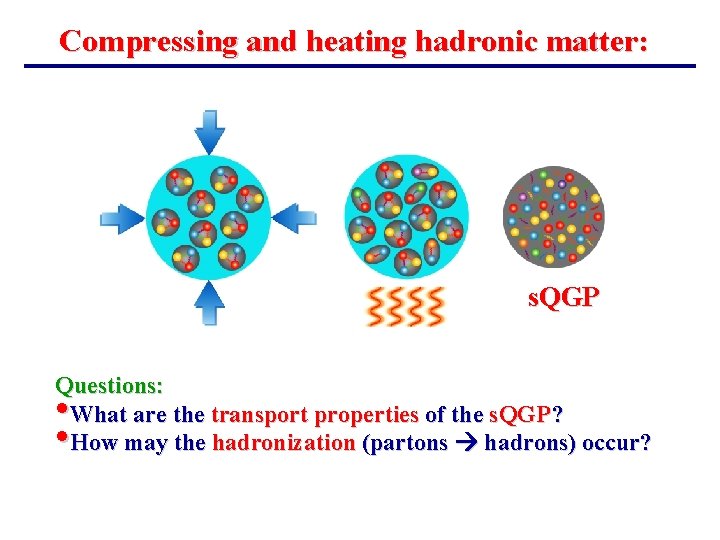
Compressing and heating hadronic matter: s. QGP Questions: What are the transport properties of the s. QGP? How may the hadronization (partons hadrons) occur? • •
From hadrons to partons We need a consistent transport model with Øexplicit parton-parton interactions (i. e. between quarks and gluons) Øexplicit phase transition from hadronic to partonic degrees of freedom ØQCD Eo. S for the partonic phase Transport theory: off-shell Kadanoff-Baym equations for the Green-functions G<h(x, p) in phase-space representation for the partonic and hadronic phase Parton-Hadron-String-Dynamics (PHSD) QGP phase described by input from the Dynamical Quasi. Particle Model (DQPM) DQPM
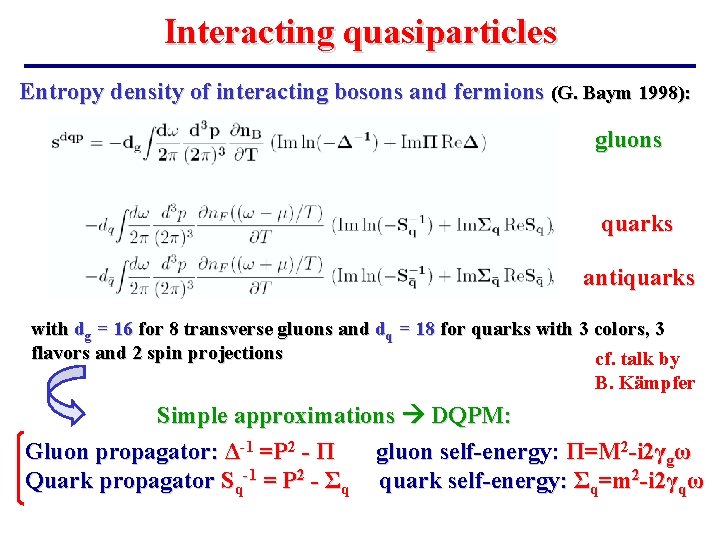
Interacting quasiparticles Entropy density of interacting bosons and fermions (G. Baym 1998): gluons quarks antiquarks with dg = 16 for 8 transverse gluons and dq = 18 for quarks with 3 colors, 3 flavors and 2 spin projections cf. talk by B. Kämpfer Simple approximations DQPM: Gluon propagator: Δ-1 =P 2 - Π gluon self-energy: Π=M 2 -i 2γgω Quark propagator Sq-1 = P 2 - Σq quark self-energy: Σq=m 2 -i 2γqω
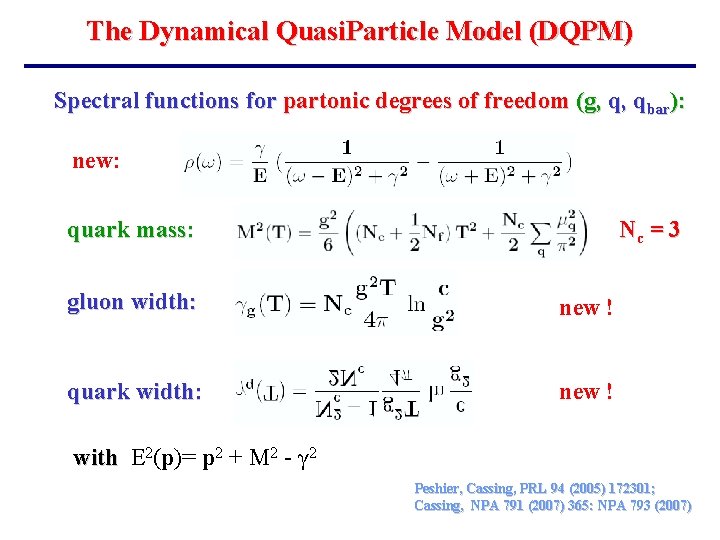
The Dynamical Quasi. Particle Model (DQPM) Spectral functions for partonic degrees of freedom (g, q, qbar): new: quark mass: Nc = 3 gluon width: new ! quark width: new ! with E 2(p)= p 2 + M 2 - γ 2 Peshier, Cassing, PRL 94 (2005) 172301; Cassing, NPA 791 (2007) 365: NPA 793 (2007)
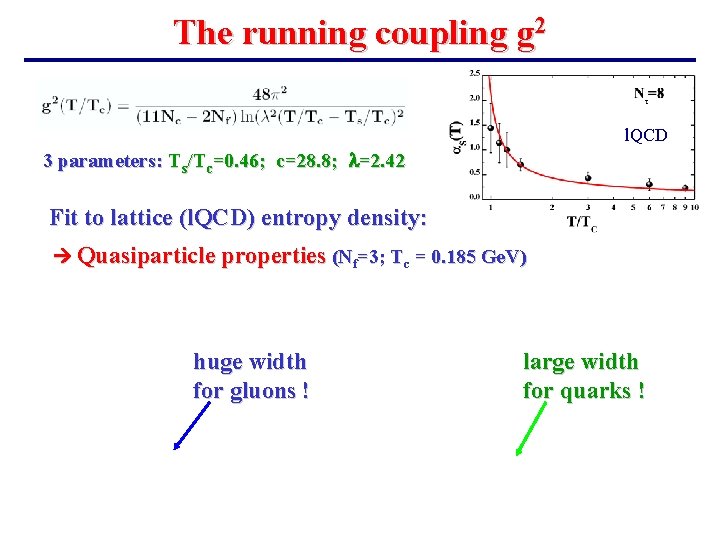
The running coupling g 2 l. QCD 3 parameters: Ts/Tc=0. 46; c=28. 8; l=2. 42 Fit to lattice (l. QCD) entropy density: Quasiparticle properties (Nf=3; Tc = 0. 185 Ge. V) huge width for gluons ! large width for quarks !
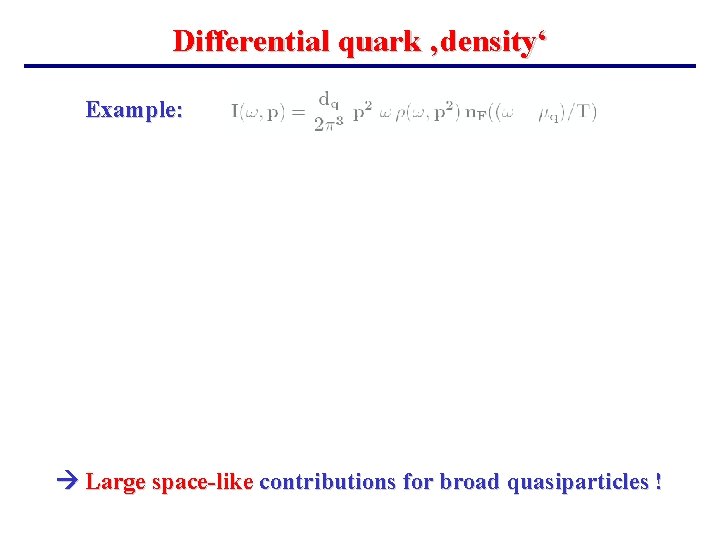
Differential quark ‚density‘ Example: Large space-like contributions for broad quasiparticles !
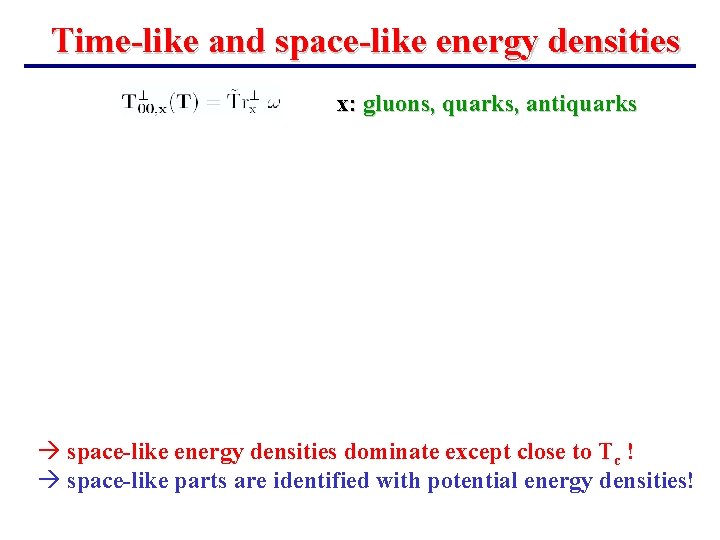
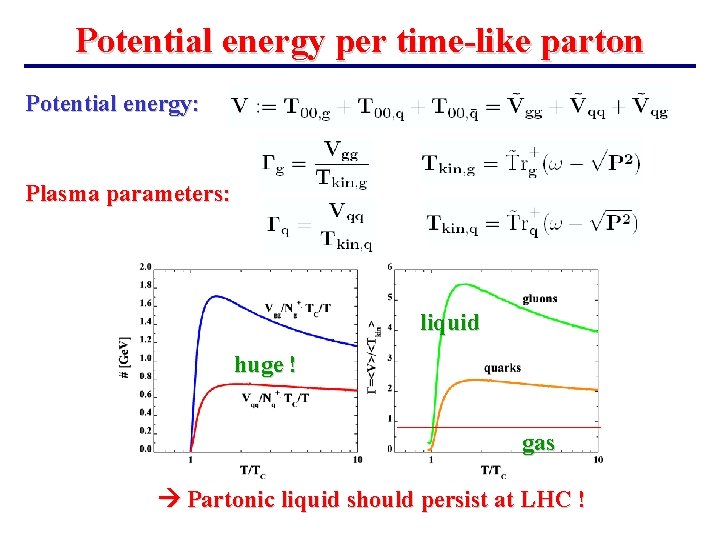
Time-like and space-like energy densities x: gluons, quarks, antiquarks à space-like energy densities dominate except close to Tc ! à space-like parts are identified with potential energy densities!
Potential energy per time-like parton Potential energy: Plasma parameters: liquid huge ! _________ gas Partonic liquid should persist at LHC !
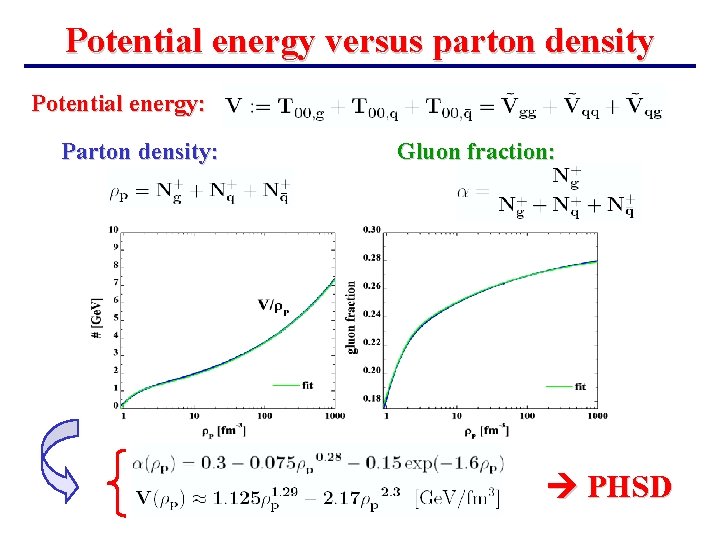
Potential energy versus parton density Potential energy: Parton density: Gluon fraction: PHSD
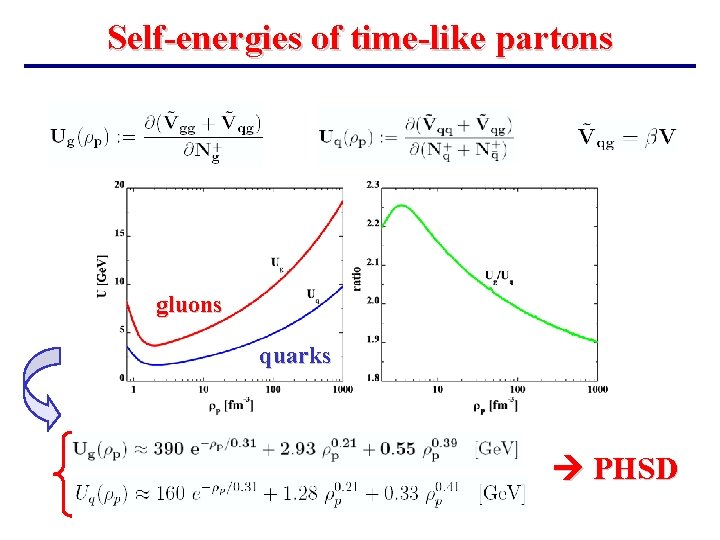
Self-energies of time-like partons gluons quarks PHSD
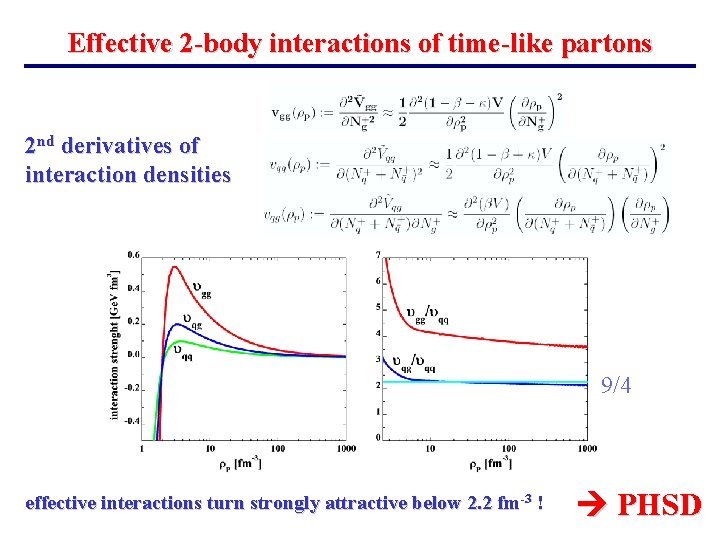
Effective 2 -body interactions of time-like partons 2 nd derivatives of interaction densities 9/4 effective interactions turn strongly attractive below 2. 2 fm-3 ! PHSD
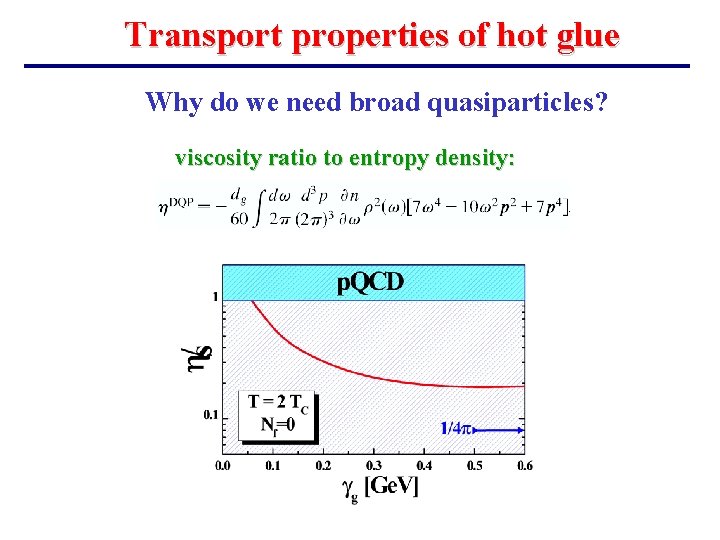
Transport properties of hot glue Why do we need broad quasiparticles? viscosity ratio to entropy density:
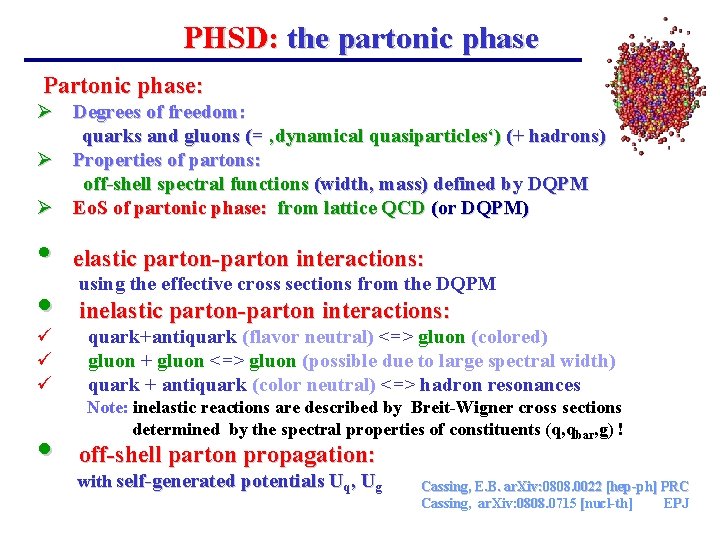
PHSD: the partonic phase Partonic phase: Ø Degrees of freedom: quarks and gluons (= ‚dynamical quasiparticles‘) (+ hadrons) Ø Properties of partons: off-shell spectral functions (width, mass) defined by DQPM Ø Eo. S of partonic phase: from lattice QCD (or DQPM) • elastic parton-parton interactions: • inelastic parton-parton interactions: ü ü ü • using the effective cross sections from the DQPM quark+antiquark (flavor neutral) <=> gluon (colored) gluon + gluon <=> gluon (possible due to large spectral width) quark + antiquark (color neutral) <=> hadron resonances Note: inelastic reactions are described by Breit-Wigner cross sections determined by the spectral properties of constituents (q, qbar, g) ! off-shell parton propagation: with self-generated potentials Uq, Ug Cassing, E. B. ar. Xiv: 0808. 0022 [hep-ph] PRC Cassing, ar. Xiv: 0808. 0715 [nucl-th] EPJ
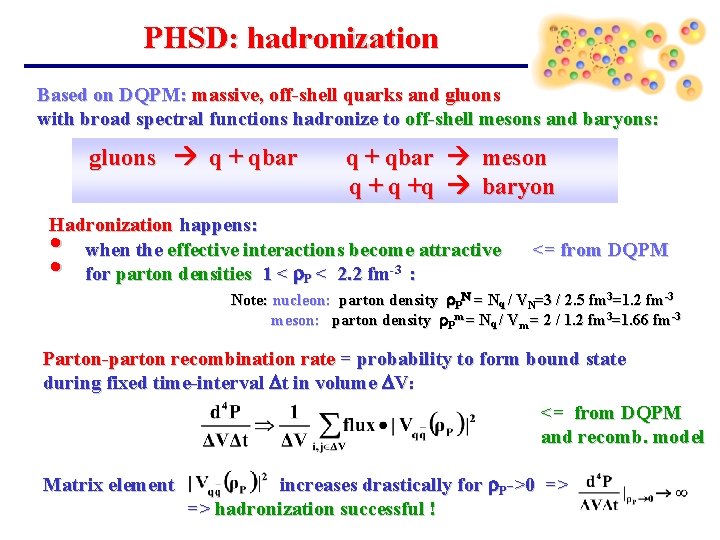
PHSD: hadronization Based on DQPM: massive, off-shell quarks and gluons with broad spectral functions hadronize to off-shell mesons and baryons: gluons q + qbar meson q +q baryon Hadronization happens: when the effective interactions become attractive for parton densities 1 < r. P < 2. 2 fm-3 : • • <= from DQPM Note: nucleon: parton density r. PN = Nq / VN=3 / 2. 5 fm 3=1. 2 fm-3 meson: parton density r. Pm = Nq / Vm = 2 / 1. 2 fm 3=1. 66 fm-3 Parton-parton recombination rate = probability to form bound state during fixed time-interval Dt in volume DV: <= from DQPM and recomb. model Matrix element increases drastically for r. P->0 => => hadronization successful !
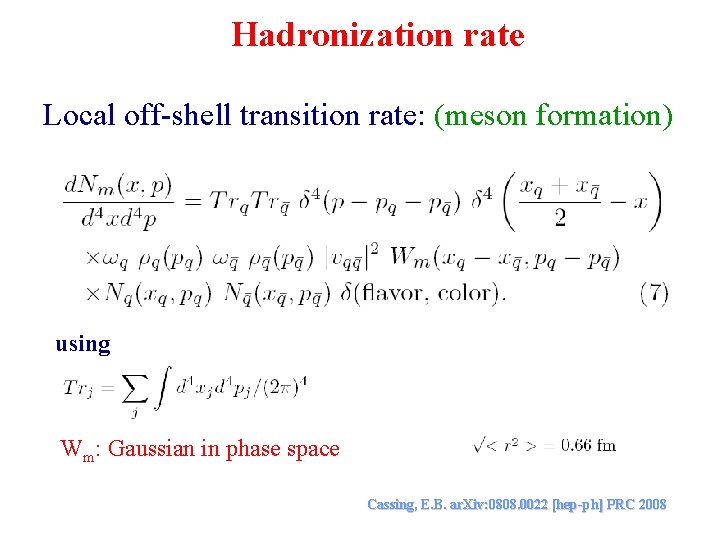
Hadronization rate Local off-shell transition rate: (meson formation) using Wm: Gaussian in phase space Cassing, E. B. ar. Xiv: 0808. 0022 [hep-ph] PRC 2008
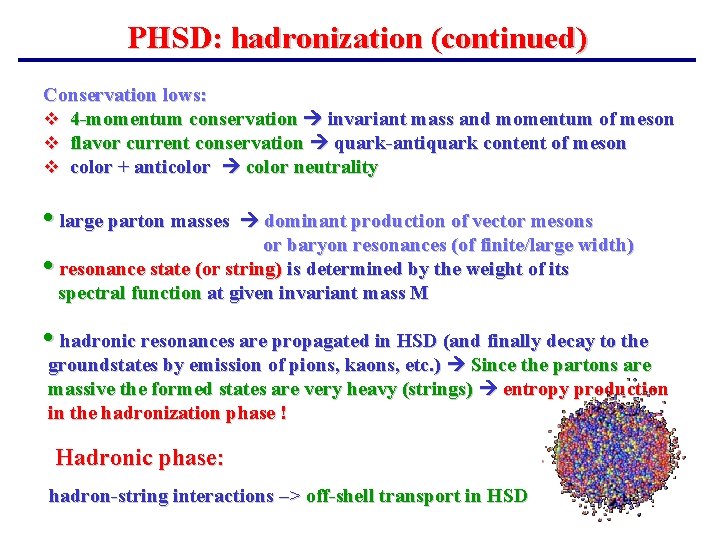
PHSD: hadronization (continued) Conservation lows: v 4 -momentum conservation invariant mass and momentum of meson v flavor current conservation quark-antiquark content of meson v color + anticolor neutrality • large parton masses dominant production of vector mesons or baryon resonances (of finite/large width) • resonance state (or string) is determined by the weight of its spectral function at given invariant mass M • hadronic resonances are propagated in HSD (and finally decay to the groundstates by emission of pions, kaons, etc. ) Since the partons are massive the formed states are very heavy (strings) entropy production in the hadronization phase ! Hadronic phase: hadron-string interactions –> off-shell transport in HSD
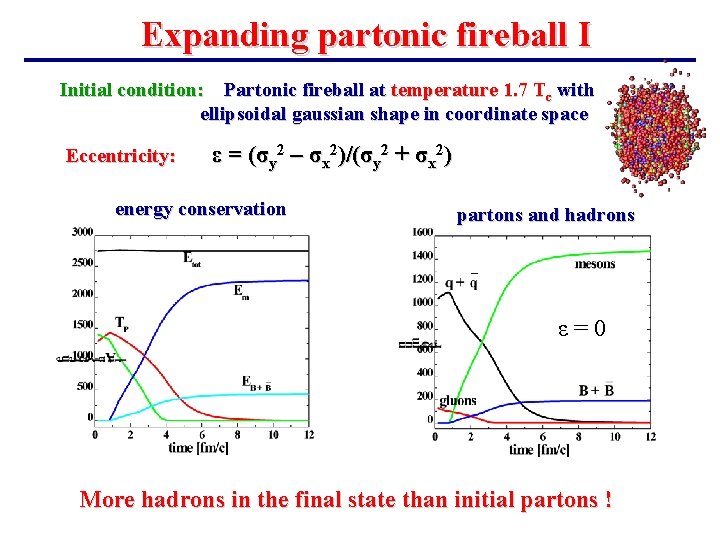
Expanding partonic fireball I Initial condition: Partonic fireball at temperature 1. 7 Tc with ellipsoidal gaussian shape in coordinate space Eccentricity: ε = (σy 2 – σx 2)/(σy 2 + σx 2) energy conservation partons and hadrons ε=0 More hadrons in the final state than initial partons !
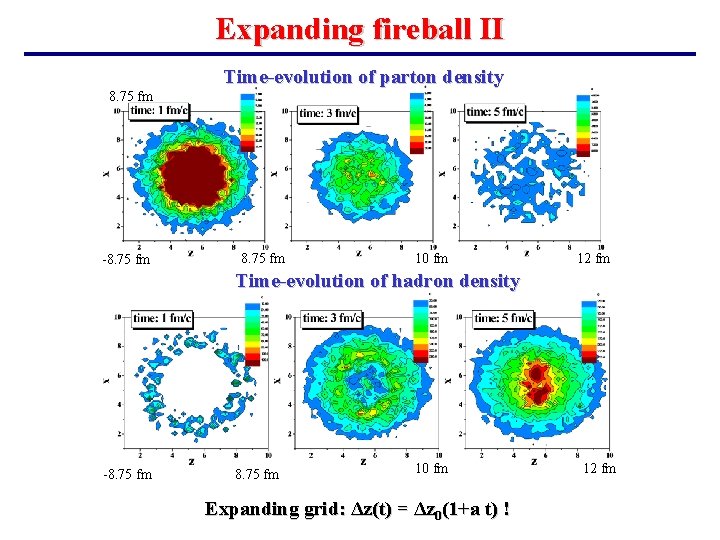
Expanding fireball II Time-evolution of parton density 8. 75 fm -8. 75 fm 10 fm 12 fm Time-evolution of hadron density -8. 75 fm 10 fm Expanding grid: Δz(t) = Δz 0(1+a t) ! 12 fm
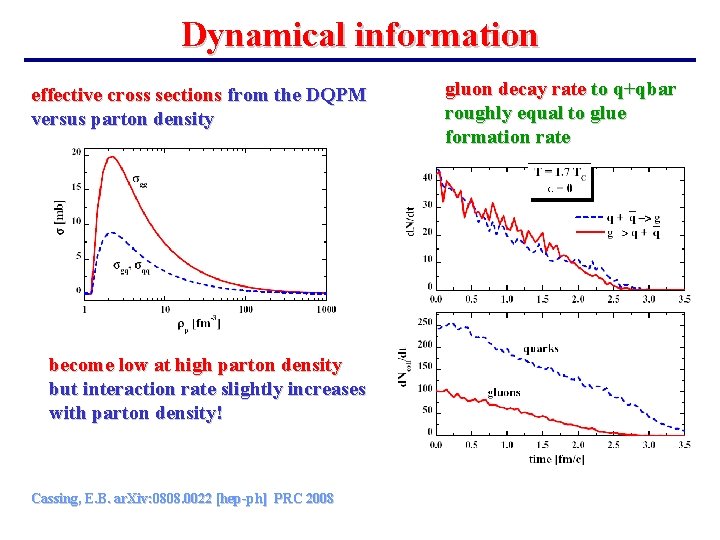
Dynamical information effective cross sections from the DQPM versus parton density become low at high parton density but interaction rate slightly increases with parton density! Cassing, E. B. ar. Xiv: 0808. 0022 [hep-ph] PRC 2008 gluon decay rate to q+qbar roughly equal to glue formation rate
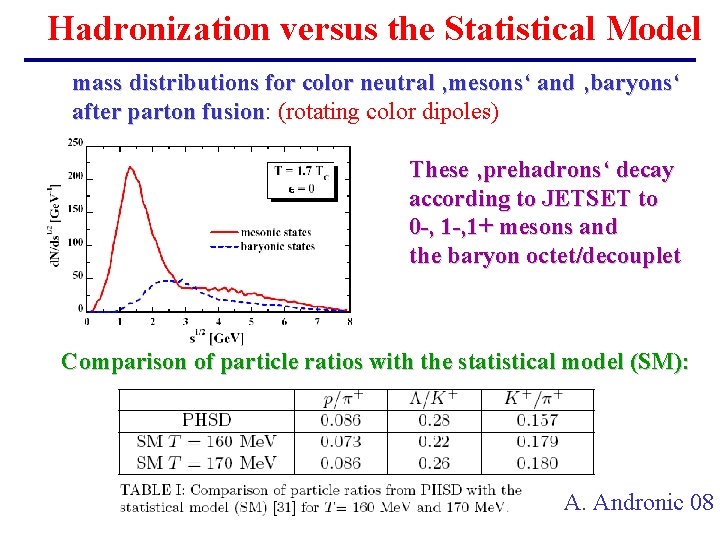
Hadronization versus the Statistical Model mass distributions for color neutral ‚mesons‘ and ‚baryons‘ after parton fusion: fusion (rotating color dipoles) These ‚prehadrons‘ decay according to JETSET to 0 -, 1+ mesons and the baryon octet/decouplet Comparison of particle ratios with the statistical model (SM): A. Andronic 08
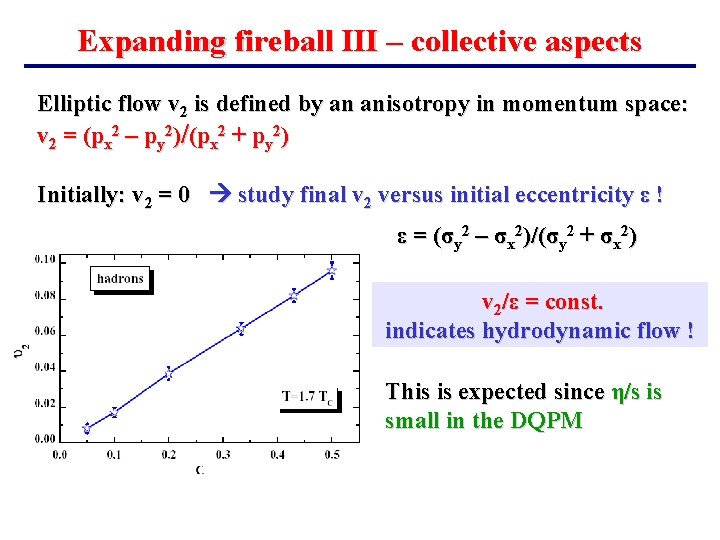
Expanding fireball III – collective aspects Elliptic flow v 2 is defined by an anisotropy in momentum space: v 2 = (px 2 – py 2)/(px 2 + py 2) Initially: v 2 = 0 study final v 2 versus initial eccentricity ε ! ε = (σy 2 – σx 2)/(σy 2 + σx 2) v 2/ε = const. indicates hydrodynamic flow ! This is expected since η/s is small in the DQPM
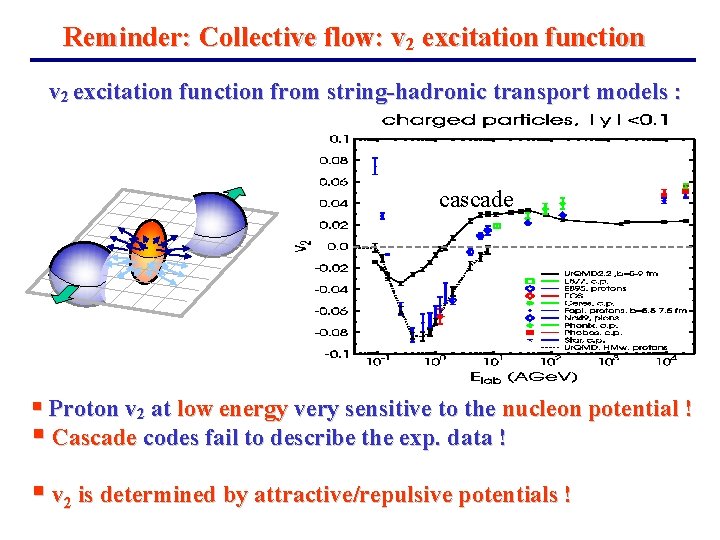
Reminder: Collective flow: v 2 excitation function from string-hadronic transport models : cascade § Proton v 2 at low energy very sensitive to the nucleon potential ! § Cascade codes fail to describe the exp. data ! § v 2 is determined by attractive/repulsive potentials !
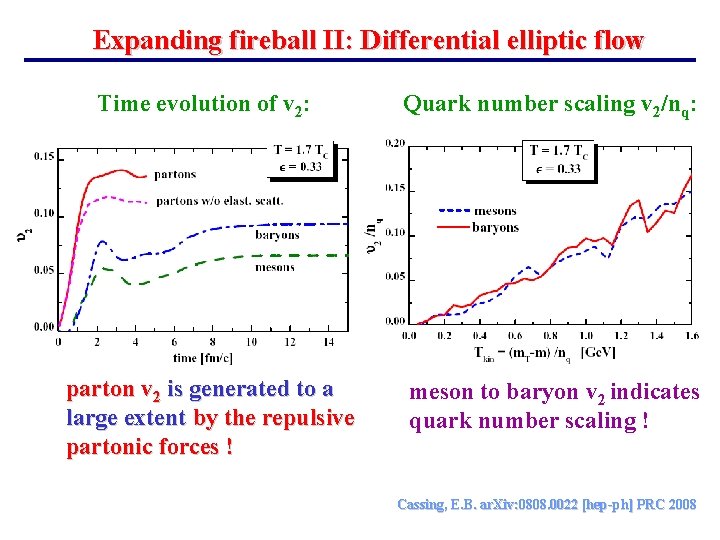
Expanding fireball II: Differential elliptic flow Time evolution of v 2: Quark number scaling v 2/nq: parton v 2 is generated to a large extent by the repulsive partonic forces ! meson to baryon v 2 indicates quark number scaling ! Cassing, E. B. ar. Xiv: 0808. 0022 [hep-ph] PRC 2008
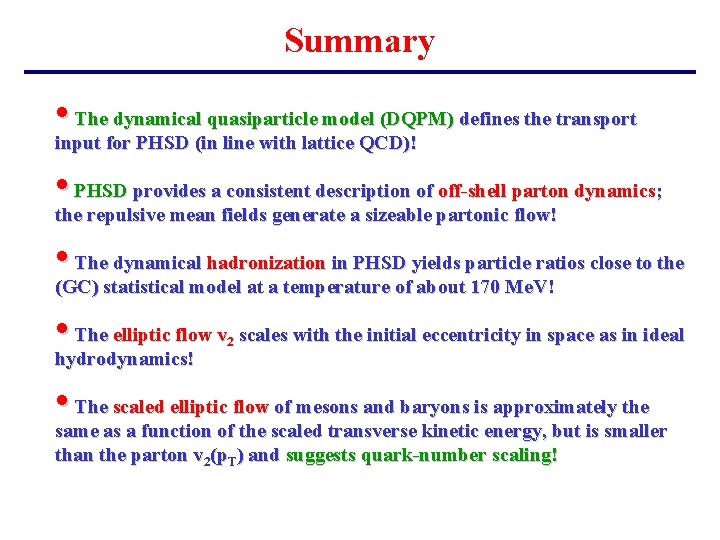
Summary • The dynamical quasiparticle model (DQPM) defines the transport input for PHSD (in line with lattice QCD)! • PHSD provides a consistent description of off-shell parton dynamics; the repulsive mean fields generate a sizeable partonic flow! • The dynamical hadronization in PHSD yields particle ratios close to the (GC) statistical model at a temperature of about 170 Me. V! • The elliptic flow v scales with the initial eccentricity in space as in ideal hydrodynamics! 2 • The scaled elliptic flow of mesons and baryons is approximately the same as a function of the scaled transverse kinetic energy, but is smaller than the parton v 2(p. T) and suggests quark-number scaling!
Thanks to Elena Bratkovskaya Sascha Juchem Andre Peshier