
Partnership Working Multidisciplinary Working A 4 Roles and

- Slides: 10
Partnership Working Multidisciplinary Working A 4. Roles and Responsibilities of workers in Health and Social Care
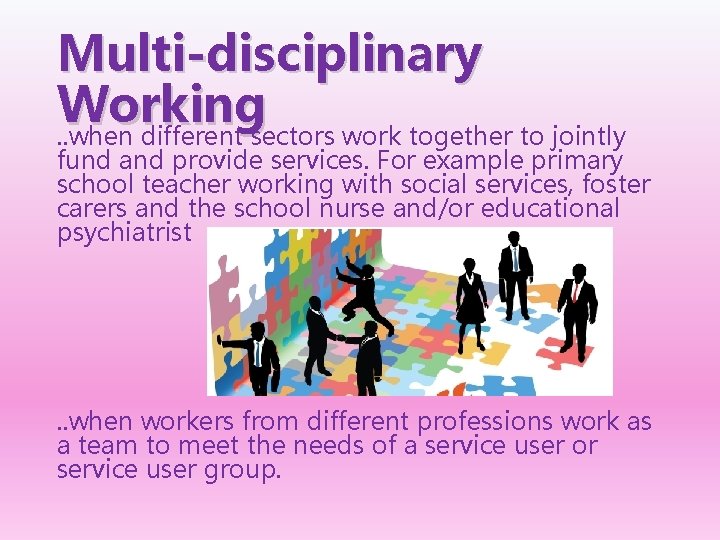
Multi-disciplinary Working. . when different sectors work together to jointly fund and provide services. For example primary school teacher working with social services, foster carers and the school nurse and/or educational psychiatrist . . when workers from different professions work as a team to meet the needs of a service user or service user group.
Key words: Multi = many Discipline = in this context this term means a practitioner has been trained in a particular set of values and techniques. E. g nursing is a discipline. Social work and occupational therapy are different disciplines. Multi-disciplinary working =when practitioners from different disciplines work together
When do practitioners work in partnership? Practitioners work in partnership to: • Assess the needs of someone who uses care services. e. g. a social worker and an occupational therapist might use the same assessment form to assess the needs of someone who has had a stroke. • Assess whethere is a need for a service and decide how to meet that need. e. g. They might discuss whether to provide a drop in service or an appointment service.
When do practitioners work in partnership? • When they need to decide which skills will be contributed by the different practitioners in the partnership (team) when working with individual clients. E. g. Care planning – which practitioner needs to teach a client how to use a Zimmer frame and which one needs to help the client walk to the toilet. • When communicate with each other about care needed or care given. e. g. through shared notes, meetings • When they need to agree how and when their service will be available. e. g. when planning the services hours and location
When do practitioners work in partnership? • When they need to share funds so that the service can be provided • When they have similar targets or mission statements. • When they need to monitor and evaluate whether the care provided to a particular client has met their needs • When the need to evaluate whether the service is meeting target
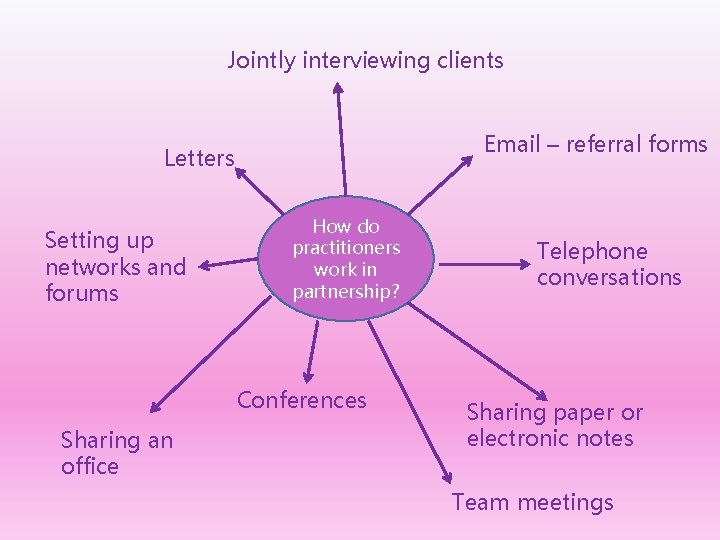
Jointly interviewing clients Email – referral forms Letters Setting up networks and forums How do practitioners work in partnership? Conferences Sharing an office Telephone conversations Sharing paper or electronic notes Team meetings
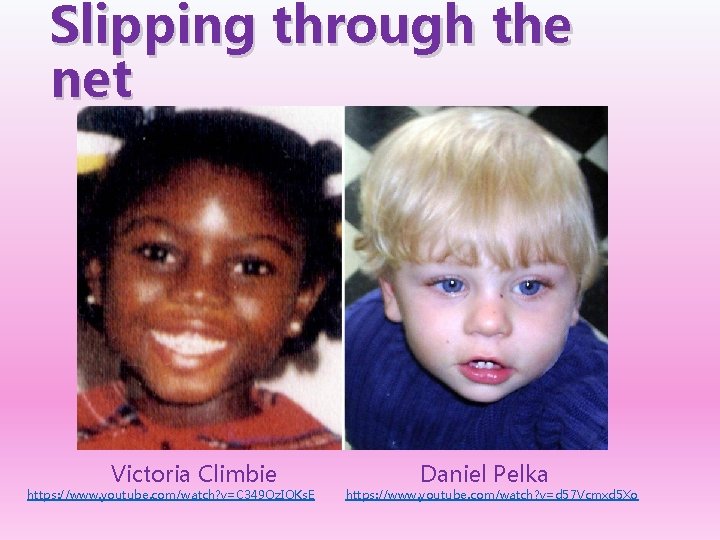
Slipping through the net Victoria Climbie https: //www. youtube. com/watch? v=C 349 Oz. IOKs. E Daniel Pelka https: //www. youtube. com/watch? v=d 57 Vcmxd 5 Xo
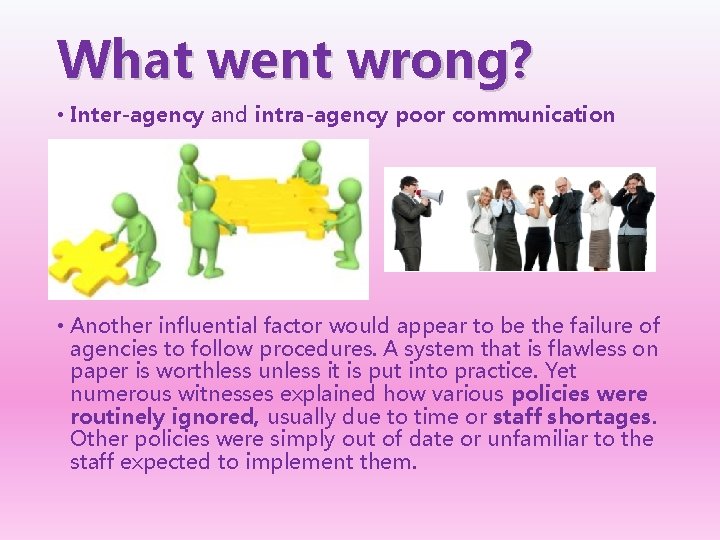
What went wrong? • Inter-agency and intra-agency poor communication • Another influential factor would appear to be the failure of agencies to follow procedures. A system that is flawless on paper is worthless unless it is put into practice. Yet numerous witnesses explained how various policies were routinely ignored, usually due to time or staff shortages. Other policies were simply out of date or unfamiliar to the staff expected to implement them.
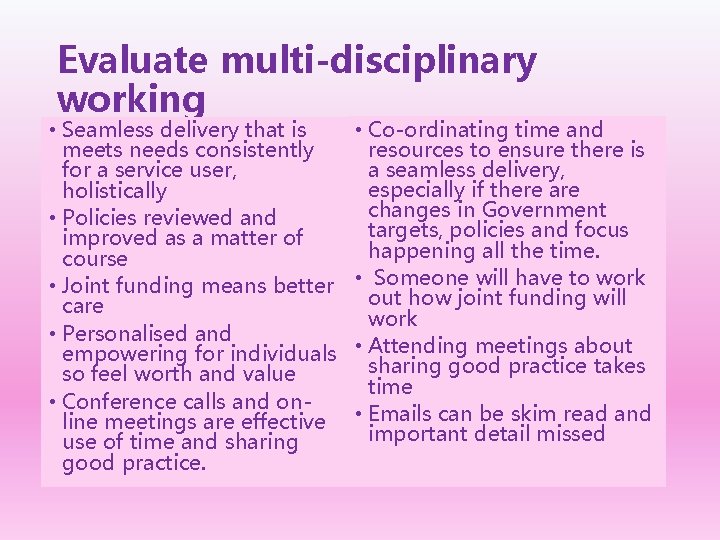
Evaluate multi-disciplinary working • Seamless delivery that is meets needs consistently for a service user, holistically • Policies reviewed and improved as a matter of course • Joint funding means better care • Personalised and empowering for individuals so feel worth and value • Conference calls and online meetings are effective use of time and sharing good practice. • Co-ordinating time and resources to ensure there is a seamless delivery, especially if there are changes in Government targets, policies and focus happening all the time. • Someone will have to work out how joint funding will work • Attending meetings about sharing good practice takes time • Emails can be skim read and important detail missed