
Partnership Tax Allocation Issues IRC 704b and Target
Partnership Tax Allocation Issues IRC § 704(b) and Target Allocations By: Belan K. Wagner 2017 Federal, State, Local and International Taxation Conference

Background �General Rule. IRC § 704(b) generally prohibits allocations of income, gain, deduction, loss or credits between partners unless those allocations have "Substantial Economic Effect. “ �Concept. The BASIC CONCEPT of § 704(b) is that if there is an allocation of income, gain, deduction, loss or credit, it will have an economic consequence to the partners. WKBK&Y- November 17, 2017 2
Background �Capital Account. That economic consequence is measured by the impact of the allocation on the Capital Account of the partners. Generally speaking, so long as an allocation of income, gain, deduction, loss or credit impacts the Capital Account and, therefore, determines how much a partner will receive upon liquidation, the allocation will be respected. WKBK&Y- November 17, 2017 3
Background �Noncapital Account Partnerships. The Regulations under § 704(b) acknowledge that all partnership agreements may not require the partners to maintain Capital Accounts in accordance with the regulations, and under such circumstances, the regulations under IRC § 704(b) require that allocations be made "in accordance with a ‘PARTNERS’ INTEREST IN THE PARTNERSHIP’"(“PIP”). WKBK&Y- November 17, 2017 4
Background � Nonrecourse Deductions. The § 704(b) regulations provide unique rules with respect to Nonrecourse Deductions because, by definition, the risk of loss falls on the creditor. The essential concept is that so long as the Nonrecourse Deductions impact the Capital Account of the partners and if the partners are required to "pay back" the tax benefit derived from the Nonrecourse Deductions upon disposition of Property (or earlier) then, the allocations of the Nonrecourse Deductions will be respected. WKBK&Y- November 17, 2017 5
Partnership/Operating Agreements �Partnerships. The partnership agreement determines the rights and duties of the partners between themselves. Most states have two specific partnership acts, one relating to limited partnerships and the other relating to general partnerships. The limited partners normally do not have an obligation to contribute capital to the partnership even to pay off company debt. WKBK&Y- November 17, 2017 6

Partnership/Operating Agreements �LLC. In a limited liability company the rights and duties of the members are determined under the "Operating Agreement. " An LLC has the unique attribute that no "member" of the company must contribute capital to the company in the absence of an agreement to the contrary set forth in the "operating agreement. " WKBK&Y- November 17, 2017 7
Deficit Capital Account Restoration Provisions �Safe Harbor Requirement. To fall under a "safe harbor" for determining whether or not a special allocation has Substantial Economic Effect, the regulations generally require the inclusion of Deficit Capital Account Restoration Provision ("DRO") in the partnership or operating agreement or under State law. Sometimes professionals, not realizing the impact of the inclusion of a DRO in a limited partnership agreement or operating agreement, include such provisions for "tax purposes”—this is an error. WKBK&Y- November 17, 2017 8
Partner's Interest in Partnership (b)(3) Regs) �Default Provision. Of essential importance to § 704(b) is the concept of the PIP. This is a default provision. If a partnership agreement does not provide for allocation income, gain, deduction, loss or credit or if any such allocation is invalid, then the default is that the allocation will be made pursuant to the PIP of each partner. WKBK&Y- November 17, 2017 9
PIP �Facts and Circumstances. The (b)(3) Regs generally provide for a facts and circumstance but list the following items as being particularly important: � The partners relative contributions to the partnership; � The interest of the partners and economic profits and losses (if different than in taxable income or loss); � The interest of the partners and cash flow and other nonliquidating distributions; and � The rights of the partners to distributions of capital upon liquidation. WKBK&Y- November 17, 2017 10
Preserved Value Rule The preserved value rule states that the “fair market value” of property is that the value of property as reflected on the books of the partnership, as adjusted for depreciation, is conclusively resumed to be the fair market value of the property. Reg. § 1. 704 -1(b)(2)(iii)(c)(2) WKBK&Y- November 17, 2017 11
Example 1 �G and H contribute $75, 000 and $25, 000, respectively, in forming an LLC. All income, gain, loss, and deduction will be allocated 50/50 between the partners and that the partners’ Capital Accounts will be maintained in accordance with the Regs. All partnership distributions will, regardless of Capital Account balances, be made 75% to G and 25% to H. There is no DRO. �The allocations in the partnership agreement do not have "substantial" economic effect" because there is no DRO. Since contributions and distributions made are in a 75/25 ratio, partnership income, gain, loss, and deduction will be reallocated 75% to G and 25% to H under PIP. WKBK&Y- November 17, 2017 12
"Substantial Economic Effect"—Regs (b)(2) �A special allocation under a partnership agreement will be respected if the allocations has "Substantial Economic Effect. " In order to satisfy the (b)(2) Regs. , two tests must be satisfied: � There must be a "economic effect" and � it must be "substantial. " �Substantial Economic Effect must be tested annually. WKBK&Y- November 17, 2017 13
Economic Effect �General Rule. In order for an allocation to have economic effect, it must first be consistent with the underlying partner’s economic arrangement. This means that in the event there is an economic benefit or economic burden that corresponds to an allocation, the partner to whom the allocation is made must receive such economic benefit or bear such economic burden. WKBK&Y- November 17, 2017 14
Economic Effect � Safe Harbor. In order to comply with the three basic requirements for economic effect safe harbor in Reg. § 1. 704 -1(b)(2)(ii), the partnership agreement must provide, throughout the full term of the partnership, as follows: � Capital Account Maintenance. The partners' Capital Accounts must be maintained in accordance with the rules of Treasury Regulation § 1. 704 -1(b)(2)(iv), WKBK&Y- November 17, 2017 15
Economic Effect (Safe Harbor Continued) � Capital Account Liquidation Distributions. Liquidating distributions are required to be made in accordance with the positive Capital Account balances of the partners, by the end of such taxable year (or, if later, within 90 days after the date of such liquidation), and WKBK&Y- November 17, 2017 16
Economic Effect (Safe Harbor Continued) � Deficit Restoration Obligation (DRO). If a partner has a deficit balance in his Capital Account following the liquidation of his interest in the partnership, he must be unconditionally obligated to restore the amount of such deficit balance to the partnership by the end of such taxable year (or, if later, within 90 days after the date of such liquidation), which amount shall, upon liquidation of the partnership, be paid to creditors of the partnership or distributed to other partners in accordance with their positive Capital Account balances. WKBK&Y- November 17, 2017 17
Example 2 �A and B form a general partnership with cash contributions of $40, 000 each, which cash is used to purchase depreciable business property at a cost of $80, 000. The partnership agreement provides that A and B will have equal shares of taxable income and loss (computed without regard to cost recovery deductions) and cash flow and that all cost recovery deductions on the property will be allocated to A. �The agreement further provides that the partners’ Capital Accounts will be maintained in accordance with the regulations, but that upon liquidation of the partnership, distributions will be made equally between the partners (regardless of Capital Account balances) and no partner will be required to restore the deficit balance in his Capital Account for distribution to partners with positive Capital Account balances. WKBK&Y- November 17, 2017 18
Example 2 Continued �In the partnership’s first taxable year, it recognizes operating income equal to its operating expenses and has an additional $20, 000 cost recovery deduction, which is allocated entirely to A. That A and B will be entitled to equal distributions on liquidation, even though A is allocated the entire $20, 000 cost recovery deduction, indicates A will not bear the full risk of the economic loss corresponding to such deduction if such loss occurs. The allocation lacks economic effect and will be disregarded. The cost recovery deductions will be reallocated equally. WKBK&Y- November 17, 2017 19
Example 3 �A and B each contribute $100 cash to the AB general partnership which purchases depreciable property (worth $500) for $200 cash and a $300 recourse note. The partnership is not required to pay principal on the note for three years. The partnership meets all of the safe harbor requirements for economic effect under the § 704(b) regulations. Under the partnership agreement, all depreciation is allocated to A, and the remainder of the partnership income and loss is shared equally. WKBK&Y- November 17, 2017 20
Example 3 Continued �During Year 1, the partnership has operating income of $180, operating expenses of $70, and depreciation of $100. To satisfy the Capital Account rules, the partners' Capital Accounts at the end of Year 1 will be as follows: WKBK&Y- November 17, 2017 21
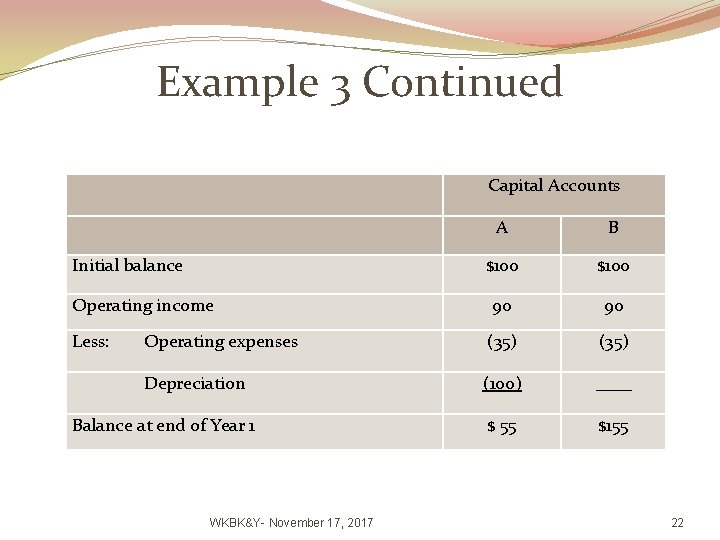
Example 3 Continued Capital Accounts A B $100 Operating income 90 90 Less: Operating expenses (35) Depreciation (100) ____ $ 55 $155 Initial balance Balance at end of Year 1 WKBK&Y- November 17, 2017 22
Example 3 Continued �The economic effect of allocating the Year 1 depreciation to A can be shown by assuming a hypothetical sale of the partnership's property for an amount equal to its book value($400) at the beginning of Year 2. Since the partnership would recognize no gain or loss on the sale, the partners' Capital Accounts would remain unchanged. After payment of the debt, the partnership would have cash of $210 ($400 sale proceeds plus $110 of cash flow from Year 1 less $300 debt repayment) available for distribution. Accordingly, each partner would be entitled to a distribution of cash equal to her Capital Account balance ($55 to A and $155 to B). The Capital Account rules force A to bear the economic burden of $100 of depreciation by reducing his share of the proceeds on liquidation. WKBK&Y- November 17, 2017 23
Alternate Test for Economic Effect: Qualified Income Offsets (QIO) � General Rule. If a partnership agreement provides for “Capital Account Maintenance” and “Capital Account Liquidation Distributions” but does not contain a DRO, the Regs. provide that the “Economic Effect Test” will still be satisfied if the partnership agreement has a “Qualified Income Offset” (“QIO”) provision. WKBK&Y- November 17, 2017 24
Alternate Test for Economic Effect: Qualified Income Offsets (QIO) � In other words, a QIO acts as a substitute for a DRO, but there is a big limitation. The allocation cannot cause or increase a deficit balance in such partners capital account (in excess of any limited DRO). WKBK&Y- November 17, 2017 25
Alternate Test for Economic Effect: Qualified Income Offsets (QIO) �What is a QIO? A QIO is a provision in the partnership agreement which provides an adjustment that a partner who unexpectedly receives an allocation, or distribution described in regulation section 1. 704 -1(B)(2)(II)(D)(4), 1. 7041(B)(2)(II)(D)(5) and 1. 704 -1(B)(2)(II)(D)(6) (herein the (D)(4)-(D)(6)) adjustments, will be allocated items of income and gain (consisting of a pro rata portion of each item of partnership income, including gross income, and gain for such year)in an amount and manner sufficient to eliminate such deficit balance as quickly as possible. WKBK&Y- November 17, 2017 26
Alternate Test for Economic Effect: Qualified Income Offsets (QIO) � Section d(4) - d(6) Adjustments. � The d(4) - d(6) Adjustments are special adjustments to the Capital Account of each partner which are required to be made to their Capital Accounts in order to determine if an allocation will reduce such partner’s Capital Account to zero. Remember that if a partnership agreement does not have a DRO, then a QIO can act as a substitute; BUT an allocation will only have Economic Effect under a QIO to the extent that the partner has a positive balance in his Capital Account. WKBK&Y- November 17, 2017 27
Example 4 �A and B form a general partnership with cash contributions of $40, 000 each which cash is used to purchase depreciable business property at a cost of $80, 000. Under the Partnership Agreement, all income and loss except depreciation is allocated equally. All depreciation is allocated to A. �The Partnership Agreement includes a “Capital Account Maintenance” provision and a “Capital Account Liquidation Distribution” provision, but no DRO provision. The Partnership Agreement includes a QIO provision. Assume that in the first year, the depreciation deduction is $20, 000 and that no d(4) - d(6) adjustments are required. WKBK&Y- November 17, 2017 28
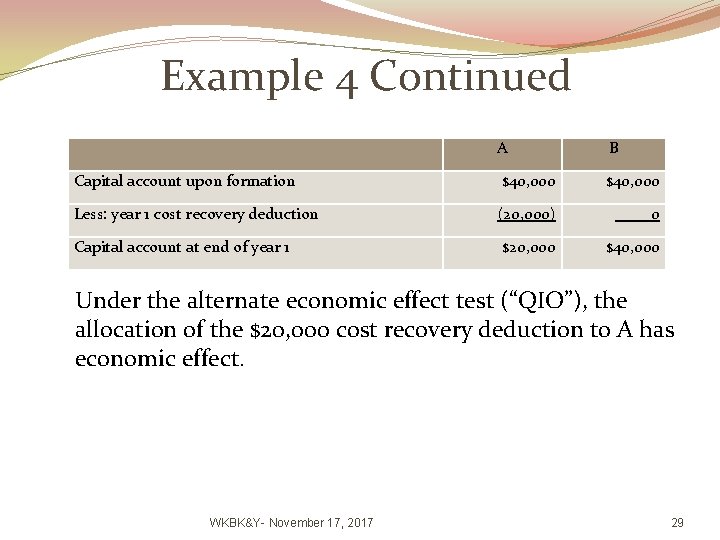
Example 4 Continued A B Capital account upon formation $40, 000 Less: year 1 cost recovery deduction (20, 000) 0 Capital account at end of year 1 $20, 000 $40, 000 Under the alternate economic effect test (“QIO”), the allocation of the $20, 000 cost recovery deduction to A has economic effect. WKBK&Y- November 17, 2017 29
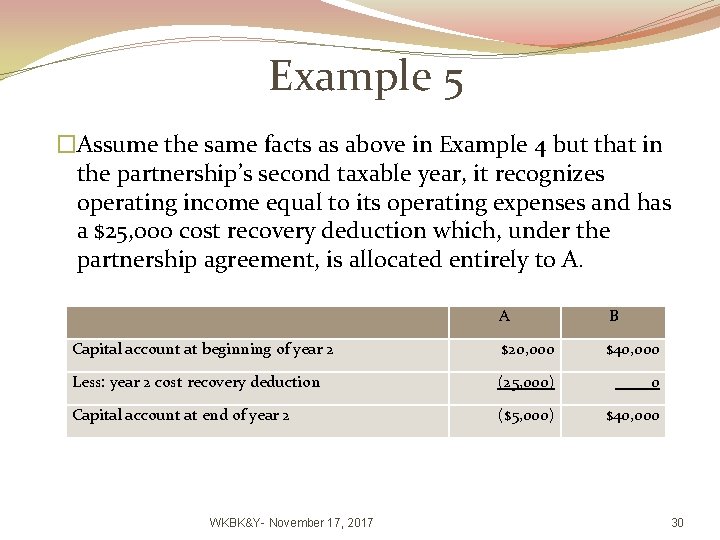
Example 5 �Assume the same facts as above in Example 4 but that in the partnership’s second taxable year, it recognizes operating income equal to its operating expenses and has a $25, 000 cost recovery deduction which, under the partnership agreement, is allocated entirely to A. A B Capital account at beginning of year 2 $20, 000 $40, 000 Less: year 2 cost recovery deduction (25, 000) 0 Capital account at end of year 2 ($5, 000) $40, 000 WKBK&Y- November 17, 2017 30
Example 5 Continued �The allocation of the $25, 000 cost recovery deduction to A satisfies the alternate economic effect test only to the extent of $20, 000. Therefore, only $20, 000 of such allocation has economic effect, and the remaining $5, 000 must be reallocated in accordance with the partners’ interests in the partnership. WKBK&Y- November 17, 2017 31
Substantiality � General Rule. The economic effect of an allocation (or allocations) is substantial if there is a reasonable possibility that the allocation (or allocations) will affect substantially the dollar amounts to be received by the partners from the partnership, independent of tax consequences. � Beware of transitory and shifting allocations. WKBK&Y- November 17, 2017 32
Nonrecourse Liabilities and Deductions � Introduction. Treasury Regulation Section 1. 704 -2 establishes rules with respect to allocations attributable to nonrecourse liabilities and “Nonrecourse Deductions”. WKBK&Y- November 17, 2017 33
Nonrecourse Liabilities and Deductions �Safe Harbor/PIP. Because Nonrecourse Deductions lack economic effect, they must be allocated in accordance with the more general facts and circumstances test, namely, the partners' interests in the partnership. Unless the “safe harbor” applies. The safe harbor test eventually requires a MGCB (“Minimum Gain Chargeback”) provision on lieu of a DRO. WKBK&Y- November 17, 2017 34
Minimum Gain �Introduction. Under the Crane and the Tufts cases, to the extent a nonrecourse liability exceeds the adjusted tax basis of the partnership property it encumbers, a disposition of that property will generate gain that at least equals that excess amount. Under 704(b) this amount is determined by reference to “Adjusted Book Value” as opposed to “Adjusted Tax Basis” (and is referred to as Partnership Minimum Gain). What’s important to note is that Partnership Minimum Gain changes as the debt diminishes or increases, and as deductions and losses attributable to nonrecourse debt arise. WKBK&Y- November 17, 2017 35
Minimum Gain � Calculating Minimum Gain. � The amount of Partnership Minimum Gain is determined by first computing for each partnership nonrecourse liability any gain the partnership would realize if it disposed of the property subject to that liability for no consideration other than full satisfaction of the liability, and then aggregating the separately computed gains. WKBK&Y- November 17, 2017 36
Minimum Gain � The amount of Partnership Minimum Gain also includes minimum gain arising from a conversion, refinancing, or other change to a debt instrument, but only to the extent a partner is allocated a share of that minimum gain. WKBK&Y- November 17, 2017 37
Minimum Gain � For any partnership taxable year, the net increase or decrease in Partnership Minimum Gain is determined by comparing the Partnership Minimum Gain on the last day of the immediately preceding taxable year with the Partnership Minimum Gain on the last day of the current taxable year. WKBK&Y- November 17, 2017 38
Minimum Gain Chargebacks � Definition. A Minimum Gain Chargeback is a gain that is allocated to a partner or partners based upon or attributable to a decrease in Partnership Minimum Gain. As such, like Nonrecourse Deductions, a Minimum Gain Chargeback, cannot have economic effect because the gain merely offsets Nonrecourse Deductions previously claimed by the partnership. WKBK&Y- November 17, 2017 39
Minimum Gain Chargebacks � Allocation to Partners. The regulations provide that “to avoid impairing the economic effect of other allocations, allocations pursuant to a Minimum Gain Chargeback must be made to the partners that either were allocated Nonrecourse Deductions or received distributions of proceeds attributable to a nonrecourse borrowing. ” WKBK&Y- November 17, 2017 40
Minimum Gain Chargebacks �Effect of Minimum Gain Chargeback. As regards the Minimum Gain Chargeback requirement, if there is a net decrease in partnership minimum gain for a partnership taxable year, the minimum gain chargeback requirement applies and each partner must be allocated items of partnership income and gain for that year equal to that partner’s share of the net decrease in partnership minimum gain. WKBK&Y- November 17, 2017 41
Minimum Gain Chargebacks �Any Minimum Gain Chargeback required for a partnership taxable year consists first of certain gains recognized from the disposition of partnership property subject to one or more partnership nonrecourse liabilities and then if necessary consists of a pro rata portion of the partnership's other items of income and gain for that year. If the amount of the Minimum Gain Chargeback requirement exceeds the partnership's income and gains for the taxable year, the excess carries over. WKBK&Y- November 17, 2017 42
Minimum Gain Chargebacks �Exception to Minimum Gain Chargeback. An exception applies to the Minimum Gain Chargeback requirement to the extent the partner contributes capital to the partnership that is used to repay the nonrecourse liability or is used to increate the basis of the property subject to the nonrecourse liability. WKBK&Y- November 17, 2017 43
Example 6 �A (the general partner) contributes no capital and B (the limited partner) contributes $200, 000 cash to the AB partnership which purchases a building (worth $1, 000) for $200, 000 cash and an $800, 000 nonrecourse note. The partnership agreement satisfies the requirements of the alternate economic effect test (“QIO”) and contains a Minimum Gain Chargeback provision. WKBK&Y- November 17, 2017 44
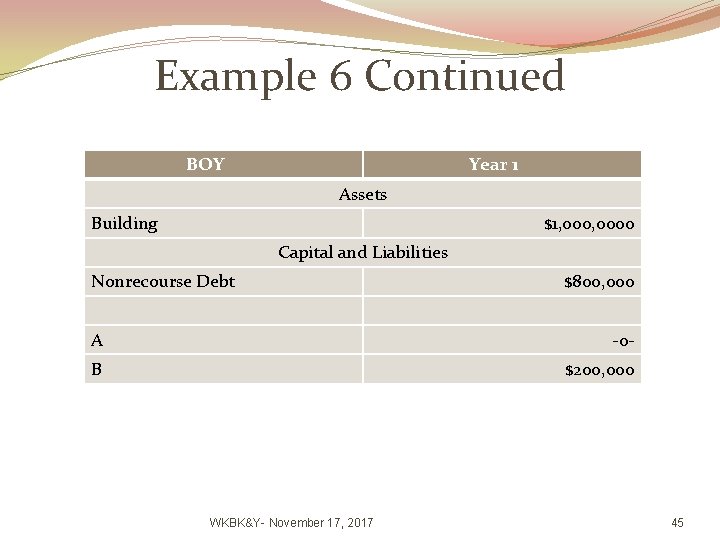
Example 6 Continued BOY Year 1 Assets Building $1, 0000 Capital and Liabilities Nonrecourse Debt $800, 000 A -0 - B $200, 000 WKBK&Y- November 17, 2017 45
Example 6 Continued Only A is required to restore any deficit in his Capital Account under state law. During Years 1 -3, the partnership has annual operating income of $150, 000, annual operating expenses of $130, 000, and annual depreciation deductions of $200, 000. The partnership uses its annual cash flow of $20, 000 to repay a portion of the loan principal at the end of each year. The partnership does not intend to make any distributions before liquidation. WKBK&Y- November 17, 2017 46
Example 6 Continued �In Year 1, the entire depreciation is allocated to B, and the net operating income of $20, 000 is allocated equally to A and B. The Year 1 allocations have economic effect, leaving each of the partners with a positive Capital Account balance ($10, 000) at year end. There are no nonrecourse deductions in Year 1 because at year end the basis of the property ($800, 000) exceeds the amount of the debt ($780, 000. ) WKBK&Y- November 17, 2017 47
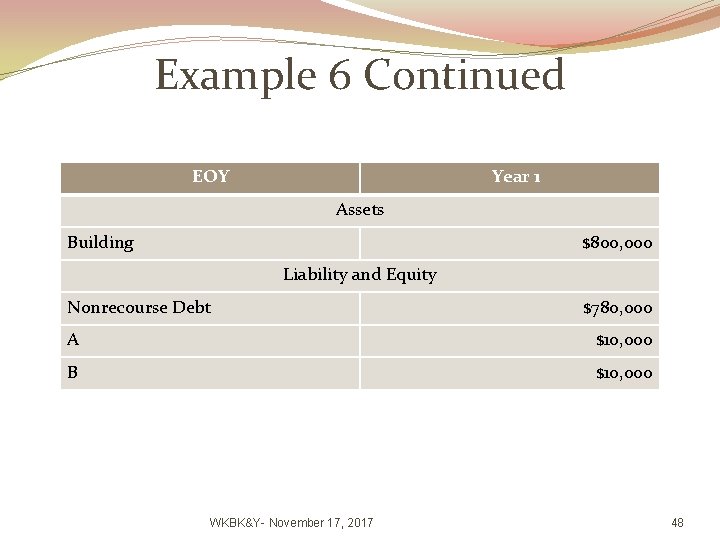
Example 6 Continued EOY Year 1 Assets Building $800, 000 Liability and Equity Nonrecourse Debt $780, 000 A $10, 000 B $10, 000 WKBK&Y- November 17, 2017 48
Example 6 Continued �At the end of Year 2, there is partnership minimum gain of $160, 000 ($760, 000 debt less $600, 000 basis). Accordingly, the $200, 000 depreciation deduction comprises $40, 000 of recourse deductions and $160, 000 of nonrecourse deductions. �Without regard to the nonrecourse deductions, the partnership has a taxable loss of $20, 000 for Year 2 ($150, 000 operating income less $130, 000 operating expenses less $40, 000 depreciation) Allocation of the $20, 000 loss equally to A and B has economic effect, and reduces each partner's Capital Account to zero. WKBK&Y- November 17, 2017 49
Example 6 Continued �The $160, 000 of nonrecourse deductions for Year 2 may be allocated in any manner that is "reasonably consistent" with valid allocations of other significant items attributable to the underlying property. A 50/50 allocation, for example, would correspond to the partners' equal division of other significant items that have economic effect. Can the entire nonrecourse deduction be allocated to B, on the ground that it corresponds to the allocation to B of the entire Year 1 depreciation (consisting of $200, 000 or recourse deductions attributable to B's investment in the property)? If the allocation of Year 1 deprecation represents a "significant item, " then an allocation of the entire nonrecourse deduction to B should be respected. WKBK&Y- November 17, 2017 50
Example 6 Continued �At the end of Year 2, B would have a negative Capital Account balance of $160, 000 which corresponds to his share of the partnership minimum gain. For purposes of the alternate economic effect test, a partner's share of partnership minimum gain is added to his actual deficit restoration obligation, if any. Reg. § 1. 704 -2(g)(1), 1(b)(2)(ii)(d). Thus, B is deemed to have a deficit restoration obligation of $160, 000. WKBK&Y- November 17, 2017 51
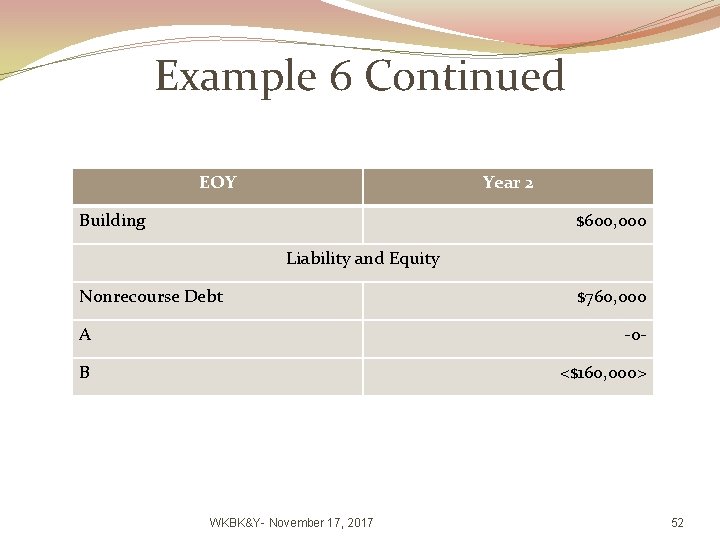
Example 6 Continued EOY Year 2 Building $600, 000 Liability and Equity Nonrecourse Debt $760, 000 A -0 - B <$160, 000> WKBK&Y- November 17, 2017 52
Targeted Allocations; the Attorney Revolt �The typical partnership agreement containing Targeted Allocation provisions provides for detailed cash distribution provisions and simply states that profits and losses are allocated so that each partner's Capital Account will be equal (or as close as possible) the cash he is supposed to receive under the cash distribution provisions as if the partnership sold all of its assets at book value and the partnership dissolved. This eliminates the need for the attorney to work through the tax allocations, and shifts it to the CPA who is in charge of compliance. WKBK&Y- November 17, 2017 53
Layercake Allocations (704(b)) �With Layercake Allocations, the attorney will draft the operating income, capital income, and tax distribution provisions. Liquidating distributions will be made in accordance with Capital Accounts in order to comply with the 704(b) regulations. The attorney then has to prepare the tax allocation provisions which will make sure that, at the end of the day, the Capital Accounts will reflect the economic relationship of the partners. This usually requires a “T Account” analysis based on projected operations and sale of the assets on liquidation, all of which must be done prior to execution of the partnership agreement. WKBK&Y- November 17, 2017 54
Example 7 �The classic situation in which a Targeted Allocation is used in when Partner A puts up the money and is entitled to a preferred return on the money plus a priority cash distribution of the preferred return and his initial capital investment. WKBK&Y- November 17, 2017 55
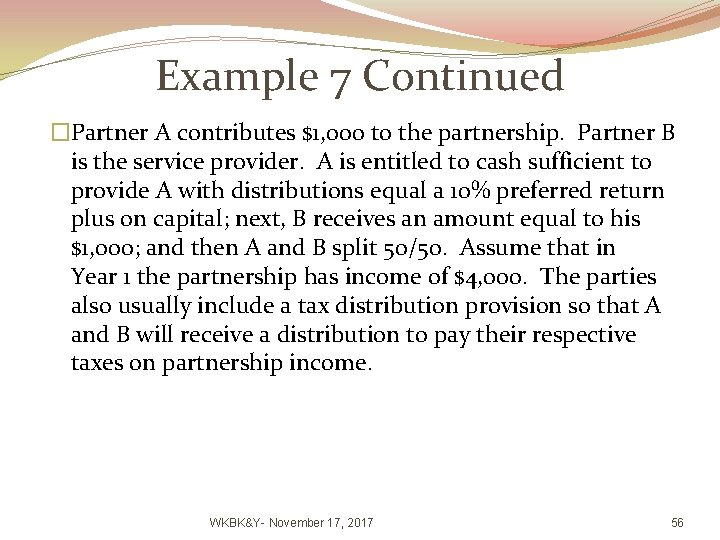
Example 7 Continued �Partner A contributes $1, 000 to the partnership. Partner B is the service provider. A is entitled to cash sufficient to provide A with distributions equal a 10% preferred return plus on capital; next, B receives an amount equal to his $1, 000; and then A and B split 50/50. Assume that in Year 1 the partnership has income of $4, 000. The parties also usually include a tax distribution provision so that A and B will receive a distribution to pay their respective taxes on partnership income. WKBK&Y- November 17, 2017 56
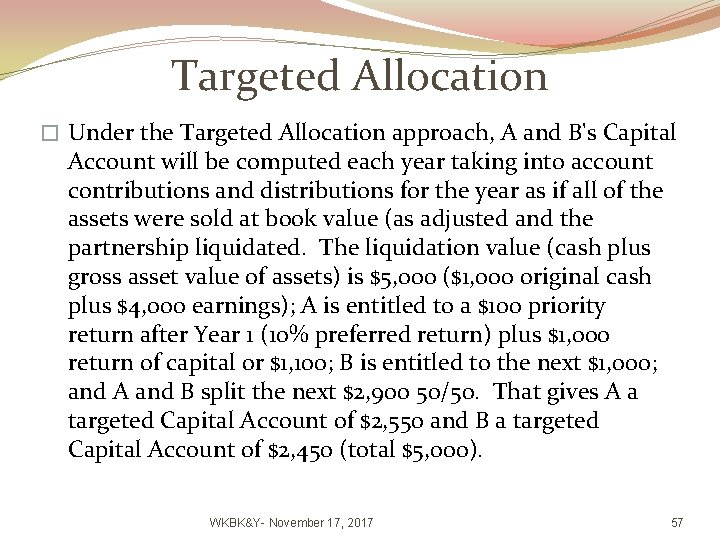
Targeted Allocation � Under the Targeted Allocation approach, A and B's Capital Account will be computed each year taking into account contributions and distributions for the year as if all of the assets were sold at book value (as adjusted and the partnership liquidated. The liquidation value (cash plus gross asset value of assets) is $5, 000 ($1, 000 original cash plus $4, 000 earnings); A is entitled to a $100 priority return after Year 1 (10% preferred return) plus $1, 000 return of capital or $1, 100; B is entitled to the next $1, 000; and A and B split the next $2, 900 50/50. That gives A a targeted Capital Account of $2, 550 and B a targeted Capital Account of $2, 450 (total $5, 000). WKBK&Y- November 17, 2017 57
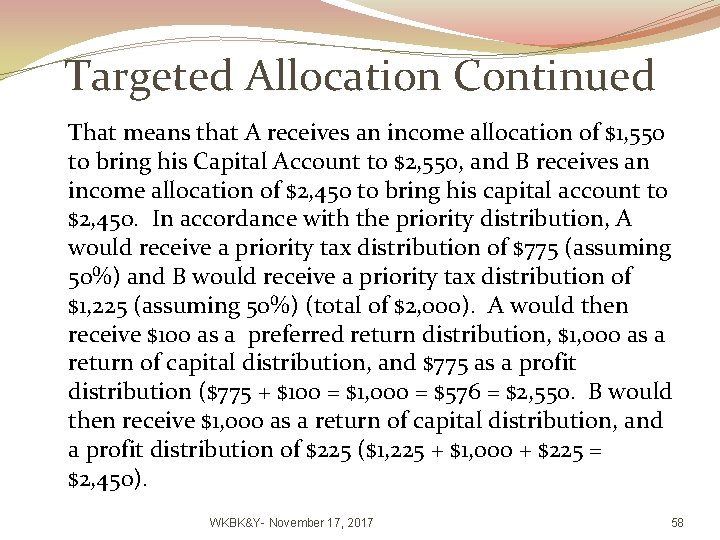
Targeted Allocation Continued That means that A receives an income allocation of $1, 550 to bring his Capital Account to $2, 550, and B receives an income allocation of $2, 450 to bring his capital account to $2, 450. In accordance with the priority distribution, A would receive a priority tax distribution of $775 (assuming 50%) and B would receive a priority tax distribution of $1, 225 (assuming 50%) (total of $2, 000). A would then receive $100 as a preferred return distribution, $1, 000 as a return of capital distribution, and $775 as a profit distribution ($775 + $100 = $1, 000 = $576 = $2, 550. B would then receive $1, 000 as a return of capital distribution, and a profit distribution of $225 ($1, 225 + $1, 000 + $225 = $2, 450). WKBK&Y- November 17, 2017 58
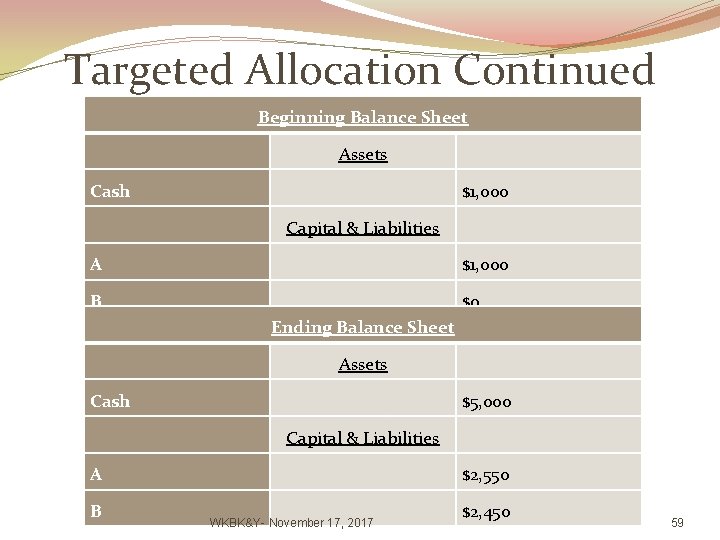
Targeted Allocation Continued Beginning Balance Sheet Cash Assets $1, 000 Capital & Liabilities A B $0 Ending Balance Sheet Cash Assets A B $1, 000 $5, 000 Capital & Liabilities $2, 550 $2, 450 WKBK&Y- November 17, 2017 59
Accounting Considerations for Targeted Allocations � Accounting. The accounting required works as follows: � Each partner’s Capital Account is adjusted based on the year’s activity (contributions, distributions, and capital account book-ups and book-downs), as well as special allocations, Nonrecourse Deductions, Minimum Gain Chargebacks, QIO allocations, 704(c) allocations, etc. that are not taken into account in the general allocation of net profits and net losses. WKBK&Y- November 17, 2017 60
Accounting Considerations for Targeted Allocations Continued � � At year end, the partnership computes the target amount needed in the Capital Account based on the amount of the hypothetical cash distribution to the partner that would result after a cash sale of partnership property at book value. Net profits and net loss items are allocated to the partners to bring each partner’s Capital Account in line with the distributions he would receive on that year-end date as well as Minimum Gain Chargebacks and QIO allocations. WKBK&Y- November 17, 2017 61
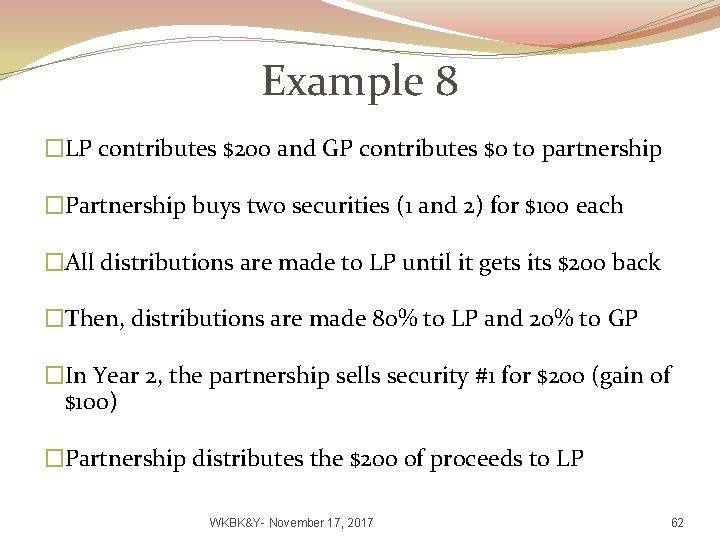
Example 8 �LP contributes $200 and GP contributes $0 to partnership �Partnership buys two securities (1 and 2) for $100 each �All distributions are made to LP until it gets its $200 back �Then, distributions are made 80% to LP and 20% to GP �In Year 2, the partnership sells security #1 for $200 (gain of $100) �Partnership distributes the $200 of proceeds to LP WKBK&Y- November 17, 2017 62
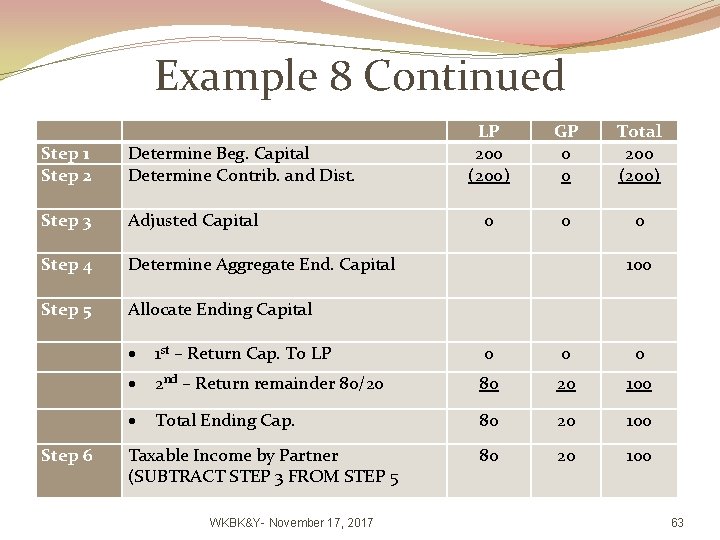
Example 8 Continued Step 1 Step 2 Determine Beg. Capital Determine Contrib. and Dist. LP 200 (200) GP 0 0 Total 200 (200) Step 3 Adjusted Capital 0 0 0 Step 4 Determine Aggregate End. Capital 100 Step 5 Allocate Ending Capital 1 st – Return Cap. To LP 0 0 0 2 nd – Return remainder 80/20 80 20 100 Total Ending Cap. 80 20 100 Step 6 Taxable Income by Partner (SUBTRACT STEP 3 FROM STEP 5 80 20 100 WKBK&Y- November 17, 2017 63
Accounting Considerations for Targeted Allocations � Legal Language. Tax practitioners have not settled on model language for targeted Capital Account allocation. Possible language would be as follows: “Except as otherwise provided in this Article, Profits and Losses (or items thereof) for any Fiscal Period shall be allocated among the Members in such manner that, as of the end of such Fiscal Period, the respective Capital Accounts of the Members shall be equal to the respective amounts that would be distributed to them, determined as if the Company were to (i) liquidate the assets of the Company for an amount equal to their Gross Asset Value and (ii) distribute the proceeds of liquidation pursuant to the waterfall distributions required above. " WKBK&Y- November 17, 2017 64
Accounting Considerations for Targeted Allocations �In addition to the normal language requiring special allocation of Nonrecourse Deductions outside of the general allocation of net profits and net losses, minimum gain chargebacks, QIO allocations and 704(c) allocations will be included. WKBK&Y- November 17, 2017 65
Targeted Allocations- Tax Issues � General. For the reasons stated below, many commentators do not believe that Targeted Allocations satisfy the 704(b) safe harbor due to the fact that proceeds on liquidation are not distributed pursuant to Capital Accounts. This leaves two other basis for qualification under 704(b): � Dumb but lucky under Regulation Section 1. 704 - 1(b)(2)(i); or � PIP. WKBK&Y- November 17, 2017 66
Targeted Allocations - Tax Issues � Capital Account Liquidation. The capital account liquidation requirement under the regulations is that the partnership agreement “provides” that “liquidating distributions are required in all cases to be made in accordance with positive Capital Account Balance. ” � It can be argued that the safe harbor economic effect tests are not satisfied because the partnership agreement does not explicitly provide for liquidations in accordance with Capital Accounts; instead it requires liquidating distributions to be made pursuant to the waterfall distribution provisions. WKBK&Y- November 17, 2017 67
Targeted Allocations- Tax Issues � The contra argument is that Targeted Allocation provisions are designed to ensure that liquidating distributions will be made in accordance with Capital Accounts. It can be argued that a partnership agreement that contains those provisions can be said to “Provide” that liquidating distributions are in accordance with Capital Accounts and that the regulation requirement is satisfied. WKBK&Y- November 17, 2017 68
Targeted Allocations - Tax Issues � Targeted Allocations and partner’s interests in the partnership. Section 704(b) provides safe harbors for substantial economic effect. Failure to satisfy these tests means that the allocation will be tested under the “partner’s interests in the partnership” standard unless the “dumb but lucky” rule applies. � While one would generally expect Targeted Allocations to equal “partner’s interests in the partnership, ” there is some softness in that conclusion because of the absence of the “book value equals fair market value” presumption in applying the partner’s interest in the partnership method. WKBK&Y- November 17, 2017 69
Targeted Allocations - Tax Issues �Targeted Allocations and Nonrecourse Deductions. As described above, allocations of Nonrecourse Deductions can never have economic effect and must be allocated in accordance with the partner’s overall economic interest in the partnership. The regulations go on to provide a special rule that says Nonrecourse Deductions will be deemed to be in accordance with the partner’s interests in the partnership when (1) liquidating distributions are made in accordance with Capital Accounts; (2) the Nonrecourse Deductions are allocated in a manner that is reasonably consistent with the allocation of another item that has substantial economic effect; and (3) there is a MGCB provision. WKBK&Y- November 17, 2017 70
Targeted Allocations - Tax Issues �Some commentators argue that this rule calls into question the ability of partnerships using Targeted Allocations to specially allocate Nonrecourse Deductions because they argue that partnership agreement does not satisfy either of the first 2 prongs of the test even if a MGCB provision is included in the partnership agreement. If correct, that conclusion would leave the allocation of nonrecourse items entirely up in the air. This would not be a good result and caution should be exercised if special allocations of Nonrecourse Deduction are a major element of the business deal. WKBK&Y- November 17, 2017 71
Targeted Allocations - Tax Issues �Preferred Return and Targeted Allocations. One of the issues with Targeted Allocations is whether a gross income allocation, guaranteed payment, or taxable capital shift may be mandatory when one partner is entitled to a preferred return that takes priority over another partner’s capital return. WKBK&Y- November 17, 2017 72
Example 9 �A and B each contributes $100 to the partnership. A is entitled to receive a compounded 12 percent return on her $100 investment plus return of capital before B is entitled to any return of capital. The partnership earns $10 of net profits in year 1. �In this example, net profits for the year fell short of the preferred return. This issue is not unique to Targeted Allocations and would also seem to be present for traditional liquidate-in-accordance-with-Capital-Account allocations. The question is whether the partnership should allocate $12 of gross income to the partner who is entitled to the priority return, or treat the amount as a $12 guaranteed payment to that partner, or simply allocate $10 of net income and wait for the next year to catch up. WKBK&Y- November 17, 2017 73
Example 9 Continued �Some commentators argue that the section 704(b) partner’s interest in the partnership rule may require a gross income allocation even if the Targeted Allocation provision in the agreement only required allocations of items of net income and loss. Alternatively, the amount could be treated as an accrued guaranteed payment for A in year 1 or a taxable capital shift. WKBK&Y- November 17, 2017 74
Targeted Allocations - Tax Issues �Fractions Rule. The "Fractions Rule" (IRC Section 514(c)(9) permits certain tax exempt partners to invest in leveraged real estate partnerships without realizing debt financed income. � The Fractions Rule requires that allocations have substantial economic effect within the meaning of IRC Section 704(b)(2). � If Targeted Allocations do not meet safe harbor for economic effect, then there is risk that the Fractions Rule may be violated. � WKBK&Y- November 17, 2017 75
Targeted Allocations - Tax Issues � Issues with Allocations of Nonrecourse Debt. �Nonrecourse Debt – Debt for which no partner has economic risk of loss �IRC Section 752(a) – partners include in the basis of their partnership interest allocable share of partnership debt. �Partners include their share of partnership nonrecourse debt in proportion to their share of partnership profits – Treas. Reg. Section 1. 752 -3(a)(3). WKBK&Y- November 17, 2017 76
Targeted Allocations - Tax Issues �Partnership agreement may specify interest in partnership profits as long as it is consistent with allocations of significant item of income or gain that have substantial economic effect under IRC Section 704(b)(2). �If Targeted Allocations do not meet safe harbor for economic effect, then the allocation of Nonrecourse Debt is called into question. WKBK&Y- November 17, 2017 77
Linked Materials �Below is a link to the AICPA proposed revenue ruling on targeted allocations from 2014 (it has examples in the back): �http: //www. aicpa. org/Advocacy/Tax/Partnerships/Do wnloadable. Documents/2014_02. 11_Proposed_Rev_Rul ings_Targeted_Allocations. pdf WKBK&Y- November 17, 2017 78
Thank You Belan K. Wagner, Esq. bwagner@wkblaw. com Wagner Kirkman Blaine Klomparens & Youmans LLP 10640 Mather Blvd. , Suite 200 Mather, CA 95655 www. wkblaw. com 1350 Treat Blvd. , Suite 400 Walnut Creek, CA 94597 www. facebook. com/wkblaw
- Slides: 79