
Partnership as Entity or Aggregate p 93 It
- Slides: 90
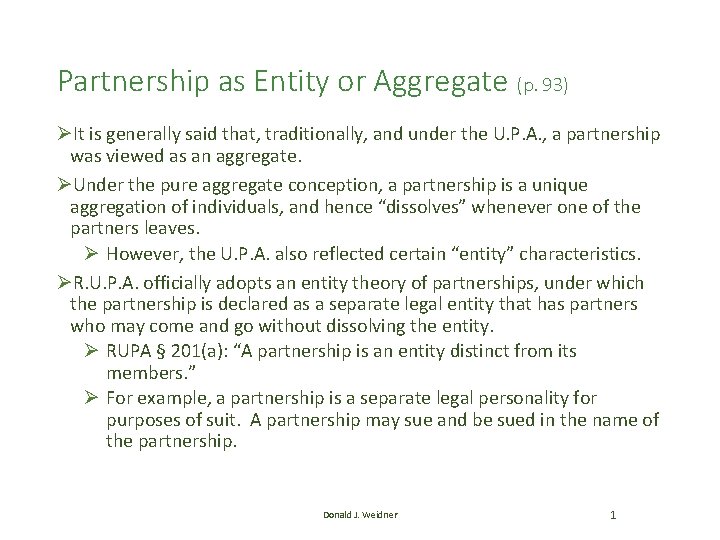
Partnership as Entity or Aggregate (p. 93) ØIt is generally said that, traditionally, and under the U. P. A. , a partnership was viewed as an aggregate. ØUnder the pure aggregate conception, a partnership is a unique aggregation of individuals, and hence “dissolves” whenever one of the partners leaves. Ø However, the U. P. A. also reflected certain “entity” characteristics. ØR. U. P. A. officially adopts an entity theory of partnerships, under which the partnership is declared as a separate legal entity that has partners who may come and go without dissolving the entity. Ø RUPA § 201(a): “A partnership is an entity distinct from its members. ” Ø For example, a partnership is a separate legal personality for purposes of suit. A partnership may sue and be sued in the name of the partnership. Donald J. Weidner 1
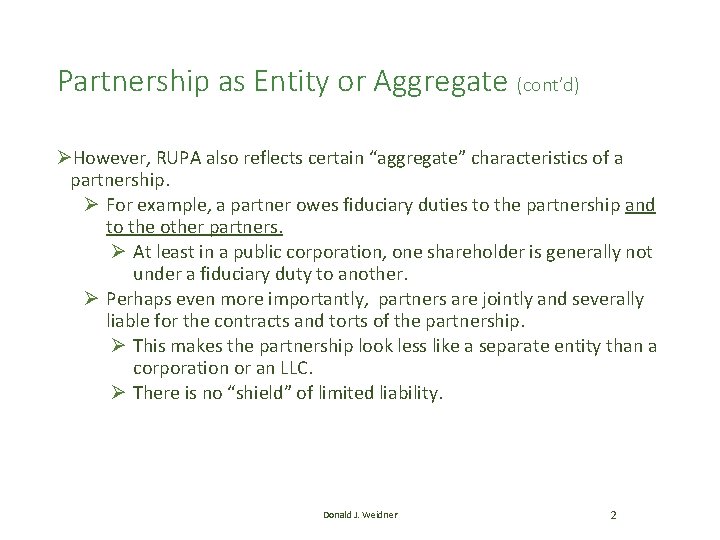
Partnership as Entity or Aggregate (cont’d) ØHowever, RUPA also reflects certain “aggregate” characteristics of a partnership. Ø For example, a partner owes fiduciary duties to the partnership and to the other partners. Ø At least in a public corporation, one shareholder is generally not under a fiduciary duty to another. Ø Perhaps even more importantly, partners are jointly and severally liable for the contracts and torts of the partnership. Ø This makes the partnership look less like a separate entity than a corporation or an LLC. Ø There is no “shield” of limited liability. Donald J. Weidner 2
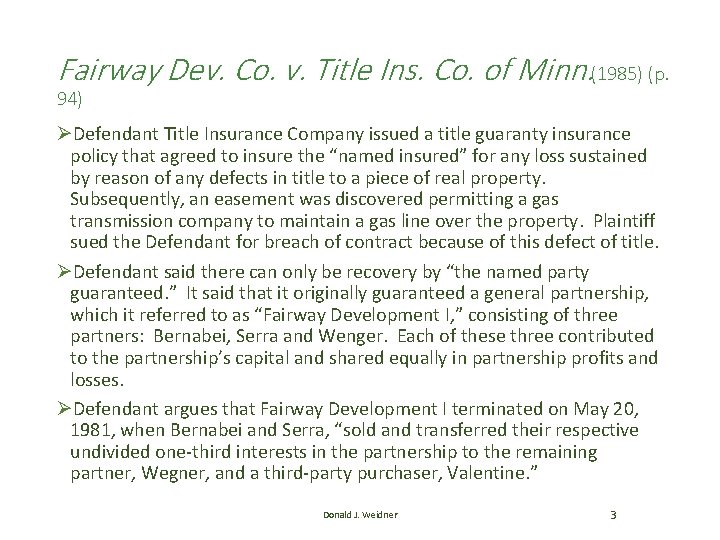
Fairway Dev. Co. v. Title Ins. Co. of Minn. (1985) (p. 94) ØDefendant Title Insurance Company issued a title guaranty insurance policy that agreed to insure the “named insured” for any loss sustained by reason of any defects in title to a piece of real property. Subsequently, an easement was discovered permitting a gas transmission company to maintain a gas line over the property. Plaintiff sued the Defendant for breach of contract because of this defect of title. ØDefendant said there can only be recovery by “the named party guaranteed. ” It said that it originally guaranteed a general partnership, which it referred to as “Fairway Development I, ” consisting of three partners: Bernabei, Serra and Wenger. Each of these three contributed to the partnership’s capital and shared equally in partnership profits and losses. ØDefendant argues that Fairway Development I terminated on May 20, 1981, when Bernabei and Serra, “sold and transferred their respective undivided one-third interests in the partnership to the remaining partner, Wegner, and a third-party purchaser, Valentine. ” Donald J. Weidner 3
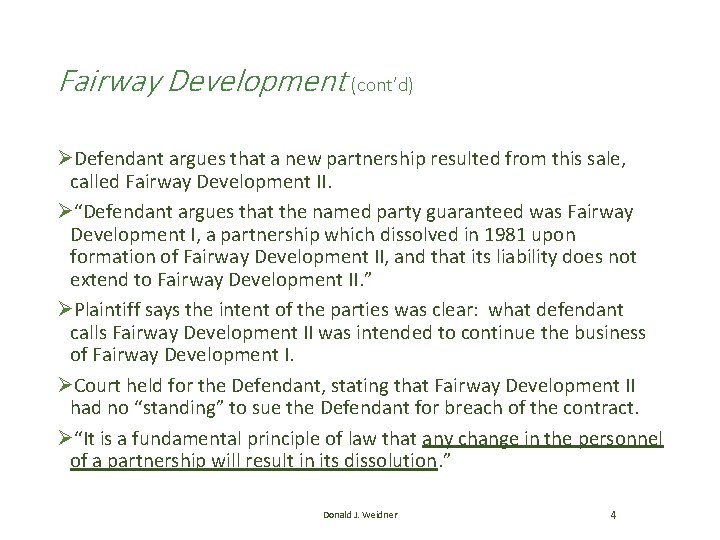
Fairway Development (cont’d) ØDefendant argues that a new partnership resulted from this sale, called Fairway Development II. Ø“Defendant argues that the named party guaranteed was Fairway Development I, a partnership which dissolved in 1981 upon formation of Fairway Development II, and that its liability does not extend to Fairway Development II. ” ØPlaintiff says the intent of the parties was clear: what defendant calls Fairway Development II was intended to continue the business of Fairway Development I. ØCourt held for the Defendant, stating that Fairway Development II had no “standing” to sue the Defendant for breach of the contract. Ø“It is a fundamental principle of law that any change in the personnel of a partnership will result in its dissolution. ” Donald J. Weidner 4
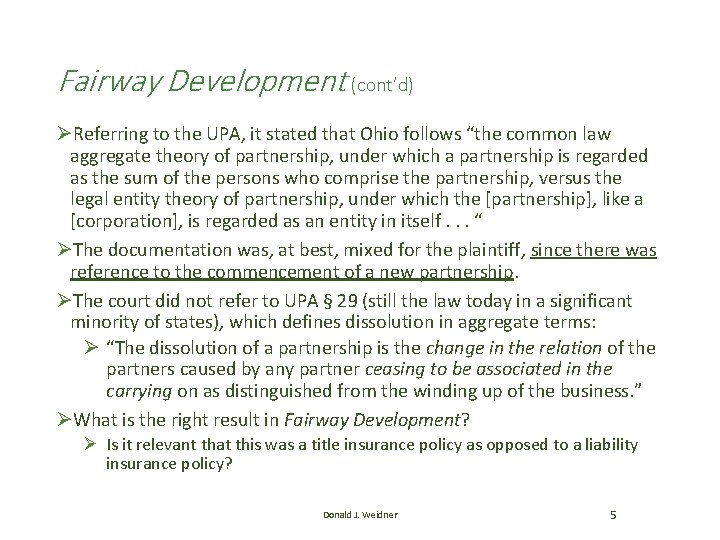
Fairway Development (cont’d) ØReferring to the UPA, it stated that Ohio follows “the common law aggregate theory of partnership, under which a partnership is regarded as the sum of the persons who comprise the partnership, versus the legal entity theory of partnership, under which the [partnership], like a [corporation], is regarded as an entity in itself. . . “ ØThe documentation was, at best, mixed for the plaintiff, since there was reference to the commencement of a new partnership. ØThe court did not refer to UPA § 29 (still the law today in a significant minority of states), which defines dissolution in aggregate terms: Ø “The dissolution of a partnership is the change in the relation of the partners caused by any partner ceasing to be associated in the carrying on as distinguished from the winding up of the business. ” ØWhat is the right result in Fairway Development? Ø Is it relevant that this was a title insurance policy as opposed to a liability insurance policy? Donald J. Weidner 5
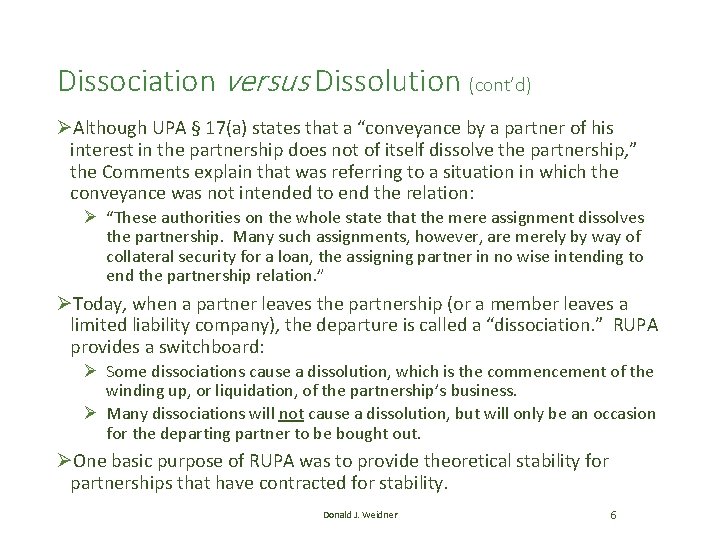
Dissociation versus Dissolution (cont’d) ØAlthough UPA § 17(a) states that a “conveyance by a partner of his interest in the partnership does not of itself dissolve the partnership, ” the Comments explain that was referring to a situation in which the conveyance was not intended to end the relation: Ø “These authorities on the whole state that the mere assignment dissolves the partnership. Many such assignments, however, are merely by way of collateral security for a loan, the assigning partner in no wise intending to end the partnership relation. ” ØToday, when a partner leaves the partnership (or a member leaves a limited liability company), the departure is called a “dissociation. ” RUPA provides a switchboard: Ø Some dissociations cause a dissolution, which is the commencement of the winding up, or liquidation, of the partnership’s business. Ø Many dissociations will not cause a dissolution, but will only be an occasion for the departing partner to be bought out. ØOne basic purpose of RUPA was to provide theoretical stability for partnerships that have contracted for stability. Donald J. Weidner 6
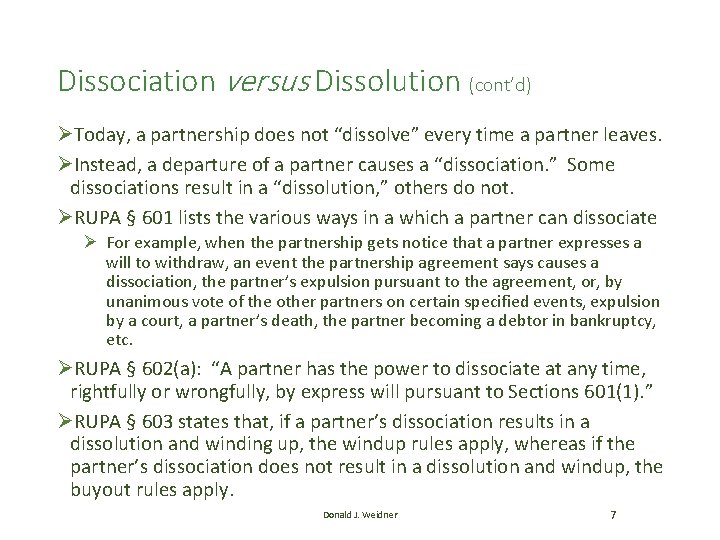
Dissociation versus Dissolution (cont’d) ØToday, a partnership does not “dissolve” every time a partner leaves. ØInstead, a departure of a partner causes a “dissociation. ” Some dissociations result in a “dissolution, ” others do not. ØRUPA § 601 lists the various ways in a which a partner can dissociate Ø For example, when the partnership gets notice that a partner expresses a will to withdraw, an event the partnership agreement says causes a dissociation, the partner’s expulsion pursuant to the agreement, or, by unanimous vote of the other partners on certain specified events, expulsion by a court, a partner’s death, the partner becoming a debtor in bankruptcy, etc. ØRUPA § 602(a): “A partner has the power to dissociate at any time, rightfully or wrongfully, by express will pursuant to Sections 601(1). ” ØRUPA § 603 states that, if a partner’s dissociation results in a dissolution and winding up, the windup rules apply, whereas if the partner’s dissociation does not result in a dissolution and windup, the buyout rules apply. Donald J. Weidner 7
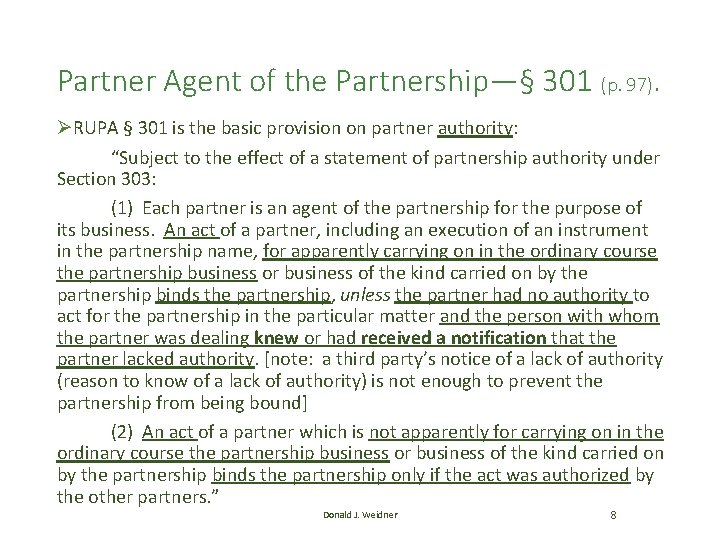
Partner Agent of the Partnership—§ 301 (p. 97). ØRUPA § 301 is the basic provision on partner authority: “Subject to the effect of a statement of partnership authority under Section 303: (1) Each partner is an agent of the partnership for the purpose of its business. An act of a partner, including an execution of an instrument in the partnership name, for apparently carrying on in the ordinary course the partnership business or business of the kind carried on by the partnership binds the partnership, unless the partner had no authority to act for the partnership in the particular matter and the person with whom the partner was dealing knew or had received a notification that the partner lacked authority. [note: a third party’s notice of a lack of authority (reason to know of a lack of authority) is not enough to prevent the partnership from being bound] (2) An act of a partner which is not apparently for carrying on in the ordinary course the partnership business or business of the kind carried on by the partnership binds the partnership only if the act was authorized by the other partners. ” Donald J. Weidner 8
Partner Agent of the Partnership—§ 301 (cont’d) ØSection 301 sets out the general power of a partner, as an agent of the firm, to bind the partnership to third parties. Ø By contrast, a “member” of an LLC does not necessarily have the authority of an agent to bind the LLC Ø For example, if the LLC is manager-managed ØAs we shall see, the power of a partner to bind the partnership to third parties can be expanded or contracted, within limits, by the filing of a statement of partnership authority. ØWhether, as among themselves, a partner has the right to bind the partnership to third parties, is a matter for the partnership agreement. ØIn general: “The effect of Section 301(1) is to characterize a partner as a general managerial agent having both actual and apparent authority coextensive in scope with the firm’s ordinary business, at least in the absence of a contrary partnership agreement. ” Donald J. Weidner 9
Partner Agent of the Partnership—§ 301 (cont’d) Ø“Under UPA Section 9(1) and (4), only a person with knowledge of a restriction on a partner’s authority is bound by it. Section 301(1) provides that a person who has received a notification of a partner’s lack of authority is also bound. The meaning of ‘received a notification’ is explained in Section 102(d). Ø RUPA § 102(d) says you receive a notification when it comes to your attention or “is duly delivered at the person’s place of business or at any other place held out by the person as a place for receiving communications. Ø“Thus, the partnership may protect itself from unauthorized acts by giving a notification of a restriction on a partner’s authority to a person dealing with that partner. A notification may be effective upon delivery, whether or not it actually comes to the other person’s attention. To that extent, the risk of lack of authority is shifted to those dealing with partners. ” Donald J. Weidner 10
Partner Agent of the Partnership—§ 301 (cont’d) ØBinding third parties simply by receipt of a notification of a partner’s lack of authority is consistent with the rules declaring the effectiveness of statements of partnership authority (RUPA § 303), of dissociation (RUPA § 704) and of dissolution (RUPA § 805). ØAs we have seen in discussing § 301, but for these supplemental provisions, a third party is not bound merely by her “reason to know” of a restriction on authority. ØRUPA § 401(j) discussed the rights of the partners as among themselves: “A difference arising as to a matter in the ordinary course of business of a partnership may be decided by a majority of the partners. An act outside the ordinary course of business of a partnership and an amendment to the partnership agreement may be undertaken only with the consent of all of the partners. ” ØUnder general agency principles, the partners can subsequently ratify a partner’s unauthorized act. RUPA § 104(a): unless otherwise displaced by RUPA, “the principles of law and equity” supplement RUPA. Donald J. Weidner 11
Acts Outside the “Ordinary Course” ØRUPA leaves it to the courts to decide what acts are outside the “ordinary course” of partnership business, and, hence, outside the scope of a partner’s authority. Ø Its predecessor, the UPA, listed matters that require unanimous consent: 1. Assign the partnership property in trust for creditors or on the 2. 3. 4. 5. assignee’s promise to pay the partnership debts; Dispose of the good will of the business; Do any other act that would make it impossible to carry on the ordinary business of the partnership; Confess a judgment*; and Submit a claim or liability in arbitration or reference. *Confess a judgment—a written agreement by a defendant accepting the agreed-upon damages it must pay to the plaintiff and agreeing that the statement may be filed as a judgment if the defendant does not pay. Donald J. Weidner 12
Statement of Partnership Authority—RUPA § 303 (p. 99) RUPA introduced an unprecedented system of optional statements that can be filed. The most important statement, especially for transfers of real property, is the Statement of Partnership Authority. ا 301(a) indicates that it is an option for the “partnership” to file “a statement of partnership authority. ” Ø Certain information must be in the statement. There is a “disclosure tax” on the exercise of the option. The statement must either name all the partners or it may list an agent who “shall maintain a list of the names and mailing addresses of all of the partners and make it available to any person on request for good cause shown. . ” RUPA § 303(b). ا 301 distinguishes between extraordinary restrictions on a partner’s authority and extraordinary grants of authority. Donald J. Weidner 13
Statement of Partnership Authority—RUPA § 303 (cont’d) ØExtraordinary Restrictions on A Partner’s Authority. Ø “(e) A person not a partner is deemed to know of a limitation on the authority of a partners to transfer real property held in the name of the partnership if a certified copy of the filed statement containing the limitation on authority is of record in the office for recording transfers of real property. ” ØThere is no similar rule for restrictions on the authority of a partner apart from real estate transfers. ØIn the case of dissociations or dissolutions, other statements may be filed to wind down a partner’s authority to bind the partnership. Donald J. Weidner 14
Statement of Partnership Authority—RUPA § 303 (cont’d) ØExtraordinary Grants of Authority to a Partner. Ø “(1) Except for transfers of real property, a grant of authority contained in a filed statement of partnership authority is conclusive in favor of a person who gives value without knowledge to the contrary. . Ø “(2) A grant of authority to transfer real property held in the name of the partnership contained in a certified copy of a filed statement of partnership authority recorded in the office for recording transfers of that real property is conclusive in favor of a person who gives value without notice to the contrary. . ØAutomatic “Sunset” of a Statement of Partnership Authority. Ø “(g) Unless earlier canceled, a filed statement of partnership authority is canceled by operation of law five years after the date on which the statement, or the most recent amendment, was filed with the [Secretary of State]. ” Donald J. Weidner 15
RNR Invs. Ltd. P’ship v. Peoples First Cmty. Bank (2002) ØRNR was a Florida Limited Partnership formed to purchase vacant land in Destin, Florida, and build on it a house for resale. Bernie was the sole general partner and the three limited partners were two other natural persons and a corporation. ØA limited partnership is formed by filing a certificate of limited partnership, which often contains very little information other than the name of the general partner and the names of the limited partners. ØThe limited partnership agreement provided a mechanism for confining the authority of the general partner to borrow and spend. There was an “approved budget” mechanism designed to limit the authority of the general partner. Limited partner consent was required. ØThat budget mechanism was not adopted but the partners apparently orally agreed that Bernie would seek financing in the approximate amount of $650, 000. Donald J. Weidner 16
RNR Invs. Ltd. P’ship v. Peoples First Cmty. Bank (cont’d) ØBernie borrowed far more than that: Ø “RNR, through its general partner, entered into a construction loan agreement, note and mortgage in the principal amount of $990, 000. For a period of approximately 9 months, Bank disbursed $952, 699 into RNR’s bank account, after architect approval that the work had progressed as planned. No representative of RNR objected to any draw or asserted that the funds were not associated with the construction of the house. ” ØRNR defaulted under the note and mortgage and ceased making payments. Bank filed foreclosure and RNR responded by asserting that the bank was estopped from foreclosing because Bernie had no authority to take out the loan, which the Bank would have discovered but for its own negligent failure to inquire. ØThe record contains no copy of an Approved Budget or any evidence that the partnership agreement or any approved budget was given to the Bank “or that notice of the general partner’s restricted authority was provided to the bank. ” Donald J. Weidner 17
RNR Invs. Ltd. P’ship v. Peoples First Cmty. Bank (cont’d) ØThe court said RUPA replaces the common law agency concept of apparent authority. Ø Which is based on? ØThe court reproduced Florida’s version of RUPA § 301, which includes a reference to “the geographic area in which the partnership operates. ” (an addition not relevant here). ØThe court summarized the relevant portion as follows: Ø “Thus, even if a general partner’s actual authority is restricted by the terms of the partnership agreement, the general partner possesses the apparent authority to bind the partnership in the ordinary course of partnership business or business of the kind carried on by the partnership, unless the third party “knew or had received a notification that the partner lacked authority. ” ØNote: mere “notice” that the partner lacked authority is not sufficient to defeat apparent authority. Notice includes “reason to know that the fact exists from all other facts known to the person at the time in question. ” ØRecall, a person “receives a notification” when (i) the notification is delivered to the person’s place of business (or other place for receiving communications) or (ii) the recipient otherwise actually learns of its Donald J. Weidner 18 existence. RUPA § 102(d).
RNR Invs. Ltd. P’ship v. Peoples First Cmty. Bank (cont’d) ØDoes RUPA reach the right result in this situation? ØThe court quotes from my article with my former colleague John Larson, who served as Associate Report in the final years of the project: Ø “RUPA provides greater protection to third persons dealing with partners, who may rely on the partner’s apparent authority absent actual knowledge or notification of a restriction in this regard. RUPA effects a slight reallocation of the risk of unauthorized agency power in favor of third parties. ” Ø“Absent actual knowledge, third parties have no duty to inspect the partnership agreement or inquire otherwise to ascertain the extent of a partner’s actual authority in the ordinary course of business. . . even if they have some reason to question it. ” ØThe partnership may protect itself (1) by notifying a third party of a partner’s lack of authority [if it is aware of the situation], or (2) it may file a statement of partnership authority restricting a partner’s authority. Donald J. Weidner 19
RNR Invs. Ltd. P’ship v. Peoples First Cmty. Bank (cont’d) There is a two-step analysis: 1. Was the partner who was purporting to bind the partnership apparently carrying on the partnership business in the usual way or a business of the kind carried on by the partnership; 2. Did the person with whom the partner is dealing actually know or have received a notification that the partner lacked authority. The partnership could have protected itself but did not. Donald J. Weidner 20
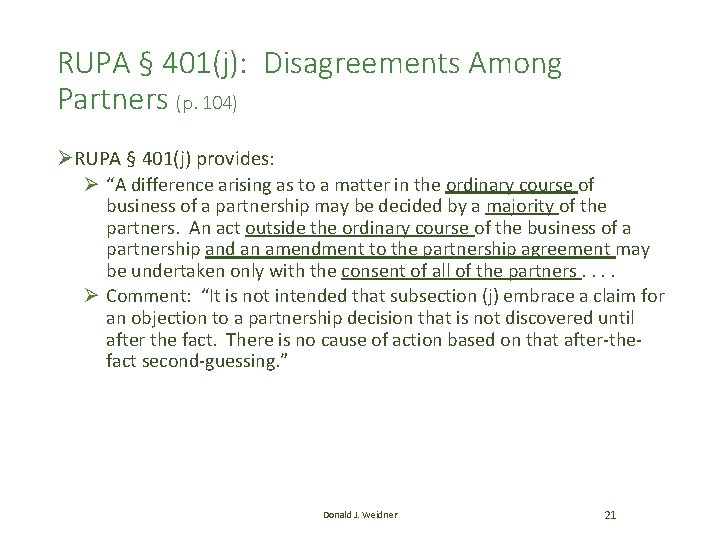
RUPA § 401(j): Disagreements Among Partners (p. 104) ØRUPA § 401(j) provides: Ø “A difference arising as to a matter in the ordinary course of business of a partnership may be decided by a majority of the partners. An act outside the ordinary course of the business of a partnership and an amendment to the partnership agreement may be undertaken only with the consent of all of the partners. . Ø Comment: “It is not intended that subsection (j) embrace a claim for an objection to a partnership decision that is not discovered until after the fact. There is no cause of action based on that after-thefact second-guessing. ” Donald J. Weidner 21
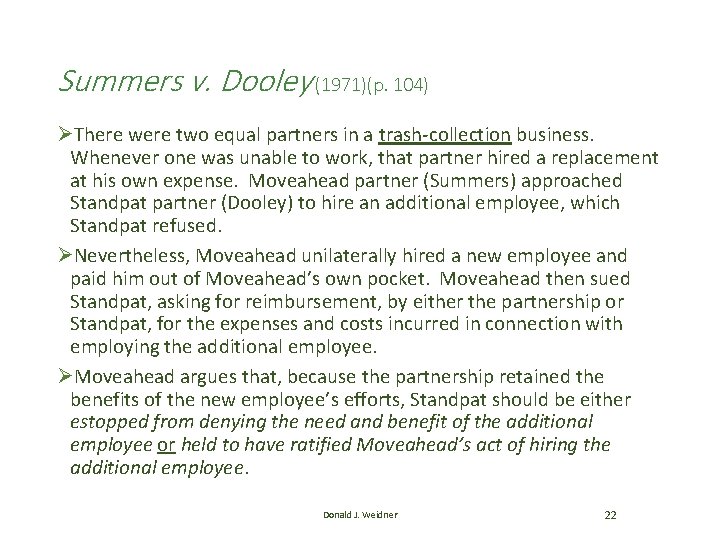
Summers v. Dooley (1971)(p. 104) ØThere were two equal partners in a trash-collection business. Whenever one was unable to work, that partner hired a replacement at his own expense. Moveahead partner (Summers) approached Standpat partner (Dooley) to hire an additional employee, which Standpat refused. ØNevertheless, Moveahead unilaterally hired a new employee and paid him out of Moveahead’s own pocket. Moveahead then sued Standpat, asking for reimbursement, by either the partnership or Standpat, for the expenses and costs incurred in connection with employing the additional employee. ØMoveahead argues that, because the partnership retained the benefits of the new employee’s efforts, Standpat should be either estopped from denying the need and benefit of the additional employee or held to have ratified Moveahead’s act of hiring the additional employee. Donald J. Weidner 22
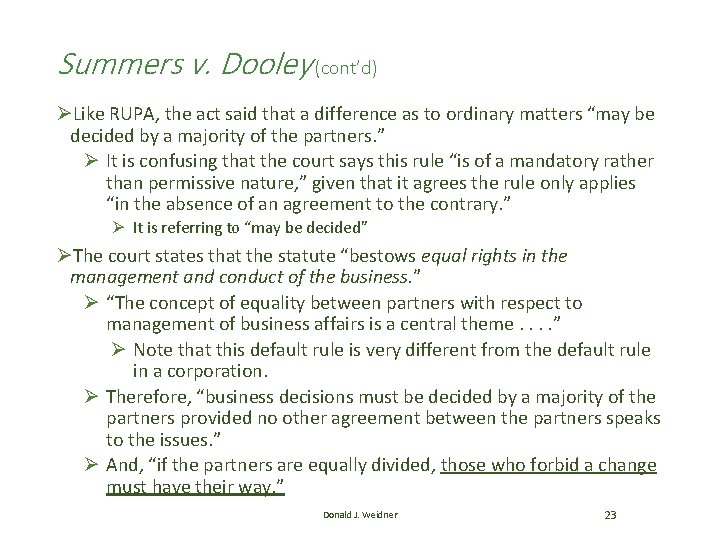
Summers v. Dooley (cont’d) ØLike RUPA, the act said that a difference as to ordinary matters “may be decided by a majority of the partners. ” Ø It is confusing that the court says this rule “is of a mandatory rather than permissive nature, ” given that it agrees the rule only applies “in the absence of an agreement to the contrary. ” Ø It is referring to “may be decided” ØThe court states that the statute “bestows equal rights in the management and conduct of the business. ” Ø “The concept of equality between partners with respect to management of business affairs is a central theme. . ” Ø Note that this default rule is very different from the default rule in a corporation. Ø Therefore, “business decisions must be decided by a majority of the partners provided no other agreement between the partners speaks to the issues. ” Ø And, “if the partners are equally divided, those who forbid a change must have their way. ” Donald J. Weidner 23
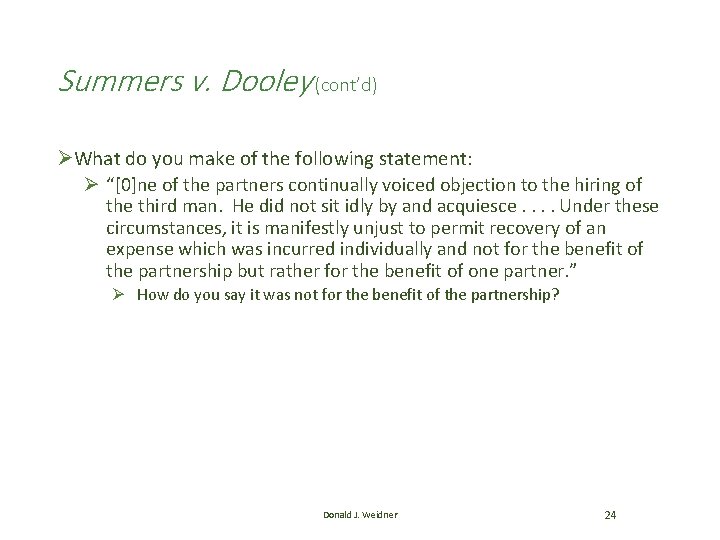
Summers v. Dooley (cont’d) ØWhat do you make of the following statement: Ø “[0]ne of the partners continually voiced objection to the hiring of the third man. He did not sit idly by and acquiesce. . Under these circumstances, it is manifestly unjust to permit recovery of an expense which was incurred individually and not for the benefit of the partnership but rather for the benefit of one partner. ” Ø How do you say it was not for the benefit of the partnership? Donald J. Weidner 24
National Biscuit Co. v. Stroud (1959) ØStroud and Freeman entered into a general partnership to sell groceries under the name “Stroud’s Food Center. ” Ø Nothing in the record indicates any limitation on the authority of Freeman as a general partner in respect to ordinary business matters. ØSeveral months before February, Stroud advised third party vendor plaintiff “that he personally would not be responsible for any additional bread sold by plaintiff to Stroud’s Food Center. ” ØNevertheless, after receiving this notice, in February, at the request of Freeman, plaintiff sold and delivered additional bread to Stroud’s Foods center. It now wants to be paid. ØLater that month, the partnership dissolved and Stroud agreed to liquidate the firm’s assets and satisfy its liabilities. Ø Is the liability to plaintiff a firm liability? Donald J. Weidner 25
National Biscuit Co. v. Stroud (cont’d) ØThe court also cited a predecessor rule to RUPA § 306(a): “all partners are liable jointly and severally for all obligations of the partnership unless otherwise agreed by the claimant or provided by law. ” Ø Did the partnership have an obligation to pay for bread deliveries made after Summers’ statement? ØThe court also cited a predecessor to RUPA § 401(f): “Each partner has equal rights in the management and conduct of the partnership business. ” ØFinally, the court cited the rule discussed in Summers v. Dooley (the trash collection case), which is the predecessor to RUPA § 401(j): Ø “A difference arising as to a matter in the ordinary course of business of a partnership may be decided by a majority of the partners. An act outside the ordinary course of business of a partnership. . . may be undertaken only with the consent of all of the partners. ” Donald J. Weidner 26
National Biscuit Co. v. Stroud (cont’d) ØThe conclusion: there was no restriction on Freeman’s authority, which was to carry on the partnership’s business in the usual way. To amend that agreement would require at least a majority vote, and Stroud was not a majority of the partners. ØHow do your reconcile Summers v. Dooley (trash collection) with National Biscuit v. Stroud (the bread sale case)? ØThe court cited Crane on Partnership: Ø “In cases of an even division of the partners as to whether or not an act within the scope of the business should be done, of which disagreement a third person has knowledge, it seems that logically no restriction can be placed upon the power to act. The partnership being a going concern, activities within the scope of the business should not be limited, save by the expressed will of the majority deciding a disputed question; half of the members are not a majority. ” Ø Is that the opposite of the holding in Summers v. Dooley, in which the court said that Moveahead (Summers) could not hire a new employee to work in the going concern? Donald J. Weidner 27
National Biscuit Co. v. Stroud (cont’d) ØHow do you apply the § 301 to this situation: “An act. . . for apparently carrying on in the ordinary course the partnership business. . . binds the partnership, unless the partner had no authority to act for the partnership in the particular matter and the person with whom the partner was dealing knew or had received a notification that the partner lacked authority. ” Ø What did the plaintiff know? ØHow would this case be handled on agency principles? Before the transaction, the person seeking to hold the partnership liable was told by a partner, whose name appeared on the store, that he would not be personally responsible. Stated differently, the lack of Freeman’s authority was communicated to the third party before the transaction. Donald J. Weidner 28
The Partnership’s Property (p. 108) ØUnder UPA § 24: “The property rights of a partner are (1) his rights in specific partnership property; (2) his interest in the partnership; and (3) his right to participate in management. ” ØWith regard to a partner’s right in specific partnership property, UPA § 25(1) provided: “A partner is co-owner with his partners of specific partnership property holding as a tenant in partnership. ” ØBy contrast, RUPA § 203 provides: “Property acquired by a partnership is property of the partnership and not of the partners individually. ” Ø This can now be said directly, given that RUPA § 201(a) provides: “A partnership is an entity distinct from its partners. ” ØMany cases involve a disagreement about whether a particular asset is partnership property. Donald J. Weidner 29
Partnership Property—RUPA § 204: When Property Is Partnership Property (cont’d) The first part of § 204 discusses when property is deemed to be partnership property. Ø“(a) Property is partnership property if acquired in the name of: 1. the partnership; or 2. one or more partners with an indication in the instrument transferring title to the property of the person’s capacity as a partner or of the existence of a partnership but without an indication of the name of the partnership. Ø “(b) Property is acquired in the name of the partnership by a transfer to: 1. 2. the partnership in its name; or one or more partners in their capacity as partners in the partnership, if the name of the partnership is indicated in the instrument transferring title to the property. The general rule, at least as among the partners, is that their intention controls whether property is partnership property or separate property. Donald J. Weidner 30
Partnership Property—RUPA § 204: When Property Is Partnership Property (cont’d) The second part of § 204 states presumptions about whether property is either partnership property or separate property. Ø“(c) Property is presumed to be partnership property if purchased with partnership assets, even if not acquired in the name of the partnership or of one or more partners with an indication in the instrument transferring title to the property of the person’s capacity as a partner or of the existence of a partnership. ” Ø“(d) Property acquired in the name of one or more of the partners, without an indication in the instrument transferring title to the property of the person’s capacity as a partner or of the existence of a partnership and without use of partnership funds, is presumed to be separate property, even if used for partnership purposes. ” ØOne caveat: “Under Section 302(b), partnership property held in the name of individual partners, without an indication of their capacity as partners or of the existence of a partnership, that is transferred by the partners in whose name title is held to a purchaser without knowledge that it is partnership property is free of any claim of the partnership. ” Donald J. Weidner 31
Partnership Accounts ØThe “guts” of a default partnership agreement are contained in RUPA § 401, which begins with a rudimentary system for keeping accounts: Ø“(a) Each partner is deemed to have an account that is: 1. credited with an amount equal to the money plus the value of any other property, net of the amount of any liabilities, the partner contributes to the partnership and the partner’s share of the partnership profits; and 2. charged with an amount equal to the money plus the value of any other property, net the amount of any liabilities, distributed by the partnership to the partner and the partner’s share of partnership losses. “(b) Each partner is entitled to an equal share of the partnership profits and is chargeable with a share of the partnership losses in proportion to the partner’s share of the profits. ” ØA negative capital account is deemed to reflect a debt to the partnership. Donald J. Weidner 32
Problem 1 (p. 111) ØC and D enter into a partnership to manufacturer and sell customgrown fur necklaces. They agree to split the work of the partnership equally. Each puts $50, 000 into the business. C will also contribute several computers he owns plus a small piece of manufacturing equipment, together worth $18, 000 in total. The parties agree that C will receive 60% of the profits and D will receive 40% of the profits. ØAfter the first year, the partnership has spent the full $100, 000 in cash and generated no receipts, largely because nobody wishes to buy custom-grown fur necklaces. What is the state of the parties’ partnership accounts after the first year? What property does the partnership own? Donald J. Weidner 33
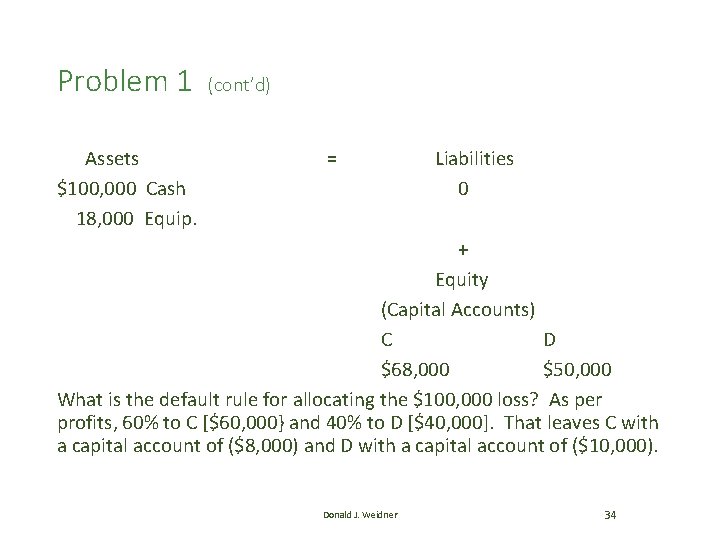
Problem 1 Assets $100, 000 Cash 18, 000 Equip. (cont’d) = Liabilities 0 + Equity (Capital Accounts) C D $68, 000 $50, 000 What is the default rule for allocating the $100, 000 loss? As per profits, 60% to C [$60, 000} and 40% to D [$40, 000]. That leaves C with a capital account of ($8, 000) and D with a capital account of ($10, 000). Donald J. Weidner 34
Problem 2 (p. 112) ØProperty and Service agree to form a partnership. Property contributes $18, 000 worth of equipment; Service contributes no property but agrees to work full time on partnership business. Three weeks later, the parties agree that it was a bad idea to go into business and that they should dissolve the partnership. What will the parties receive on dissolution? ØRUPA § 402: “A partner has no right to receive, and may not be required to accept, a distribution in kind. ” (default rule) ØRUPA § 401(h): “A partner is not entitled to remuneration for services performed for the partnership, except for reasonable compensation for services rendered in winding up the business of the partnership. ” (default rule) Ø What if the $18, 000 equipment is still worth $18, 000? Ø What if the $18, 000 piece of equipment is now worth only $9, 000? Ø We shall revisit this topic when we discuss Kovacik v. Reed Donald J. Weidner 35
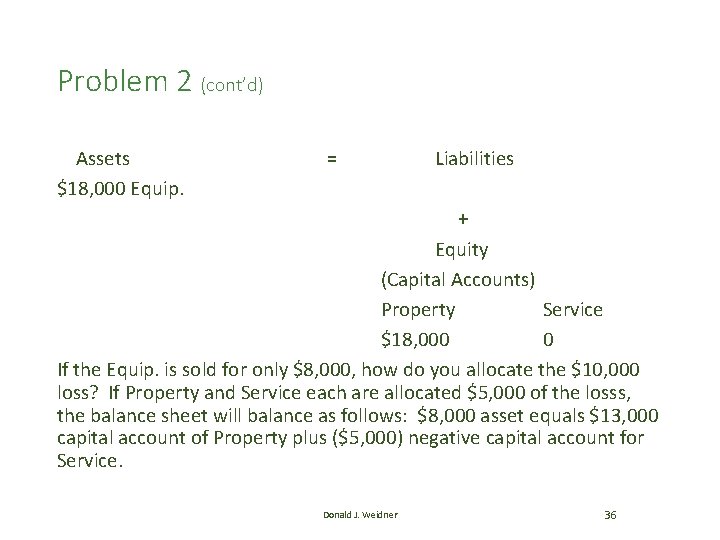
Problem 2 (cont’d) Assets $18, 000 Equip. = Liabilities + Equity (Capital Accounts) Property Service $18, 000 0 If the Equip. is sold for only $8, 000, how do you allocate the $10, 000 loss? If Property and Service each are allocated $5, 000 of the losss, the balance sheet will balance as follows: $8, 000 asset equals $13, 000 capital account of Property plus ($5, 000) negative capital account for Service. Donald J. Weidner 36
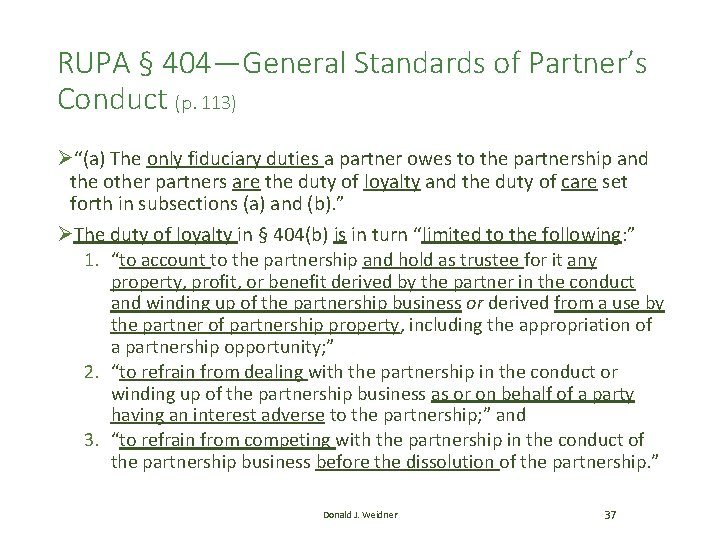
RUPA § 404—General Standards of Partner’s Conduct (p. 113) Ø“(a) The only fiduciary duties a partner owes to the partnership and the other partners are the duty of loyalty and the duty of care set forth in subsections (a) and (b). ” ØThe duty of loyalty in § 404(b) is in turn “limited to the following: ” 1. “to account to the partnership and hold as trustee for it any property, profit, or benefit derived by the partner in the conduct and winding up of the partnership business or derived from a use by the partner of partnership property, including the appropriation of a partnership opportunity; ” 2. “to refrain from dealing with the partnership in the conduct or winding up of the partnership business as or on behalf of a party having an interest adverse to the partnership; ” and 3. “to refrain from competing with the partnership in the conduct of the partnership business before the dissolution of the partnership. ” Donald J. Weidner 37
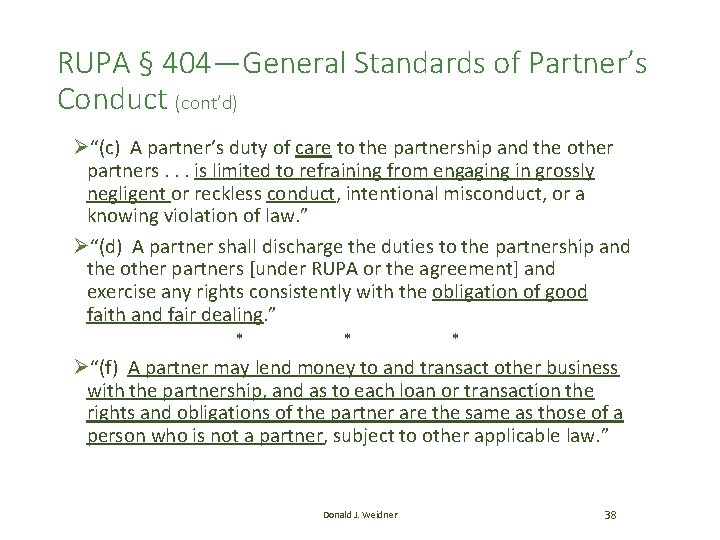
RUPA § 404—General Standards of Partner’s Conduct (cont’d) Ø“(c) A partner’s duty of care to the partnership and the other partners. . . is limited to refraining from engaging in grossly negligent or reckless conduct, intentional misconduct, or a knowing violation of law. ” Ø“(d) A partner shall discharge the duties to the partnership and the other partners [under RUPA or the agreement] and exercise any rights consistently with the obligation of good faith and fair dealing. ” * * * Ø“(f) A partner may lend money to and transact other business with the partnership, and as to each loan or transaction the rights and obligations of the partner are the same as those of a person who is not a partner, subject to other applicable law. ” Donald J. Weidner 38
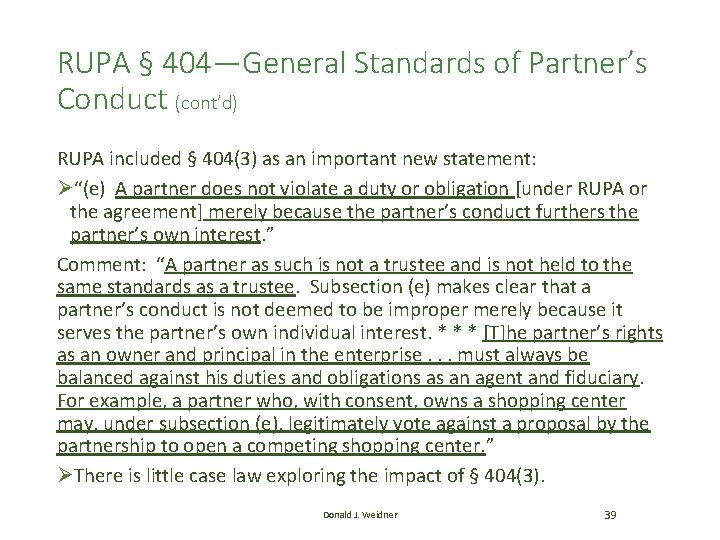
RUPA § 404—General Standards of Partner’s Conduct (cont’d) RUPA included § 404(3) as an important new statement: Ø“(e) A partner does not violate a duty or obligation [under RUPA or the agreement] merely because the partner’s conduct furthers the partner’s own interest. ” Comment: “A partner as such is not a trustee and is not held to the same standards as a trustee. Subsection (e) makes clear that a partner’s conduct is not deemed to be improper merely because it serves the partner’s own individual interest. * * * [T]he partner’s rights as an owner and principal in the enterprise. . . must always be balanced against his duties and obligations as an agent and fiduciary. For example, a partner who, with consent, owns a shopping center may, under subsection (e), legitimately vote against a proposal by the partnership to open a competing shopping center. ” ØThere is little case law exploring the impact of § 404(3). Donald J. Weidner 39
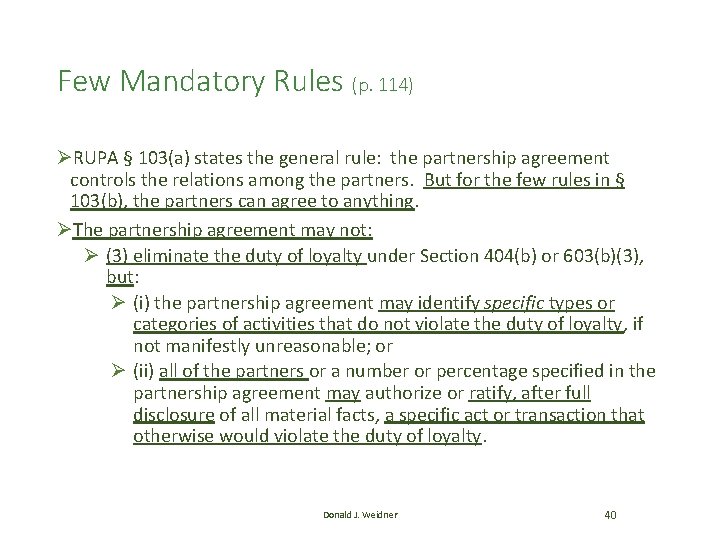
Few Mandatory Rules (p. 114) ØRUPA § 103(a) states the general rule: the partnership agreement controls the relations among the partners. But for the few rules in § 103(b), the partners can agree to anything. ØThe partnership agreement may not: Ø (3) eliminate the duty of loyalty under Section 404(b) or 603(b)(3), but: Ø (i) the partnership agreement may identify specific types or categories of activities that do not violate the duty of loyalty, if not manifestly unreasonable; or Ø (ii) all of the partners or a number or percentage specified in the partnership agreement may authorize or ratify, after full disclosure of all material facts, a specific act or transaction that otherwise would violate the duty of loyalty. Donald J. Weidner 40
Few Mandatory Rules (cont’d) ØThe partnership agreement may not (cont’d) Ø “(4) unreasonably restrict the duty of care. . . Ø “(5) eliminate the obligation of good faith and fair dealing under Section 404(d), but the partnership agreement may prescribe the standards by which the performance of the obligation is to be measured, if the standards are not manifestly unreasonable. . Donald J. Weidner 41
Meinhard v. Salmon (1928) (p. 115) ØLouisa Gerry leased the Hotel Bristol to defendant Salmon for a term of 20 years, to end on April 30, 1922. The lease committed Salmon to spend $200, 000 to convert the hotel building to use for shops and offices. The alterations and additions were to become a part of the land. ØWhile negotiating for the lease, real estate operator Salmon was also negotiating with wool merchant Meinhard for the necessary funds. They entered into a written agreement in which Meinhard was to pay Salmon half the money needed to reconstruct, manage and operate the property. Salmon was to pay Meinhard 40% of the profits for the first 5 years of the lease, and 50% for the years thereafter. Each party was to bear any losses equally. Salmon was to have sole power “to manage, lease, underlet and operate” the building. Ø“The two were coadventurers, subject to fiduciary duties “akin to partners. ” ØThey were extremely successful financially. Donald J. Weidner 42
Meinhard v. Salmon (cont’d) ØWhen the 20 year lease was almost over, Elbridge Gerry, then-owner of the reversion, also owned five additional contiguous lots. He wanted to lease the entire 6 -lot parcel to a developer to raze the existing buildings and put up another in their place. He approached several people to no avail. Finally, in January 1922, less than four months before the Hotel Bristol lease was to end, Gerry approached Salmon. ØThe result was a new lease, signed later that month, to Midpoint Realty, a corporation “owned and controlled by Salmon. ” It covered all 6 lots, involved a huge outlay, for a base term of 20 years but with renewal options to 80 years. By the end of 7 years, the existing buildings are to be razed, and a new building costing $3, 000 is to be constructed. Although the rental on the Bristol lease was only $55, 000, the new rental is to be from $350, 000 -$475, 000 for the combined properties. Salmon personally guaranteed the performance of the lease covenants until such time as the new building is completed and fully paid for. Donald J. Weidner 43
Meinhard v. Salmon (cont’d) ØMeinhard knew nothing of the new project until after the lease was signed. He then demanded that the lease “be held in trust as an asset of the venture, ” offering to share the personal obligations incidental to Salmon’s guarantee. ØThe courts below granted relief, but differed on the remedy. Ø Meinhard was originally given only a 25% interest in the lease, because that reflected one half of so much of the value of the lease as was represented by the Bristol site. Ø The intermediate appellate court awarded Meinhard a 50% interest in the entire lease. ØThe case is famous for Justice Cardozo’s extensive flowery language. ØSee the first full paragraph at 116. Ø“Joint adventurers, like copartners, owe to one another, while the enterprise continues, the duty of the finest loyalty. ” Ø“A trustee is held to something stricter than the standards of the market place. ” Donald J. Weidner 44
Meinhard v. Salmon (cont’d) ØSalmon very likely “assumed in all good faith that with the approaching end of the venture he might ignore his coventurer and take the extension for himself. ” Unlike Meinhard, he gave time, labor and money. Ø“The common standards of competitors” are not pertinent here. Ø “Salmon had put himself in a position in which thought of self was to be renounced, however hard the abnegation. ” Ø“Not honesty alone, but the punctilio of an honor the most sensitive, is then the standard of behavior. ” ØSalmon’s name was on the lease of the Hotel Bristol site (which was “the keystone” of the project), Meinhard’s was not. Court said the opportunity came to him because of that visible position. ØIn “secrecy and silence, ” Salmon appropriated this “pre-emptive opportunity, ” which was an incident of the enterprise. ØSalmon “might have warned Meinhard, ” so that they could both compete for the new lease. Donald J. Weidner 45
Meinhard v. Salmon (cont’d) ØIf Salmon had warned Meinhard, “we do not need to say whether he would have been under a duty, if successful in the competition, to hold the lease so acquired for the benefit of a venture then about to end, and thus prolong by indirection its responsibilities and duties. ” Ø“The trouble about his conduct is that he excluded his coadventurer from any chance to compete. ” Ø “This chance, if nothing more, he was under a duty to concede. ” Ø If we let Meinhard cut off Salmon 4 months before the lease ended, he could cut him off 4 years before it ended. ØCardozo admits that the new lease “with its many changes is not strictly a renewal. ” Ø“To say that a partner is free. . . to buy in the reversion. . . where the business is conducted is to say in effect that he may strip the good will of its chief element of value, since good will is largely dependent upon continuity of possession. ” Donald J. Weidner 46
Meinhard v. Salmon (cont’d) ØThere “may be no abuse of special opportunities growing out of a special trust as manager or agent. ” Ø “If conflicting inferences are possible as to abuse or opportunity, the trier of the facts must make the choice between them. ” Ø Note that the burden has shifted against the person classified as a fiduciary Ø“A constructive trust is then the remedial device through which preference of self is made subordinate to loyalty to others. ” ØEven if Salmon “assumed in all good faith” that he might take the new transaction for himself, he was a “managing coadventurer” for whom “the rule of undivided loyalty is relentless and extreme. ” ØWhat if Gerry had come to Salmon with an opportunity at a remote site? Ø He “might” have held that privilege for himself. Donald J. Weidner 47
Meinhard v. Salmon (cont’d) ØAs to the remedy, Cardozo says that, at Salmon’s option, he can give Meinhard 49% of the shares in Midpoint Realty, rather than a 50% interest in the lease. ØInterestingly, 5 years before the end of old lease/beginning of the new lease, Meinhard assigned to his wife all his “right, title and interest in and to” the agreement with Salmon did not object, and thereafter made his payments directly to Meinhard’s wife. Ø Wife apparently reconveyed to Meinhard for purposes of this suit. Ø“We do not need to determine what the effect of the assignment would have been in 1917 if either coadventurer had then chosen to treat the venture as dissolved. ” Ø Salmon was the sole manager and the only active duty on Meinhard’s side “was one wholly ministerial, the duty of contributing his share of the expense, ” which Meinhard was still bound to do after he assigned to his wife. Ø Neither viewed the enterprise as ended. ØIn general, on dissolution, partners are free to compete. Donald J. Weidner 48
Meinhard v. Salmon (cont’d) ØCardozo also says he does not need to decide the result if there had been a partnership “in the strict sense, ” with “active duties of agency laid on each of the two venturers. ” ØDISSENTING Judge Andrews says: The test is simply whether what Salmon did was unfair or inequitable. ØThis was not a general partnership but a joint venture, limited in time and scope. This massive new undertaking was far outside the scope of that joint venture, and was more like a purchase of the reversion. ØBut he’d call it an “offshoot of the old” if a general partnership were involved. ØWould the parties likely have bargained for the disclosure Cardozo required? Donald J. Weidner 49
Meinhard v. Salmon—Recalling Agency Principles ØRecall the “General Fiduciary Principle” of Agency: “to act loyally for the principal’s benefit in all matters connected with the agency relationship. ” ØThe first specific fiduciary duty: “not to acquire a material benefit from a third party. . . through the agent’s use of the agent’s position. ” ØThe second specific fiduciary duty: “not to deal with the principal as or on behalf of an adverse party in a transaction connected with the agency relationship. ” ØThe third specific fiduciary duty: “to refrain from competing” during the agency relationship. ØThe fourth specific fiduciary duty: “not to use property of the principal. ” ØO’Kelly and Thompson text: “An important aspect of fiduciary duty is its impact in litigants’ burden of proof. Under the normal rule, fiduciaries must carry the burden of proving by clear and convincing evidence that they have fulfilled their fiduciary obligations. ” Donald J. Weidner 50
Partnership Liable for Partner’s Actionable Conduct (p. 120) ØRUPA § 305(a): “A partnership is liable for loss or injury caused to a person, or for a penalty incurred, as a result of a wrongful act or omission, or other actionable conduct, of a partner acting in the ordinary course of business of the partnership or with authority of the partnership. . ” ØThis section is primarily aimed at making clear that the partnership is liable to third parties. ØThis section also permits partners to sue the partnership for loss or injury without the need to also seek a dissolution of the partnership or an accounting. Ø In effect, a partner may proceed as a third party. ØThis section imposes vicarious liability for “no-fault” torts. Donald J. Weidner 51
Moren v. Jax Rest. (2004) (p. 121) ØJax Restaurant was a partnership. One of the partners, Nicole, completed her day shift and picked up her two year old son. Later that afternoon, she returned to the restaurant after learning that her sister and partner, Amy, needed help. She brought the child to the restaurant and her husband said he would pick him up in 20 minutes. ØTo keep child from running around the restaurant, she brought him back into the kitchen, where his hand was crushed in a doughpressing machine. ØThe son, through his father, sued the partnership, but did not sue Nicole or any other partner individually. In addition, the partnership filed a third-party complaint against Nicole, arguing that, if it were liable, it was entitled to sue Nicole for indemnity or contribution on account of her negligence. ØThe District Court rejected the partnership’s argument that its obligation to compensate the child is diminished in proportion to Nicole’s predominating negligence as a mother, even though, as a business owner it is responsible for her conduct. Donald J. Weidner 52
Moren v. Jax Rest. (cont’d) ØThe district court granted summary judgment to Nicole on the partnership’s third-party complaint against her. It said that she had no obligation to indemnify the partnership so long as the injury occurred while she was engaged in the ordinary course of the partnership’s business. ØThe court mentioned some, but not all, of the relevant provisions of RUPA. ØIt quoted from § 305(a): “A partnership is liable for the loss or injury caused to a person. . . as a result of a wrongful act or omission, or other actionable conduct of, a partner acting in the ordinary course of business of the partnership or with authority of the partnership. ” ØIt also quoted from § 301(2): “An act of a partner which is not apparently for carrying on in the ordinary course the partnership business or business of the kind carried on by the partnership binds the partnership only if the act was authorized by the other partners. ” Donald J. Weidner 53
Moren v. Jax Rest. (cont’d) ØWas Nicole acting “in the ordinary course of business of the partnership? Ø because the court decided she was, it did not reach whether she was acting “with authority of the partnership” Ø The “ordinary course” inquiry is similar to the “scope of employment” inquiry we discussed in the agency context. Ø Recall, some said motive was the test, others said it was just a factor. Loss sharing, proper economic incentives and notions of the proper scope of enterprise liability were also factors. Ø Partnership argued that she was engaged in a personal mission, and not acting in the ordinary course when she brought her son into the kitchen. Ø How do you decide this issue? Ø Court said her act is within the “ordinary course” even if the “predominant motive of the partner was to benefit [herself] or third persons” Donald J. Weidner 54
Moren v. Jax Rest. (cont’d) ØThe court also discussed RUPA § 401(c): Ø “(c). A partnership shall reimburse a partner for payments made and indemnify a partner for liabilities incurred by the partner in the ordinary course of the business of the partnership or for the preservation of its business or property. ” ØThe court said that “under the plain language of the UPA, a partner has a right to indemnity from the partnership, but the partnership’s claim of indemnity from a partner is not authorized or required. ” ØThe court appears to be saying that indemnity is a one-way street. Ø That is, although there is a statutory provision for the partnership to indemnify a partner; by contrast Ø There is no reciprocal statutory provision that discusses a partner’s duty to indemnify the partnership. ØIt seems odd for the court to say the partnership “owes indemnity to her for her negligence. ” Ø Which seems to be its way of saying that the partnership loses in its lawsuit to recover from her indemnity or contribution for the damages it had to pay because of her negligence. Donald J. Weidner 55
Moren v. Jax Rest. (cont’d) ØDoes it seem like the right result as a matter of statutory construction that a partnership has no right to claim indemnity or contribution from a partner whose misconduct has caused a loss to the partnership? ØSurprisingly, the court did not discuss RUPA § 404(c): Ø “(c) A partner’s duty of care to the partnership and the other partners in the conduct and winding up of the partnership business is limited to refraining from engaging in grossly negligent or reckless conduct, intentional misconduct, or knowing violation of law. ” Ø This clearly states that a partnership has a right to recover from a partner for her gross negligence, even if the recovery is not described as an “indemnification” or “contribution. ” ØEven prior to RUPA, see the Orosco case at p. 123: A “joint venture sued for the negligence of one venturer is entitled to indemnity from the negligent venturer. ” [Indemnity that RUPA limits to situations involving gross negligence] ØWhat is the agency rule—what if Nicole had been an employee whose negligence caused loss to her employer? Donald J. Weidner 56
RUPA § 305(b) ØRUPA § 305(b) contains a special rule of partnership liability in the event money or property was transferred to a partner or the partnership: Ø “(b). If, in the course of the partnership’s business or while acting with authority of the partnership, a partner receives or causes the partnership to receive money or property of a person not a partner, and the money or property is misapplied by a partner, the partnership is liable for the loss. ” Ø Statutes require careful reading for words they do not include. Unlike the general rule of § 305(a), the word “ordinary” does not appear before the word “course. ” Donald J. Weidner 57
Partner’s Liability for Partnership Obligations (p. 123) ØWe have just been discussing the rules that indicate when a partnership as an entity will be liable because of the conduct or inaction of a partner. ØWe are now turning to the rules that look at when and how the partners are liable for the obligations of the partnership. ØIn the simple case, the partnership pays its bills and satisfies its other obligations. ØIf a general partnership is insolvent, however, the partners themselves bear the risk of insolvency, not third party creditors. Ø The general partnership is the only business form in which all the owners and operators are responsible for the obligations of the organization. Donald J. Weidner 58
Partner’s Liability for Partnership Obligations (cont’d) ØUnder the UPA, the individual partners were “jointly and severally” liable for partnership torts. Ø If any partner committed a tort in the course of partnership business, the partnership was liable and recovery could be had directly against any partner. ØBy contrast, partners were only “jointly” liable for the partnership’s contract and other obligations. Ø For contract claims against the partnership, third parties would ordinarily need to sue all the partners individually and then could recover against all of them individually. Ø Though procedurally more complicated, the result was very similar to joint and several liability; any solvent partners could be fully responsible for the obligations of the partnership. Ø Other statutes often assisted the partnership creditors. Donald J. Weidner 59
Partner’s Liability for Partnership Obligations (cont’d) ØRUPA simplifies partner liability, declaring that the partners are “jointly and severally liable” for partnership obligations. ØRUPA § 306(a) provides: Ø “(a) Except as otherwise provided in [subsections (b) and (c)], all partners are liable jointly and severally for all obligations of the partnership unless otherwise agreed by the claimant or provided by law. ” Ø “(b) A person admitted as a partner into an existing partnership is not personally liable for any partnership obligation incurred before the person’s admission as a partner. ” Ø “(c)” [Contains the limited liability partnership rule we shall discuss more later. In short, only the entity is liable for partnership obligations]. ØHowever, RUPA § 307 adds additional rules to make partnership creditors pursue partnership assets before pursuing the separate assets of individual partners. ØThe concept is similar to a concept that many states have in their mortgage law. Donald J. Weidner 60
Partner’s Liability for Partnership Obligations (cont’d) ØIn some states, when a borrower who has signed a note and mortgage defaults on her obligation to repay, the lender can elect to sue either directly on the note or on the mortgage. ØIn other states, the lender must first pursue the mortgaged property, or at least contemporaneously pursue it, rather than independently sue the borrower directly on the note. Ø The idea is that the understanding implicit in the transaction is that the mortgaged property would be the “primary fund” for repayment. ØThe RUPA idea is similar although perhaps imperfectly executed. The implicit understanding is the partnership assets are the primary fund for repayment. Therefore, the creditor must pursue them before pursuing an individual partner’s separate assets. ØRUPA § 307(a) provides: “An action may be brought against the partnership and, to the extent not inconsistent with [the preadmission loss rule and the limited liability partnership rule], any or all of the partners in the same action or in separate actions. ” Donald J. Weidner 61
Partner’s Liability for Partnership Obligations (cont’d) ØRUPA § 307(c): “A judgment against a partnership is not by itself a judgment against a partner. A judgment against a partnership may not be satisfied from a partner’s assets unless there is also a judgment against the partner. ” ØWhat if a partner was joined in the suit and there is a judgment against the partner? RUPA § 307(d) by its terms only clicks in AFTER the partnership creditor has obtained a judgment against the partner: “A judgment creditor of a partner may not levy execution against the assets of the partner to satisfy a judgment based on a claim against the partnership unless the partner is personally liable for the claim under Section 306 and [one of 5 listed conditions is present]. Ø In each of these 5 situations, it is appropriate to go directly after the partner’s separate assets either because the partnership assets have already been pursued with no or limited success, the partnership is bankrupt, the partners have agreed to be pursued directly or the law so provides, partnership assets “are clearly insufficient”, exhaustion is not feasible, or a court concludes it is equitable. Donald J. Weidner 62
Gildon v. Simon Prop. Group, Inc. (2006) (p. 124) ØGildon addresses the “pursue partnership assets first” rule: Ø “Applying well-settled rules of statutory construction and common sense, and considering the RUPA as a whole, a better reading of [§ 307(d)] is that when a plaintiff sues the partnership, he or she cannot enforce the judgment against a partner who is not [? ] personally liable without first exhausting partnership assets. But a plaintiff need not sue the partnership as a precondition for proceeding against a partner. This is so because nothing in the statute requires the plaintiff to sue the partnership in addition to an individual partner. . ” Ø “[§ 307(d) simply] restricts a plaintiff’s post-judgment execution remedies. ” ØGildon is cited for the proposition that a partner may be sued for the partner’s own wrongdoing (rather than on the basis of liability for a partnership obligation), with execution levy, without pursuing the partnership or its assets. Donald J. Weidner 63
Gildon v. Simon Prop. Group, Inc. (cont’d) ØSee Hillman, Weidner and Donn, authors’ comment 4(b) to § 307(d): “By its terms, Section 307(d) limits only post-judgment relief. On the other hand, the Official Comment states that “the law of prejudgment remedies already adequately embodies the principle that partnership assets should be exhausted before partners’ assets are attached or garnished. More fundamentally, despite the broad declaration of the joint and several liability of partner, Section 307(d) treats partners as analogous to guarantors. Ø“RUPA’s elevation of the entity for purposes of suit is not quite complete. RUPA does not say that a partner may defend an action on the ground that no judgment has been had against the partnership. Section 307(d) states only that a partner may resist execution levy on the ground that no judgment based on the same claim has been had against the partnership. ” Donald J. Weidner 64
The Partner’s Transferable Interest (p. 125) ØA partner may not transfer all of his, her or its interest in the partnership. In particular, a partner may not transfer either right to manage or control the business or her right to have access to information or books or records. ØThe reason is that the other partners cannot be forced to accept an unwanted partner. The relationship is so consequential the law will not force partners to accept new members. The basic and historic rule of delectus personarum, or “right to choose the person, ” is reflected in RUPA § 401(i): Ø “A person may become a partner only with the consent of all of the partners. ” ØThis basic policy judgment is confirmed and enlarged upon in RUPA §§ 502 and 503. ا 502: “The only transferable interest of a partner in the partnership is the partner’s share of the profits and losses of the partnership and the partner’s right to receive distributions. The interest is personal property. ” Donald J. Weidner 65
Transfer of a Partner’s Transferable Interest (p. 126) ØA transferee is not entitled to participate in management or even in the conduct of the partnership business, nor entitled to access to information about partnership transactions or the partnership books and records. RUPA § 503(a)(3). ØRUPA § 503(b) provides that a transferee is entitled: 1. to receive, in accordance with the transfer, distributions to which the transferor would otherwise be entitled; 2. to receive upon the dissolution and winding up of the partnership business, in accordance with the transfer, the net amount otherwise distributable to the transferor; and 3. to seek under section 801(6) a judicial determination that it is equitable to wind up the partnership business. Ø RUPA § 503(f): “A transfer of a partner’s transferable interest. . . in violation of a restriction on transfer contained in the partnership agreement is ineffective as to a person having notice of the restriction at the time of transfer. ” Donald J. Weidner 66
Bauer v. Bloomfield Company/Holden Joint Venture (1993) ØThe Holdens were two of six partners in a partnership. They took out an unrelated loan of $800, 000 from Bauer and secured it with an assignment to Bauer of “all of their right, title and interest” in the partnership. The other four partners consented to the assignment. ØThe Holdens defaulted on their loan and Bauer gave notice to the partnership that he was exercising his right to receive all distributions to which the Holdens would have been entitled. For a while, the partnership made monthly payments to Bauer. ØIn January, 1989, the partners stopped making payments. They unanimously decided, instead, to pay an $877, 000 “commission” to one of the other partners in the amount of 5% of the increased gross rental income on lease extensions that partner obtained from the state. That payment wiped out the profits that would have gone to Bauer, $207, 567. Donald J. Weidner 67
Bauer v. Bloomfield Company/Holden Joint Venture (cont’d) ØBauer sued the partnership and all the partners but the Holdens. ØMajority agreed with the court below that the assignment did not make assignee Bauer a partner. Ø The court rejected his argument that the assignment made him a “de facto” partner. Ø“Therefore, he was not entitled to complain about a decision made with the consent of all the partners. ” Ø Even a change in policy that ended distributions. ØAs an assignee, Bauer was not entitled “to interfere in the management or administration of the partnership business or affairs, or to require any information or account of partnership transactions or inspect the partnership books. ” ØBecause all the partners agree that the commission should be paid, there were no profits left to distribute. Donald J. Weidner 68
Bauer v. Bloomfield Company/Holden Joint Venture (cont’d) Ø“We are unwilling to hold that partners owe a duty of good faith and fair dealing to assignees. To do so would undermine the clear intent of the [partnership act]. ” Ø“Partners should be able to manage their partnership without regard for the concerns of an assignee, who may have little interest in the partnership venture. ” Ø The interests of assignees, assignors, and nonassigning partners are balanced “in a way that is suited to the very closely held business. Although the assignee’s impotence obviously limits the market value of the partners’ interest, the partners need to be protected from interference by unwanted strangers. ” [citing Bromberg & Ribstein] ØDISSENT says the crucial question is whether the decision to pay the commission was made in good faith. Without asking that question, the majority leaves the assignee with no remedy. Donald J. Weidner 69
Bauer v. Bloomfield Company/Holden Joint Venture (cont’d) ØThe DISSENT continues: Ø “Requiring the partners to make decisions regarding distributions in good faith does not interfere with management, it merely requires that the partners fulfill their existing contractual duties in good faith. ” ØThe statute was not designed to allow the withholding of distributions “for whatever outrageous motive or reason. The court’s opinion essentially leaves the assignee of a partnership interest without remedy to enforce his right. ” ØWhen the limited partnership was formed, a contractual relationship arose among the partners. This court has held that a covenant of good faith and fair dealing is implied in all contracts. The basis for imposing this covenant “is a hybrid of social policy and an effort to further the expectations of the contracting parties that the promises will be executed in good faith. ” Donald J. Weidner 70
Bauer v. Bloomfield Company/Holden Joint Venture (cont’d) ØOne element of the contract is the Holdens’ right to receive their share of profits when a distribution is made. As an element of the partnership contract, this right is accompanied by the duty [obligation] of the parties to deal fairly and in good faith. Ø“The partnership has a right to decide not to make a distribution, but in making this decision, the partnership must act in good faith. ” ØUnder the law of assignments, Bauer steps into the shoes of the Holdens. Accompanying their contractual right to distributions is the partnership’s obligation to make decisions concerning distributions in good faith. ØGood faith involves a question of fact. “If there is a dispute as to why someone did what he did, there is a question of fact for the jury. ” The burden is on the assignees to establish that a genuine issue of fact existed as to whether the 5% commission was paid “in good faith. ” Donald J. Weidner 71
Bauer v. Bloomfield Company/Holden Joint Venture (cont’d) ØWas this a disguised distribution of profits rather than a “commission” of the sort that would have been paid to a third party? ØWas the majority or the dissent correct about statutory intent? ØNote: UPA § 32(b) provided that a court shall decree dissolution, on the application of the purchaser of a partner’s interest: “At any time if the partnership was a partnership at will when the interest was assigned or when the charging order was issued. ” ØRUPA § 801(6) provides relief for a transferee that is not automatic: Ø “A partnership is dissolved, and its business must be wound up, only upon the occurrence of any of the following events: * * * “(6) on application by a transferee of a partner’s transferable interest, a judicial determination that it is equitable to wind up the partnership business: * * * (ii) at any time, if the partnership was a partnership at will at the time of the transfer or entry of the charging order that gave rise to the transfer. ” Donald J. Weidner 72
Bauer v. Bloomfield Company/Holden Joint Venture (cont’d) ØFinally, as to the interpretation of legislative intent, see comment b to § 112 of Re-ULLCA (2006) (p. 130): Ø “If the law categorically favors the owners, there is a serious risk of expropriation and other abuse. On the other hand, if the law grants former owners and other transferees the right to seek judicial protection, that specter can ‘freeze the deal’ as of the moment an owner leaves the enterprise or a third party obtains an economic interest * * * Ø “The Bauer majority is consistent with the limited but long-standing case law in this area (all of it pertaining to partnerships rather than LLCs). This subsection follows the Bauer majority and other cases by expressly subjecting transferees and dissociated members to operating agreement amendments made after the transfer or dissociation. Ø “The issue of whether, in extreme and sufficiently harsh circumstances, transferees might be able to claim some type of duty or obligation to protect against expropriation is a question for other law. ” Donald J. Weidner 73
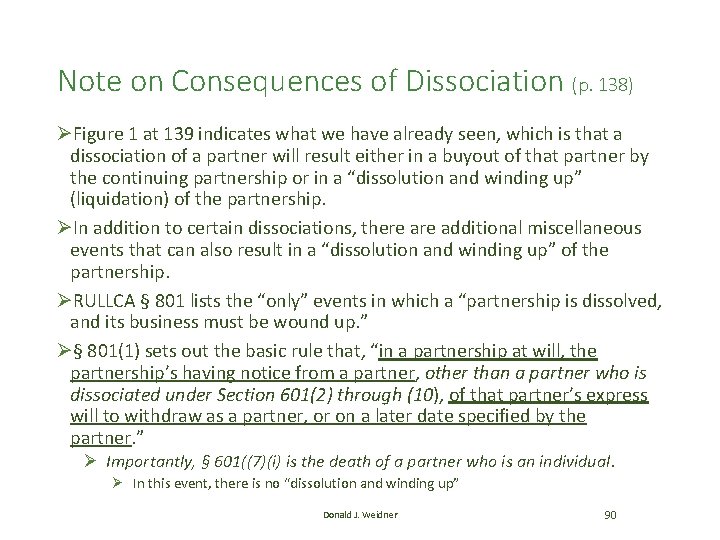
The Dissociation of a Partner (p. 131) ØAs mentioned during our entity/aggregate discussion, there is no longer a “dissolution” every time a partner “ceases to be associated” in the carrying on, as opposed to the winding up, of the business. ØUnder RUPA, the “cessation of association” in the carrying on of the business is called a “dissociation. ” ØA dissociation MAY trigger a “dissolution and winding up” (liquidation) of the partnership. Or, it may trigger a right to be bought out. ØA dissociation WILL cause a “dissolution and winding up if it is one of the dissociations listed in § 801, which lists “Events Causing Dissolution and Winding Up of Partnership Business. ” ØIf a dissociation is NOT caused by an event listed in § 801, the continuing partnership must buy out the dissociating partner pursuant to § 701(a): “If a partner is dissociated from a partnership without resulting in a dissolution and winding up of the partnership business under Section 801, the partnership shall cause the dissociated partner’s interest in the partnership to be purchased for a buyout price determined pursuant to subsection (b)). ” Donald J. Weidner 74
The Dissociation of a Partner (cont’d) ØRUPA § 601 provides: “A partner is dissociated from a partnership upon the occurrence of any of the following events” and lists 10 different ways in which one can cease to be associated in the carrying on of the partnership business. ØThe first is certainly one of the most common: 1. “The partnership’s having notice of the partner’s express will to withdraw as a partner or on a later date specified by a partner. ” This rule reflects that a partner has the power, if not the right, to withdraw from the partnership at any time, by giving notice. ØAssume that Don, Christina and Laurence are in a partnership to buy, sell and lease real estate and have no agreement to continue for a set period of time or through a particular transaction. Ø If Christina sends a notice that she withdraws as a partner immediately, she is dissociated. Does that dissociation cause a dissolution? Donald J. Weidner 75
The Dissociation of a Partner (cont’d) ØRUPA § 801 provides: “A partnership is dissolved, and its business must be wound up, only upon the occurrence of any of the following events: “(1) in a partnership at will, the partnership’s having notice from a partner, other than a partner who is dissociated under Section 601(2) through (10) [an event agreed to cause a dissociation, a partner’s expulsion pursuant to the partnership agreement, the unanimous vote of the other partners permitted in certain situations, a judicial expulsion permitted in certain situations, certain negative credit events concerning the partner, the partner’s death, etc. ] of that partner’s express will to withdraw as a partner, or on a later date specified by the partner. ” ØOn the other hand, if we had agreed to remain partners for five years, the partnership is considered for “a definite term or particular undertaking. ” ØOnly the very unusual events listed in § 801(2) will cause a dissolution of a term partnership, and none applies here. ØTherefore, the partnership continues without Christina but must buy out her interest. Donald J. Weidner 76
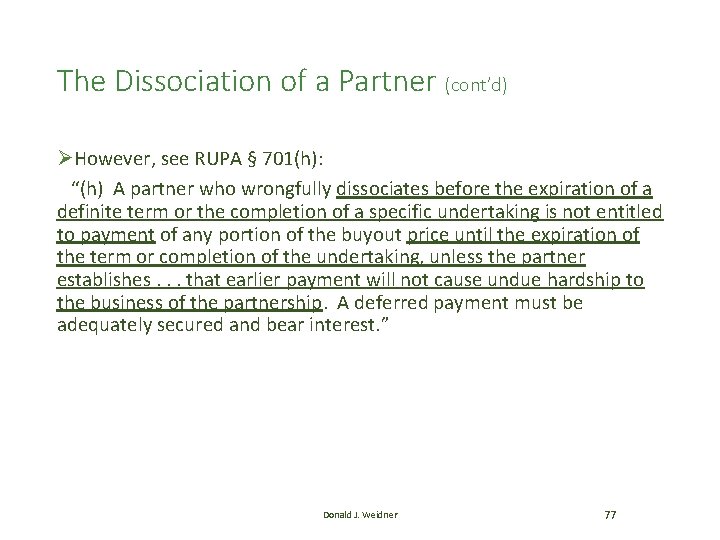
The Dissociation of a Partner (cont’d) ØHowever, see RUPA § 701(h): “(h) A partner who wrongfully dissociates before the expiration of a definite term or the completion of a specific undertaking is not entitled to payment of any portion of the buyout price until the expiration of the term or completion of the undertaking, unless the partner establishes. . . that earlier payment will not cause undue hardship to the business of the partnership. A deferred payment must be adequately secured and bear interest. ” Donald J. Weidner 77
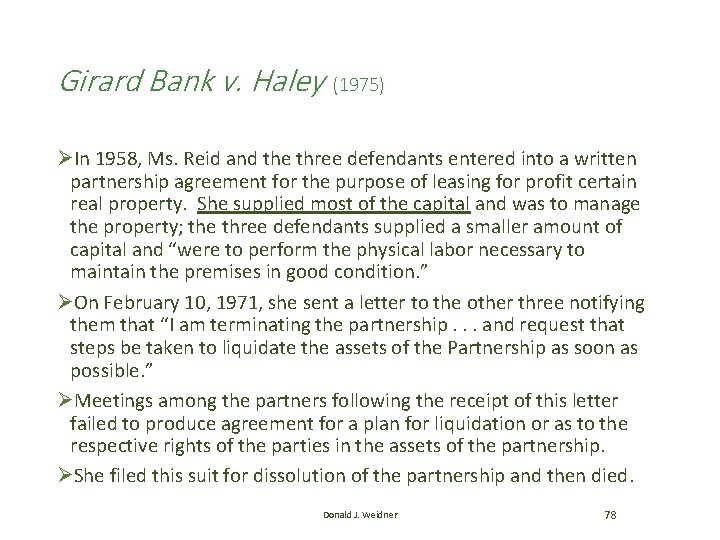
Girard Bank v. Haley (1975) ØIn 1958, Ms. Reid and the three defendants entered into a written partnership agreement for the purpose of leasing for profit certain real property. She supplied most of the capital and was to manage the property; the three defendants supplied a smaller amount of capital and “were to perform the physical labor necessary to maintain the premises in good condition. ” ØOn February 10, 1971, she sent a letter to the other three notifying them that “I am terminating the partnership. . . and request that steps be taken to liquidate the assets of the Partnership as soon as possible. ” ØMeetings among the partners following the receipt of this letter failed to produce agreement for a plan for liquidation or as to the respective rights of the parties in the assets of the partnership. ØShe filed this suit for dissolution of the partnership and then died. Donald J. Weidner 78
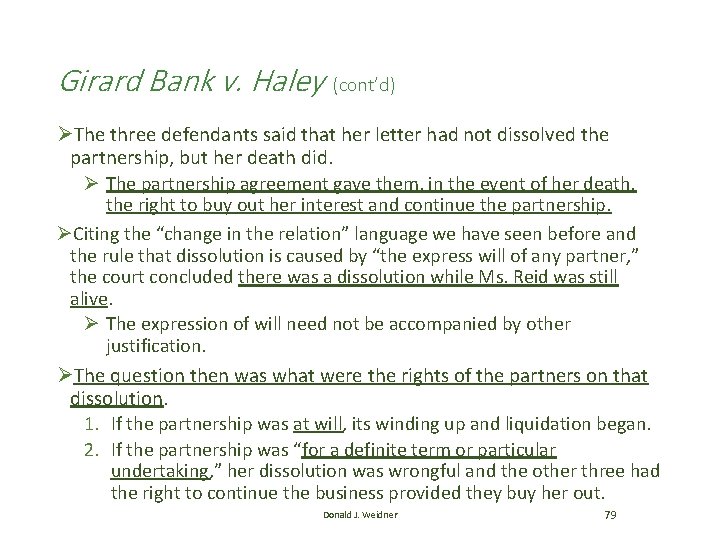
Girard Bank v. Haley (cont’d) ØThe three defendants said that her letter had not dissolved the partnership, but her death did. Ø The partnership agreement gave them, in the event of her death, the right to buy out her interest and continue the partnership. ØCiting the “change in the relation” language we have seen before and the rule that dissolution is caused by “the express will of any partner, ” the court concluded there was a dissolution while Ms. Reid was still alive. Ø The expression of will need not be accompanied by other justification. ØThe question then was what were the rights of the partners on that dissolution. 1. If the partnership was at will, its winding up and liquidation began. 2. If the partnership was “for a definite term or particular undertaking, ” her dissolution was wrongful and the other three had the right to continue the business provided they buy her out. Donald J. Weidner 79
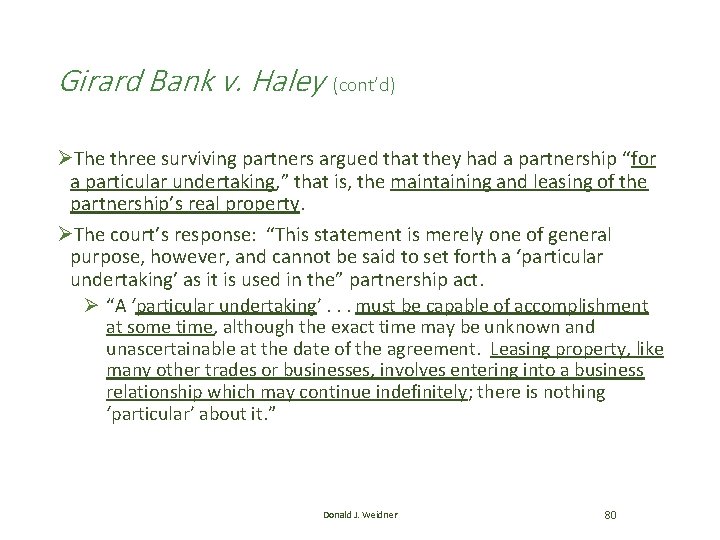
Girard Bank v. Haley (cont’d) ØThe three surviving partners argued that they had a partnership “for a particular undertaking, ” that is, the maintaining and leasing of the partnership’s real property. ØThe court’s response: “This statement is merely one of general purpose, however, and cannot be said to set forth a ‘particular undertaking’ as it is used in the” partnership act. Ø “A ‘particular undertaking’. . . must be capable of accomplishment at some time, although the exact time may be unknown and unascertainable at the date of the agreement. Leasing property, like many other trades or businesses, involves entering into a business relationship which may continue indefinitely; there is nothing ‘particular’ about it. ” Donald J. Weidner 80
Page v. Page (1961) (p. 135) ØPlaintiff and defendant, brothers, had been partners in a number of partnerships. The partnership in question is an oral partnership formed in 1949 in a linen supply business. Each partner contributed approximately $43, 000 for the purchase of land, machinery and linens. For the first eight years, the business was unprofitable, losing approximately $62, 000. ØThe partnership’s major creditor is a corporation, wholly-owned by plaintiff (who is the managing partner), that supplies the linen and machinery necessary for the day-to-day operation of the business. The corporation holds a $47, 000 demand note of the partnership. ØStarting in 1958, the partnership operations began to improve and the partnership started earning money. Despite the improvement, the plaintiff managing partner wishes to terminate the partnership. Donald J. Weidner 81
Page v. Page (cont’d) ØAs we have seen under RUPA, any partner has the power to dissociate by express will by giving notice to the partnership. However, that partner’s rights are dramatically different depending upon whether the partnership is a term partnership or an at-will partnership. ØThe trial court in Page said the linen supply partnership was a term partnership rather than an at will partnership. Ø The term was “such reasonable time as is necessary to enable said partnership to repay from partnership profits, indebtedness incurred for the purchase of land, buildings and delivery equipment and linen for the operation of such business. ” Ø The plaintiff and defendant had one former partnership with an agreement providing in writing that profits were to be retained until all obligations were repaid. Ø But that was a limited partnership for a 5 -year term and at-will thereafter. Donald J. Weidner 82
Page v. Page (cont’d) ØDefendant insisted that prior practice between them reflected an understanding that “all obligations were to be repaid from profits. ” Ø But conceding that “there was no understanding as to the term of the present partnership in the event of losses. ” Ø Nor was there an understanding of payment in the event of losses. ØThis is as common in commercial divorce as it is in marital divorce: the participants don’t plan in advance for the dissolution of their relationship. ØCourt: evidence viewed most favorably to defendant “proves only that the partners expected to meet current expenses from current income and to recoup their investment if the business were successful. ” ØCourt acknowledged earlier cases that holding “that partners may impliedly agree to continue in business until a certain sum of money is earned, or one or more partners recoup their investment, or until certain debts are paid, or under certain property could be disposed of on favorable terms. ” Donald J. Weidner 83
Page v. Page (cont’d) ØHowever, defendant here failed to provide any facts from which a continuation agreement my be implied: Ø “The understanding. . . was no more than a common hope that the partnership earnings would pay for all the necessary expenses. Such a hope does not establish even by implication a ‘definite term or particular undertaking’ as required by [RUPA § 801(2) (p. 139)]. All partnerships are ordinarily entered into with the hope that they will be profitable, but that alone does not make them all partnerships for a term and obligate the partners to continue in the partnerships until all of the losses over a period of many years have been recovered. ” ØSo, having established that the partnership is at will, such that the plaintiff has not just the power to dissolve but also the right to dissolve, what is the further issue? Donald J. Weidner 84
Page v. Page (cont’d) ØDefendant claims that plaintiff is acting in bad faith and is “attempting to use his superior financial position to appropriate the now profitable business of the partnership. ” Ø Vandenberg Air Force Base has been established nearby and needs lots of linens. Ø“Defendant has invested $43, 000 in the firm, and owing to the long period of losses his interest in the partnership assets is very small. The fact that plaintiff’s wholly-owned corporation holds a $47, 000 demand note of the partnership may make it difficult to sell the business as a going concern. Defendant fears that upon dissolution he will receive very little and that plaintiff, who is the managing partner and knows how to conduct the operations of the partnership, will receive a business that has become very profitable because of the establishment of Vandenberg Air Force base in its vicinity. ” ØOpinion is on request for declaratory judgment with no showing of bad faith yet. Court said defendant “is amply protected by the fiduciary duties of partners. ” Donald J. Weidner 85
Page v. Page (cont’d) Ø“Even though. . . a partnership at will may be dissolved by the express will of any partner, this power, like any other power held by a fiduciary, must be exercised in good faith. ” ØA partner is a trustee for the other partners and must act “in the highest good faith to his copartner and may not obtain any advantage over him in the partnership affairs by the slightest misrepresentation, concealment, threat or adverse pressure of any kind. ” Ø“A partner at will is not bound to remain in a partnership, regardless of whether the business is profitable or unprofitable. A partner may not, however, by use of adverse pressure ‘freeze out’ a copartner and appropriate the business to his own use. A partner may not dissolve a partnership to gain the benefits of the business for himself, unless he fully compensates his copartner for his share of the prospective business opportunity. In this regard, his fiduciary duties are at least as great as those of a shareholder of a corporation. ” (emphasis added) Donald J. Weidner 86
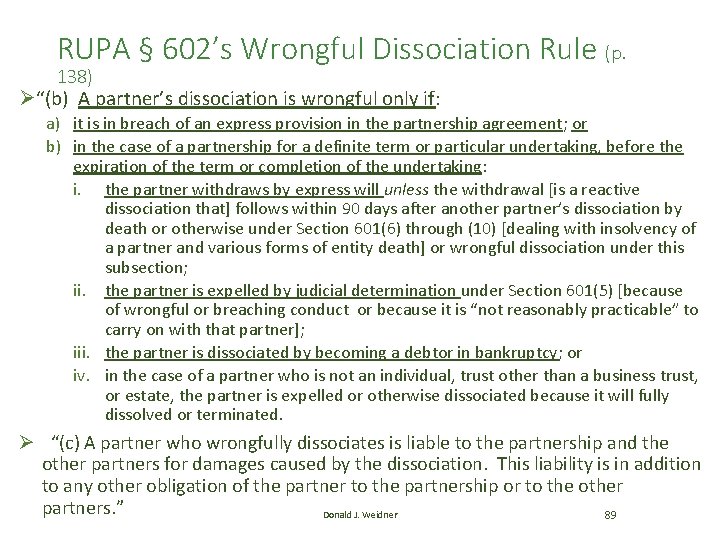
Page v. Page (cont’d) ØPrevious case held that although shareholders representing 50 per cent of the voting power have a [statutory] right to dissolve a corporation, they may not exercise that right in order “to defraud the other shareholders, to ‘freeze out’ the minority shareholders, or to sell the assets of the dissolved corporation at an inadequate price. ” Ø“Likewise, in the instant case, plaintiff has the power to dissolve the partnership by express notice to defendant. If, however, it is proved that plaintiff acted in bad faith and violated his fiduciary duties by attempting to appropriate to his own use the new prosperity of the partnership without adequate compensation to his copartner, the dissolution would be wrongful and the plaintiff would be liable. . . for violation of the implied agreement not to exclude defendant wrongfully from the partnership business opportunity. ” ØRUPA § 602 also provides that, although a partner has the power to dissociate at any time, a partner who does so wrongfully may be liable for resulting damages. Donald J. Weidner 87
Page v. Page: An Analogous LLC Case ØIn Yu v. Guard Hill Estates, LLC, No. 656510/2016, 2018 BL 36614 (S. Ct. Sept. 28, 2018), plaintiff and two siblings were the sole members of an LLC that was a holding company. Each was named as a managing member of the LLC, which held the remainder interest in the Yu family property. The parents and the other two siblings wanted plaintiff out, but he refused their offer, saying it was no where near fair value. The other two siblings amended the operating agreement, removing plaintiff as a manager and demanding a capital call of all members. They knew that plaintiff would not be able to afford it. The amended OA provided that, if a call was not honored, the breaching member’s interest would be foreclosed. Held: the litigation must go forward. “Where one has a right under a contract, that right may not be exercised solely for personal gain in such as way as to deprive the other party of the fruits of the contract. A fiduciary may breach his duties by exercising his rights in an unfair or inequitable manner. ” (citations omitted) Donald J. Weidner 88
RUPA § 602’s Wrongful Dissociation Rule (p. 138) Ø“(b) A partner’s dissociation is wrongful only if: a) it is in breach of an express provision in the partnership agreement; or b) in the case of a partnership for a definite term or particular undertaking, before the expiration of the term or completion of the undertaking: i. the partner withdraws by express will unless the withdrawal [is a reactive dissociation that] follows within 90 days after another partner’s dissociation by death or otherwise under Section 601(6) through (10) [dealing with insolvency of a partner and various forms of entity death] or wrongful dissociation under this subsection; ii. the partner is expelled by judicial determination under Section 601(5) [because of wrongful or breaching conduct or because it is “not reasonably practicable” to carry on with that partner]; iii. the partner is dissociated by becoming a debtor in bankruptcy; or iv. in the case of a partner who is not an individual, trust other than a business trust, or estate, the partner is expelled or otherwise dissociated because it will fully dissolved or terminated. Ø “(c) A partner who wrongfully dissociates is liable to the partnership and the other partners for damages caused by the dissociation. This liability is in addition to any other obligation of the partner to the partnership or to the other partners. ” Donald J. Weidner 89
Note on Consequences of Dissociation (p. 138) ØFigure 1 at 139 indicates what we have already seen, which is that a dissociation of a partner will result either in a buyout of that partner by the continuing partnership or in a “dissolution and winding up” (liquidation) of the partnership. ØIn addition to certain dissociations, there additional miscellaneous events that can also result in a “dissolution and winding up” of the partnership. ØRULLCA § 801 lists the “only” events in which a “partnership is dissolved, and its business must be wound up. ” ا 801(1) sets out the basic rule that, “in a partnership at will, the partnership’s having notice from a partner, other than a partner who is dissociated under Section 601(2) through (10), of that partner’s express will to withdraw as a partner, or on a later date specified by the partner. ” Ø Importantly, § 601((7)(i) is the death of a partner who is an individual. Ø In this event, there is no “dissolution and winding up” Donald J. Weidner 90