
Partnering for effective medical case management What is

- Slides: 22
Partnering for effective medical case management
What is utilization review, utilization management? Utilization review (UR) involves comparing treatment requests for medical services to treatment guidelines. Utilization management (UM) is the ongoing process of assessing, planning, organizing, directing, coordinating and evaluating health-care services.
What is case management? Case management is a collaborative process that assesses, plans, implements, coordinates, monitors and evaluates the options/services required to meet the client's health and human services needs. It is characterized by advocacy, communication and resource management; it promotes quality and cost-effective interventions and outcomes.
MCO treatment authorization process (C-9) C-9 or treatment request – Must be legible – Proper identification of treatment • Frequency/duration – Identification of body part – Appropriate requesting provider
MCO treatment authorization process (C-9) • Review claim allowances vs. hearing orders • Initiate clarification process • Review history of approvals and denials • Contact with parties (when warranted) • Determine necessity for independent medical exam (staff with BWC)
UR/UM and case management Minimal UR/UM requirements include: • Inpatient services; • Outpatient services (including surgery); • High cost diagnostics/treatment/services; • Physical medicine modalities.
UR/UM and case management Medical case management • MCO provides medical case-management services based on: – Severity of claim (including obtaining a treatment plan); – Reviewing plan with treatment guidelines; – Authorizing medical services/supplies; – On-site visits; – Life care planning, etc.
UR/UM and case management • Initial review and/or peer review necessary • Quality assurance – Should have a medical management program that: • Is updated quarterly; • Coincides with URAC standards; • Maintains a credentialing committee for panel providers and a quality assurance committee for panel and non-panel providers.
UR/UM and case management Treatment standards and guidelines to follow include: • Official Disability Guidelines (ODG); • Mercy; • Milliman & Robertson (M&R); • Others are also available and used.
Case management’s role in medically managing claims • Assists with coordination/collaboration of care • Acts as injured worker advocate • Assists with decision making • Educates involved parties • Enhances case/claim resolution It is effective when case management is offered in a climate that allows direct communication.
Claims requiring casemanagement intervention • Mandatory medical case-management assignment • All lost-time claims with a disability period of 21 calendar days or greater with lost time continuing • All catastrophic claims • Amputations • Brain injuries (traumatic or anoxic) • Spinal cord injuries
Claims requiring casemanagement intervention • Eye injuries requiring hospitalization • All claims with request for inpatient hospitalization • All claims with psychiatric disorders allowed requiring hospitalization • Claims with pre-existing or non-related significant co-morbidities, such as diabetes, heart disease, mental health disorders, etc. which negatively impact the disability duration
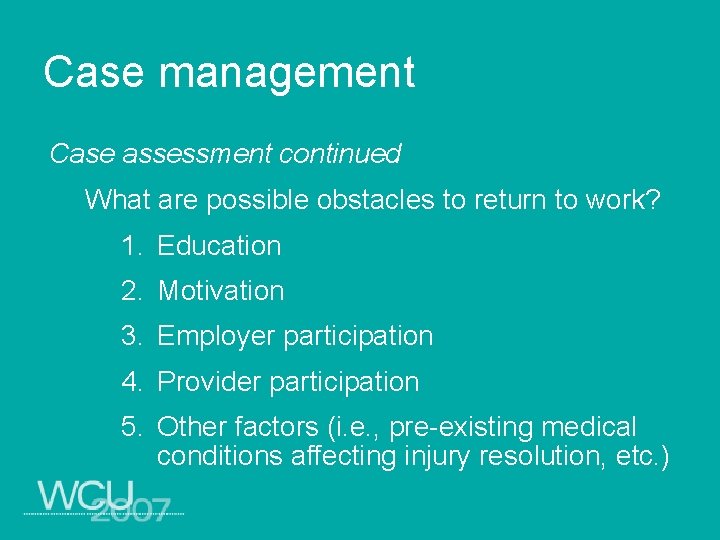
Case management Case assessment 1. Has the injured worker been provided education regarding the specific work-related injury and proposed plan of treatment? 2. Is the injured worker compliant with the current treatment plan? 3. What is the injury prognosis and expected duration of disability?
Case management Case assessment continued What are possible obstacles to return to work? 1. Education 2. Motivation 3. Employer participation 4. Provider participation 5. Other factors (i. e. , pre-existing medical conditions affecting injury resolution, etc. )
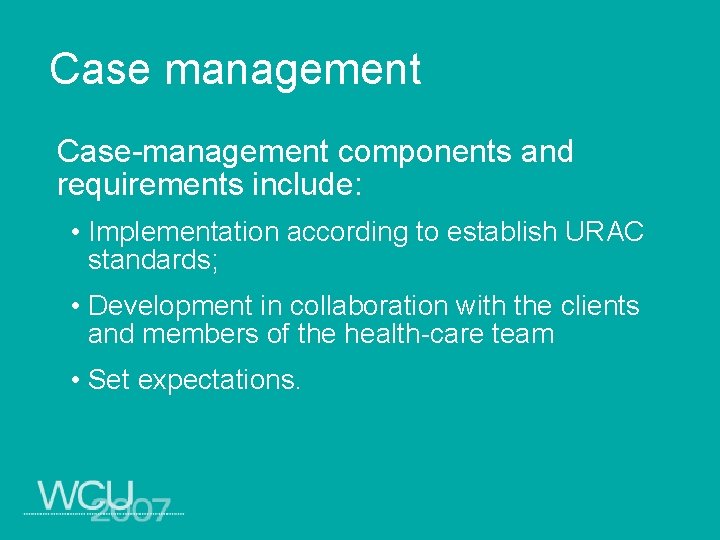
Case management Case-management components and requirements include: • Implementation according to establish URAC standards; • Development in collaboration with the clients and members of the health-care team • Set expectations.
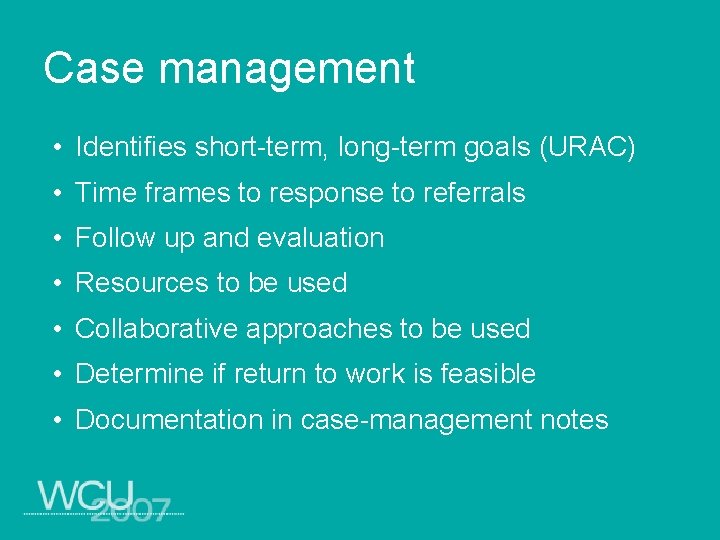
Case management • Identifies short-term, long-term goals (URAC) • Time frames to response to referrals • Follow up and evaluation • Resources to be used • Collaborative approaches to be used • Determine if return to work is feasible • Documentation in case-management notes
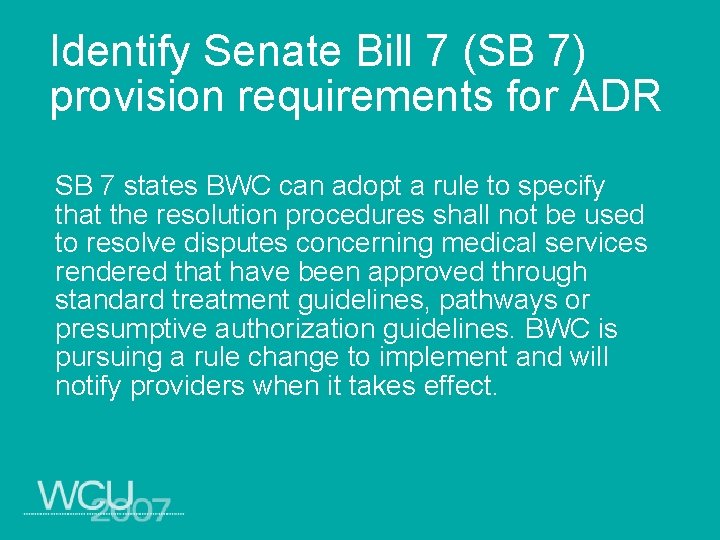
Identify Senate Bill 7 (SB 7) provision requirements for ADR SB 7 states BWC can adopt a rule to specify that the resolution procedures shall not be used to resolve disputes concerning medical services rendered that have been approved through standard treatment guidelines, pathways or presumptive authorization guidelines. BWC is pursuing a rule change to implement and will notify providers when it takes effect.
SB 7 provision and ADR process Responsibilities of the MCOs include: • Identifying the specific treatment guidelines used; • Supporting criteria for the approval.
ADR process and case management Peer reviews/IMEs – MCO responsible for ongoing education of peer reviewers – Make sure they adhere to BWC’s guidelines, including: • • • Quality of reports; Miller; Reference to guidelines; Legible report; Include all diagnosis (allowed/disallowed).
ADR and case management Disputes are on the rise due to: • Lack of case direction; • Lack of collaboration; • Lack of education with parties; • Frivolous and/or repeated appeals; • Retroactive treatment requests.
ADR and case management Noncompliance issues include: • Lack of an MCO established case- management plan affecting case direction and/or resolution; • Submission of retroactive treatment requests; • Noncompliance with submission of medical documentation from the treating or requesting physician.
Questions? Contact information Alicia Vivo – (614) 644 -5966 E-mail – Alicia. v. 1@bwc. state. oh. us Steve Taylor – (614) 644 -7656 E-mail – Steven. T. 2@bwc. state. oh. us Web site – ohiobwc. com