
Partner Sales Strategy Contents l Buying behavior l
Partner Sales Strategy Contents: l Buying behavior l Target groups l Acquisition process l Customer problems and solutions l Basel II ã SAP AG 2003
Partner Sales Strategy: Unit Objectives At the conclusion of this unit, you will be able to: l Describe the buying behavior and buying criteria of small and midsize companies l Define your customer target group l Describe the acquisition process l Describe potential problem areas facing small and midsize companies and how to solve them using SAP Business One l Describe Basel II and how it effects small and midsize businesses ã SAP AG 2003
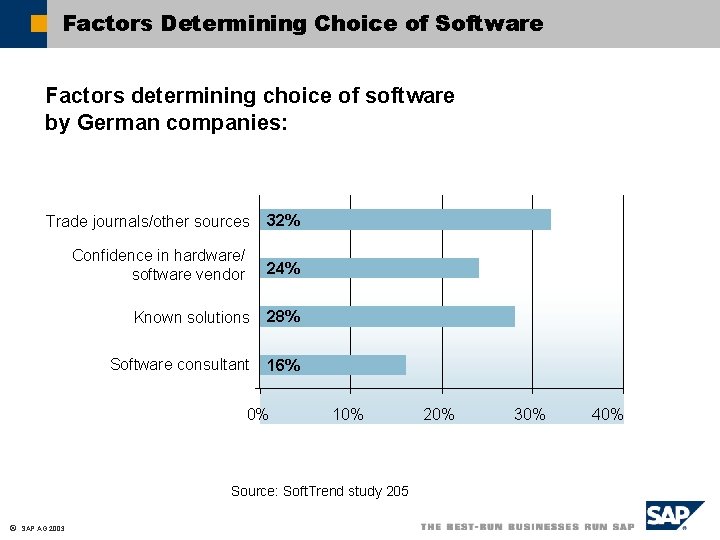
Factors Determining Choice of Software Factors determining choice of software by German companies: Trade journals/other sources 32% Confidence in hardware/ software vendor 24% Known solutions 28% Software consultant 16% 0% 10% Source: Soft. Trend study 205 ã SAP AG 2003 20% 30% 40%
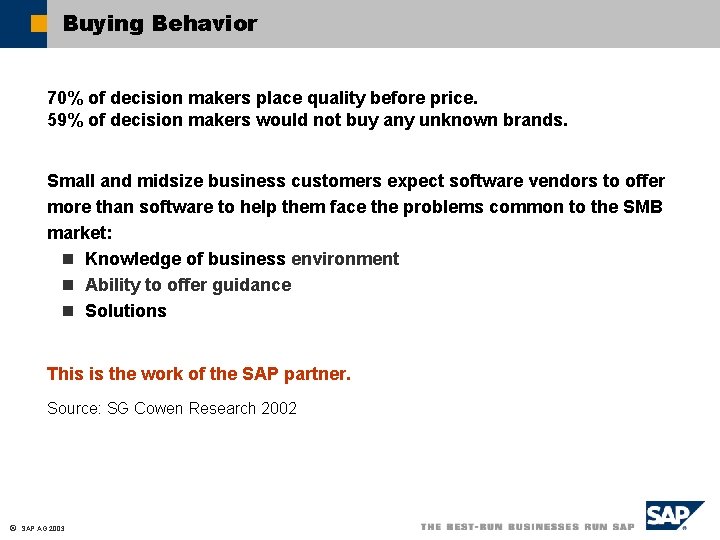
Buying Behavior 70% of decision makers place quality before price. 59% of decision makers would not buy any unknown brands. Small and midsize business customers expect software vendors to offer more than software to help them face the problems common to the SMB market: n Knowledge of business environment n Ability to offer guidance n Solutions This is the work of the SAP partner. Source: SG Cowen Research 2002 ã SAP AG 2003
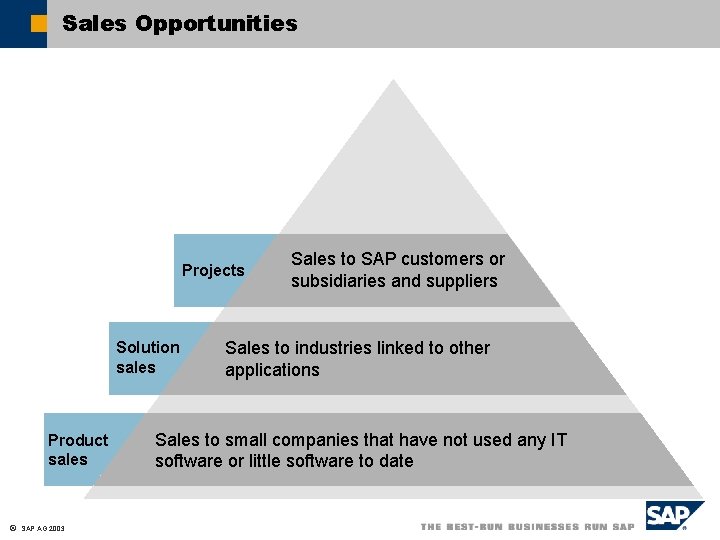
Sales Opportunities Projects Solution sales Product sales ã SAP AG 2003 Sales to SAP customers or subsidiaries and suppliers Sales to industries linked to other applications Sales to small companies that have not used any IT software or little software to date
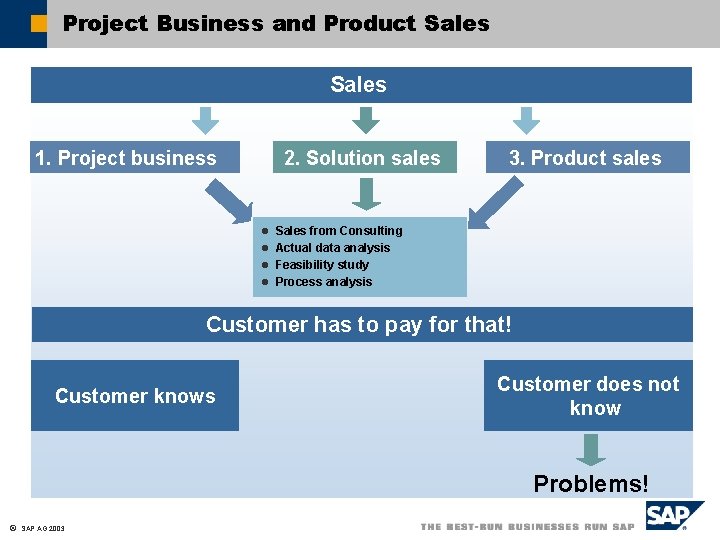
Project Business and Product Sales 1. Project business 2. Solution sales 3. Product sales l Sales from Consulting l Actual data analysis l Feasibility study l Process analysis Customer has to pay for that! Customer knows Customer does not know Problems! ã SAP AG 2003
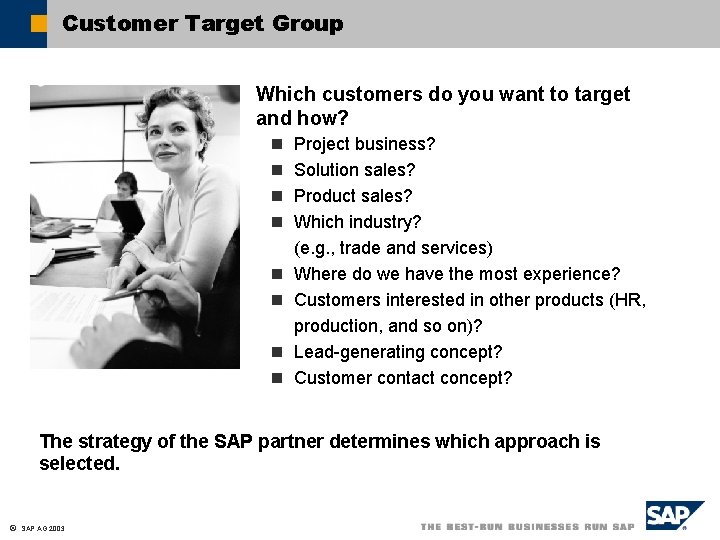
Customer Target Group Which customers do you want to target and how? n Project business? n Solution sales? n Product sales? n Which industry? n n (e. g. , trade and services) Where do we have the most experience? Customers interested in other products (HR, production, and so on)? Lead-generating concept? Customer contact concept? The strategy of the SAP partner determines which approach is selected. ã SAP AG 2003
Acquisition Process 1 Steps: 1. Define suitable target group 2. Compile addresses ( Address publisher) 3. Collect information on customer/industries 4. Conduct telephone inquiries (name of contact person) 5. Conduct mailing (SAP Marketing offers templates) 6. Phone call to potential customer: „Give me 30 minutes and I will show you how helpful and easy to handle SAP Business One is and how many reports Business One offers for your daily business!!” ã SAP AG 2003
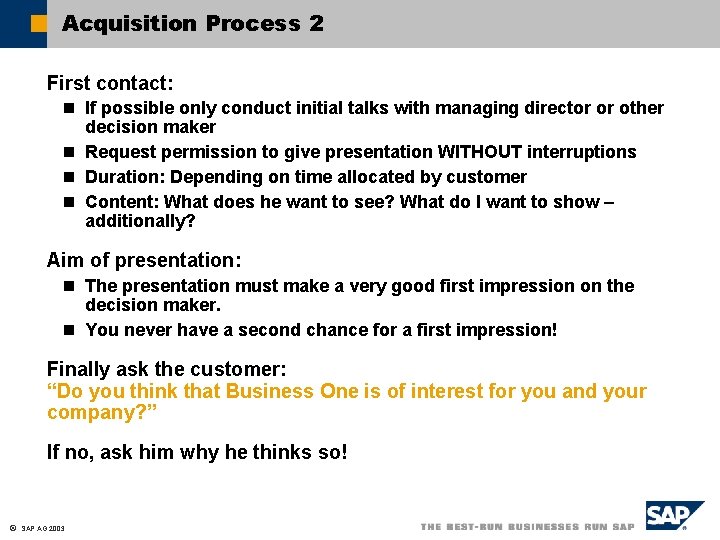
Acquisition Process 2 First contact: n If possible only conduct initial talks with managing director or other decision maker n Request permission to give presentation WITHOUT interruptions n Duration: Depending on time allocated by customer n Content: What does he want to see? What do I want to show – additionally? Aim of presentation: n The presentation must make a very good first impression on the decision maker. n You never have a second chance for a first impression! Finally ask the customer: “Do you think that Business One is of interest for you and your company? ” If no, ask him why he thinks so! ã SAP AG 2003
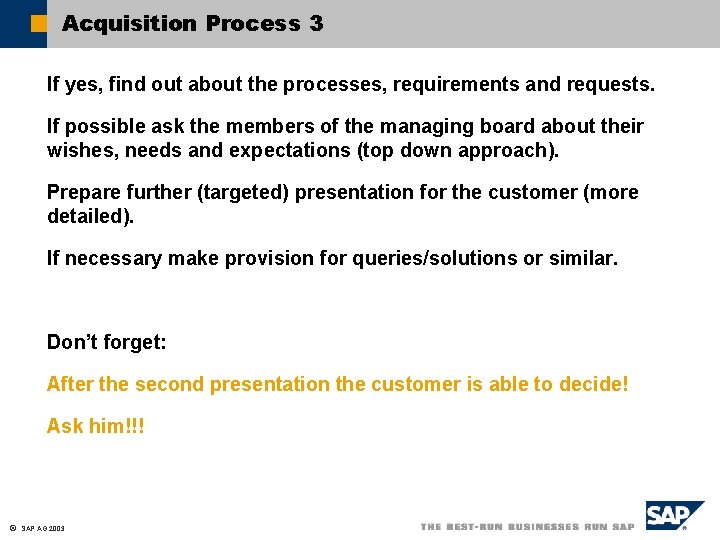
Acquisition Process 3 If yes, find out about the processes, requirements and requests. If possible ask the members of the managing board about their wishes, needs and expectations (top down approach). Prepare further (targeted) presentation for the customer (more detailed). If necessary make provision for queries/solutions or similar. Don’t forget: After the second presentation the customer is able to decide! Ask him!!! ã SAP AG 2003
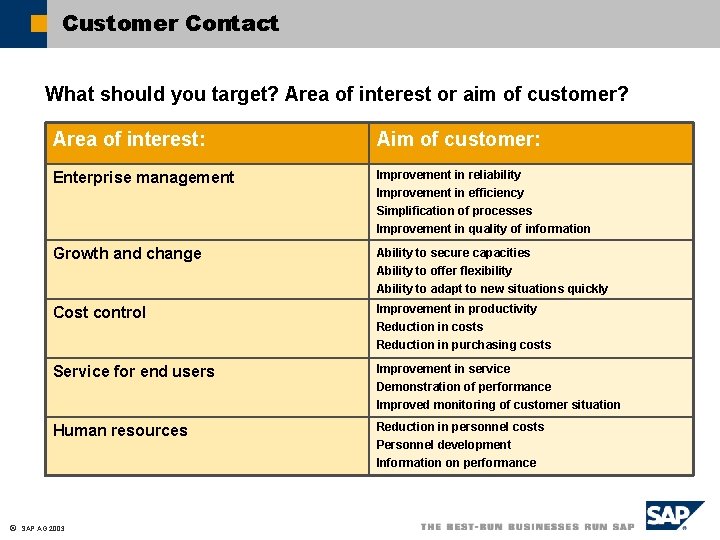
Customer Contact What should you target? Area of interest or aim of customer? Area of interest: Aim of customer: Enterprise management Improvement in reliability Growth and change Ability to secure capacities Improvement in efficiency Simplification of processes Improvement in quality of information Ability to offer flexibility Ability to adapt to new situations quickly Cost control Improvement in productivity Service for end users Improvement in service Reduction in costs Reduction in purchasing costs Demonstration of performance Improved monitoring of customer situation Human resources ã SAP AG 2003 Reduction in personnel costs Personnel development Information on performance
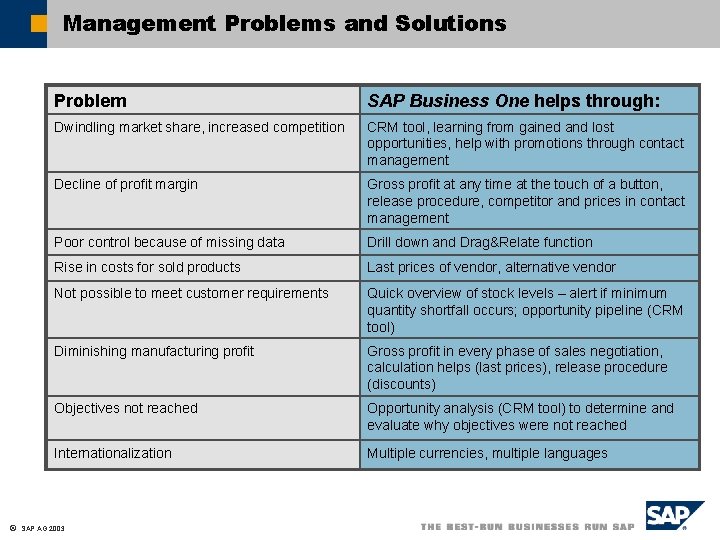
Management Problems and Solutions ã Problem SAP Business One helps through: Dwindling market share, increased competition CRM tool, learning from gained and lost opportunities, help with promotions through contact management Decline of profit margin Gross profit at any time at the touch of a button, release procedure, competitor and prices in contact management Poor control because of missing data Drill down and Drag&Relate function Rise in costs for sold products Last prices of vendor, alternative vendor Not possible to meet customer requirements Quick overview of stock levels – alert if minimum quantity shortfall occurs; opportunity pipeline (CRM tool) Diminishing manufacturing profit Gross profit in every phase of sales negotiation, calculation helps (last prices), release procedure (discounts) Objectives not reached Opportunity analysis (CRM tool) to determine and evaluate why objectives were not reached Internationalization Multiple currencies, multiple languages SAP AG 2003
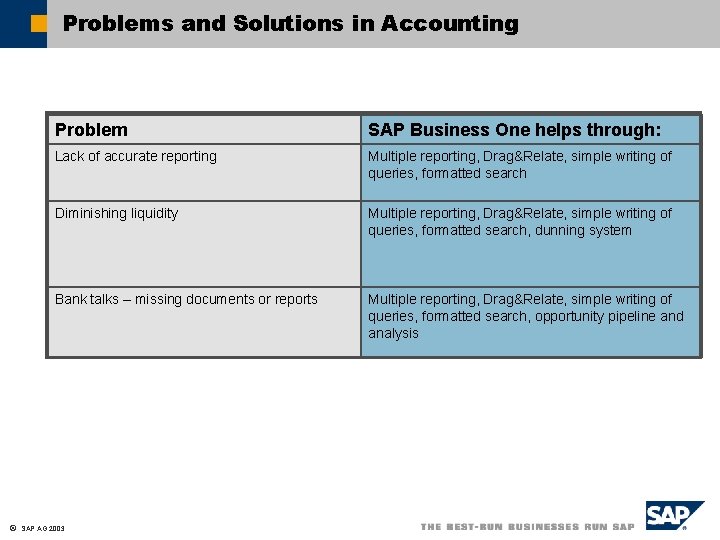
Problems and Solutions in Accounting ã Problem SAP Business One helps through: Lack of accurate reporting Multiple reporting, Drag&Relate, simple writing of queries, formatted search Diminishing liquidity Multiple reporting, Drag&Relate, simple writing of queries, formatted search, dunning system Bank talks – missing documents or reports Multiple reporting, Drag&Relate, simple writing of queries, formatted search, opportunity pipeline and analysis SAP AG 2003
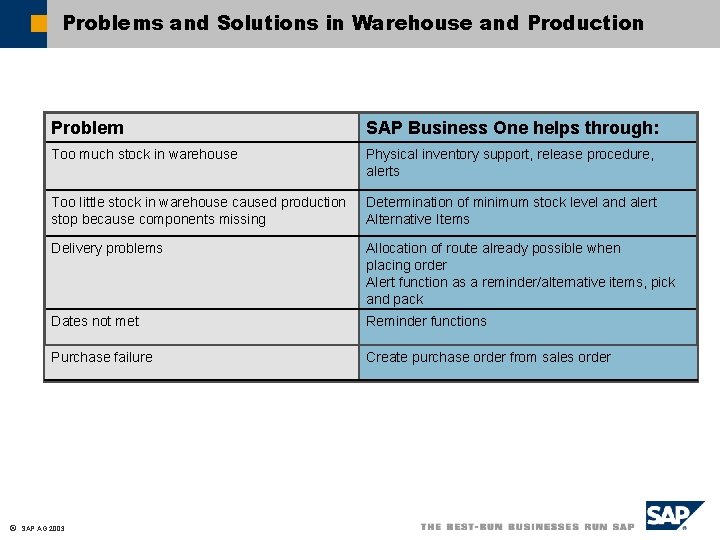
Problems and Solutions in Warehouse and Production ã Problem SAP Business One helps through: Too much stock in warehouse Physical inventory support, release procedure, alerts Too little stock in warehouse caused production stop because components missing Determination of minimum stock level and alert Alternative Items Delivery problems Allocation of route already possible when placing order Alert function as a reminder/alternative items, pick and pack Dates not met Reminder functions Purchase failure Create purchase order from sales order SAP AG 2003
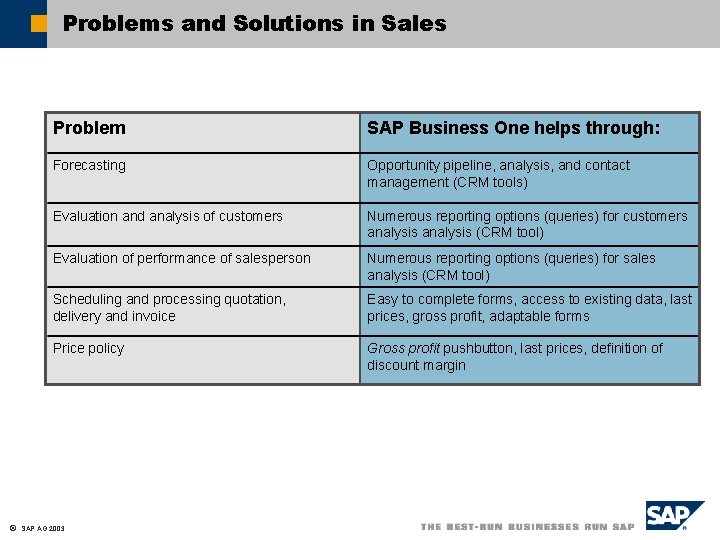
Problems and Solutions in Sales ã Problem SAP Business One helps through: Forecasting Opportunity pipeline, analysis, and contact management (CRM tools) Evaluation and analysis of customers Numerous reporting options (queries) for customers analysis (CRM tool) Evaluation of performance of salesperson Numerous reporting options (queries) for sales analysis (CRM tool) Scheduling and processing quotation, delivery and invoice Easy to complete forms, access to existing data, last prices, gross profit, adaptable forms Price policy Gross profit pushbutton, last prices, definition of discount margin SAP AG 2003
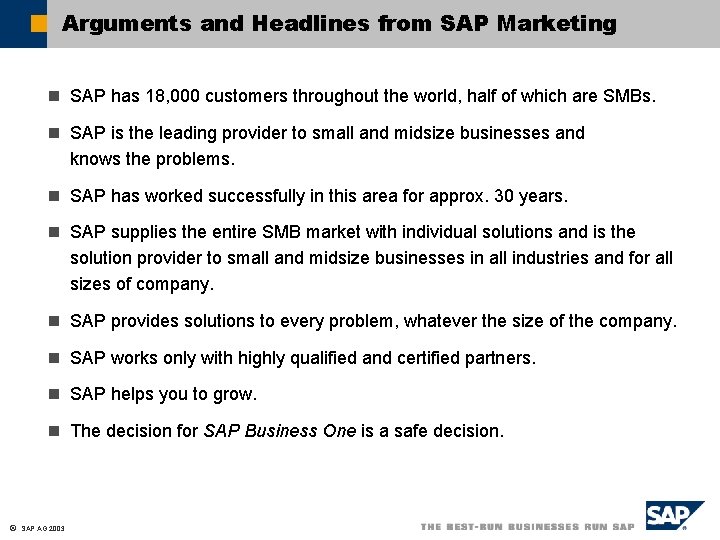
Arguments and Headlines from SAP Marketing n SAP has 18, 000 customers throughout the world, half of which are SMBs. n SAP is the leading provider to small and midsize businesses and knows the problems. n SAP has worked successfully in this area for approx. 30 years. n SAP supplies the entire SMB market with individual solutions and is the solution provider to small and midsize businesses in all industries and for all sizes of company. n SAP provides solutions to every problem, whatever the size of the company. n SAP works only with highly qualified and certified partners. n SAP helps you to grow. n The decision for SAP Business One is a safe decision. ã SAP AG 2003
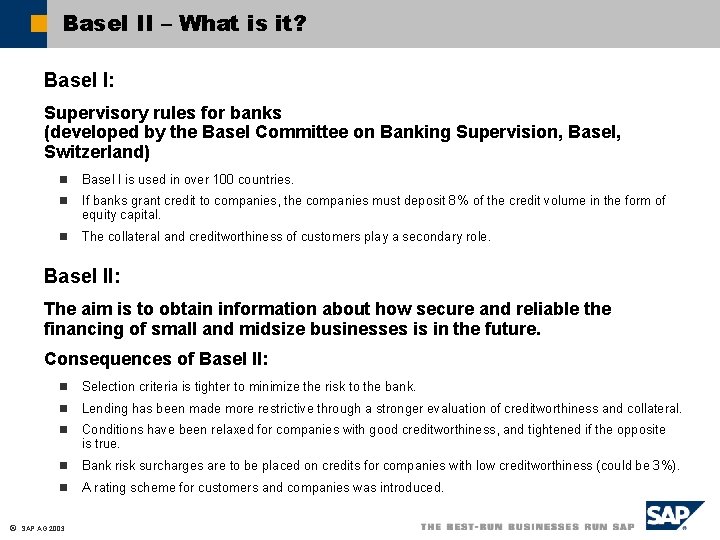
Basel II – What is it? Basel I: Supervisory rules for banks (developed by the Basel Committee on Banking Supervision, Basel, Switzerland) n Basel I is used in over 100 countries. n If banks grant credit to companies, the companies must deposit 8% of the credit volume in the form of equity capital. n The collateral and creditworthiness of customers play a secondary role. Basel II: The aim is to obtain information about how secure and reliable the financing of small and midsize businesses is in the future. Consequences of Basel II: ã n Selection criteria is tighter to minimize the risk to the bank. n Lending has been made more restrictive through a stronger evaluation of creditworthiness and collateral. n Conditions have been relaxed for companies with good creditworthiness, and tightened if the opposite is true. n Bank risk surcharges are to be placed on credits for companies with low creditworthiness (could be 3%). n A rating scheme for customers and companies was introduced. SAP AG 2003
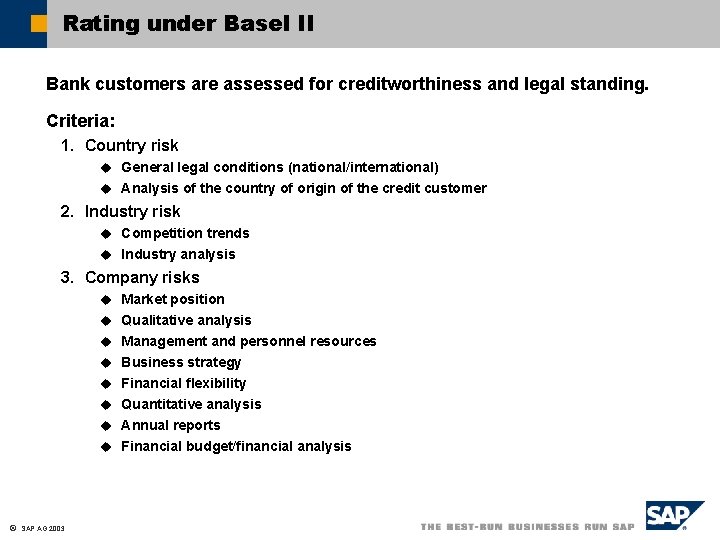
Rating under Basel II Bank customers are assessed for creditworthiness and legal standing. Criteria: 1. Country risk u General legal conditions (national/international) u Analysis of the country of origin of the credit customer 2. Industry risk u Competition trends u Industry analysis 3. Company risks u Market position u Qualitative analysis u Management and personnel resources u Business strategy u Financial flexibility u Quantitative analysis u Annual reports u Financial budget/financial analysis ã SAP AG 2003
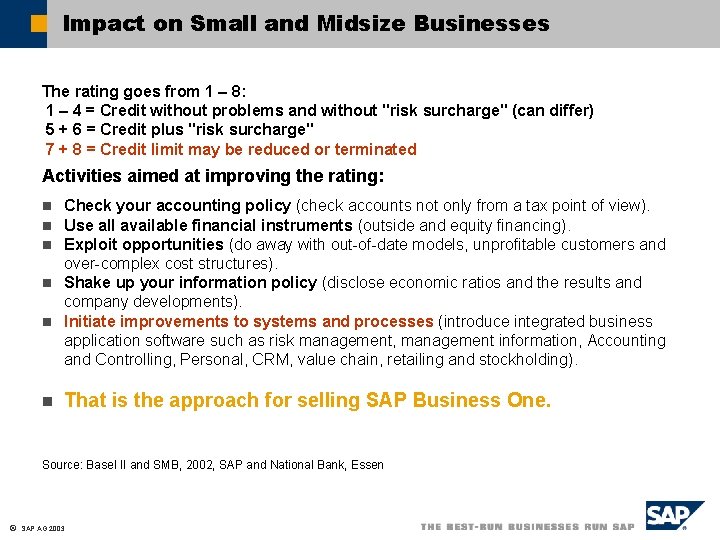
Impact on Small and Midsize Businesses The rating goes from 1 – 8: 1 – 4 = Credit without problems and without "risk surcharge" (can differ) 5 + 6 = Credit plus "risk surcharge" 7 + 8 = Credit limit may be reduced or terminated Activities aimed at improving the rating: Check your accounting policy (check accounts not only from a tax point of view). Use all available financial instruments (outside and equity financing). Exploit opportunities (do away with out-of-date models, unprofitable customers and over-complex cost structures). n Shake up your information policy (disclose economic ratios and the results and company developments). n Initiate improvements to systems and processes (introduce integrated business application software such as risk management, management information, Accounting and Controlling, Personal, CRM, value chain, retailing and stockholding). n n That is the approach for selling SAP Business One. Source: Basel II and SMB, 2002, SAP and National Bank, Essen ã SAP AG 2003
Group Work Which features and functions of SAP Business One are essential for inclusion the first time we give a presentation at the customer? Priority 1: Priority 2: Priority 3: Time allowed: Display results on board after 30 minutes. ã SAP AG 2003
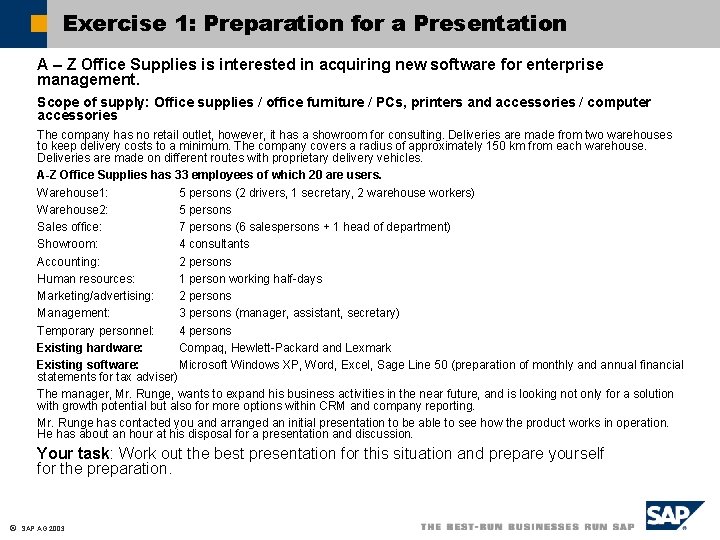
Exercise 1: Preparation for a Presentation A – Z Office Supplies is interested in acquiring new software for enterprise management. Scope of supply: Office supplies / office furniture / PCs, printers and accessories / computer accessories The company has no retail outlet, however, it has a showroom for consulting. Deliveries are made from two warehouses to keep delivery costs to a minimum. The company covers a radius of approximately 150 km from each warehouse. Deliveries are made on different routes with proprietary delivery vehicles. A-Z Office Supplies has 33 employees of which 20 are users. Warehouse 1: 5 persons (2 drivers, 1 secretary, 2 warehouse workers) Warehouse 2: 5 persons Sales office: 7 persons (6 salespersons + 1 head of department) Showroom: 4 consultants Accounting: 2 persons Human resources: 1 person working half-days Marketing/advertising: 2 persons Management: 3 persons (manager, assistant, secretary) Temporary personnel: 4 persons Existing hardware: Compaq, Hewlett-Packard and Lexmark Existing software: Microsoft Windows XP, Word, Excel, Sage Line 50 (preparation of monthly and annual financial statements for tax adviser) The manager, Mr. Runge, wants to expand his business activities in the near future, and is looking not only for a solution with growth potential but also for more options within CRM and company reporting. Mr. Runge has contacted you and arranged an initial presentation to be able to see how the product works in operation. He has about an hour at his disposal for a presentation and discussion. Your task: Work out the best presentation for this situation and prepare yourself for the preparation. ã SAP AG 2003
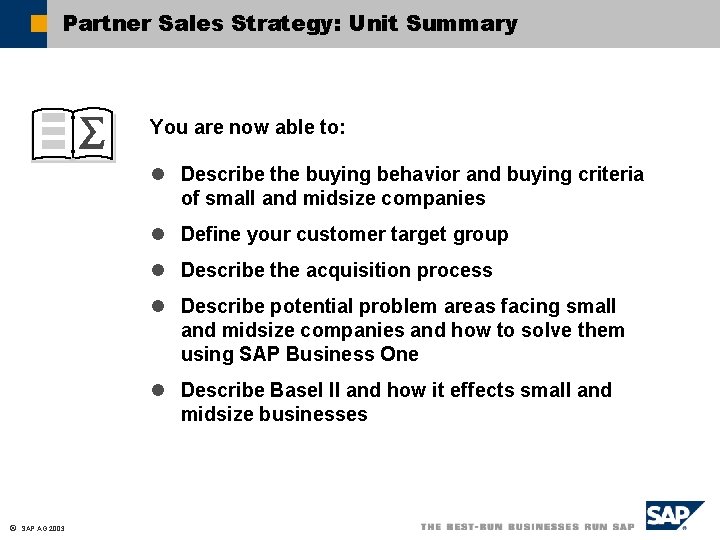
Partner Sales Strategy: Unit Summary You are now able to: l Describe the buying behavior and buying criteria of small and midsize companies l Define your customer target group l Describe the acquisition process l Describe potential problem areas facing small and midsize companies and how to solve them using SAP Business One l Describe Basel II and how it effects small and midsize businesses ã SAP AG 2003
- Slides: 22