
Particulate bone graftseffectiveness of bone cell supply Ingo
Particulate bone grafts-effectiveness of bone cell supply Ingo N. G. Springer, Hendrik Terheyden, Stefan Geiß, Franz Härle Jürgen Hedderich, Yahya Açil Clinical Oral Implants Research, 2004
Particulate bone graft vs Bock bone graft It has been suggested that particulate bone grafting is superior to bone-block grafting. Marx et al. JOMS 1984; Shirota et al. JOMS 1996
Autogenous Bone Grafting : Gold Standard, Why ? 1. Osteoconductive as well as osteoinductive. 2. Provide optimal conditions for the penetration of blood vessels and migration of cells with osteogenic potential. Fonseca et al 1980, Stroud et al. 1980, Marx et al. 1984, Akamine et al. 1994, Kamijou et al. 1994, Block & Kent 1997, Lundgren et al. 1997
Purposes of this experiment : 1. Small bone particles have a greater cumulative transplant surface area ? 2. Mechanical manipulation of small bone particles leads to a reduction in the number of viable cells transplanted ? Springer et al. , COIR 2004
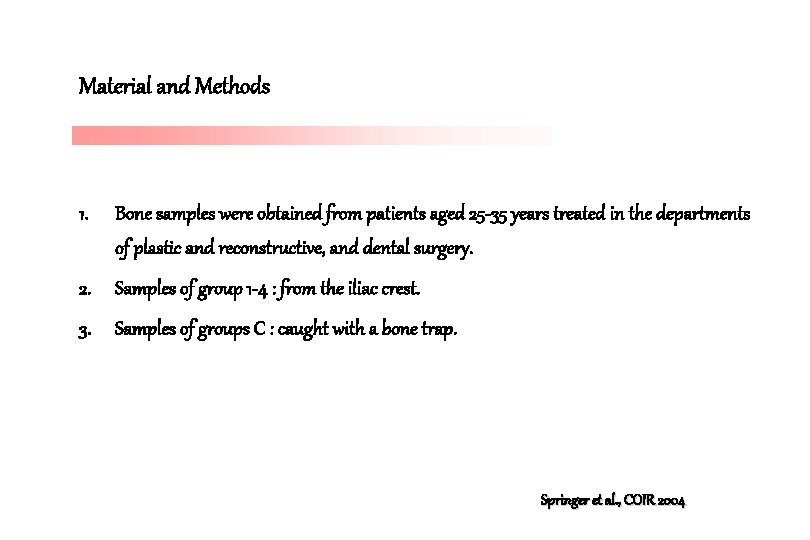
Material and Methods 1. Bone samples were obtained from patients aged 25 -35 years treated in the departments of plastic and reconstructive, and dental surgery. 2. Samples of group 1 -4 : from the iliac crest. 3. Samples of groups C : caught with a bone trap. Springer et al. , COIR 2004
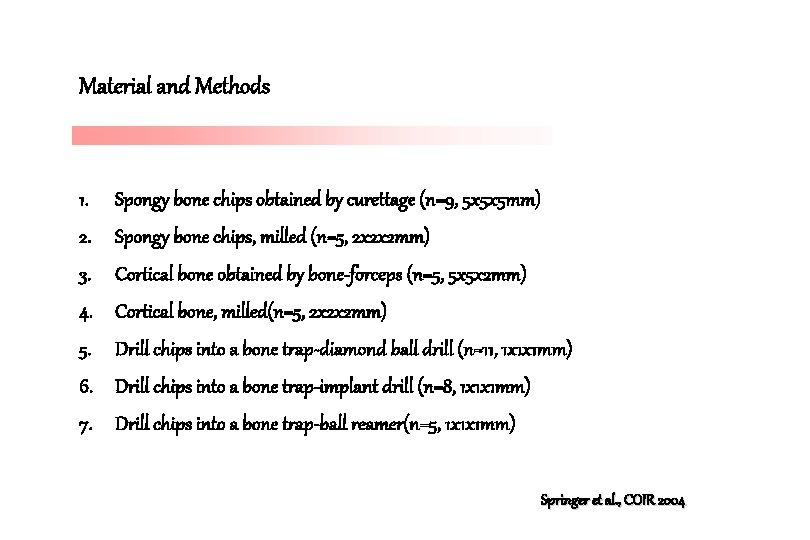
Material and Methods 1. Spongy bone chips obtained by curettage (n=9, 5 x 5 x 5 mm) 2. Spongy bone chips, milled (n=5, 2 x 2 x 2 mm) 3. Cortical bone obtained by bone-forceps (n=5, 5 x 5 x 2 mm) 4. Cortical bone, milled(n=5, 2 x 2 x 2 mm) 5. Drill chips into a bone trap-diamond ball drill (n=11, 1 x 1 x 1 mm) 6. Drill chips into a bone trap-implant drill (n=8, 1 x 1 x 1 mm) 7. Drill chips into a bone trap-ball reamer(n=5, 1 x 1 x 1 mm) Springer et al. , COIR 2004
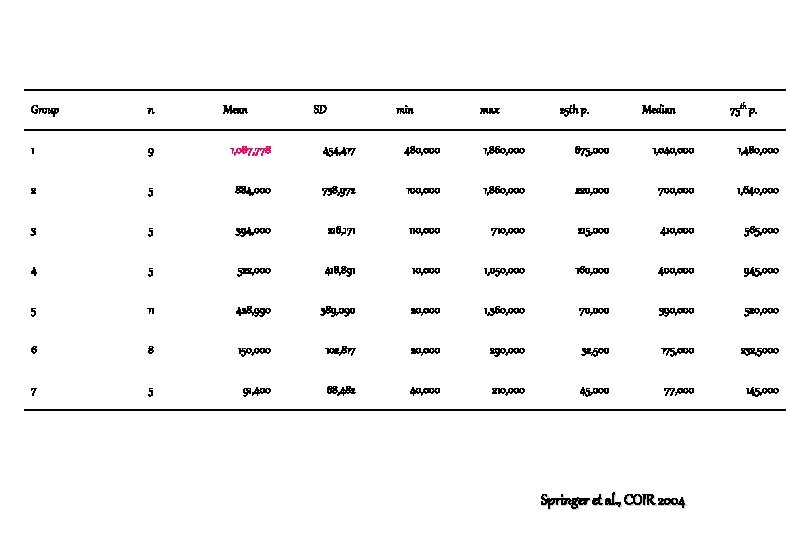
Mean SD min max 25 th p. Median 75 th p. Group n 1 9 1, 087, 778 454, 417 480, 000 1, 860, 000 675, 000 1, 040, 000 1, 480, 000 2 5 884, 000 738, 972 100, 000 1, 860, 000 220, 000 700, 000 1, 640, 000 3 5 394, 000 216, 171 110, 000 710, 000 215, 000 410, 000 565, 000 4 5 522, 000 418, 891 10, 000 1, 050, 000 160, 000 400, 000 945, 000 5 11 428, 990 389, 090 20, 000 1, 360, 000 70, 000 390, 000 520, 000 6 8 150, 000 102, 817 20, 000 290, 000 32, 500 175, 000 232, 5000 7 5 91, 400 68, 482 40, 000 210, 000 45, 000 77, 000 145, 000 Springer et al. , COIR 2004
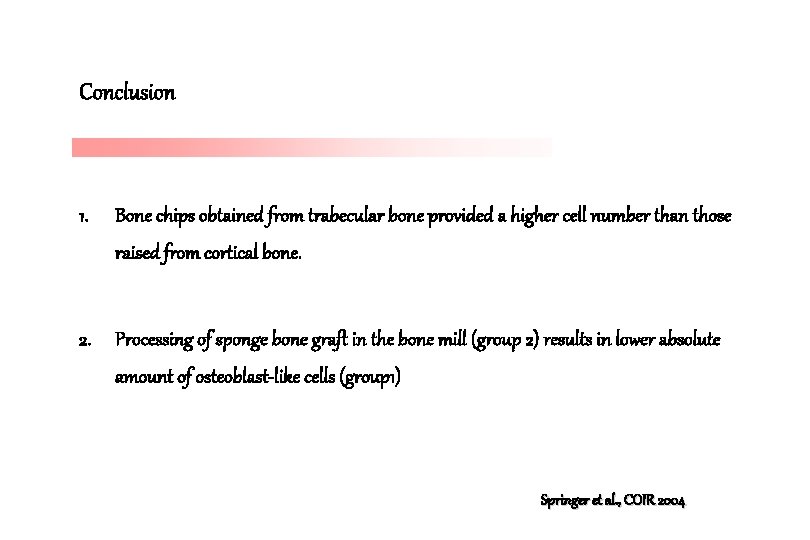
Conclusion 1. Bone chips obtained from trabecular bone provided a higher cell number than those raised from cortical bone. 2. Processing of sponge bone graft in the bone mill (group 2) results in lower absolute amount of osteoblast-like cells (group 1) Springer et al. , COIR 2004
Conclusion 3. Use of the bone mill in cortical bone has no impact on the number of cells counted (group 3, 4). 4. The treatment of transplants with the bone mill or raising of transplants by rotating instruments appears to reduce the amount of bone cells supplied. Springer et al. , COIR 2004
Effects of Graft Particle Size 1. Small particles are proposed as having improved osteoconductive properties as compared to bigger particles. Fonseca et al 1980, Stroud et al. 1980, Marx et al. 1984, Block & Kent 1997, Lundgren et al. 1997. 2. Grafts with a small particle size have reduced mechanical stability and have a higher osteoclastic activity when compared to bone grafts with a larger particle size. Fonseca et al. 1980, Ullmark 2000 Springer et al. , COIR 2004
Effects of Graft Particle Size 3. When particle size decreases, the absolute square measure of the surface of the transplant increases. An increased absolute square measure of the surface of a transplant leads to an increased amount of living cells released. 4. Yet the treatment of transplant with the bone mill or raising of transplants by rotating instruments appears to reduce the amount of bone cells supplied. Springer et al. , COIR 2004
- Slides: 11