
Particle Synthesis A unified model for granular synthesis
- Slides: 17
Particle Synthesis A unified model for granular synthesis Øyvind Brandtsegg Sigurd Saue Thom Johansen
Overview ¢ Granular synthesis General characteristics l Specific subtypes (Roads) l ¢ Particle synthesis – partikkel (Csound) All in one generator l New features and new varieties of GS l ¢ Interface and applications
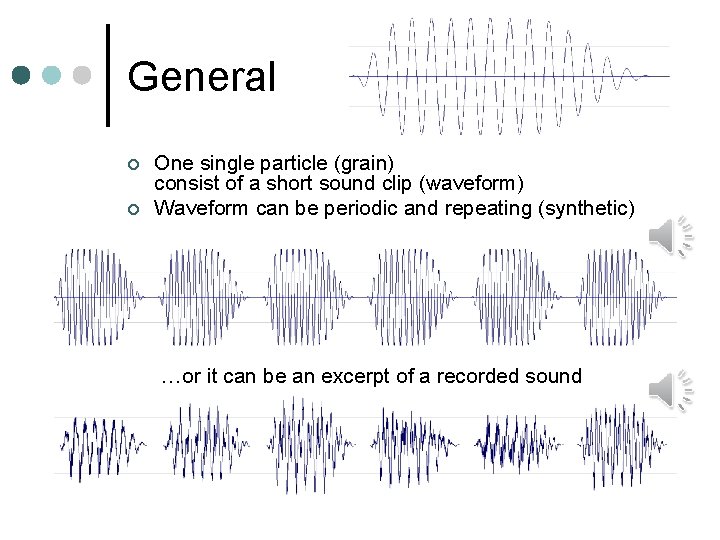
General ¢ ¢ One single particle (grain) consist of a short sound clip (waveform) Waveform can be periodic and repeating (synthetic) …or it can be an excerpt of a recorded sound
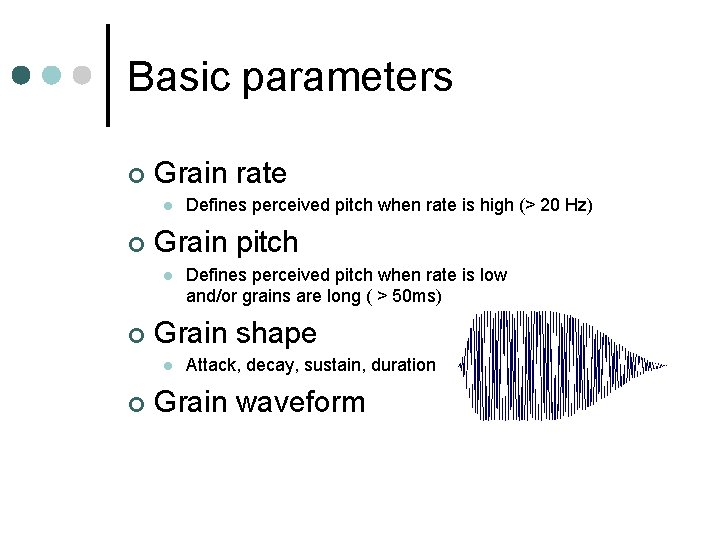
Basic parameters ¢ Grain rate l ¢ Grain pitch l ¢ Defines perceived pitch when rate is low and/or grains are long ( > 50 ms) Grain shape l ¢ Defines perceived pitch when rate is high (> 20 Hz) Attack, decay, sustain, duration Grain waveform
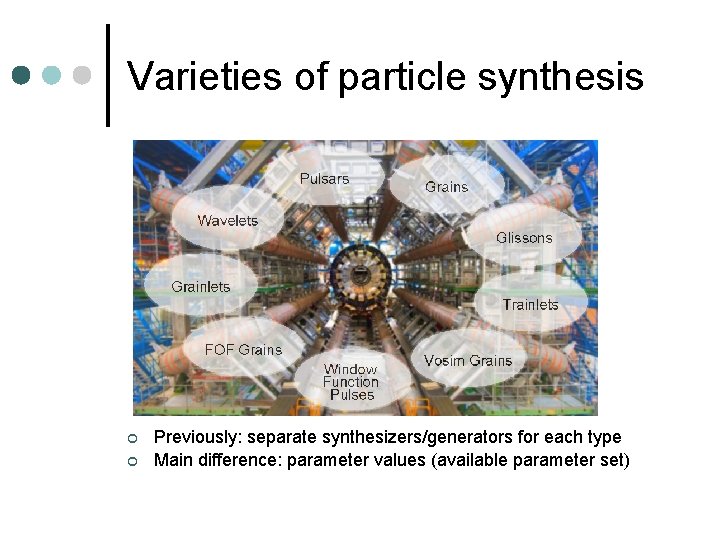
Varieties of particle synthesis ¢ ¢ Previously: separate synthesizers/generators for each type Main difference: parameter values (available parameter set)
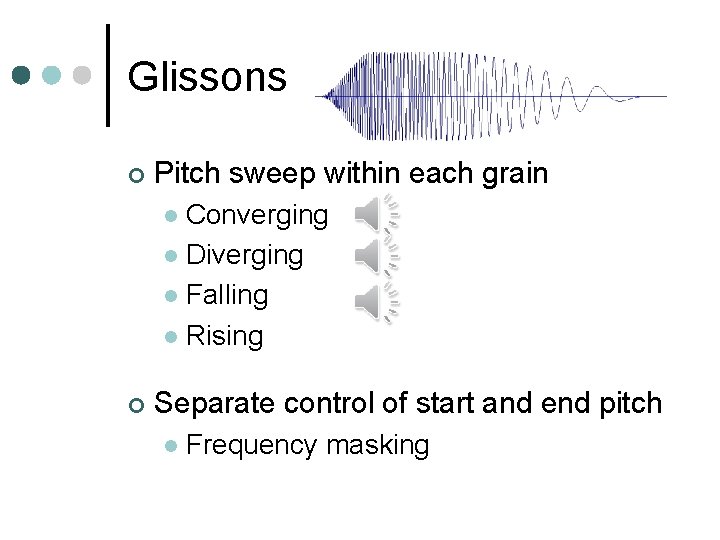
Glissons ¢ Pitch sweep within each grain Converging l Diverging l Falling l Rising l ¢ Separate control of start and end pitch l Frequency masking
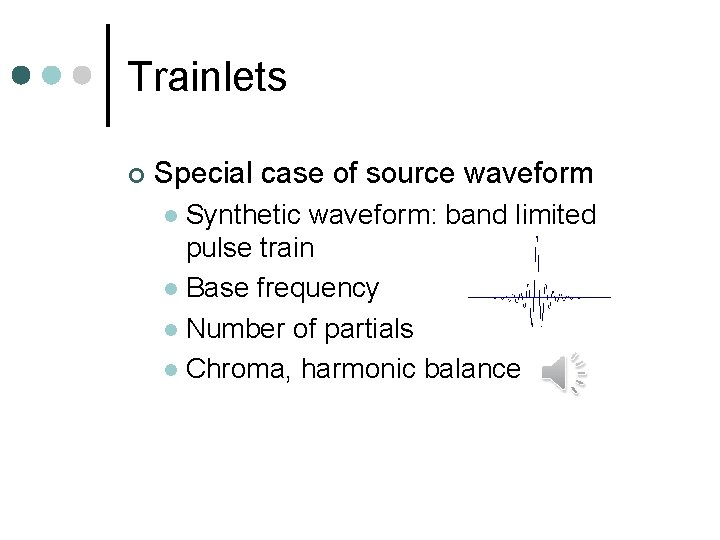
Trainlets ¢ Special case of source waveform Synthetic waveform: band limited pulse train l Base frequency l Number of partials l Chroma, harmonic balance l
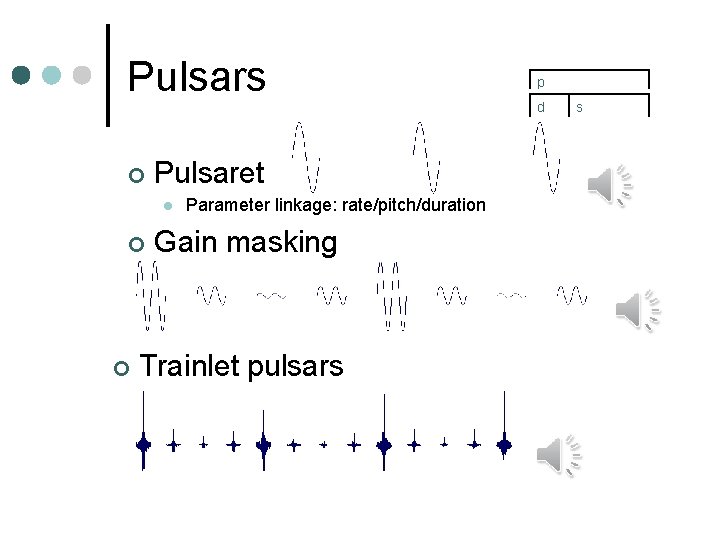
Pulsars ¢ Pulsaret l ¢ ¢ Parameter linkage: rate/pitch/duration Gain masking Trainlet pulsars p d s
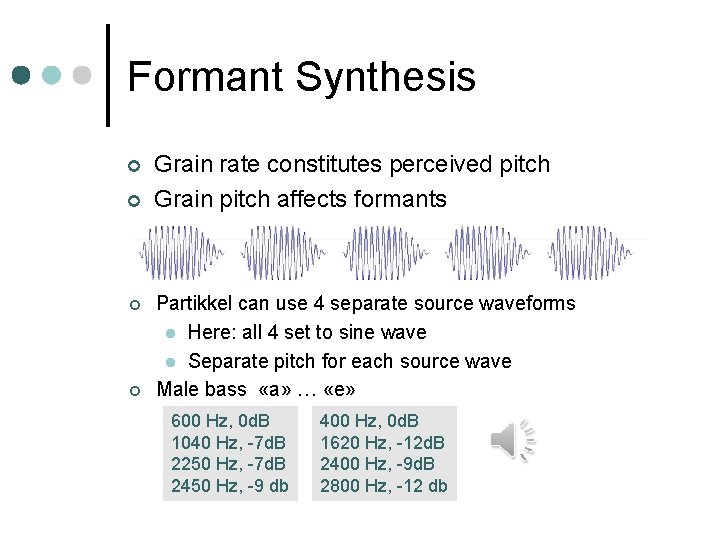
Formant Synthesis ¢ ¢ Grain rate constitutes perceived pitch Grain pitch affects formants Partikkel can use 4 separate source waveforms l Here: all 4 set to sine wave l Separate pitch for each source wave Male bass «a» … «e» 600 Hz, 0 d. B 1040 Hz, -7 d. B 2250 Hz, -7 d. B 2450 Hz, -9 db 400 Hz, 0 d. B 1620 Hz, -12 d. B 2400 Hz, -9 d. B 2800 Hz, -12 db
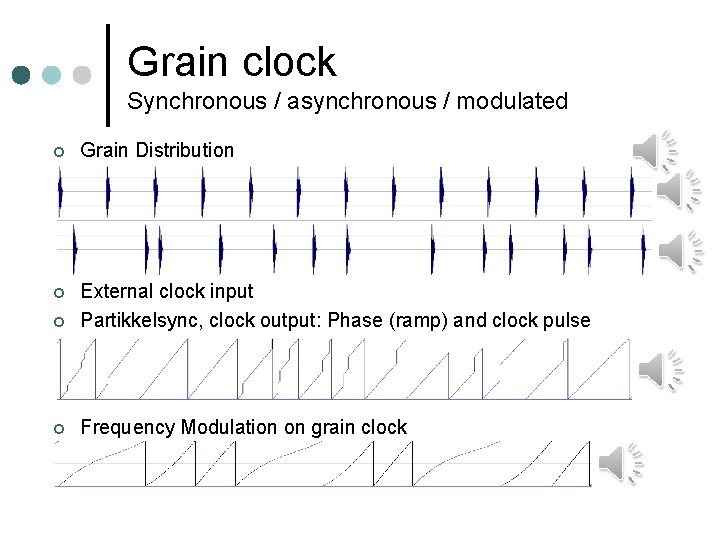
Grain clock Synchronous / asynchronous / modulated ¢ Grain Distribution ¢ ¢ External clock input Partikkelsync, clock output: Phase (ramp) and clock pulse ¢ Frequency Modulation on grain clock
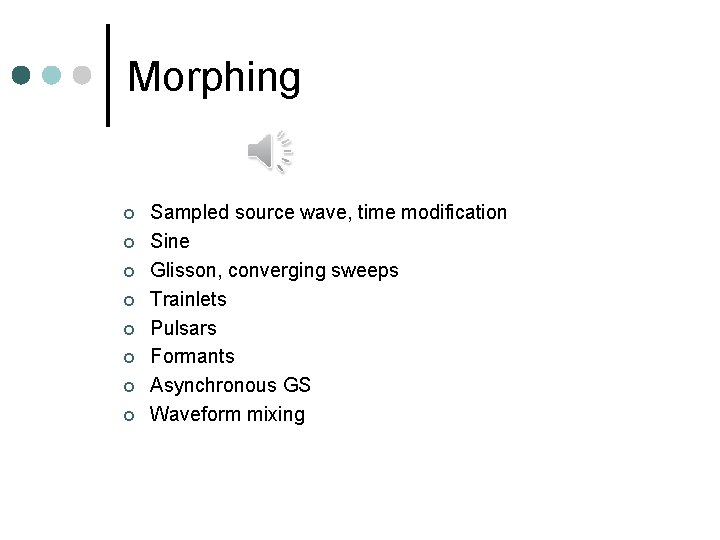
Morphing ¢ ¢ ¢ ¢ Sampled source wave, time modification Sine Glisson, converging sweeps Trainlets Pulsars Formants Asynchronous GS Waveform mixing
Is it hard to use ? ¢ 40 parameters per note event l Some parameters are multidimensional (Grain masking parameters) • Output routing, • mix of waveform sources • ++ l l l These are put in tables Format: • loop start, loop end, data 1, data 2, data 3, … …and as if that was not enough
Hadron Particle Synthesizer Using partikkel and Csound as a DSP core ¢ Large set of modulators, freely assignable to all partikkel (and modulator) parameters l l ¢ ¢ Envelopes, LFOs, Random generators All midi input (note num, velocity, expression controllers) Transfer functions, dividers, modulo Analysis tracks: Transient, Pitch, Amp Feedback in modulator signals allowed 52 modulators, 209 parameters
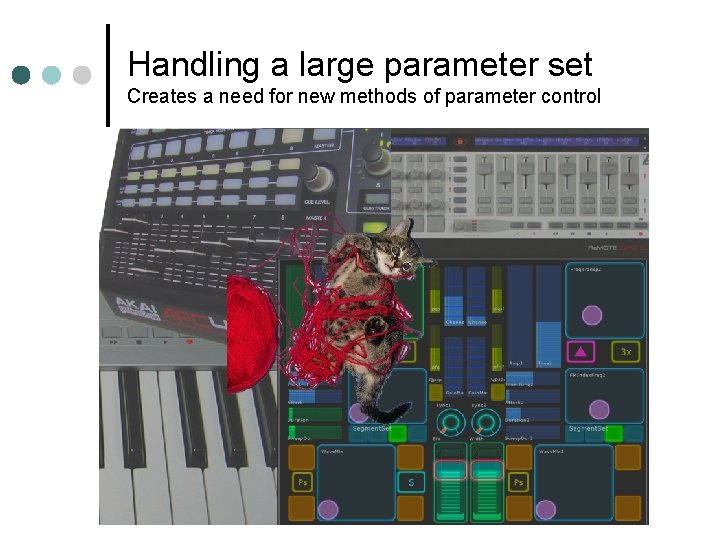
Handling a large parameter set Creates a need for new methods of parameter control
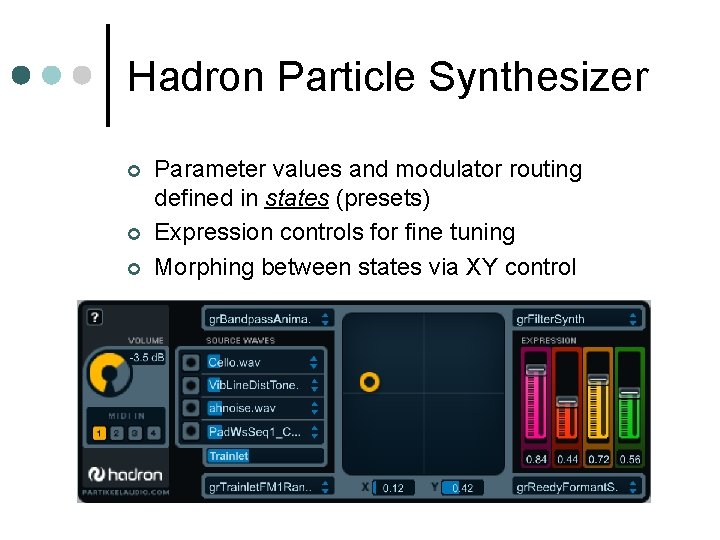
Hadron Particle Synthesizer ¢ ¢ ¢ Parameter values and modulator routing defined in states (presets) Expression controls for fine tuning Morphing between states via XY control
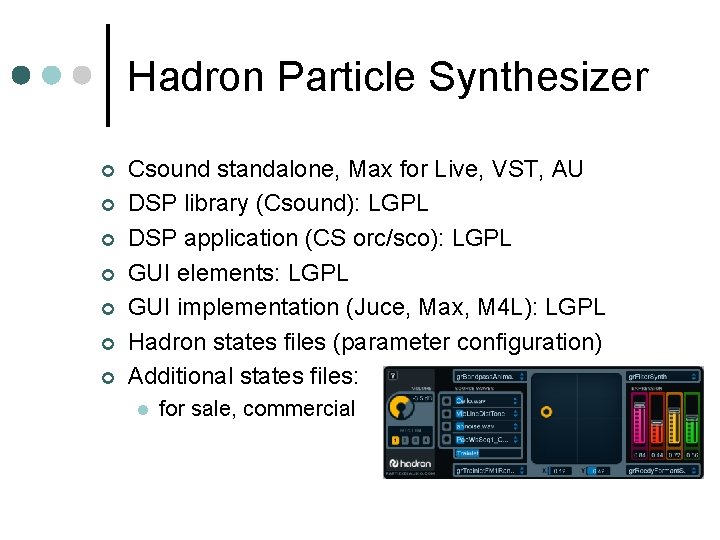
Hadron Particle Synthesizer ¢ ¢ ¢ ¢ Csound standalone, Max for Live, VST, AU DSP library (Csound): LGPL DSP application (CS orc/sco): LGPL GUI elements: LGPL GUI implementation (Juce, Max, M 4 L): LGPL Hadron states files (parameter configuration) Additional states files: l for sale, commercial
Thank you Hadron at Linux Sound Night tonight