
Particle Sizing Technique 3 Laser Diffraction Photon Correlation
- Slides: 21
Particle Sizing Technique 3: Laser Diffraction Photon Correlation Spectroscopy Kausar Ahmad Kulliyyah of Pharmacy, IIUM http: //staff. iiu. edu. my/akausar Physical Pharmacy 2 1
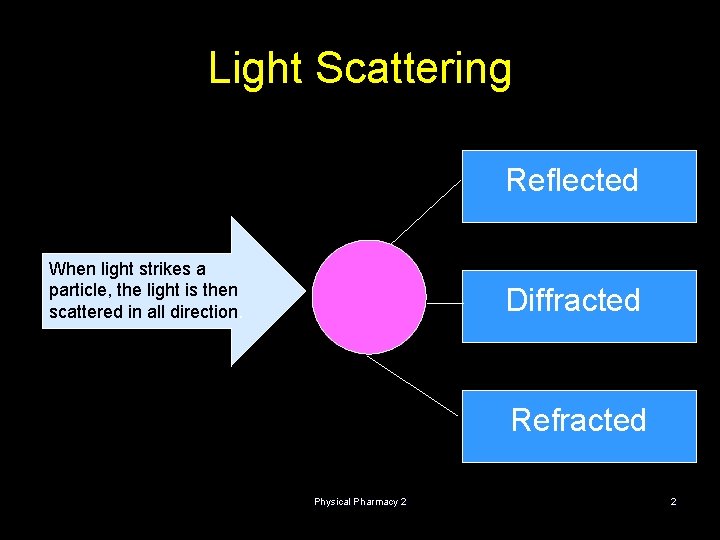
Light Scattering Reflected When light strikes a particle, the light is then scattered in all direction. Diffracted Refracted Physical Pharmacy 2 2
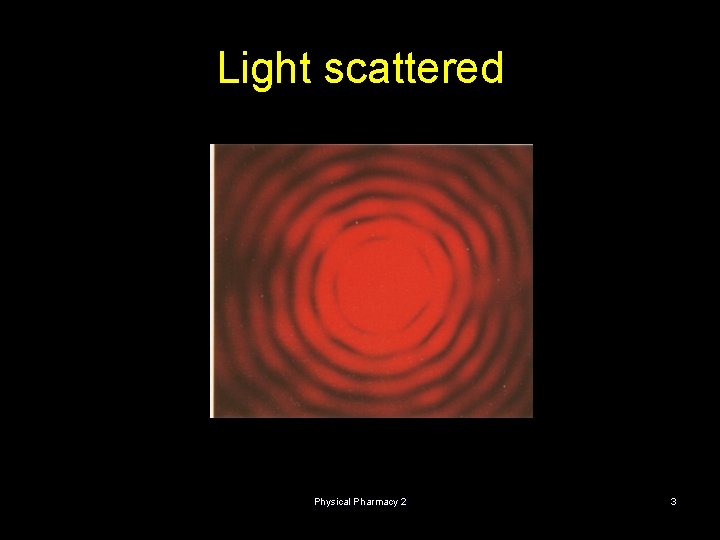
Light scattered Physical Pharmacy 2 3
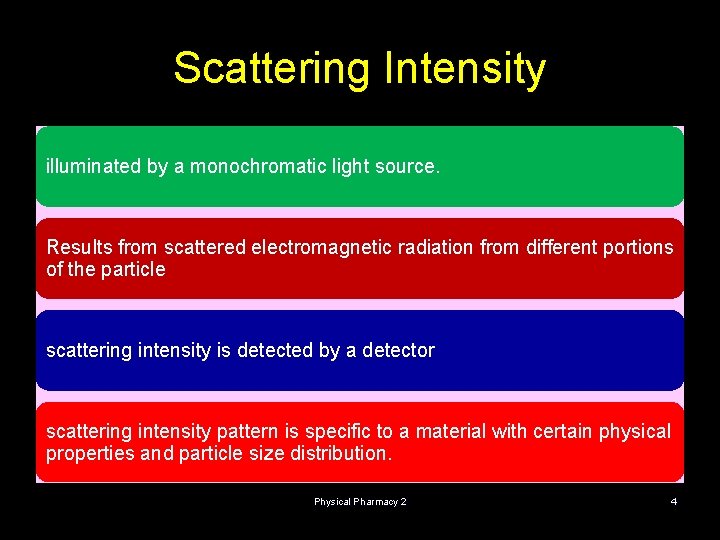
Scattering Intensity illuminated by a monochromatic light source. Results from scattered electromagnetic radiation from different portions of the particle scattering intensity is detected by a detector scattering intensity pattern is specific to a material with certain physical properties and particle size distribution. Physical Pharmacy 2 4
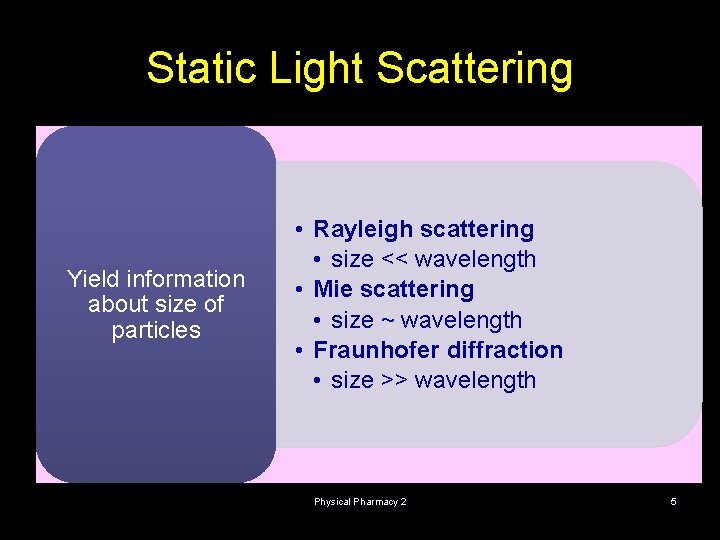
Static Light Scattering Yield information about size of particles • Rayleigh scattering • size << wavelength • Mie scattering • size ~ wavelength • Fraunhofer diffraction • size >> wavelength Physical Pharmacy 2 5
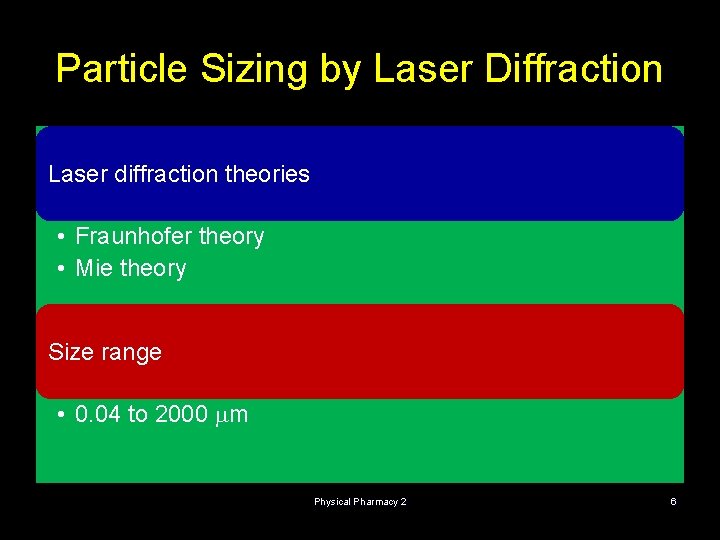
Particle Sizing by Laser Diffraction Laser diffraction theories • Fraunhofer theory • Mie theory Size range • 0. 04 to 2000 m Physical Pharmacy 2 6
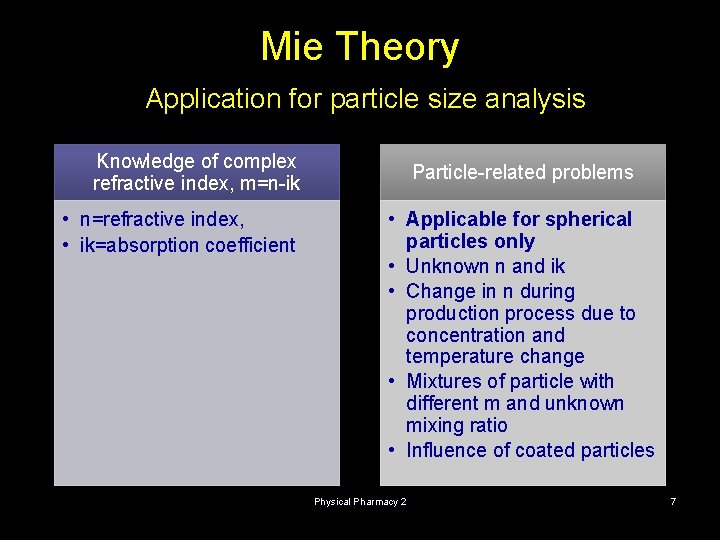
Mie Theory Application for particle size analysis Knowledge of complex refractive index, m=n-ik • n=refractive index, • ik=absorption coefficient Particle-related problems • Applicable for spherical particles only • Unknown n and ik • Change in n during production process due to concentration and temperature change • Mixtures of particle with different m and unknown mixing ratio • Influence of coated particles Physical Pharmacy 2 7
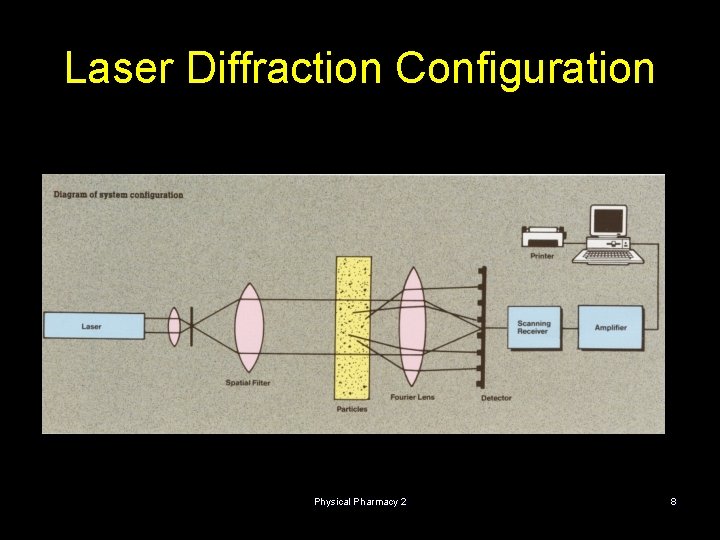
Laser Diffraction Configuration Physical Pharmacy 2 8
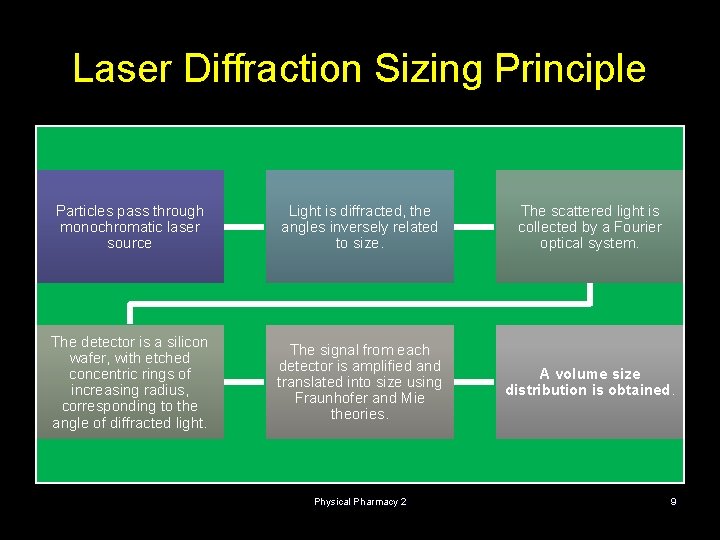
Laser Diffraction Sizing Principle Particles pass through monochromatic laser source Light is diffracted, the angles inversely related to size. The scattered light is collected by a Fourier optical system. The detector is a silicon wafer, with etched concentric rings of increasing radius, corresponding to the angle of diffracted light. The signal from each detector is amplified and translated into size using Fraunhofer and Mie theories. A volume size distribution is obtained. Physical Pharmacy 2 9
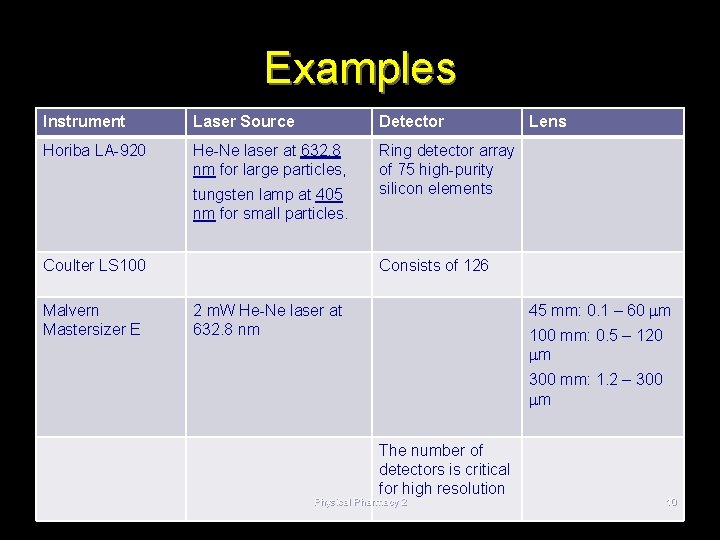
Examples Instrument Laser Source Detector Horiba LA-920 He-Ne laser at 632. 8 nm for large particles, Ring detector array of 75 high-purity silicon elements tungsten lamp at 405 nm for small particles. Coulter LS 100 Malvern Mastersizer E Lens Consists of 126 45 mm: 0. 1 – 60 m 2 m. W He-Ne laser at 632. 8 nm 100 mm: 0. 5 – 120 m 300 mm: 1. 2 – 300 m The number of detectors is critical for high resolution Physical Pharmacy 2 10
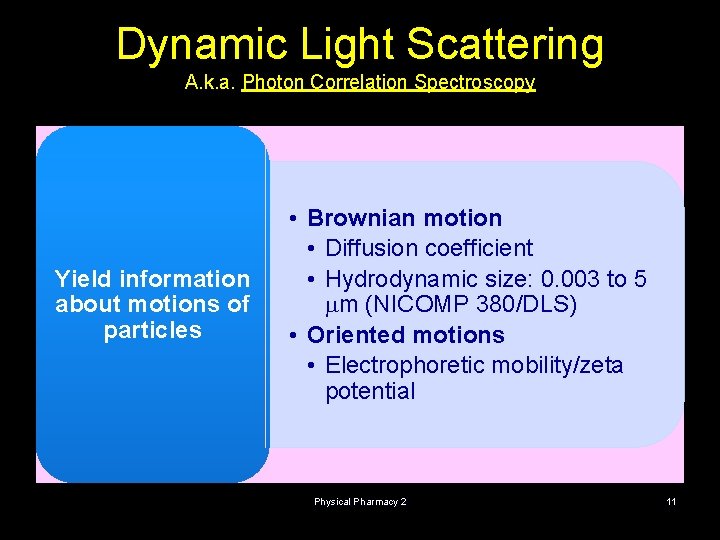
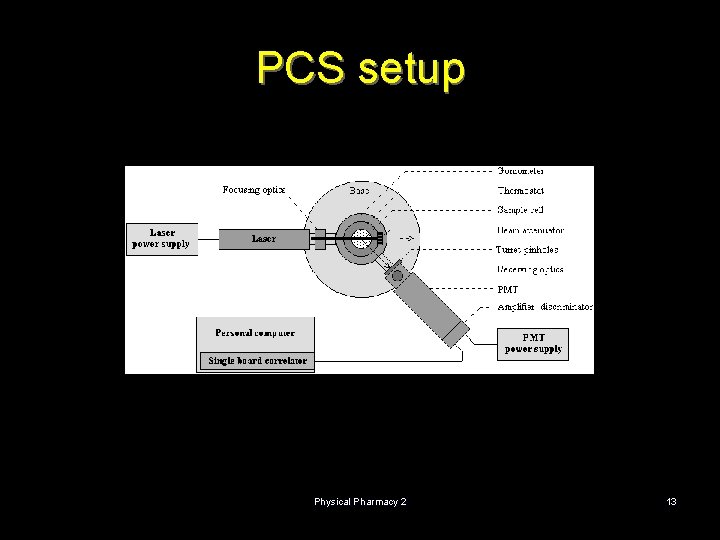
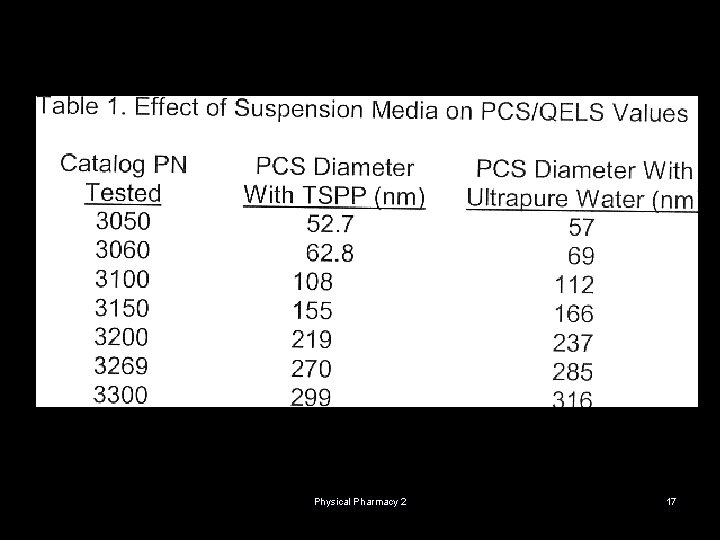
Dynamic Light Scattering A. k. a. Photon Correlation Spectroscopy Yield information about motions of particles • Brownian motion • Diffusion coefficient • Hydrodynamic size: 0. 003 to 5 m (NICOMP 380/DLS) • Oriented motions • Electrophoretic mobility/zeta potential Physical Pharmacy 2 11
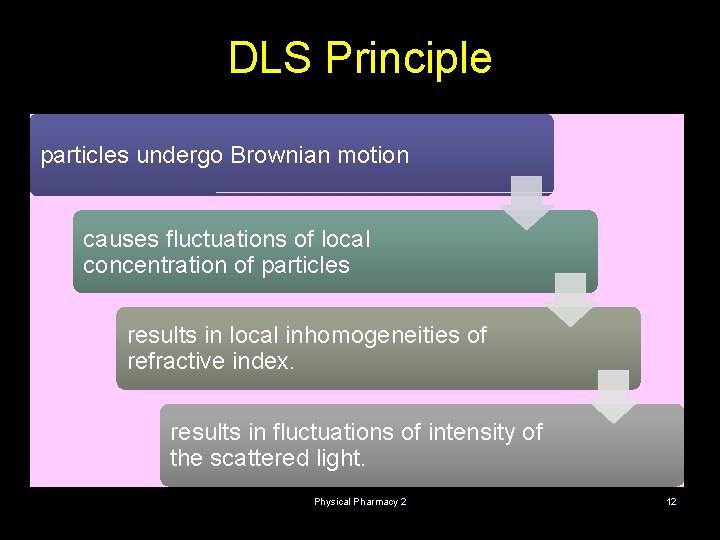
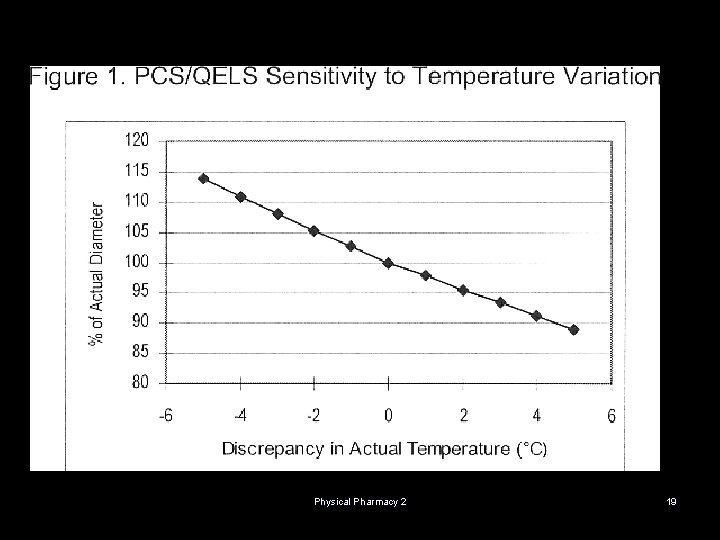
DLS Principle particles undergo Brownian motion causes fluctuations of local concentration of particles results in local inhomogeneities of refractive index. results in fluctuations of intensity of the scattered light. Physical Pharmacy 2 12
PCS setup Physical Pharmacy 2 13
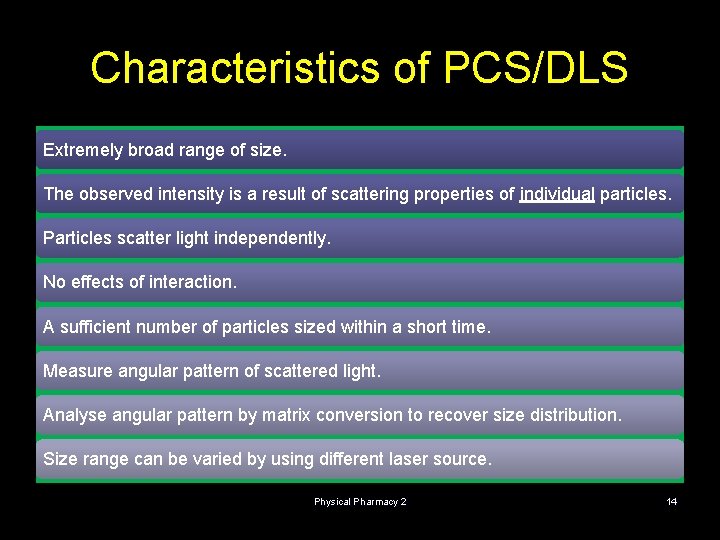
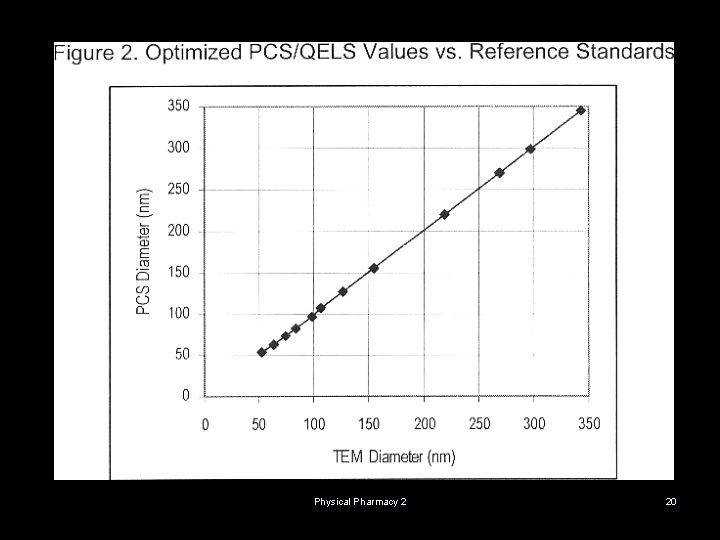
Characteristics of PCS/DLS Extremely broad range of size. The observed intensity is a result of scattering properties of individual particles. Particles scatter light independently. No effects of interaction. A sufficient number of particles sized within a short time. Measure angular pattern of scattered light. Analyse angular pattern by matrix conversion to recover size distribution. Size range can be varied by using different laser source. Physical Pharmacy 2 14
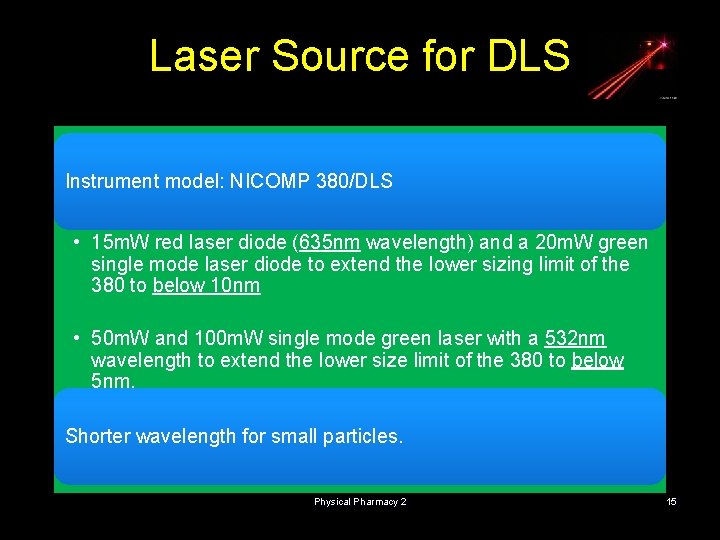
Laser Source for DLS Instrument model: NICOMP 380/DLS • 15 m. W red laser diode (635 nm wavelength) and a 20 m. W green single mode laser diode to extend the lower sizing limit of the 380 to below 10 nm • 50 m. W and 100 m. W single mode green laser with a 532 nm wavelength to extend the lower size limit of the 380 to below 5 nm. Shorter wavelength for small particles. Physical Pharmacy 2 15
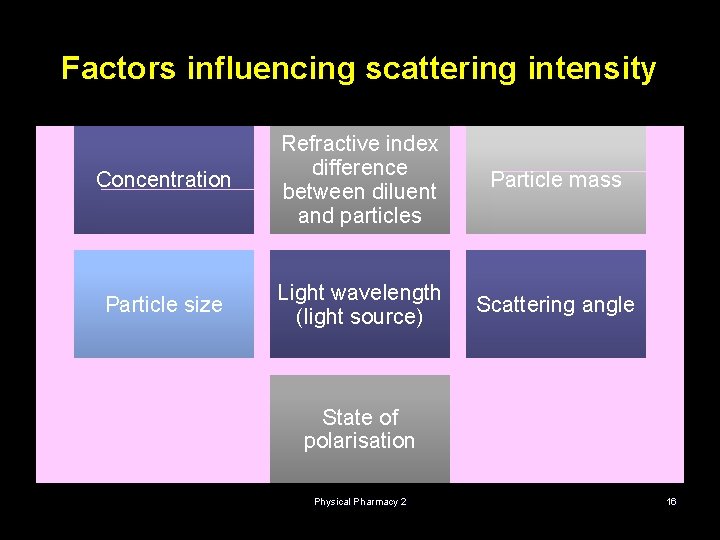
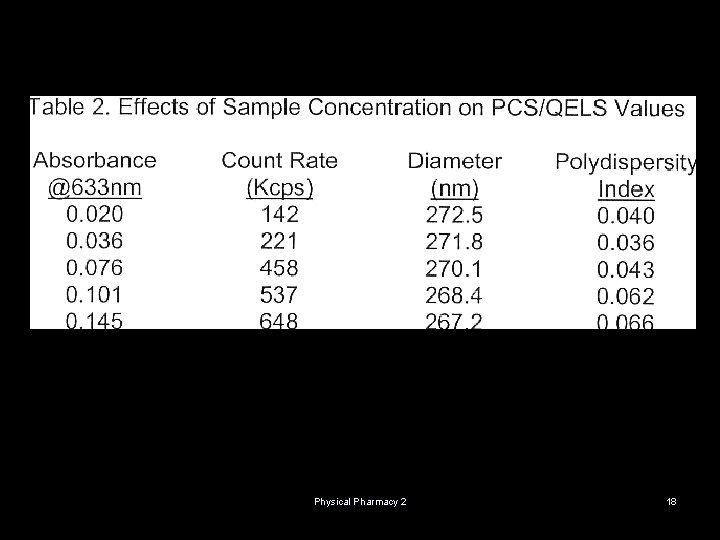
Factors influencing scattering intensity Concentration Refractive index difference between diluent and particles Particle mass Particle size Light wavelength (light source) Scattering angle State of polarisation Physical Pharmacy 2 16
Physical Pharmacy 2 17
Physical Pharmacy 2 18
Physical Pharmacy 2 19
Physical Pharmacy 2 20
References http: //www. photocor. com/photon_correlation_spectroscopy. htm SD Duke, RE Brown, EB Layendecker, “Calibration of spherical particles by light scattering”, Duke Scientific Corporation, Technical Note-002 B, May 15, 2000. Physical Pharmacy 2 21