
Particle size distribution A particle population which consists
Particle size distribution • A particle population which consists of spheres or equivalent spheres with uniform dimensions is monosized and its characteristics can be described by a single diameter or equivalent diameter. • it is unusual for particles to be completely monosized, most powders contain particles with a large number of different equivalent diameters.
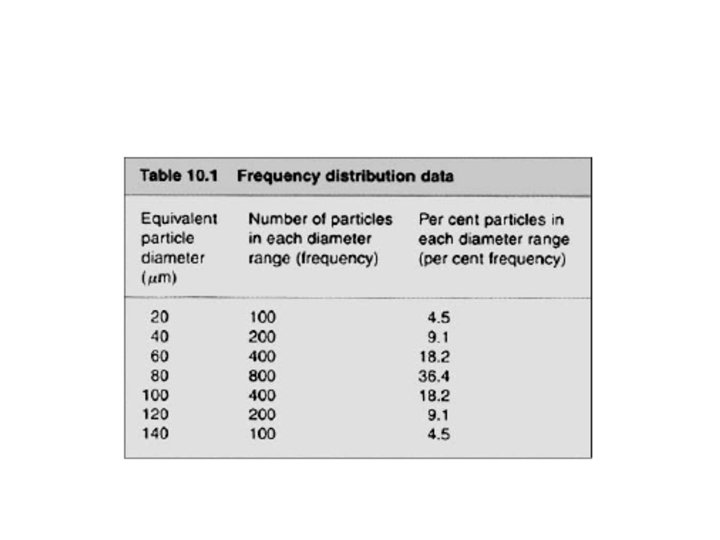
• to be able to define a size distribution or compare the characteristics of two or more powders consisting of particles with many different diameters, the size distribution can be broken down into different size ranges, which can be presented in the form of a histogram
• a histogram presents an interpretation of the particle size distribution and enables the percentage of particles having a given equivalent diameter to be determined. • A histogram representation allows different particle size distributions to be compared;
• for example, the size distribution shown in Fig. (b) contains a larger proportion of fine particles than the powder in (a) in which the particles are normally distributed. • The peak frequency value, known as the mode, separates the normal curve into two identical halves, because the size distribution is fully symmetrical.
• A frequency curve with an elongated tail towards higher size ranges is positively skewed (Fig. (b)); the reverse case exhibits negative skewness. • These skewed distributions can sometimes be normalized by replotting the equivalent particle diameters using a logarithmic scale, and are thus usually referred to as log normal distributions.
• In some size distributions more than one mode occurs: Figure (c) shows bimodal frequency distribution for a powder which has been subjected to milling. • Some of the coarser particles from the unmilled population remain unbroken and produce a mode towards the highest particle size, whereas the fractured particles have a new mode which appears lower down the size range.
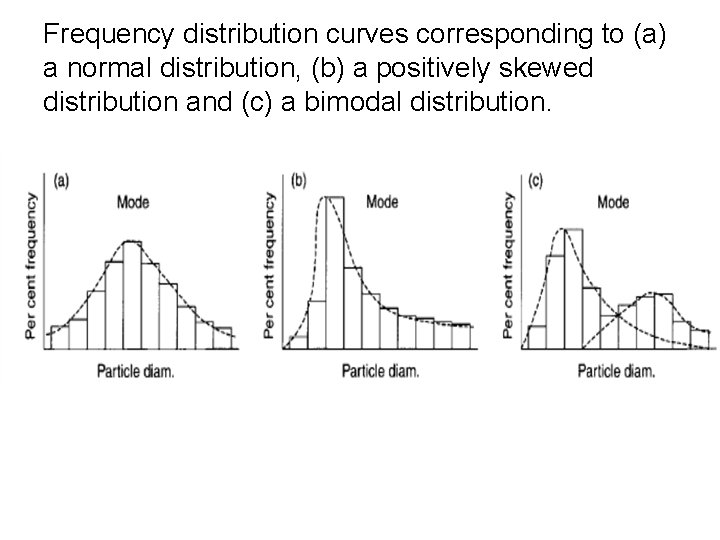
Frequency distribution curves corresponding to (a) a normal distribution, (b) a positively skewed distribution and (c) a bimodal distribution.
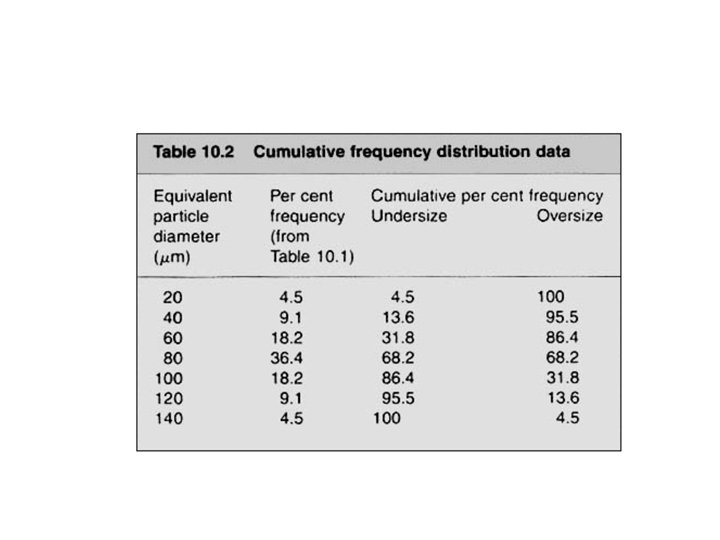
• An alternative to the histogram representation of a particle size distribution is obtained by sequentially adding the percent frequency values as shown in Table 10. 2 to produce a cumulative percent frequency distribution. • If the addition sequence begins with the coarsest particles, the values obtained will be cumulative percent frequency oversize; the reverse case produces a cumulative percent undersize.
• The median particle diameter corresponds to the point that separates the cumulative frequency curve into two equal halves, above and below which 50% of the particles lie (point a in Fig. 10. 5(a)). • the lower and upper quartile points at 25% and 75% divide the upper and lower ranges of a symmetrical curve into equal parts (points b and c, respectively, in Fig. 10. 5(a)).
• it is possible to compare two or more particle populations using the cumulative distribution representation. • For example, the size distribution in Fig. (a) shows that this powder has a larger range or spread of equivalent diameters than the powder represented in Figure (b).
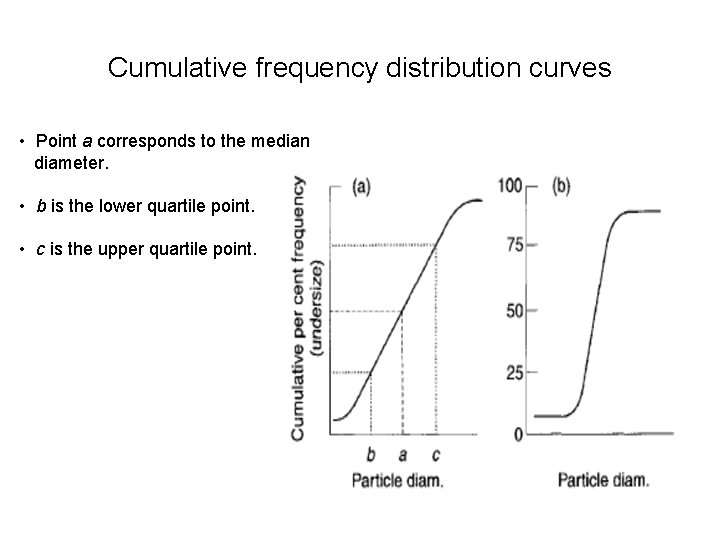
Cumulative frequency distribution curves • Point a corresponds to the median diameter. • b is the lower quartile point. • c is the upper quartile point.
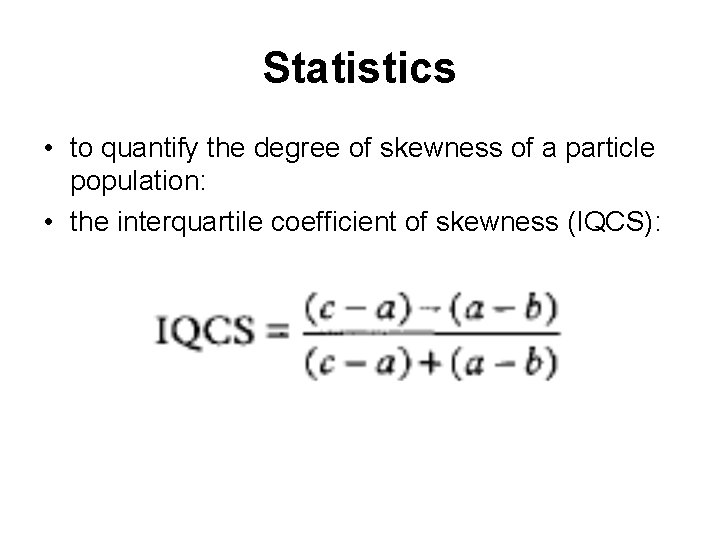
Statistics • to quantify the degree of skewness of a particle population: • the interquartile coefficient of skewness (IQCS):
• • Where: a is the median diameter b is the lower quartile point c is upper quartile point • The IQCS can take any value between -1 and +1. • If the IQCS is zero then the size distribution is practically symmetrical between the quartile points.
• To quantify the degree of symmetry of a particle size distribution a property known as kurtosis can be determined. • The symmetry of a distribution is based on a comparison of the height or thickness of the tails and the 'sharpness' of the peaks with those of a normal distribution.
• 'Thick'-tailed 'sharp‘ peaked curves are described as leptokurtic • 'thin'-tailed 'blunt' peaked curves are platykurtic • the normal distribution is mesokurtic.
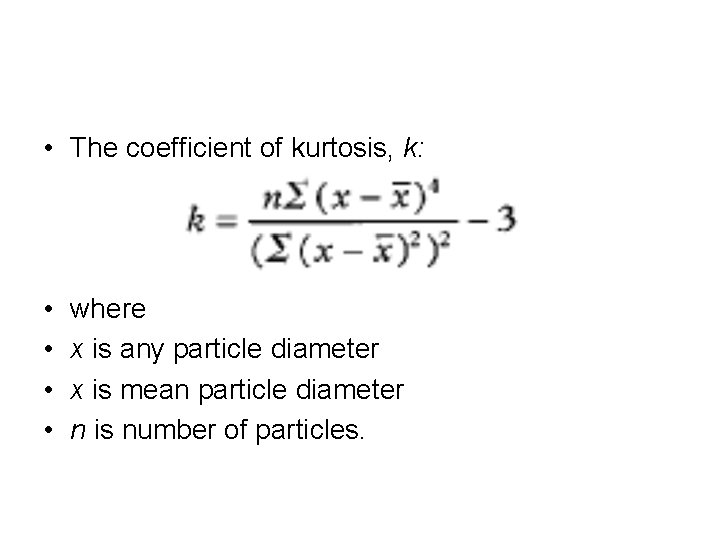
• The coefficient of kurtosis, k: • • where x is any particle diameter x is mean particle diameter n is number of particles.
• The coefficient of kurtosis has: • a value of 0 for a normal curve. • a negative value for curves showing platykurtosis. • positive values for leptokurtic size distributions.
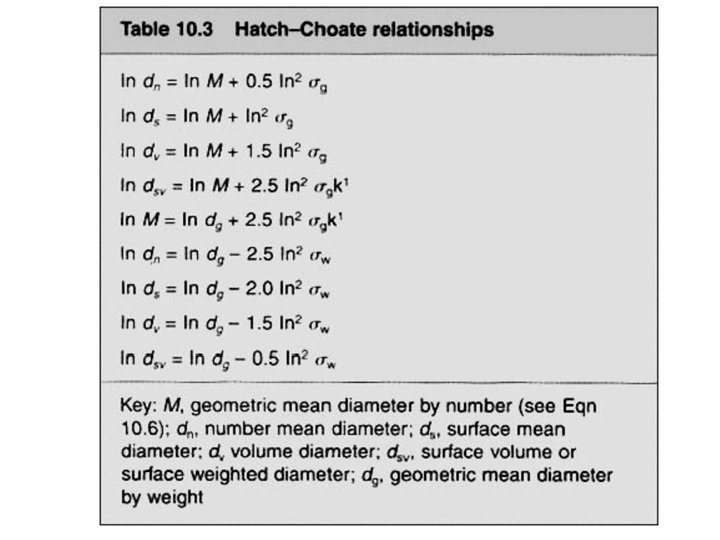
• The mean of the particle population, the median and the mode are all measures of central tendency and provide a single value near the middle of the size distribution, which represents a central particle diameter. • It is also possible to define and determine the mean in several ways and, for log-normal distributions, a series of relationships known as Hatch- Choate equations link the different mean diameters of a size distribution.
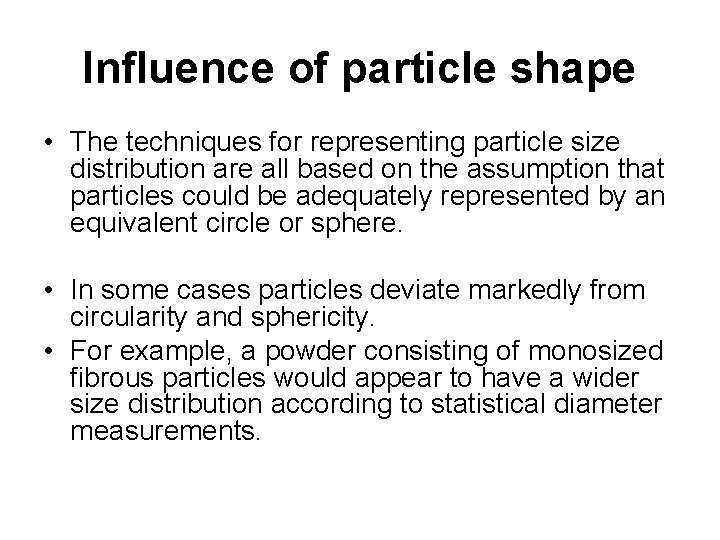
Influence of particle shape • The techniques for representing particle size distribution are all based on the assumption that particles could be adequately represented by an equivalent circle or sphere. • In some cases particles deviate markedly from circularity and sphericity. • For example, a powder consisting of monosized fibrous particles would appear to have a wider size distribution according to statistical diameter measurements.
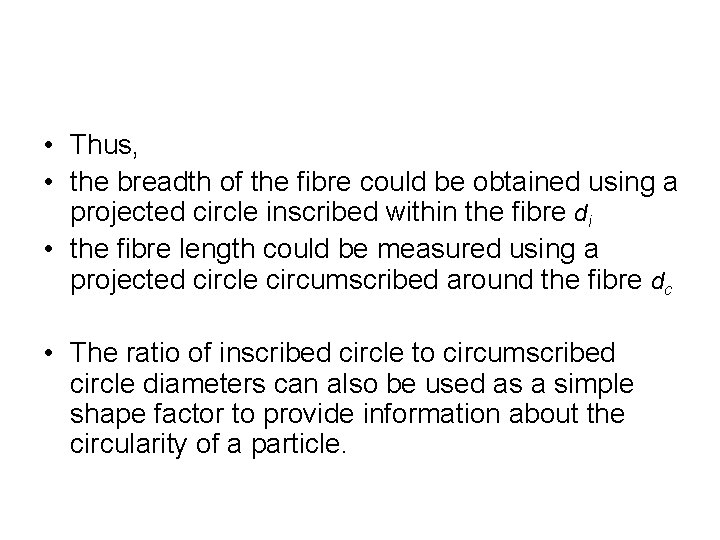
• Thus, • the breadth of the fibre could be obtained using a projected circle inscribed within the fibre di • the fibre length could be measured using a projected circle circumscribed around the fibre dc • The ratio of inscribed circle to circumscribed circle diameters can also be used as a simple shape factor to provide information about the circularity of a particle.
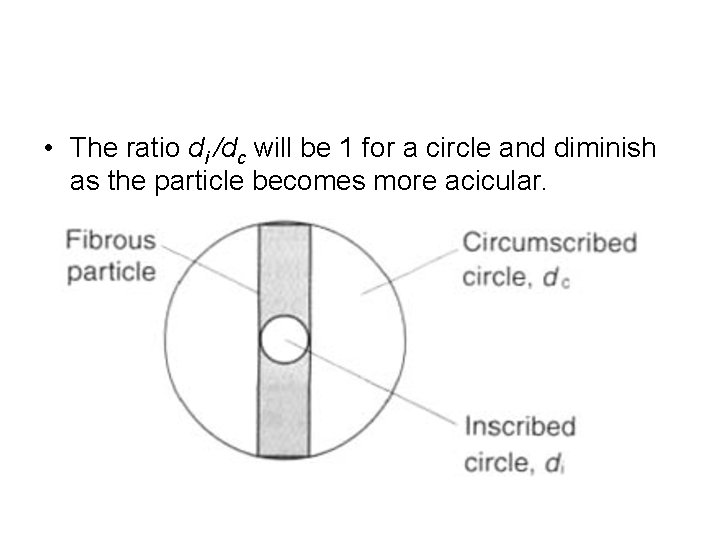
• The ratio di /dc will be 1 for a circle and diminish as the particle becomes more acicular.
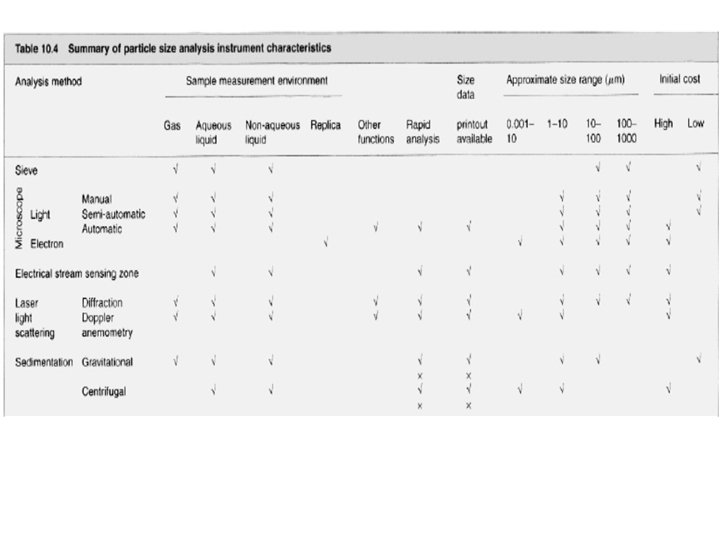
PARTICLE SIZE ANALYSIS METHODS • Particle-size analysis methods can be divided into different categories based on several different criteria: • • size range of analysis; wet or dry methods; manual or automatic methods; speed of analysis.
1. Sieve methods 2. Microscope methods 3. Electrical stream sensing zone method (Coulter counter) 4. Laser light scattering methods 5. Sedimentation methods
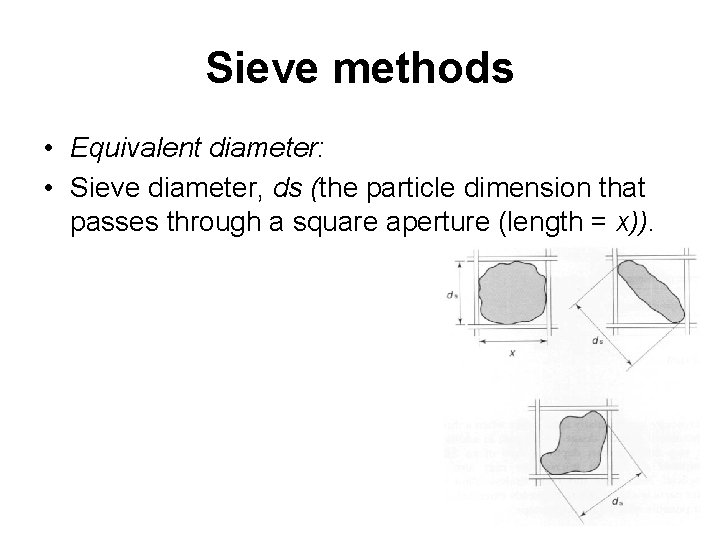
Sieve methods • Equivalent diameter: • Sieve diameter, ds (the particle dimension that passes through a square aperture (length = x)).
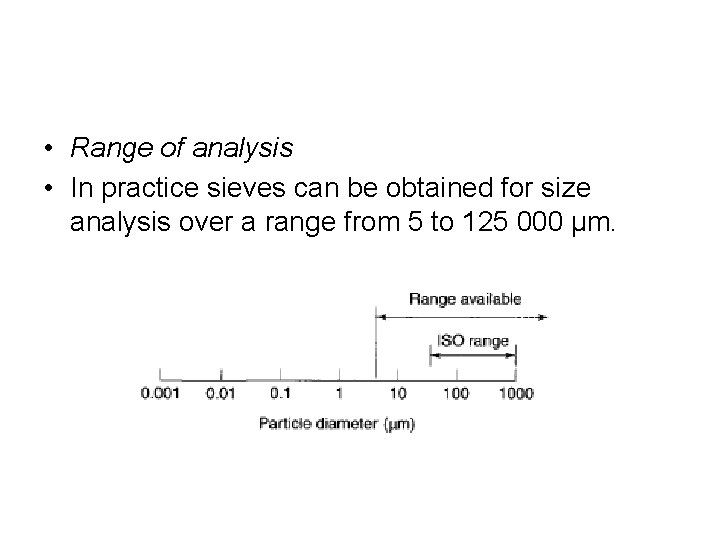
• Range of analysis • In practice sieves can be obtained for size analysis over a range from 5 to 125 000 µm.
• Principle of measurement: • Sieve analysis utilizes a woven, punched or electroformed mesh, often in brass or stainless steel, with known aperture diameters which form a physical barrier to particles. • Most sieve analyses utilize a series, stack or 'nest' of sieves, which has the smallest mesh above a collector tray followed by meshes that become progressively coarser towards the top of the series.
• A sieve stack usually comprises 6 -8 sieves with an aperture progression based on a √ 2 or 2√ 2 change in diameter between adjacent sieves. • Powder is loaded on to the coarsest sieve of the assembled stack and the nest is subjected to mechanical vibration.
• After a suitable time the particles are considered to be retained on the sieve mesh with an aperture corresponding to the sieve diameter. • Sieving times should not be arbitrary and it is recommended that sieving be continued until less than 0. 2% of material passes a given sieve aperture in any 5 -minute interval.
• Alternative techniques: • Another form of sieve analysis, called air-jet sieving, • uses individual sieves rather than a complete nest of sieves. • Starting with the finest-aperture sieve and progressively removing the undersize particle fraction by sequentially increasing the apertures of each sieve.
• Particles are encouraged to pass through each aperture under the influence of a partial vacuum applied below the sieve mesh. • A reverse air jet circulates beneath the sieve mesh, blowing oversize particles away from the mesh to prevent blocking. • Air-jet sieving is often more efficient and reproducible than using mechanically vibrated sieve analysis, although with finer particles agglomeration can become a problem.
• Automatic methods: • Sieve analysis is still largely a non-automated process, although an automated wet sieving technique has been described.
Microscope methods (microscopy) • Equivalent diameters: • • Projected area diameter, da projected perimeter diameter dp Feret's diameter d. F Martin's diameter d. M
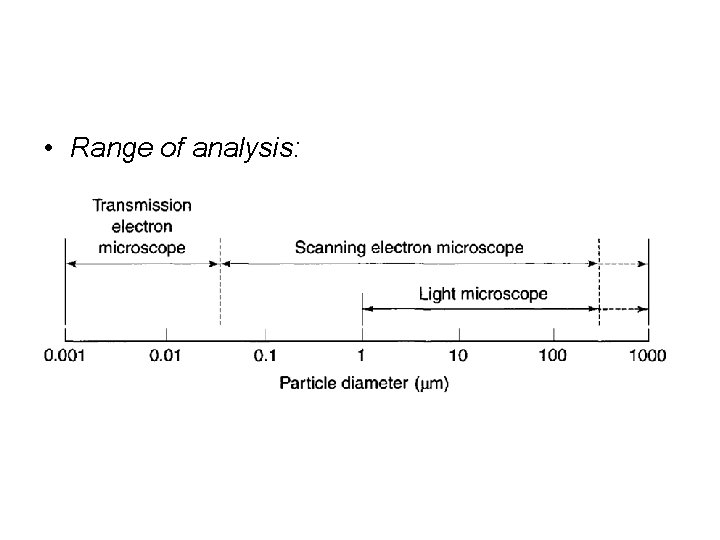
• Range of analysis:
• Sample preparation and analysis conditions: • Specimens prepared for light microscopy must be adequately dispersed on a microscope slide to avoid analysis of agglomerated particles • Specimens for scanning electron microscopy are prepared by fixing to aluminium stubs before sputter coating with a film of gold a few nm in thickness. • Specimens for transmission electron microscopy are often set in resin, sectioned by microtome and supported on a metal grid before metallic coating.
• Principle of measurement: • Size analysis by light microscopy is carried out on the two-dimensional images of particles oriented in three dimensions. • for dendrites, fibres or flakes it is very improbable that the particles will orient with their minimum dimensions in the plane of measurement.
• Under such conditions, size analysis is carried out accepting that they are viewed in their most stable orientation. • This will lead to an overestimation of size, as the largest dimensions of the particle will be observed.
• The two-dimensional images are analysed according to the desired equivalent diameter. • Using a conventional light microscope, particlesize analysis can be carried out using a projection screen with screen distances related to particle dimensions by a previously derived calibration factor using a graticule.
• A graticule can also be used which has a series of opaque and transparent circles of different diameters, usually in a √ 2 progression. • Particles are compared with the two sets of circles and are sized according to the circle that corresponds most closely to the equivalent particle diameter being measured. • The field of view is divided into segments to facilitate measurement of different numbers of particles.
• Alternative techniques: • scanning electron microscopy (SEM). • transmission electron microscopy (TEM).
• Scanning electron microscopy is particularly appropriate when a three dimensional particle image is required; in addition. • Both SEM and TEM analysis allow the lower particle-sizing limit to be greatly extended over that possible with a light microscope.
• Automatic methods: • Semiautomatic methods use some form of precalibrated variable distance to split particles into different size ranges. • One technique, called a particle comparator, utilizes a variable diameter light spot projected on to a photomicrograph or electron photomicrograph of a particle under analysis.
• The variable iris controlling the light spot diameter is linked electronically to a series of counter memories, each corresponding to a different size range. • Alteration of the iris diameter causes the particle count to be directed into the appropriate counter memory following activation of a switch by the operator.
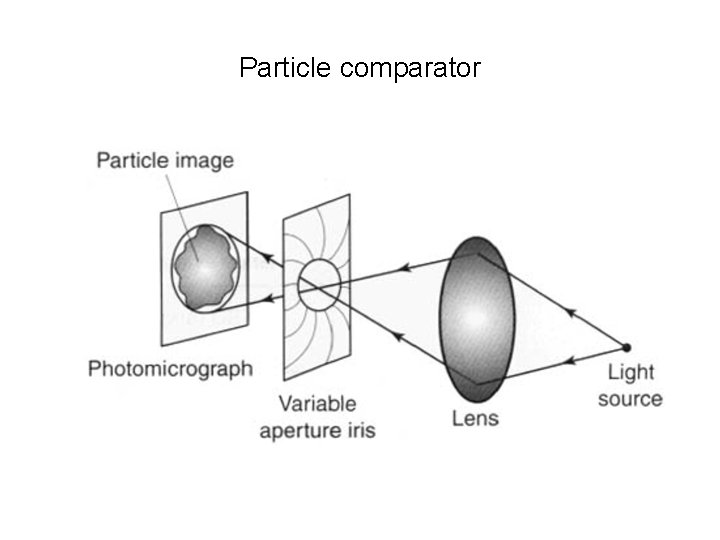
Particle comparator
• A second technique uses a double-prism arrangement mounted in place of the light microscope eyepiece. • The image from the prisms is usually displayed on a video monitor. • The double-prism arrangement allows light to pass through to the monitor unaltered, where the usual single particle image is produced.
• When the prisms are sheared against one another a double image of each particle is produced and the separation of the split images corresponds to the degree of shear between the prisms. • Particle-size analysis can be carried out by shearing the prisms until the two images of a single particle make touching contact. • The prism shearing mechanism is linked to a precalibrated micrometer scale from which the equivalent diameter can be read directly.
• Alternatively, a complete size distribution can be obtained more quickly by subjecting the prisms to a sequentially increased and decreased shear distance between two preset levels corresponding to a known size range. • All particles whose images separate and overlap sequentially under a given shear range are considered to fall in this size range, and are counted by operating a switch which activates the appropriate counter memory.
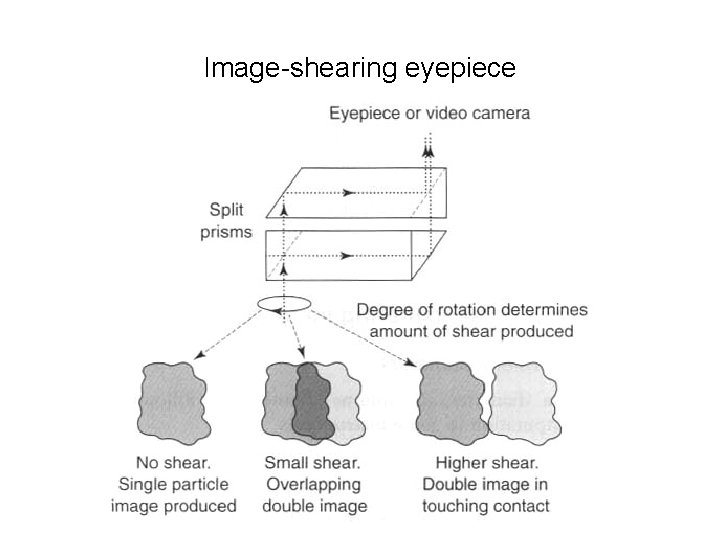
Image-shearing eyepiece
• Automatic microscopy is usually associated with microprocessor-controlled manipulation of an analogue signal derived from some form of video monitor used to image particles directly from a light microscope or from photomicrographs of particles.
• fully automatic size analysis has the advantage of: 1. being more objective, 2. very much faster, 3. enables a much wider variety of size and shape parameters to be processed.
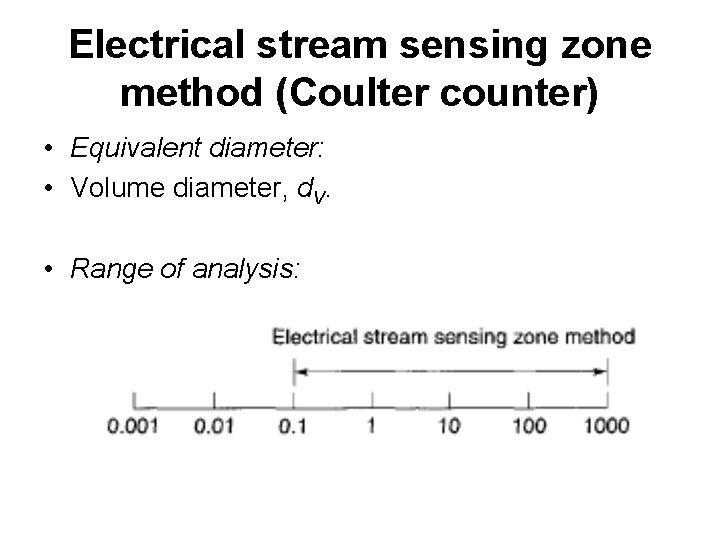
Electrical stream sensing zone method (Coulter counter) • Equivalent diameter: • Volume diameter, d. V. • Range of analysis:
• Sample preparation and analysis conditions: • Powder samples are dispersed in an electrolyte to form a very dilute suspension. • The suspension is usually subjected to ultrasonic agitation for a period to break up any particle agglomerates. • A dispersant may also be added to aid particle deagglomeration.
• Principle of measurement: • The particle suspension is drawn through an aperture accurately drilled through a sapphire crystal set into the wall of a hollow glass tube. • Electrodes situated on either side of the aperture and surrounded by an electrolyte solution, monitor the change in electrical signal that occurs when a particle momentarily occupies the orifice and displaces its own volume of electrolyte.
• The volume of suspension drawn through the orifice is determined by the suction potential created by a mercury thread rebalancing in a convoluted U-tube. • The volume of electrolyte fluid which is displaced in the orifice by the presence of a particle causes a change in electrical resistance between the electrodes that is proportional to the volume of the particle.
• The change in resistance is converted into a voltage pulse which is amplified and processed electronically. • Pulses falling within precalibrated limits or thresholds are used to split the particle size distribution into many different size ranges.
• In order to carry out size analysis over a wide diameter range it will be necessary to change the orifice diameter used, to prevent coarser particles blocking a small-diameter orifice. • Conversely, finer particles in a large-diameter orifice will cause too small a relative change in volume to be accurately quantified.
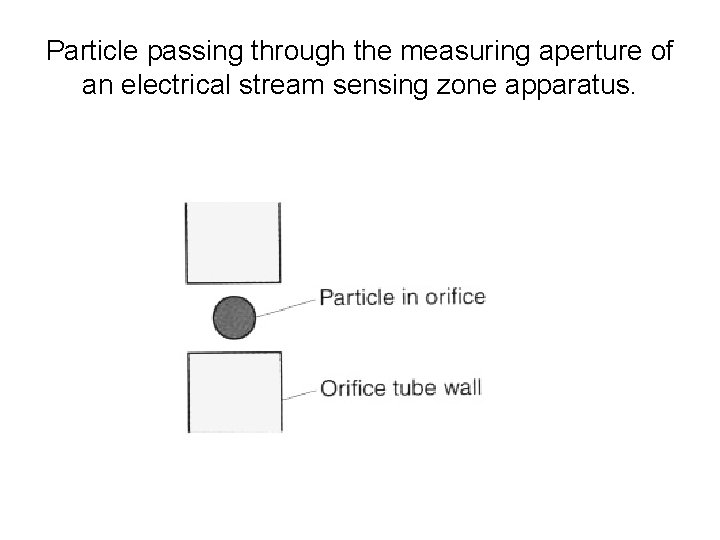
Particle passing through the measuring aperture of an electrical stream sensing zone apparatus.
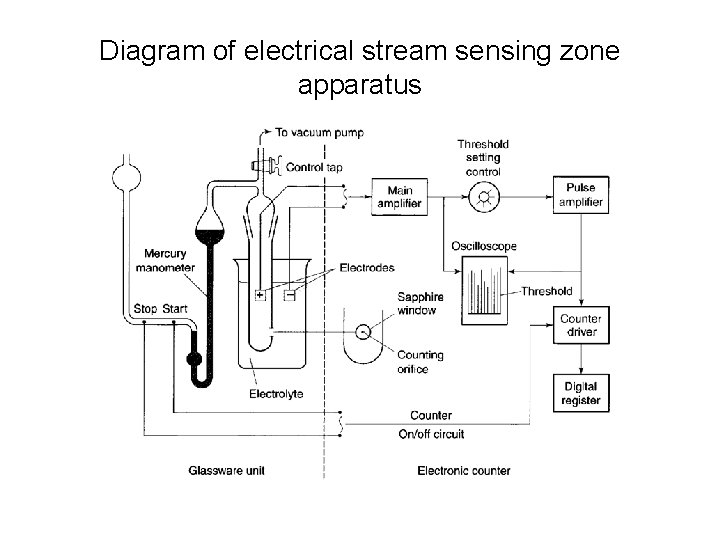
Diagram of electrical stream sensing zone apparatus
• Alternative techniques: • use of alternative orifice designs and hydrodynamic focusing, but in general the particle detection technique remains the same. • Another type of stream sensing analyser utilizes the attenuation of a light beam by particles drawn through the sensing zone
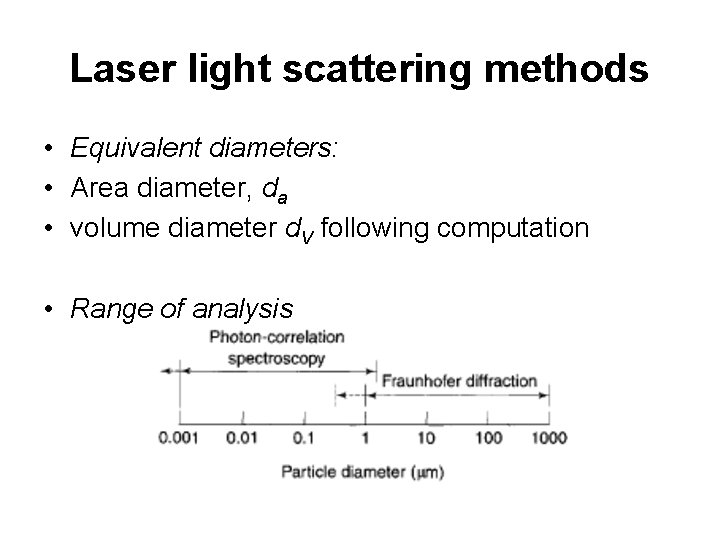
Laser light scattering methods • Equivalent diameters: • Area diameter, da • volume diameter d. V following computation • Range of analysis
• Sample preparation and analysis conditions: • Depending on the type of measurement to be carried out and the instrument used, particles can be presented either in liquid or in air suspension.
• Principles of measurement: • Both the large-particle and small-particle analysers are based on the interaction of laser light with particles. • Fraunhofer diffraction • For particles that are much larger than the wavelength of light, any interaction with particles causes light to be scattered in a forward direction with only a small change in angle.
• This phenomenon is known as Fraunhofer diffraction, and produces light intensity patterns that occur at regular angular intervals and are proportional to the particle diameter producing the scatter. • The composite diffraction pattern produced by different diameter particles may be considered to be the sum of all the individual patterns produced by each particle in the size distribution.
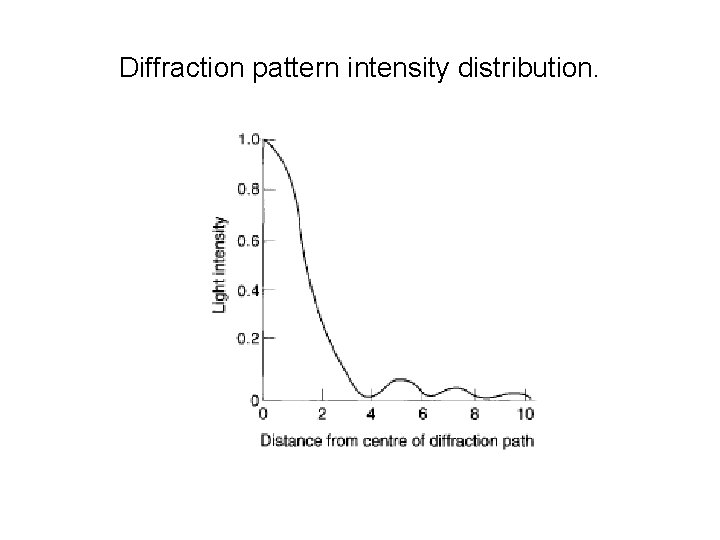
Diffraction pattern intensity distribution.
• Light emitted by a helium-neon laser is incident on the sample of particles and diffraction occurs. • In some cases the scattered light is focused by a lens directly on to a photodetector, which converts the signals into an equivalent area diameter.
• In other cases the scattered light is directed by a lens on to a rotating filter, which is used to convert equivalent area diameters into volume diameters which are quantified by final focusing on to a photodetector using a second lens. • The light flux signals occurring on the photodetector are converted into electrical current, which is digitized and processed into size distribution data using a microprocessor.
• Small particle sizes can be analysed based on light diffraction or by photon correlation spectroscopy.
• As particles approach the dimension of the wavelength of the light, some light is still scattered in the forward direction, according to Mie scatter theory, but there is also some side scatter at different wavelengths and polarizations.
• In the case of photon-correlation spectroscopy (PCS) the principle of Brownian motion is used to measure particle size. • PCS analyses the constantly changing patterns of laser light scattered or diffracted by particles in Brownian motion and monitors the rate of change of scattered light during diffusion.
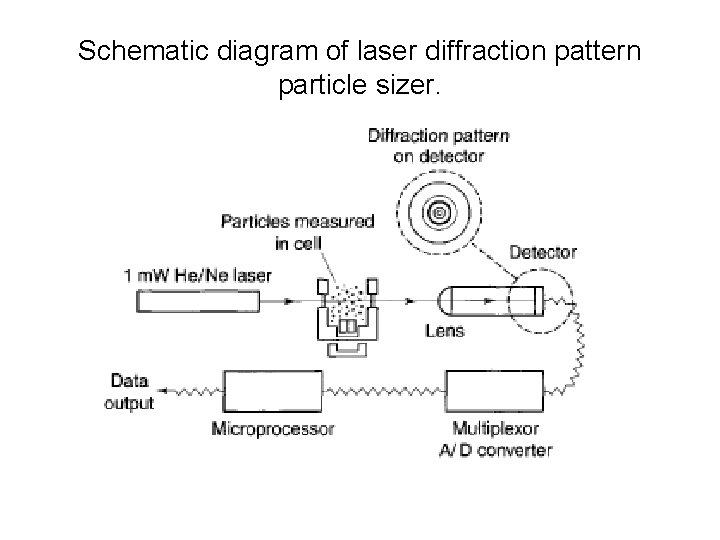
Schematic diagram of laser diffraction pattern particle sizer.
• Alternative techniques: • based on laser Doppler anemometry or velocimetry, and diffraction measurements. • The instruments vary according to their ability to characterize different particle-size ranges, produce complete size distributions, measure both solid and liquid particles, determine molecular weights, diffusion coefficients, zeta potential or electrophoretic mobility.
• Automatic methods: • Most of the instruments based on laser light scattering produce a full particle-size analysis automatically. • The data are often presented in graphical and tabular form.
Sedimentation methods • Equivalent diameters: 1. dfd, frictional drag diameter, a sphere having an equivalent drag force to a particle of the same diameter in the same fluid at the same velocity. 2. dst, Stokes diameter, the diameter of a particle measured during sedimentation at constant rate in laminar flow conditions.
• Range of analysis:
• Sample preparation and analysis conditions: • Particle-size distributions can be determined by examining the powder as it sediments out. • In cases where the powder is not uniformly dispersed in a fluid it can be introduced as a thin layer on the surface of the liquid.
• If the powder is hydrophobic it may be necessary to add a dispersing agent to aid wetting. • In cases where the powder is soluble in water it will be necessary to use non-aqueous liquids, or carry out the analysis in a gas.
• • Principles of measurement: two main categories according to the method of measurement used. 1. One type is based on measurement of particles in a retention zone. 2. second type uses a non-retention measurement zone.
non-retention zone measurement • the pipette method. • known volumes of suspension are drawn off and the concentration differences are measured with respect to time. • The Andreasen fixed-position pipette consists of a 200 mm graduated cylinder which can hold about 500 m. L of suspension fluid.
• A pipette is located centrally in the cylinder and is held in position by a ground-glass stopper so that its tip coincides with the zero level. • A three-way tap allows fluid to be drawn into a 10 m. L reservoir, which can then be emptied into a beaker or centrifuge tube.
• The amount of powder can be determined by weight following drying or centrifuging; or chemical analysis of the particles. • The largest size present in each sample is then calculated from Stokes' equation. • Stokes' law is an expression of the drag factor in a fluid and is linked to the flow conditions characterized by a Reynolds number.
• three forces acting on a particle sedimenting in a gravitational field: 1. A drag force, Fd, acts upwards, 2. A buoyancy force, Fb; acts upwards, 3. Gravity force, Fg, acts as the driving force of sedimentation.
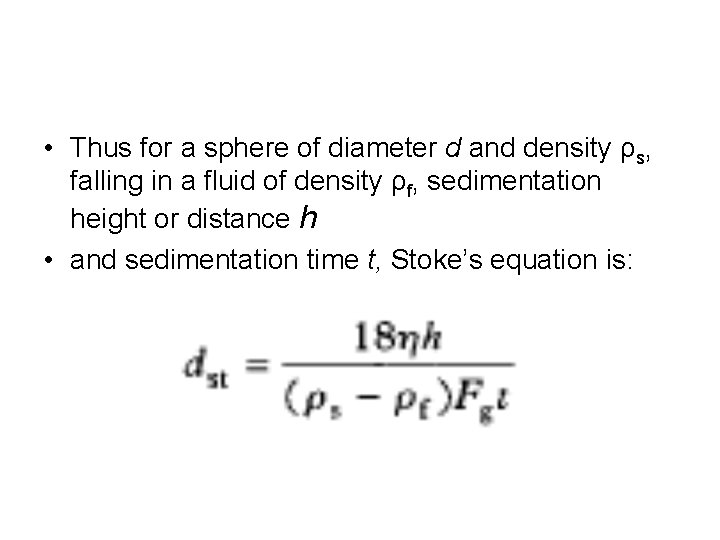
• Thus for a sphere of diameter d and density ρs, falling in a fluid of density ρf, sedimentation height or distance h • and sedimentation time t, Stoke’s equation is:
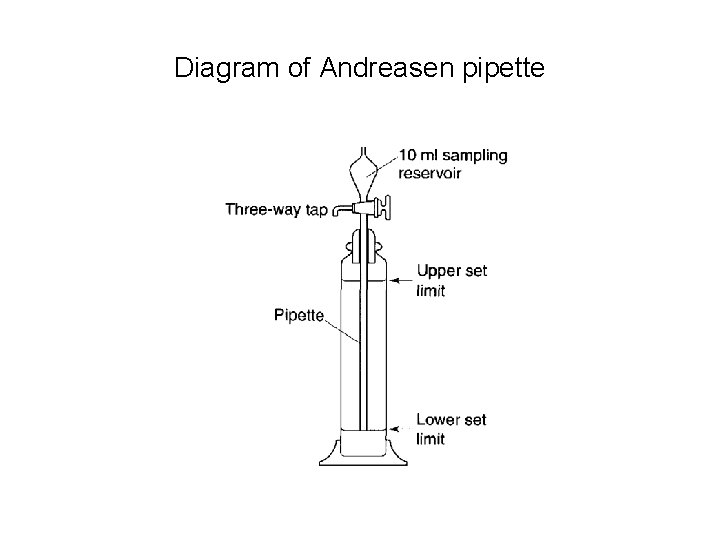
Diagram of Andreasen pipette
retention zone methods • also use Stokes' law to quantify particle size. • use a sedimentation balance. • the amount of sedimented particles falling on to a balance pan suspended in the fluid is recorded. • The continual increase in weight of sediment is recorded with respect to time.
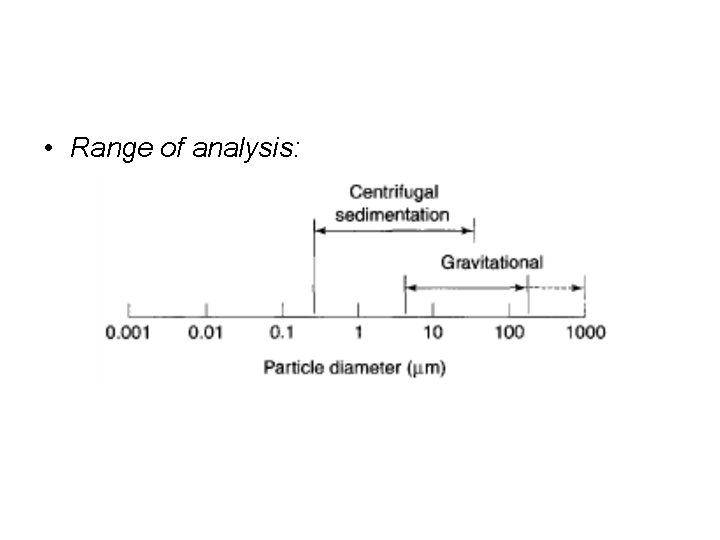
• Alternative techniques: • One of the limitations of gravitational sedimentation is that below a diameter of approximately 5µ particle settling becomes prolonged and is subject to interference from convection, diffusion and Brownian motion. • These effects can be minimized by increasing the driving force of sedimentation by replacing gravitational forces with a larger centrifugal force.
• sedimentation can be monitored by retention or non-retention methods. • Stokes equation requires modification because particles are subjected to different forces.
• A small quantity of concentrated suspension is introduced on to the surface of a bulk sedimentation liquid known as spin fluid. • Using this technique of disc centrifugation, all particles of the same size are in the same position in the centrifugal field and hence move with the same velocity.
• Automatic methods: • gravity sedimentation methods tend to be less automated than those using centrifugal forces. • a retention zone gravity sedimentation method is known as a Micromerograph and measures sedimentation of particles in a gas rather than a fluid. • The advantages of this method are that sizing is carried out relatively rapidly and the analysis is virtually automatic
SELECTION OF A PARTICLE SIZE ANALYSIS METHOD • • governed by: The properties of the powder particles The type of size information required. Analysis requirements such as: – speed of measurement – particle size data processing – the physical separation of different particlesize powders for subsequent processing.
• For example, size analysis over a very wide range of particle diameters may preclude the use of a gravity sedimentation method.
- Slides: 93