
Particle simulations of the global pulsar magnetosphere Shinpei
Particle simulations of the global pulsar magnetosphere Shinpei Shibata Department of Phys. Yamagata University shibata@sci. kj. yamagata-u. ac. jp Collaborators: Tomohide Wada and Shinya Yuki School of Science and Technology, Yamagata University
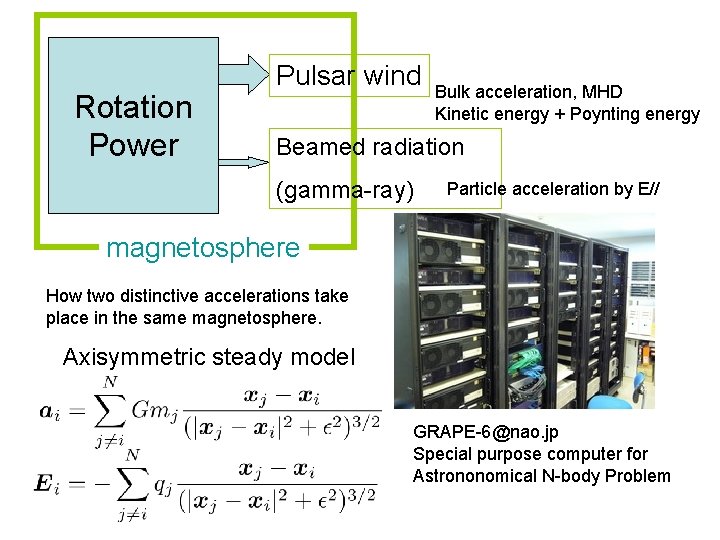
Rotation Power Pulsar wind Bulk acceleration, MHD Kinetic energy + Poynting energy Beamed radiation (gamma-ray) Particle acceleration by E// magnetosphere How two distinctive accelerations take place in the same magnetosphere. Axisymmetric steady model GRAPE-6@nao. jp Special purpose computer for Astrononomical N-body Problem
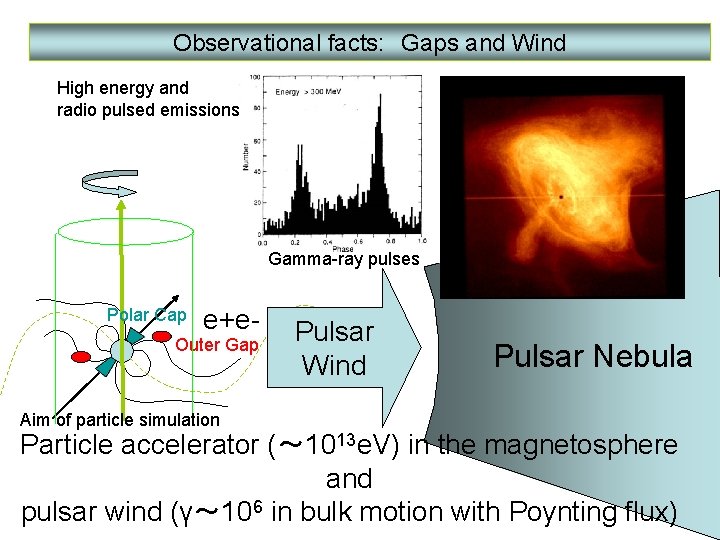
Observational facts: Gaps and Wind High energy and radio pulsed emissions Gamma-ray pulses Polar Cap e+e- Outer Gap Aim of particle simulation Pulsar Wind Pulsar Nebula Particle accelerator (~ 1013 e. V) in the magnetosphere and pulsar wind (γ~ 106 in bulk motion with Poynting flux)
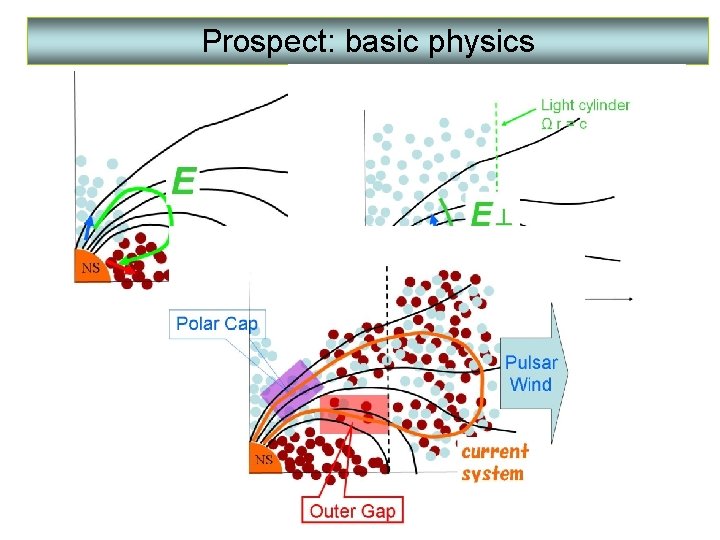
Prospect: basic physics Let us consider what happens around the rotating neutron star in the vacuum space.
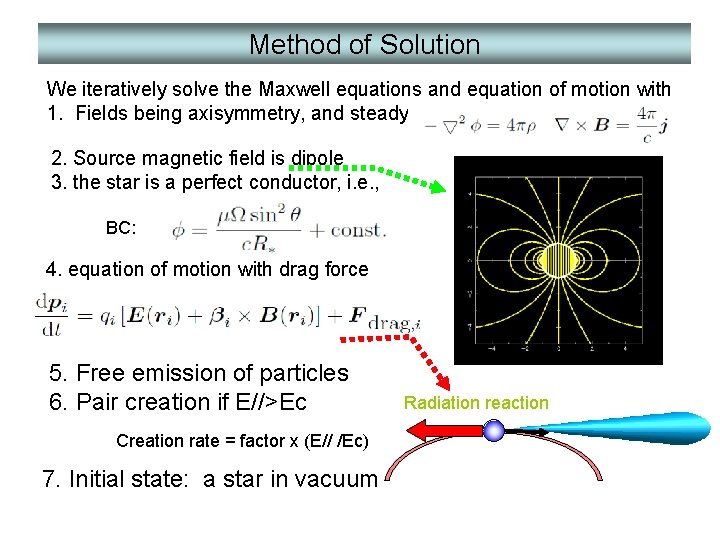
Method of Solution We iteratively solve the Maxwell equations and equation of motion with 1. Fields being axisymmetry, and steady: 2. Source magnetic field is dipole 3. the star is a perfect conductor, i. e. , BC: 4. equation of motion with drag force 5. Free emission of particles 6. Pair creation if E//>Ec Creation rate = factor x (E// /Ec) 7. Initial state: a star in vacuum Radiation reaction
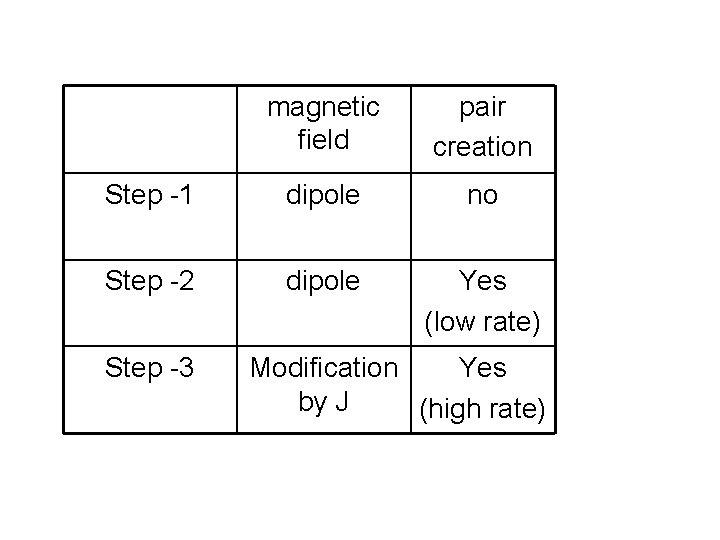
magnetic field pair creation Step -1 dipole no Step -2 dipole Yes (low rate) Step -3 Modification Yes by J (high rate)
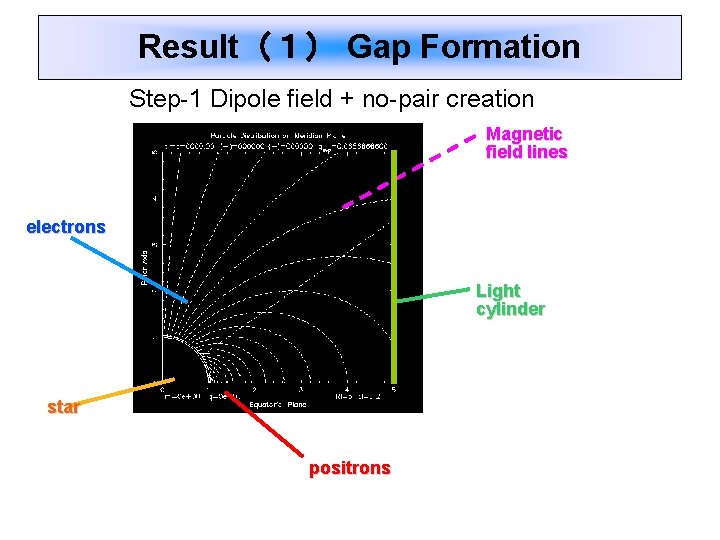
Result(1) Gap Formation Step-1 Dipole field + no-pair creation Magnetic field lines electrons Light cylinder star positrons
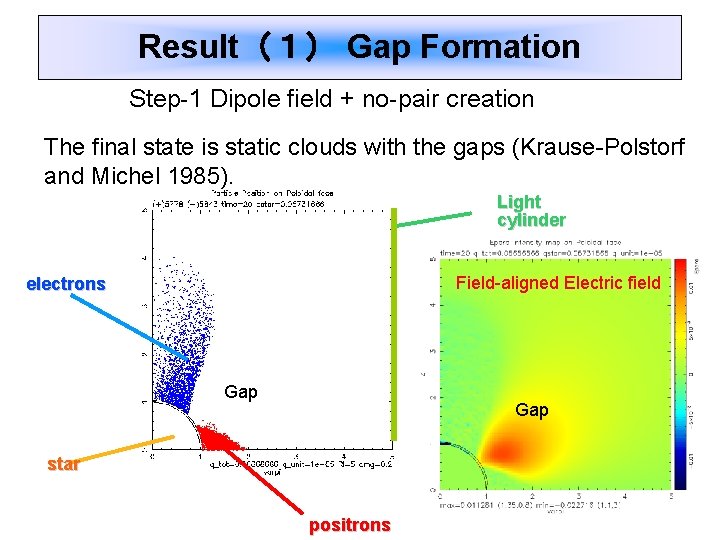
Result(1) Gap Formation Step-1 Dipole field + no-pair creation The final state is static clouds with the gaps (Krause-Polstorf and Michel 1985). Light cylinder Field-aligned Electric field electrons Gap star positrons
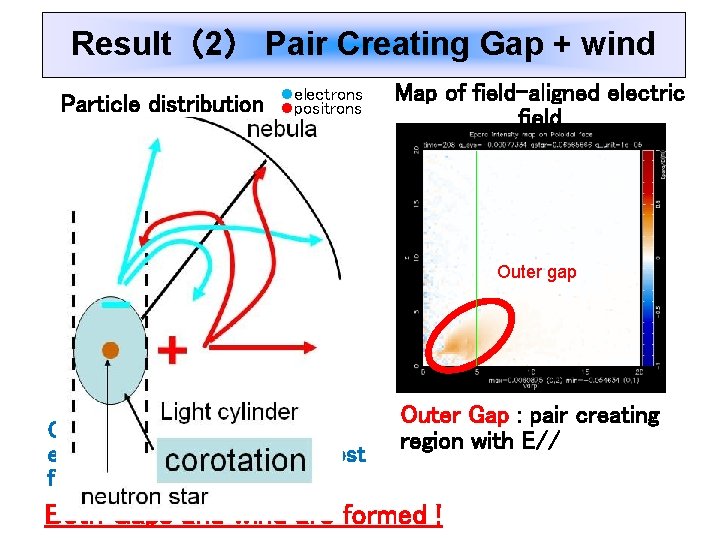
Result(2) Pair Creating Gap + wind Particle distribution 粒子分布 lelectrons lpositrons Map of field-aligned electric field Outer gap Outflow (equal amount of electrons and positrons are lost from the magnetosphere. Outer Gap : pair creating region with E// Both Gaps and wind are formed !
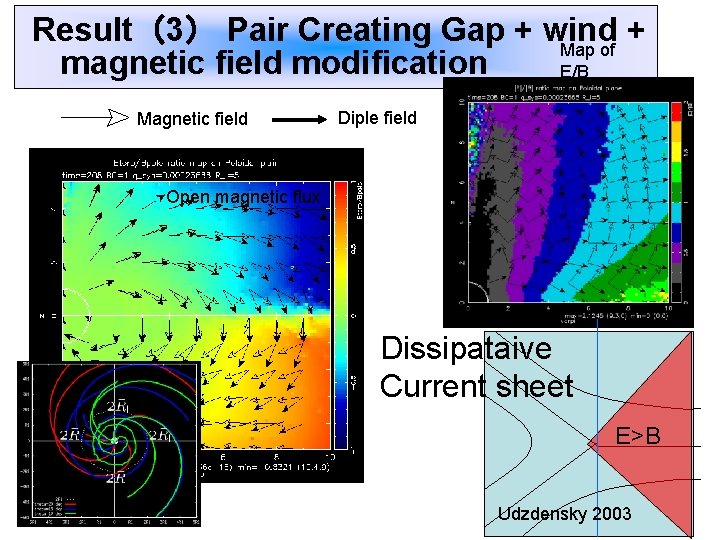
Result(3) Pair Creating Gap + wind + Map of magnetic field modification E/B Magnetic field Diple field Open magnetic flux Dissipataive Current sheet E>B Udzdensky 2003
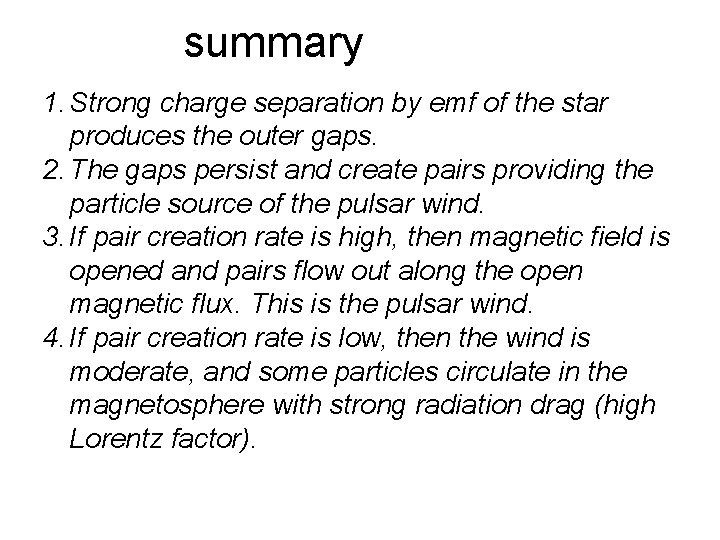
summary 1. Strong charge separation by emf of the star produces the outer gaps. 2. The gaps persist and create pairs providing the particle source of the pulsar wind. 3. If pair creation rate is high, then magnetic field is opened and pairs flow out along the open magnetic flux. This is the pulsar wind. 4. If pair creation rate is low, then the wind is moderate, and some particles circulate in the magnetosphere with strong radiation drag (high Lorentz factor).
- Slides: 11