
Particle Physics True or False The fundamental particles
![The 6 Quarks, when & where… Quark Date Where Mass [Ge. V/c 2] Comment](https://slidetodoc.com/presentation_image_h/102643bf0594637e97584459b4b5656c/image-10.jpg "The 6 Quarks, when & where… Quark Date Where Mass [Ge. V/c 2] Comment")
- Slides: 67
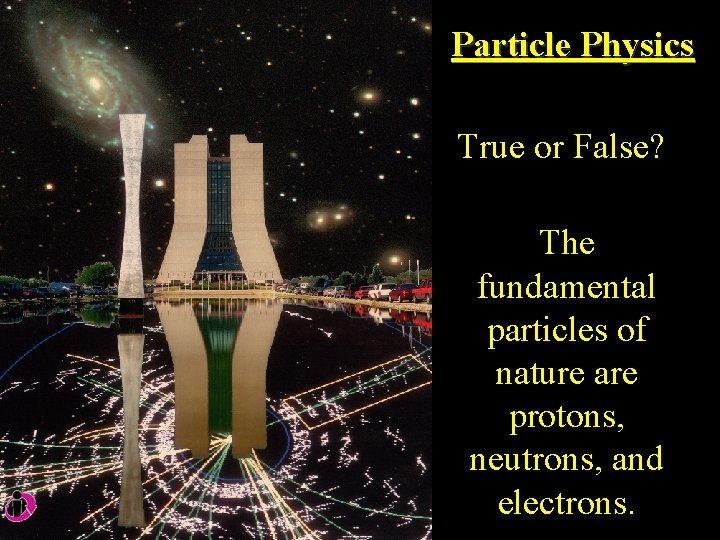
Particle Physics True or False? The fundamental particles of nature are protons, neutrons, and electrons.
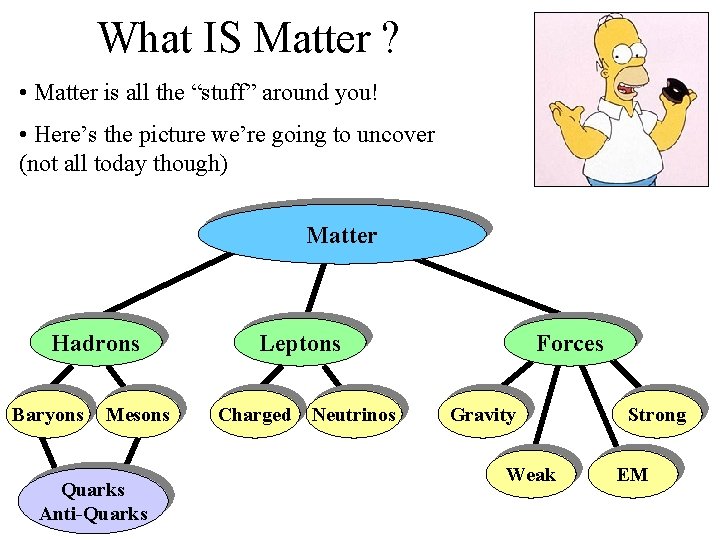
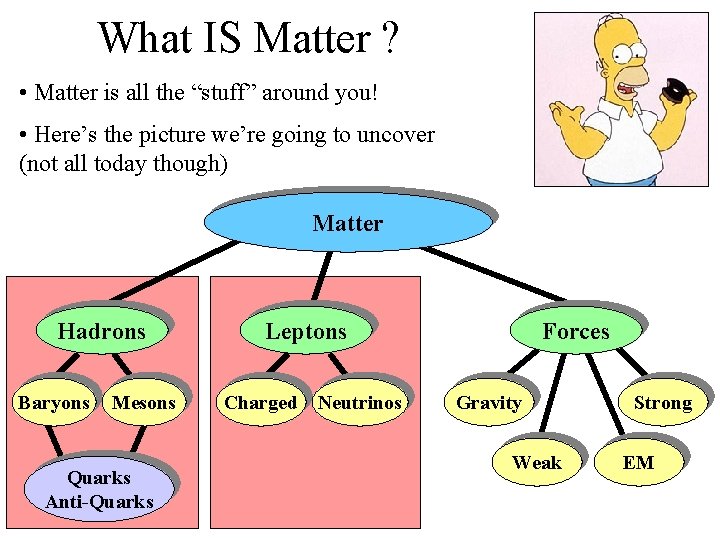
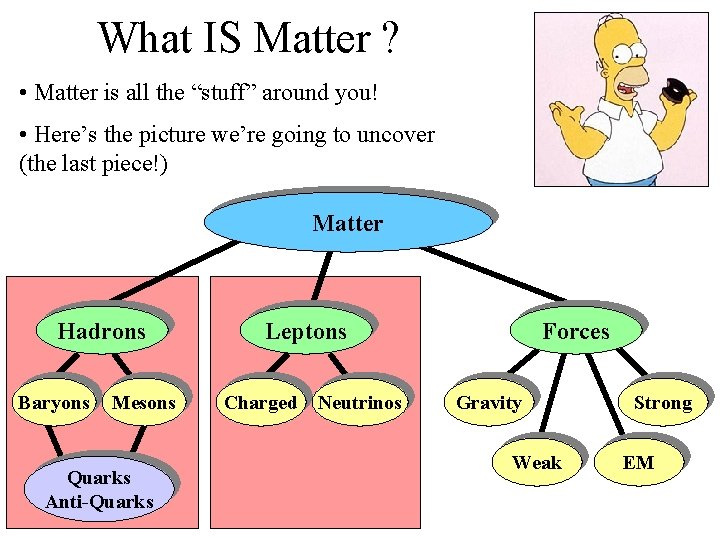
What IS Matter ? • Matter is all the “stuff” around you! • Here’s the picture we’re going to uncover (not all today though) Matter Hadrons Baryons Mesons Quarks Anti-Quarks Leptons Charged Neutrinos Forces Gravity Weak Strong EM
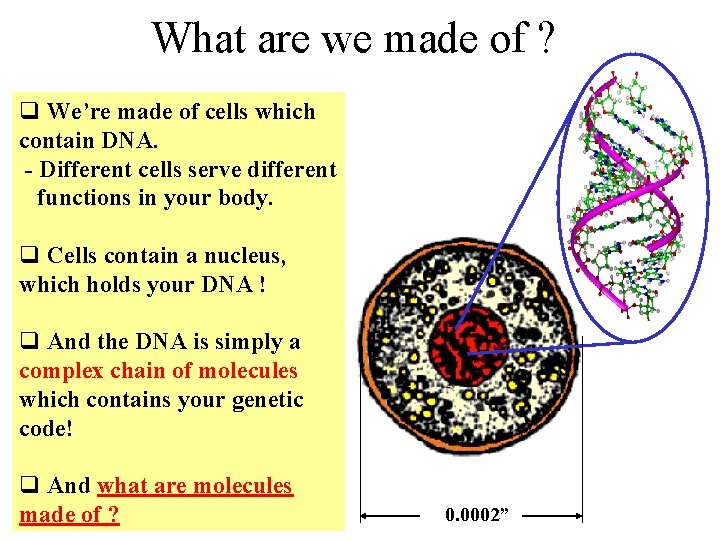
What are we made of ? q We’re made of cells which contain DNA. - Different cells serve different functions in your body. q Cells contain a nucleus, which holds your DNA ! q And the DNA is simply a complex chain of molecules which contains your genetic code! q And what are molecules made of ? 0. 0002”
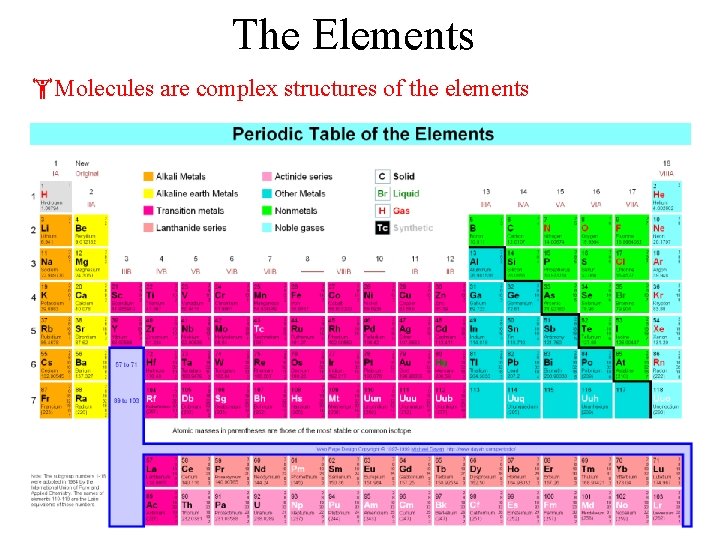
The Elements Molecules are complex structures of the elements
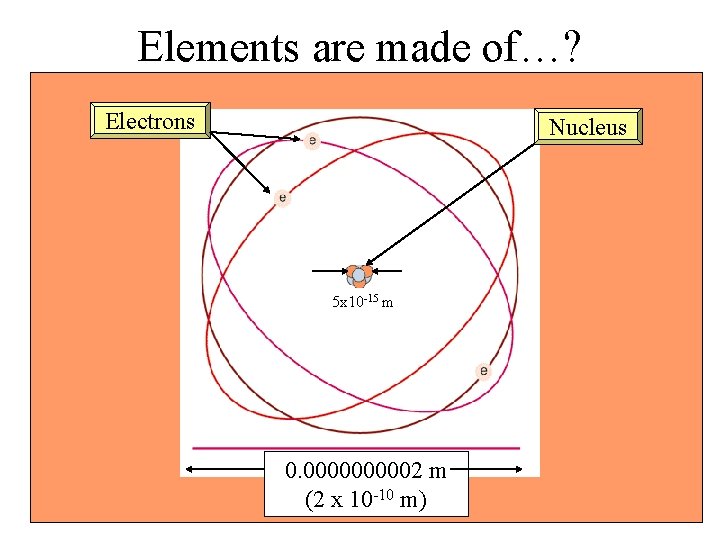
Elements are made of…? Electrons Nucleus 5 x 10 -15 m 0. 000002 m (2 x 10 -10 m)
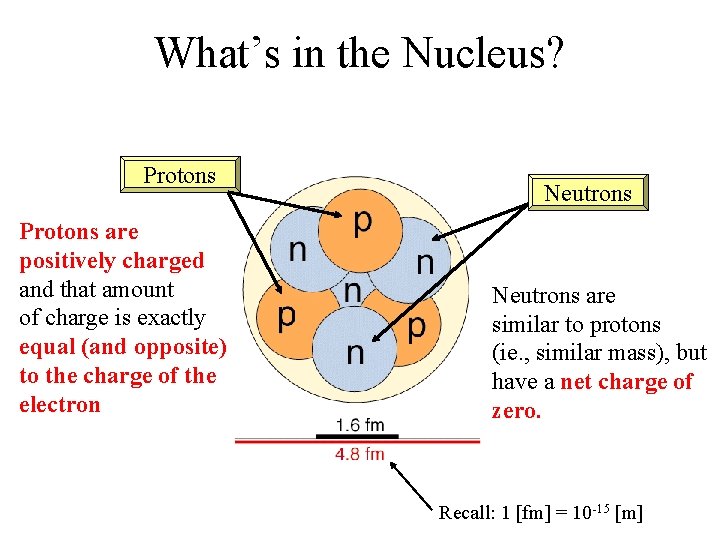
What’s in the Nucleus? Protons are positively charged and that amount of charge is exactly equal (and opposite) to the charge of the electron Neutrons are similar to protons (ie. , similar mass), but have a net charge of zero. Recall: 1 [fm] = 10 -15 [m]
Atomic Model • To give you another perspective on the size of the atom. If the nucleons (protons/neutrons) were one cm in diameter… • what is the diameter of the nucleus? – 10 cm • what is the diameter of the electron? – less than the diameter of your hair • What is the diameter of the entire atom? – 30 football fields!
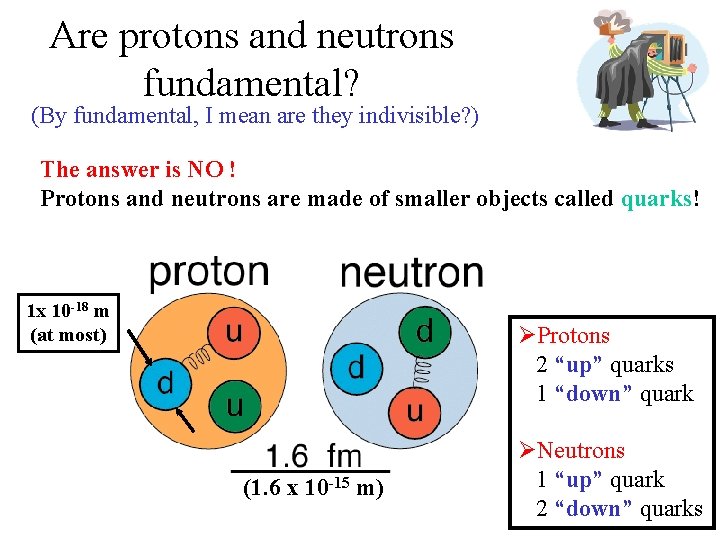
Are protons and neutrons fundamental? (By fundamental, I mean are they indivisible? ) The answer is NO ! Protons and neutrons are made of smaller objects called quarks! 1 x 10 -18 m (at most) ØProtons 2 “up” quarks 1 “down” quark (1. 6 x 10 -15 m) ØNeutrons 1 “up” quark 2 “down” quarks
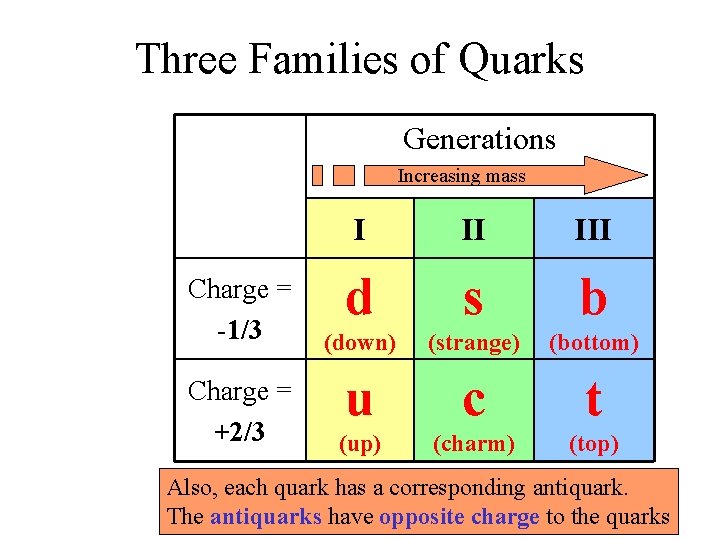
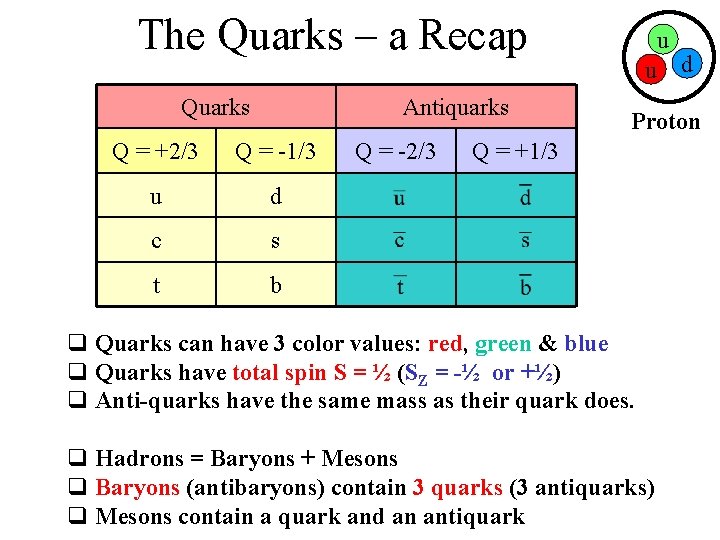
Three Families of Quarks Generations Increasing mass Charge = -1/3 Charge = +2/3 I II III d s b (down) (strange) (bottom) u c t (up) (charm) (top) Also, each quark has a corresponding antiquark. The antiquarks have opposite charge to the quarks
The 6 Quarks, when & where… Quark Date Where Mass [Ge. V/c 2] Comment up, down - - ~0. 005, ~0. 010 Constituents of hadrons, most prominently, proton and neutrons. strange 1947 - ~0. 2 discovered in cosmic rays ~1. 5 Discovered simultaneously in both pp and e+e- collisions. ~4. 5 Discovered in collisions of protons on nuclei ~175 Discovered in pp collisions charm bottom top 1974 1977 1995 SLAC/ BNL Fermilab
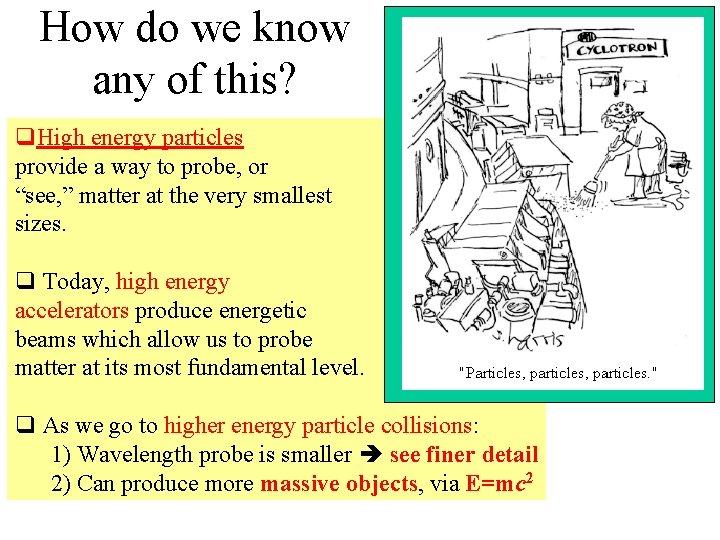
How do we know any of this? q. High energy particles provide a way to probe, or “see, ” matter at the very smallest sizes. q Today, high energy accelerators produce energetic beams which allow us to probe matter at its most fundamental level. q As we go to higher energy particle collisions: 1) Wavelength probe is smaller see finer detail 2) Can produce more massive objects, via E=mc 2
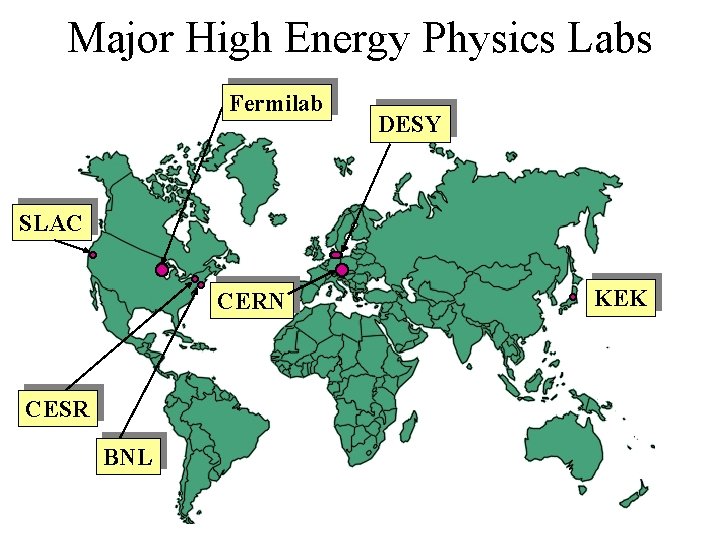
Major High Energy Physics Labs Fermilab DESY SLAC CERN CESR BNL KEK
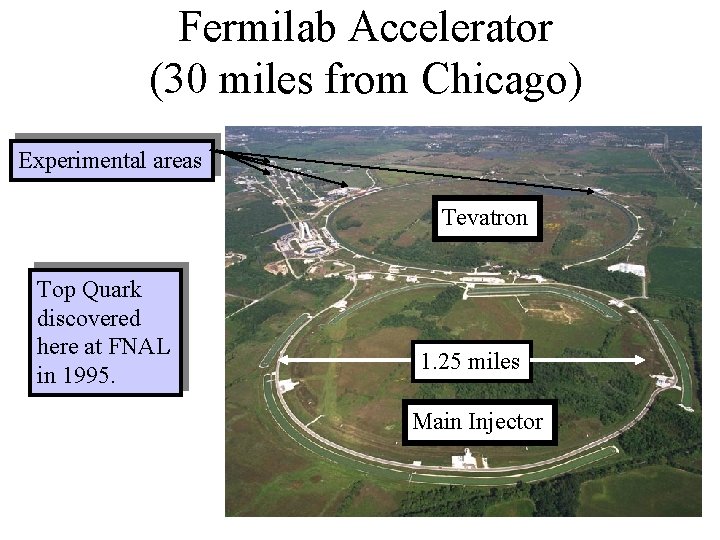
Fermilab Accelerator (30 miles from Chicago) Experimental areas Tevatron Top Quark discovered here at FNAL in 1995. 1. 25 miles Main Injector
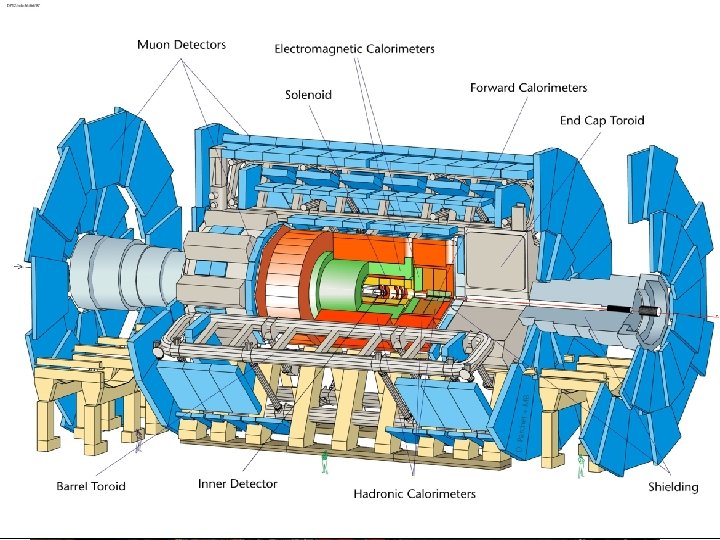
“Typical” Particle Detector
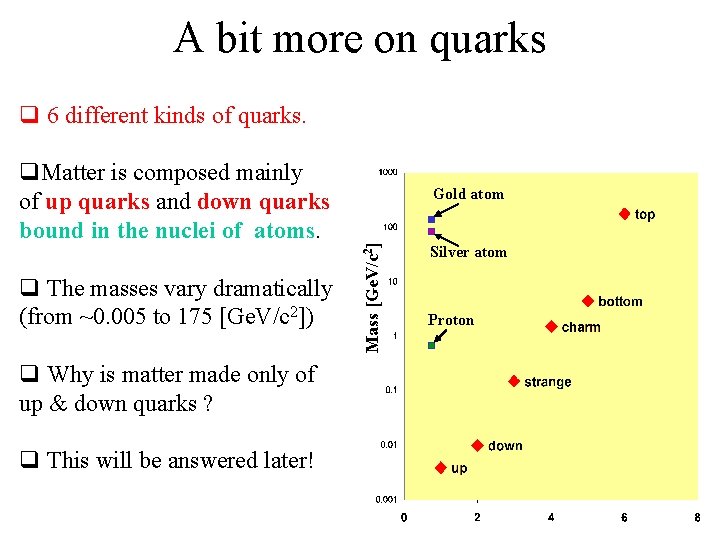
A bit more on quarks q 6 different kinds of quarks. q The masses vary dramatically (from ~0. 005 to 175 [Ge. V/c 2]) q Why is matter made only of up & down quarks ? q This will be answered later! Gold atom Mass [Ge. V/c 2] q. Matter is composed mainly of up quarks and down quarks bound in the nuclei of atoms. Silver atom Proton
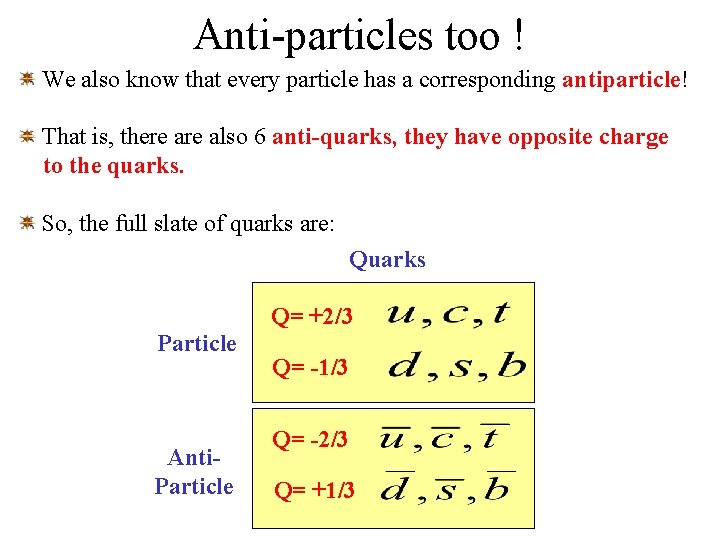
Anti-particles too ! We also know that every particle has a corresponding antiparticle! That is, there also 6 anti-quarks, they have opposite charge to the quarks. So, the full slate of quarks are: Quarks Q= +2/3 Particle Anti. Particle Q= -1/3 Q= -2/3 Q= +1/3
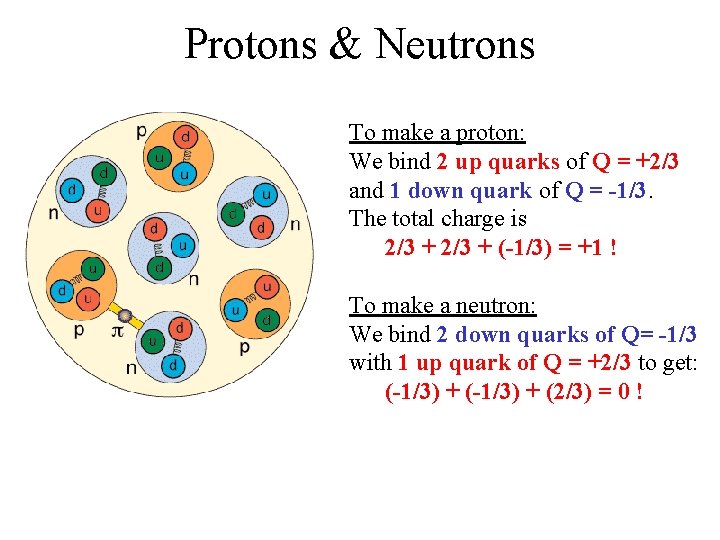
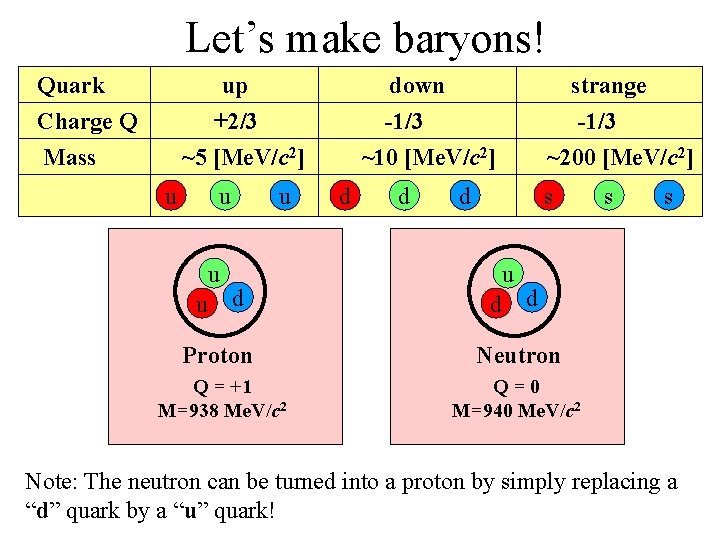
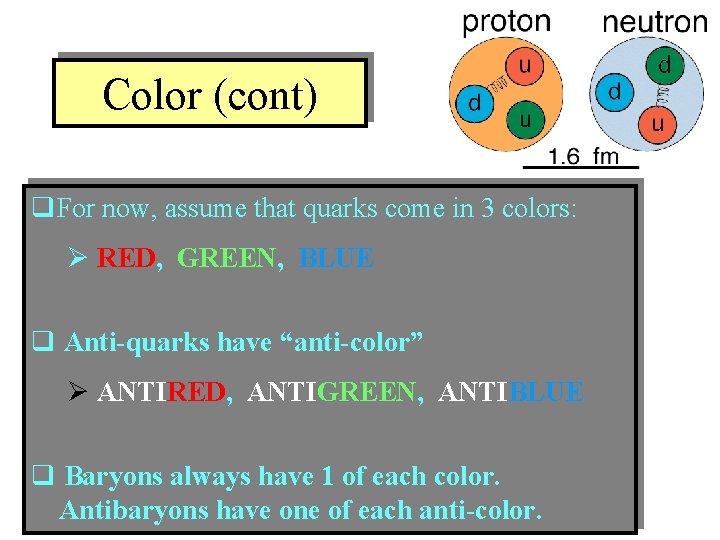
Protons & Neutrons To make a proton: We bind 2 up quarks of Q = +2/3 and 1 down quark of Q = -1/3. The total charge is 2/3 + (-1/3) = +1 ! To make a neutron: We bind 2 down quarks of Q= -1/3 with 1 up quark of Q = +2/3 to get: (-1/3) + (2/3) = 0 !
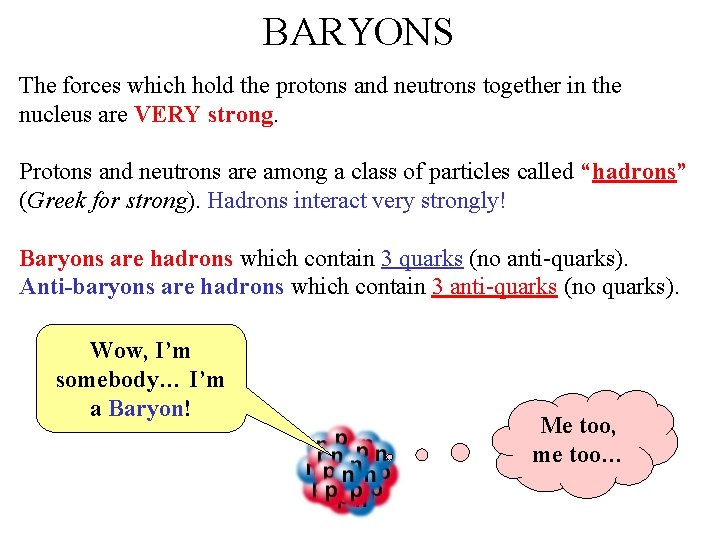
BARYONS The forces which hold the protons and neutrons together in the nucleus are VERY strong. Protons and neutrons are among a class of particles called “hadrons” (Greek for strong). Hadrons interact very strongly! Baryons are hadrons which contain 3 quarks (no anti-quarks). Anti-baryons are hadrons which contain 3 anti-quarks (no quarks). Wow, I’m somebody… I’m a Baryon! Me too, me too…
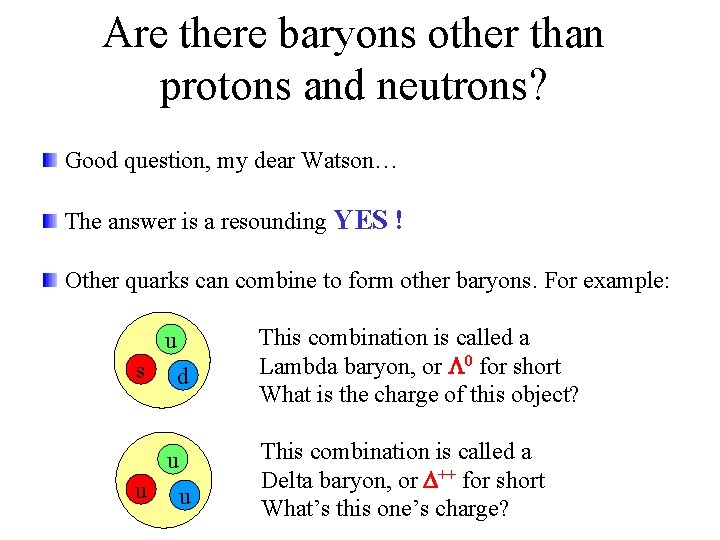
Are there baryons other than protons and neutrons? Good question, my dear Watson… The answer is a resounding YES ! Other quarks can combine to form other baryons. For example: u s d u u u This combination is called a Lambda baryon, or L 0 for short What is the charge of this object? This combination is called a Delta baryon, or D++ for short What’s this one’s charge?
Let’s make baryons! Quark Charge Q up +2/3 Mass down -1/3 ~5 [Me. V/c 2] u u u d strange -1/3 ~10 [Me. V/c 2] d d ~200 [Me. V/c 2] d s u d s s d Proton Neutron Q = +1 M=938 Me. V/c 2 Q=0 M=940 Me. V/c 2 Note: The neutron can be turned into a proton by simply replacing a “d” quark by a “u” quark!
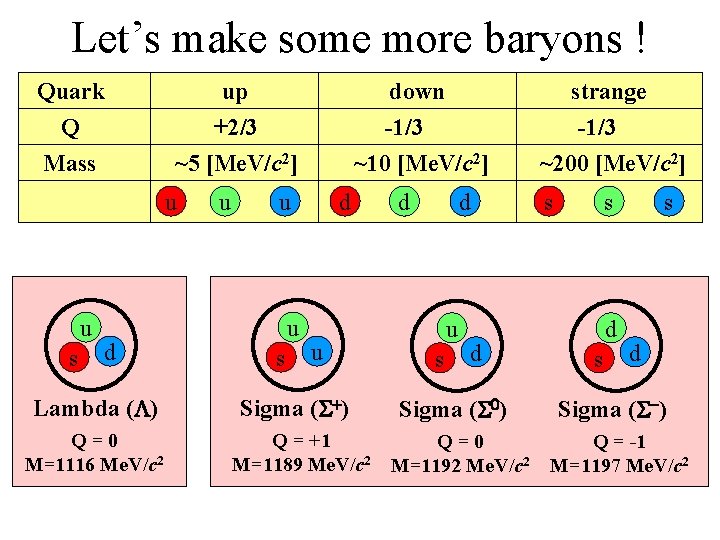
Let’s make some more baryons ! Quark up Q +2/3 Mass ~5 [Me. V/c 2] u u s d Lambda (L) Q=0 M=1116 Me. V/c 2 u s strange -1/3 ~10 [Me. V/c 2] u u down d u Sigma (S+) Q = +1 M=1189 Me. V/c 2 d d u s d Sigma (S 0) Q=0 M=1192 Me. V/c 2 ~200 [Me. V/c 2] s s d Sigma (S-) Q = -1 M=1197 Me. V/c 2
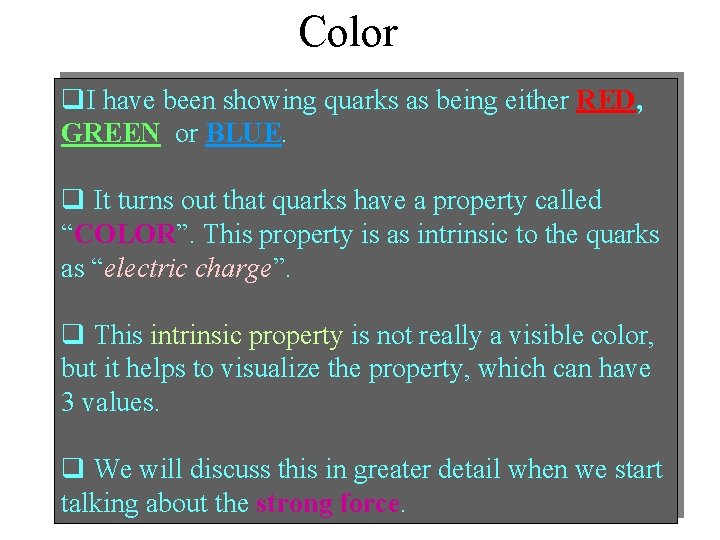
Color q. I have been showing quarks as being either RED, GREEN or BLUE. q It turns out that quarks have a property called “COLOR”. This property is as intrinsic to the quarks as “electric charge”. q This intrinsic property is not really a visible color, but it helps to visualize the property, which can have 3 values. q We will discuss this in greater detail when we start talking about the strong force.
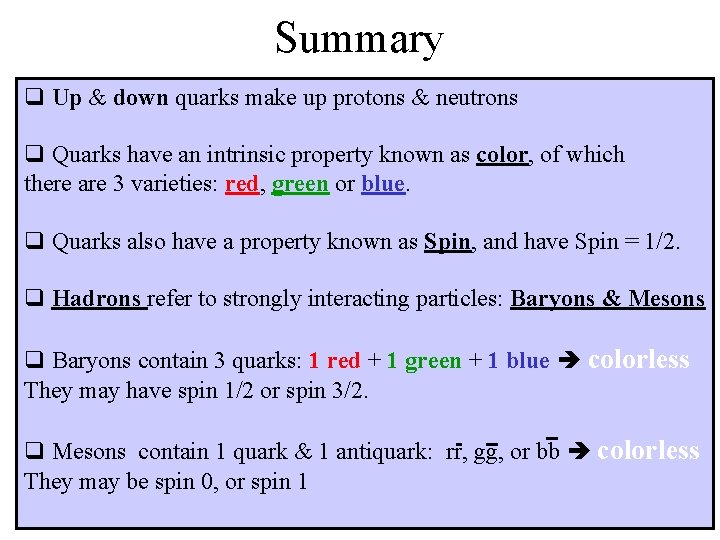
Color (cont) q. For now, assume that quarks come in 3 colors: Ø RED, GREEN, BLUE q Anti-quarks have “anti-color” Ø ANTIRED, ANTIGREEN, ANTIBLUE q Baryons always have 1 of each color. Antibaryons have one of each anti-color.
Spin q There’s another intrinsic property which Quarks have known as “spin”. q For convenience, you can think of it as a spinning top, but this is just a conceptual aid… q Quarks have spin S = ½.
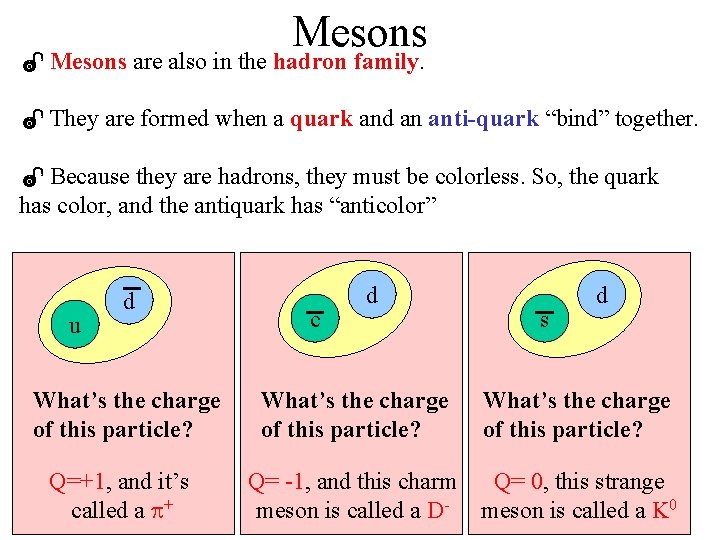
Mesons Ð Mesons are also in the hadron family. Ð They are formed when a quark and an anti-quark “bind” together. Ð Because they are hadrons, they must be colorless. So, the quark has color, and the antiquark has “anticolor” u d What’s the charge of this particle? Q=+1, and it’s called a p+ c d What’s the charge of this particle? s d What’s the charge of this particle? Q= -1, and this charm Q= 0, this strange meson is called a D- meson is called a K 0
Summary q Up & down quarks make up protons & neutrons q Quarks have an intrinsic property known as color, of which there are 3 varieties: red, green or blue. q Quarks also have a property known as Spin, and have Spin = 1/2. q Hadrons refer to strongly interacting particles: Baryons & Mesons q Baryons contain 3 quarks: 1 red + 1 green + 1 blue colorless They may have spin 1/2 or spin 3/2. q Mesons contain 1 quark & 1 antiquark: rr, gg, or bb colorless They may be spin 0, or spin 1
What IS Matter ? • Matter is all the “stuff” around you! • Here’s the picture we’re going to uncover (not all today though) Matter Hadrons Baryons Mesons Quarks Anti-Quarks Leptons Charged Neutrinos Forces Gravity Weak Strong EM
The Quarks – a Recap Quarks Antiquarks Q = +2/3 Q = -1/3 u d c s t b Q = -2/3 u u d Proton Q = +1/3 q Quarks can have 3 color values: red, green & blue q Quarks have total spin S = ½ (SZ = -½ or +½) q Anti-quarks have the same mass as their quark does. q Hadrons = Baryons + Mesons q Baryons (antibaryons) contain 3 quarks (3 antiquarks) q Mesons contain a quark and an antiquark
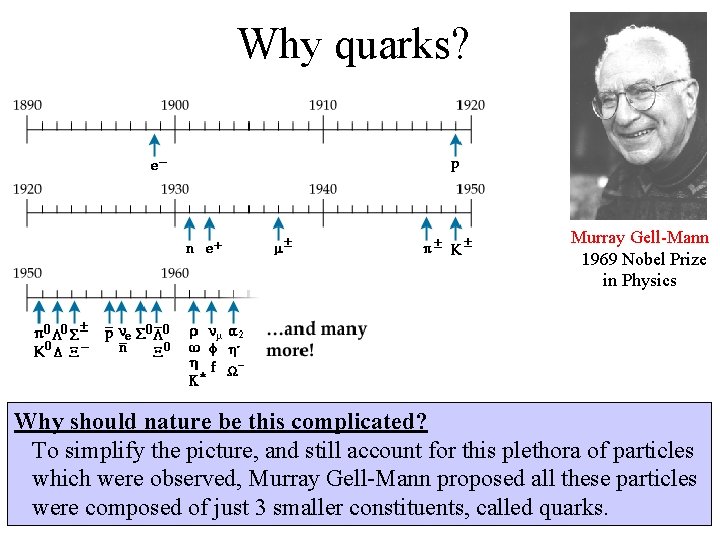
Why quarks? Murray Gell-Mann 1969 Nobel Prize in Physics Why should nature be this complicated? To simplify the picture, and still account for this plethora of particles which were observed, Murray Gell-Mann proposed all these particles were composed of just 3 smaller constituents, called quarks.
If neutrons & protons are not fundamental, what about electrons? Are they made up of smaller constituents also ? As far as we can tell, electrons appear to be indivisible.
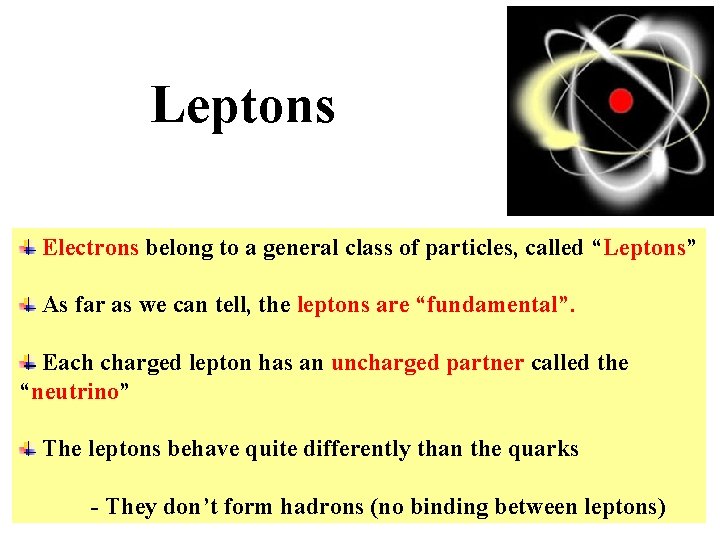
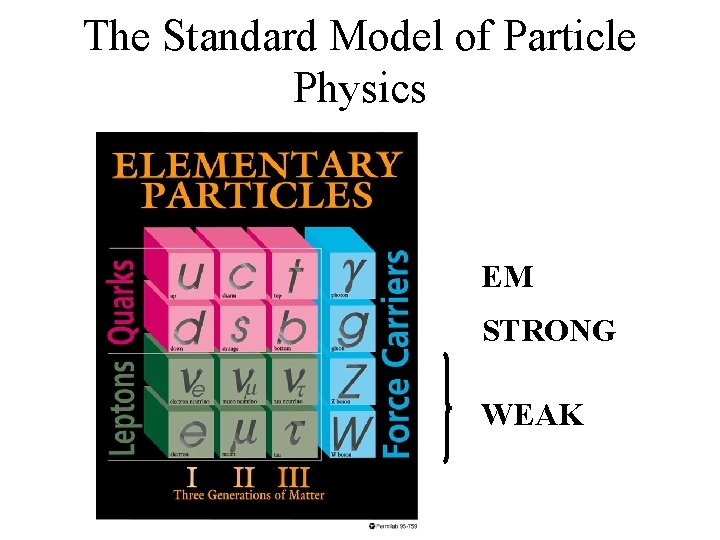
Leptons Electrons belong to a general class of particles, called “Leptons” As far as we can tell, the leptons are “fundamental”. Each charged lepton has an uncharged partner called the “neutrino” The leptons behave quite differently than the quarks - They don’t form hadrons (no binding between leptons)
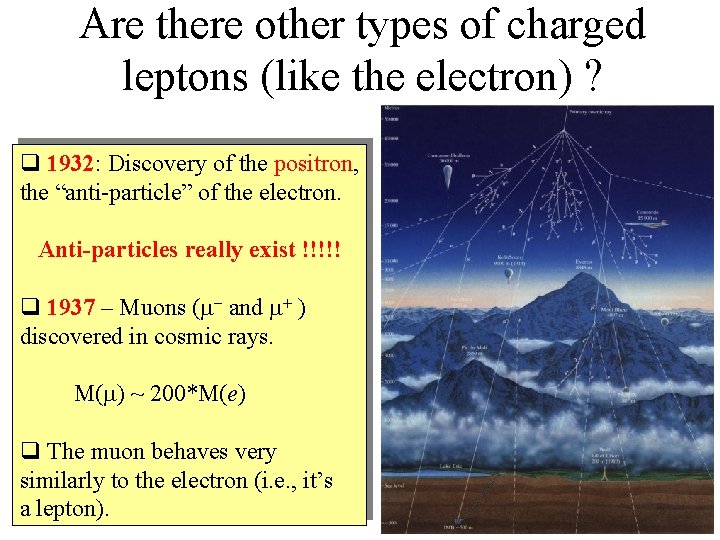
Are there other types of charged leptons (like the electron) ? q 1932: Discovery of the positron, the “anti-particle” of the electron. Anti-particles really exist !!!!! q 1937 – Muons (m- and m+ ) discovered in cosmic rays. M(m) ~ 200*M(e) q The muon behaves very similarly to the electron (i. e. , it’s a lepton).
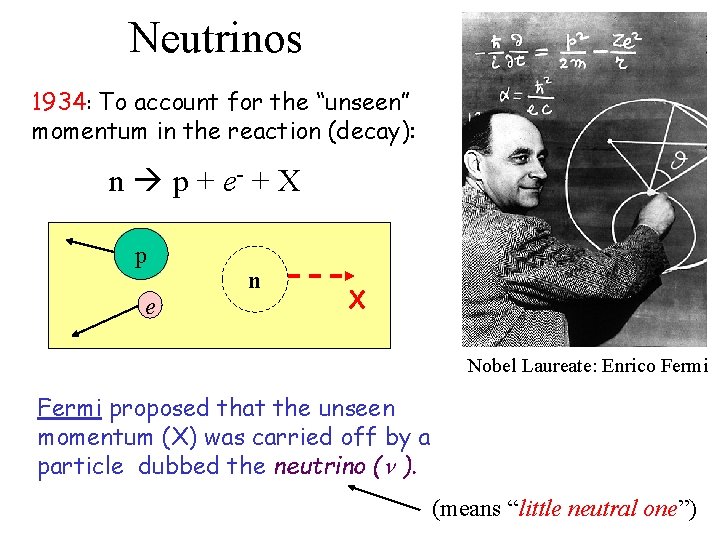
Neutrinos 1934: To account for the “unseen” momentum in the reaction (decay): n p + e- + X p e n X Nobel Laureate: Enrico Fermi proposed that the unseen momentum (X) was carried off by a particle dubbed the neutrino (n ). (means “little neutral one”)
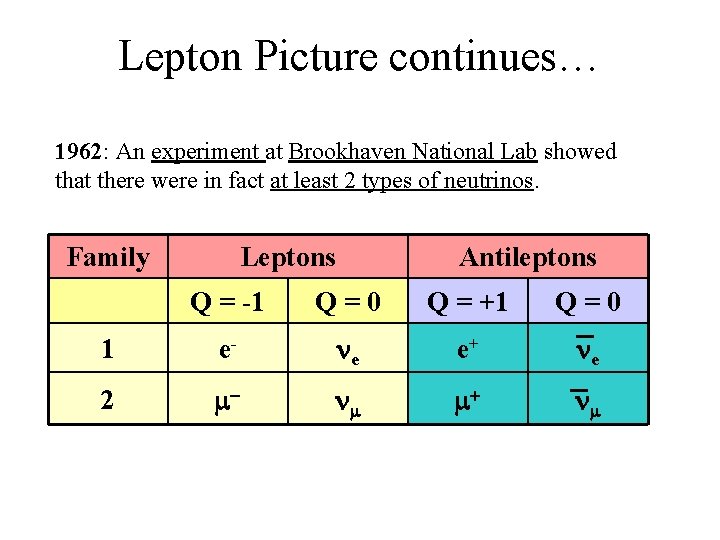
Lepton Picture continues… 1962: An experiment at Brookhaven National Lab showed that there were in fact at least 2 types of neutrinos. Family Leptons Antileptons Q = -1 Q=0 Q = +1 Q=0 1 e- ne e+ ne 2 m- nm m+ nm
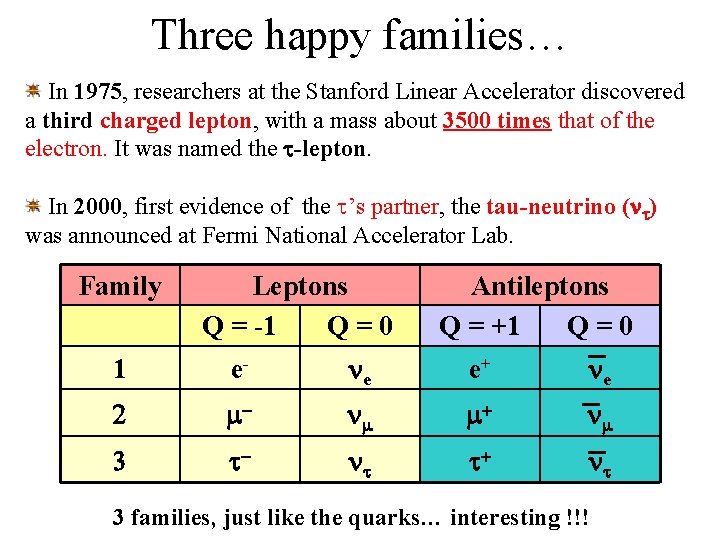
Three happy families… In 1975, researchers at the Stanford Linear Accelerator discovered a third charged lepton, with a mass about 3500 times that of the electron. It was named the t-lepton. In 2000, first evidence of the t’s partner, the tau-neutrino (nt) was announced at Fermi National Accelerator Lab. Family Leptons Q = -1 Q=0 Antileptons Q = +1 Q=0 1 e- ne e+ ne 2 m- nm m+ nm 3 t- nt t+ nt 3 families, just like the quarks… interesting !!!
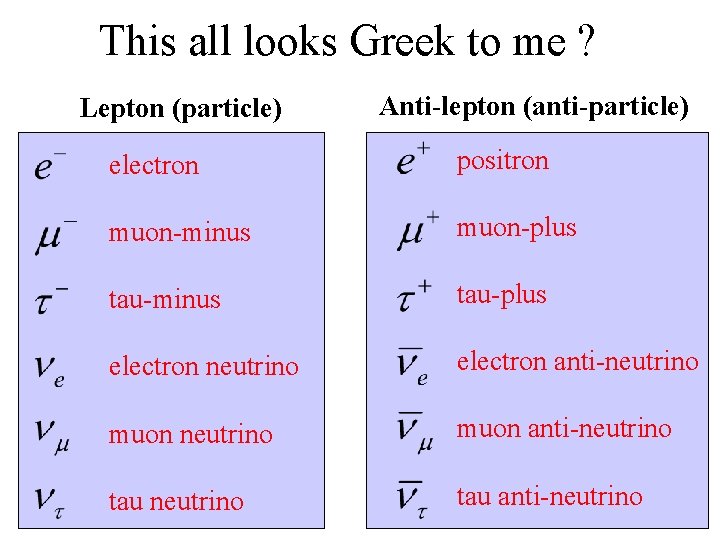
This all looks Greek to me ? Lepton (particle) Anti-lepton (anti-particle) electron positron muon-minus muon-plus tau-minus tau-plus electron neutrino electron anti-neutrino muon anti-neutrino tau anti-neutrino
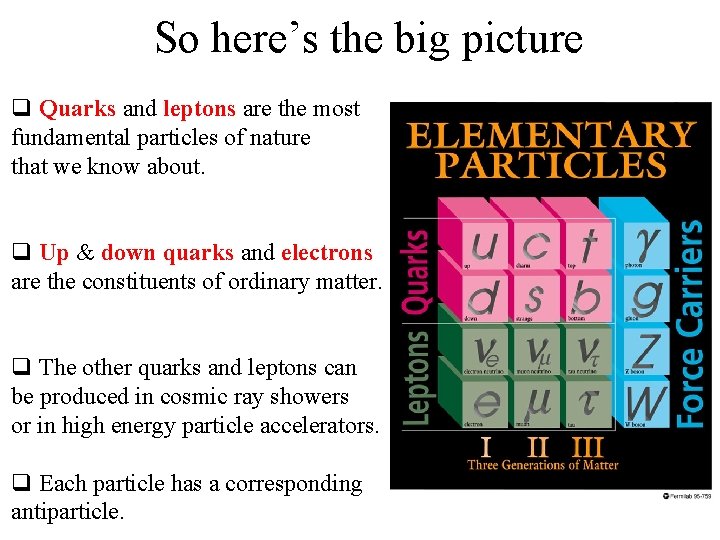
So here’s the big picture q Quarks and leptons are the most fundamental particles of nature that we know about. q Up & down quarks and electrons are the constituents of ordinary matter. q The other quarks and leptons can be produced in cosmic ray showers or in high energy particle accelerators. q Each particle has a corresponding antiparticle.
The Standard Model of Particle Physics EM STRONG WEAK
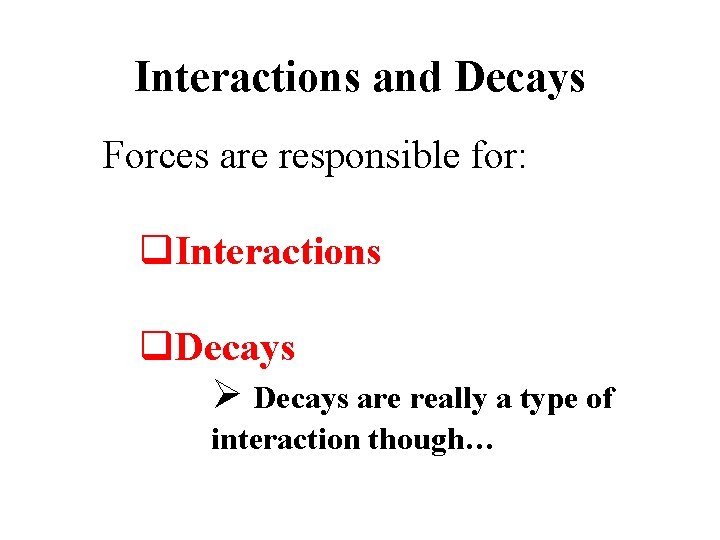
Interactions and Decays Forces are responsible for: q. Interactions q. Decays Ø Decays are really a type of interaction though…
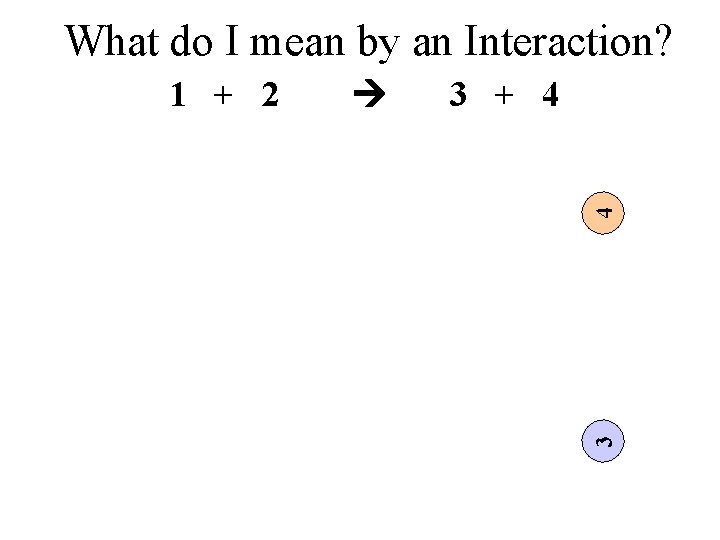
What do I mean by an Interaction? 1 + 2 3 + 4 4 1 3 2 3 12 34 4 1 BAM 2
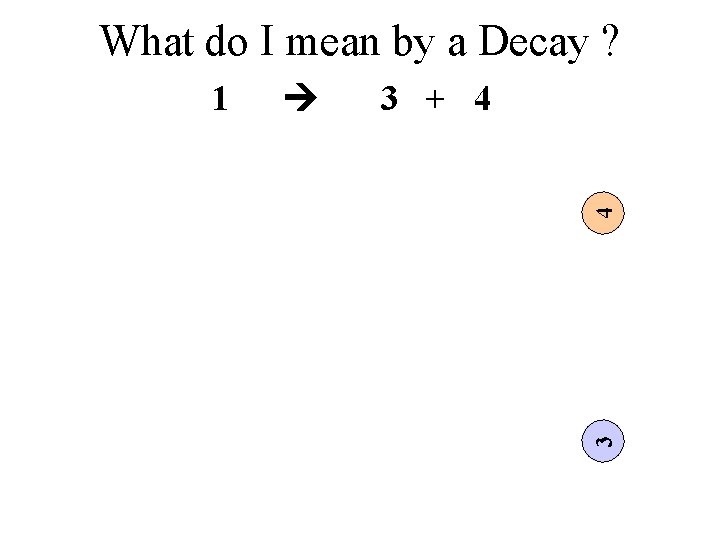
What do I mean by a Decay ? 3 + 4 3 3 3 1 1 BAM 34 4 1
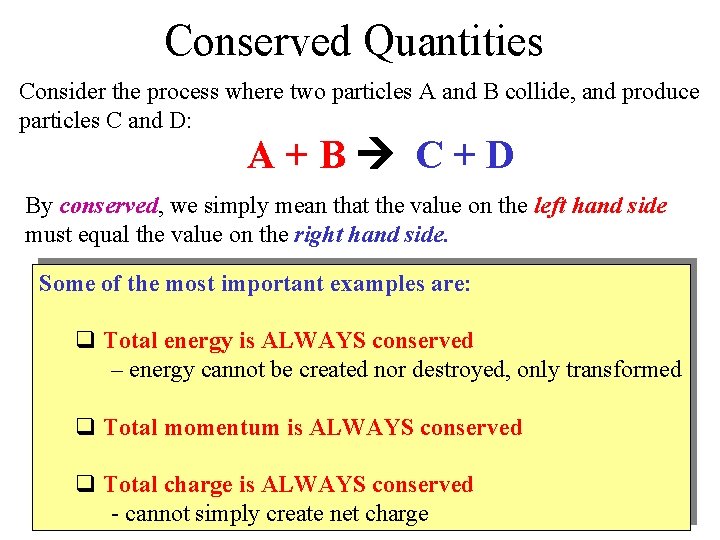
Conserved Quantities Consider the process where two particles A and B collide, and produce particles C and D: A+B C+D By conserved, we simply mean that the value on the left hand side must equal the value on the right hand side. Some of the most important examples are: q Total energy is ALWAYS conserved – energy cannot be created nor destroyed, only transformed q Total momentum is ALWAYS conserved q Total charge is ALWAYS conserved - cannot simply create net charge
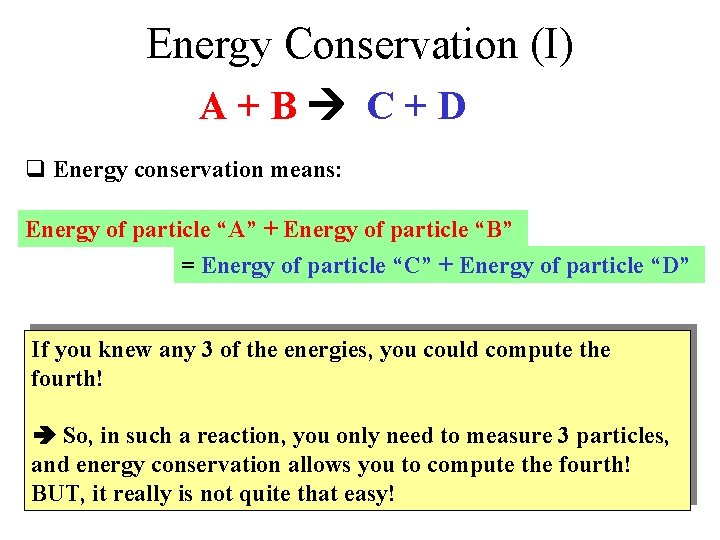
Energy Conservation (I) A+B C+D q Energy conservation means: Energy of particle “A” + Energy of particle “B” = Energy of particle “C” + Energy of particle “D” If you knew any 3 of the energies, you could compute the fourth! So, in such a reaction, you only need to measure 3 particles, and energy conservation allows you to compute the fourth! BUT, it really is not quite that easy!
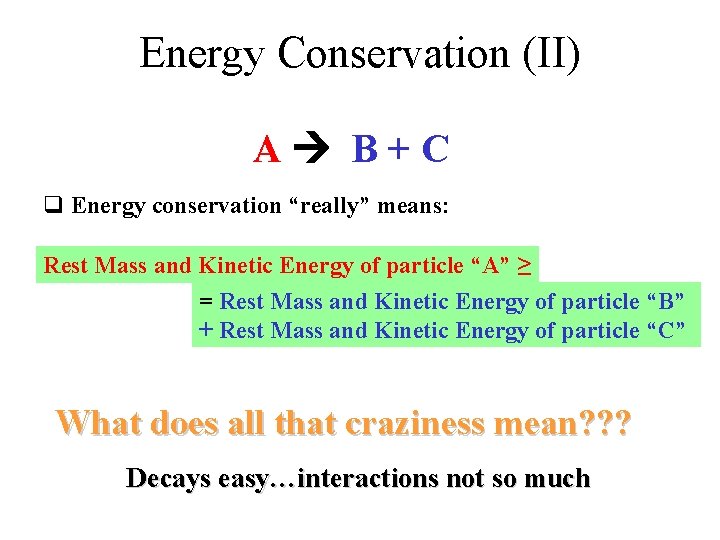
Energy Conservation (II) A B+C q Energy conservation “really” means: Rest Mass and Kinetic Energy of particle “A” ≥ = Rest Mass and Kinetic Energy of particle “B” + Rest Mass and Kinetic Energy of particle “C” What does all that craziness mean? ? ? Decays easy…interactions not so much
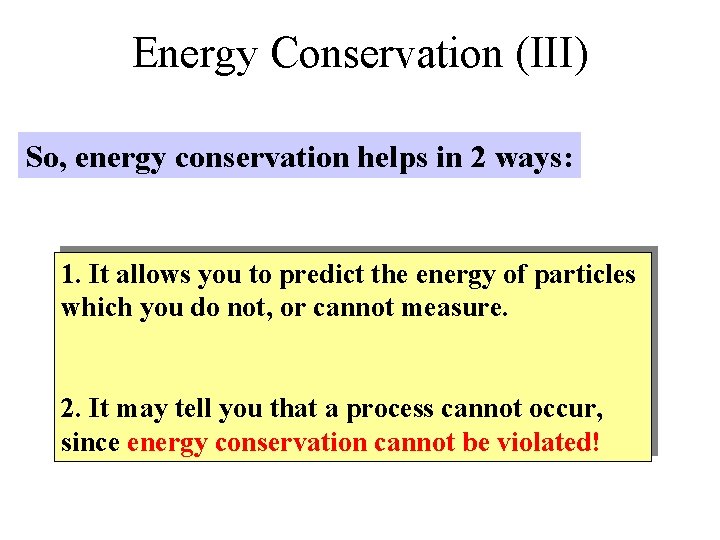
Energy Conservation (III) So, energy conservation helps in 2 ways: 1. It allows you to predict the energy of particles which you do not, or cannot measure. 2. It may tell you that a process cannot occur, since energy conservation cannot be violated!
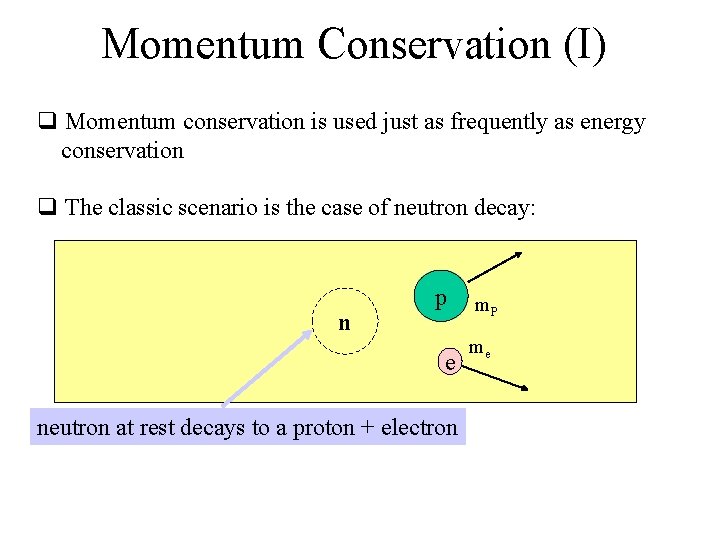
Momentum Conservation (I) q Momentum conservation is used just as frequently as energy conservation q The classic scenario is the case of neutron decay: n p e neutron at rest decays to a proton + electron m. P me
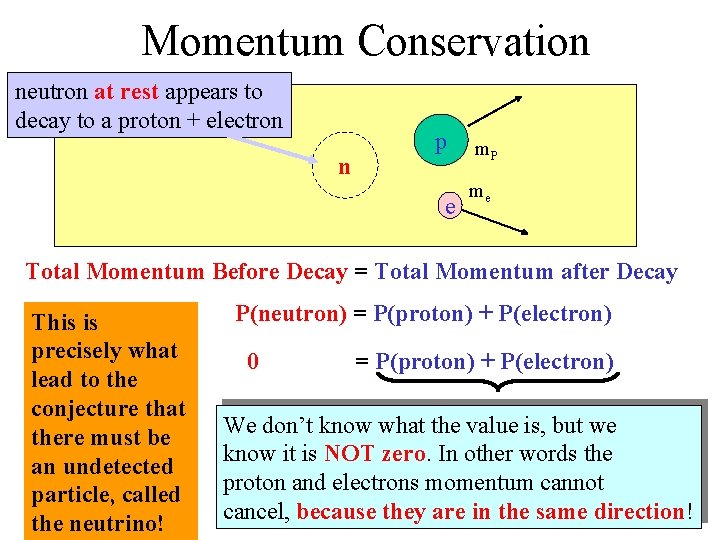
Momentum Conservation neutron at rest appears to decay to a proton + electron n p e m. P me Total Momentum Before Decay = Total Momentum after Decay This is precisely what lead to the conjecture that there must be an undetected particle, called the neutrino! P(neutron) = P(proton) + P(electron) 0 = P(proton) + P(electron) We don’t know what the value is, but we know it is NOT zero. In other words the proton and electrons momentum cannot cancel, because they are in the same direction!
Charge Conservation (I) Again, let’s consider the process: A+B C+D q Charge conservation implies that: Charge of particle “A” + Charge of particle “B” = Charge of particle “C” + Charge of particle “D” So, if you know the charge of any 3 of the particles, you can immediately say what the charge of the 4 th MUST BE!
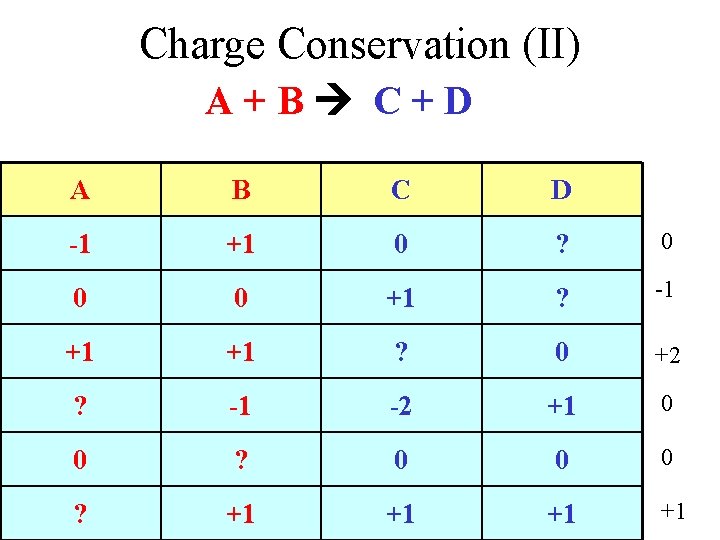
Charge Conservation (II) A+B C+D A B C D -1 +1 0 ? 0 0 0 +1 ? -1 +1 +1 ? 0 +2 ? -1 -2 +1 0 0 ? 0 0 0 ? +1 +1
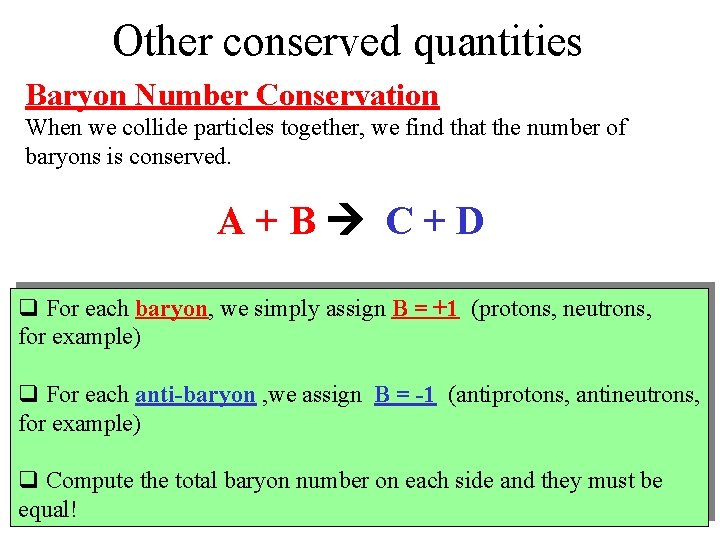
Other conserved quantities Baryon Number Conservation When we collide particles together, we find that the number of baryons is conserved. A+B C+D q For each baryon, we simply assign B = +1 (protons, neutrons, for example) q For each anti-baryon , we assign B = -1 (antiprotons, antineutrons, for example) q Compute the total baryon number on each side and they must be equal!
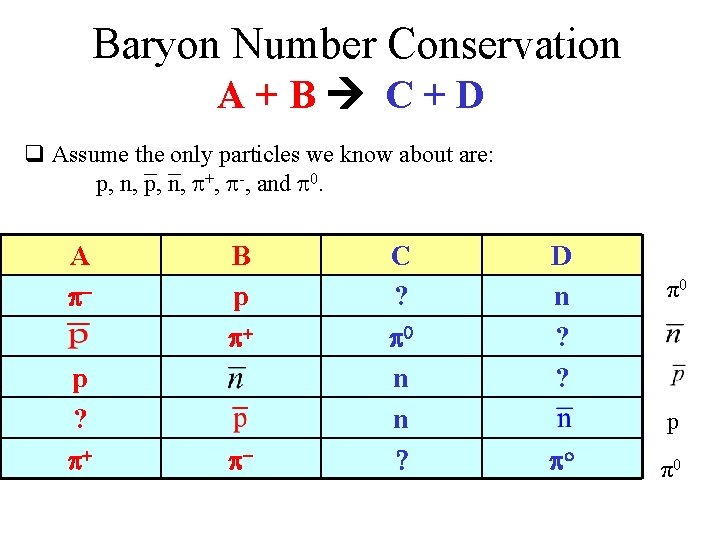
Baryon Number Conservation A+B C+D q Assume the only particles we know about are: p, n, p+, p-, and p 0. A pp ? p+ B p p+ p- C ? p 0 n n ? D n ? ? π0 p po π0
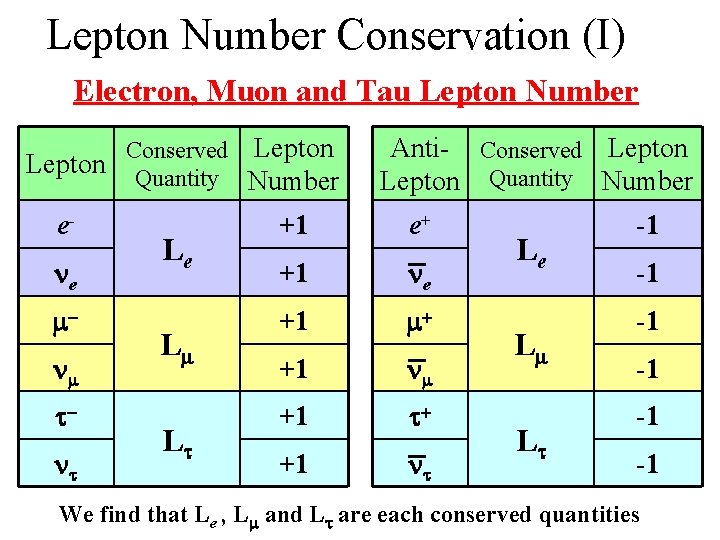
Lepton Number Conservation (I) Electron, Muon and Tau Lepton Number Conserved Lepton Quantity Number ene mnm tnt Le Lm Lt Anti- Conserved Lepton Quantity Number +1 e+ +1 ne +1 m+ +1 nm +1 t+ +1 nt Le Lm Lt -1 -1 -1 We find that Le , Lm and Lt are each conserved quantities
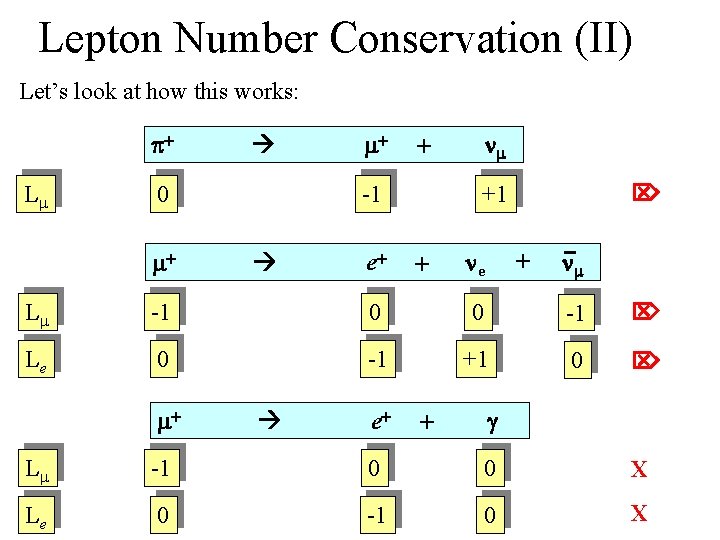
Lepton Number Conservation (II) Let’s look at how this works: p+ Lm 0 m+ m+ + -1 e+ nm +1 + ne + nm Lm -1 0 0 -1 Le 0 -1 +1 0 m+ e+ + g Lm -1 0 0 X Le 0 -1 0 X
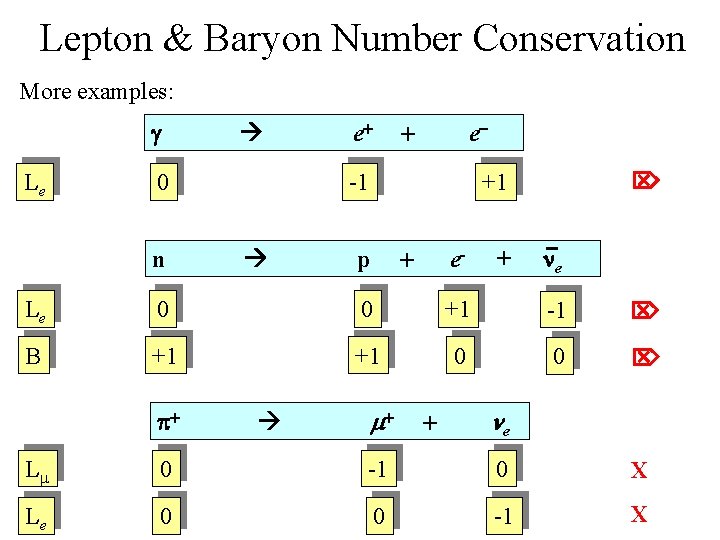
Lepton & Baryon Number Conservation More examples: g Le 0 n + e+ e- -1 +1 + p e- + ne Le 0 0 +1 -1 B +1 +1 0 0 p+ m+ + ne Lm 0 -1 0 X Le 0 0 -1 X
There is no such thing as “Meson Number CONSERVATION”
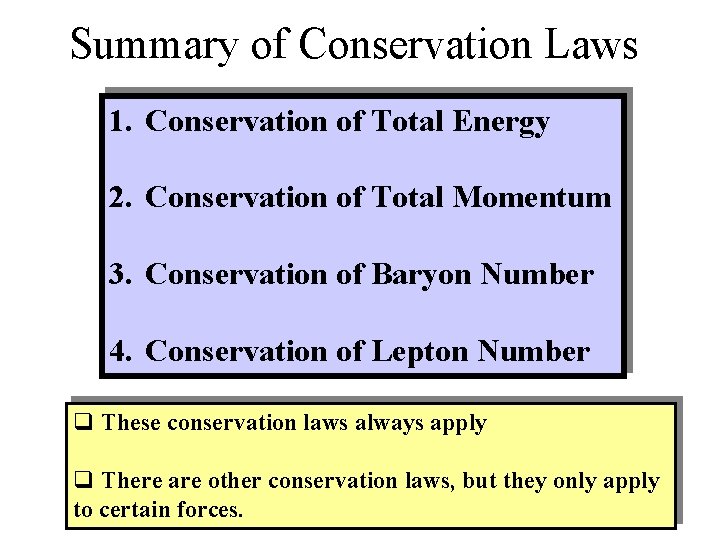
Summary of Conservation Laws 1. Conservation of Total Energy 2. Conservation of Total Momentum 3. Conservation of Baryon Number 4. Conservation of Lepton Number q These conservation laws always apply q There are other conservation laws, but they only apply to certain forces.
What IS Matter ? • Matter is all the “stuff” around you! • Here’s the picture we’re going to uncover (the last piece!) Matter Hadrons Baryons Mesons Quarks Anti-Quarks Leptons Charged Neutrinos Forces Gravity Weak Strong EM
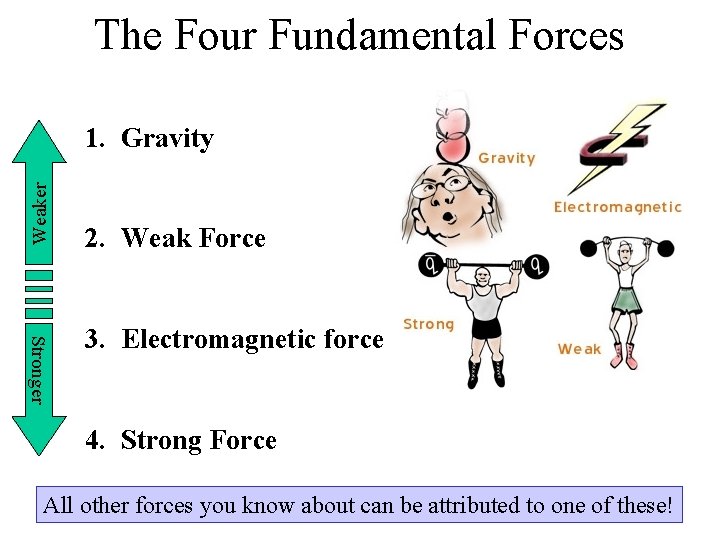
The Four Fundamental Forces Weaker 1. Gravity 2. Weak Force Stronger 3. Electromagnetic force 4. Strong Force All other forces you know about can be attributed to one of these!
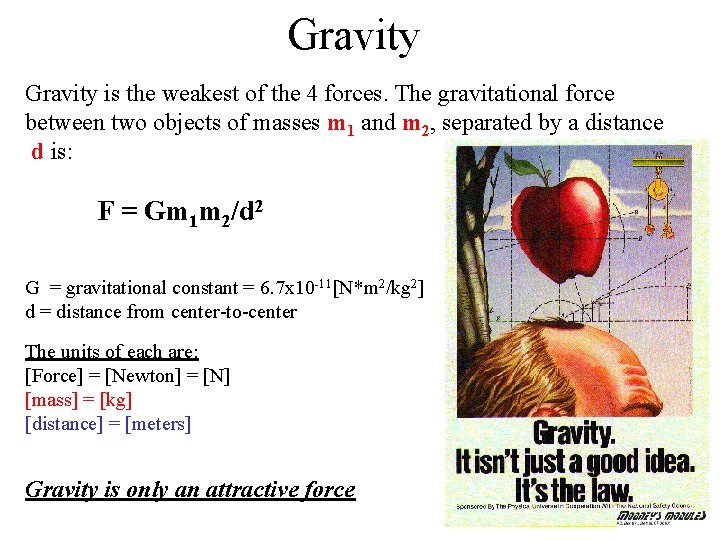
Gravity is the weakest of the 4 forces. The gravitational force between two objects of masses m 1 and m 2, separated by a distance d is: F = Gm 1 m 2/d 2 G = gravitational constant = 6. 7 x 10 -11[N*m 2/kg 2] d = distance from center-to-center The units of each are: [Force] = [Newton] = [N] [mass] = [kg] [distance] = [meters] Gravity is only an attractive force
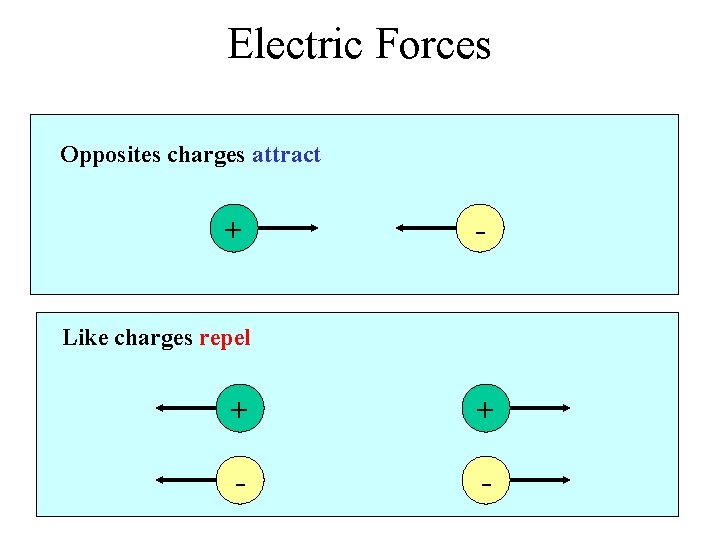
Electric Forces Opposites charges attract + - Like charges repel + + - -
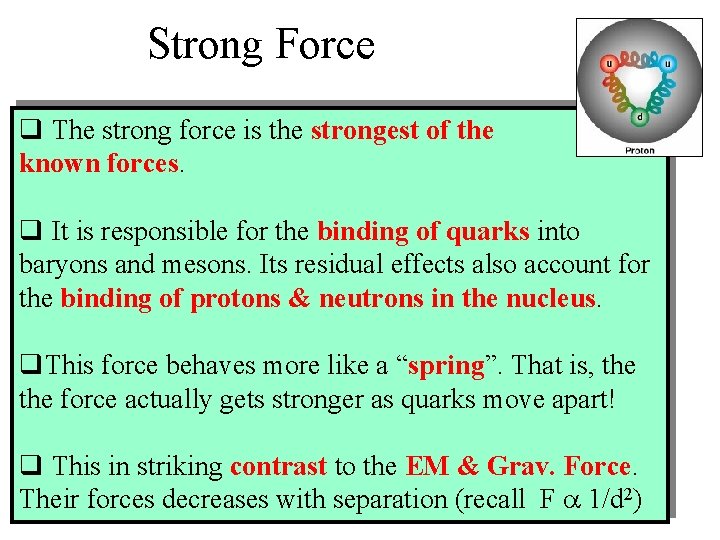
Strong Force q The strong force is the strongest of the known forces. q It is responsible for the binding of quarks into baryons and mesons. Its residual effects also account for the binding of protons & neutrons in the nucleus. q. This force behaves more like a “spring”. That is, the force actually gets stronger as quarks move apart! q This in striking contrast to the EM & Grav. Force. Their forces decreases with separation (recall F a 1/d 2)
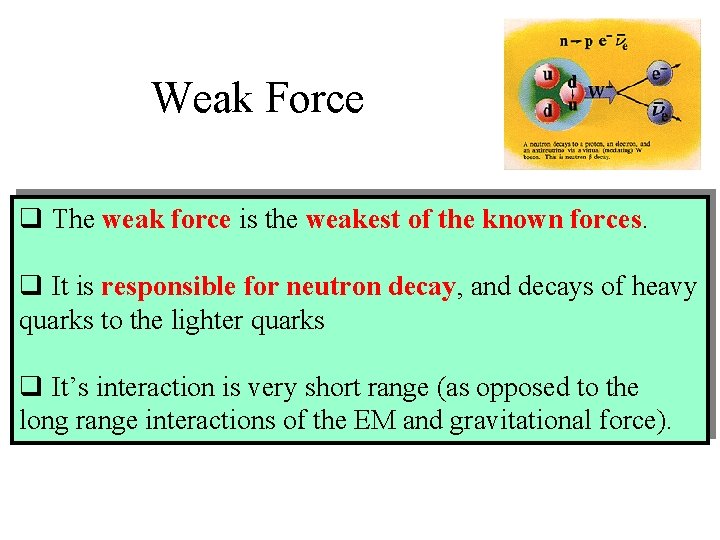
Weak Force q The weak force is the weakest of the known forces. q It is responsible for neutron decay, and decays of heavy quarks to the lighter quarks q It’s interaction is very short range (as opposed to the long range interactions of the EM and gravitational force).
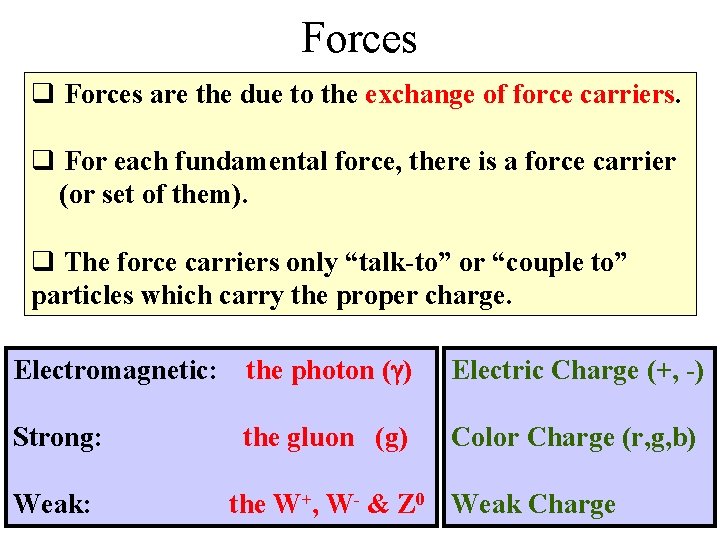
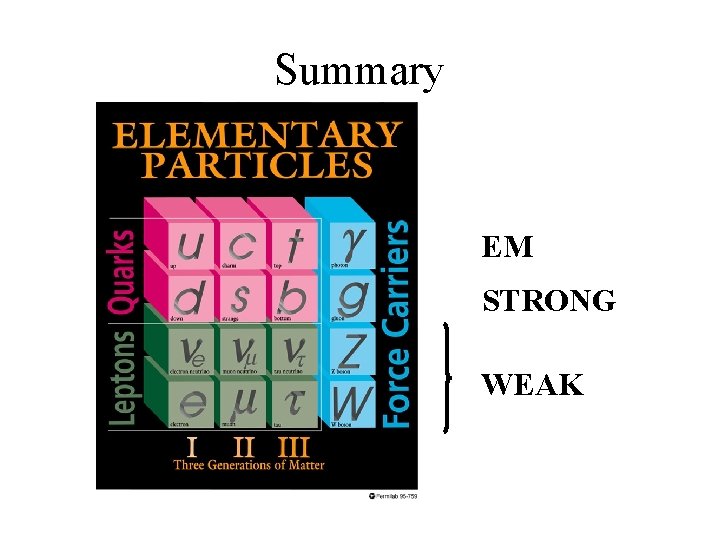
Forces q Forces are the due to the exchange of force carriers. q For each fundamental force, there is a force carrier (or set of them). q The force carriers only “talk-to” or “couple to” particles which carry the proper charge. Electromagnetic: the photon (g) Electric Charge (+, -) Strong: the gluon (g) Color Charge (r, g, b) Weak: the W+, W- & Z 0 Weak Charge
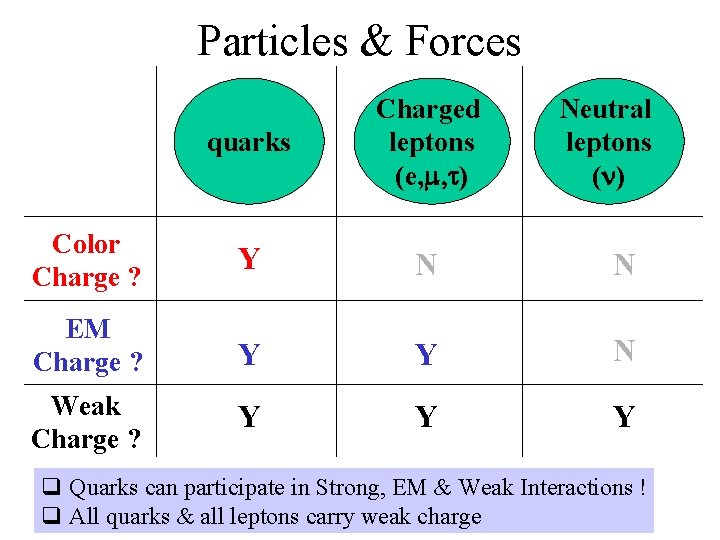
Particles & Forces quarks Charged leptons (e, m, t) Neutral leptons (n) Color Charge ? Y N N EM Charge ? Y Y N Weak Charge ? Y Y Y q Quarks can participate in Strong, EM & Weak Interactions ! q All quarks & all leptons carry weak charge
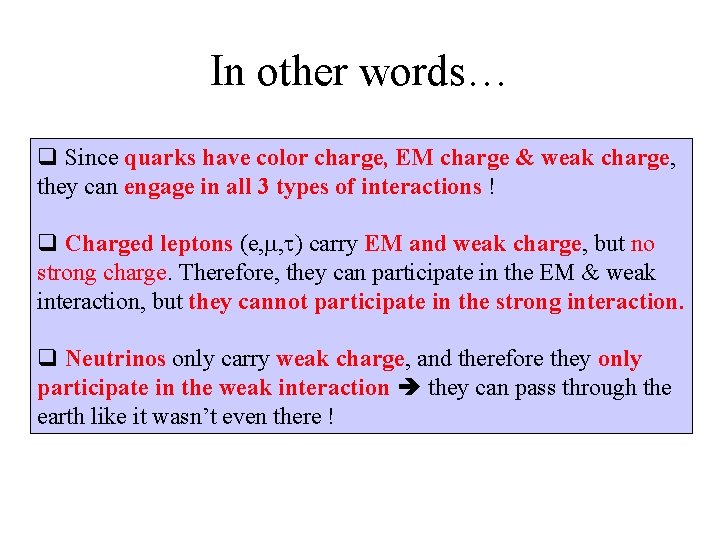
In other words… q Since quarks have color charge, EM charge & weak charge, they can engage in all 3 types of interactions ! q Charged leptons (e, m, t) carry EM and weak charge, but no strong charge. Therefore, they can participate in the EM & weak interaction, but they cannot participate in the strong interaction. q Neutrinos only carry weak charge, and therefore they only participate in the weak interaction they can pass through the earth like it wasn’t even there !
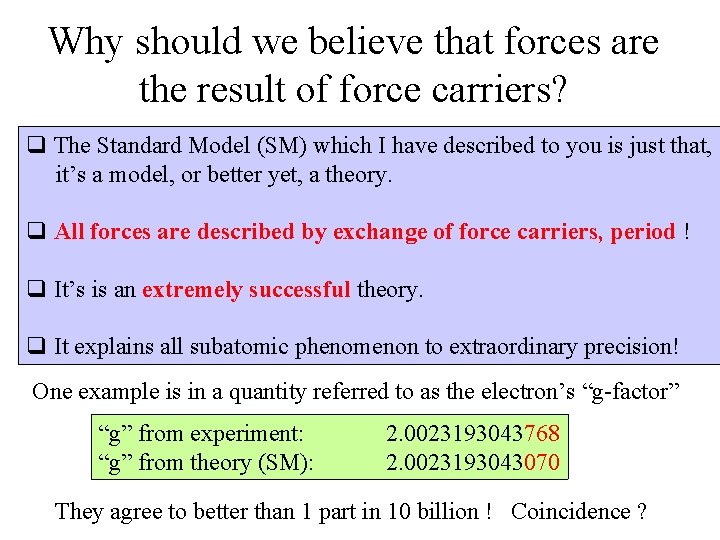
Why should we believe that forces are the result of force carriers? q The Standard Model (SM) which I have described to you is just that, it’s a model, or better yet, a theory. q All forces are described by exchange of force carriers, period ! q It’s is an extremely successful theory. q It explains all subatomic phenomenon to extraordinary precision! One example is in a quantity referred to as the electron’s “g-factor” “g” from experiment: “g” from theory (SM): 2. 0023193043768 2. 0023193043070 They agree to better than 1 part in 10 billion ! Coincidence ?
Summary EM STRONG WEAK