
Particle Physics Status and Perspectives 142 095 ClaudiaElisabeth
Particle Physics Status and Perspectives 142. 095 Claudia-Elisabeth Wulz Institute of High Energy Physics Austrian Academy of Sciences c/o CERN/PH, CH-1211 Geneva 23 Tel. 0041 22 767 6592, GSM: 0041 75 411 0919 E-mail: Claudia. Wulz@cern. ch http: //home. cern. ch/~wulz 2 May 2017 Part 1
Literature Theory: T. Morii, C. S. Lim, S. N. Mukherjee: The Physics of the Standard Model and Beyond, World Scientific Publishing Co. (2004) D. Griffiths: Introduction to Elementary Particles, J. Wiley VCH (2008) General: B. R. Martin, G. Shaw: Particle Physics, J. Wiley and Sons (3 rd ed. 2008) D. H. Perkins: Introduction to High Energy Physics, Cambridge U. Press (4 th edition, 2000) Detectors: W. R. Leo: Techniques for Nuclear and Particle Physics Experiments, Springer (2 nd ed. 1994) Ch. Joram: Particle Detectors, http: //joram. web. cern. ch/Joram/lectures. htm 1
Web pages Introductions to particle physics: http: //www. cpepweb. org/ http: //particleadventure. org http: //www. particlephysics. ac. uk http: //www 2. slac. stanford. edu/vvc/Default. htm http: //www. teilchen. at For physicists/students: http: //indico. cern. ch/category. Display. py? categ. Id=70 http: //pdg. lbl. gov/ 2
High Energy Physics = Elementary particle physics • • What is matter made of and how does it keep together? • • It deals with particles and their interactions 3
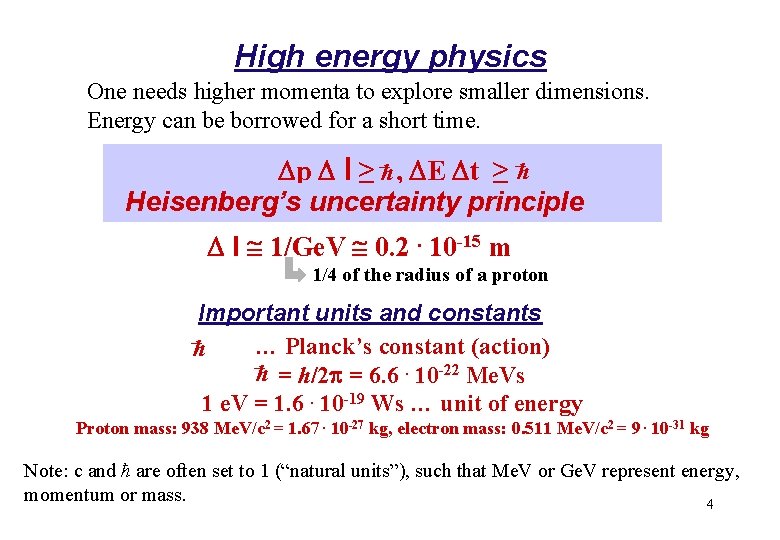
High energy physics One needs higher momenta to explore smaller dimensions. Energy can be borrowed for a short time. _ _ Dp D l ≥ h , DE Dt ≥ h Heisenberg’s uncertainty principle D l @ 1/Ge. V @ 0. 2. 10 -15 m 1/4 of the radius of a proton Important units and constants _ … Planck’s constant (action) h _ h = h/2 = 6. 6. 10 -22 Me. Vs 1 e. V = 1. 6. 10 -19 Ws … unit of energy Proton mass: 938 Me. V/c 2 = 1. 67. 10 -27 kg, electron mass: 0. 511 Me. V/c 2 = 9. 10 -31 kg Note: c and ħ are often set to 1 (“natural units”), such that Me. V or Ge. V represent energy, momentum or mass. 4
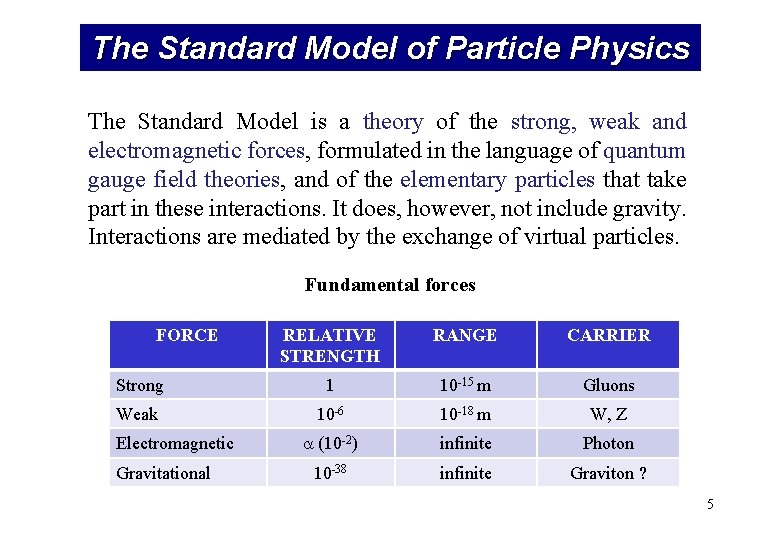
The Standard Model of Particle Physics The Standard Model is a theory of the strong, weak and electromagnetic forces, formulated in the language of quantum gauge field theories, and of the elementary particles that take part in these interactions. It does, however, not include gravity. Interactions are mediated by the exchange of virtual particles. Fundamental forces FORCE RELATIVE STRENGTH RANGE CARRIER Strong 1 10 -15 m Gluons Weak 10 -6 10 -18 m W, Z a (10 -2) infinite Photon 10 -38 infinite Graviton ? Electromagnetic Gravitational 5
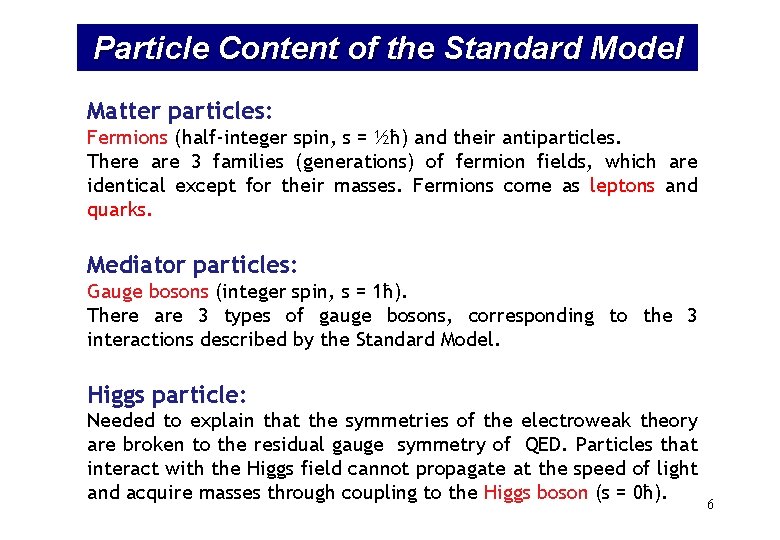
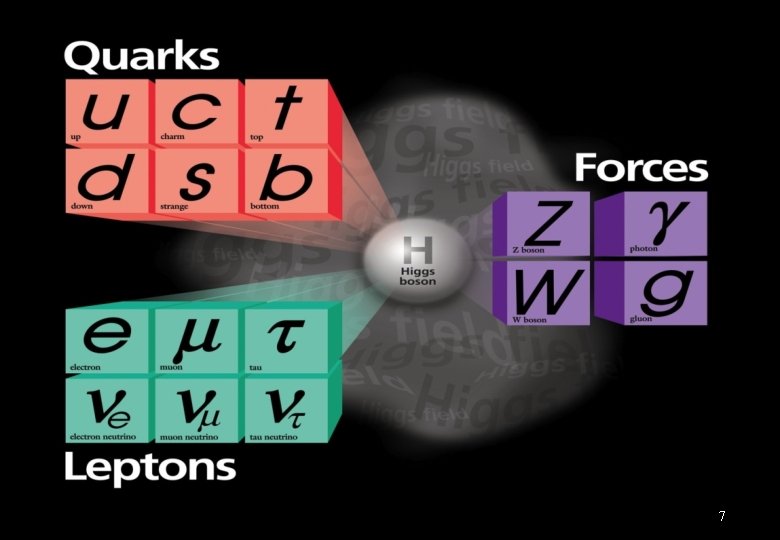
Particle Content of the Standard Model Matter particles: Fermions (half-integer spin, s = ½ħ) and their antiparticles. There are 3 families (generations) of fermion fields, which are identical except for their masses. Fermions come as leptons and quarks. Mediator particles: Gauge bosons (integer spin, s = 1ħ). There are 3 types of gauge bosons, corresponding to the 3 interactions described by the Standard Model. Higgs particle: Needed to explain that the symmetries of the electroweak theory are broken to the residual gauge symmetry of QED. Particles that interact with the Higgs field cannot propagate at the speed of light and acquire masses through coupling to the Higgs boson (s = 0ħ). 6
7 7
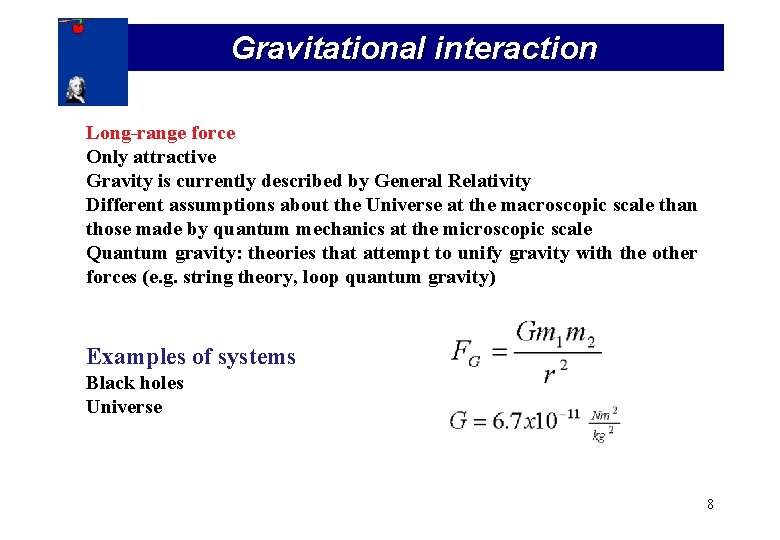
Gravitational interaction Long-range force Only attractive Gravity is currently described by General Relativity Different assumptions about the Universe at the macroscopic scale than those made by quantum mechanics at the microscopic scale Quantum gravity: theories that attempt to unify gravity with the other forces (e. g. string theory, loop quantum gravity) Examples of systems Black holes Universe 8
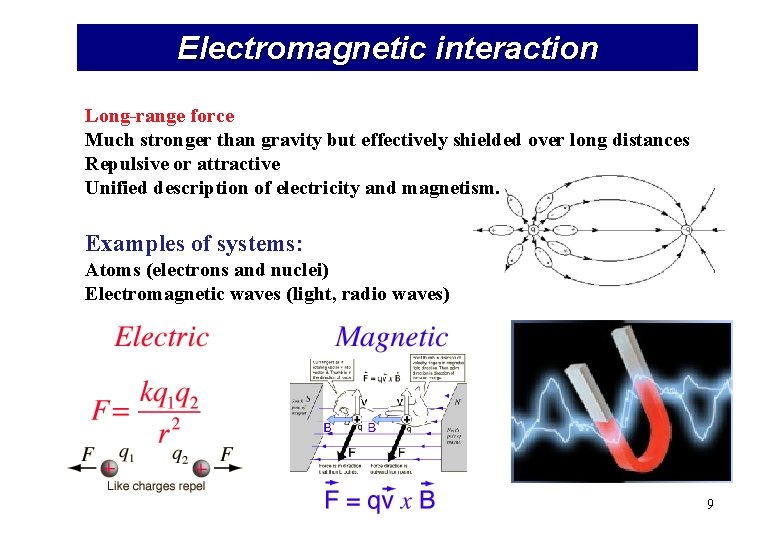
Electromagnetic interaction Long-range force Much stronger than gravity but effectively shielded over long distances Repulsive or attractive Unified description of electricity and magnetism. Examples of systems: Atoms (electrons and nuclei) Electromagnetic waves (light, radio waves) 9

Weak interaction Short-range force Very weak Only force that can change the flavor of quarks (e. g. d -> u) Unified with electromagnetic force CP violation (charge conjugation, parity not conserved) Examples of systems Neutrino interactions Beta decays Nuclear fusion 10
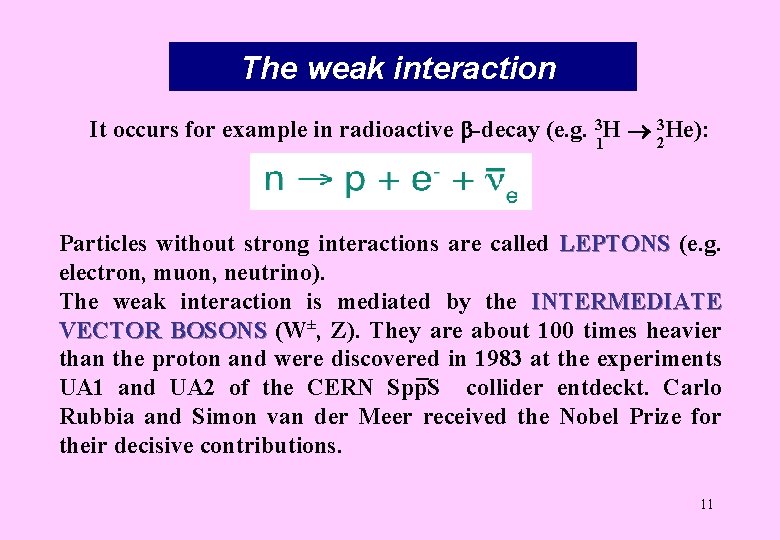
The weak interaction It occurs for example in radioactive b-decay (e. g. 31 H 23 He): Particles without strong interactions are called LEPTONS (e. g. electron, muon, neutrino). The weak interaction is mediated by the INTERMEDIATE VECTOR BOSONS (W±, Z). They are about 100 times heavier than the proton and were discovered in 1983 at the experiments UA 1 and UA 2 of the CERN Spp. S collider entdeckt. Carlo Rubbia and Simon van der Meer received the Nobel Prize for their decisive contributions. 11
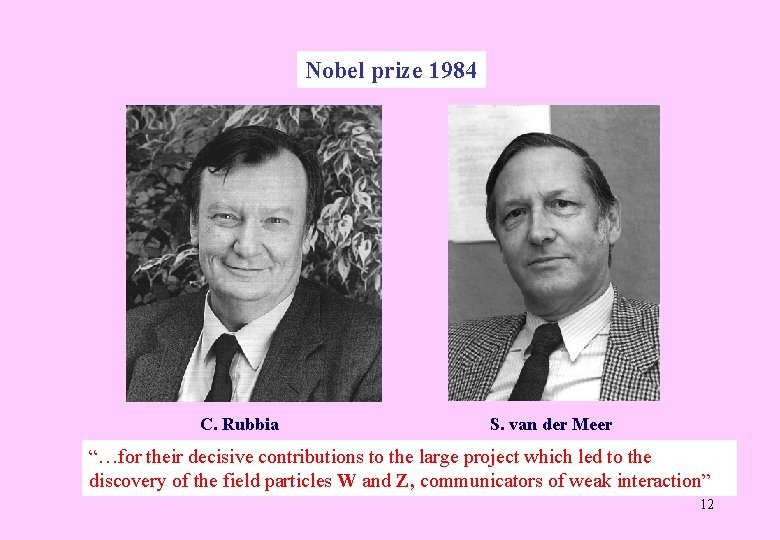
Nobel prize 1984 C. Rubbia S. van der Meer “…for their decisive contributions to the large project which led to the discovery of the field particles W and Z, communicators of weak interaction” 12
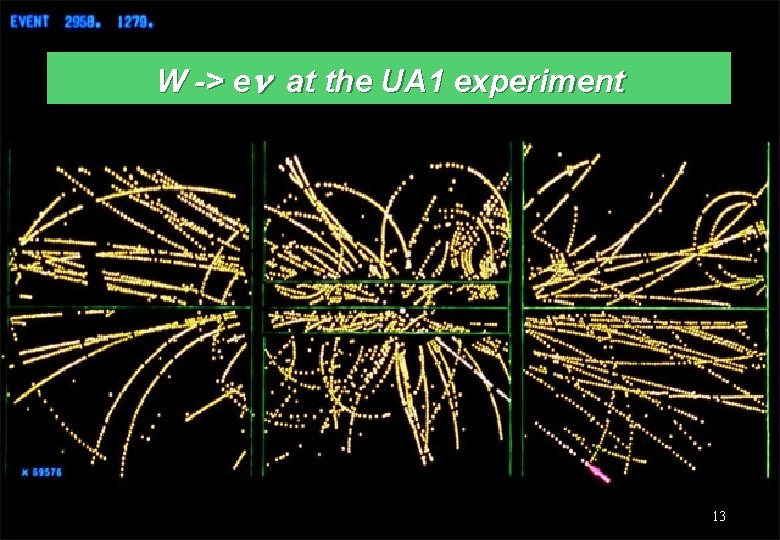
W -> e at the UA 1 experiment C. -E. Wulz 13 13 13
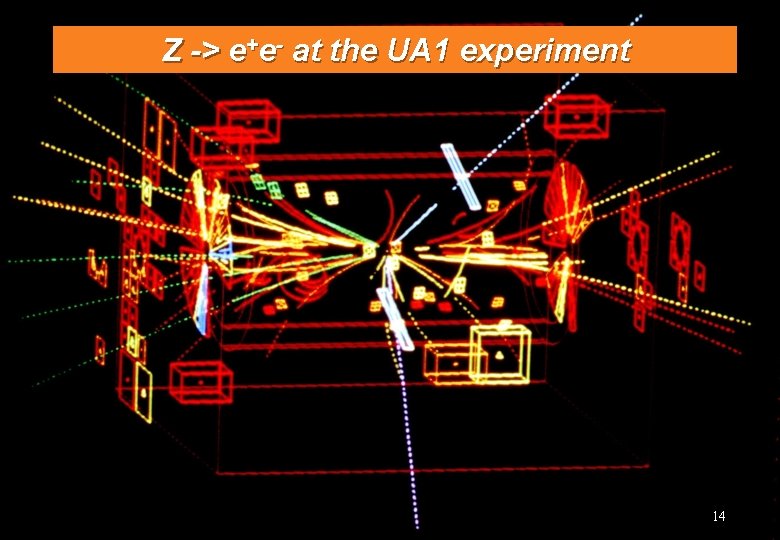
Z -> e+e- at the UA 1 experiment ino C. -E. Wulz 14 14 14
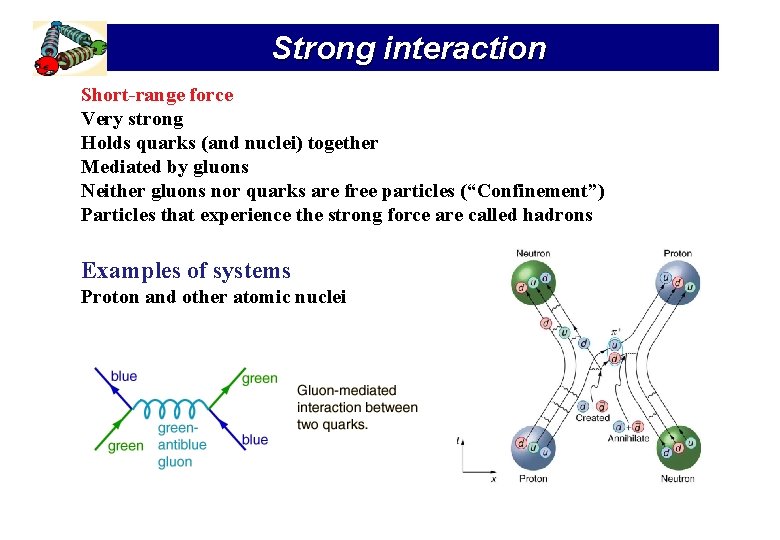
Strong interaction Short-range force Very strong Holds quarks (and nuclei) together Mediated by gluons Neither gluons nor quarks are free particles (“Confinement”) Particles that experience the strong force are called hadrons Examples of systems Proton and other atomic nuclei
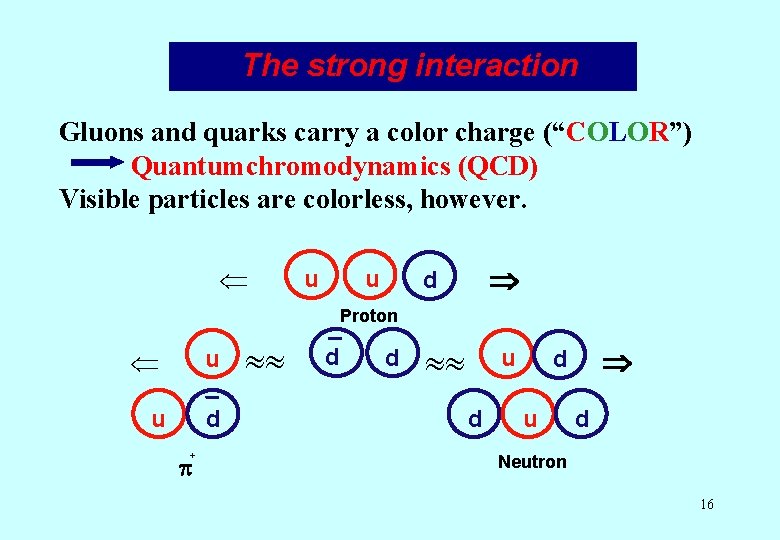
The strong interaction Gluons and quarks carry a color charge (“COLOR”) Quantumchromodynamics (QCD) Visible particles are colorless, however. Ü u u Þ d Proton Ü u u d + » » d d » » u d Þ d u d Neutron 16
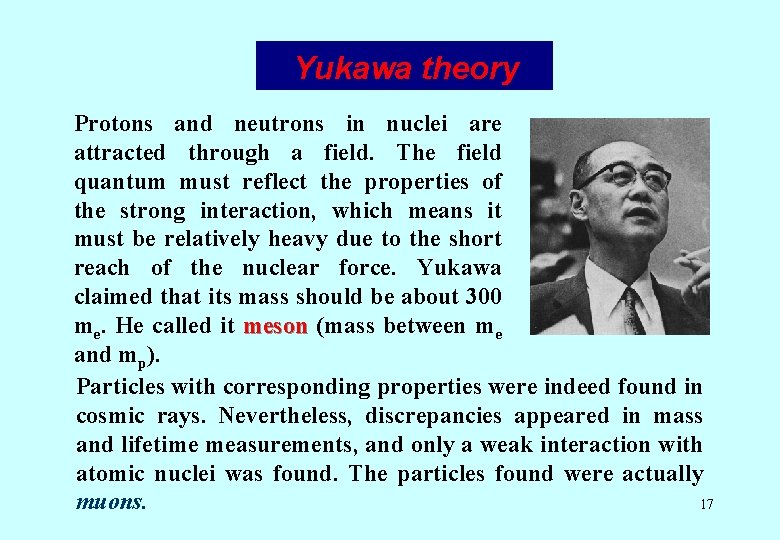
Yukawa theory Protons and neutrons in nuclei are attracted through a field. The field quantum must reflect the properties of the strong interaction, which means it must be relatively heavy due to the short reach of the nuclear force. Yukawa claimed that its mass should be about 300 me. He called it meson (mass between me and mp). Particles with corresponding properties were indeed found in cosmic rays. Nevertheless, discrepancies appeared in mass and lifetime measurements, and only a weak interaction with atomic nuclei was found. The particles found were actually 17 muons.
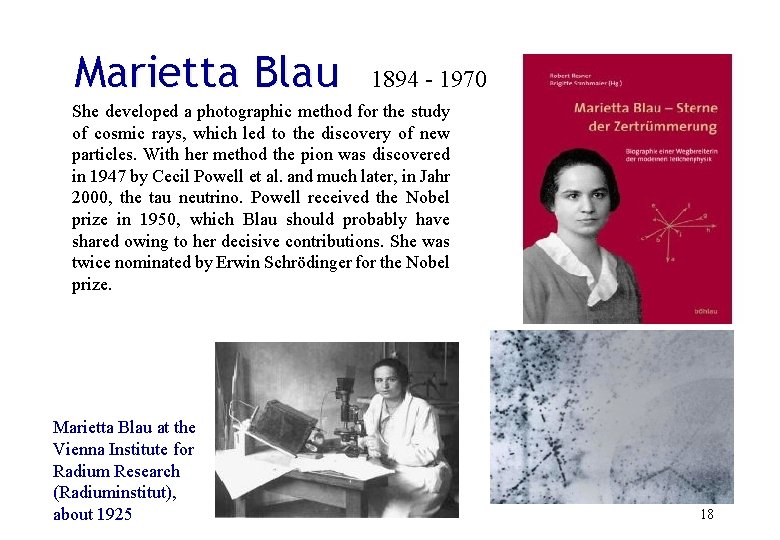
Marietta Blau 1894 - 1970 She developed a photographic method for the study of cosmic rays, which led to the discovery of new particles. With her method the pion was discovered in 1947 by Cecil Powell et al. and much later, in Jahr 2000, the tau neutrino. Powell received the Nobel prize in 1950, which Blau should probably have shared owing to her decisive contributions. She was twice nominated by Erwin Schrödinger for the Nobel prize. Marietta Blau at the Vienna Institute for Radium Research (Radiuminstitut), about 1925 18
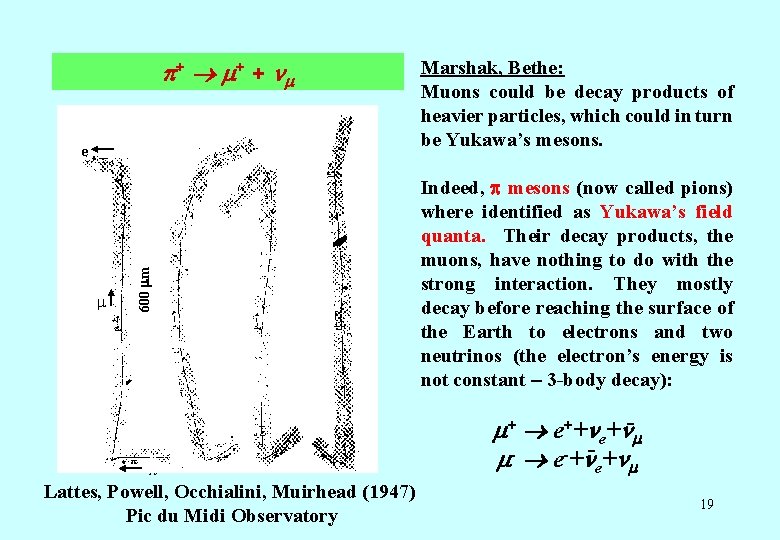
+ + + m 600 m e p Lattes, Powell, Occhialini, Muirhead (1947) Pic du Midi Observatory Marshak, Bethe: Muons could be decay products of heavier particles, which could in turn be Yukawa’s mesons. Indeed, mesons (now called pions) where identified as Yukawa’s field quanta. Their decay products, the muons, have nothing to do with the strong interaction. They mostly decay before reaching the surface of the Earth to electrons and two neutrinos (the electron’s energy is not constant – 3 -body decay): + e++ e+ - - + - e -+ e 19
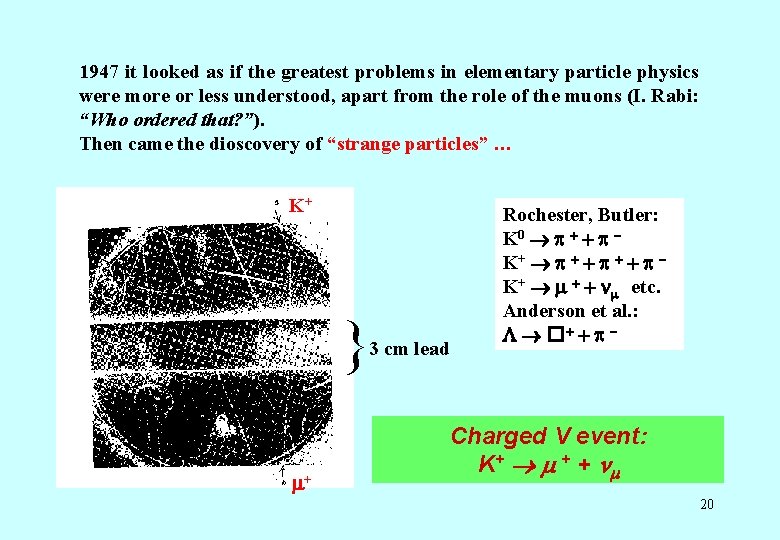
1947 it looked as if the greatest problems in elementary particle physics were more or less understood, apart from the role of the muons (I. Rabi: “Who ordered that? ”). Then came the dioscovery of “strange particles” … K+ } 3 cm lead + Rochester, Butler: K 0 K+ etc. Anderson et al. : � Charged V event: K+ + + 20
The “strange particles” were strange insofar as they were produced in large quantities (time scale typically 10 -23 s), but decayed relatively slowly (time scale 10 -10 s). This meant that their production and decay mechanisms were different. Strange particles are produced through the strong interaction, but they decay through the weak interaction. Gell-Mann and Nijishima attributed a property named “strangeness” to each particle, which is conserved in strong interactions, but violated in weak interactions. Therefore strange particles are only produced in pairs, such as + + K 0 + When they decay, strangeness is not conserved, e. g. p + . 21
Willis Lamb in his Nobel lecture 1955: When the Nobel Prizes were first awarded in 1901, physicists knew something of just two objects which are now called « elementary particles » : the electron and the proton. A deluge of other « elementary » particles appeared after 1930; neutron, neutrino, μ meson, π meson, heavier mesons, and various hyperons. I have heard it said that « the finder of a new elementary particle used to be rewarded by a Nobel Prize, but such a discovery now ought to be punished by a $10, 000 fine » . A similar thing was said in 1963 by Enrico Fermi (to Leon Lederman) in connection with hadron spectroscopy, which resulted from the quark model that was subsequently presented: Young man, if I could remember the names of all these particles, I would have been a botanist. 22
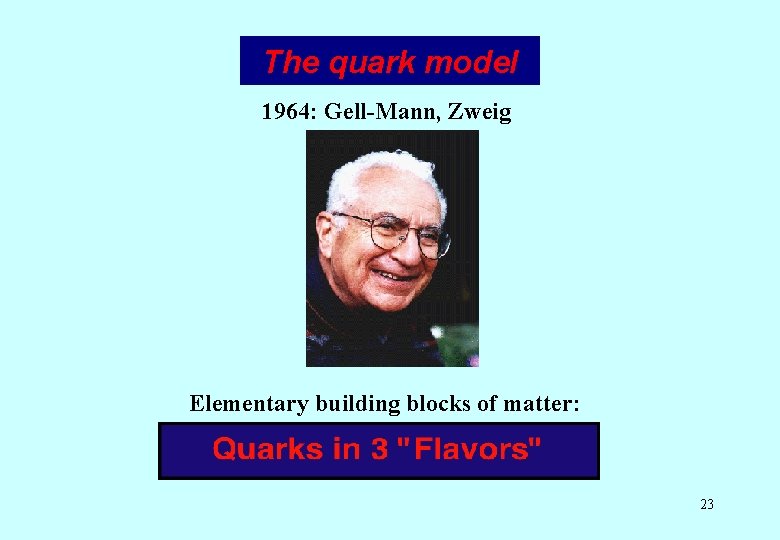
The quark model 1964: Gell-Mann, Zweig Elementary building blocks of matter: Materie: 23
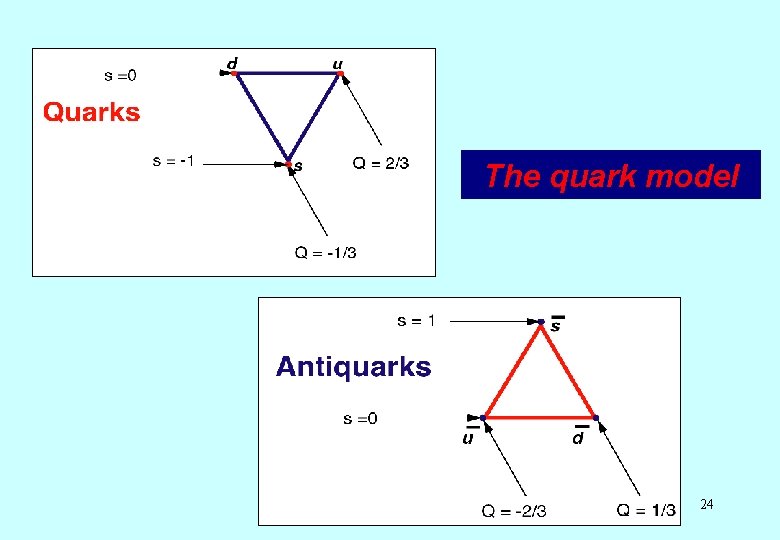
The quark model 24
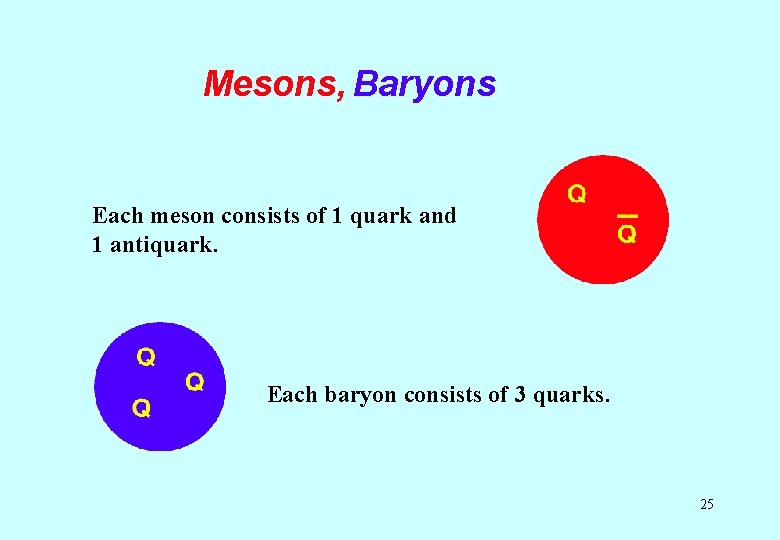
Mesons, Baryons Each meson consists of 1 quark and 1 antiquark. Each baryon consists of 3 quarks. 25
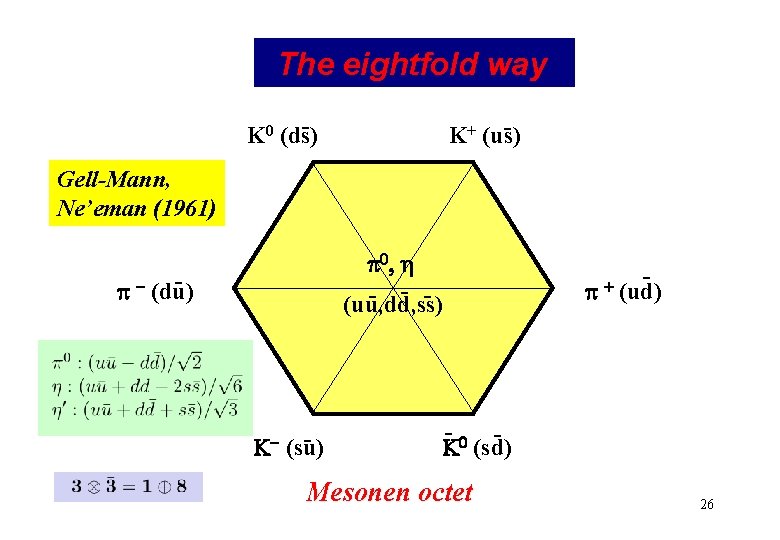
The eightfold way K 0 (ds) K+ (us) Gell-Mann, Ne’eman (1961) 0, h - (uu, dd, ss) (du) K (su) (ud) -0 K (sd) Mesonen octet 26
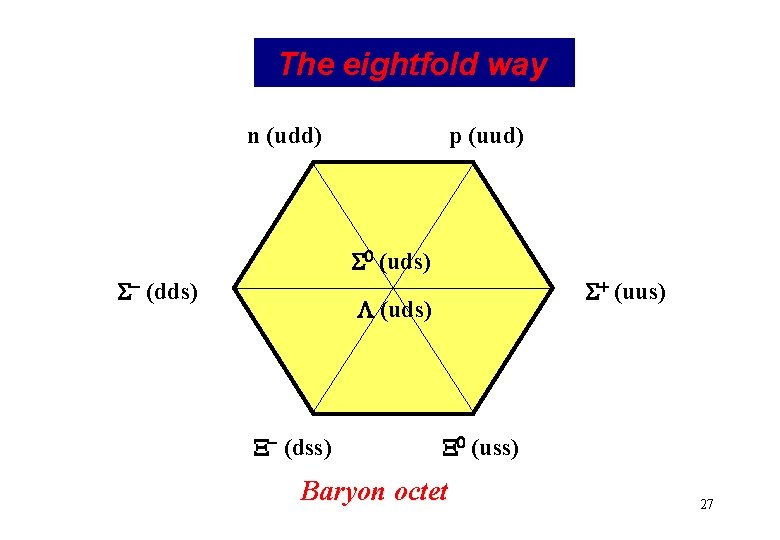
The eightfold way n (udd) p (uud) S 0 (uds) S (dds) S (uus) (uds) X (dss) X 0 (uss) Baryon octet 27
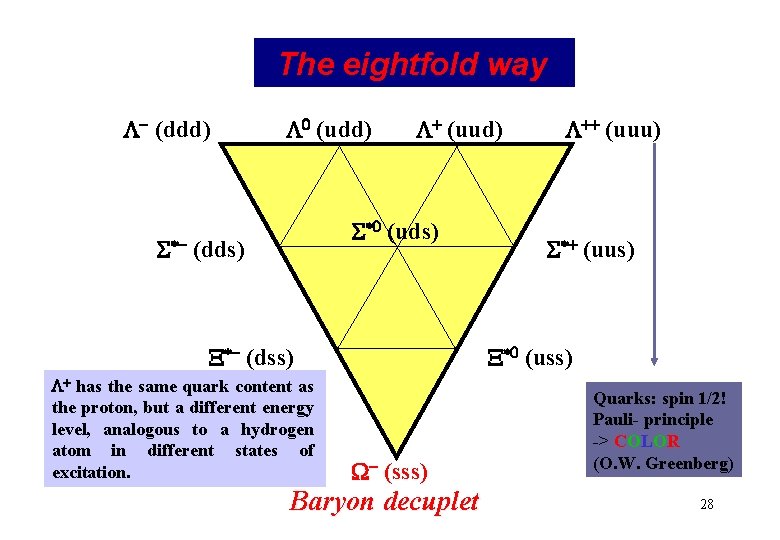
The eightfold way (ddd) 0 (udd) (uud) S*0 (uds) S* (dds) X* (dss) has the same quark content as the proton, but a different energy level, analogous to a hydrogen atom in different states of excitation. (uuu) S* (uus) X*0 (uss) W (sss) Baryon decuplet Quarks: spin 1/2! Pauli- principle -> COLOR (O. W. Greenberg) 28
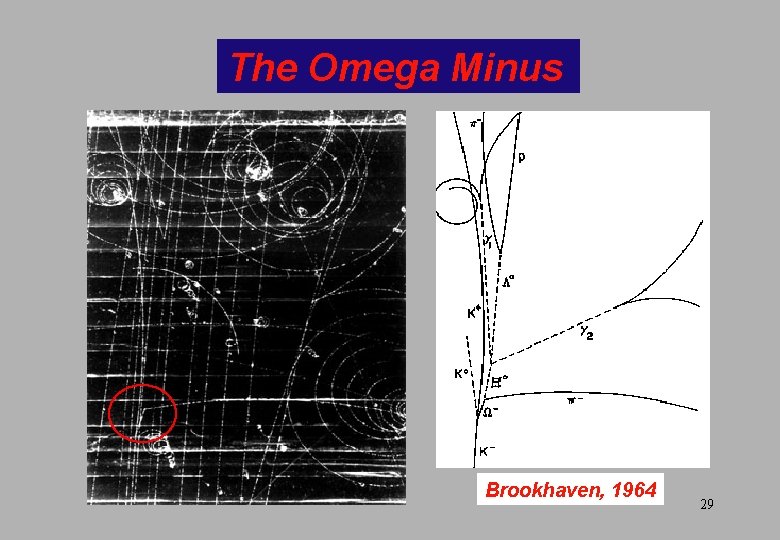
The Omega Minus Brookhaven, 1964 29
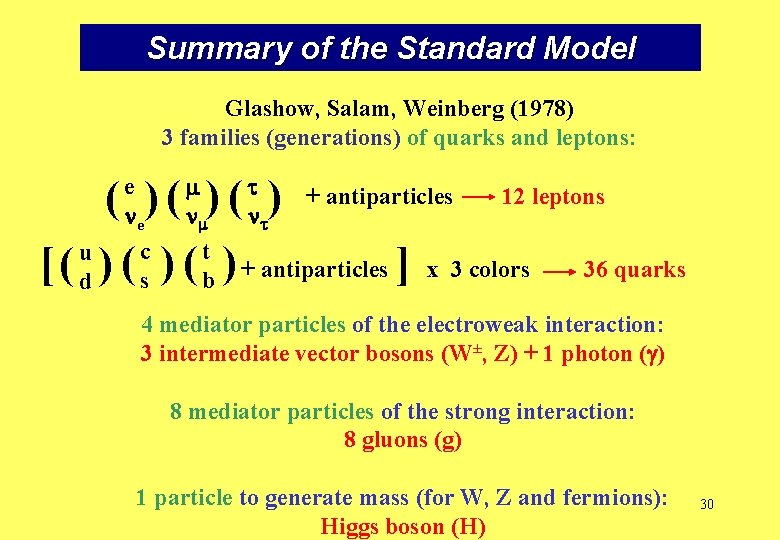
Summary of the Standard Model Glashow, Salam, Weinberg (1978) 3 families (generations) of quarks and leptons: t b t t ( ) ( ) + antiparticles 12 leptons u [ ( d ) ( ) + antiparticles ] x 3 colors 36 quarks e e c s 4 mediator particles of the electroweak interaction: 3 intermediate vector bosons (W±, Z) + 1 photon (g) 8 mediator particles of the strong interaction: 8 gluons (g) 1 particle to generate mass (for W, Z and fermions): Higgs boson (H) 30
The Higgs boson Practically all existing data (except neutrino masses) are very well described by the standard model. But the question of particle masses is not yet fully understood! In the standard model there is a particle associated with the mechanism through which most (or all? ) particles obtain mass - the Higgs boson. àIt was found at the Large Hadron Collider (LHC) Design beam energy: 14 Te. V p-p (2012 8 Te. V, since 2014 13 Te. V) It was not possible to establish a discovery at Fermilab‘s Tevatron near Chicago. Previously, at LEP at CERN compatible events were also found, but their statistical significance was not high enough. In the framework of supersymmetry there could be more Higgs 31 particles as well as supersymmetric partners of known particles
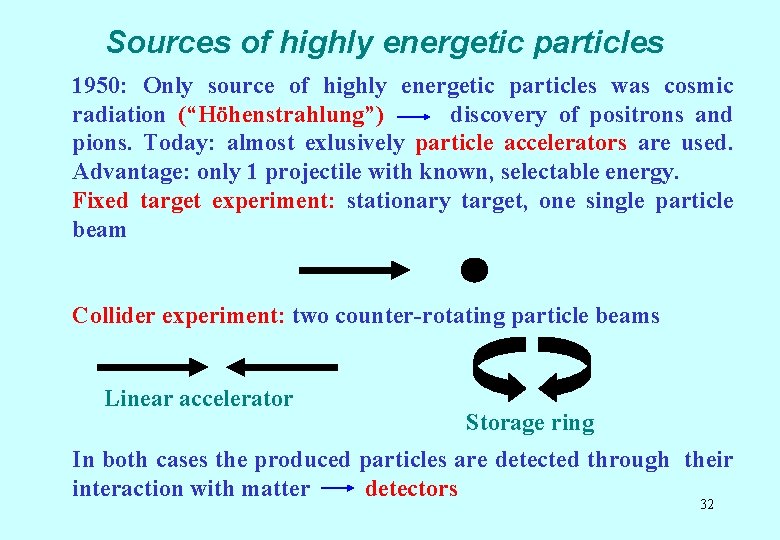
Sources of highly energetic particles 1950: Only source of highly energetic particles was cosmic radiation (“Höhenstrahlung”) discovery of positrons and pions. Today: almost exlusively particle accelerators are used. Advantage: only 1 projectile with known, selectable energy. Fixed target experiment: stationary target, one single particle beam Collider experiment: two counter-rotating particle beams Linear accelerator Storage ring In both cases the produced particles are detected through their interaction with matter detectors 32
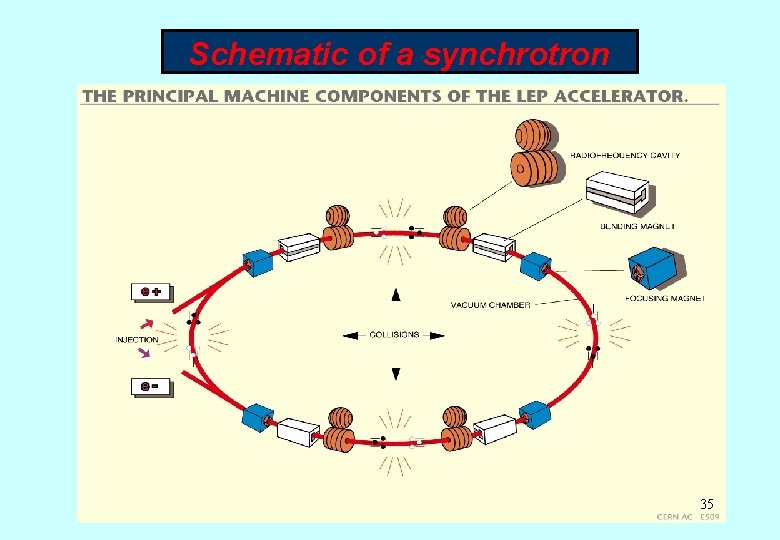
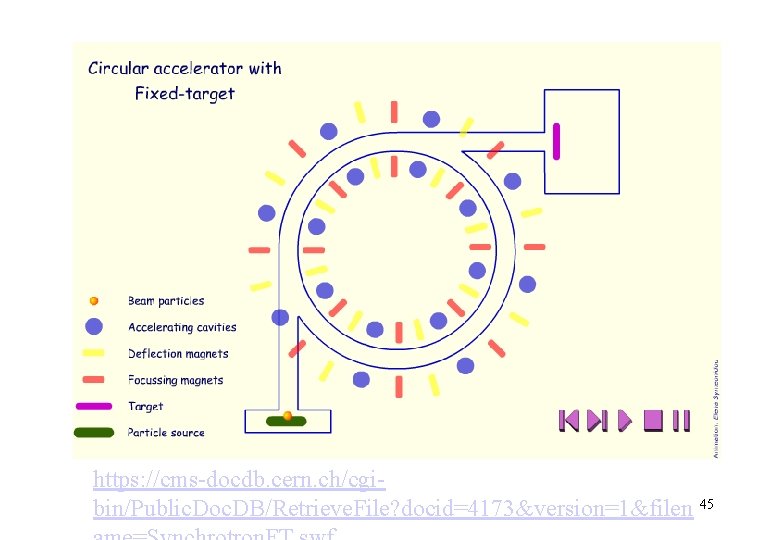
Particle accelerators Electromagnetic forces are used to accelerate stable, charged particles. A source is needed, e. g. hot cathode (heated wire) or an ion source. - Linear accelerators (LINACs) - Circular accelerators (cyclotrons, synchrotrons) Synchrotrons: Energies larger than 1 Ge. V. “Circular” orbit through arrangement of dipole magnets (deflection magnets), acceleration through high frequency cavities. For beam focussing quadrupole- , sextupole- or more complex magnets (focussing magnets) are used. 33
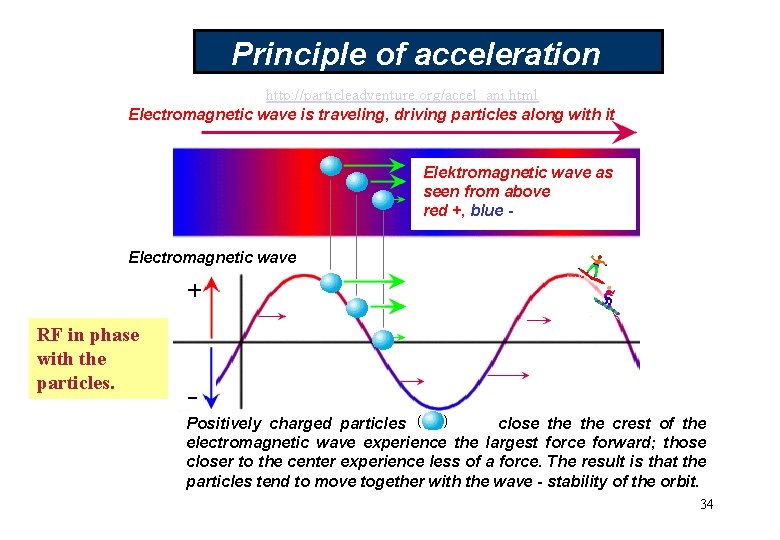
Principle of acceleration http: //particleadventure. org/accel_ani. html Electromagnetic wave is traveling, driving particles along with it Elektromagnetic wave as seen from above red +, blue Electromagnetic wave RF in phase with the particles. Positively charged particles close the crest of the electromagnetic wave experience the largest force forward; those closer to the center experience less of a force. The result is that the particles tend to move together with the wave - stability of the orbit. 34
Schematic of a synchrotron 35
Super Proton Synchrotron of CERN 36
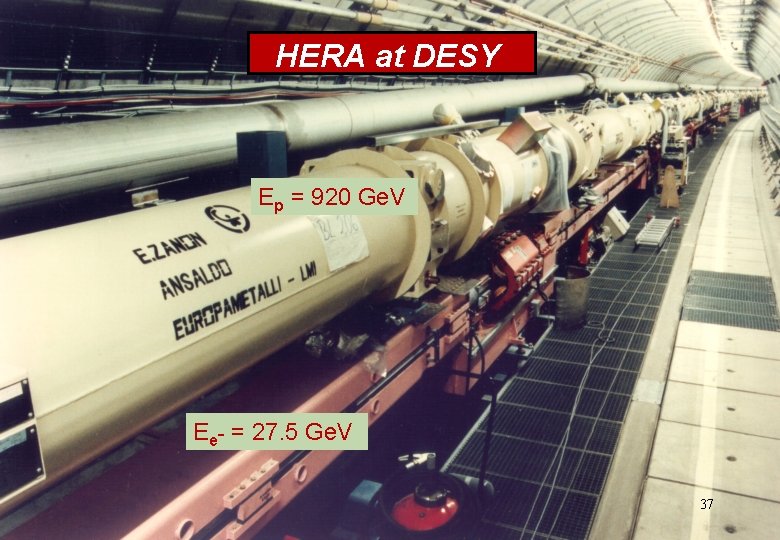
HERA at DESY Ep = 920 Ge. V Ee- = 27. 5 Ge. V 37
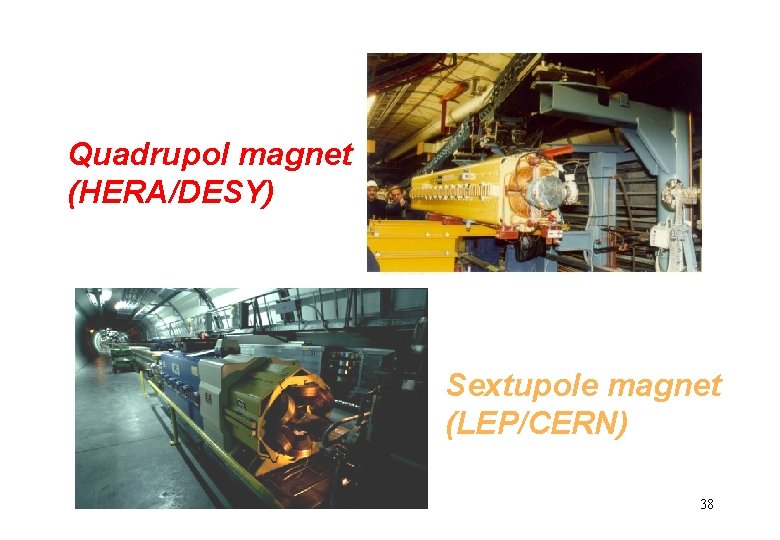
Quadrupol magnet (HERA/DESY) Sextupole magnet (LEP/CERN) 38
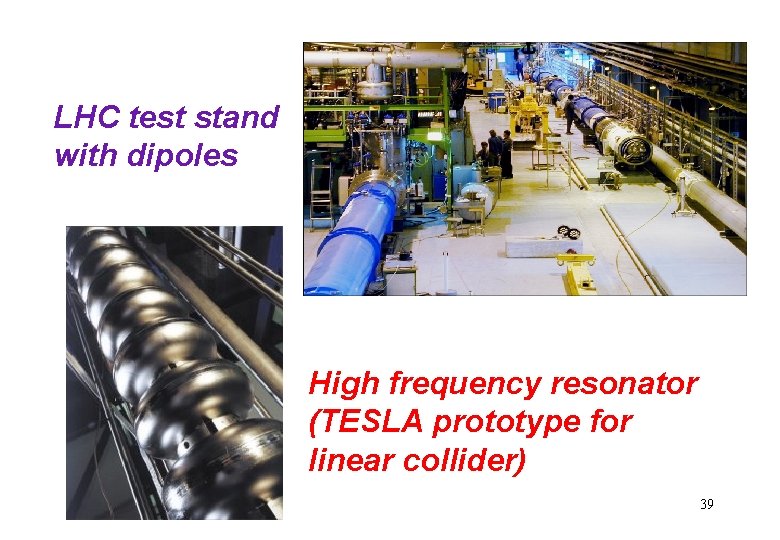
LHC test stand with dipoles High frequency resonator (TESLA prototype for linear collider) 39
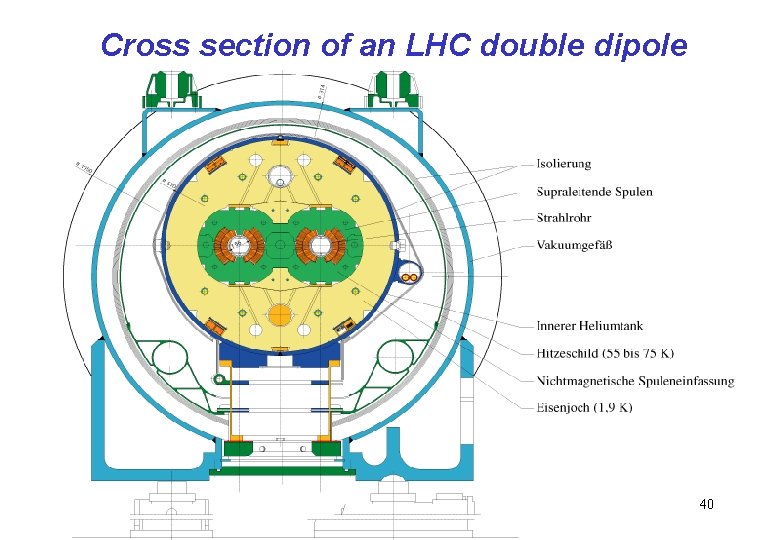
Cross section of an LHC double dipole 40
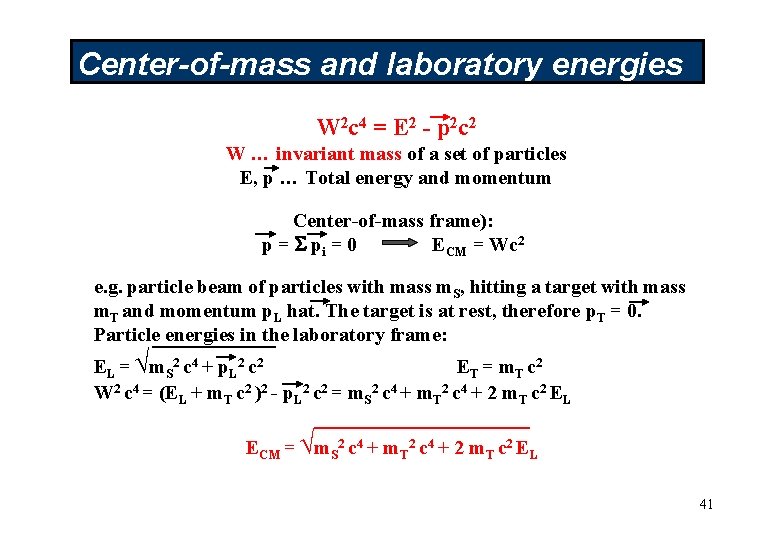
Center-of-mass and laboratory energies W 2 c 4 = E 2 - p 2 c 2 W … invariant mass of a set of particles E, p … Total energy and momentum Center-of-mass frame): p = S pi = 0 ECM = Wc 2 e. g. particle beam of particles with mass m. S, hitting a target with mass m. T and momentum p. L hat. The target is at rest, therefore p. T = 0. Particle energies in the laboratory frame: EL = √m. S 2 c 4 + p. L 2 c 2 ET = m. T c 2 W 2 c 4 = (EL + m. T c 2 )2 - p. L 2 c 2 = m. S 2 c 4 + m. T 2 c 4 + 2 m. T c 2 EL ECM = √m. S 2 c 4 + m. T 2 c 4 + 2 m. T c 2 EL 41
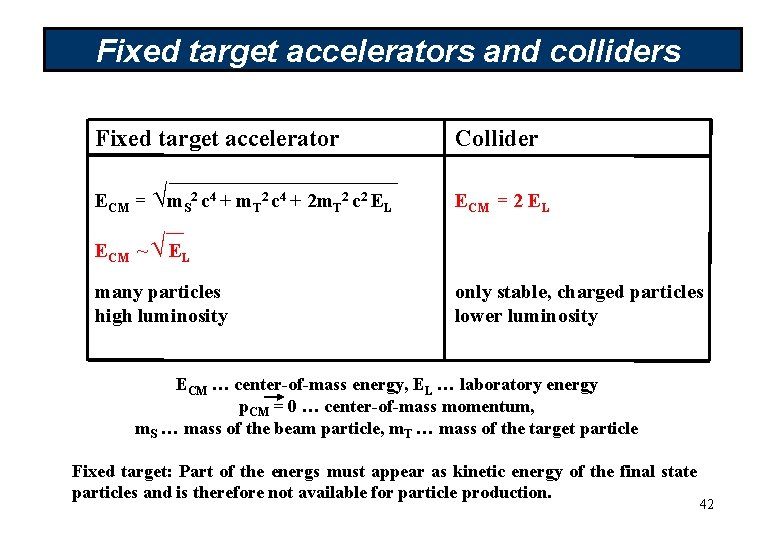
Fixed target accelerators and colliders Fixed target accelerator Collider ECM = √m. S 2 c 4 + m. T 2 c 4 + 2 m. T 2 c 2 EL ECM = 2 EL ECM ~ √ EL many particles high luminosity only stable, charged particles lower luminosity ECM … center-of-mass energy, EL … laboratory energy p. CM = 0 … center-of-mass momentum, m. S … mass of the beam particle, m. T … mass of the target particle Fixed target: Part of the energs must appear as kinetic energy of the final state particles and is therefore not available for particle production. 42
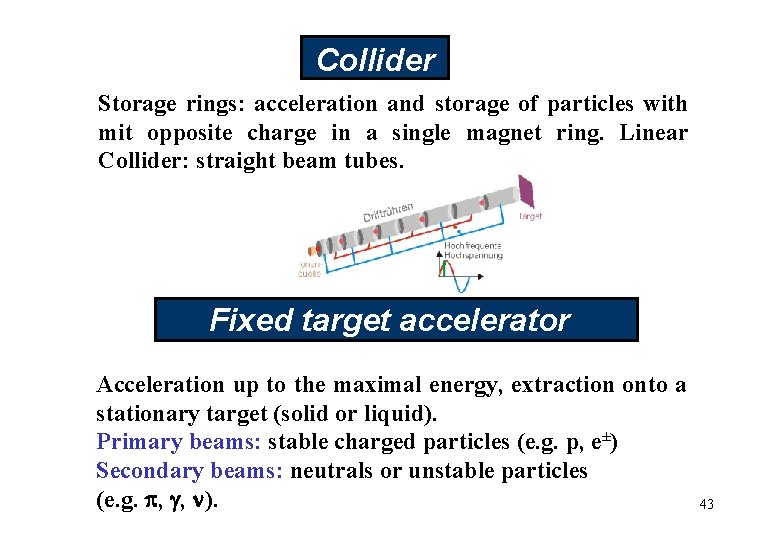
Collider Storage rings: acceleration and storage of particles with mit opposite charge in a single magnet ring. Linear Collider: straight beam tubes. Fixed target accelerator Acceleration up to the maximal energy, extraction onto a stationary target (solid or liquid). Primary beams: stable charged particles (e. g. p, e±) Secondary beams: neutrals or unstable particles (e. g. , g, ). 43
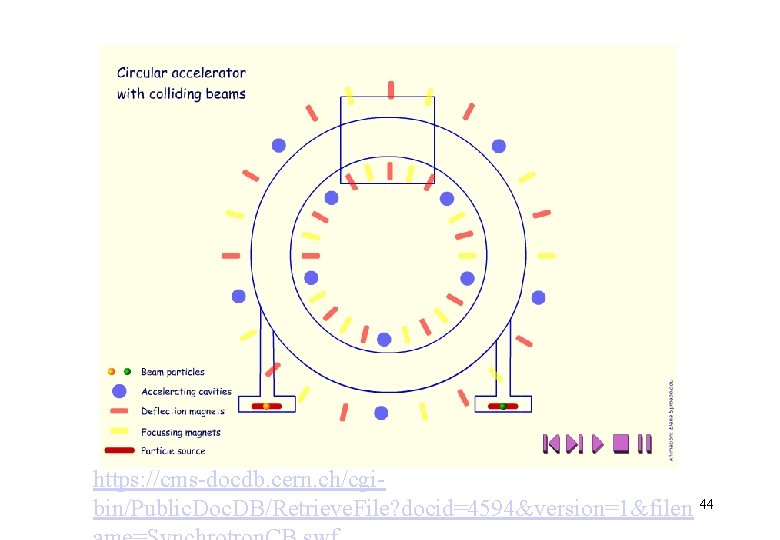
https: //cms-docdb. cern. ch/cgibin/Public. Doc. DB/Retrieve. File? docid=4594&version=1&filen 44
https: //cms-docdb. cern. ch/cgibin/Public. Doc. DB/Retrieve. File? docid=4173&version=1&filen 45
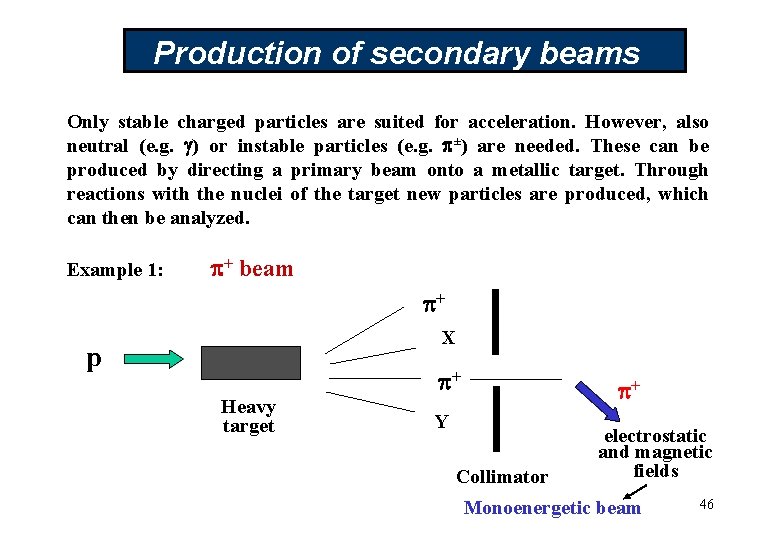
Production of secondary beams Only stable charged particles are suited for acceleration. However, also neutral (e. g. g) or instable particles (e. g. ±) are needed. These can be produced by directing a primary beam onto a metallic target. Through reactions with the nuclei of the target new particles are produced, which can then be analyzed. Example 1: + beam + X p + Heavy target + Y Collimator electrostatic and magnetic fields Monoenergetic beam 46
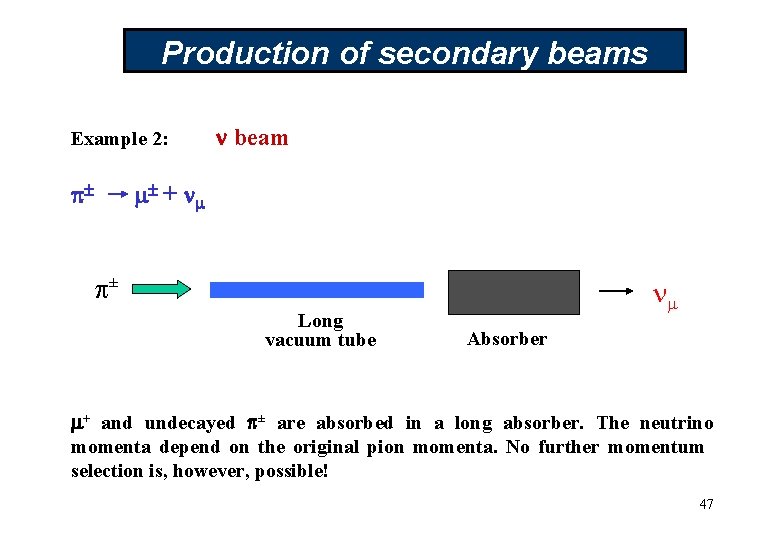
Production of secondary beams Example 2: ± beam ± + p± Long vacuum tube nm Absorber + and undecayed ± are absorbed in a long absorber. The neutrino momenta depend on the original pion momenta. No further momentum selection is, however, possible! 47
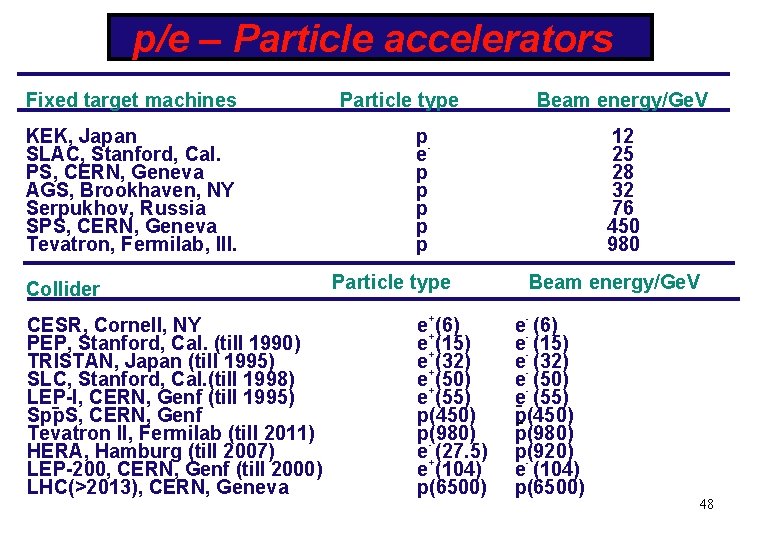
p/e – Particle accelerators Fixed target machines KEK, Japan SLAC, Stanford, Cal. PS, CERN, Geneva AGS, Brookhaven, NY Serpukhov, Russia SPS, CERN, Geneva Tevatron, Fermilab, Ill. Collider CESR, Cornell, NY PEP, Stanford, Cal. (till 1990) TRISTAN, Japan (till 1995) SLC, Stanford, Cal. (till 1998) LEP-I, CERN, Genf (till 1995) Spp. S, CERN, Genf Tevatron II, Fermilab (till 2011) HERA, Hamburg (till 2007) LEP-200, CERN, Genf (till 2000) LHC(>2013), CERN, Geneva Particle type Beam energy/Ge. V pe p p p Particle type e ++(6) e +(15) e +(32) e +(50) e (55) p(450) p(980) e -+(27. 5) e (104) p(6500) 12 25 28 32 76 450 980 Beam energy/Ge. V e -- (6) e - (15) e - (32) e - (50) e (55) p(450) p(980) p(920) e - (104) p(6500) 48
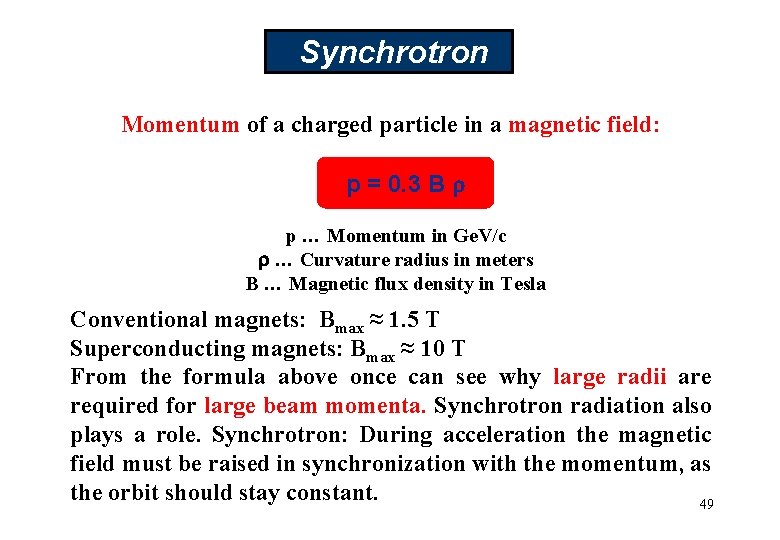
Synchrotron Momentum of a charged particle in a magnetic field: p = 0. 3 B r p … Momentum in Ge. V/c r … Curvature radius in meters B … Magnetic flux density in Tesla Conventional magnets: Bmax ≈ 1. 5 T Superconducting magnets: Bmax ≈ 10 T From the formula above once can see why large radii are required for large beam momenta. Synchrotron radiation also plays a role. Synchrotron: During acceleration the magnetic field must be raised in synchronization with the momentum, as the orbit should stay constant. 49
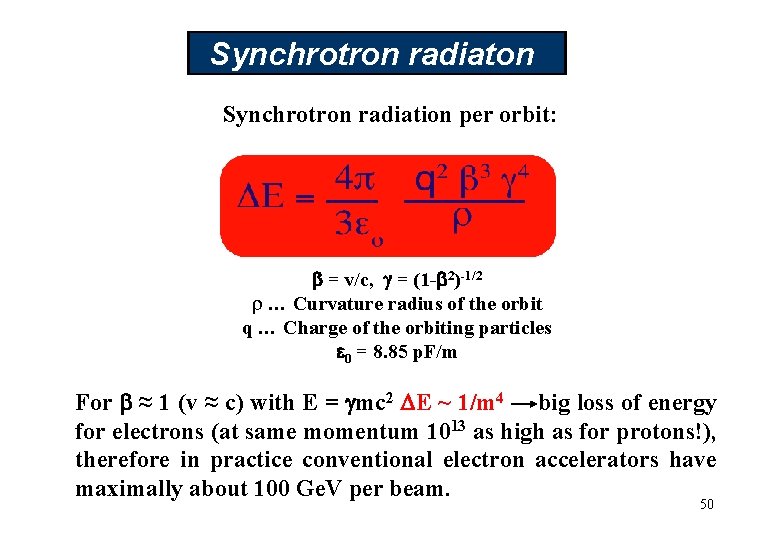
Synchrotron radiaton Synchrotron radiation per orbit: b = v/c, g = (1 -b 2)-1/2 r … Curvature radius of the orbit q … Charge of the orbiting particles e 0 = 8. 85 p. F/m For b ≈ 1 (v ≈ c) with E = gmc 2 DE ~ 1/m 4 big loss of energy for electrons (at same momentum 1013 as high as for protons!), therefore in practice conventional electron accelerators have maximally about 100 Ge. V per beam. 50
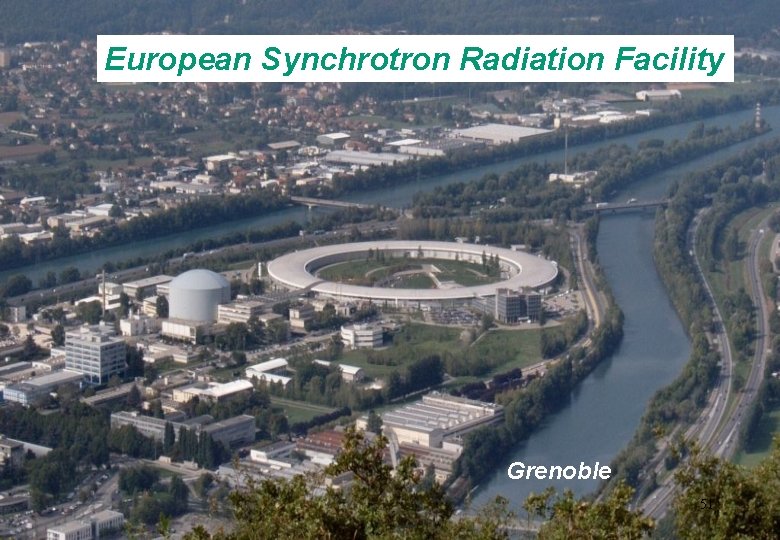
European Synchrotron Radiation Facility Grenoble 51
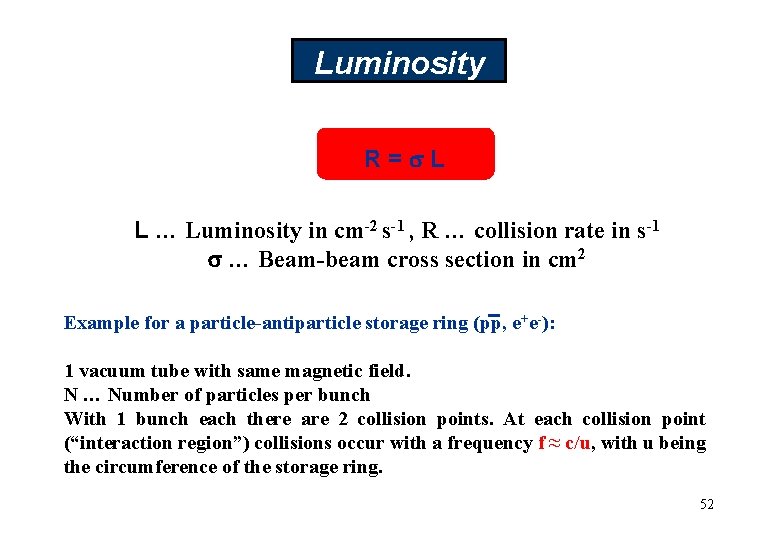
Luminosity R= L L … Luminosity in cm-2 s-1 , R … collision rate in s-1 … Beam-beam cross section in cm 2 Example for a particle-antiparticle storage ring (pp, e+e-): 1 vacuum tube with same magnetic field. N … Number of particles per bunch With 1 bunch each there are 2 collision points. At each collision point (“interaction region”) collisions occur with a frequency f ≈ c/u, with u being the circumference of the storage ring. 52
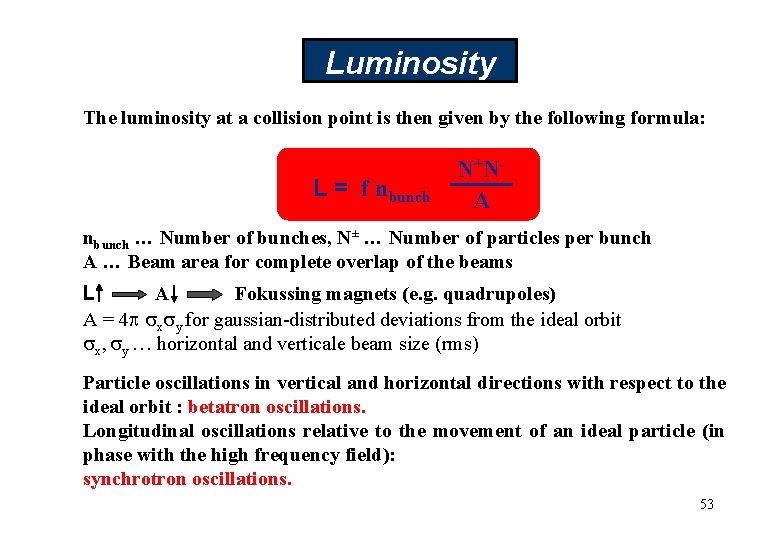
Luminosity The luminosity at a collision point is then given by the following formula: L = f nbunch N+ NA nbunch … Number of bunches, N± … Number of particles per bunch A … Beam area for complete overlap of the beams L A Fokussing magnets (e. g. quadrupoles) A = 4 p sxsy for gaussian-distributed deviations from the ideal orbit sx, sy … horizontal and verticale beam size (rms) Particle oscillations in vertical and horizontal directions with respect to the ideal orbit : betatron oscillations. Longitudinal oscillations relative to the movement of an ideal particle (in phase with the high frequency field): synchrotron oscillations. 53
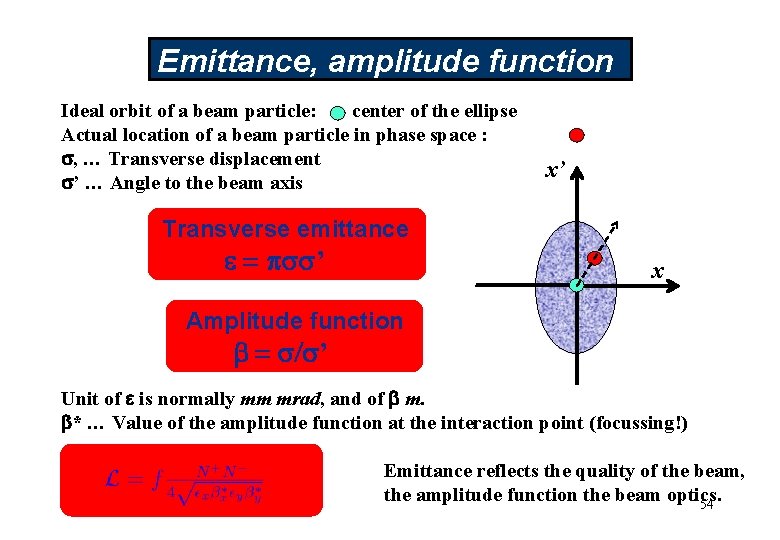
Emittance, amplitude function Ideal orbit of a beam particle: center of the ellipse Actual location of a beam particle in phase space : , … Transverse displacement ’ … Angle to the beam axis x’ Transverse emittance e = ’ x Amplitude function b = / ’ Unit of e is normally mm mrad, and of b m. b* … Value of the amplitude function at the interaction point (focussing!) Emittance reflects the quality of the beam, the amplitude function the beam optics. 54
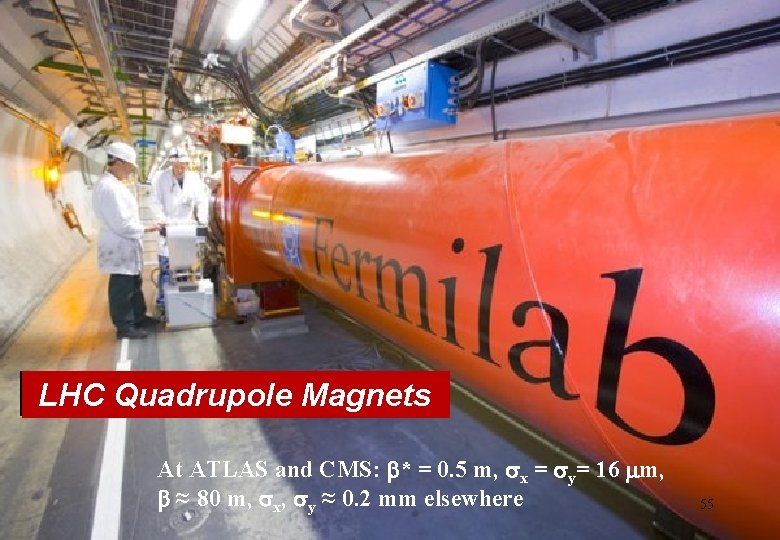
LHC Quadrupole Magnets At ATLAS and CMS: b* = 0. 5 m, x = y= 16 m, b ≈ 80 m, x, y ≈ 0. 2 mm elsewhere 55
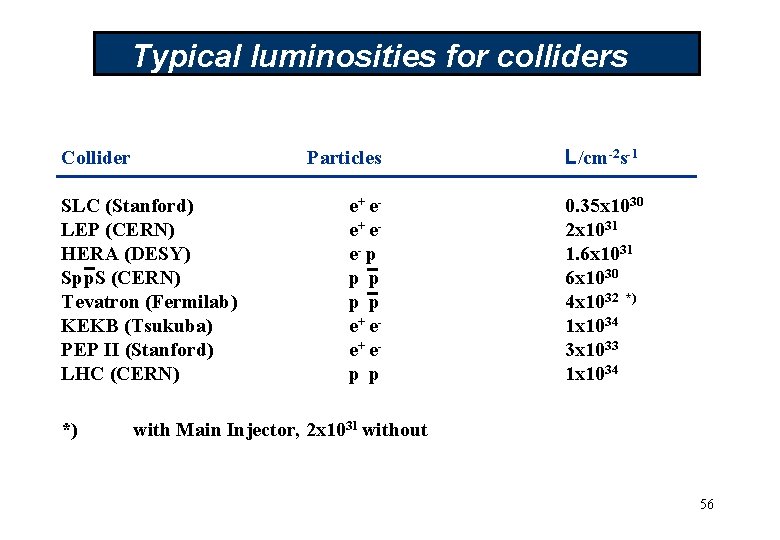
Typical luminosities for colliders Collider SLC (Stanford) LEP (CERN) HERA (DESY) Spp. S (CERN) Tevatron (Fermilab) KEKB (Tsukuba) PEP II (Stanford) LHC (CERN) *) Particles L/cm-2 s-1 e+ ee- p p p e+ ep p 0. 35 x 1030 2 x 1031 1. 6 x 1031 6 x 1030 4 x 1032 *) 1 x 1034 3 x 1033 1 x 1034 with Main Injector, 2 x 1031 without 56
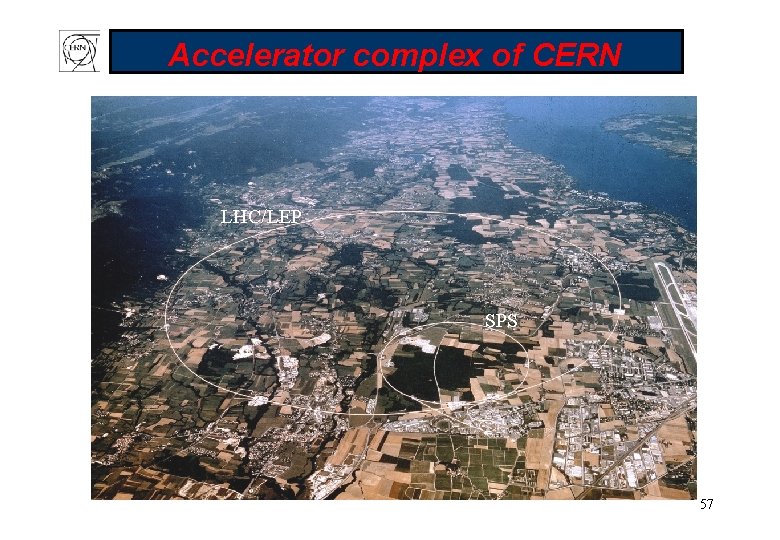
Accelerator complex of CERN LHC/LEP SPS 57
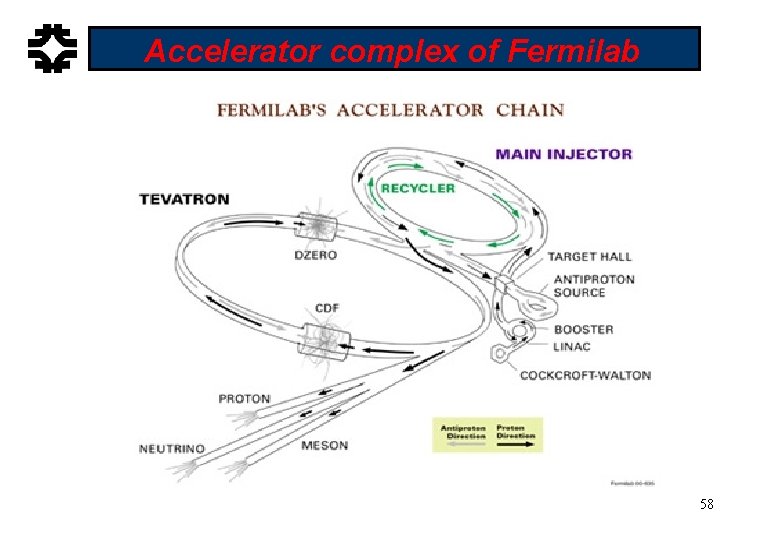
Accelerator complex of Fermilab Tevatron Main Injector 58
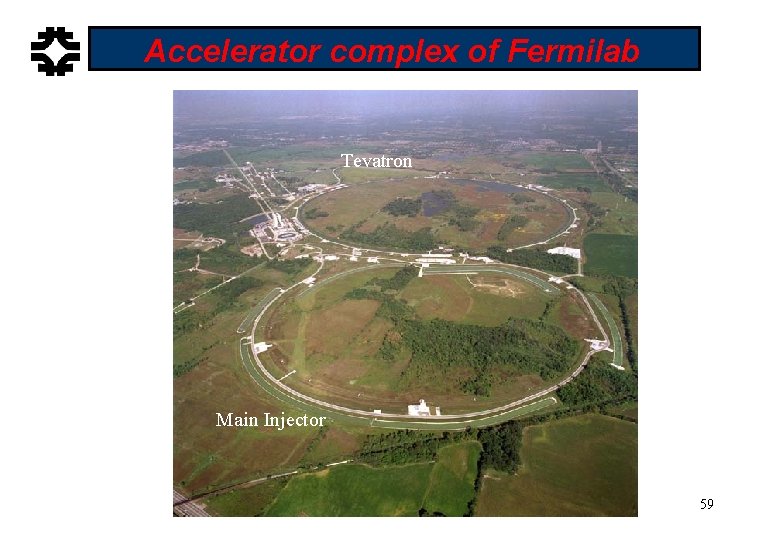
Accelerator complex of Fermilab Tevatron Main Injector 59
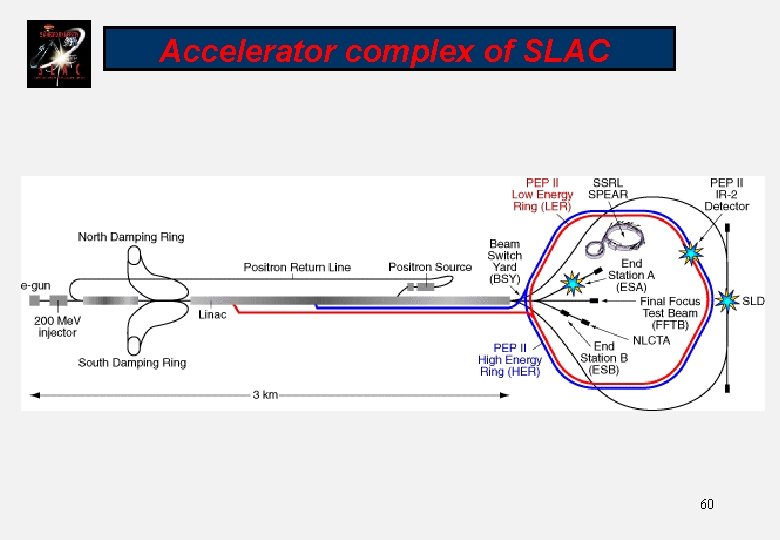
Accelerator complex of SLAC 60
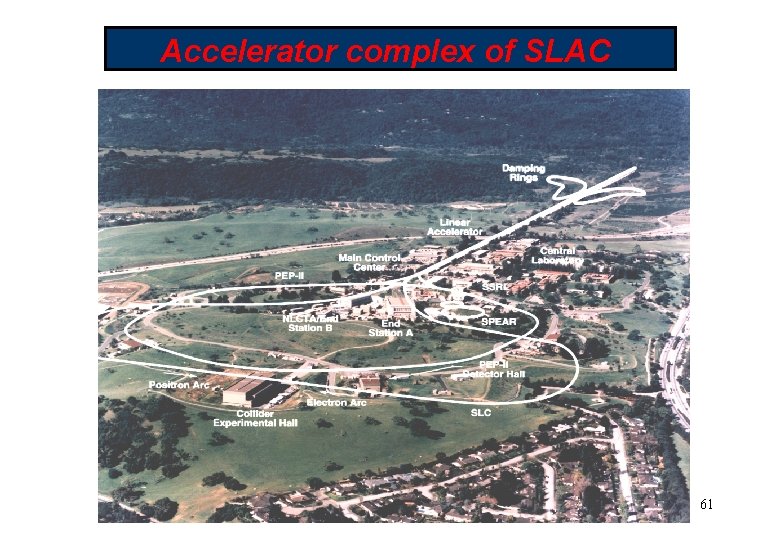
Accelerator complex of SLAC 61
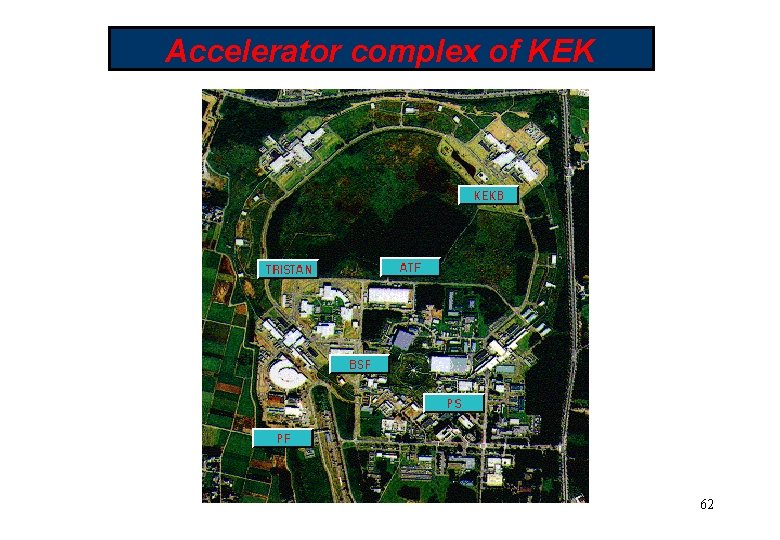
Accelerator complex of KEK 62
Particle detection Particles are detected through: l Interaction with the detector material (nuclei) l Strong interaction for hadrons l Weak interaction for neutrinos l Production of new particles if energy sufficiently high l Ionization of atoms (charged particles) l Emission of electromagnetic radiation (charged particles) l g -> e+e- 63
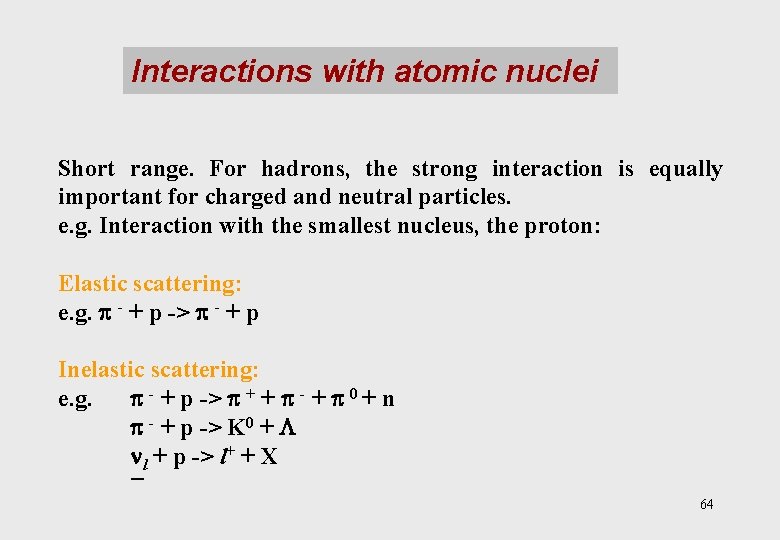
Interactions with atomic nuclei Short range. For hadrons, the strong interaction is equally important for charged and neutral particles. e. g. Interaction with the smallest nucleus, the proton: Elastic scattering: e. g. - + p -> - + p Inelastic scattering: e. g. - + p -> + + - + 0 + n - + p -> K 0 + _l + p -> l+ + X 64
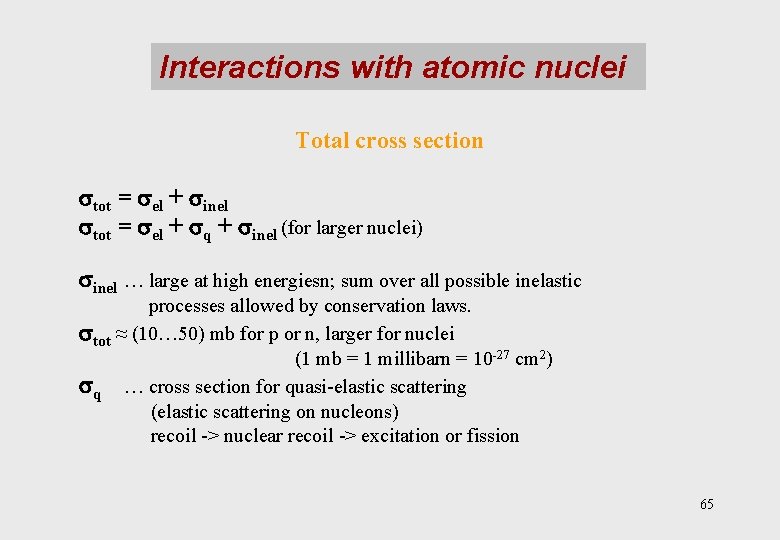
Interactions with atomic nuclei Total cross section tot = el + inel tot = el + q + inel (for larger nuclei) inel … large at high energiesn; sum over all possible inelastic processes allowed by conservation laws. tot ≈ (10… 50) mb for p or n, larger for nuclei (1 mb = 1 millibarn = 10 -27 cm 2) q … cross section for quasi-elastic scattering (elastic scattering on nucleons) recoil -> nuclear recoil -> excitation or fission 65
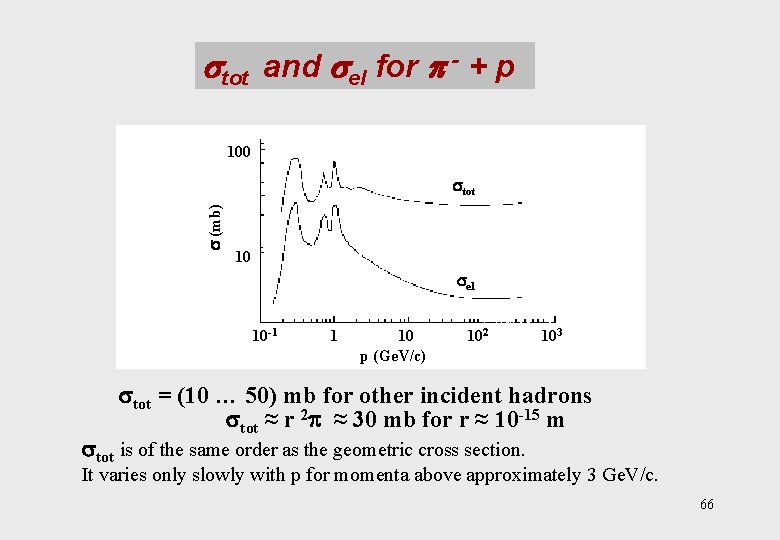
stot and sel for - + p 100 (mb) tot 10 el 10 -1 1 10 p (Ge. V/c) 102 103 tot = (10 … 50) mb for other incident hadrons tot ≈ r 2 ≈ 30 mb for r ≈ 10 -15 m tot is of the same order as the geometric cross section. It varies only slowly with p for momenta above approximately 3 Ge. V/c. 66
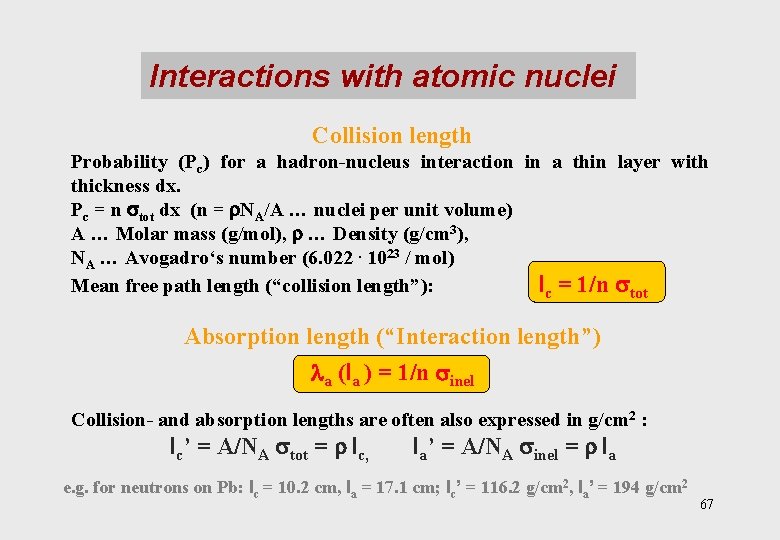
Interactions with atomic nuclei Collision length Probability (Pc) for a hadron-nucleus interaction in a thin layer with thickness dx. Pc = n tot dx (n = r. NA/A … nuclei per unit volume) A … Molar mass (g/mol), r … Density (g/cm 3), NA … Avogadro‘s number (6. 022. 1023 / mol) Mean free path length (“collision length”): lc = 1/n tot Absorption length (“Interaction length”) la (la ) = 1/n inel Collision- and absorption lengths are often also expressed in g/cm 2 : lc’ = A/NA tot = r lc, la’ = A/NA inel = r la e. g. for neutrons on Pb: lc = 10. 2 cm, la = 17. 1 cm; lc’ = 116. 2 g/cm 2, la’ = 194 g/cm 2 67
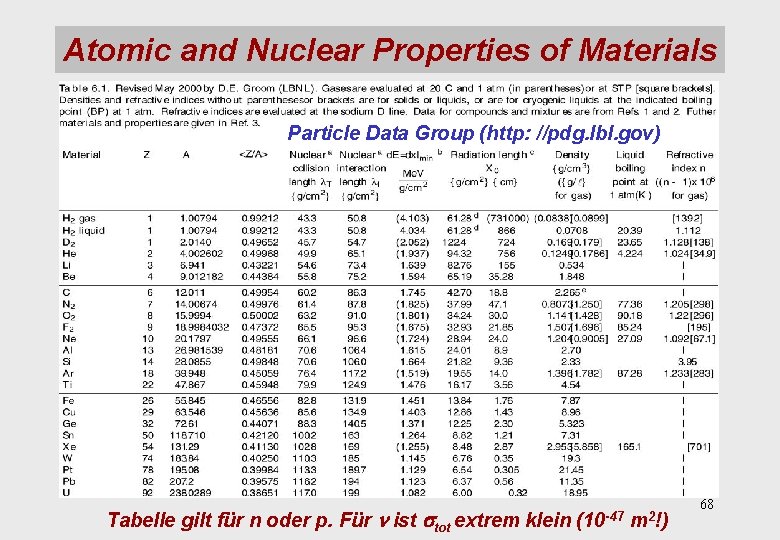
Atomic and Nuclear Properties of Materials Particle Data Group (http: //pdg. lbl. gov) Tabelle gilt für n oder p. Für ist stot extrem klein (10 -47 m 2!) 68
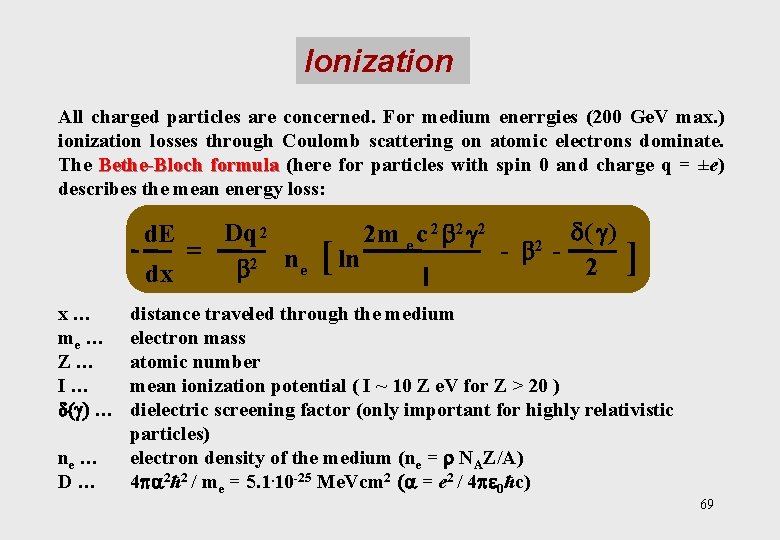
Ionization All charged particles are concerned. For medium enerrgies (200 Ge. V max. ) ionization losses through Coulomb scattering on atomic electrons dominate. The Bethe-Bloch formula (here for particles with spin 0 and charge q = ±e) describes the mean energy loss: Dq 2 = ne 2 b dx d. E x… me … Z… I… d(g) … ne … D… [ ln 2 m e c 2 b 2 g 2 I d( g) - b 2 2 ] distance traveled through the medium electron mass atomic number mean ionization potential ( I ~ 10 Z e. V for Z > 20 ) dielectric screening factor (only important for highly relativistic particles) electron density of the medium (ne = r NAZ/A) 4 a 2ħ 2 / me = 5. 1. 10 -25 Me. Vcm 2 (a = e 2 / 4 e 0ħc) 69
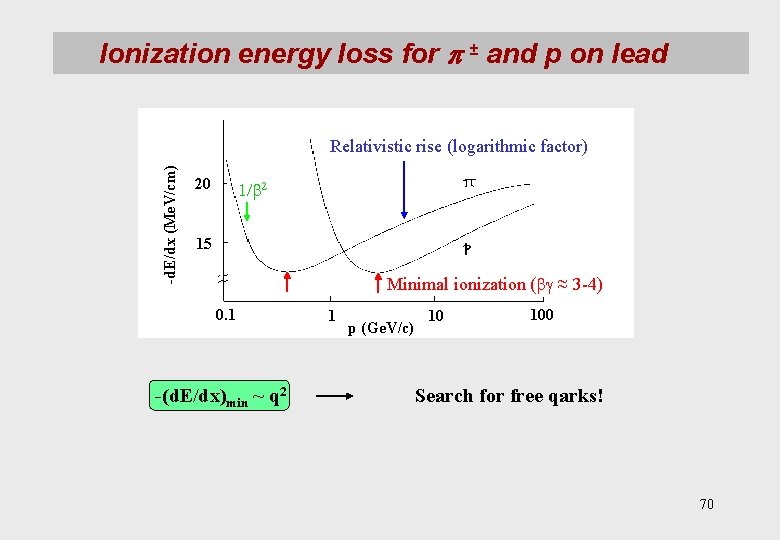
Ionization energy loss for ± and p on lead -d. E/dx (Me. V/cm) Relativistic rise (logarithmic factor) 20 1/b 2 15 Minimal ionization (bg ≈ 3 -4) 0. 1 -(d. E/dx)min ~ q 2 1 p (Ge. V/c) 10 100 Search for free qarks! 70
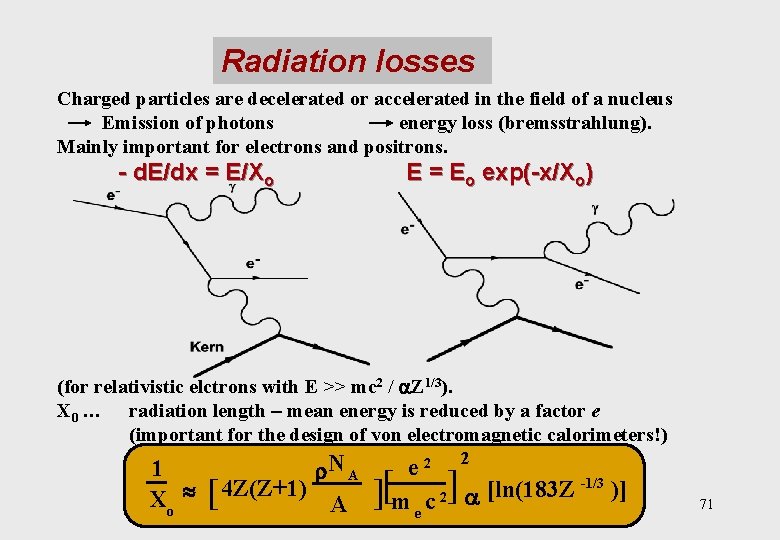
Radiation losses Charged particles are decelerated or accelerated in the field of a nucleus Emission of photons energy loss (bremsstrahlung). Mainly important for electrons and positrons. - d. E/dx = E/Xo E = Eo exp(-x/Xo) (for relativistic elctrons with E >> mc 2 / a. Z 1/3). X 0 … radiation length – mean energy is reduced by a factor e (important for the design of von electromagnetic calorimeters!) 1 r. N A Xo » [ 4 Z(Z+1) A e 2 2 -1/3 [ ] [ln(183 Z )] ] mec 2 a 71
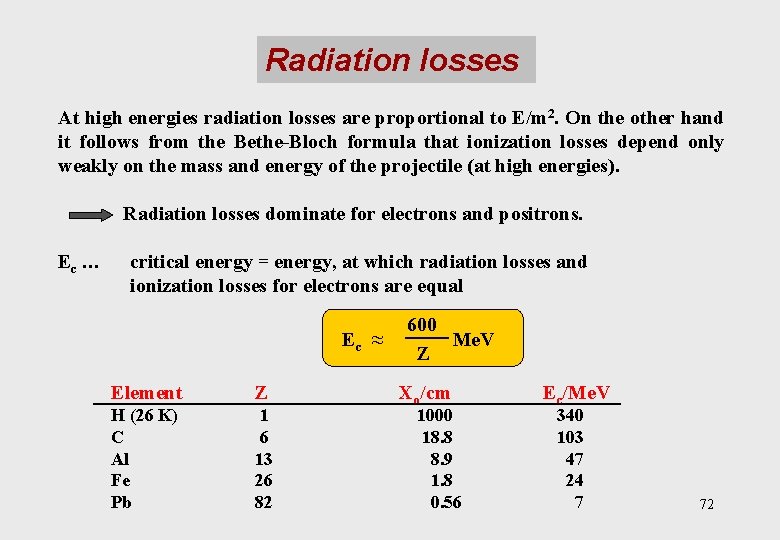
Radiation losses At high energies radiation losses are proportional to E/m 2. On the other hand it follows from the Bethe-Bloch formula that ionization losses depend only weakly on the mass and energy of the projectile (at high energies). Radiation losses dominate for electrons and positrons. Ec … critical energy = energy, at which radiation losses and ionization losses for electrons are equal Ec ≈ Element Z H (26 K) C Al Fe Pb 1 6 13 26 82 600 Me. V Z Xo/cm 1000 18. 8 8. 9 1. 8 0. 56 Ec/Me. V 340 103 47 24 7 72
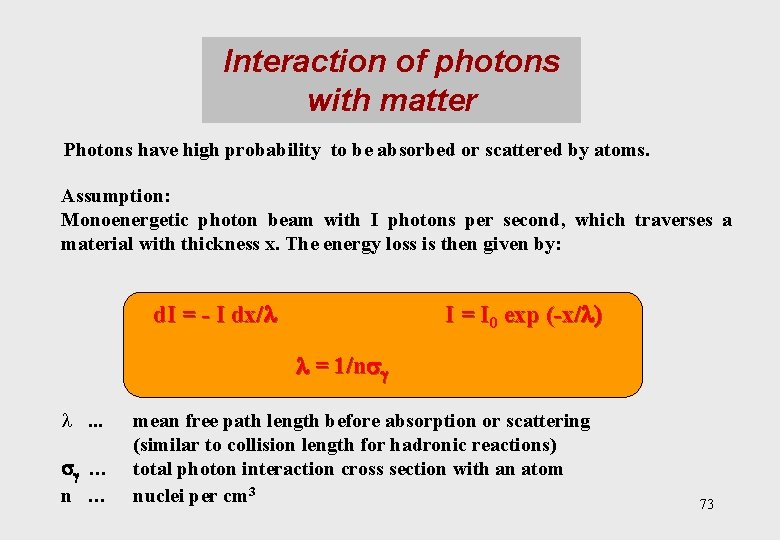
Interaction of photons with matter Photons have high probability to be absorbed or scattered by atoms. Assumption: Monoenergetic photon beam with I photons per second, which traverses a material with thickness x. The energy loss is then given by: d. I = - I dx/l I = I 0 exp (-x/l) l = 1/n g l. . . g … n … mean free path length before absorption or scattering (similar to collision length for hadronic reactions) total photon interaction cross section with an atom nuclei per cm 3 73
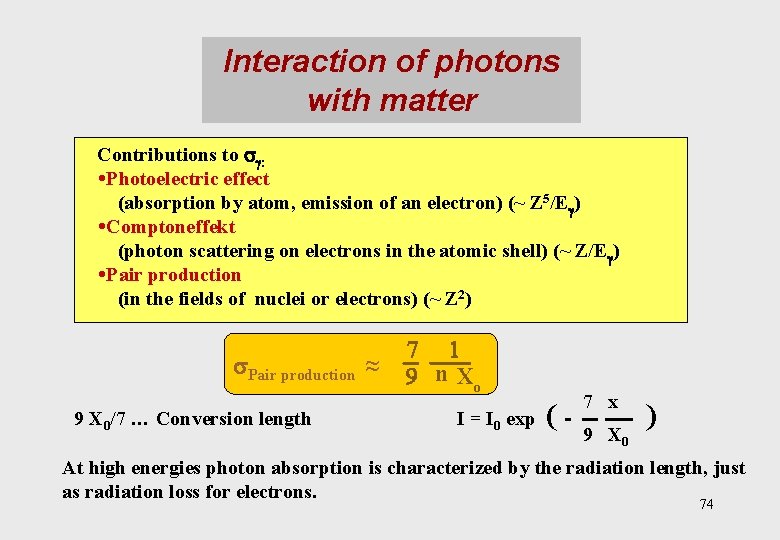
Interaction of photons with matter Contributions to g: Photoelectric effect (absorption by atom, emission of an electron) (~ Z 5/Eg) Comptoneffekt (photon scattering on electrons in the atomic shell) (~ Z/Eg) Pair production (in the fields of nuclei or electrons) (~ Z 2) Pair production ≈ 9 X 0/7 … Conversion length 7 1 9 n Xo I = I 0 exp ( 7 x 9 X 0 ) At high energies photon absorption is characterized by the radiation length, just as radiation loss for electrons. 74
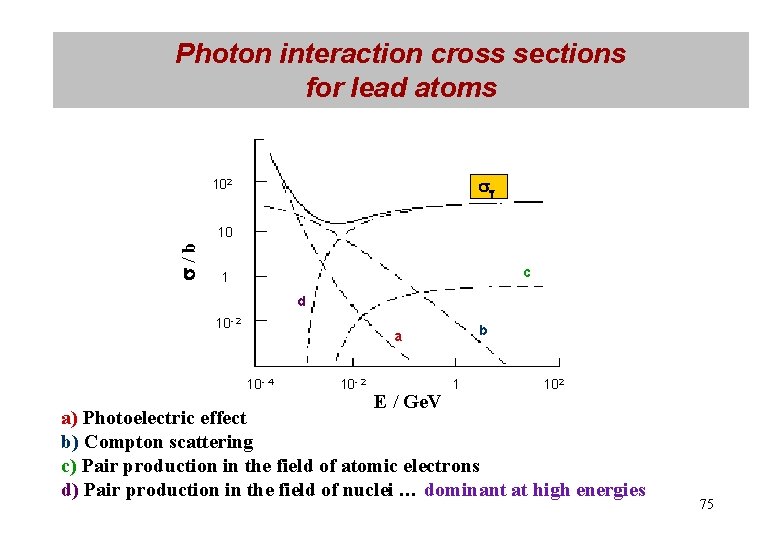
Photon interaction cross sections for lead atoms g 102 /b 10 c 1 d 10 - 2 b a 10 - 4 10 - 2 E / Ge. V 1 102 a) Photoelectric effect b) Compton scattering c) Pair production in the field of atomic electrons d) Pair production in the field of nuclei … dominant at high energies 75
- Slides: 76