
Particle Physics Michaelmas Term 2010 Prof Mark Thomson
- Slides: 28
Particle Physics Michaelmas Term 2010 Prof Mark Thomson Handout 13 : Electroweak Unification and the W and Z Bosons Prof. M. A. Thomson Michaelmas 2010
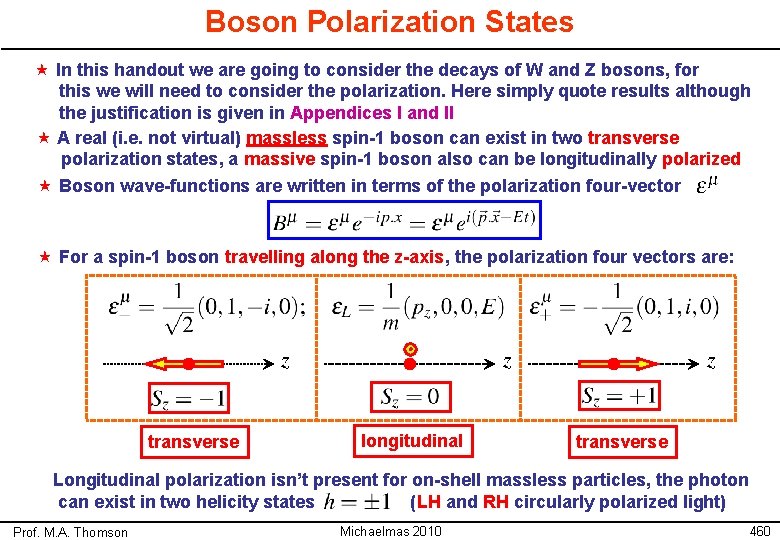
Boson Polarization States « In this handout we are going to consider the decays of W and Z bosons, for this we will need to consider the polarization. Here simply quote results although the justification is given in Appendices I and II « A real (i. e. not virtual) massless spin-1 boson can exist in two transverse polarization states, a massive spin-1 boson also can be longitudinally polarized « Boson wave-functions are written in terms of the polarization four-vector « For a spin-1 boson travelling along the z-axis, the polarization four vectors are: transverse longitudinal transverse Longitudinal polarization isn’t present for on-shell massless particles, the photon can exist in two helicity states (LH and RH circularly polarized light) Prof. M. A. Thomson Michaelmas 2010 460
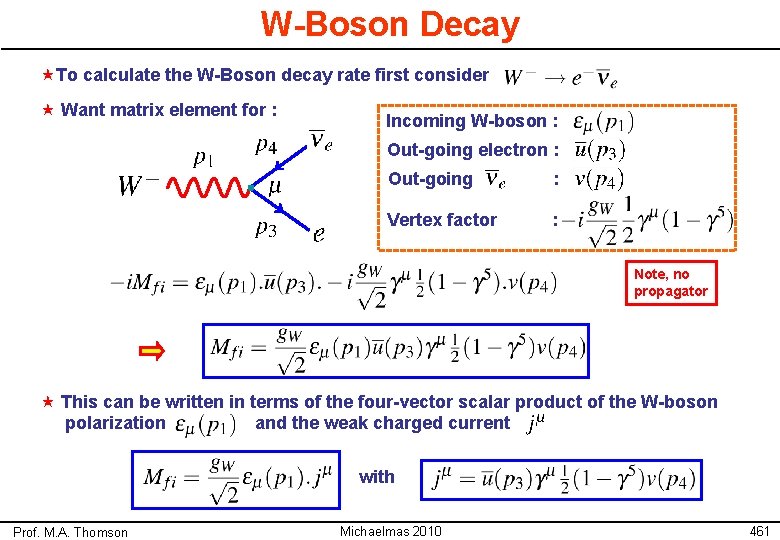
W-Boson Decay «To calculate the W-Boson decay rate first consider « Want matrix element for : Incoming W-boson : Out-going electron : Out-going : Vertex factor : Note, no propagator « This can be written in terms of the four-vector scalar product of the W-boson polarization and the weak charged current with Prof. M. A. Thomson Michaelmas 2010 461
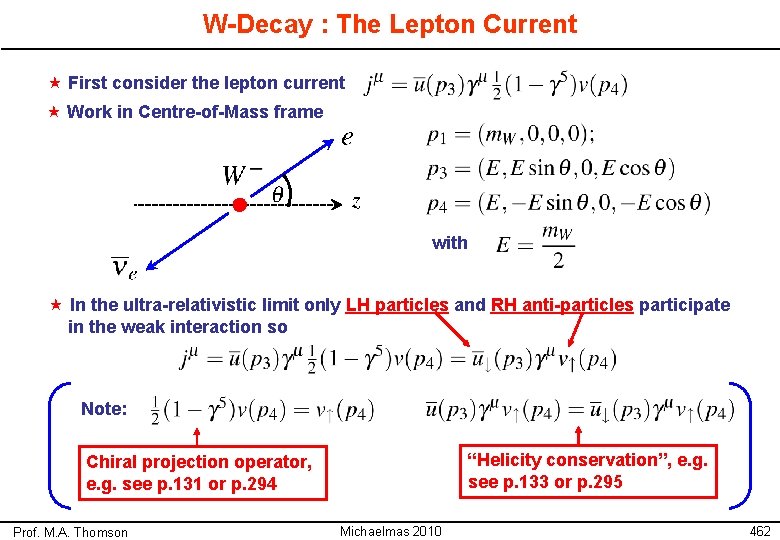
W-Decay : The Lepton Current « First consider the lepton current « Work in Centre-of-Mass frame with « In the ultra-relativistic limit only LH particles and RH anti-particles participate in the weak interaction so Note: “Helicity conservation”, e. g. see p. 133 or p. 295 Chiral projection operator, e. g. see p. 131 or p. 294 Prof. M. A. Thomson Michaelmas 2010 462
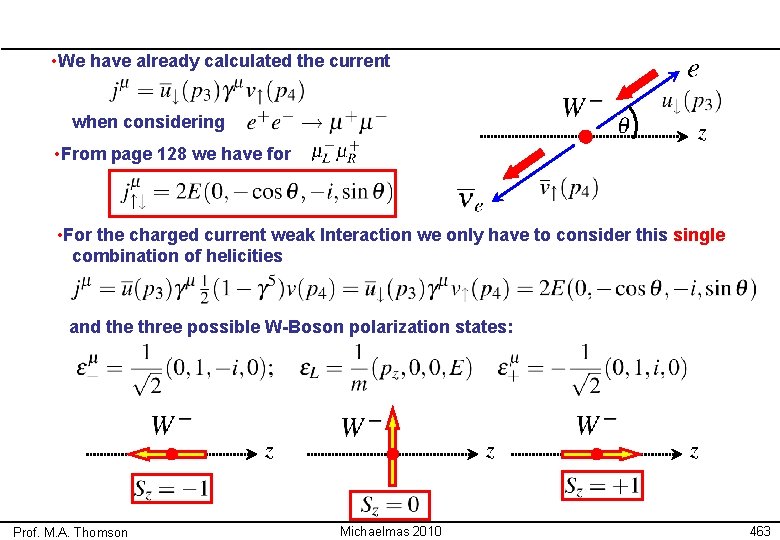
• We have already calculated the current when considering • From page 128 we have for • For the charged current weak Interaction we only have to consider this single combination of helicities and the three possible W-Boson polarization states: Prof. M. A. Thomson Michaelmas 2010 463
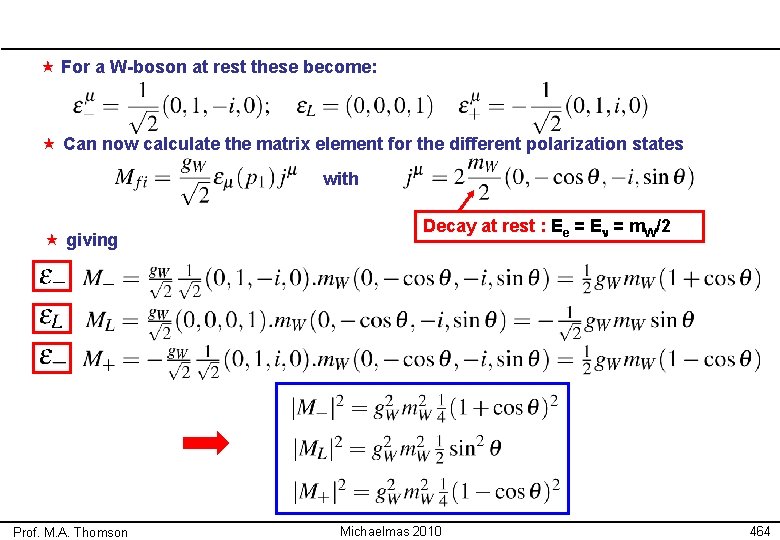
« For a W-boson at rest these become: « Can now calculate the matrix element for the different polarization states with « giving Prof. M. A. Thomson Decay at rest : Ee = En = m. W/2 Michaelmas 2010 464
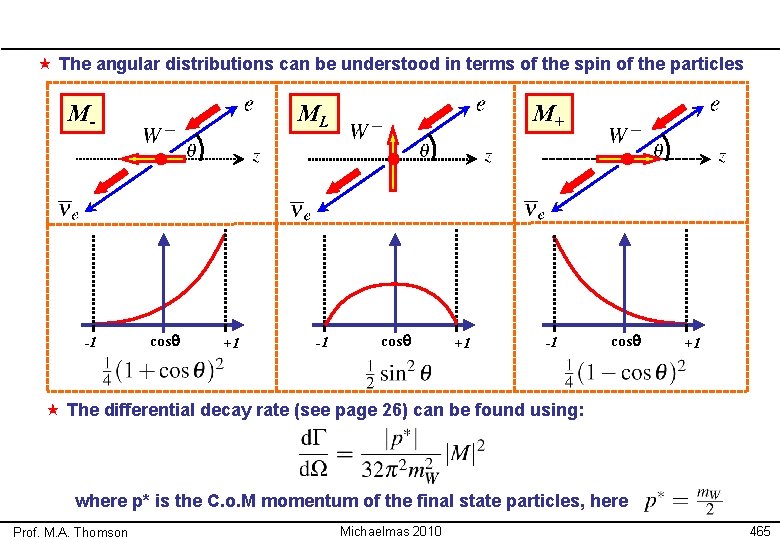
« The angular distributions can be understood in terms of the spin of the particles M- -1 ML cosq +1 -1 M+ cosq +1 -1 cosq +1 « The differential decay rate (see page 26) can be found using: where p* is the C. o. M momentum of the final state particles, here Prof. M. A. Thomson Michaelmas 2010 465
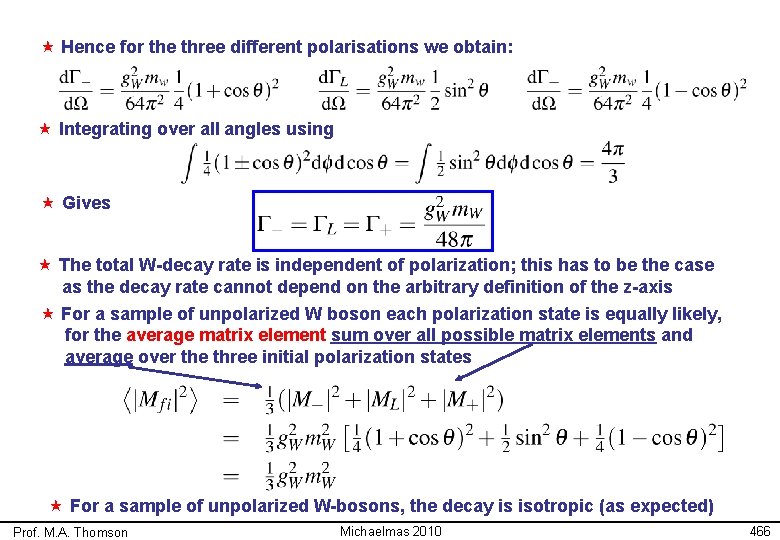
« Hence for the three different polarisations we obtain: « Integrating over all angles using « Gives « The total W-decay rate is independent of polarization; this has to be the case as the decay rate cannot depend on the arbitrary definition of the z-axis « For a sample of unpolarized W boson each polarization state is equally likely, for the average matrix element sum over all possible matrix elements and average over the three initial polarization states « For a sample of unpolarized W-bosons, the decay is isotropic (as expected) Prof. M. A. Thomson Michaelmas 2010 466
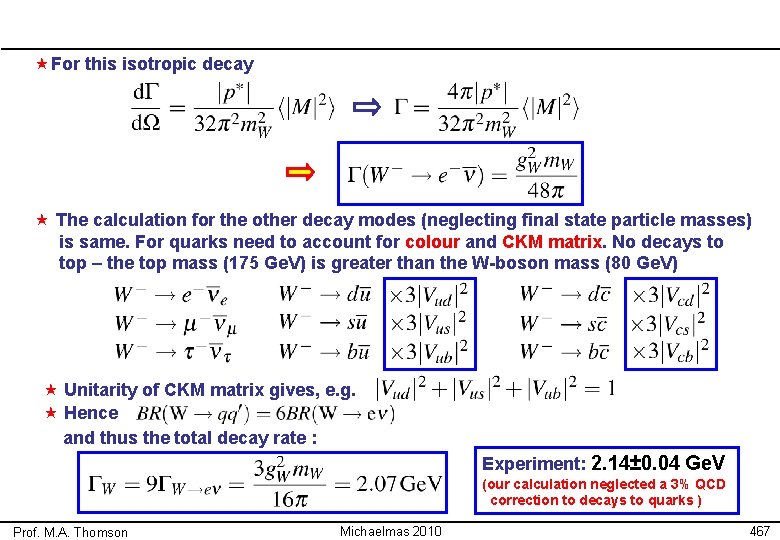
«For this isotropic decay « The calculation for the other decay modes (neglecting final state particle masses) is same. For quarks need to account for colour and CKM matrix. No decays to top – the top mass (175 Ge. V) is greater than the W-boson mass (80 Ge. V) « Unitarity of CKM matrix gives, e. g. « Hence and thus the total decay rate : Experiment: 2. 14± 0. 04 Ge. V (our calculation neglected a 3% QCD correction to decays to quarks ) Prof. M. A. Thomson Michaelmas 2010 467
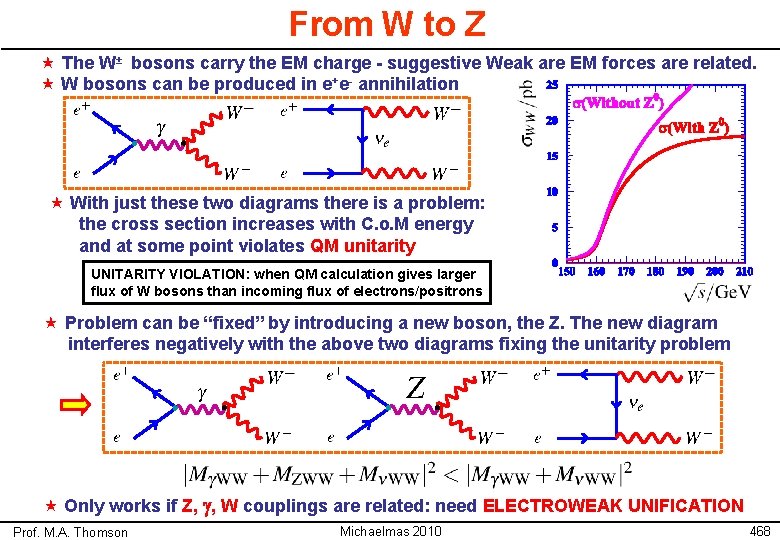
From W to Z « The W± bosons carry the EM charge - suggestive Weak are EM forces are related. « W bosons can be produced in e+e- annihilation « With just these two diagrams there is a problem: the cross section increases with C. o. M energy and at some point violates QM unitarity UNITARITY VIOLATION: when QM calculation gives larger flux of W bosons than incoming flux of electrons/positrons « Problem can be “fixed” by introducing a new boson, the Z. The new diagram interferes negatively with the above two diagrams fixing the unitarity problem « Only works if Z, g, W couplings are related: need ELECTROWEAK UNIFICATION Prof. M. A. Thomson Michaelmas 2010 468
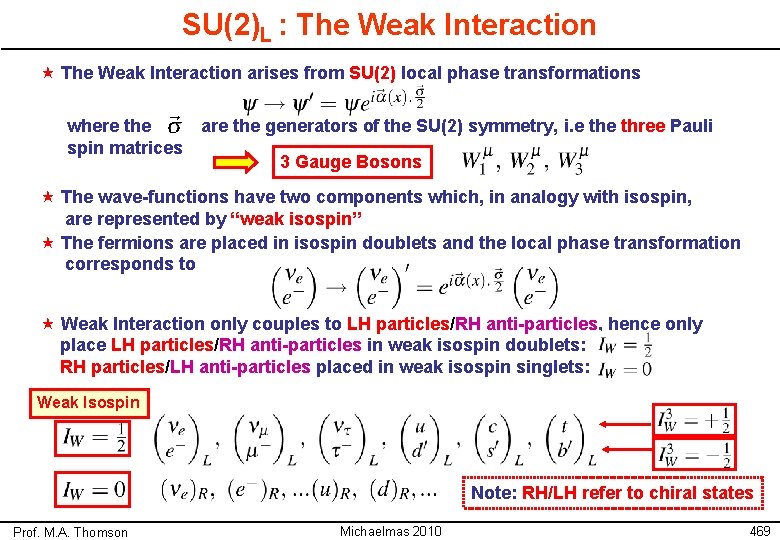
SU(2)L : The Weak Interaction « The Weak Interaction arises from SU(2) local phase transformations where the are the generators of the SU(2) symmetry, i. e three Pauli spin matrices 3 Gauge Bosons « The wave-functions have two components which, in analogy with isospin, are represented by “weak isospin” « The fermions are placed in isospin doublets and the local phase transformation corresponds to « Weak Interaction only couples to LH particles/RH anti-particles, hence only place LH particles/RH anti-particles in weak isospin doublets: RH particles/LH anti-particles placed in weak isospin singlets: Weak Isospin Note: RH/LH refer to chiral states Prof. M. A. Thomson Michaelmas 2010 469
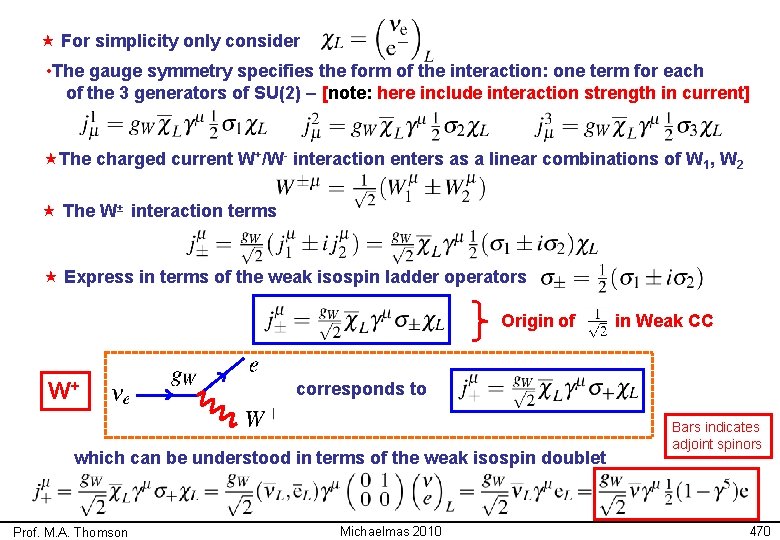
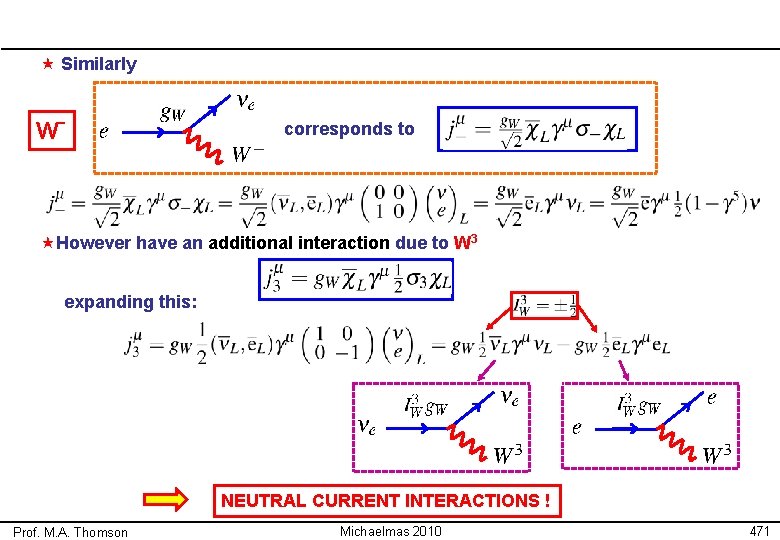
« For simplicity only consider • The gauge symmetry specifies the form of the interaction: one term for each of the 3 generators of SU(2) – [note: here include interaction strength in current] «The charged current W+/W- interaction enters as a linear combinations of W 1, W 2 « The W± interaction terms « Express in terms of the weak isospin ladder operators Origin of W+ corresponds to which can be understood in terms of the weak isospin doublet Prof. M. A. Thomson in Weak CC Michaelmas 2010 Bars indicates adjoint spinors 470
« Similarly W- corresponds to «However have an additional interaction due to W 3 expanding this: NEUTRAL CURRENT INTERACTIONS ! Prof. M. A. Thomson Michaelmas 2010 471
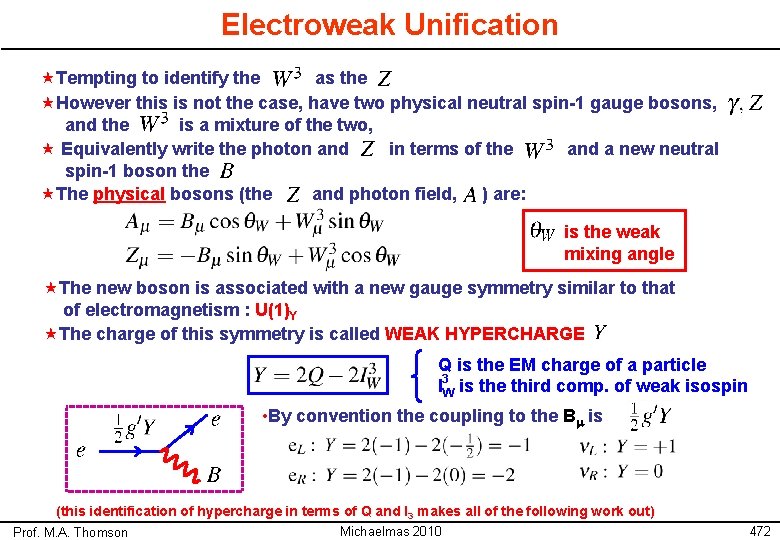
Electroweak Unification «Tempting to identify the as the «However this is not the case, have two physical neutral spin-1 gauge bosons, and the is a mixture of the two, « Equivalently write the photon and in terms of the and a new neutral spin-1 boson the «The physical bosons (the and photon field, ) are: is the weak mixing angle «The new boson is associated with a new gauge symmetry similar to that of electromagnetism : U(1)Y «The charge of this symmetry is called WEAK HYPERCHARGE Q is the EM charge of a particle 3 IW is the third comp. of weak isospin • By convention the coupling to the Bm is (this identification of hypercharge in terms of Q and I 3 makes all of the following work out) Prof. M. A. Thomson Michaelmas 2010 472
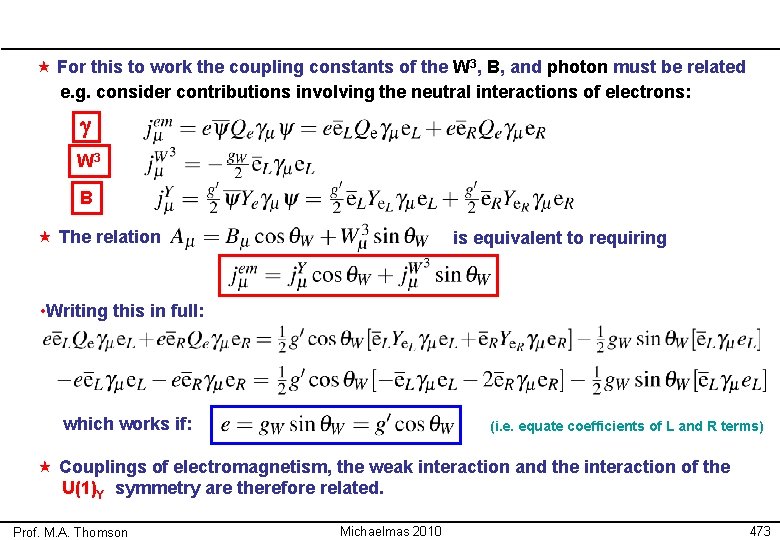
« For this to work the coupling constants of the W 3, B, and photon must be related e. g. consider contributions involving the neutral interactions of electrons: g W 3 B « The relation is equivalent to requiring • Writing this in full: which works if: (i. e. equate coefficients of L and R terms) « Couplings of electromagnetism, the weak interaction and the interaction of the U(1)Y symmetry are therefore related. Prof. M. A. Thomson Michaelmas 2010 473
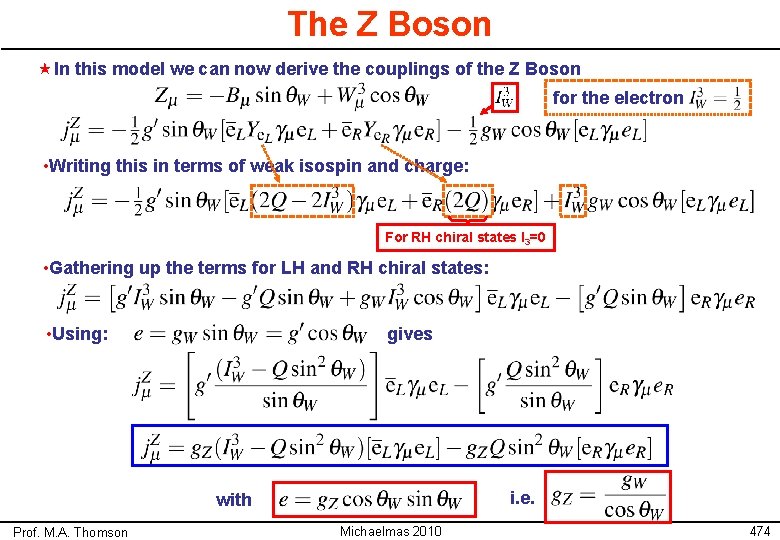
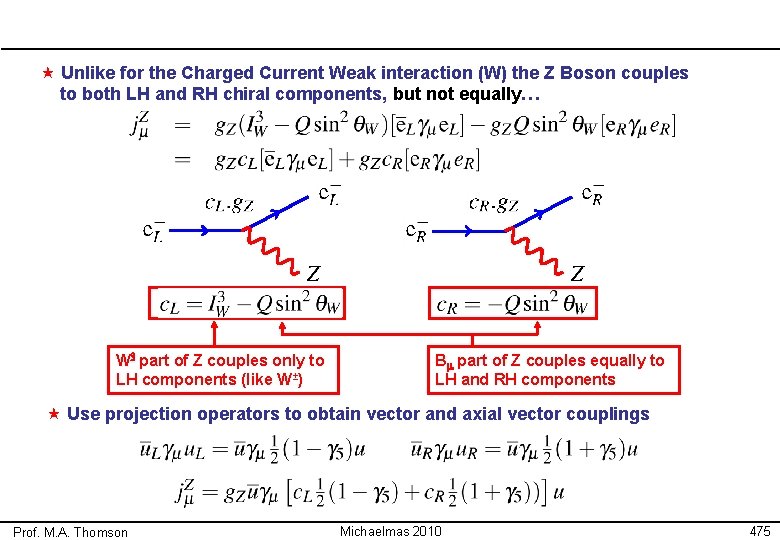
The Z Boson «In this model we can now derive the couplings of the Z Boson for the electron • Writing this in terms of weak isospin and charge: For RH chiral states I 3=0 • Gathering up the terms for LH and RH chiral states: • Using: gives i. e. with Prof. M. A. Thomson Michaelmas 2010 474
« Unlike for the Charged Current Weak interaction (W) the Z Boson couples to both LH and RH chiral components, but not equally… W 3 part of Z couples only to LH components (like W±) Bm part of Z couples equally to LH and RH components « Use projection operators to obtain vector and axial vector couplings Prof. M. A. Thomson Michaelmas 2010 475
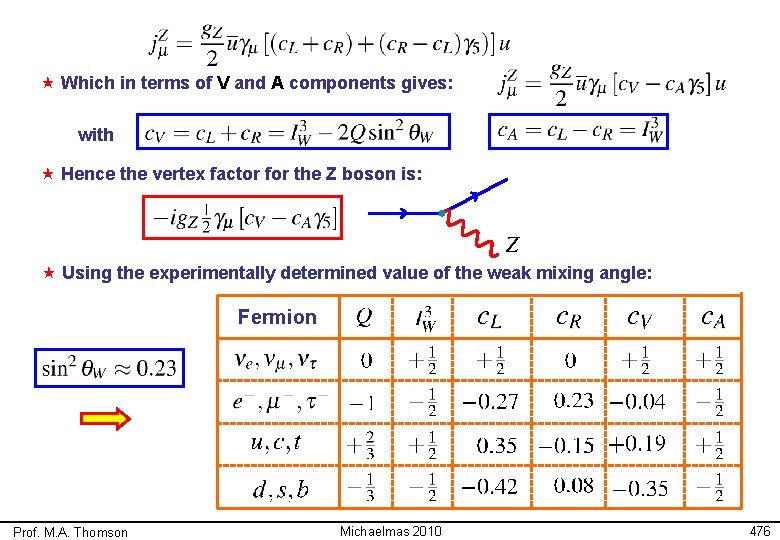
« Which in terms of V and A components gives: with « Hence the vertex factor for the Z boson is: « Using the experimentally determined value of the weak mixing angle: Fermion Prof. M. A. Thomson Michaelmas 2010 476
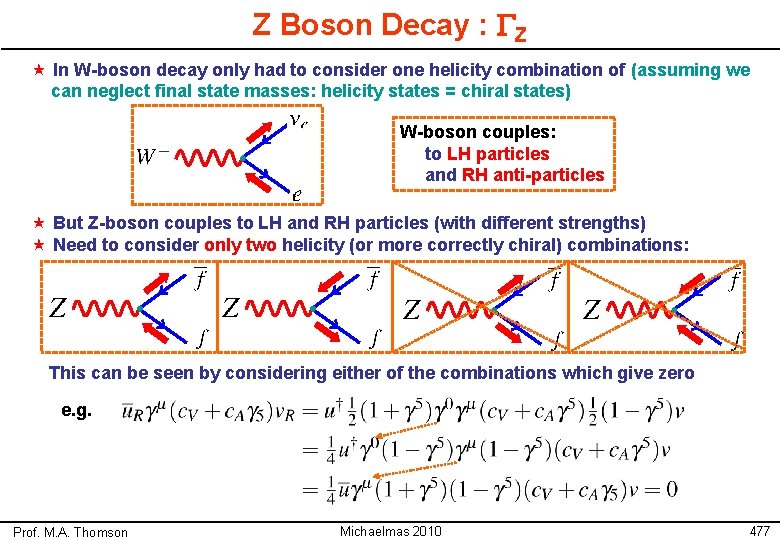
Z Boson Decay : GZ « In W-boson decay only had to consider one helicity combination of (assuming we can neglect final state masses: helicity states = chiral states) W-boson couples: to LH particles and RH anti-particles « But Z-boson couples to LH and RH particles (with different strengths) « Need to consider only two helicity (or more correctly chiral) combinations: This can be seen by considering either of the combinations which give zero e. g. Prof. M. A. Thomson Michaelmas 2010 477
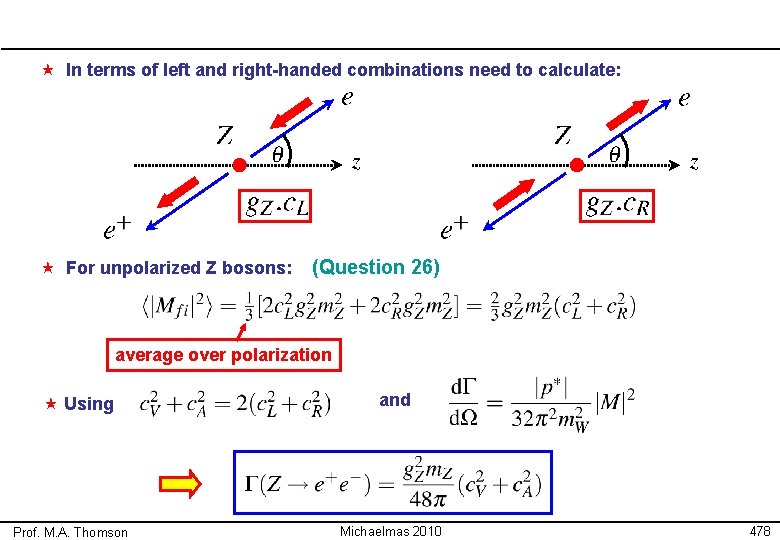
« In terms of left and right-handed combinations need to calculate: « For unpolarized Z bosons: (Question 26) average over polarization « Using Prof. M. A. Thomson and Michaelmas 2010 478
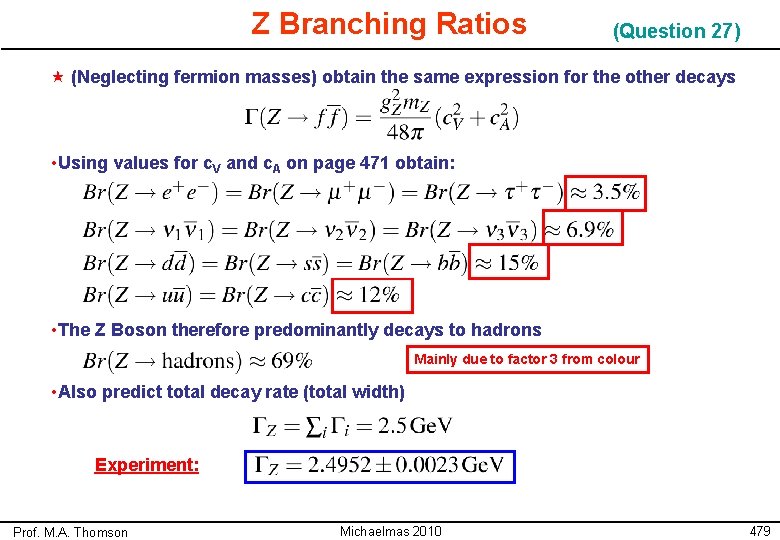
Z Branching Ratios (Question 27) « (Neglecting fermion masses) obtain the same expression for the other decays • Using values for c. V and c. A on page 471 obtain: • The Z Boson therefore predominantly decays to hadrons Mainly due to factor 3 from colour • Also predict total decay rate (total width) Experiment: Prof. M. A. Thomson Michaelmas 2010 479
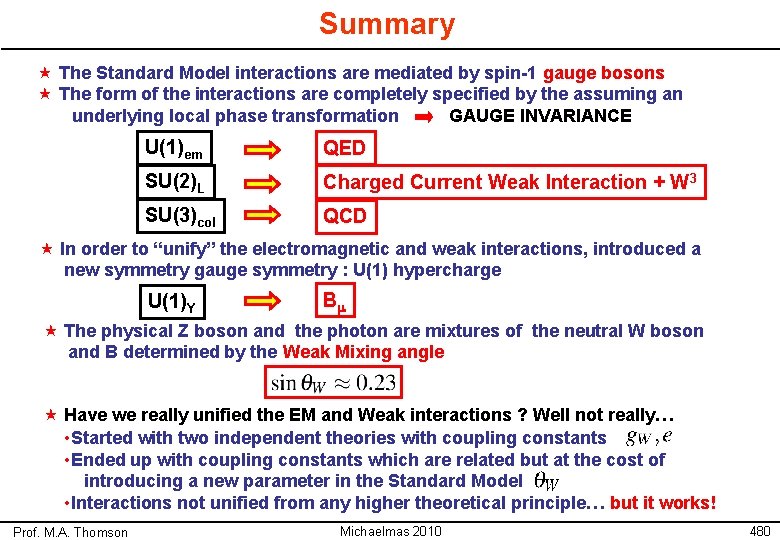
Summary « The Standard Model interactions are mediated by spin-1 gauge bosons « The form of the interactions are completely specified by the assuming an underlying local phase transformation GAUGE INVARIANCE U(1)em QED SU(2)L Charged Current Weak Interaction + W 3 SU(3)col QCD « In order to “unify” the electromagnetic and weak interactions, introduced a new symmetry gauge symmetry : U(1) hypercharge U(1)Y Bm « The physical Z boson and the photon are mixtures of the neutral W boson and B determined by the Weak Mixing angle « Have we really unified the EM and Weak interactions ? Well not really… • Started with two independent theories with coupling constants • Ended up with coupling constants which are related but at the cost of introducing a new parameter in the Standard Model • Interactions not unified from any higher theoretical principle… but it works! Prof. M. A. Thomson Michaelmas 2010 480
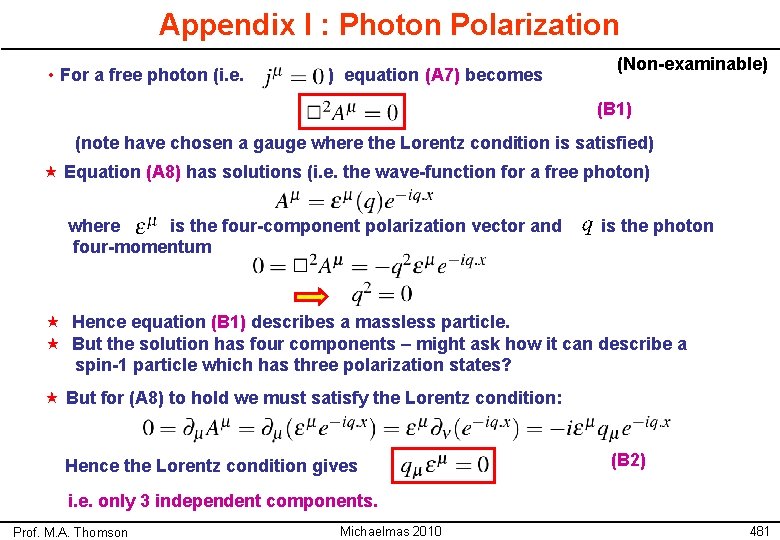
Appendix I : Photon Polarization • For a free photon (i. e. ) equation (A 7) becomes (Non-examinable) (B 1) (note have chosen a gauge where the Lorentz condition is satisfied) « Equation (A 8) has solutions (i. e. the wave-function for a free photon) where is the four-component polarization vector and four-momentum is the photon « Hence equation (B 1) describes a massless particle. « But the solution has four components – might ask how it can describe a spin-1 particle which has three polarization states? « But for (A 8) to hold we must satisfy the Lorentz condition: Hence the Lorentz condition gives (B 2) i. e. only 3 independent components. Prof. M. A. Thomson Michaelmas 2010 481
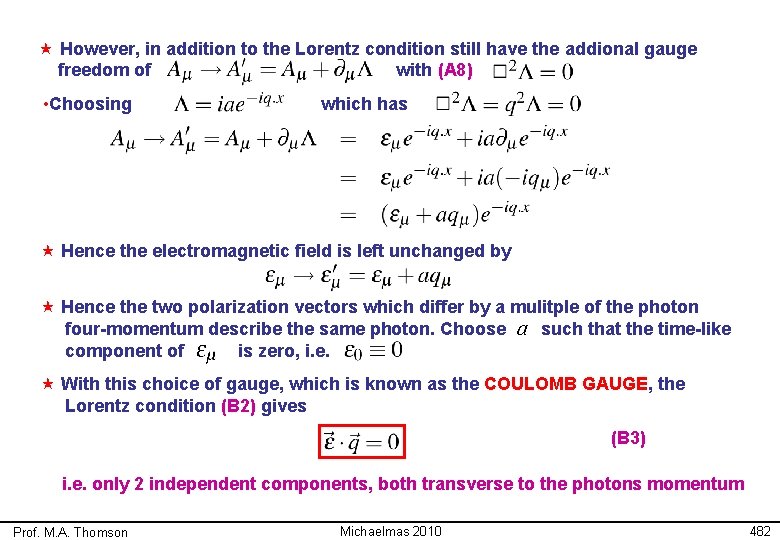
« However, in addition to the Lorentz condition still have the addional gauge freedom of with (A 8) • Choosing which has « Hence the electromagnetic field is left unchanged by « Hence the two polarization vectors which differ by a mulitple of the photon four-momentum describe the same photon. Choose such that the time-like component of is zero, i. e. « With this choice of gauge, which is known as the COULOMB GAUGE, the Lorentz condition (B 2) gives (B 3) i. e. only 2 independent components, both transverse to the photons momentum Prof. M. A. Thomson Michaelmas 2010 482
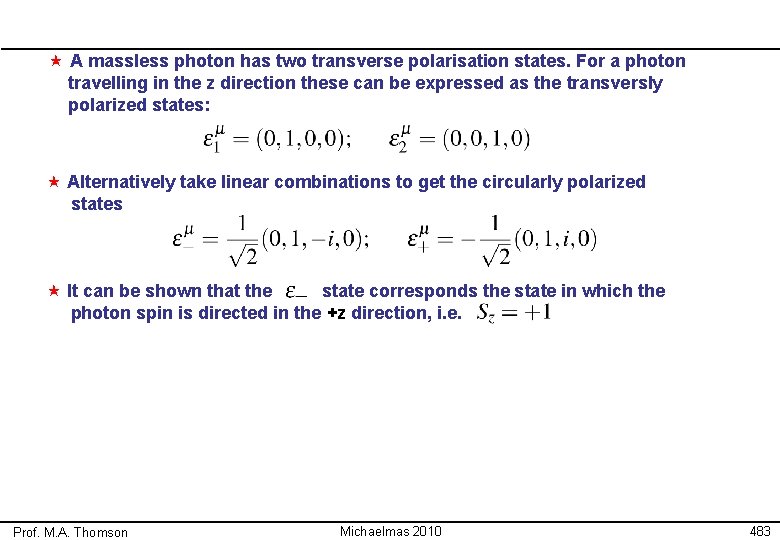
« A massless photon has two transverse polarisation states. For a photon travelling in the z direction these can be expressed as the transversly polarized states: « Alternatively take linear combinations to get the circularly polarized states « It can be shown that the state corresponds the state in which the photon spin is directed in the +z direction, i. e. Prof. M. A. Thomson Michaelmas 2010 483
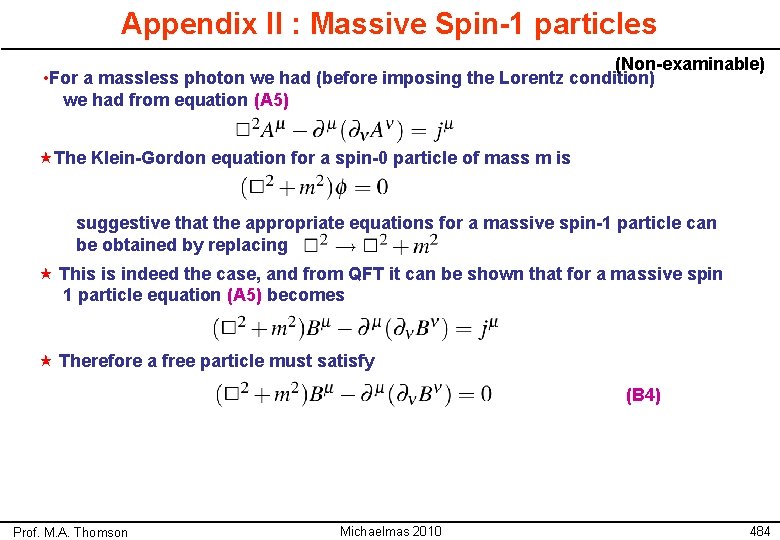
Appendix II : Massive Spin-1 particles (Non-examinable) • For a massless photon we had (before imposing the Lorentz condition) we had from equation (A 5) «The Klein-Gordon equation for a spin-0 particle of mass m is suggestive that the appropriate equations for a massive spin-1 particle can be obtained by replacing « This is indeed the case, and from QFT it can be shown that for a massive spin 1 particle equation (A 5) becomes « Therefore a free particle must satisfy (B 4) Prof. M. A. Thomson Michaelmas 2010 484
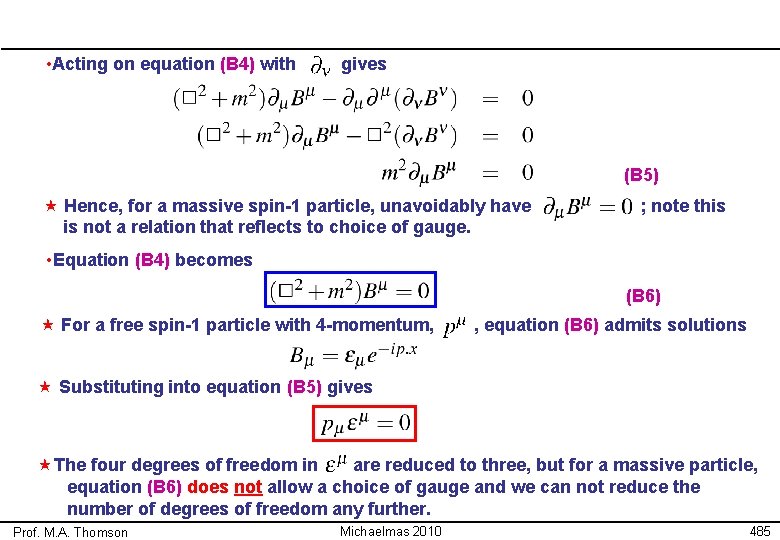
• Acting on equation (B 4) with gives (B 5) « Hence, for a massive spin-1 particle, unavoidably have is not a relation that reflects to choice of gauge. ; note this • Equation (B 4) becomes (B 6) « For a free spin-1 particle with 4 -momentum, , equation (B 6) admits solutions « Substituting into equation (B 5) gives «The four degrees of freedom in are reduced to three, but for a massive particle, equation (B 6) does not allow a choice of gauge and we can not reduce the number of degrees of freedom any further. Prof. M. A. Thomson Michaelmas 2010 485
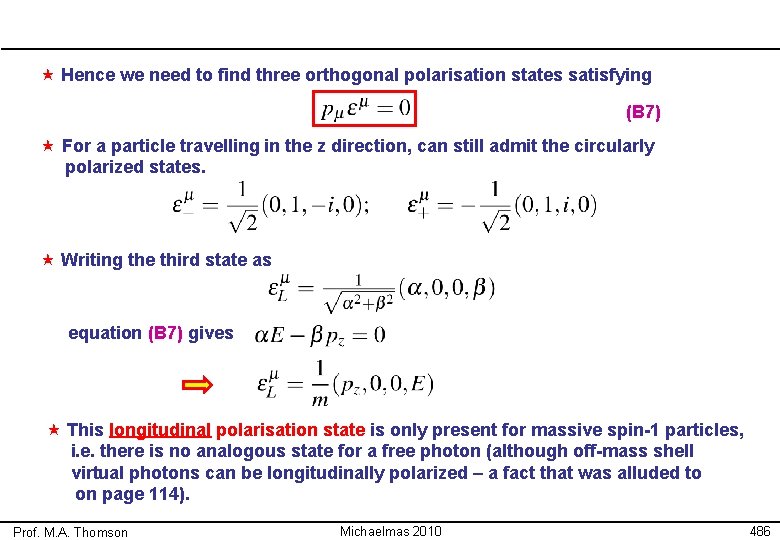
« Hence we need to find three orthogonal polarisation states satisfying (B 7) « For a particle travelling in the z direction, can still admit the circularly polarized states. « Writing the third state as equation (B 7) gives « This longitudinal polarisation state is only present for massive spin-1 particles, i. e. there is no analogous state for a free photon (although off-mass shell virtual photons can be longitudinally polarized – a fact that was alluded to on page 114). Prof. M. A. Thomson Michaelmas 2010 486