
Particle Physics Michaelmas Term 2009 Prof Mark Thomson
- Slides: 41
Particle Physics Michaelmas Term 2009 Prof Mark Thomson Handout 8 : Quantum Chromodynamics Prof. M. A. Thomson Michaelmas 2009
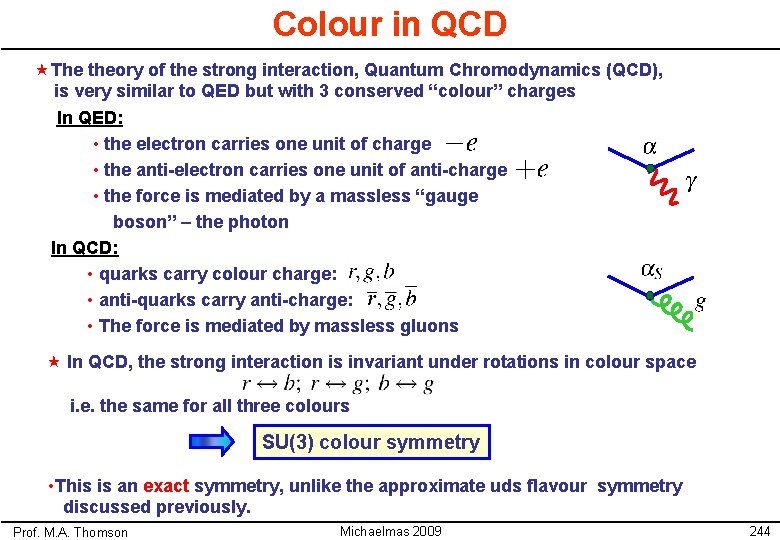
Colour in QCD «The theory of the strong interaction, Quantum Chromodynamics (QCD), is very similar to QED but with 3 conserved “colour” charges In QED: • the electron carries one unit of charge • the anti-electron carries one unit of anti-charge • the force is mediated by a massless “gauge boson” – the photon In QCD: • quarks carry colour charge: • anti-quarks carry anti-charge: • The force is mediated by massless gluons « In QCD, the strong interaction is invariant under rotations in colour space i. e. the same for all three colours SU(3) colour symmetry • This is an exact symmetry, unlike the approximate uds flavour symmetry discussed previously. Prof. M. A. Thomson Michaelmas 2009 244
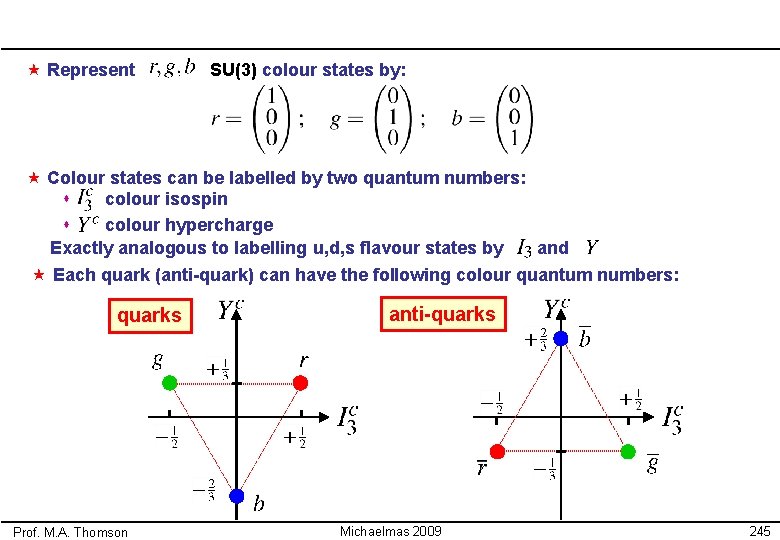
« Represent SU(3) colour states by: « Colour states can be labelled by two quantum numbers: s colour isospin s colour hypercharge Exactly analogous to labelling u, d, s flavour states by and « Each quark (anti-quark) can have the following colour quantum numbers: quarks Prof. M. A. Thomson anti-quarks Michaelmas 2009 245
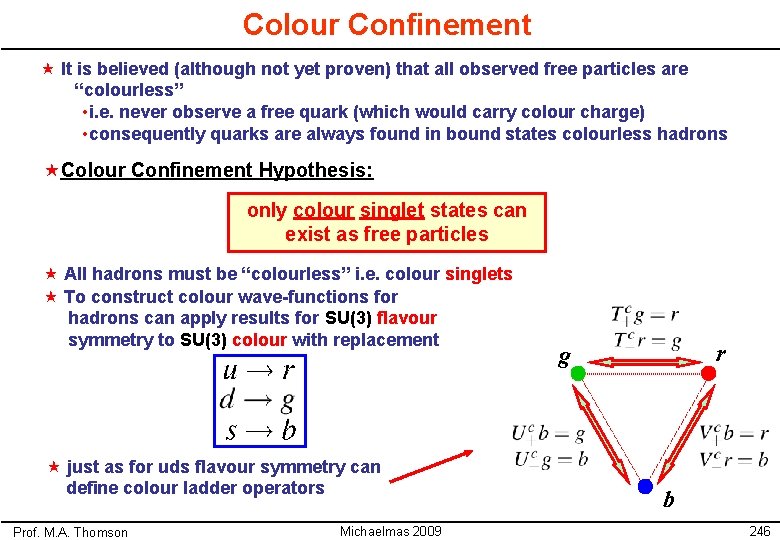
Colour Confinement « It is believed (although not yet proven) that all observed free particles are “colourless” • i. e. never observe a free quark (which would carry colour charge) • consequently quarks are always found in bound states colourless hadrons «Colour Confinement Hypothesis: only colour singlet states can exist as free particles « All hadrons must be “colourless” i. e. colour singlets « To construct colour wave-functions for hadrons can apply results for SU(3) flavour symmetry to SU(3) colour with replacement « just as for uds flavour symmetry can define colour ladder operators Prof. M. A. Thomson Michaelmas 2009 r g b 246
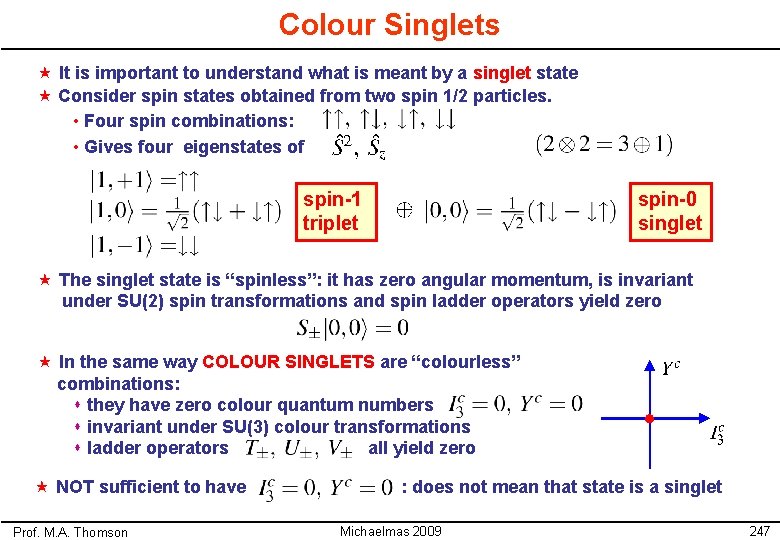
Colour Singlets « It is important to understand what is meant by a singlet state « Consider spin states obtained from two spin 1/2 particles. • Four spin combinations: • Gives four eigenstates of spin-1 triplet spin-0 singlet « The singlet state is “spinless”: it has zero angular momentum, is invariant under SU(2) spin transformations and spin ladder operators yield zero « In the same way COLOUR SINGLETS are “colourless” combinations: s they have zero colour quantum numbers s invariant under SU(3) colour transformations s ladder operators all yield zero « NOT sufficient to have Prof. M. A. Thomson : does not mean that state is a singlet Michaelmas 2009 247
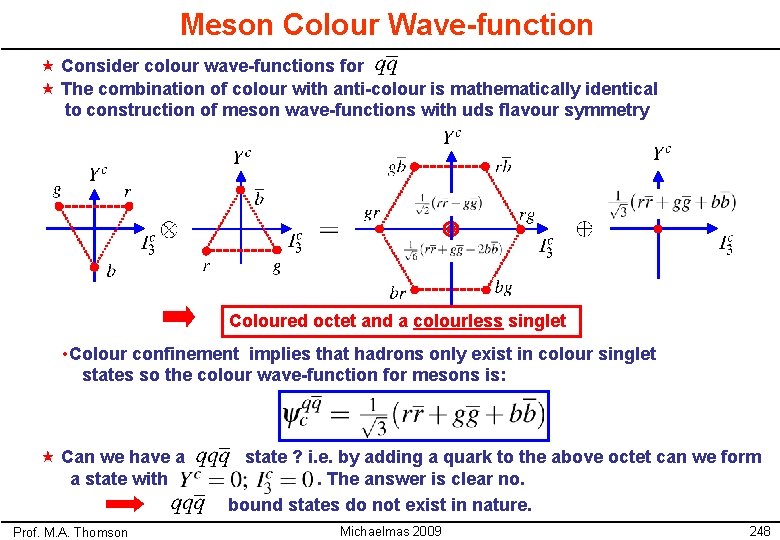
Meson Colour Wave-function « Consider colour wave-functions for « The combination of colour with anti-colour is mathematically identical to construction of meson wave-functions with uds flavour symmetry Coloured octet and a colourless singlet • Colour confinement implies that hadrons only exist in colour singlet states so the colour wave-function for mesons is: « Can we have a a state with Prof. M. A. Thomson state ? i. e. by adding a quark to the above octet can we form. The answer is clear no. bound states do not exist in nature. Michaelmas 2009 248
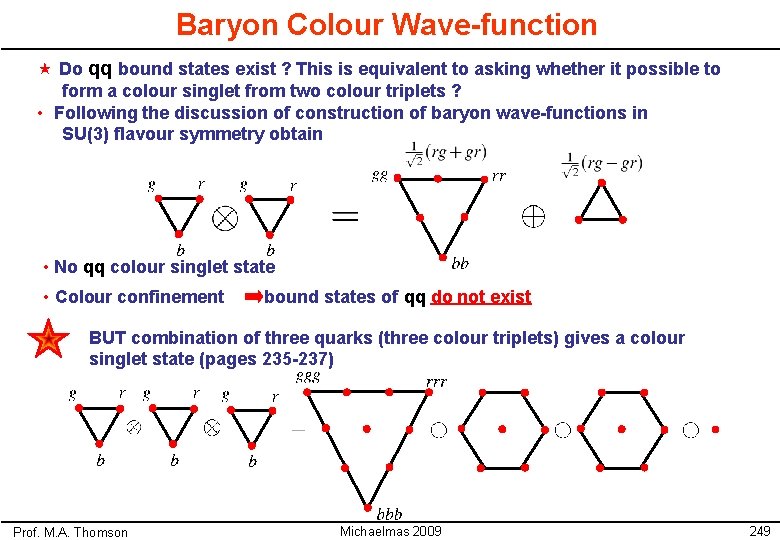
Baryon Colour Wave-function « Do qq bound states exist ? This is equivalent to asking whether it possible to form a colour singlet from two colour triplets ? • Following the discussion of construction of baryon wave-functions in SU(3) flavour symmetry obtain • No qq colour singlet state • Colour confinement bound states of qq do not exist BUT combination of three quarks (three colour triplets) gives a colour singlet state (pages 235 -237) Prof. M. A. Thomson Michaelmas 2009 249
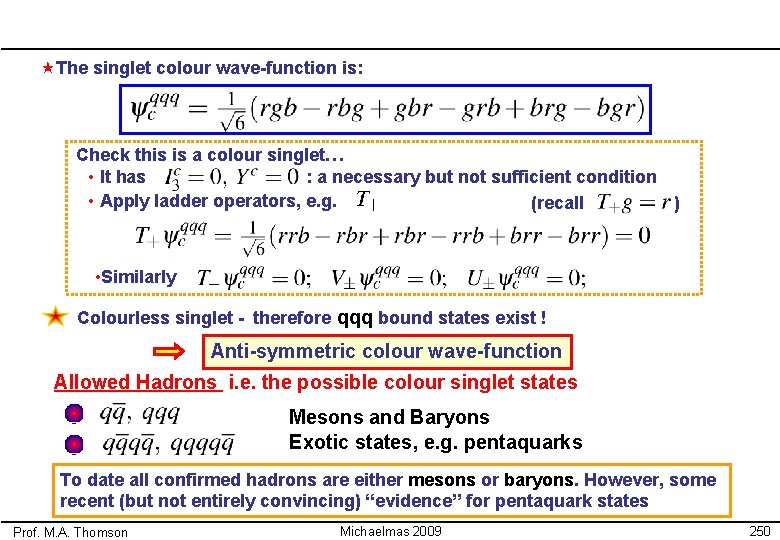
«The singlet colour wave-function is: Check this is a colour singlet… • It has : a necessary but not sufficient condition • Apply ladder operators, e. g. (recall ) • Similarly Colourless singlet - therefore qqq bound states exist ! Anti-symmetric colour wave-function Allowed Hadrons i. e. the possible colour singlet states Mesons and Baryons Exotic states, e. g. pentaquarks To date all confirmed hadrons are either mesons or baryons. However, some recent (but not entirely convincing) “evidence” for pentaquark states Prof. M. A. Thomson Michaelmas 2009 250
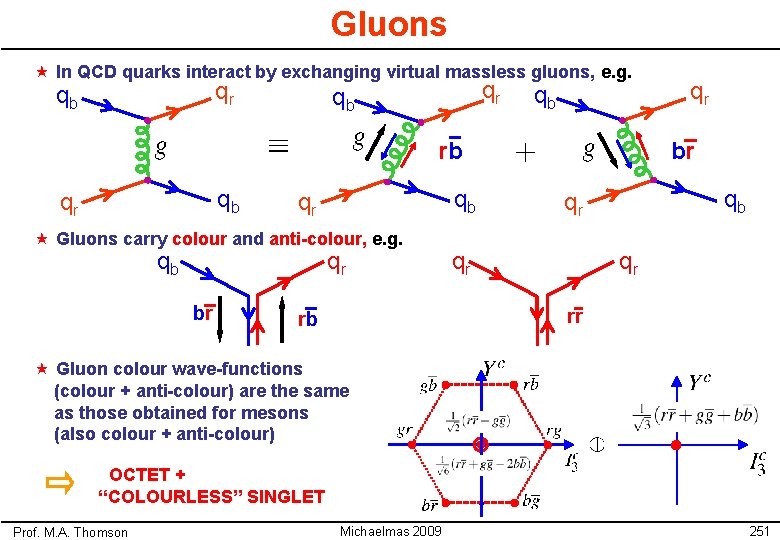
Gluons « In QCD quarks interact by exchanging virtual massless gluons, e. g. qr qb qb rb qb qr « Gluons carry colour and anti-colour, e. g. qb qr br qb qr qr qr rr rb « Gluon colour wave-functions (colour + anti-colour) are the same as those obtained for mesons (also colour + anti-colour) OCTET + “COLOURLESS” SINGLET Prof. M. A. Thomson Michaelmas 2009 251
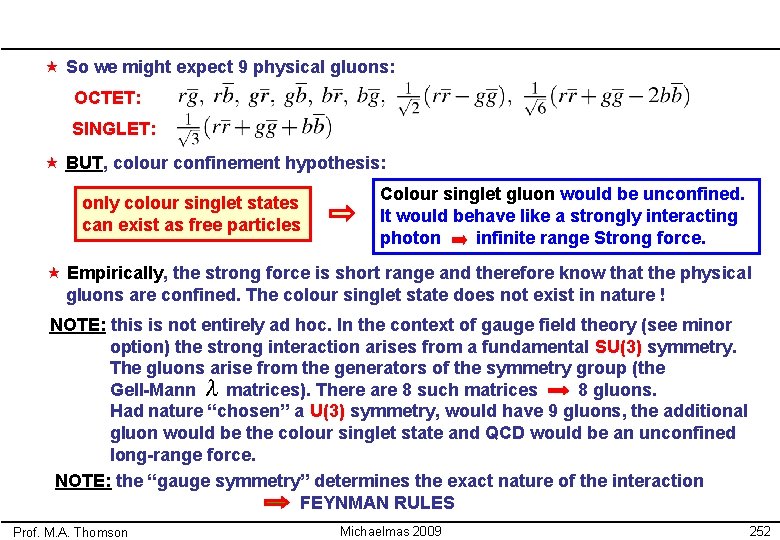
« So we might expect 9 physical gluons: OCTET: SINGLET: « BUT, colour confinement hypothesis: only colour singlet states can exist as free particles Colour singlet gluon would be unconfined. It would behave like a strongly interacting photon infinite range Strong force. « Empirically, the strong force is short range and therefore know that the physical gluons are confined. The colour singlet state does not exist in nature ! NOTE: this is not entirely ad hoc. In the context of gauge field theory (see minor option) the strong interaction arises from a fundamental SU(3) symmetry. The gluons arise from the generators of the symmetry group (the Gell-Mann matrices). There are 8 such matrices 8 gluons. Had nature “chosen” a U(3) symmetry, would have 9 gluons, the additional gluon would be the colour singlet state and QCD would be an unconfined long-range force. NOTE: the “gauge symmetry” determines the exact nature of the interaction FEYNMAN RULES Prof. M. A. Thomson Michaelmas 2009 252
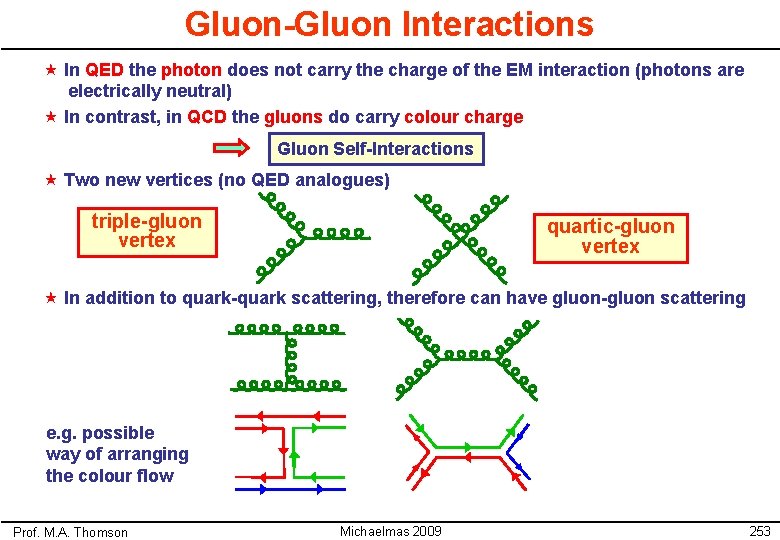
Gluon-Gluon Interactions « In QED the photon does not carry the charge of the EM interaction (photons are electrically neutral) « In contrast, in QCD the gluons do carry colour charge Gluon Self-Interactions « Two new vertices (no QED analogues) triple-gluon vertex quartic-gluon vertex « In addition to quark-quark scattering, therefore can have gluon-gluon scattering e. g. possible way of arranging the colour flow Prof. M. A. Thomson Michaelmas 2009 253
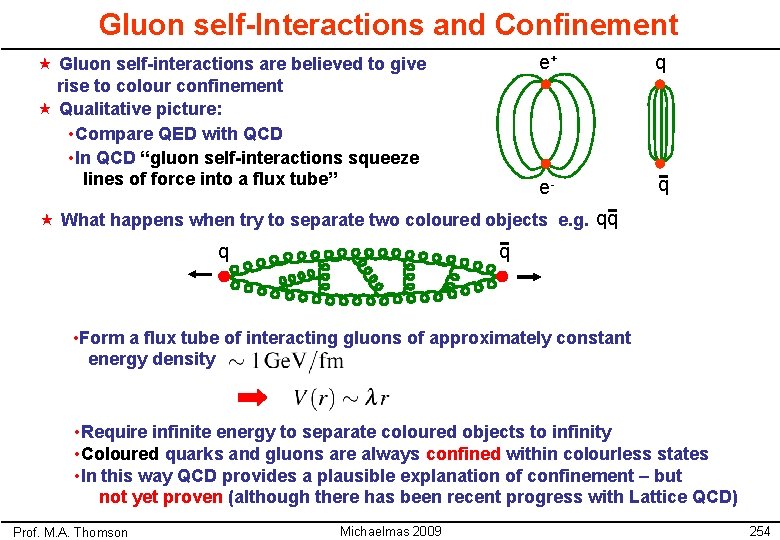
Gluon self-Interactions and Confinement « Gluon self-interactions are believed to give rise to colour confinement « Qualitative picture: • Compare QED with QCD • In QCD “gluon self-interactions squeeze lines of force into a flux tube” e+ q e- q « What happens when try to separate two coloured objects e. g. qq q q • Form a flux tube of interacting gluons of approximately constant energy density • Require infinite energy to separate coloured objects to infinity • Coloured quarks and gluons are always confined within colourless states • In this way QCD provides a plausible explanation of confinement – but not yet proven (although there has been recent progress with Lattice QCD) Prof. M. A. Thomson Michaelmas 2009 254
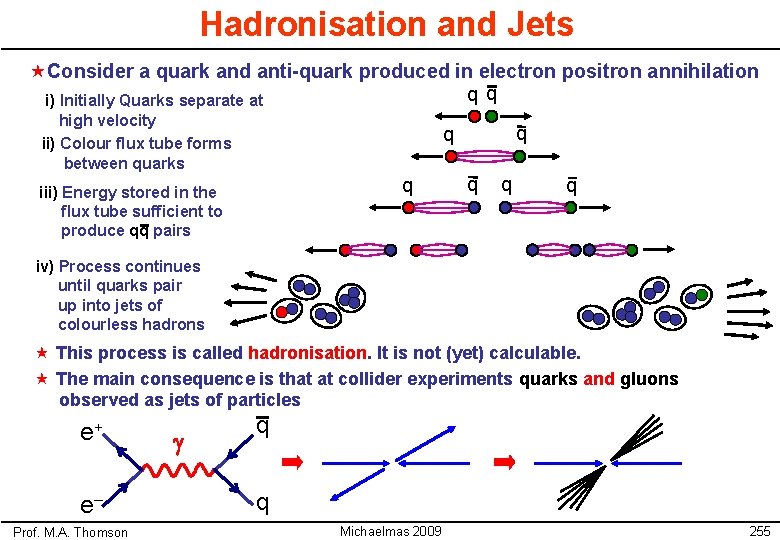
Hadronisation and Jets «Consider a quark and anti-quark produced in electron positron annihilation q q i) Initially Quarks separate at high velocity ii) Colour flux tube forms between quarks q q q iii) Energy stored in the flux tube sufficient to produce qq pairs q q q iv) Process continues until quarks pair up into jets of colourless hadrons « This process is called hadronisation. It is not (yet) calculable. « The main consequence is that at collider experiments quarks and gluons observed as jets of particles e+ e– Prof. M. A. Thomson g q q Michaelmas 2009 255
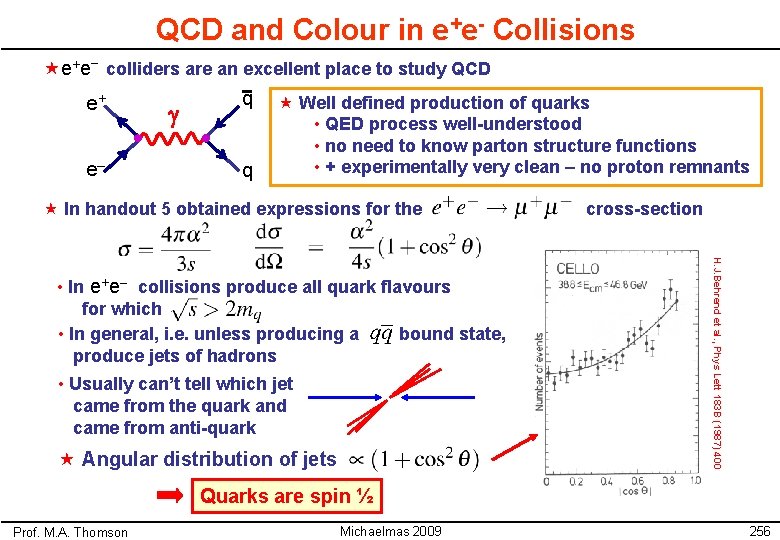
QCD and Colour in e+e- Collisions «e+e– colliders are an excellent place to study QCD q « Well defined production of quarks e+ g e– q • QED process well-understood • no need to know parton structure functions • + experimentally very clean – no proton remnants « In handout 5 obtained expressions for the • Usually can’t tell which jet came from the quark and came from anti-quark « Angular distribution of jets H. J. Behrend et al. , Phys Lett 183 B (1987) 400 • In e+e– collisions produce all quark flavours for which • In general, i. e. unless producing a bound state, produce jets of hadrons cross-section Quarks are spin ½ Prof. M. A. Thomson Michaelmas 2009 256
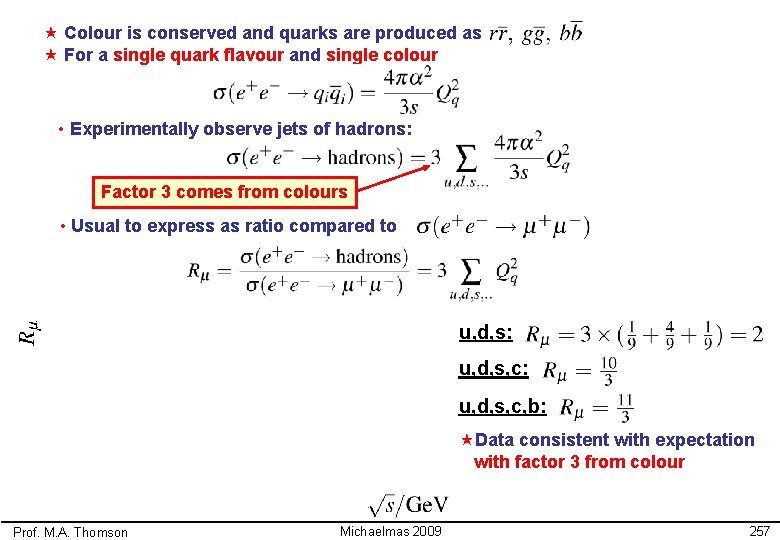
« Colour is conserved and quarks are produced as « For a single quark flavour and single colour • Experimentally observe jets of hadrons: Factor 3 comes from colours • Usual to express as ratio compared to u, d, s: u, d, s, c, b: «Data consistent with expectation with factor 3 from colour Prof. M. A. Thomson Michaelmas 2009 257
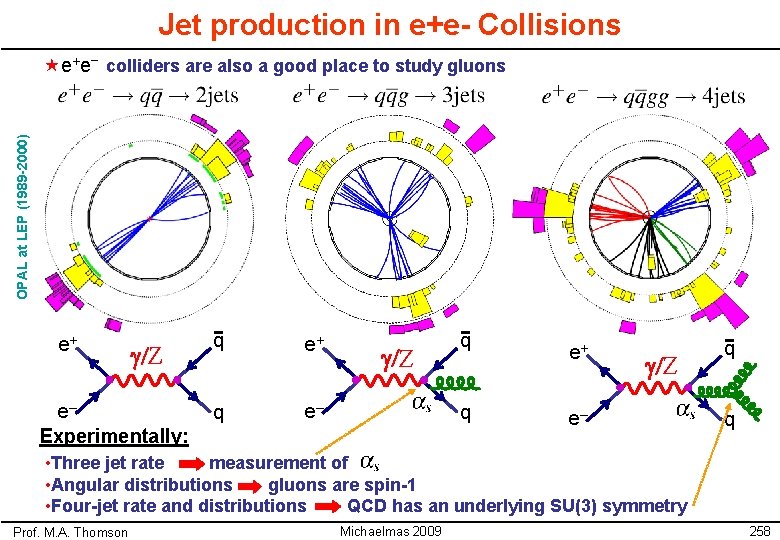
Jet production in e+e- Collisions OPAL at LEP (1989 -2000) «e+e– colliders are also a good place to study gluons e+ g/Z e– Experimentally: q e+ q e– g/Z q q e+ g/Z e– q q • Three jet rate measurement of • Angular distributions gluons are spin-1 • Four-jet rate and distributions QCD has an underlying SU(3) symmetry Prof. M. A. Thomson Michaelmas 2009 258
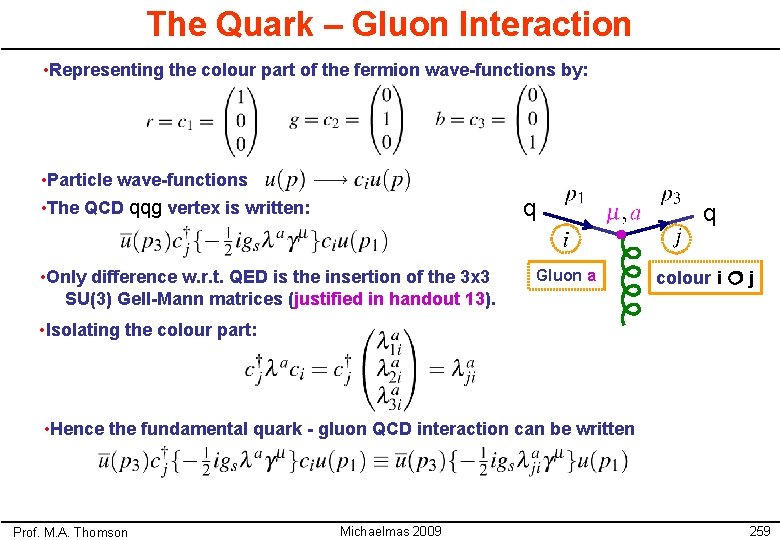
The Quark – Gluon Interaction • Representing the colour part of the fermion wave-functions by: • Particle wave-functions q • The QCD qqg vertex is written: • Only difference w. r. t. QED is the insertion of the 3 x 3 SU(3) Gell-Mann matrices (justified in handout 13). Gluon a q colour i j • Isolating the colour part: • Hence the fundamental quark - gluon QCD interaction can be written Prof. M. A. Thomson Michaelmas 2009 259
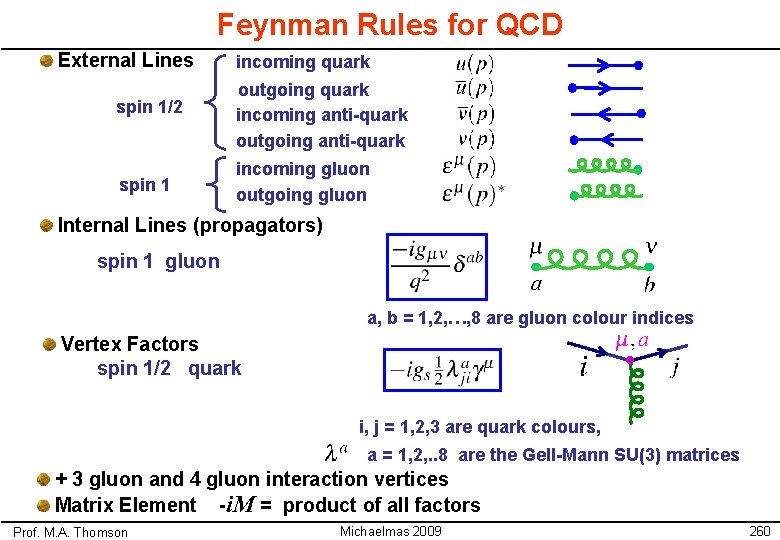
Feynman Rules for QCD External Lines incoming quark spin 1/2 outgoing quark incoming anti-quark outgoing anti-quark spin 1 incoming gluon outgoing gluon Internal Lines (propagators) spin 1 gluon a, b = 1, 2, …, 8 are gluon colour indices Vertex Factors spin 1/2 quark i, j = 1, 2, 3 are quark colours, a = 1, 2, . . 8 are the Gell-Mann SU(3) matrices + 3 gluon and 4 gluon interaction vertices Matrix Element -i. M = product of all factors Prof. M. A. Thomson Michaelmas 2009 260
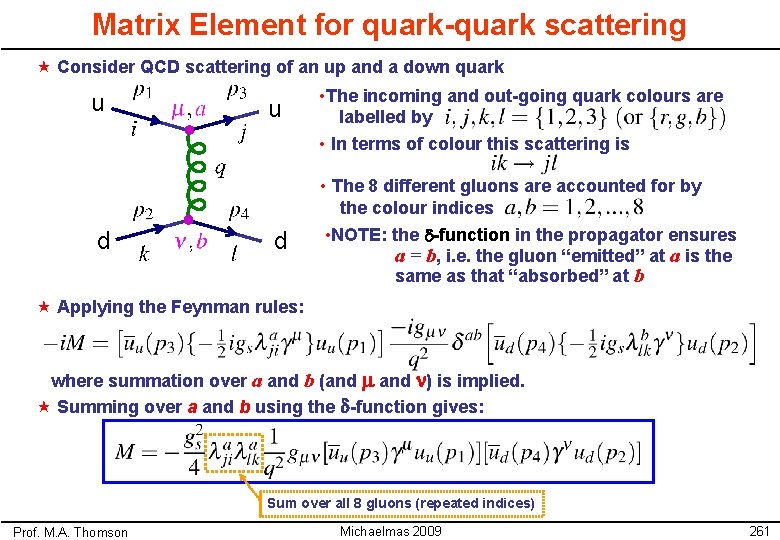
Matrix Element for quark-quark scattering « Consider QCD scattering of an up and a down quark u d • The incoming and out-going quark colours are labelled by • In terms of colour this scattering is • The 8 different gluons are accounted for by the colour indices • NOTE: the d-function in the propagator ensures a = b, i. e. the gluon “emitted” at a is the same as that “absorbed” at b « Applying the Feynman rules: where summation over a and b (and m and n) is implied. « Summing over a and b using the d-function gives: Sum over all 8 gluons (repeated indices) Prof. M. A. Thomson Michaelmas 2009 261
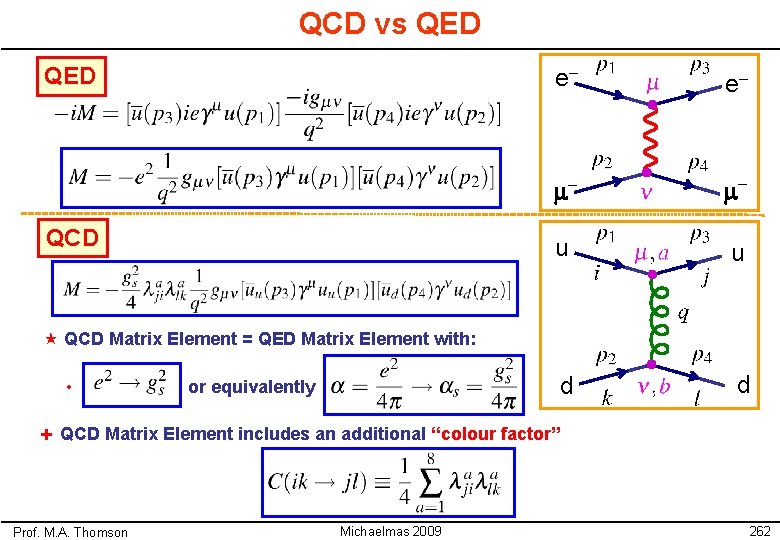
QCD vs QED QCD e– e– m– m– u u d d « QCD Matrix Element = QED Matrix Element with: • or equivalently + QCD Matrix Element includes an additional “colour factor” Prof. M. A. Thomson Michaelmas 2009 262
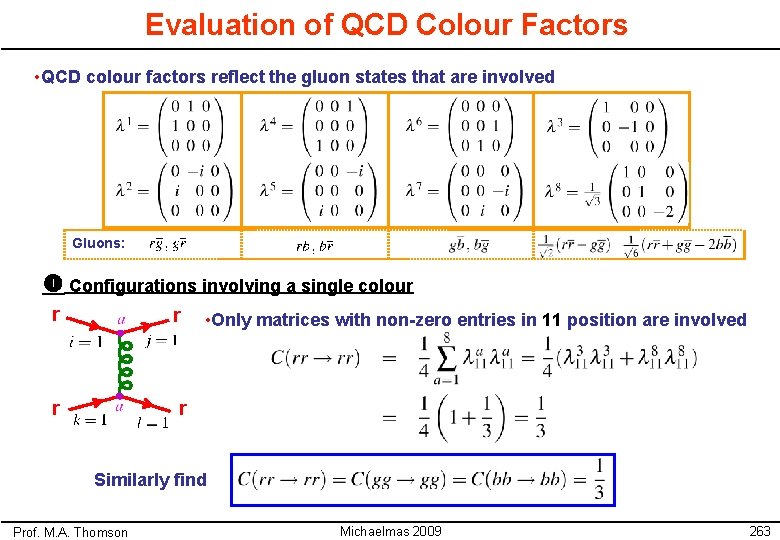
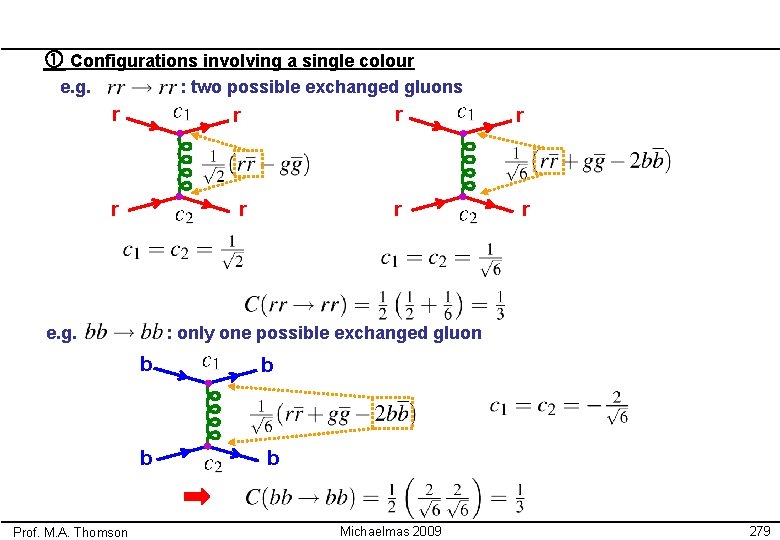
Evaluation of QCD Colour Factors • QCD colour factors reflect the gluon states that are involved Gluons: Configurations involving a single colour r r • Only matrices with non-zero entries in 11 position are involved Similarly find Prof. M. A. Thomson Michaelmas 2009 263
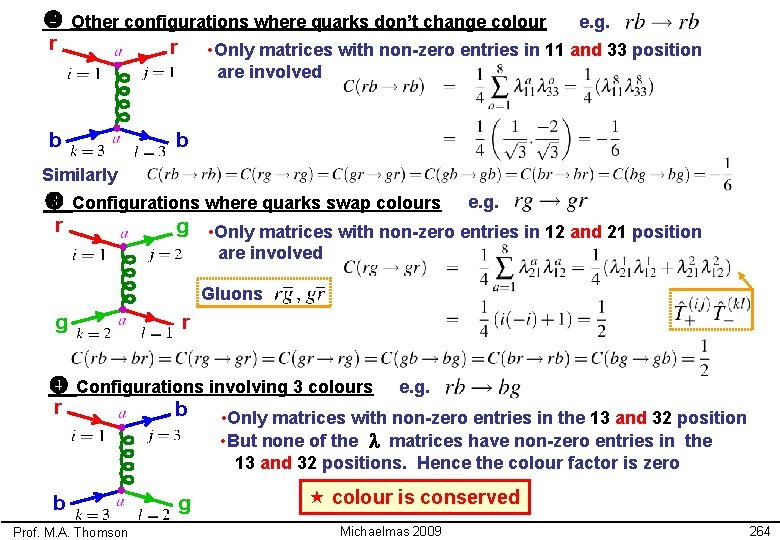
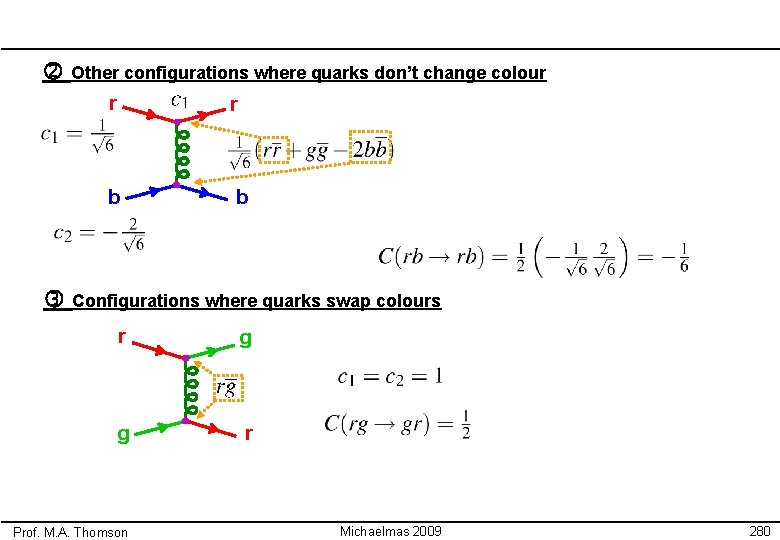
Other configurations where quarks don’t change colour r r b b e. g. • Only matrices with non-zero entries in 11 and 33 position are involved Similarly Configurations where quarks swap colours r e. g. g • Only matrices with non-zero entries in 12 and 21 position are involved Gluons g r Configurations involving 3 colours r b b g Prof. M. A. Thomson e. g. • Only matrices with non-zero entries in the 13 and 32 position • But none of the l matrices have non-zero entries in the 13 and 32 positions. Hence the colour factor is zero « colour is conserved Michaelmas 2009 264
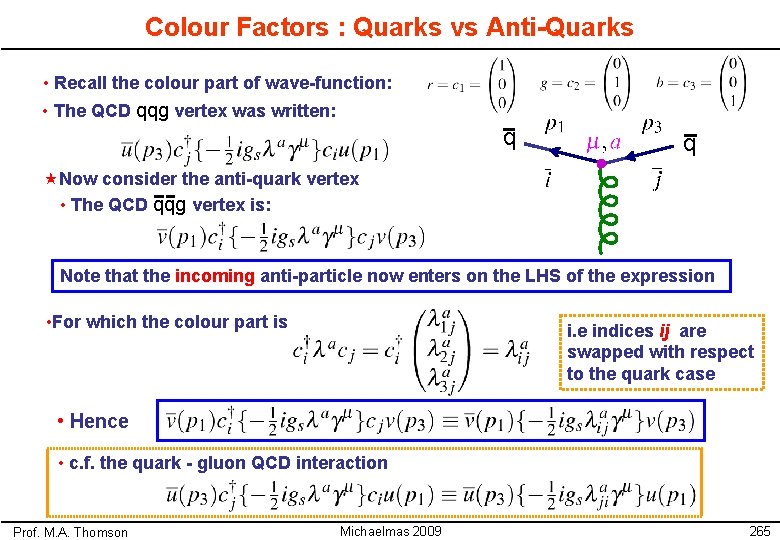
Colour Factors : Quarks vs Anti-Quarks • Recall the colour part of wave-function: • The QCD qqg vertex was written: q q «Now consider the anti-quark vertex • The QCD qqg vertex is: Note that the incoming anti-particle now enters on the LHS of the expression • For which the colour part is i. e indices ij are swapped with respect to the quark case • Hence • c. f. the quark - gluon QCD interaction Prof. M. A. Thomson Michaelmas 2009 265
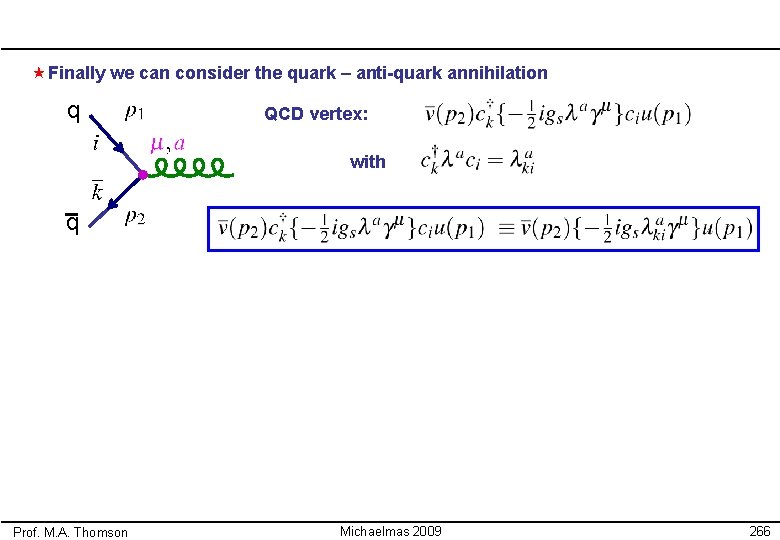
«Finally we can consider the quark – anti-quark annihilation q QCD vertex: with q Prof. M. A. Thomson Michaelmas 2009 266
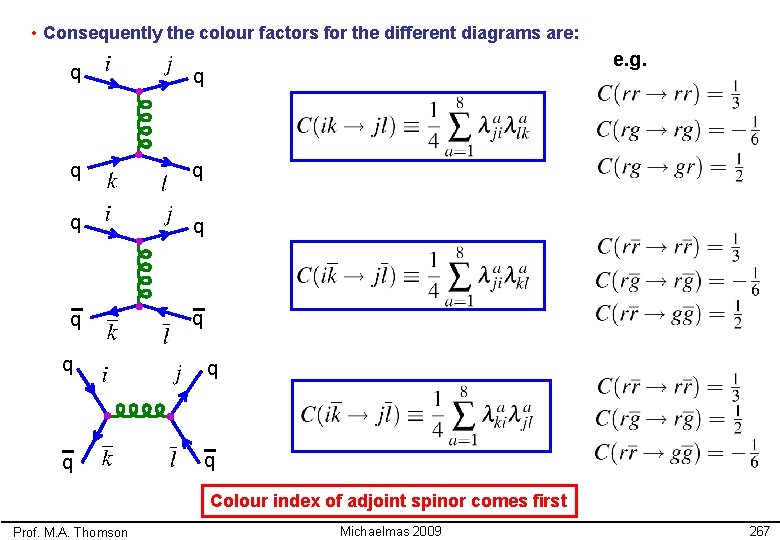
• Consequently the colour factors for the different diagrams are: q q q q e. g. q q Colour index of adjoint spinor comes first Prof. M. A. Thomson Michaelmas 2009 267
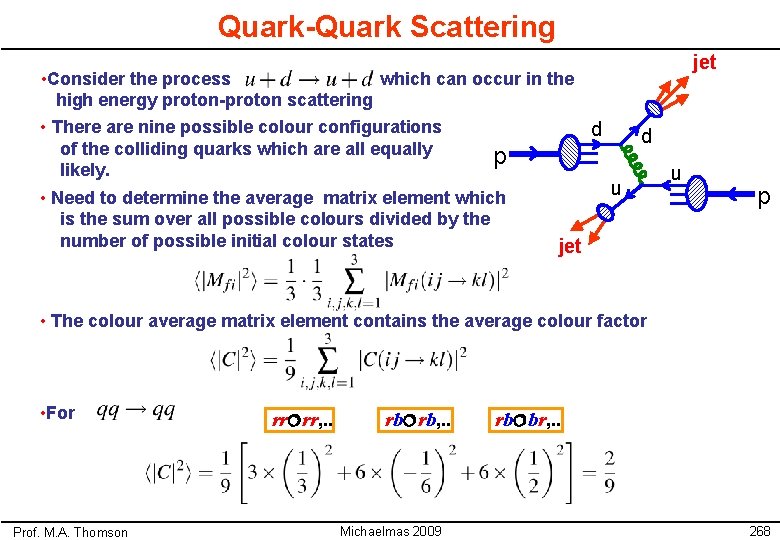
Quark-Quark Scattering • Consider the process which can occur in the high energy proton-proton scattering • There are nine possible colour configurations d of the colliding quarks which are all equally p likely. u • Need to determine the average matrix element which is the sum over all possible colours divided by the number of possible initial colour states jet d u p • The colour average matrix element contains the average colour factor • For Prof. M. A. Thomson rr rr, . . rb rb, . . Michaelmas 2009 rb br, . . 268
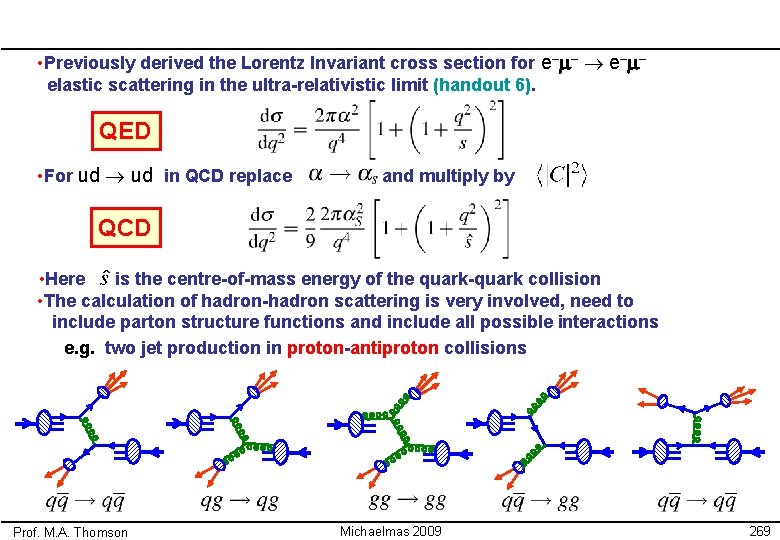
• Previously derived the Lorentz Invariant cross section for e–m– elastic scattering in the ultra-relativistic limit (handout 6). QED • For ud in QCD replace and multiply by QCD • Here is the centre-of-mass energy of the quark-quark collision • The calculation of hadron-hadron scattering is very involved, need to include parton structure functions and include all possible interactions e. g. two jet production in proton-antiproton collisions Prof. M. A. Thomson Michaelmas 2009 269
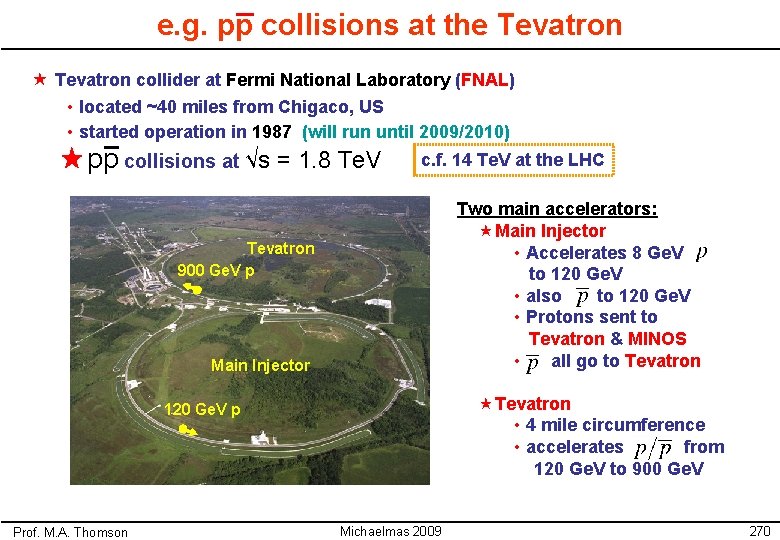
e. g. pp collisions at the Tevatron « Tevatron collider at Fermi National Laboratory (FNAL) • located ~40 miles from Chigaco, US • started operation in 1987 (will run until 2009/2010) pp collisions at √s = 1. 8 Te. V c. f. 14 Te. V at the LHC Two main accelerators: «Main Injector • Accelerates 8 Ge. V to 120 Ge. V • also to 120 Ge. V • Protons sent to Tevatron & MINOS • all go to Tevatron 900 Ge. V p Main Injector «Tevatron • 4 mile circumference • accelerates from 120 Ge. V to 900 Ge. V 120 Ge. V p Prof. M. A. Thomson Michaelmas 2009 270
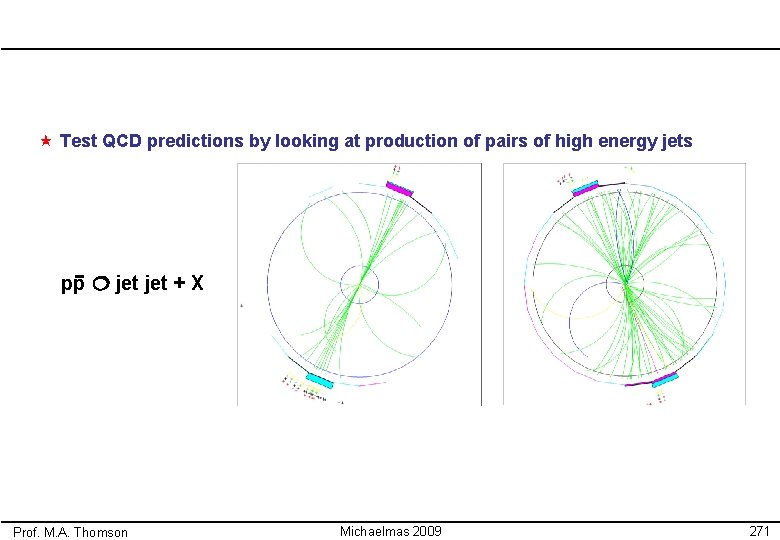
« Test QCD predictions by looking at production of pairs of high energy jets pp jet + X Prof. M. A. Thomson Michaelmas 2009 271
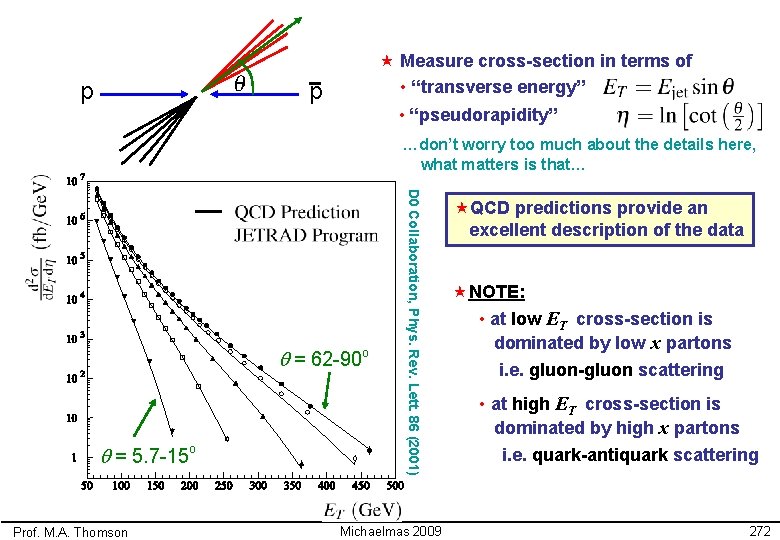
p « Measure cross-section in terms of • “transverse energy” • “pseudorapidity” p …don’t worry too much about the details here, what matters is that… q = 5. 7 -15 o Prof. M. A. Thomson D 0 Collaboration, Phys. Rev. Lett. 86 (2001) q = 62 -90 o Michaelmas 2009 «QCD predictions provide an excellent description of the data «NOTE: • at low ET cross-section is dominated by low x partons i. e. gluon-gluon scattering • at high ET cross-section is dominated by high x partons i. e. quark-antiquark scattering 272
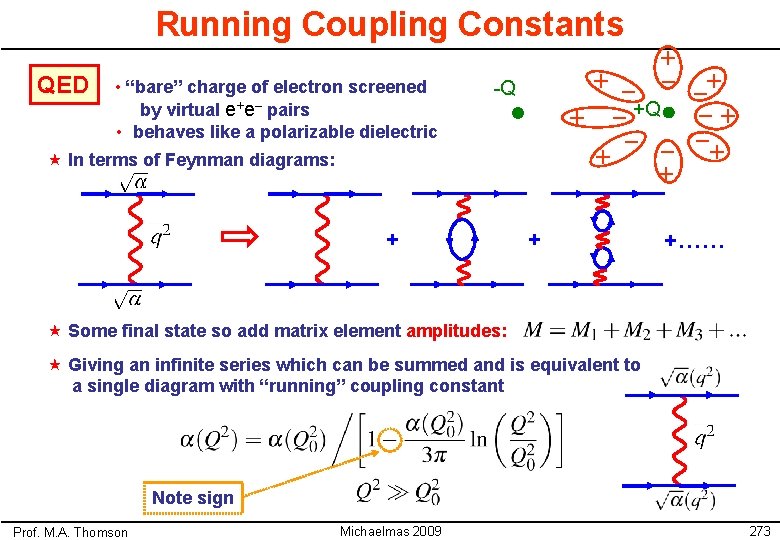
Running Coupling Constants QED • “bare” charge of electron screened by virtual e+e– pairs • behaves like a polarizable dielectric + + +Q + + + -Q « In terms of Feynman diagrams: + +…… « Some final state so add matrix element amplitudes: « Giving an infinite series which can be summed and is equivalent to a single diagram with “running” coupling constant Note sign Prof. M. A. Thomson Michaelmas 2009 273
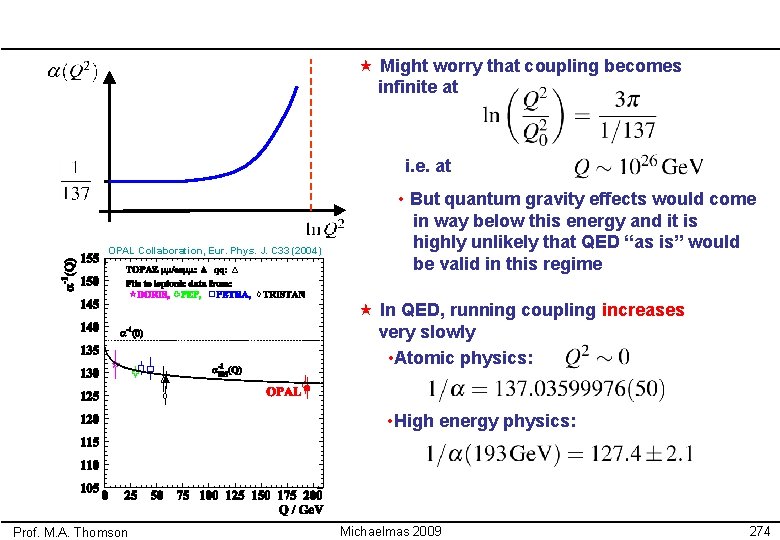
« Might worry that coupling becomes infinite at i. e. at OPAL Collaboration, Eur. Phys. J. C 33 (2004) • But quantum gravity effects would come in way below this energy and it is highly unlikely that QED “as is” would be valid in this regime « In QED, running coupling increases very slowly • Atomic physics: • High energy physics: Prof. M. A. Thomson Michaelmas 2009 274
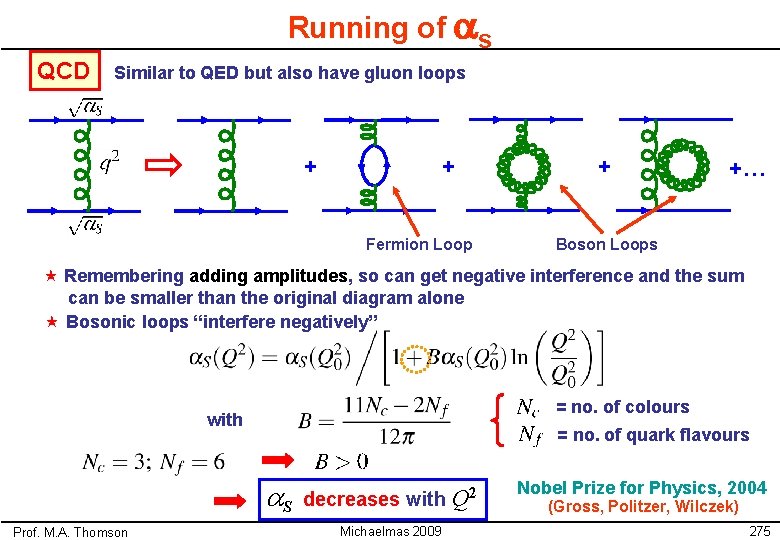
Running of as QCD Similar to QED but also have gluon loops + + Fermion Loop + +… Boson Loops « Remembering adding amplitudes, so can get negative interference and the sum can be smaller than the original diagram alone « Bosonic loops “interfere negatively” = no. of colours with = no. of quark flavours a. S Prof. M. A. Thomson decreases with Q 2 Michaelmas 2009 Nobel Prize for Physics, 2004 (Gross, Politzer, Wilczek) 275
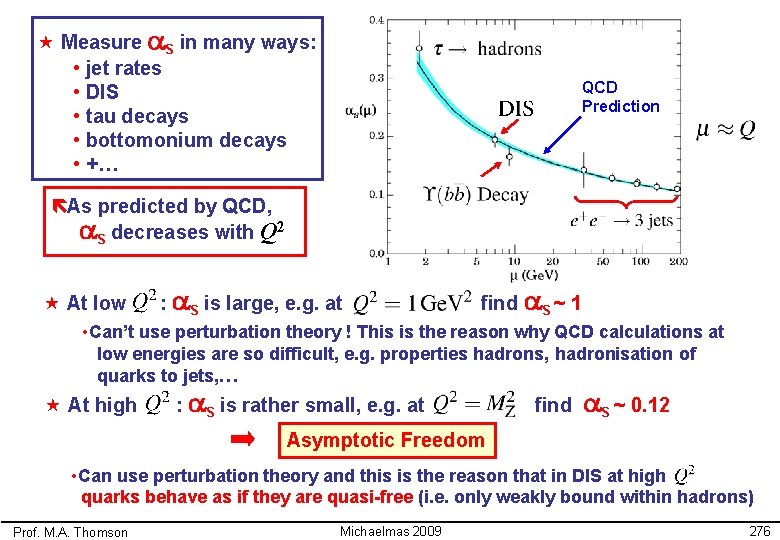
« Measure a. S in many ways: • jet rates • DIS • tau decays • bottomonium decays • +… QCD Prediction ëAs predicted by QCD, a. S decreases with Q 2 « At low : a. S is large, e. g. at find a. S ~ 1 • Can’t use perturbation theory ! This is the reason why QCD calculations at low energies are so difficult, e. g. properties hadrons, hadronisation of quarks to jets, … « At high : a. S is rather small, e. g. at find a. S ~ 0. 12 Asymptotic Freedom • Can use perturbation theory and this is the reason that in DIS at high quarks behave as if they are quasi-free (i. e. only weakly bound within hadrons) Prof. M. A. Thomson Michaelmas 2009 276
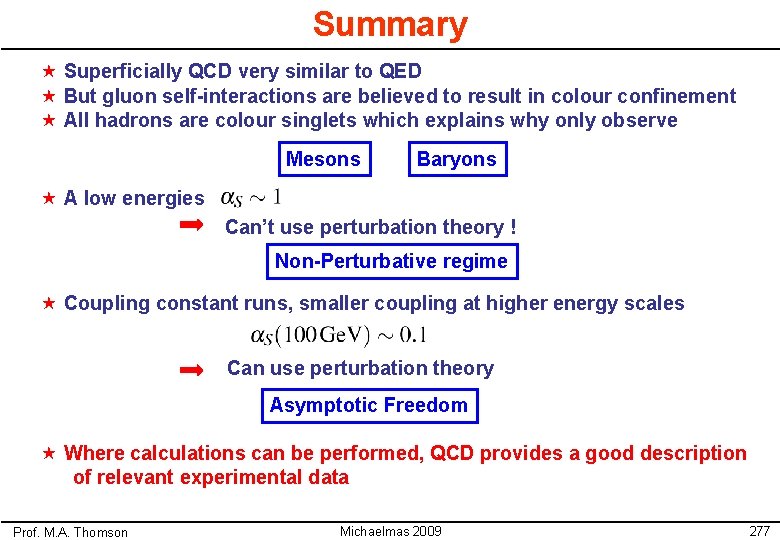
Summary « Superficially QCD very similar to QED « But gluon self-interactions are believed to result in colour confinement « All hadrons are colour singlets which explains why only observe Mesons Baryons « A low energies Can’t use perturbation theory ! Non-Perturbative regime « Coupling constant runs, smaller coupling at higher energy scales Can use perturbation theory Asymptotic Freedom « Where calculations can be performed, QCD provides a good description of relevant experimental data Prof. M. A. Thomson Michaelmas 2009 277
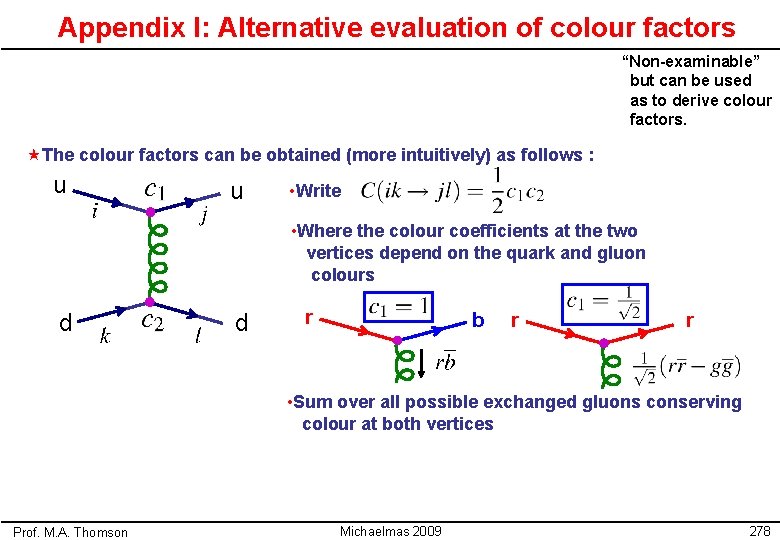
Appendix I: Alternative evaluation of colour factors “Non-examinable” but can be used as to derive colour factors. «The colour factors can be obtained (more intuitively) as follows : u u • Write • Where the colour coefficients at the two vertices depend on the quark and gluon colours d d r b r r • Sum over all possible exchanged gluons conserving colour at both vertices Prof. M. A. Thomson Michaelmas 2009 278
Configurations involving a single colour e. g. : two possible exchanged gluons r r r r e. g. Prof. M. A. Thomson : only one possible exchanged gluon b b Michaelmas 2009 279
Other configurations where quarks don’t change colour r r b b Configurations where quarks swap colours r g g r Prof. M. A. Thomson Michaelmas 2009 280
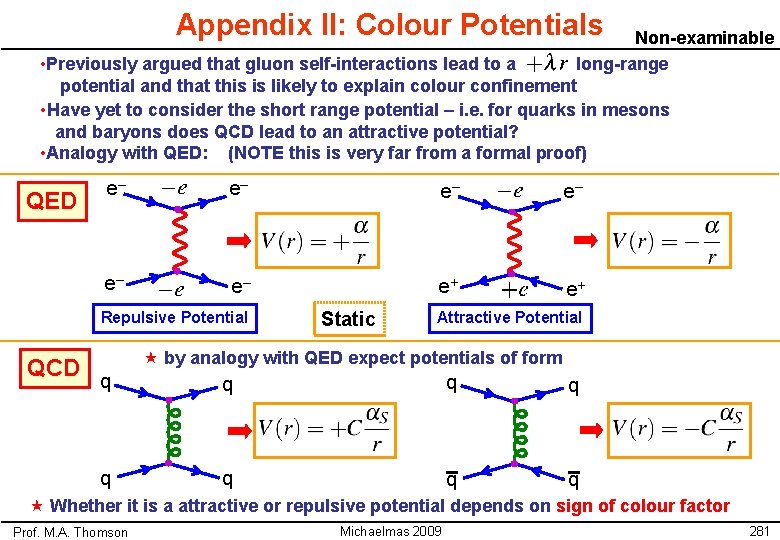
Appendix II: Colour Potentials Non-examinable • Previously argued that gluon self-interactions lead to a long-range potential and that this is likely to explain colour confinement • Have yet to consider the short range potential – i. e. for quarks in mesons and baryons does QCD lead to an attractive potential? • Analogy with QED: (NOTE this is very far from a formal proof) QED e– e– e– e+ e+ Repulsive Potential QCD q q Static Attractive Potential « by analogy with QED expect potentials of form q q q « Whether it is a attractive or repulsive potential depends on sign of colour factor Prof. M. A. Thomson Michaelmas 2009 281
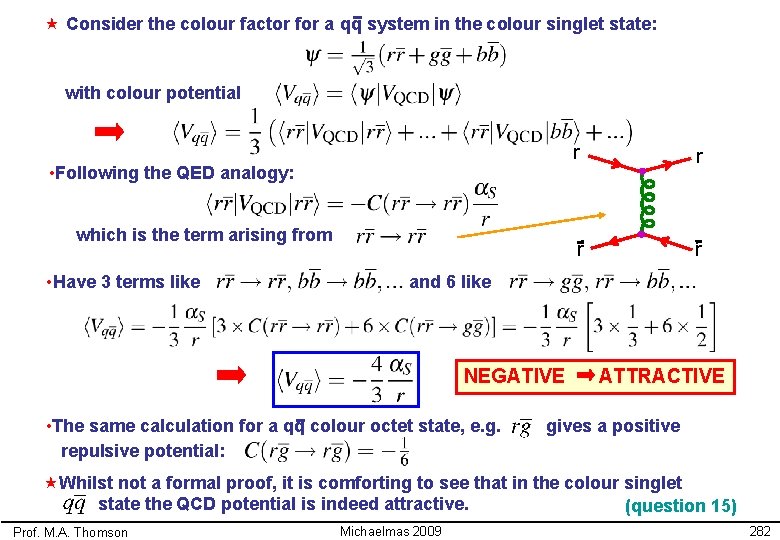
« Consider the colour factor for a qq system in the colour singlet state: with colour potential • Following the QED analogy: which is the term arising from • Have 3 terms like r r and 6 like NEGATIVE • The same calculation for a qq colour octet state, e. g. repulsive potential: ATTRACTIVE gives a positive «Whilst not a formal proof, it is comforting to see that in the colour singlet state the QCD potential is indeed attractive. (question 15) Prof. M. A. Thomson Michaelmas 2009 282
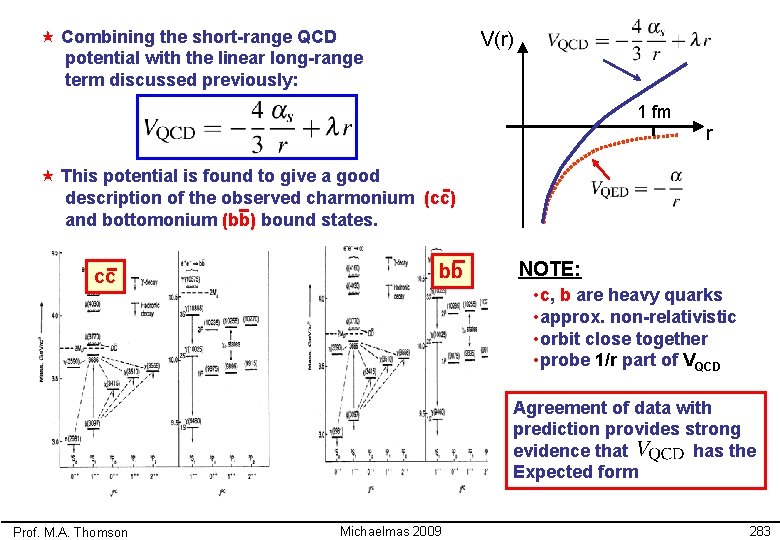
« Combining the short-range QCD potential with the linear long-range term discussed previously: V(r) 1 fm r « This potential is found to give a good description of the observed charmonium (cc) and bottomonium (bb) bound states. cc bb NOTE: • c, b are heavy quarks • approx. non-relativistic • orbit close together • probe 1/r part of VQCD Agreement of data with prediction provides strong evidence that has the Expected form Prof. M. A. Thomson Michaelmas 2009 283