
Particle Physics 2 nd Handout Feynman Graphs of
- Slides: 16
Particle Physics 2 nd Handout Feynman Graphs of QFT • Relativistic Quantum Mechanics • QED • Standard model vertices • Amplitudes and Probabilities • QCD • Running Coupling Constants • Quark confinement http: //ppewww. ph. gla. ac. uk/~parkes/teaching/PP/PP. html Chris Parkes
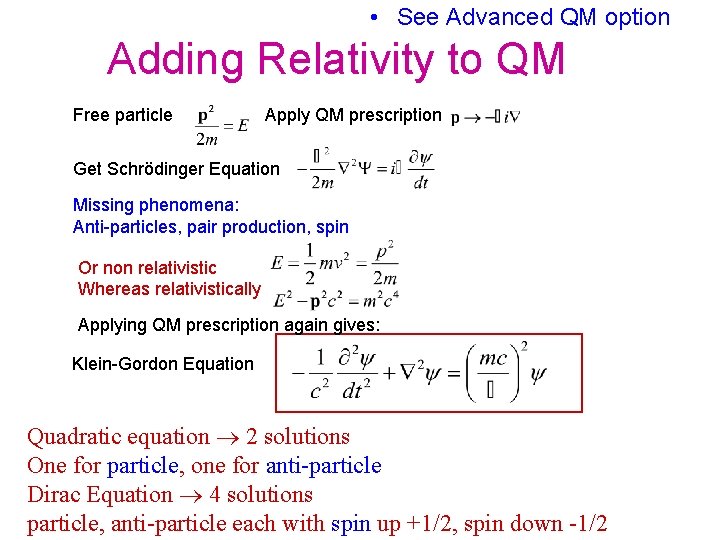
• See Advanced QM option Adding Relativity to QM Free particle Apply QM prescription Get Schrödinger Equation Missing phenomena: Anti-particles, pair production, spin Or non relativistic Whereas relativistically Applying QM prescription again gives: Klein-Gordon Equation Quadratic equation 2 solutions One for particle, one for anti-particle Dirac Equation 4 solutions particle, anti-particle each with spin up +1/2, spin down -1/2
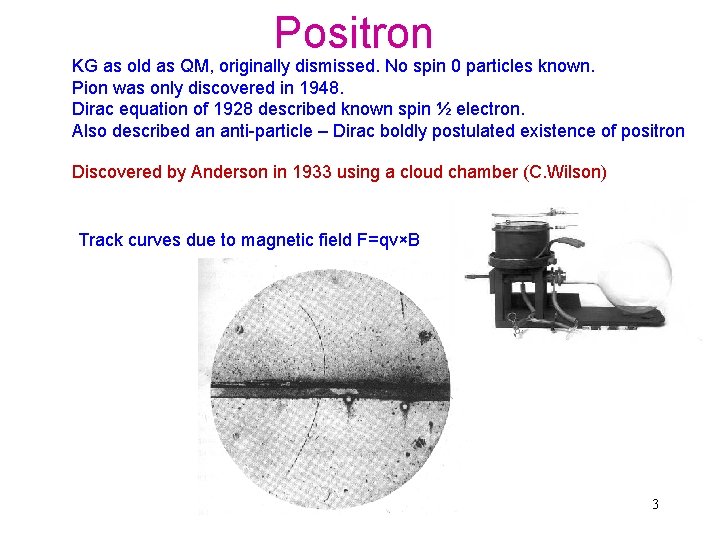
Positron KG as old as QM, originally dismissed. No spin 0 particles known. Pion was only discovered in 1948. Dirac equation of 1928 described known spin ½ electron. Also described an anti-particle – Dirac boldly postulated existence of positron Discovered by Anderson in 1933 using a cloud chamber (C. Wilson) Track curves due to magnetic field F=qv×B 3
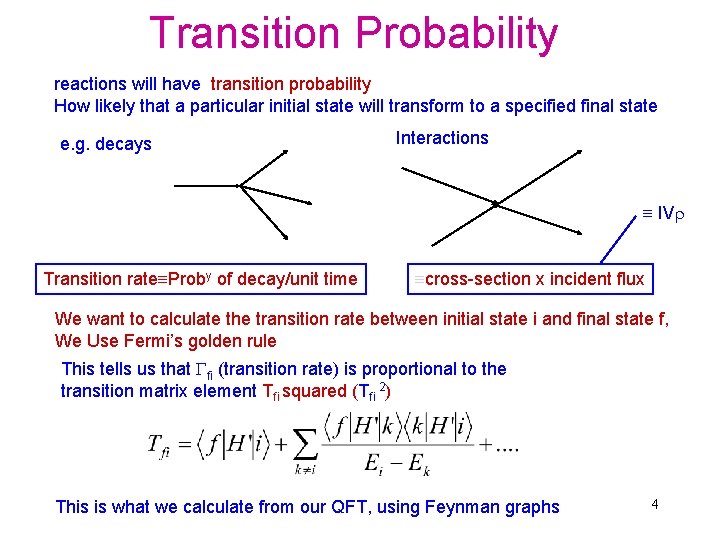
Transition Probability reactions will have transition probability How likely that a particular initial state will transform to a specified final state e. g. decays Interactions IV Transition rate Proby of decay/unit time cross-section x incident flux We want to calculate the transition rate between initial state i and final state f, We Use Fermi’s golden rule This tells us that fi (transition rate) is proportional to the transition matrix element Tfi squared (Tfi 2) This is what we calculate from our QFT, using Feynman graphs 4
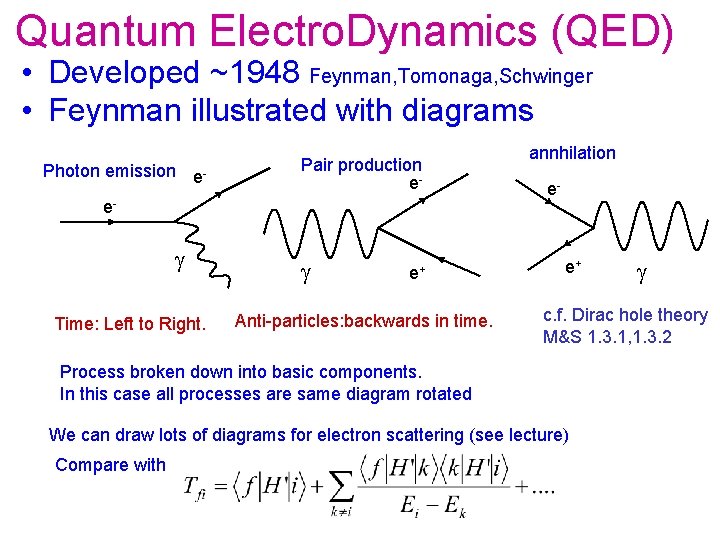
Quantum Electro. Dynamics (QED) • Developed ~1948 Feynman, Tomonaga, Schwinger • Feynman illustrated with diagrams Photon emission e- Pair production e- e- Time: Left to Right. e+ Anti-particles: backwards in time. annhilation e- e+ c. f. Dirac hole theory M&S 1. 3. 1, 1. 3. 2 Process broken down into basic components. In this case all processes are same diagram rotated We can draw lots of diagrams for electron scattering (see lecture) Compare with
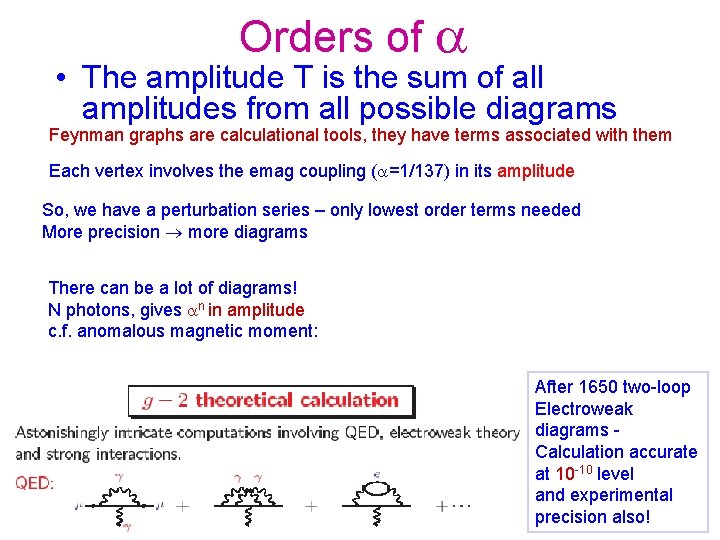
Orders of • The amplitude T is the sum of all amplitudes from all possible diagrams Feynman graphs are calculational tools, they have terms associated with them Each vertex involves the emag coupling ( =1/137) in its amplitude So, we have a perturbation series – only lowest order terms needed More precision more diagrams There can be a lot of diagrams! N photons, gives n in amplitude c. f. anomalous magnetic moment: After 1650 two-loop Electroweak diagrams Calculation accurate at 10 -10 level and experimental precision also!
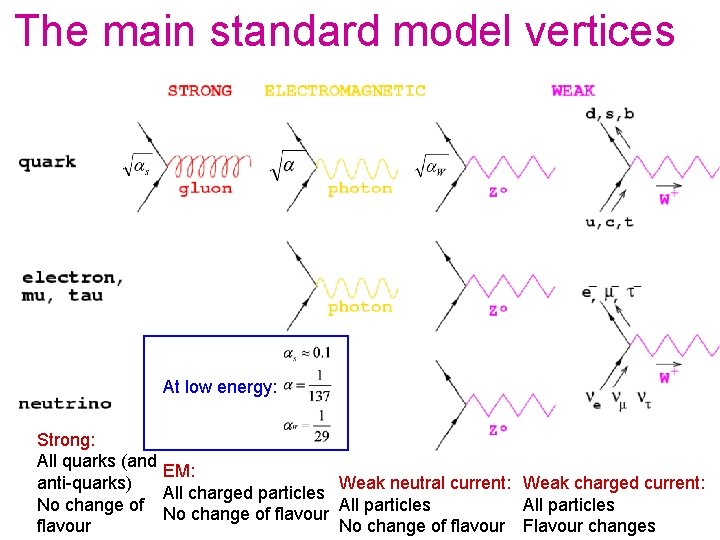
The main standard model vertices At low energy: Strong: All quarks (and EM: anti-quarks) Weak neutral current: Weak charged current: All charged particles No change of All particles No change of flavour Flavour changes
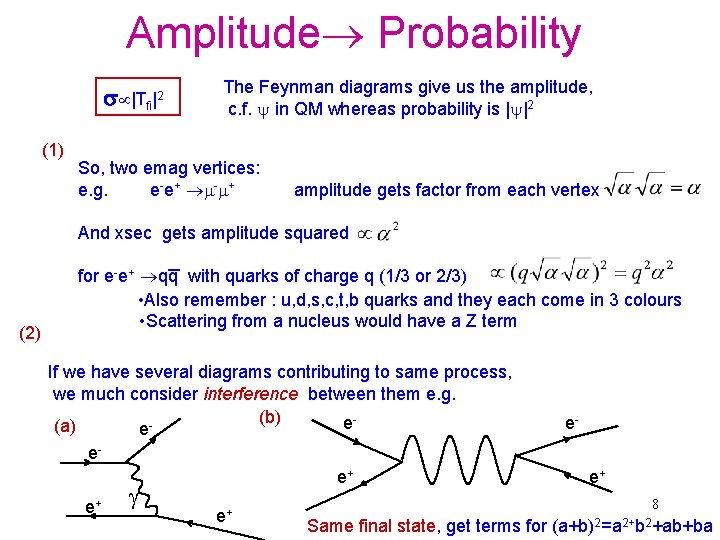
Amplitude Probability |Tfi|2 (1) The Feynman diagrams give us the amplitude, c. f. in QM whereas probability is | |2 So, two emag vertices: e. g. e-e+ - + amplitude gets factor from each vertex And xsec gets amplitude squared (2) for e-e+ qq with quarks of charge q (1/3 or 2/3) • Also remember : u, d, s, c, t, b quarks and they each come in 3 colours • Scattering from a nucleus would have a Z term If we have several diagrams contributing to same process, we much consider interference between them e. g. (b) e(a) eee+ e+ e+ ee+ 8 Same final state, get terms for (a+b)2=a 2+b 2+ab+ba
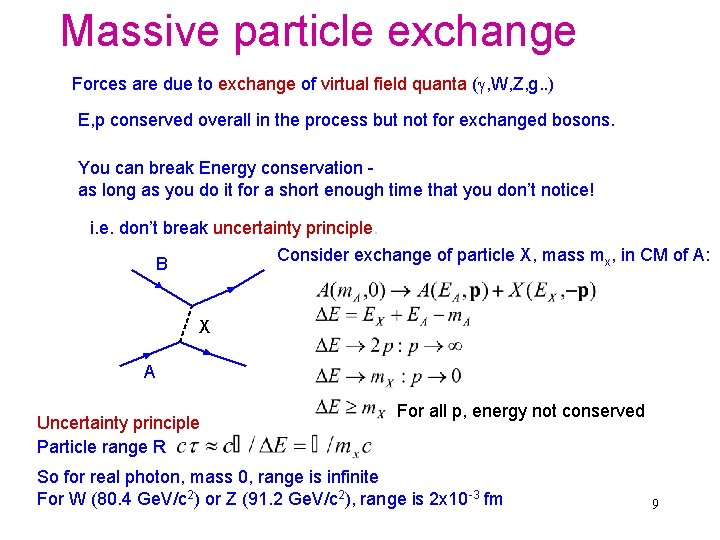
Massive particle exchange Forces are due to exchange of virtual field quanta ( , W, Z, g. . ) E, p conserved overall in the process but not for exchanged bosons. You can break Energy conservation as long as you do it for a short enough time that you don’t notice! i. e. don’t break uncertainty principle. Consider exchange of particle X, mass mx, in CM of A: B X A Uncertainty principle Particle range R For all p, energy not conserved So for real photon, mass 0, range is infinite For W (80. 4 Ge. V/c 2) or Z (91. 2 Ge. V/c 2), range is 2 x 10 -3 fm 9
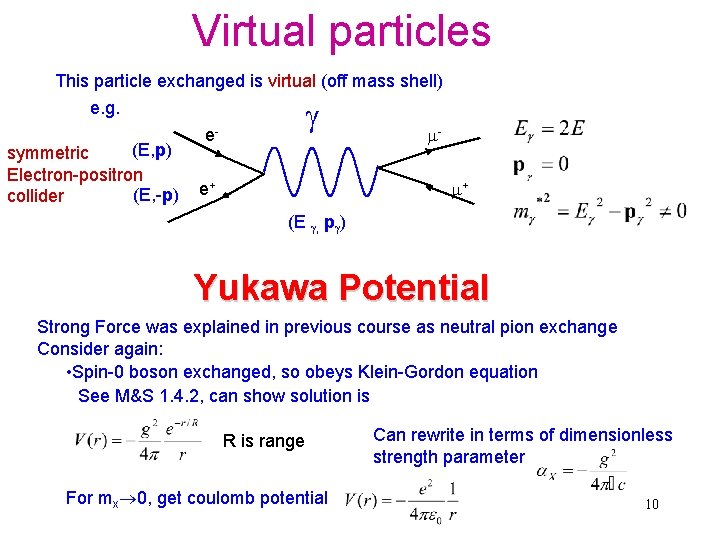
Virtual particles This particle exchanged is virtual (off mass shell) e. g. (E, p) symmetric Electron-positron (E, -p) collider e- + e+ (E , p ) Yukawa Potential Strong Force was explained in previous course as neutral pion exchange Consider again: • Spin-0 boson exchanged, so obeys Klein-Gordon equation See M&S 1. 4. 2, can show solution is R is range For mx 0, get coulomb potential Can rewrite in terms of dimensionless strength parameter 10
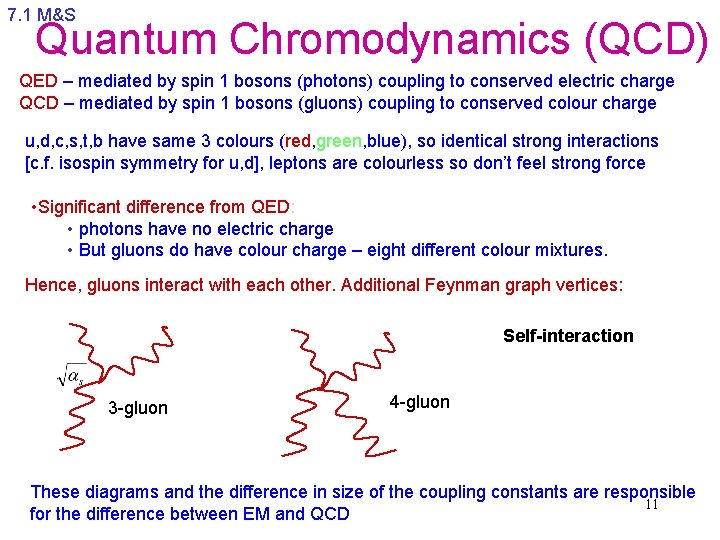
7. 1 M&S Quantum Chromodynamics (QCD) QED – mediated by spin 1 bosons (photons) coupling to conserved electric charge QCD – mediated by spin 1 bosons (gluons) coupling to conserved colour charge u, d, c, s, t, b have same 3 colours (red, green, blue), so identical strong interactions [c. f. isospin symmetry for u, d], leptons are colourless so don’t feel strong force • Significant difference from QED: • photons have no electric charge • But gluons do have colour charge – eight different colour mixtures. Hence, gluons interact with each other. Additional Feynman graph vertices: Self-interaction 3 -gluon 4 -gluon These diagrams and the difference in size of the coupling constants are responsible 11 for the difference between EM and QCD
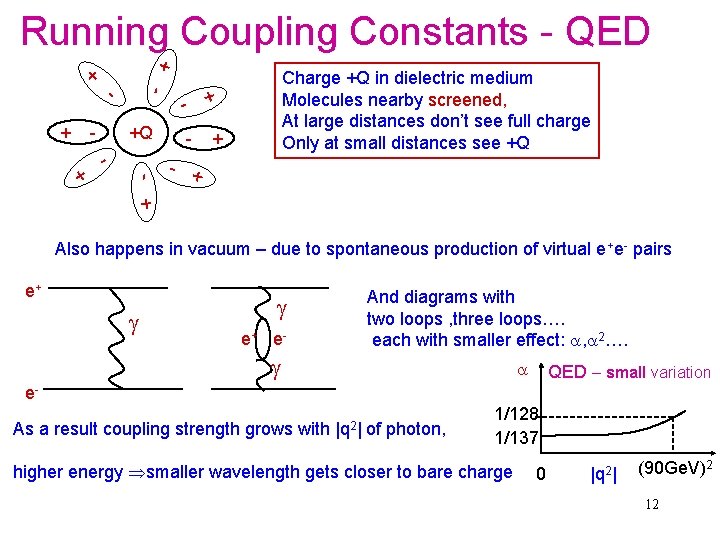
Running Coupling Constants - QED + + + - - - + +Q + - - Charge +Q in dielectric medium Molecules nearby screened, At large distances don’t see full charge Only at small distances see +Q + + Also happens in vacuum – due to spontaneous production of virtual e+e- pairs e+ e - And diagrams with two loops , three loops…. each with smaller effect: , 2…. QED – small variation e. As a result coupling strength grows with |q 2| of photon, 1/128 1/137 higher energy smaller wavelength gets closer to bare charge 0 |q 2| (90 Ge. V)2 12
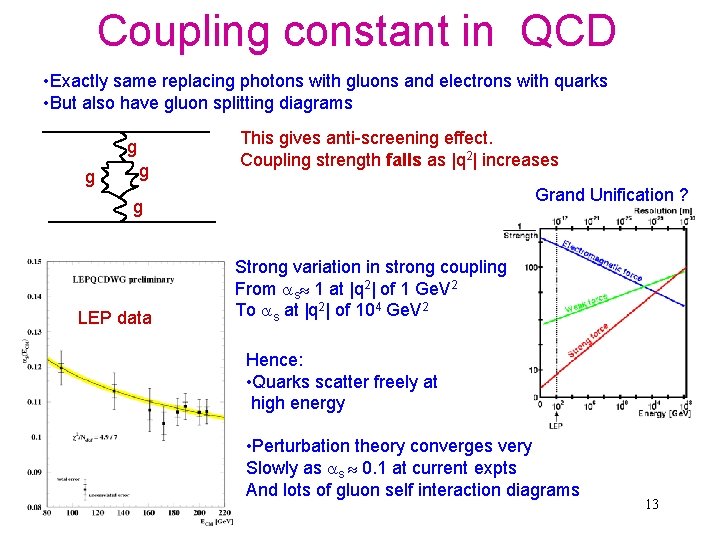
Coupling constant in QCD • Exactly same replacing photons with gluons and electrons with quarks • But also have gluon splitting diagrams g g g This gives anti-screening effect. Coupling strength falls as |q 2| increases Grand Unification ? g LEP data Strong variation in strong coupling From s 1 at |q 2| of 1 Ge. V 2 To s at |q 2| of 104 Ge. V 2 Hence: • Quarks scatter freely at high energy • Perturbation theory converges very Slowly as s 0. 1 at current expts And lots of gluon self interaction diagrams 13
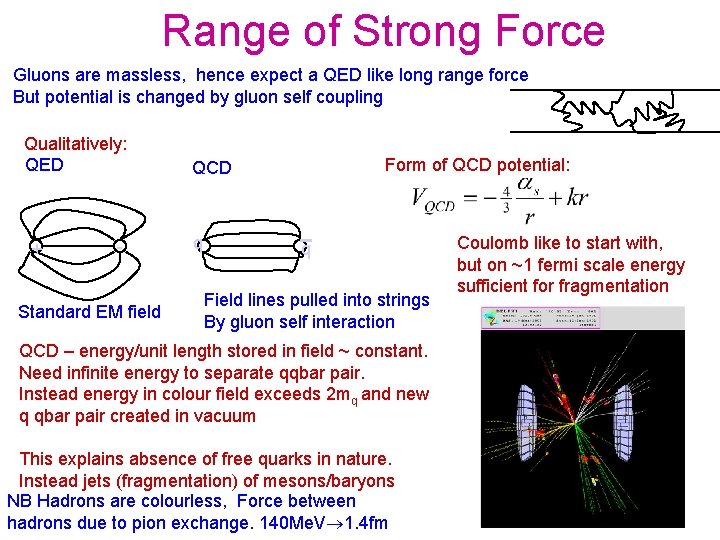
Range of Strong Force Gluons are massless, hence expect a QED like long range force But potential is changed by gluon self coupling Qualitatively: QED + - Standard EM field Form of QCD potential: QCD q q Field lines pulled into strings By gluon self interaction Coulomb like to start with, but on ~1 fermi scale energy sufficient for fragmentation QCD – energy/unit length stored in field ~ constant. Need infinite energy to separate qqbar pair. Instead energy in colour field exceeds 2 mq and new q qbar pair created in vacuum This explains absence of free quarks in nature. Instead jets (fragmentation) of mesons/baryons NB Hadrons are colourless, Force between hadrons due to pion exchange. 140 Me. V 1. 4 fm 14
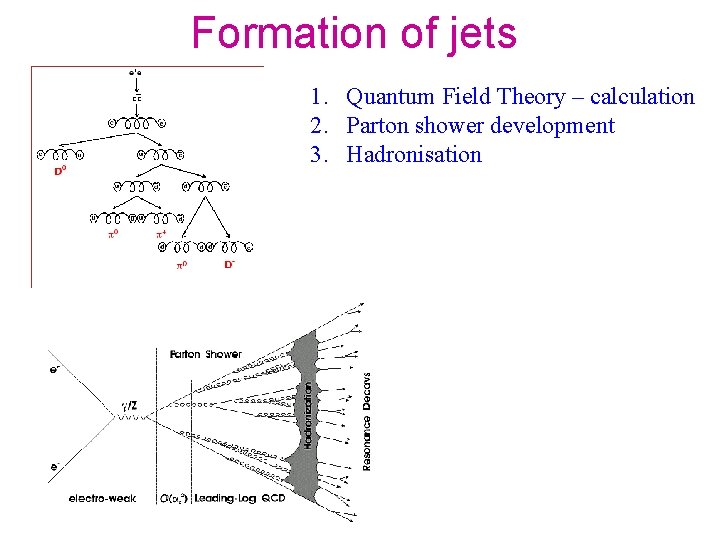
Formation of jets 1. Quantum Field Theory – calculation 2. Parton shower development 3. Hadronisation
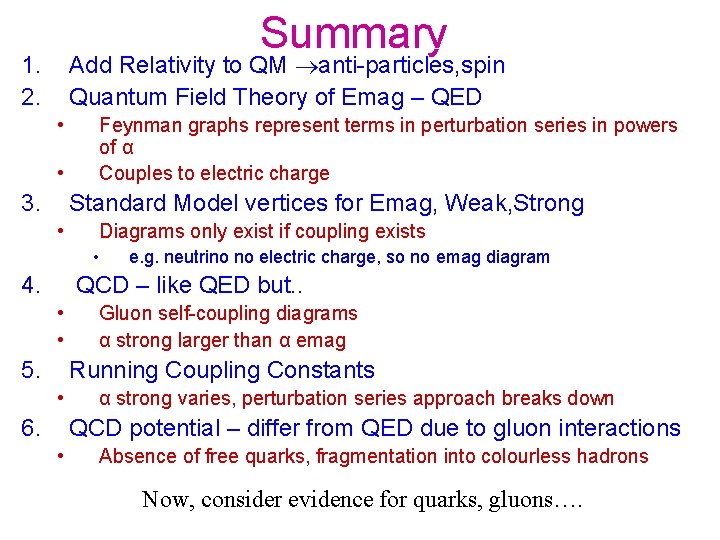
Summary Add Relativity to QM anti-particles, spin Quantum Field Theory of Emag – QED 1. 2. • • 3. Feynman graphs represent terms in perturbation series in powers of α Couples to electric charge Standard Model vertices for Emag, Weak, Strong • Diagrams only exist if coupling exists • 4. e. g. neutrino no electric charge, so no emag diagram QCD – like QED but. . • • 5. Gluon self-coupling diagrams α strong larger than α emag Running Coupling Constants • 6. α strong varies, perturbation series approach breaks down QCD potential – differ from QED due to gluon interactions • Absence of free quarks, fragmentation into colourless hadrons Now, consider evidence for quarks, gluons….