
Particle Image Velocimetry for Fluid Dynamics Measurements Lyes
- Slides: 42
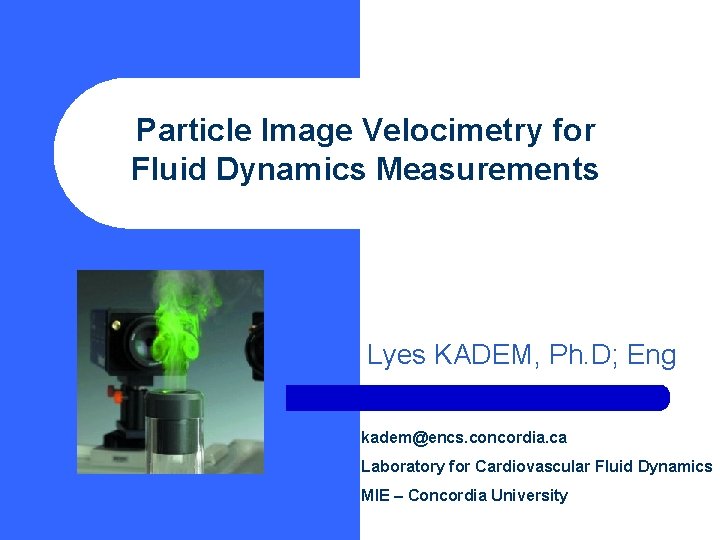
Particle Image Velocimetry for Fluid Dynamics Measurements Lyes KADEM, Ph. D; Eng kadem@encs. concordia. ca Laboratory for Cardiovascular Fluid Dynamics MIE – Concordia University
Presentation - A bit of history - What is PIV? - How to perform PIV measurements? - Which PIV system and for What? - How to post-process Data? 2
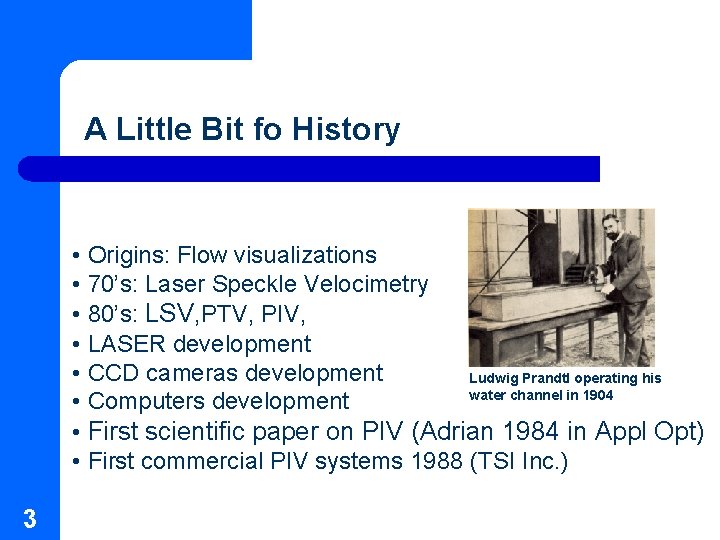
A Little Bit fo History • Origins: Flow visualizations • 70’s: Laser Speckle Velocimetry • 80’s: LSV, PTV, PIV, • LASER development • CCD cameras development Ludwig Prandtl operating his water channel in 1904 • Computers development • First scientific paper on PIV (Adrian 1984 in Appl Opt) • First commercial PIV systems 1988 (TSI Inc. ) 3
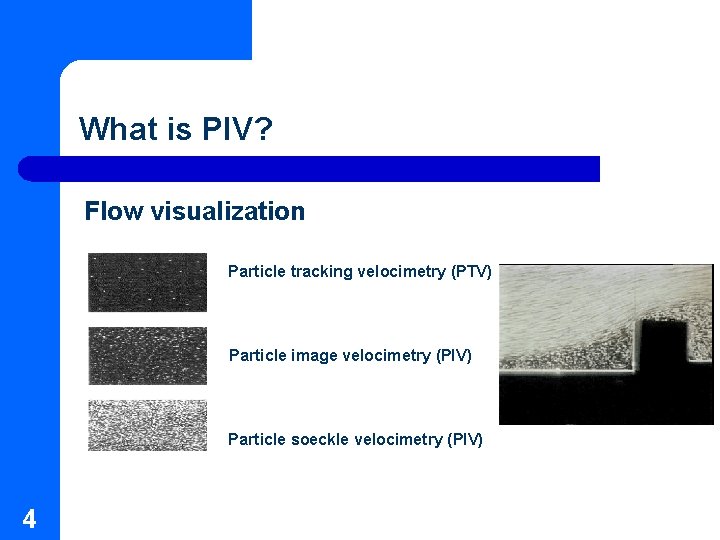
What is PIV? Flow visualization Particle tracking velocimetry (PTV) Particle image velocimetry (PIV) Particle soeckle velocimetry (PIV) 4
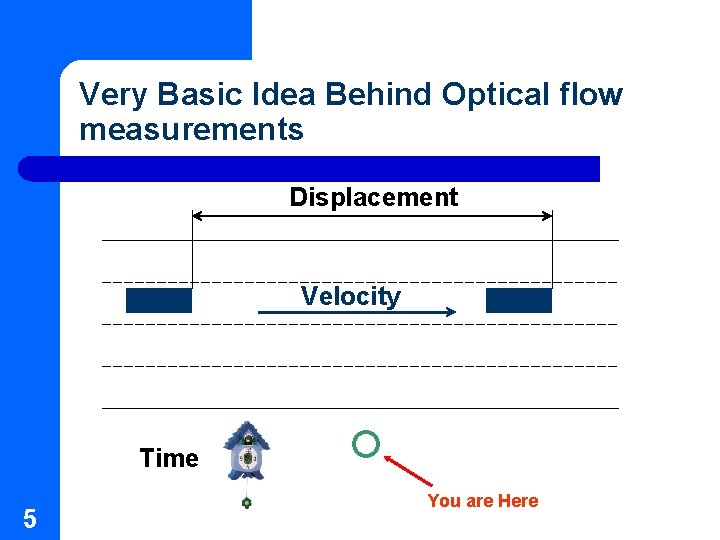
Very Basic Idea Behind Optical flow measurements Displacement Velocity Time 5 You are Here
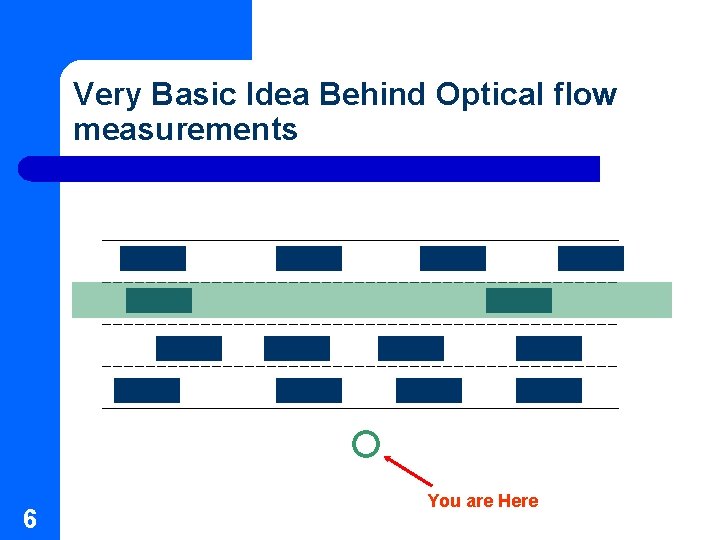
Very Basic Idea Behind Optical flow measurements 6 You are Here
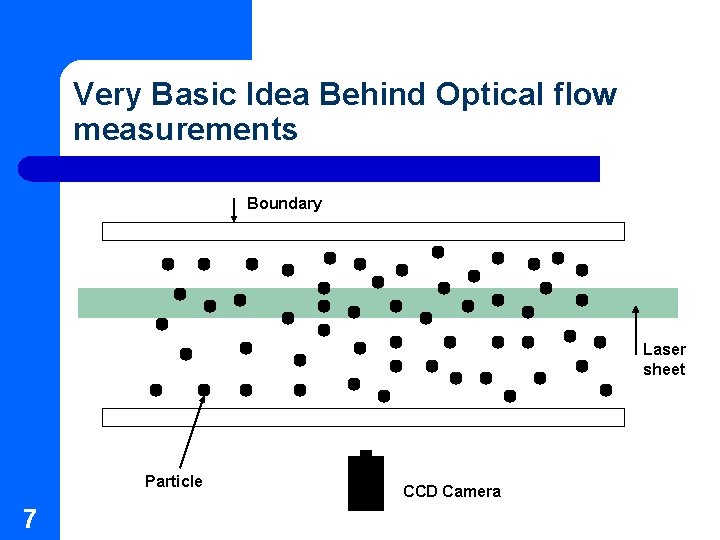
Very Basic Idea Behind Optical flow measurements Boundary Laser sheet Particle 7 CCD Camera
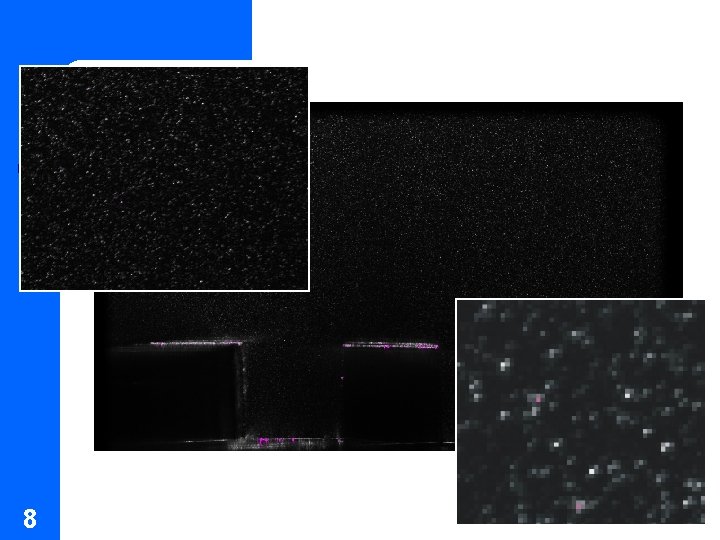
8
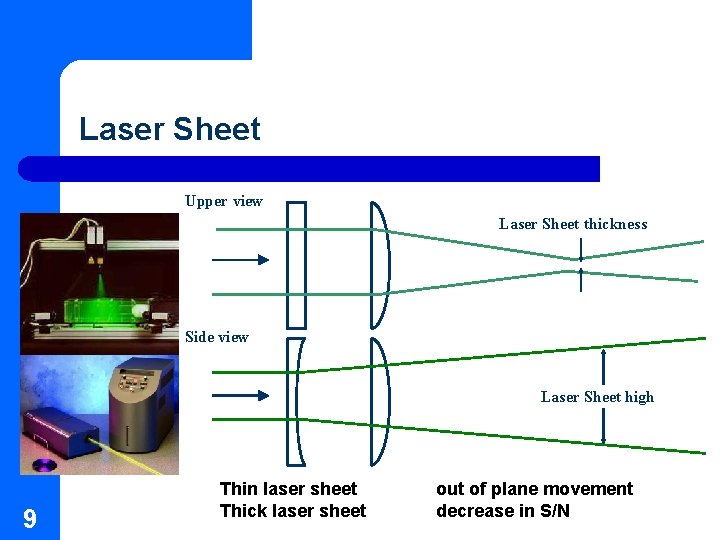
Laser Sheet Upper view Laser Sheet thickness Side view Laser Sheet high 9 Thin laser sheet Thick laser sheet out of plane movement decrease in S/N
Laser Sheet - A large amount of light (from 20 m. J to 400 m. J) must be available in a short time (~ 5 ns). - Inter-pulse ( t) timing may vary from less than 1 s to many ms depending upon the velocity of the flow. - The repetition rate of a pulsed laser is typically 10 -30 Hz 10 adequate only for velocities < 1 m/s
Laser Sheet Which Laser and for what? - Double pulsed laser ( t: 1 -150 s ), 10 Hz, adequate for high-speed airflow applications. - Dual head system ( t: 100 ns-1 s ), over 50 Hz, adequate for time resolved PIV. - Two color Laser for two-color PIV, adequate for two phase flow measurement. 11
Laser Sheet: Safety The laser used are usually in Class 4 High power devices; hazardous to the eyes (especially from reflected beam) and skin; can be also a fire hazard - Keep all reflective materials away from the beam. - Do not place your hand or any other body part into the laser beam. - Wear a safety glasses (same wavelength as the laser beam). - Work back to the laser sheet. - Put a light to indicate that the laser is on. 12
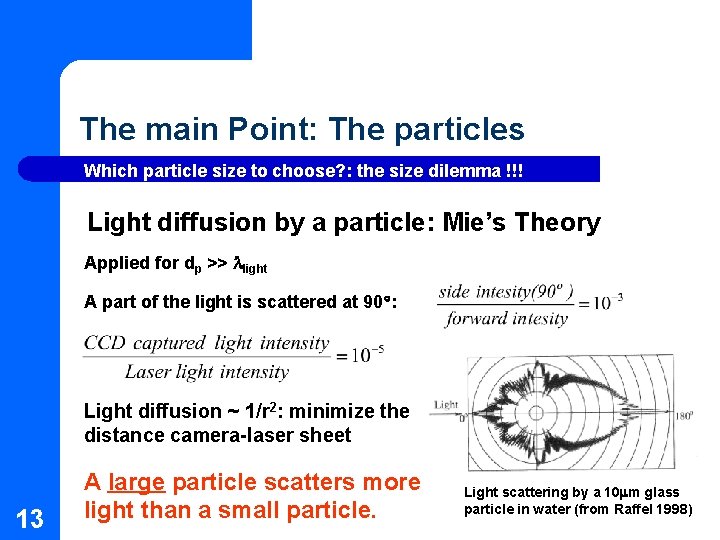
The main Point: The particles Which particle size to choose? : the size dilemma !!! Light diffusion by a particle: Mie’s Theory Applied for dp >> light A part of the light is scattered at 90 : Light diffusion ~ 1/r 2: minimize the distance camera-laser sheet 13 A large particle scatters more light than a small particle. Light scattering by a 10 m glass particle in water (from Raffel 1998)
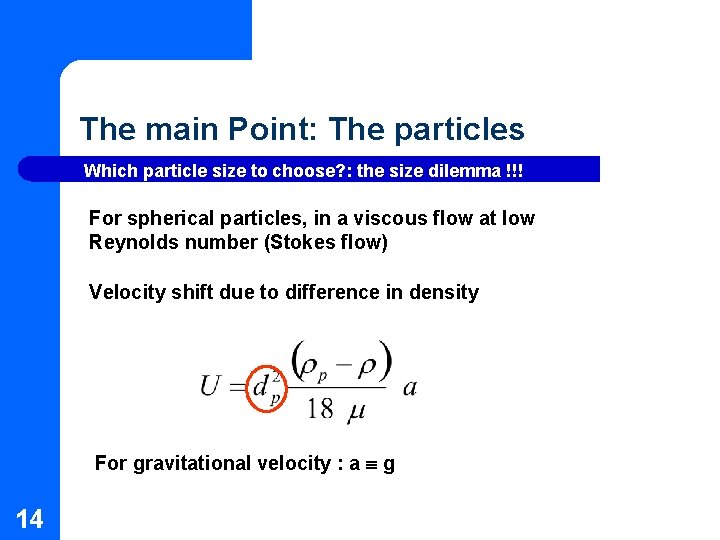
The main Point: The particles Which particle size to choose? : the size dilemma !!! For spherical particles, in a viscous flow at low Reynolds number (Stokes flow) Velocity shift due to difference in density For gravitational velocity : a g 14
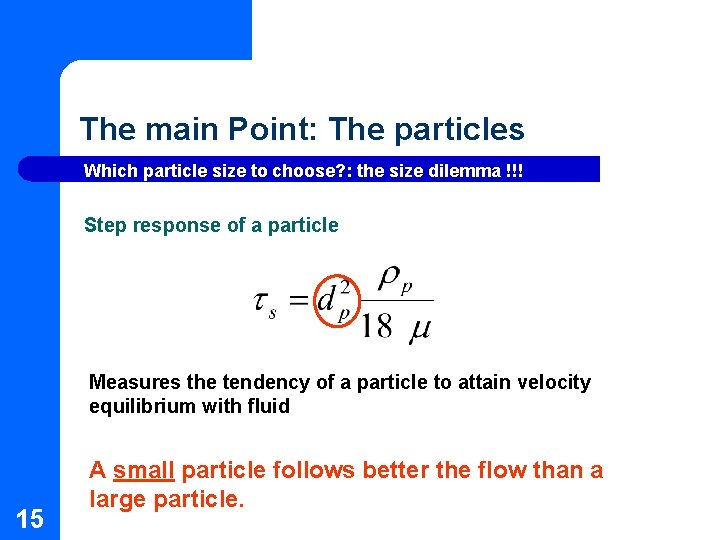
The main Point: The particles Which particle size to choose? : the size dilemma !!! Step response of a particle Measures the tendency of a particle to attain velocity equilibrium with fluid 15 A small particle follows better the flow than a large particle.
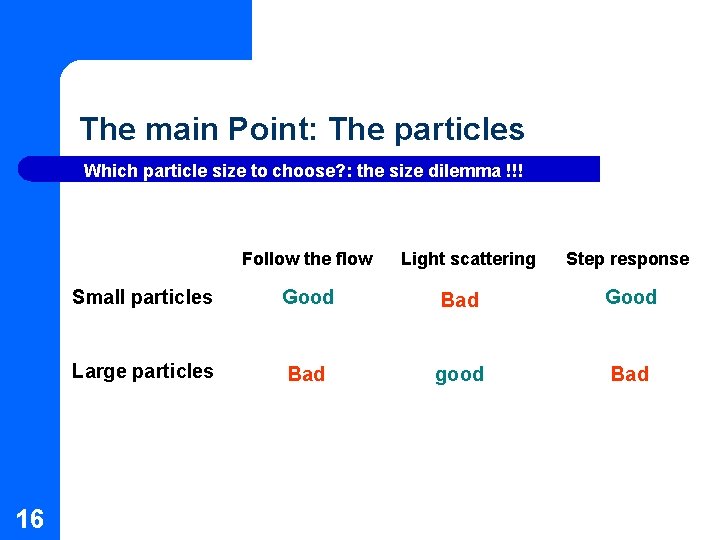
The main Point: The particles Which particle size to choose? : the size dilemma !!! Follow the flow 16 Light scattering Step response Small particles Good Bad Good Large particles Bad good Bad
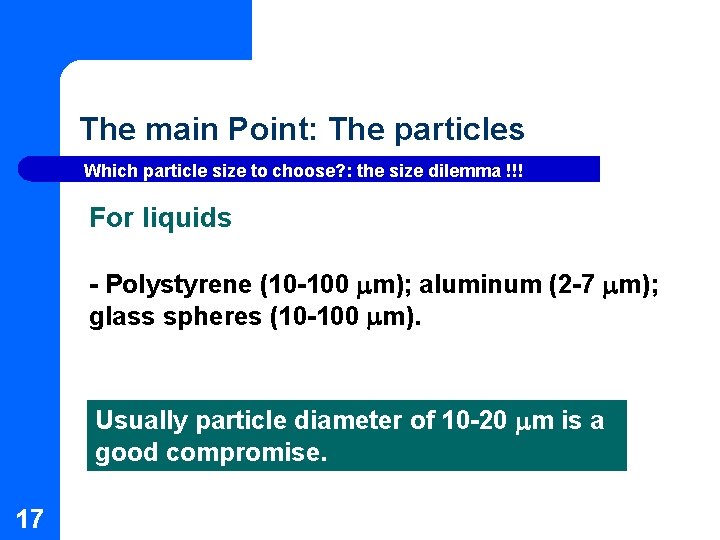
The main Point: The particles Which particle size to choose? : the size dilemma !!! For liquids - Polystyrene (10 -100 m); aluminum (2 -7 m); glass spheres (10 -100 m). Usually particle diameter of 10 -20 m is a good compromise. 17
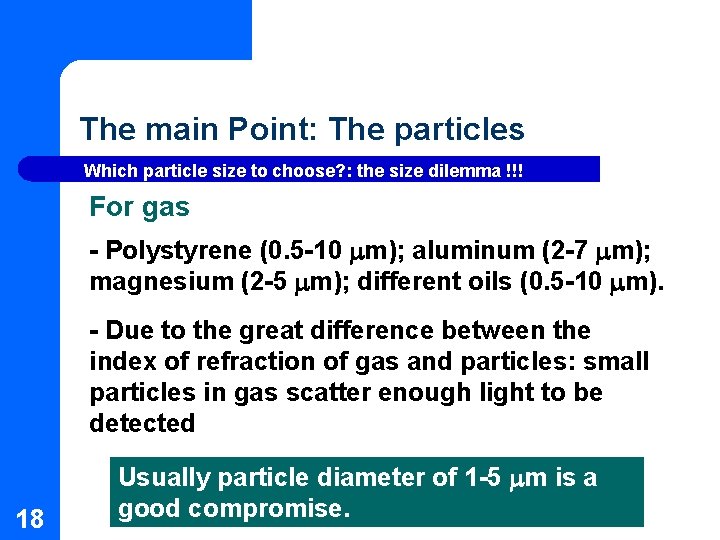
The main Point: The particles Which particle size to choose? : the size dilemma !!! For gas - Polystyrene (0. 5 -10 m); aluminum (2 -7 m); magnesium (2 -5 m); different oils (0. 5 -10 m). - Due to the great difference between the index of refraction of gas and particles: small particles in gas scatter enough light to be detected 18 Usually particle diameter of 1 -5 m is a good compromise.
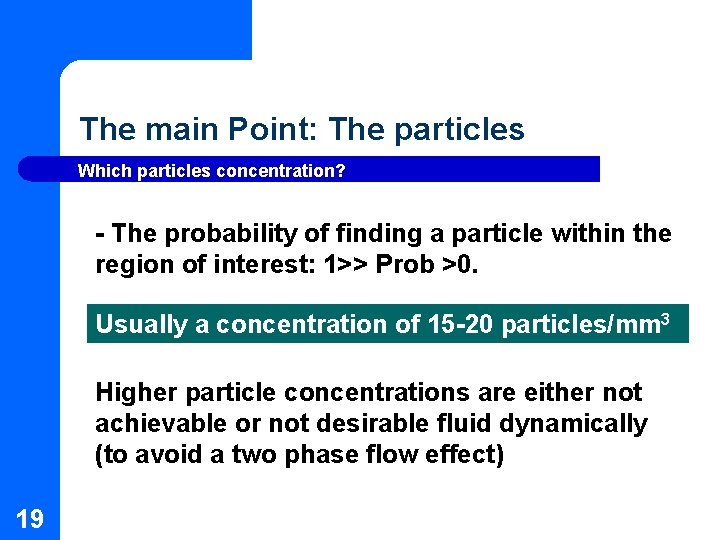
The main Point: The particles Which particles concentration? - The probability of finding a particle within the region of interest: 1>> Prob >0. Usually a concentration of 15 -20 particles/mm 3 Higher particle concentrations are either not achievable or not desirable fluid dynamically (to avoid a two phase flow effect) 19
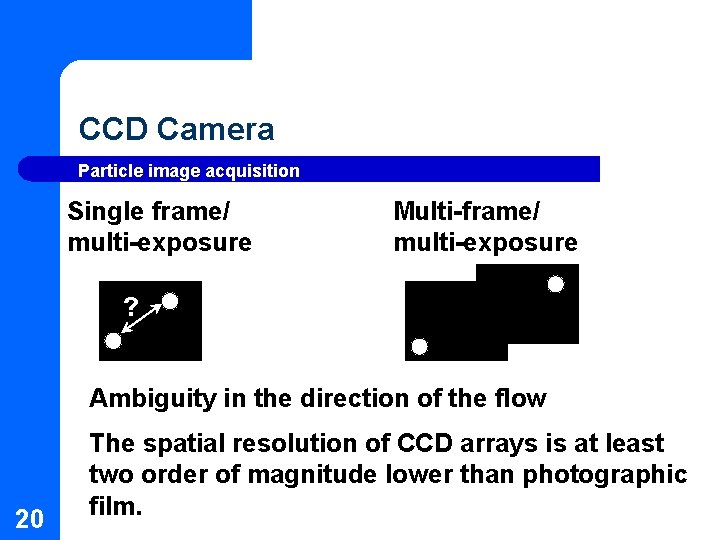
CCD Camera Particle image acquisition Single frame/ multi-exposure Multi-frame/ multi-exposure ? Ambiguity in the direction of the flow 20 The spatial resolution of CCD arrays is at least two order of magnitude lower than photographic film.
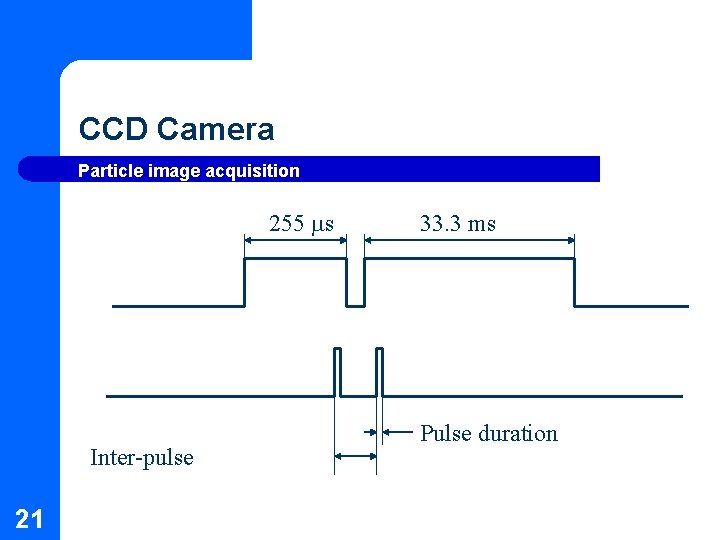
CCD Camera Particle image acquisition 255 s Inter-pulse 21 33. 3 ms Pulse duration
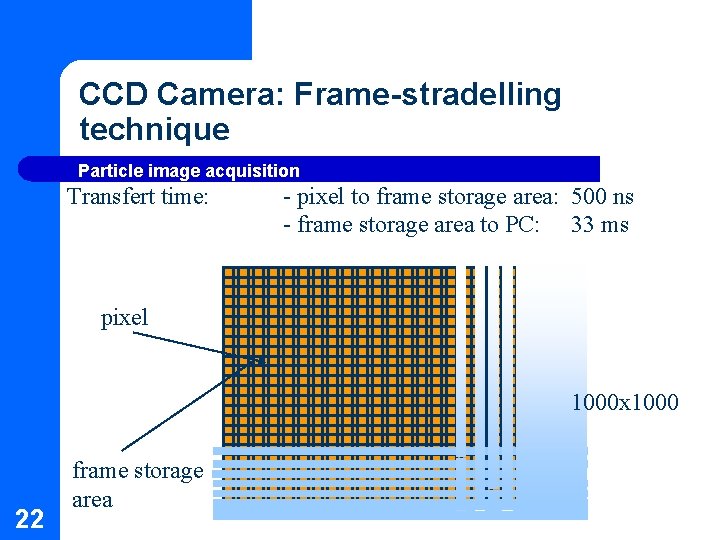
CCD Camera: Frame-stradelling technique Particle image acquisition Transfert time: - pixel to frame storage area: 500 ns - frame storage area to PC: 33 ms pixel 1000 x 1000 22 frame storage area
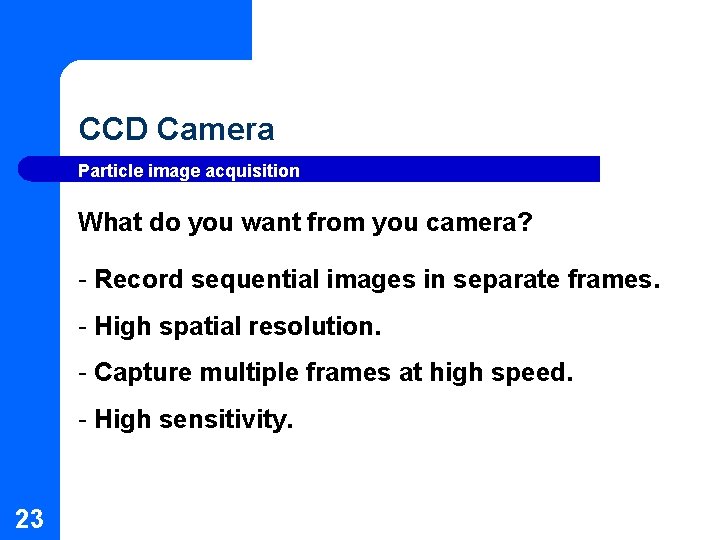
CCD Camera Particle image acquisition What do you want from you camera? - Record sequential images in separate frames. - High spatial resolution. - Capture multiple frames at high speed. - High sensitivity. 23
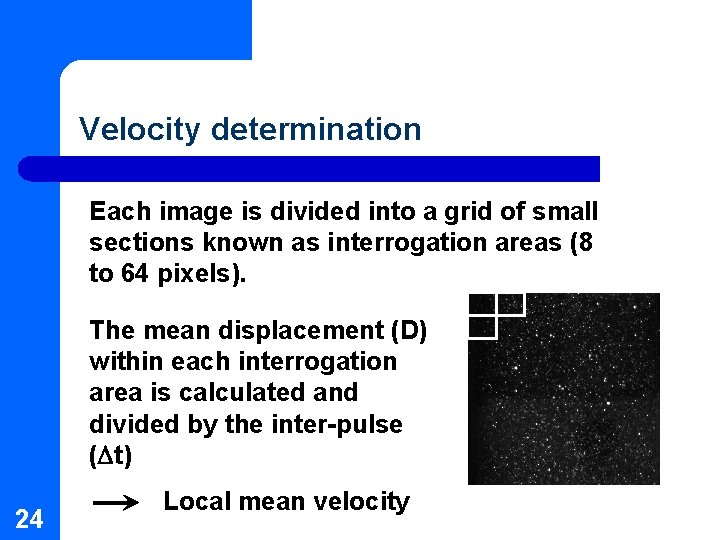
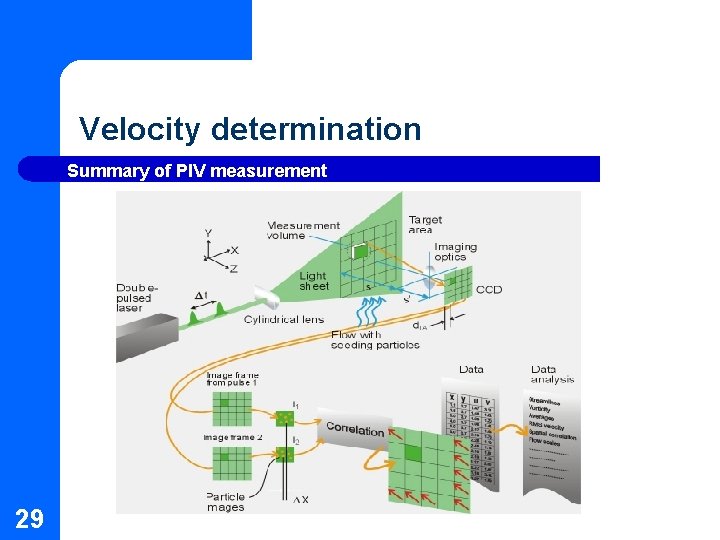
Velocity determination Each image is divided into a grid of small sections known as interrogation areas (8 to 64 pixels). The mean displacement (D) within each interrogation area is calculated and divided by the inter-pulse ( t) 24 Local mean velocity
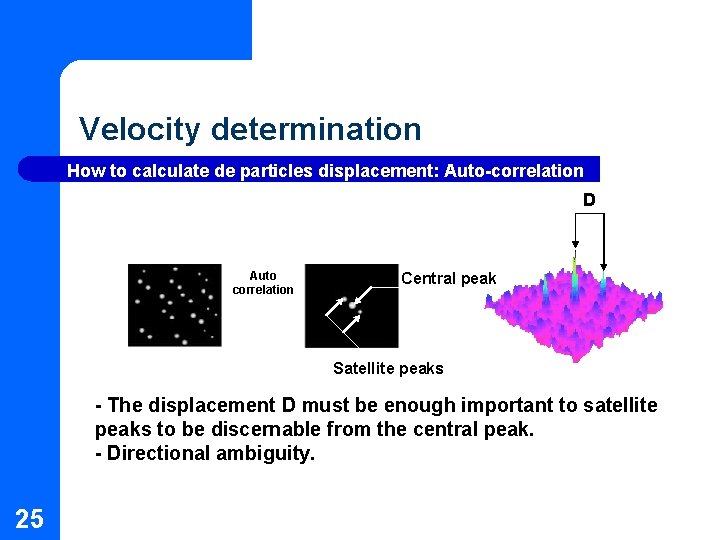
Velocity determination How to calculate de particles displacement: Auto-correlation D Auto correlation Central peak Satellite peaks - The displacement D must be enough important to satellite peaks to be discernable from the central peak. - Directional ambiguity. 25
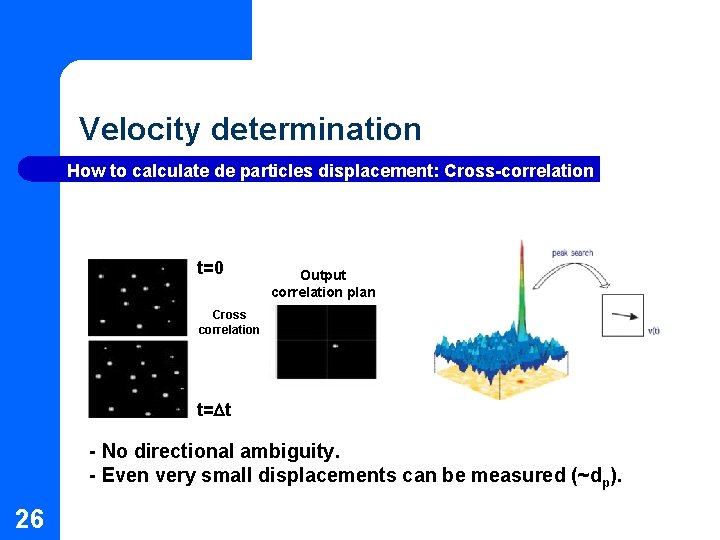
Velocity determination How to calculate de particles displacement: Cross-correlation t=0 Output correlation plan Cross correlation t= t - No directional ambiguity. - Even very small displacements can be measured (~dp). 26
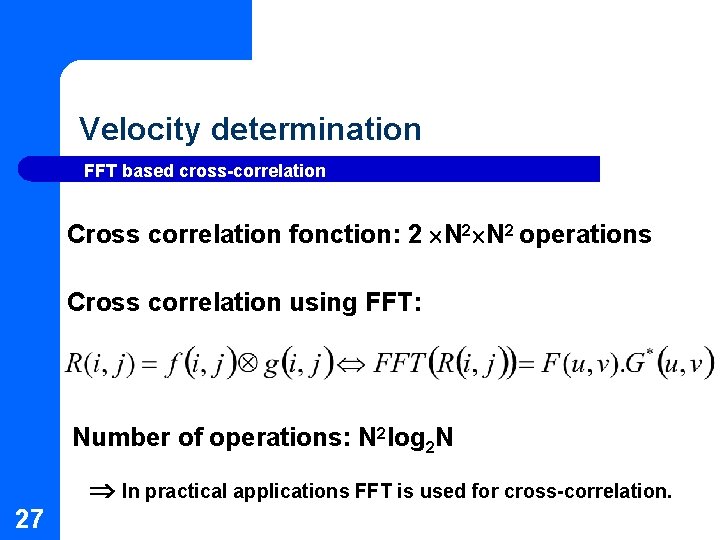
Velocity determination FFT based cross-correlation Cross correlation fonction: 2 N 2 operations Cross correlation using FFT: Number of operations: N 2 log 2 N In practical applications FFT is used for cross-correlation. 27
Velocity determination FFT based cross-correlation Limitations of FFT based cross-correlation Direct cross correlation can be defined for a finite domain, whereas FFT based cross-correlation is well defined for infinite domain. The two sub-samples have to be of square and equal size (N) and a power of 2 (8 8; 16 16; 32 32; 64 64). A loss in spatial resolution when N has to be selected larger than required. 28
Velocity determination Summary of PIV measurement 29
Velocity determination Optimization of the cross-correlation - The displacement of the particles during inter-pulse duration must be less that ¼ of the interrogation area size: “the ¼ law” - To increase spatial resolution an interrogation cell overlap of 50% can be used. - Number of particle per interrogation area: 10 -15. - Standard and deformed window shifting. - Using PTV and PIV. 30
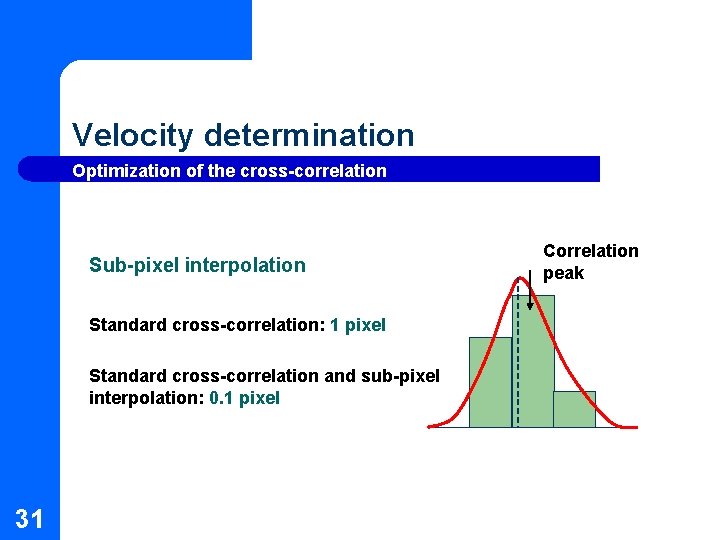
Velocity determination Optimization of the cross-correlation Sub-pixel interpolation Standard cross-correlation: 1 pixel Standard cross-correlation and sub-pixel interpolation: 0. 1 pixel 31 Correlation peak
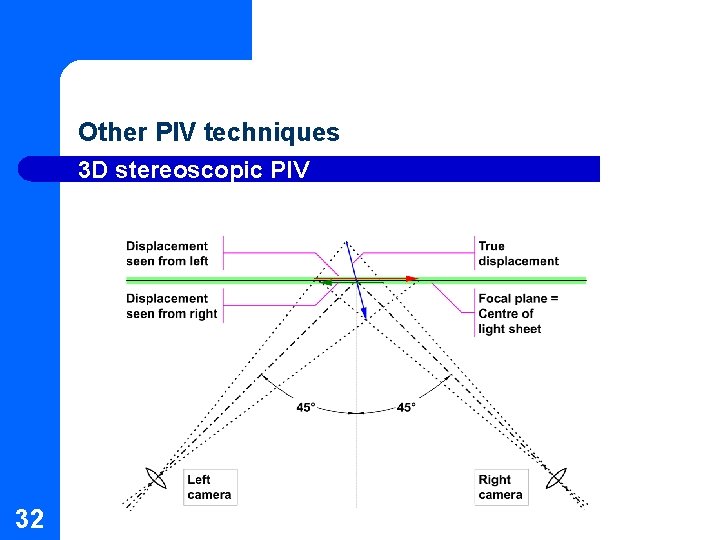
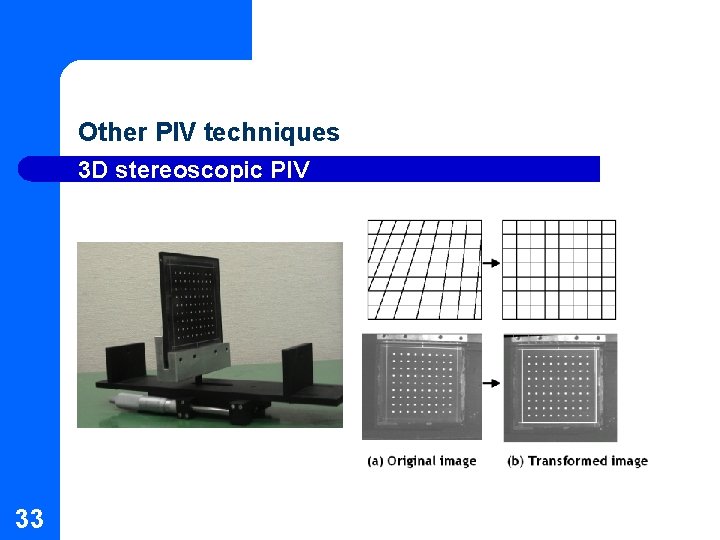
Other PIV techniques 3 D stereoscopic PIV 32
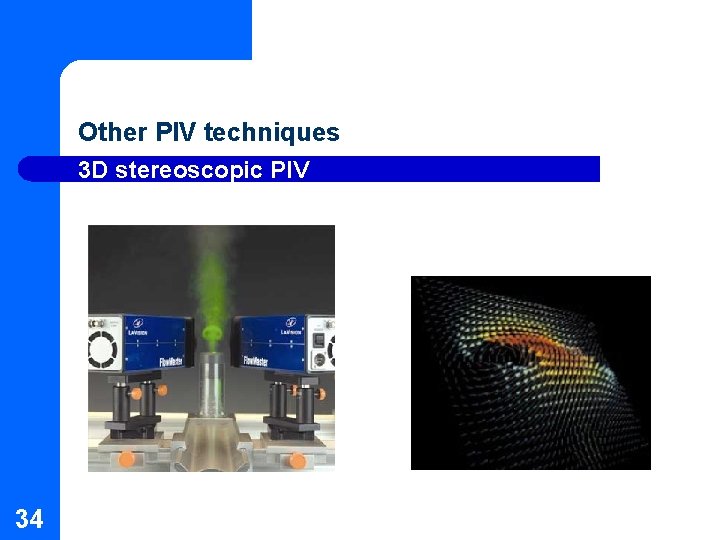
Other PIV techniques 3 D stereoscopic PIV 33
Other PIV techniques 3 D stereoscopic PIV 34
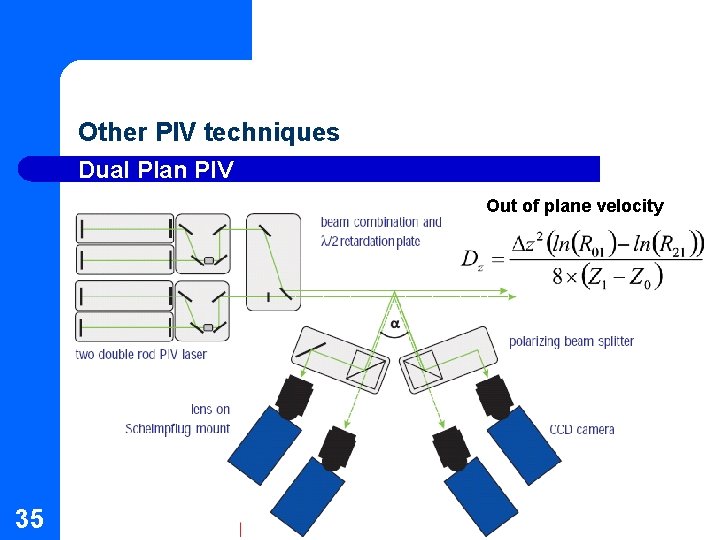
Other PIV techniques Dual Plan PIV Out of plane velocity 35
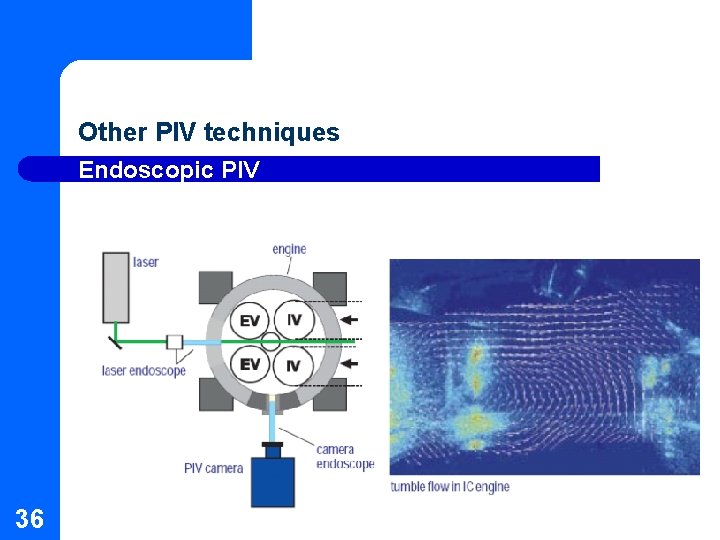
Other PIV techniques Endoscopic PIV 36
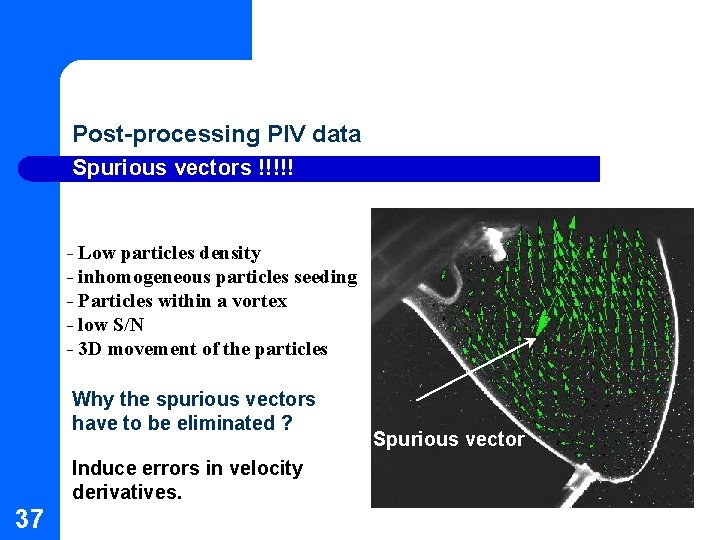
Post-processing PIV data Spurious vectors !!!!! - Low particles density - inhomogeneous particles seeding - Particles within a vortex - low S/N - 3 D movement of the particles Why the spurious vectors have to be eliminated ? Induce errors in velocity derivatives. 37 Spurious vector
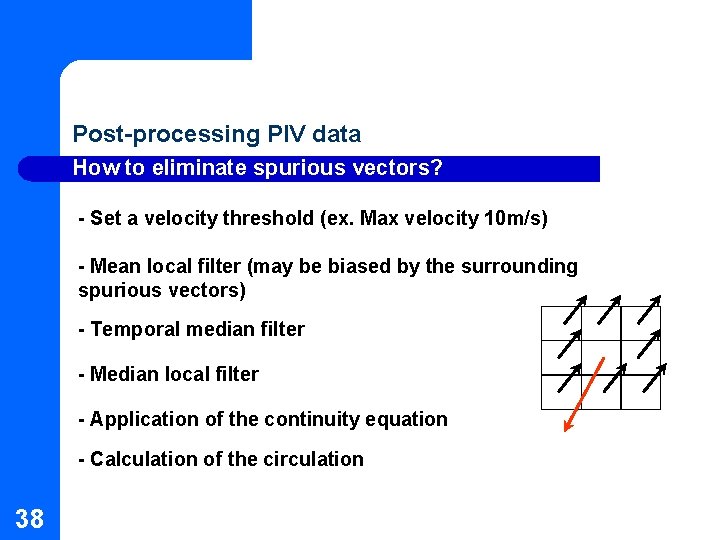
Post-processing PIV data How to eliminate spurious vectors? - Set a velocity threshold (ex. Max velocity 10 m/s) - Mean local filter (may be biased by the surrounding spurious vectors) - Temporal median filter - Median local filter - Application of the continuity equation - Calculation of the circulation 38
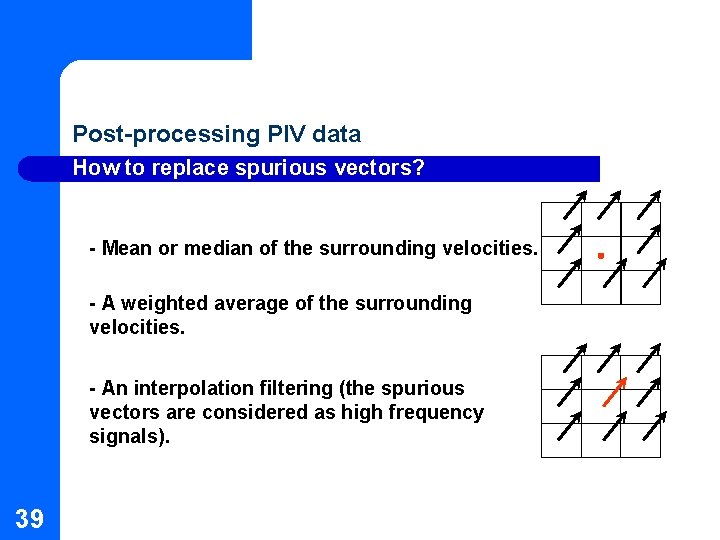
Post-processing PIV data How to replace spurious vectors? Filling the holes of spurious vectors? - Mean or median of the surrounding velocities. - A weighted average of the surrounding velocities. - An interpolation filtering (the spurious vectors are considered as high frequency signals). 39
Post-processing PIV data Estimation of differential quantities Finite difference method: forward, backward, center, Richardson, … Determination of the vorticity from the circulation (the 8 points circulation method) Turbulence micro scales (only with high speed PIV) Pressure field 40
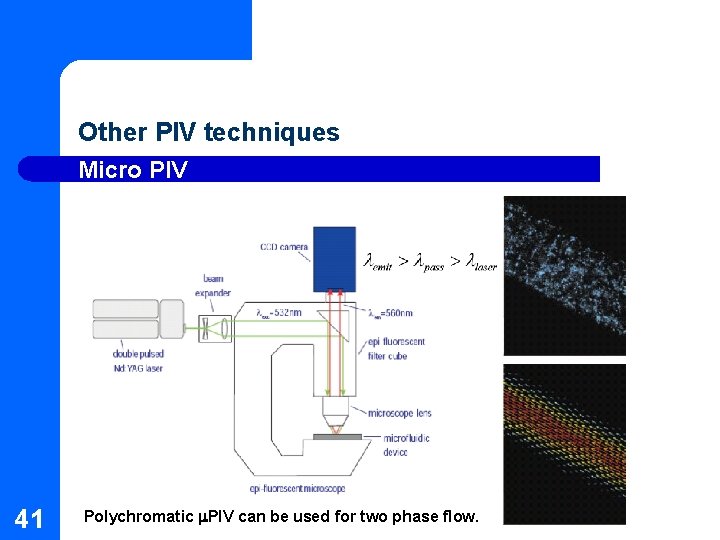
Other PIV techniques Micro PIV 41 Polychromatic PIV can be used for two phase flow.
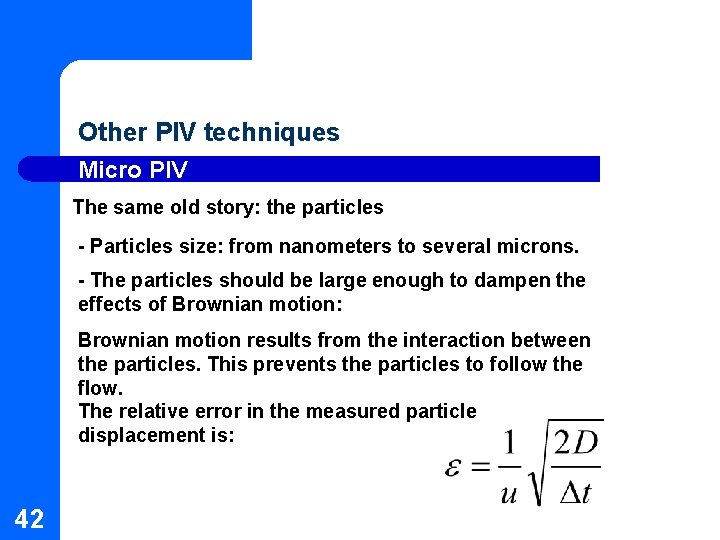
Other PIV techniques Micro PIV The same old story: the particles - Particles size: from nanometers to several microns. - The particles should be large enough to dampen the effects of Brownian motion: Brownian motion results from the interaction between the particles. This prevents the particles to follow the flow. The relative error in the measured particle displacement is: 42