
Particle Identification in the LHCb Experiment Paul Soler
Particle Identification in the LHCb Experiment Paul Soler University of Glasgow and Rutherford Appleton Laboratory (on behalf of LHCb RICH group) III LHC Symposium on Physics and Detectors Chia, Sardinia, Italy. 29 October 2001.
Participating Institutes CERN Sezione di Milano Sezione di Genova University of Bristol University of Edinburgh University of Glasgow Imperial College University of Oxford Rutherford Appleton Laboratory III LHC Symposium, Chia, Sardinia, 29 October 2001 2
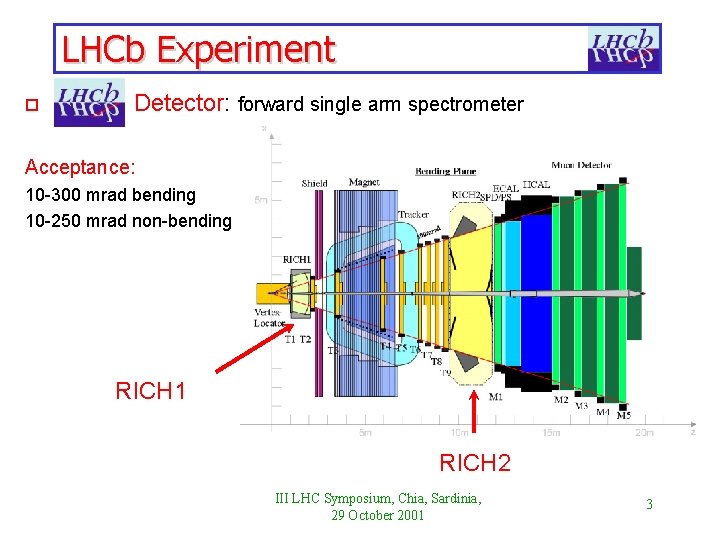
LHCb Experiment o LHCb Detector: forward single arm spectrometer Acceptance: 10 -300 mrad bending 10 -250 mrad non-bending RICH 1 RICH 2 III LHC Symposium, Chia, Sardinia, 29 October 2001 3
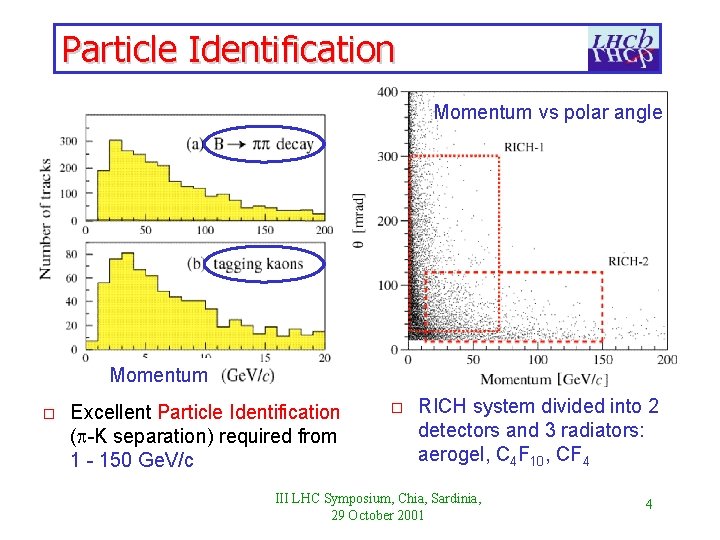
Particle Identification Momentum vs polar angle Momentum o Excellent Particle Identification ( -K separation) required from 1 - 150 Ge. V/c o RICH system divided into 2 detectors and 3 radiators: aerogel, C 4 F 10, CF 4 III LHC Symposium, Chia, Sardinia, 29 October 2001 4
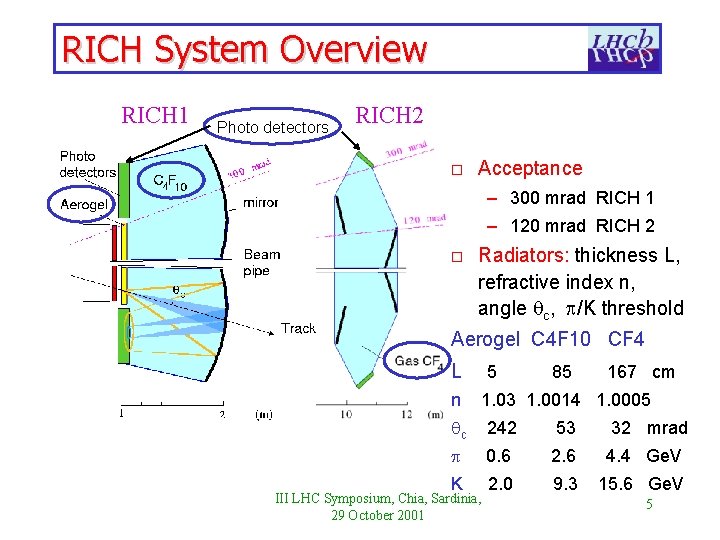
RICH System Overview RICH 1 Photo detectors RICH 2 o Acceptance – 300 mrad RICH 1 – 120 mrad RICH 2 o Radiators: thickness L, refractive index n, angle c, /K threshold Aerogel C 4 F 10 CF 4 L 5 85 167 cm n 1. 03 1. 0014 1. 0005 c 242 53 0. 6 2. 6 4. 4 Ge. V K 2. 0 9. 3 15. 6 Ge. V III LHC Symposium, Chia, Sardinia, 29 October 2001 32 mrad 5
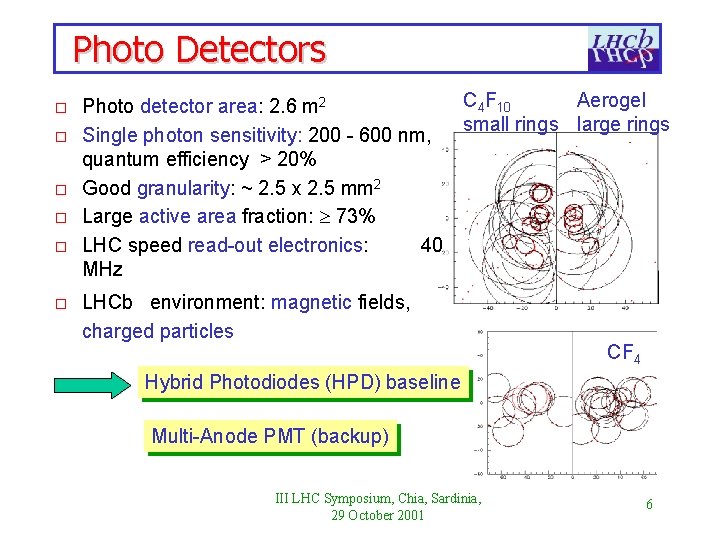
Photo Detectors o o o Photo detector area: 2. 6 m 2 Single photon sensitivity: 200 - 600 nm, quantum efficiency > 20% Good granularity: ~ 2. 5 x 2. 5 mm 2 Large active area fraction: 73% LHC speed read-out electronics: 40 MHz C 4 F 10 Aerogel small rings large rings LHCb environment: magnetic fields, charged particles CF 4 Hybrid Photodiodes (HPD) baseline Multi-Anode PMT (backup) III LHC Symposium, Chia, Sardinia, 29 October 2001 6
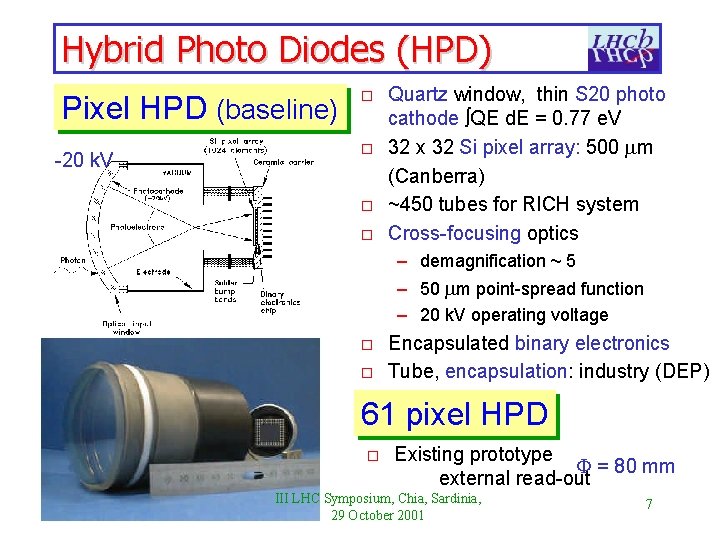
Hybrid Photo Diodes (HPD) Pixel HPD (baseline) -20 k. V o o Quartz window, thin S 20 photo cathode QE d. E = 0. 77 e. V 32 x 32 Si pixel array: 500 m (Canberra) ~450 tubes for RICH system Cross-focusing optics – demagnification ~ 5 – 50 m point-spread function – 20 k. V operating voltage o o Encapsulated binary electronics Tube, encapsulation: industry (DEP) 61 pixel HPD o Existing prototype = 80 mm external read-out III LHC Symposium, Chia, Sardinia, 29 October 2001 7
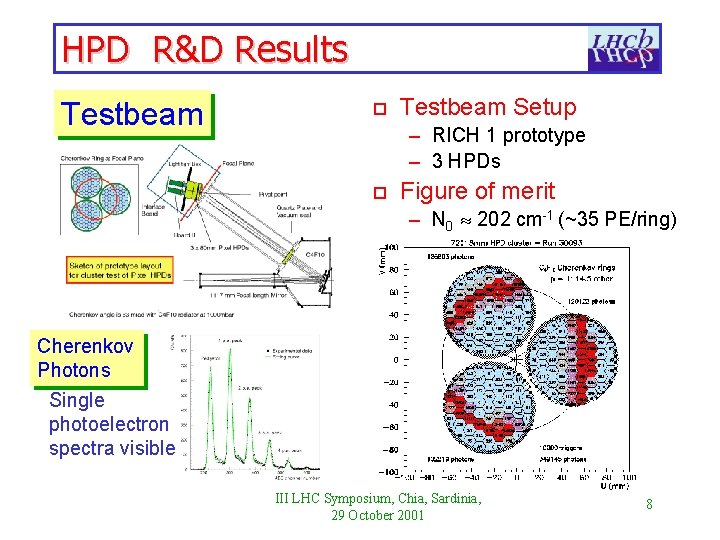
HPD R&D Results Testbeam o Testbeam Setup – RICH 1 prototype – 3 HPDs o Figure of merit – N 0 202 cm-1 (~35 PE/ring) Cherenkov Photons Single photoelectron spectra visible III LHC Symposium, Chia, Sardinia, 29 October 2001 8
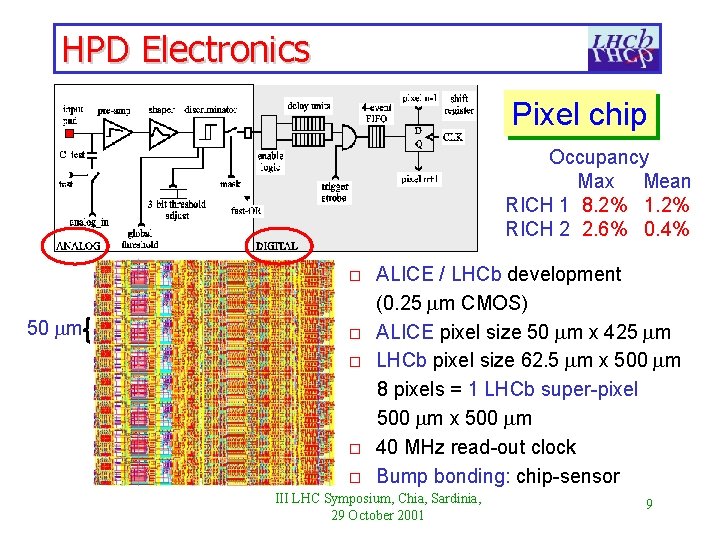
HPD Electronics Pixel chip Occupancy Max Mean RICH 1 8. 2% 1. 2% RICH 2 2. 6% 0. 4% o 50 m o o o ALICE / LHCb development (0. 25 m CMOS) ALICE pixel size 50 m x 425 m LHCb pixel size 62. 5 m x 500 m 8 pixels = 1 LHCb super-pixel 500 m x 500 m 40 MHz read-out clock Bump bonding: chip-sensor o III LHC Symposium, Chia, Sardinia, 29 October 2001 9
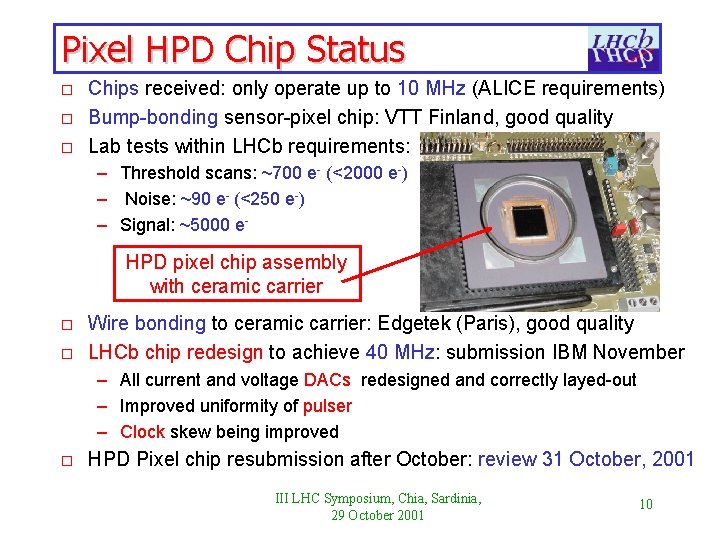
Pixel HPD Chip Status o o o Chips received: only operate up to 10 MHz (ALICE requirements) Bump-bonding sensor-pixel chip: VTT Finland, good quality Lab tests within LHCb requirements: – Threshold scans: ~700 e- (<2000 e-) – Noise: ~90 e- (<250 e-) – Signal: ~5000 e- HPD pixel chip assembly with ceramic carrier o o Wire bonding to ceramic carrier: Edgetek (Paris), good quality LHCb chip redesign to achieve 40 MHz: submission IBM November – All current and voltage DACs redesigned and correctly layed-out – Improved uniformity of pulser – Clock skew being improved o HPD Pixel chip resubmission after October: review 31 October, 2001 III LHC Symposium, Chia, Sardinia, 29 October 2001 10
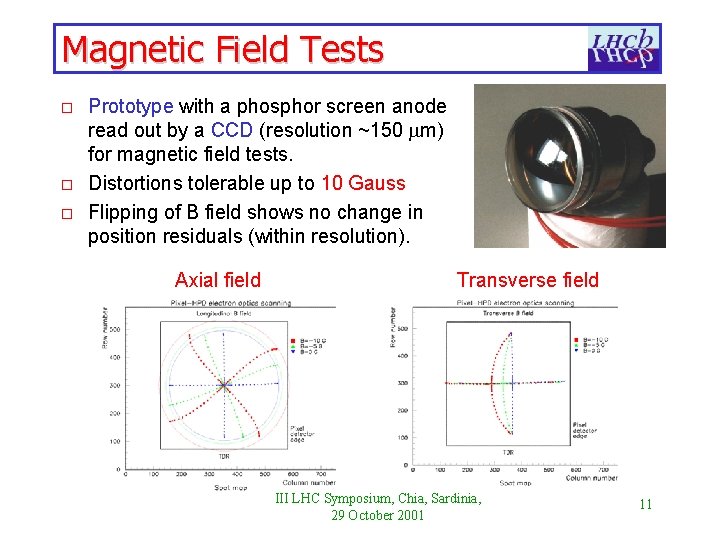
Magnetic Field Tests o o o Prototype with a phosphor screen anode read out by a CCD (resolution ~150 m) for magnetic field tests. Distortions tolerable up to 10 Gauss Flipping of B field shows no change in position residuals (within resolution). Axial field Transverse field III LHC Symposium, Chia, Sardinia, 29 October 2001 11
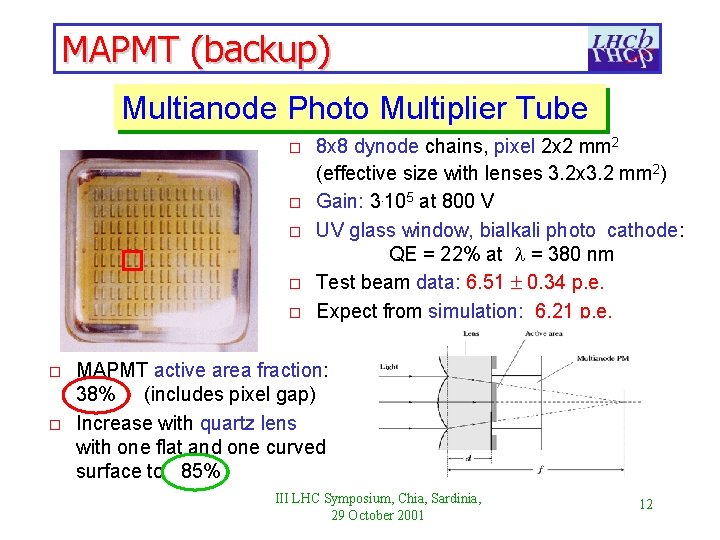
MAPMT (backup) Multianode Photo Multiplier Tube o o o o 8 x 8 dynode chains, pixel 2 x 2 mm 2 (effective size with lenses 3. 2 x 3. 2 mm 2) Gain: 3. 105 at 800 V UV glass window, bialkali photo cathode: QE = 22% at = 380 nm Test beam data: 6. 51 0. 34 p. e. Expect from simulation: 6. 21 p. e. MAPMT active area fraction: 38% (includes pixel gap) Increase with quartz lens with one flat and one curved surface to 85% III LHC Symposium, Chia, Sardinia, 29 October 2001 12
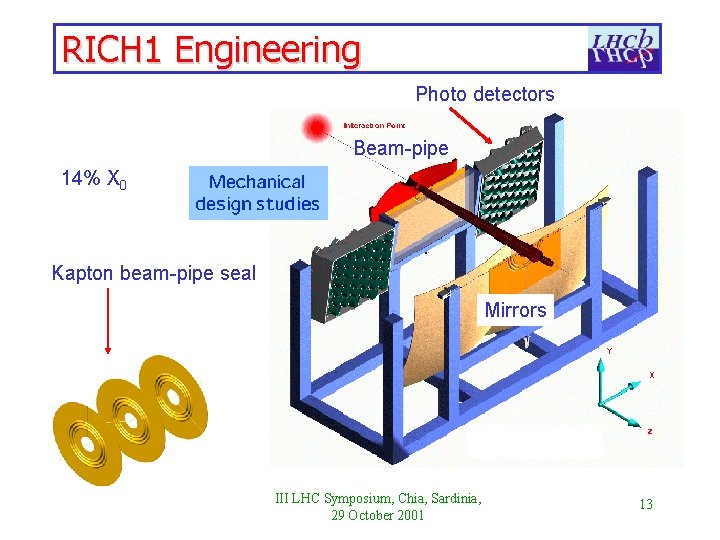
RICH 1 Engineering Photo detectors Beam-pipe 14% X 0 Kapton beam-pipe seal Mirrors III LHC Symposium, Chia, Sardinia, 29 October 2001 13
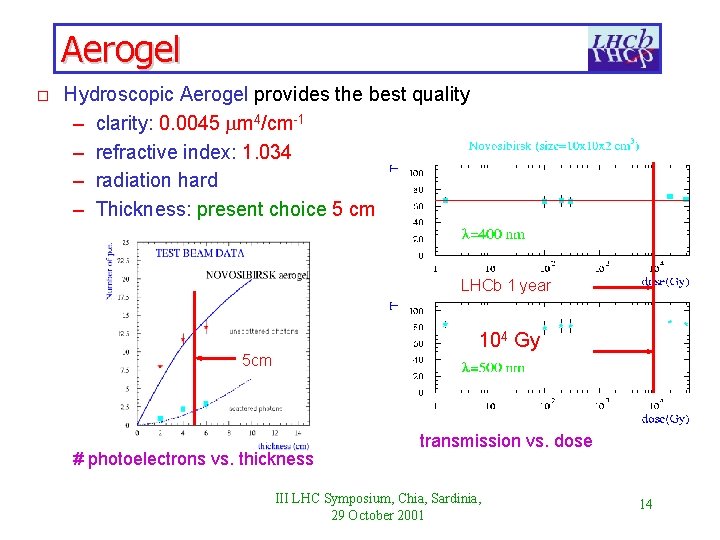
Aerogel o Hydroscopic Aerogel provides the best quality – clarity: 0. 0045 m 4/cm-1 – refractive index: 1. 034 – radiation hard – Thickness: present choice 5 cm LHCb 1 year 104 Gy 5 cm # photoelectrons vs. thickness transmission vs. dose III LHC Symposium, Chia, Sardinia, 29 October 2001 14
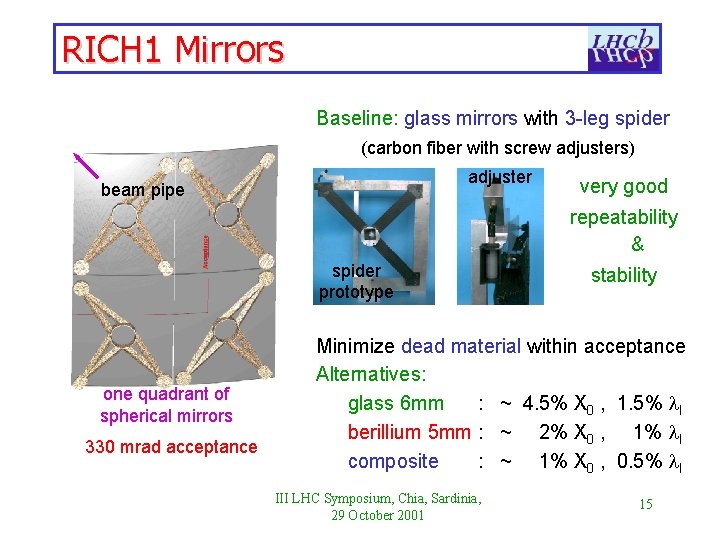
RICH 1 Mirrors o Baseline: glass mirrors with 3 -leg spider (carbon fiber with screw adjusters) adjuster beam pipe repeatability & beam pipe spider prototype o one quadrant of spherical mirrors 330 mrad acceptance very good stability Minimize dead material within acceptance Alternatives: glass 6 mm : ~ 4. 5% X 0 , 1. 5% l berillium 5 mm : ~ 2% X 0 , 1% l composite : ~ 1% X 0 , 0. 5% I III LHC Symposium, Chia, Sardinia, 29 October 2001 15
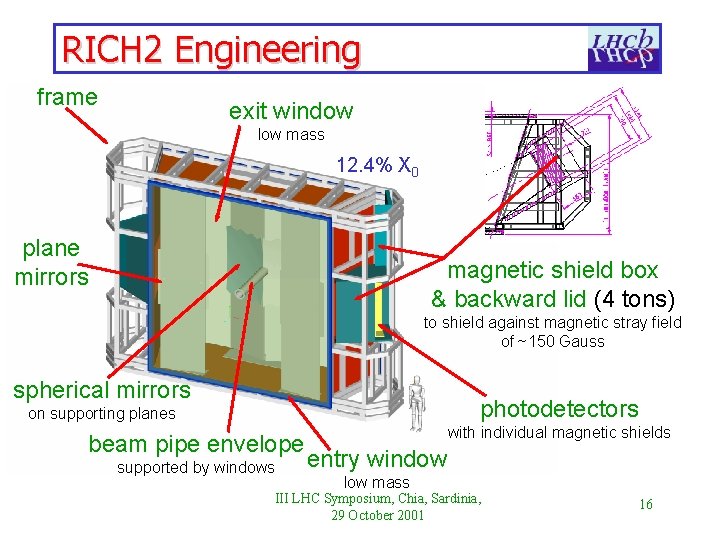
RICH 2 Engineering frame exit window low mass 12. 4% X 0 plane mirrors magnetic shield box & backward lid (4 tons) to shield against magnetic stray field of ~150 Gauss spherical mirrors photodetectors on supporting planes beam pipe envelope supported by windows with individual magnetic shields entry window low mass III LHC Symposium, Chia, Sardinia, 29 October 2001 16
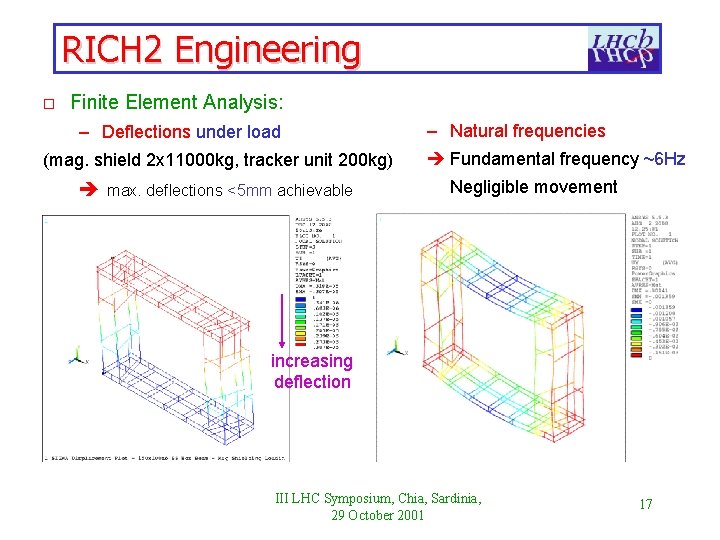
RICH 2 Engineering o Finite Element Analysis: – Deflections under load (mag. shield 2 x 11000 kg, tracker unit 200 kg) è max. deflections <5 mm achievable – Natural frequencies è Fundamental frequency ~6 Hz Negligible movement increasing deflection III LHC Symposium, Chia, Sardinia, 29 October 2001 17
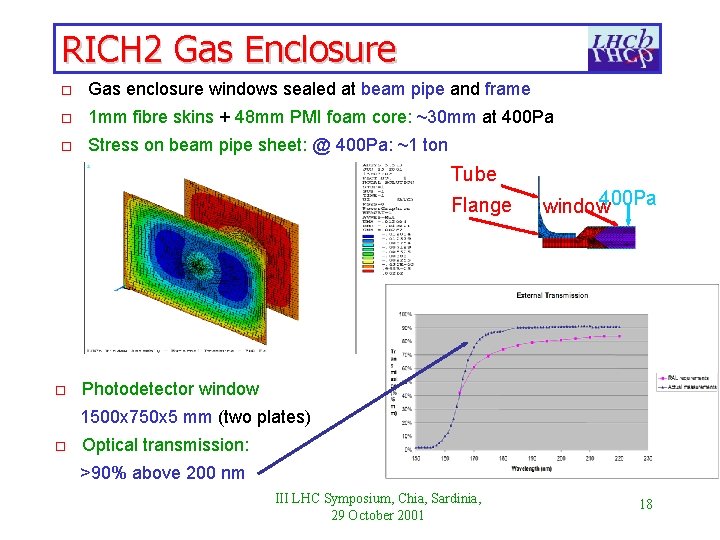
RICH 2 Gas Enclosure o Gas enclosure windows sealed at beam pipe and frame o 1 mm fibre skins + 48 mm PMI foam core: ~30 mm at 400 Pa o Stress on beam pipe sheet: @ 400 Pa: ~1 ton Tube Flange o 400 Pa window Photodetector window 1500 x 750 x 5 mm (two plates) o Optical transmission: >90% above 200 nm III LHC Symposium, Chia, Sardinia, 29 October 2001 18
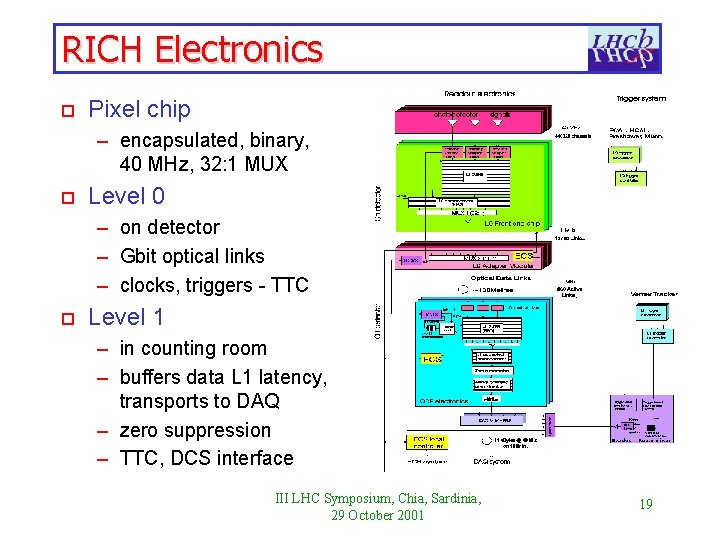
RICH Electronics o Pixel chip – encapsulated, binary, 40 MHz, 32: 1 MUX o Level 0 – on detector – Gbit optical links – clocks, triggers - TTC o Level 1 – in counting room – buffers data L 1 latency, transports to DAQ – zero suppression – TTC, DCS interface III LHC Symposium, Chia, Sardinia, 29 October 2001 19
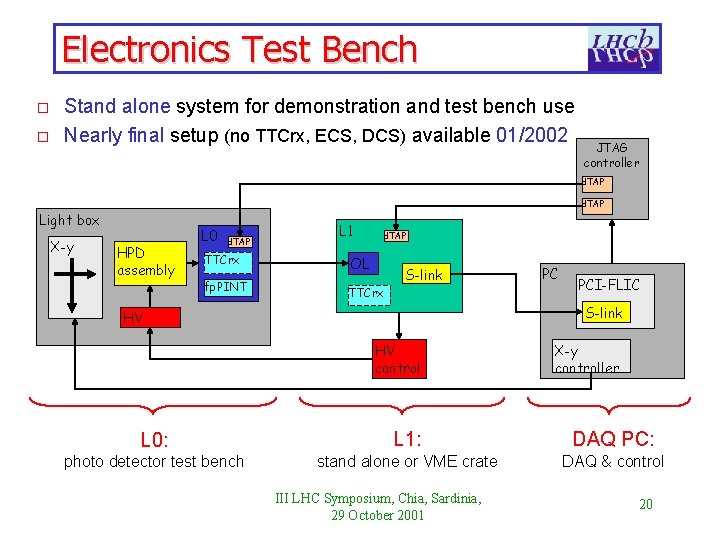
Electronics Test Bench o o Stand alone system for demonstration and test bench use Nearly final setup (no TTCrx, ECS, DCS) available 01/2002 JTAG controller d. TAP Light box X-y HPD assembly L 0 d. TAP L 1 d. TAP TTCrx OL fp. PINT TTCrx S-link PC PCI-FLIC S-link HV HV control X-y controller L 0: L 1: DAQ PC: photo detector test bench stand alone or VME crate DAQ & control III LHC Symposium, Chia, Sardinia, 29 October 2001 20
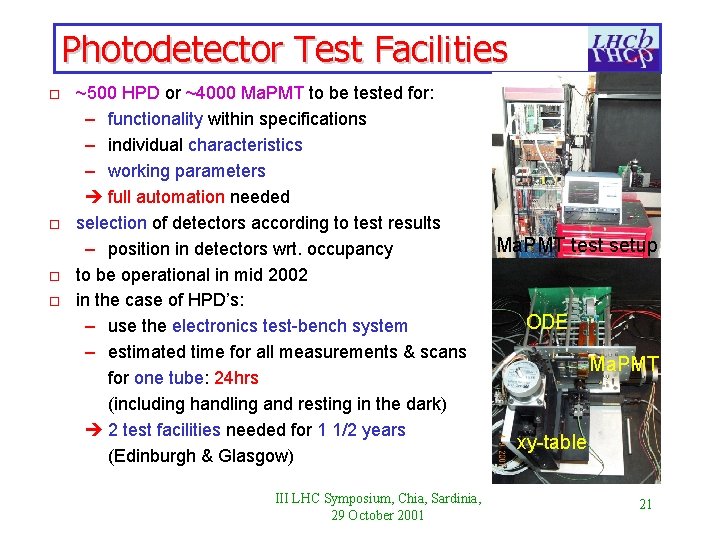
Photodetector Test Facilities o o ~500 HPD or ~4000 Ma. PMT to be tested for: – functionality within specifications – individual characteristics – working parameters è full automation needed selection of detectors according to test results – position in detectors wrt. occupancy to be operational in mid 2002 in the case of HPD’s: – use the electronics test-bench system – estimated time for all measurements & scans for one tube: 24 hrs (including handling and resting in the dark) è 2 test facilities needed for 1 1/2 years (Edinburgh & Glasgow) III LHC Symposium, Chia, Sardinia, 29 October 2001 Ma. PMT test setup ODE Ma. PMT xy-table 21
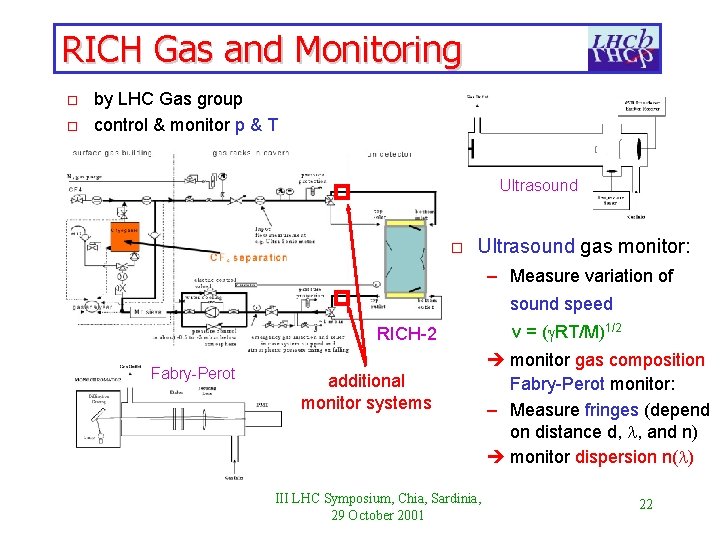
RICH Gas and Monitoring o o by LHC Gas group control & monitor p & T Ultrasound o Ultrasound gas monitor: – Measure variation of sound speed RICH-2 Fabry-Perot additional monitor systems III LHC Symposium, Chia, Sardinia, 29 October 2001 v = ( RT/M)1/2 è monitor gas composition Fabry-Perot monitor: – Measure fringes (depend on distance d, , and n) è monitor dispersion n( ) 22
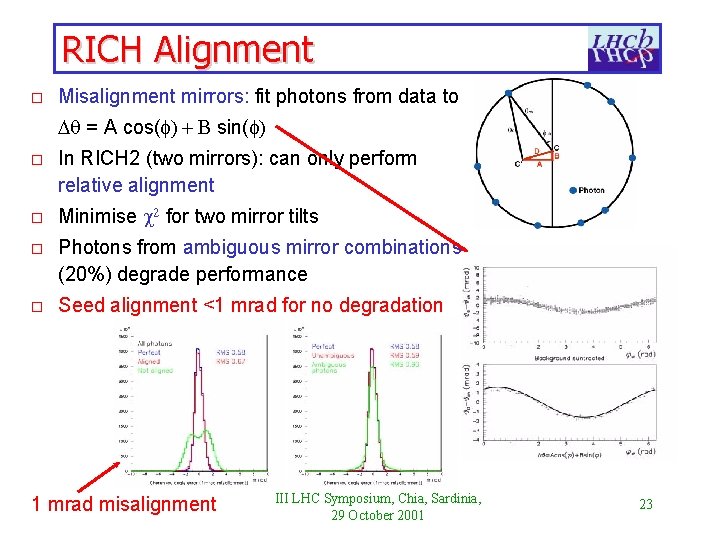
RICH Alignment o Misalignment mirrors: fit photons from data to D = A cos(f) + B sin(f) o In RICH 2 (two mirrors): can only perform relative alignment o Minimise c 2 for two mirror tilts o Photons from ambiguous mirror combinations (20%) degrade performance o Seed alignment <1 mrad for no degradation 1 mrad misalignment III LHC Symposium, Chia, Sardinia, 29 October 2001 23
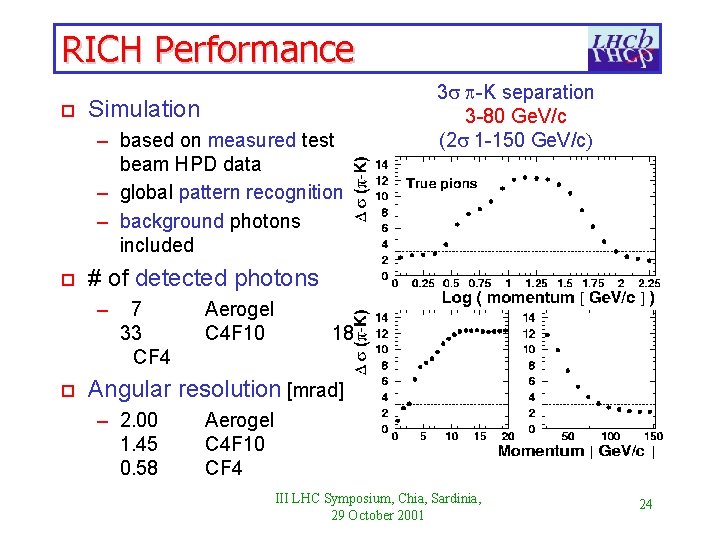
RICH Performance o Simulation – based on measured test beam HPD data – global pattern recognition – background photons included o # of detected photons – o 3 s -K separation 3 -80 Ge. V/c (2 s 1 -150 Ge. V/c) 7 33 CF 4 Aerogel C 4 F 10 18 Angular resolution [mrad] – 2. 00 1. 45 0. 58 Aerogel C 4 F 10 CF 4 III LHC Symposium, Chia, Sardinia, 29 October 2001 24
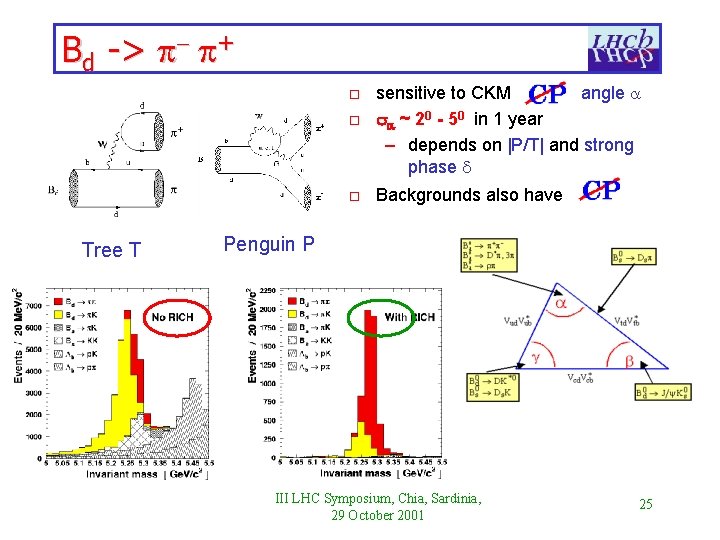
Bd -> + o o o Tree T sensitive to CKM angle ~ 20 - 50 in 1 year – depends on |P/T| and strong phase Backgrounds also have Penguin P III LHC Symposium, Chia, Sardinia, 29 October 2001 25
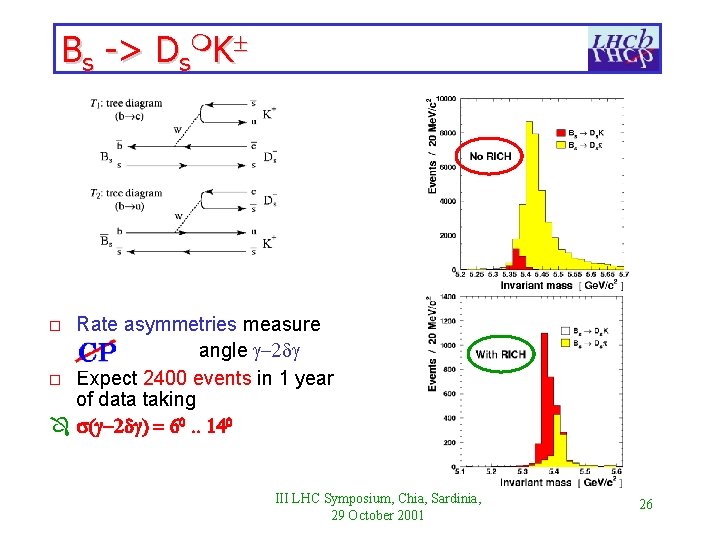
Bs -> Ds K Rate asymmetries measure angle 2 o Expect 2400 events in 1 year of data taking Ô (g-2 dg) = 60. . 140 o III LHC Symposium, Chia, Sardinia, 29 October 2001 26
Conclusions o o Physics performance studies show that the RICH is essential for the LHCb physics programme. The RICH design of LHCb with two detectors and three radiators provides 3 s -K separation from 3 -80 Ge. V/c LHCb RICH is progressing since TDR – Pixel HPD chip has incurred a delay but is not in critical path (project under review). – Design for subsystems are detailed and advanced – Transition from R&D to construction In time to take data when LHC becomes operational in 2006 III LHC Symposium, Chia, Sardinia, 29 October 2001 27
- Slides: 27