
Particle ID for Higgs Physics Anna Kaczmarska Institute




- Slides: 32
Particle ID for Higgs Physics Anna Kaczmarska Institute of Nuclear Physics, PAN, Cracow (On behalf of the ATLAS collaboration) 1. 2. 3. 4. 5. 6. 7. 8. Motivations ATLAS detector Electron ID Photon ID Muon ID Tau ID b-tagging Conclusions H 4 e Anna Kaczmarska Physics at LHC, Krakow, 3 July 2006
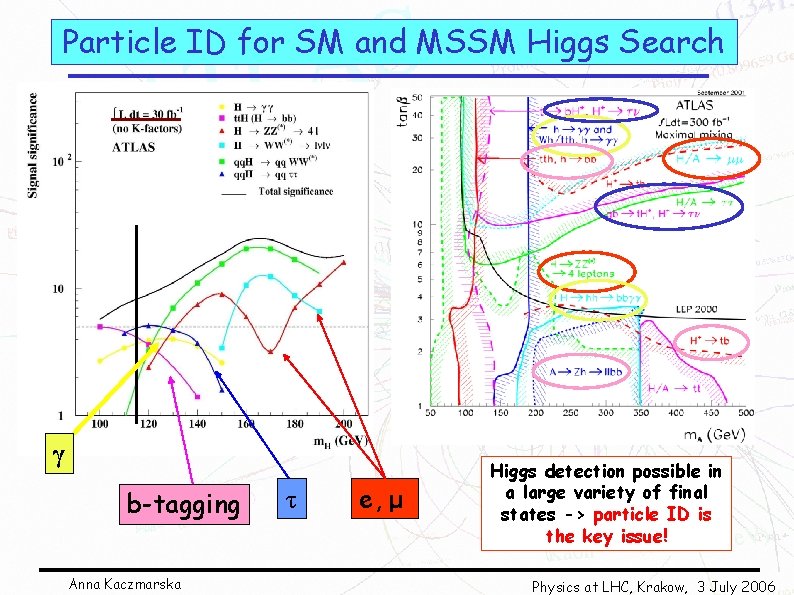
Particle ID for SM and MSSM Higgs Search γ b-tagging Anna Kaczmarska τ e, μ Higgs detection possible in a large variety of final states -> particle ID is the key issue! Physics at LHC, Krakow, 3 July 2006
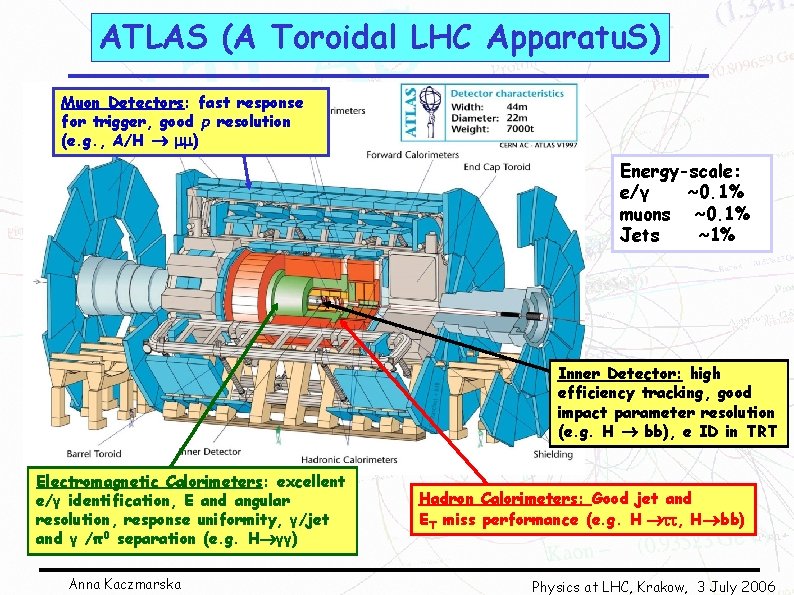
ATLAS (A Toroidal LHC Apparatu. S) Muon Detectors: fast response for trigger, good p resolution (e. g. , A/H ) Energy-scale: e/γ ~0. 1% muons ~0. 1% Jets ~1% Inner Detector: high efficiency tracking, good impact parameter resolution (e. g. H bb), e ID in TRT Electromagnetic Calorimeters: excellent e/γ identification, E and angular resolution, response uniformity, γ/jet and γ /π0 separation (e. g. H γγ) Anna Kaczmarska Hadron Calorimeters: Good jet and ET miss performance (e. g. H , H bb) Physics at LHC, Krakow, 3 July 2006
Electron ID SM Higgs H->ZZ(*)->4 l, H->WW(*)->4 l, lνlν MSSM Higgs H->ZZ(*)->4 l lepton trigger for WH, ZW, tt. H b-tagging with soft electrons for H->bb (m. H<130 Ge. V) Anna Kaczmarska Physics at LHC, Krakow, 3 July 2006
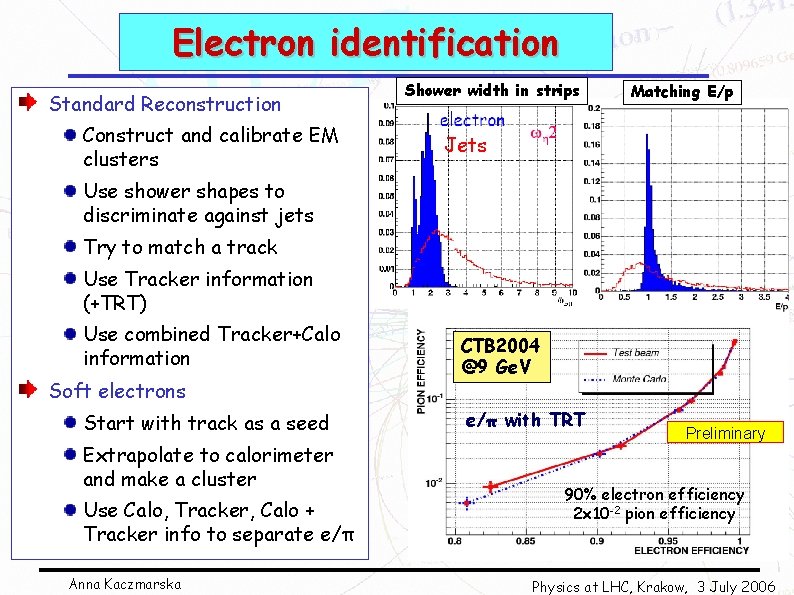
Electron identification Standard Reconstruction Construct and calibrate EM clusters Shower width in strips Matching E/p Jets Use shower shapes to discriminate against jets Try to match a track Use Tracker information (+TRT) Use combined Tracker+Calo information Soft electrons Start with track as a seed Extrapolate to calorimeter and make a cluster Use Calo, Tracker, Calo + Tracker info to separate e/π Anna Kaczmarska CTB 2004 @9 Ge. V e/π with TRT Preliminary 90% electron efficiency 2 x 10 -2 pion efficiency Physics at LHC, Krakow, 3 July 2006
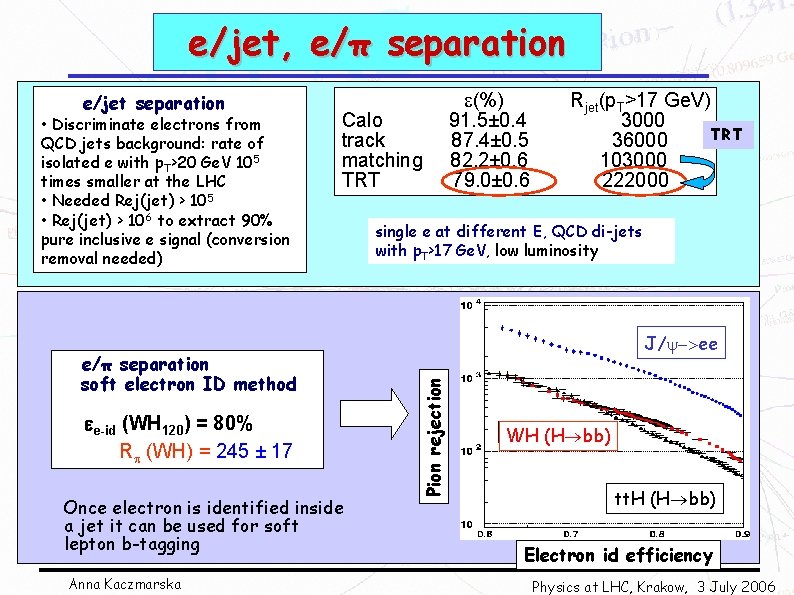
e/jet, e/π separation • Discriminate electrons from QCD jets background: rate of isolated e with p. T>20 Ge. V 105 times smaller at the LHC • Needed Rej(jet) > 105 • Rej(jet) > 106 to extract 90% pure inclusive e signal (conversion removal needed) Calo track matching TRT e/π separation soft electron ID method e-id (WH 120) = 80% R (WH) = 245 ± 17 Once electron is identified inside a jet it can be used for soft lepton b-tagging Anna Kaczmarska (%) 91. 5± 0. 4 87. 4± 0. 5 82. 2± 0. 6 79. 0± 0. 6 Rjet(p. T>17 Ge. V) 3000 TRT 36000 103000 222000 single e at different E, QCD di-jets with p. T>17 Ge. V, low luminosity J/ ->ee Pion rejection e/jet separation WH (H bb) tt. H (H bb) Electron id efficiency Physics at LHC, Krakow, 3 July 2006
Photon ID SM Higgs H->γγ: signal, background rejection (jet-jet, γ -jet, Z->ee), H->Zγ MSSM Higgs h/H/A-> γγ Anna Kaczmarska Physics at LHC, Krakow, 3 July 2006
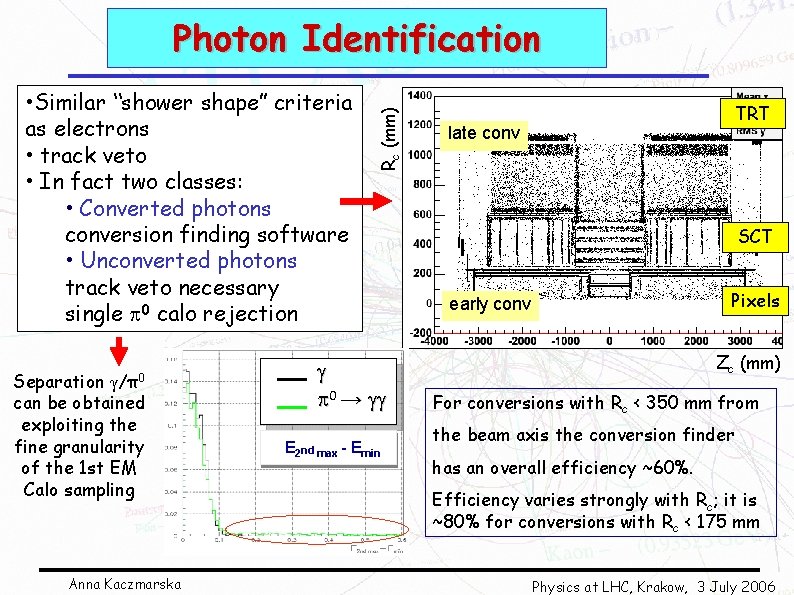
• Similar “shower shape” criteria as electrons • track veto • In fact two classes: • Converted photons conversion finding software • Unconverted photons track veto necessary single 0 calo rejection Separation can be obtained exploiting the fine granularity of the 1 st EM Calo sampling γ/π0 Anna Kaczmarska Rc (mm) Photon Identification 0 → E 2 nd max - Emin TRT late conv SCT Pixels early conv Zc (mm) For conversions with Rc < 350 mm from the beam axis the conversion finder has an overall efficiency ~60%. Efficiency varies strongly with Rc; it is ~80% for conversions with Rc < 175 mm Physics at LHC, Krakow, 3 July 2006
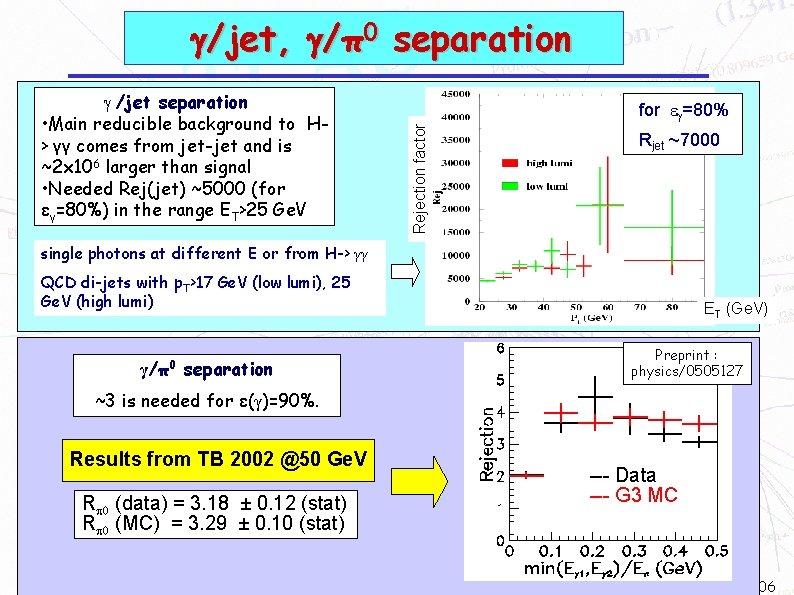
/jet, /π0 separation for =80% Rejection factor /jet separation • Main reducible background to H> γγ comes from jet-jet and is ~2 x 10⁶ larger than signal • Needed Rej(jet) ~5000 (for εγ=80%) in the range ET>25 Ge. V Rjet ~7000 single photons at different E or from H-> γγ QCD di-jets with p. T>17 Ge. V (low lumi), 25 Ge. V (high lumi) γ/π0 separation ET (Ge. V) Preprint : physics/0505127 ~3 is needed for ε(γ)=90%. Results from TB 2002 @50 Ge. V R (data) = 3. 18 ± 0. 12 (stat) R (MC) = 3. 29 ± 0. 10 (stat) Anna Kaczmarska --- Data --- G 3 MC Physics at LHC, Krakow, 3 July 2006
Muon ID SM Higgs H->ZZ(*)->4 l MSSM Higgs A->μμ lepton trigger for WH, ZW, tt. H b-tagging with soft muons for H>bb (m. H<130 Ge. V) Anna Kaczmarska Physics at LHC, Krakow, 3 July 2006
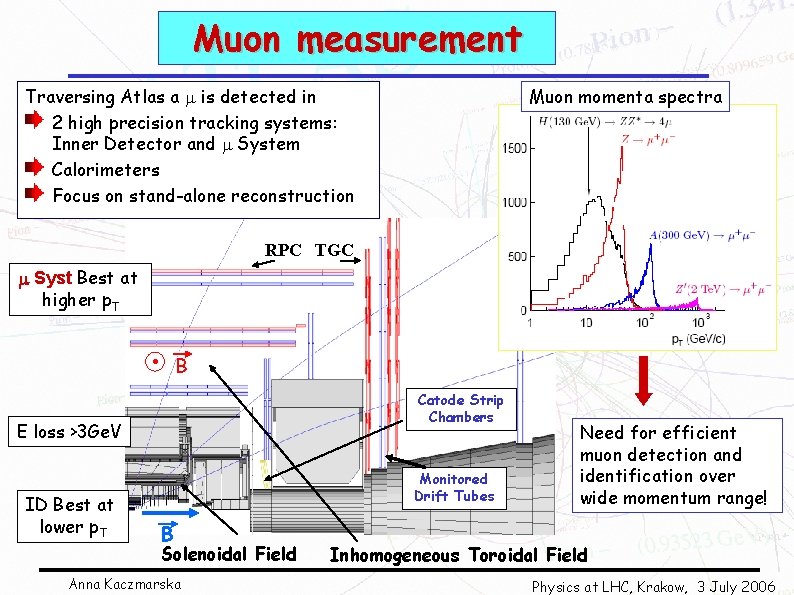
Muon measurement Muon momenta spectra Traversing Atlas a is detected in 2 high precision tracking systems: Inner Detector and System Calorimeters Focus on stand-alone reconstruction RPC TGC Syst Best at higher p. T ● B Catode Strip Chambers E loss >3 Ge. V ID Best at lower p. T Monitored Drift Tubes B Solenoidal Field Anna Kaczmarska Need for efficient muon detection and identification over wide momentum range! Inhomogeneous Toroidal Field Physics at LHC, Krakow, 3 July 2006
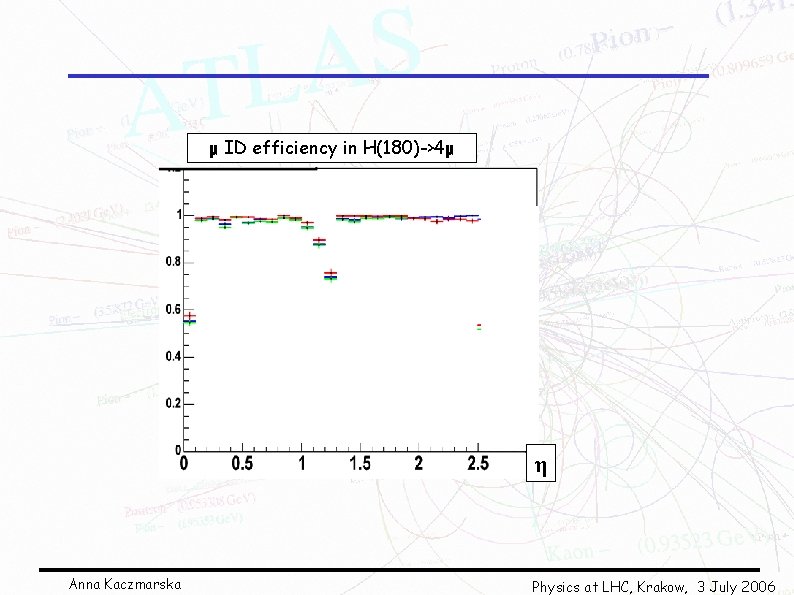
Muon identification μ ID efficiency in H(180)->4μ μ ID efficiency – inside b-jets Muonboy Staco+Mutag p. T (Ge. V) Efficiency: ~95. 5% Efficiency: ~90% Fake track < 1% ->Compatible with single muon perf -> can be used in b-tagging with soft leptons ->~83 % for 4 muons Anna Kaczmarska Physics at LHC, Krakow, 3 July 2006
Tau ID SM Higgs (VBF, tt. H): qq. H->qqττ tt. H->ttττ MSSM Higgs (id + QCD jet background rejection) : A/H -> ττ, H+-> τν W->τν, Z->ττ: background rejection, control channel Anna Kaczmarska Physics at LHC, Krakow, 3 July 2006
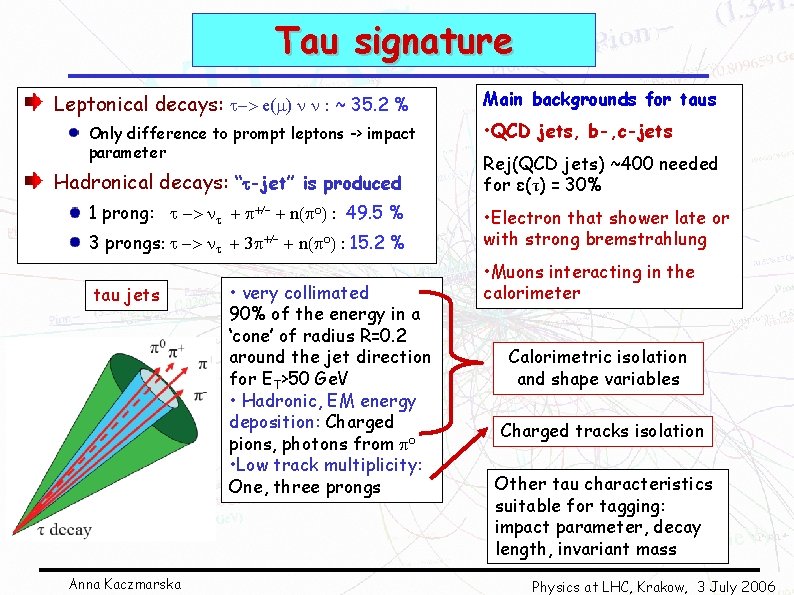
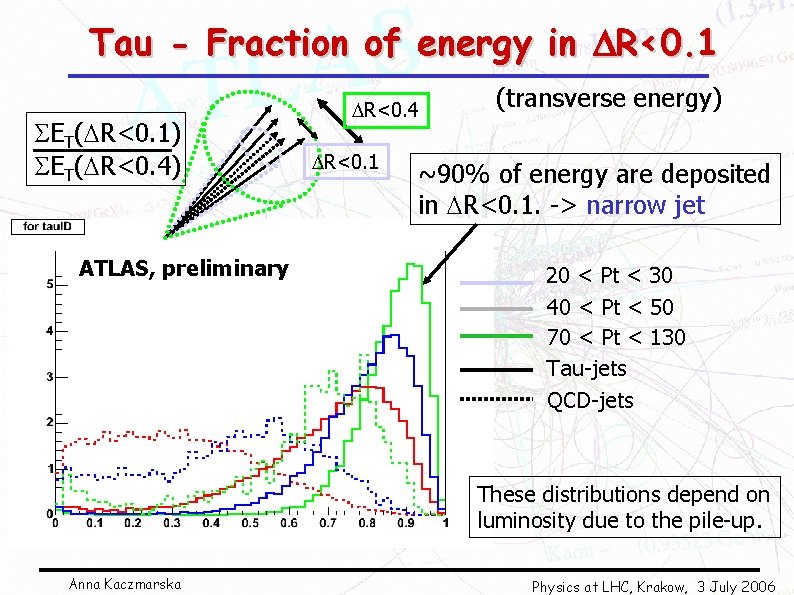
Tau signature Leptonical decays: t-> e( ) n n : ~ 35. 2 % Only difference to prompt leptons -> impact parameter Hadronical decays: “ -jet” is produced 1 prong: t -> nt + +/- + n( o) : 49. 5 % 3 prongs: t -> nt + 3 +/- + n( o) : 15. 2 % tau jets Anna Kaczmarska • very collimated 90% of the energy in a ‘cone’ of radius R=0. 2 around the jet direction for ET>50 Ge. V • Hadronic, EM energy deposition: Charged pions, photons from o • Low track multiplicity: One, three prongs Main backgrounds for taus • QCD jets, b-, c-jets Rej(QCD jets) ~400 needed for ε(τ) = 30% • Electron that shower late or with strong bremstrahlung • Muons interacting in the calorimeter Calorimetric isolation and shape variables Charged tracks isolation Other tau characteristics suitable for tagging: impact parameter, decay length, invariant mass Physics at LHC, Krakow, 3 July 2006
Tau identification – standard • • associate tracks to candidate build set of discriminating variables calibrate energy of candidate (using calorimeters) Likelihood/variable cut for tau-id (both depend on ET) Rejection QCD-jets Standard reconstruction • starts from different objects: clusters, jets, tracks various ET bins efficiency tau-id For ε(τ)=30%, 15< p. T< 334. 5 Rej(QCD jets) = 400 - 10 000 Anna Kaczmarska Physics at LHC, Krakow, 3 July 2006
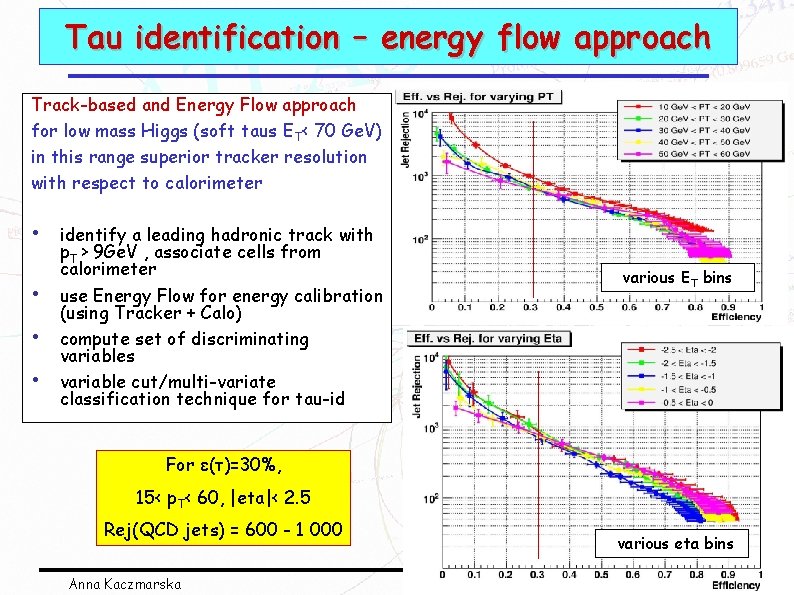
Tau identification – energy flow approach Track-based and Energy Flow approach for low mass Higgs (soft taus ET< 70 Ge. V) in this range superior tracker resolution with respect to calorimeter • • identify a leading hadronic track with p. T > 9 Ge. V , associate cells from calorimeter use Energy Flow for energy calibration (using Tracker + Calo) compute set of discriminating variables variable cut/multi-variate classification technique for tau-id various ET bins For ε(τ)=30%, 15< p. T< 60, |eta|< 2. 5 Rej(QCD jets) = 600 - 1 000 Anna Kaczmarska various eta bins Physics at LHC, Krakow, 3 July 2006
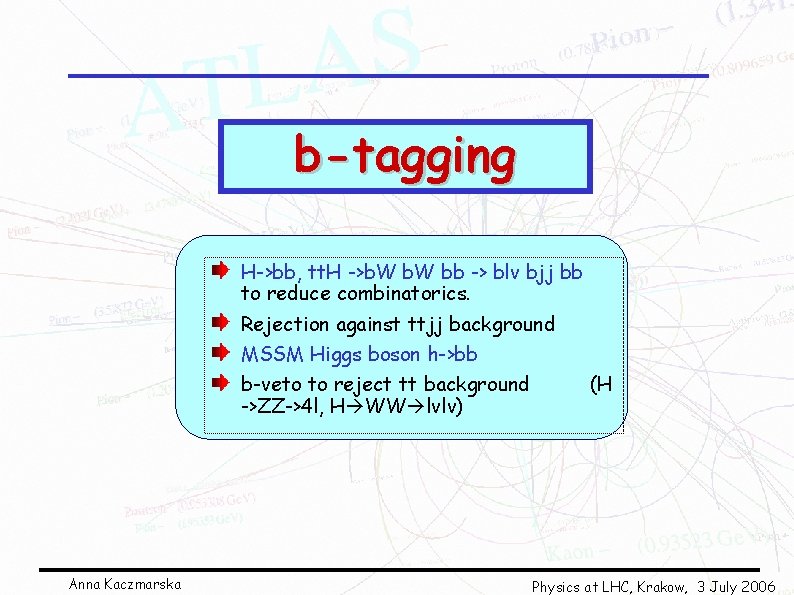
b-tagging H->bb, tt. H ->b. W bb -> blv bjj bb to reduce combinatorics. Rejection against ttjj background MSSM Higgs boson h->bb b-veto to reject tt background ->ZZ->4 l, H WW lνlν) Anna Kaczmarska (H Physics at LHC, Krakow, 3 July 2006
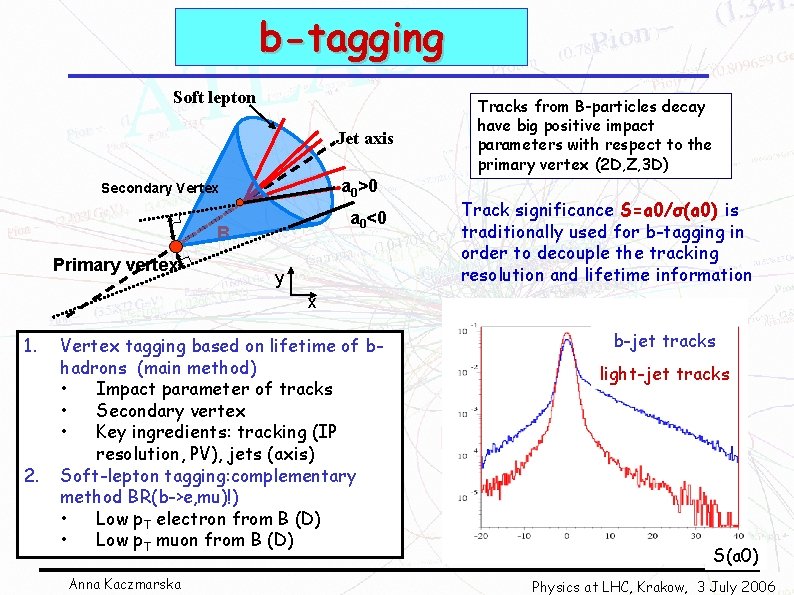
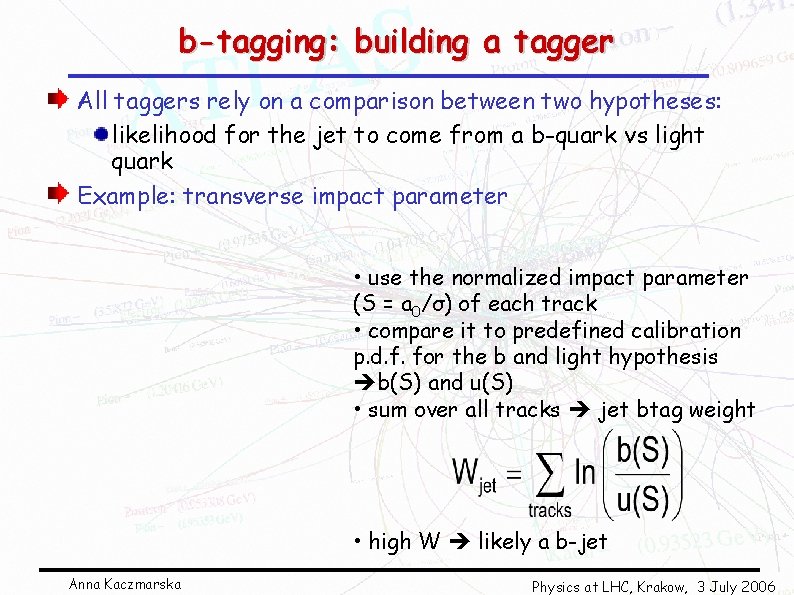
b-tagging Soft lepton Jet axis a 0>0 Secondary Vertex a 0<0 B Primary vertex y Tracks from B-particles decay have big positive impact parameters with respect to the primary vertex (2 D, Z, 3 D) Track significance S=a 0/σ(a 0) is traditionally used for b-tagging in order to decouple the tracking resolution and lifetime information x 1. 2. Vertex tagging based on lifetime of bhadrons (main method) • Impact parameter of tracks • Secondary vertex • Key ingredients: tracking (IP resolution, PV), jets (axis) Soft-lepton tagging: complementary method BR(b->e, mu)!) • Low p. T electron from B (D) • Low p. T muon from B (D) Anna Kaczmarska b-jet tracks light-jet tracks S(a 0) Physics at LHC, Krakow, 3 July 2006
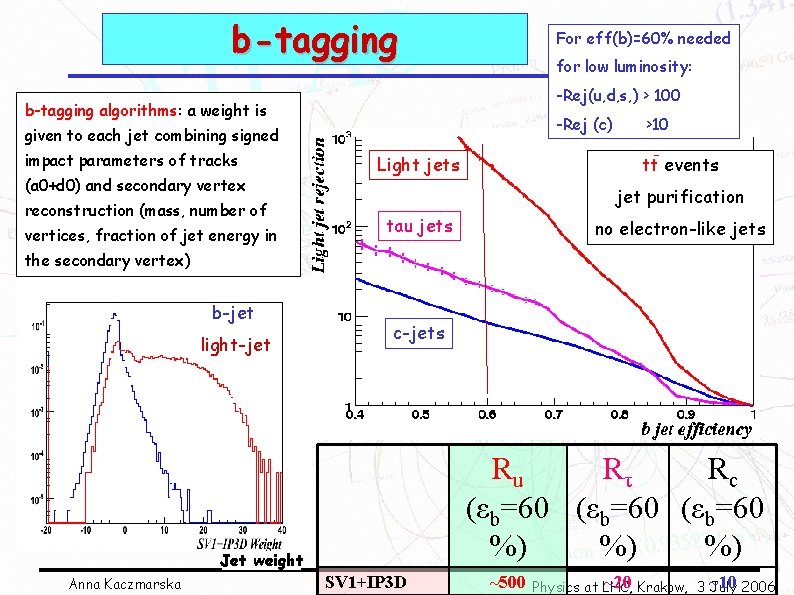
b-tagging For eff(b)=60% needed for low luminosity: -Rej(u, d, s, ) > 100 b-tagging algorithms: a weight is -Rej (c) given to each jet combining signed impact parameters of tracks (a 0+d 0) and secondary vertex reconstruction (mass, number of vertices, fraction of jet energy in >10 tt events Light jets jet purification tau jets no electron-like jets the secondary vertex) b-jet light-jet c-jets Ru Rτ Rc (εb=60 %) %) %) Jet weight Anna Kaczmarska SV 1+IP 3 D ~500 ~20 Krakow, 3 ~10 Physics at LHC, July 2006
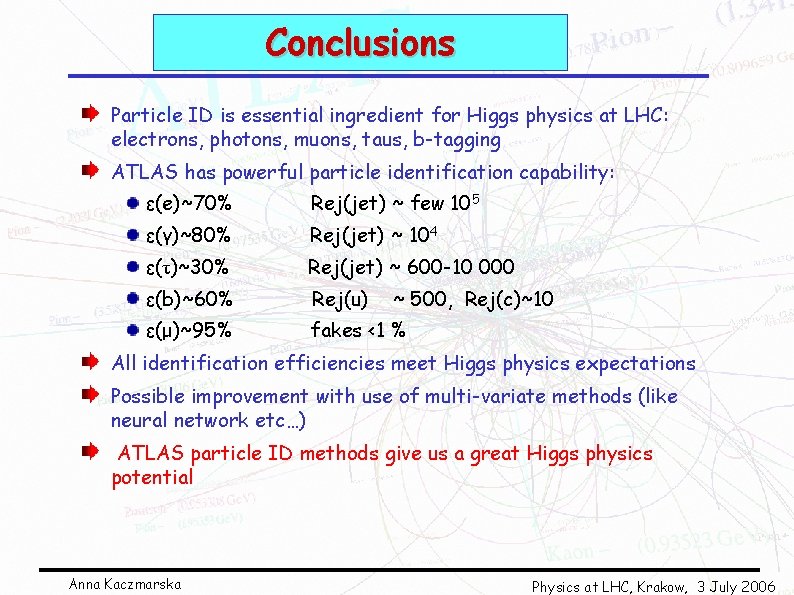
Conclusions Particle ID is essential ingredient for Higgs physics at LHC: electrons, photons, muons, taus, b-tagging ATLAS has powerful particle identification capability: ε(e)~70% Rej(jet) ~ few 105 ε(γ)~80% Rej(jet) ~ 104 ε(τ)~30% Rej(jet) ~ 600 -10 000 ε(b)~60% Rej(u) ε(μ)~95% fakes <1 % ~ 500, Rej(c)~10 All identification efficiencies meet Higgs physics expectations Possible improvement with use of multi-variate methods (like neural network etc…) ATLAS particle ID methods give us a great Higgs physics potential Anna Kaczmarska Physics at LHC, Krakow, 3 July 2006
Backup Slides Anna Kaczmarska Physics at LHC, Krakow, 3 July 2006
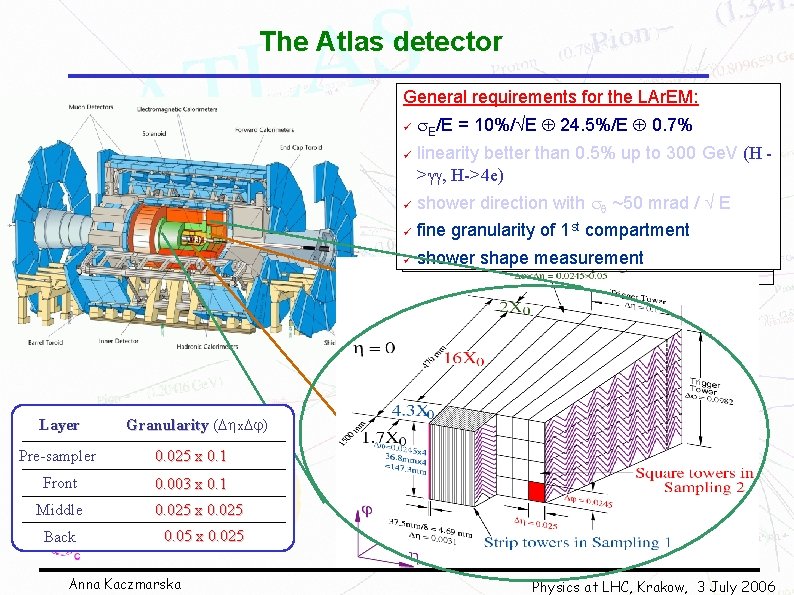
The Atlas detector General for the LAr. EM: Generalrequirements ID: General requirements for the ID: = 10%/ E 24. 5%/E 0. 7% robust pattern recognition linearity bettertrigger than 0. 5% up to 300 Ge. V (H fast level-2 > , fast. H->4 e) level-2 trigger accurate momentum measurements accurate momentum shower direction with measurements ~50 mrad / E accurate vertexing measurement fine granularity of 1 st compartment stand-alone electron-id with the TRT shower shape electron-id measurement stand-alone with the TRT E/E TRT Layer TRT Pre-sampler p cap d En. Front -ca d n E Middle Back p Granularity ( x ) cap d End-ca En 0. 025 x 0. 1 Radiator 0. 003 Radiator x 0. 1 0. 025 x 0. 025 0. 05 x 0. 025 Straws Anna Kaczmarska Physics at LHC, Krakow, 3 July 2006
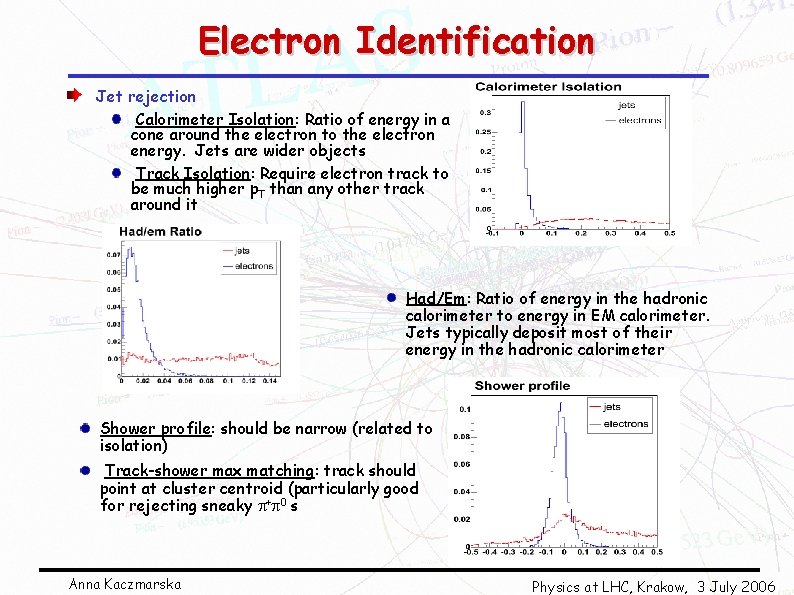
Electron Identification Jet rejection Calorimeter Isolation: Ratio of energy in a cone around the electron to the electron energy. Jets are wider objects Track Isolation: Require electron track to be much higher p. T than any other track around it Had/Em: Ratio of energy in the hadronic calorimeter to energy in EM calorimeter. Jets typically deposit most of their energy in the hadronic calorimeter Shower profile: should be narrow (related to isolation) Track-shower max matching: track should point at cluster centroid (particularly good for rejecting sneaky + 0 s Anna Kaczmarska Physics at LHC, Krakow, 3 July 2006
Low p. T electron identification in simulated data Start with a track as a seed. Extrapolate it to calorimeters and build cluster around Discriminating variables are similar : use of TRT + shower shapes in calorimeter Pion rejection� Performance on single tracks J/ e-id (J/ )= 80% R (bb X)= 1050 ± 50 Allows a S/B ~2 in the J/ mass window after vertex refitting WH (H bb) tt. H (H bb) e-id (WH 120)= 80% R (WH)= 245 ± 17 Once electron is identified inside a jet it can be used for b-tagging b-id = 60% R (WH 120)= 151 ± 2 Electron id efficiency Anna Kaczmarska Complementary to standard vertexing method Ru (WH 120)= 115 BUT = b-id (60%)* BR ~ 8% Physics at LHC, Krakow, 3 July 2006
Tau - Fraction of energy in DR<0. 1 SET( R<0. 1) SET( R<0. 4) ATLAS, preliminary R<0. 4 R<0. 1 (transverse energy) ~90% of energy are deposited in R<0. 1. -> narrow jet 20 < Pt < 30 40 < Pt < 50 70 < Pt < 130 Tau-jets QCD-jets These distributions depend on luminosity due to the pile-up. Anna Kaczmarska Physics at LHC, Krakow, 3 July 2006
b-tagging: building a tagger All taggers rely on a comparison between two hypotheses: likelihood for the jet to come from a b-quark vs light quark Example: transverse impact parameter • use the normalized impact parameter (S = a 0/σ) of each track • compare it to predefined calibration p. d. f. for the b and light hypothesis b(S) and u(S) • sum over all tracks jet btag weight • high W likely a b-jet Anna Kaczmarska Physics at LHC, Krakow, 3 July 2006
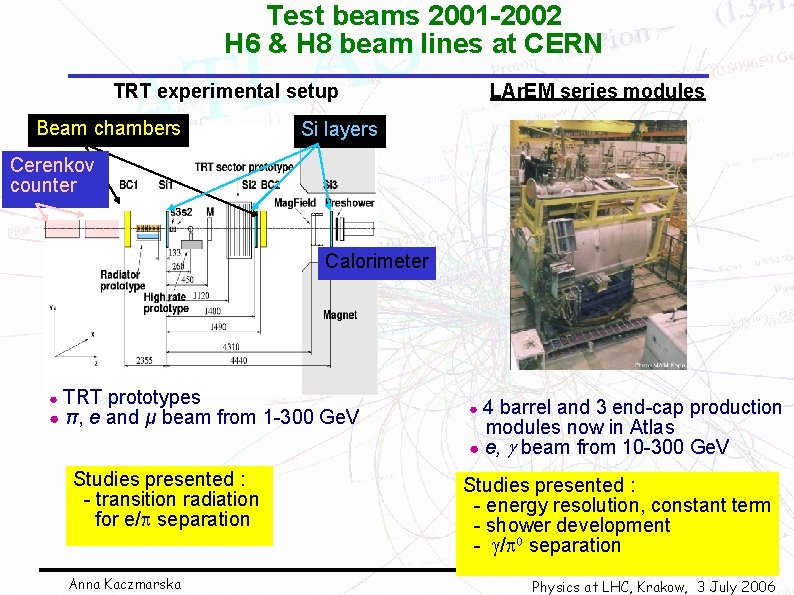
Test beams 2001 -2002 H 6 & H 8 beam lines at CERN TRT experimental setup Beam chambers LAr. EM series modules Si layers Cerenkov counter Calorimeter TRT prototypes ● π, e and μ beam from 1 -300 Ge. V ● Studies presented : - transition radiation for e/ separation Anna Kaczmarska 4 barrel and 3 end-cap production modules now in Atlas ● e, beam from 10 -300 Ge. V ● Studies presented : - energy resolution, constant term - shower development - / separation Physics at LHC, Krakow, 3 July 2006
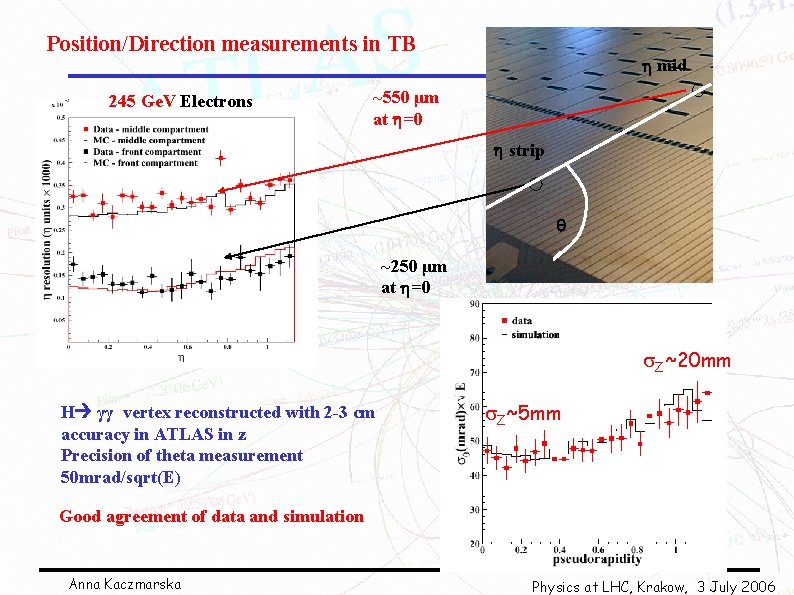
Position/Direction measurements in TB 245 Ge. V Electrons mid ~550 μm at =0 strip ~250 μm at =0 Z~20 mm H γγ vertex reconstructed with 2 -3 cm accuracy in ATLAS in z Precision of theta measurement 50 mrad/sqrt(E) Z~5 mm Good agreement of data and simulation Anna Kaczmarska Physics at LHC, Krakow, 3 July 2006
Electromagnetic shower shapes LAr. EM beam test 2001 -2002 Comparison between data and G 4 standalone simulation Longitudinal development Lateral development presampler Fraction of E rec. in 1 st samp. Ebeam = 10 Ge. V Ebeam = 60 Ge. V 2 rd samp. Fraction of E rec. in 3 rd samp. Ebeam = 100 Ge. V Ebeam = 180 Ge. V The contamination and the non-uniform distribution of dead material located in the beam line and not described in the Monte Carlo might explain the small discrepancy Shower profile in agreement between data/simulation from 10 to 180 Ge. V Anna Kaczmarska Physics at LHC, Krakow, 3 July 2006
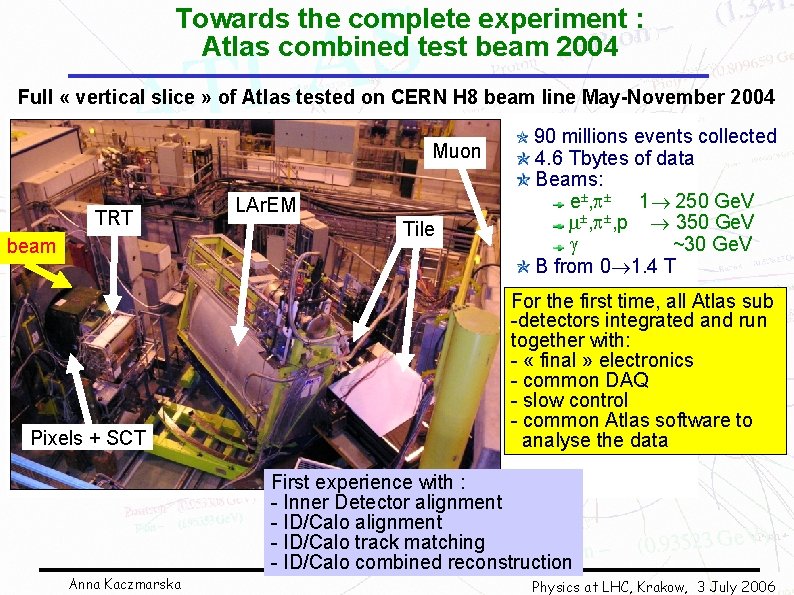
Towards the complete experiment : Atlas combined test beam 2004 Full « vertical slice » of Atlas tested on CERN H 8 beam line May-November 2004 G 4 simulation of subdetectors setup TRT beam Pixels + SCT Muon LAr. EM Tile 90 millions events collected 4. 6 Tbytes of data Beams: e±, ± 1 250 Ge. V ±, ±, p 350 Ge. V ~30 Ge. V B from 0 1. 4 T For the first time, all Atlas sub -detectors integrated and run together with: - « final » electronics - common DAQ - slow control - common Atlas software to analyse the data First experience with : - Inner Detector alignment - ID/Calo track matching - ID/Calo combined reconstruction Anna Kaczmarska Physics at LHC, Krakow, 3 July 2006
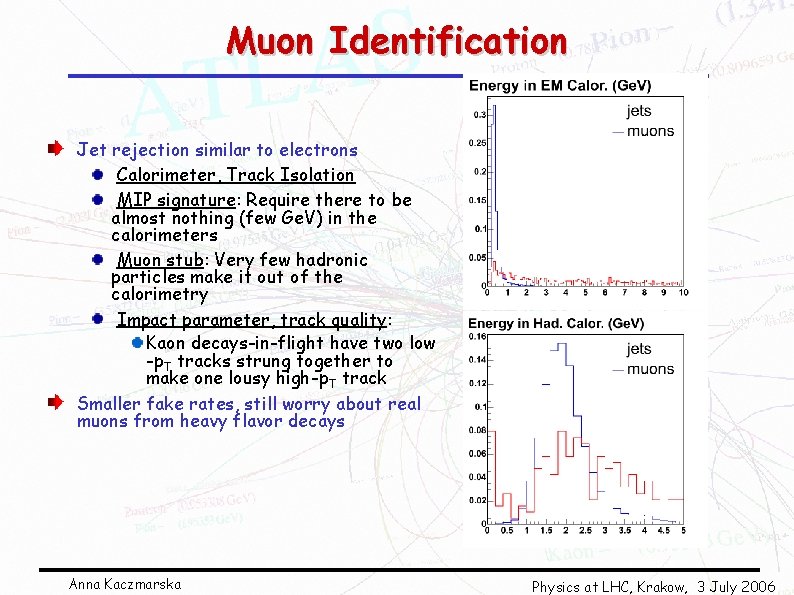
Muon Identification Jet rejection similar to electrons Calorimeter, Track Isolation MIP signature: Require there to be almost nothing (few Ge. V) in the calorimeters Muon stub: Very few hadronic particles make it out of the calorimetry Impact parameter, track quality: Kaon decays-in-flight have two low -p. T tracks strung together to make one lousy high-p. T track Smaller fake rates, still worry about real muons from heavy flavor decays Anna Kaczmarska Physics at LHC, Krakow, 3 July 2006
μ ID efficiency in H(180)->4μ η Anna Kaczmarska Physics at LHC, Krakow, 3 July 2006