
Particle acceleration in relativistic outflows Martin Lemoine Institut
- Slides: 20
Particle acceleration in relativistic outflows Martin Lemoine Institut d’Astrophysique de Paris CNRS – Sorbonne Université e. Xtreme 19 Conference – Padova, Jan. 22 -25 2019
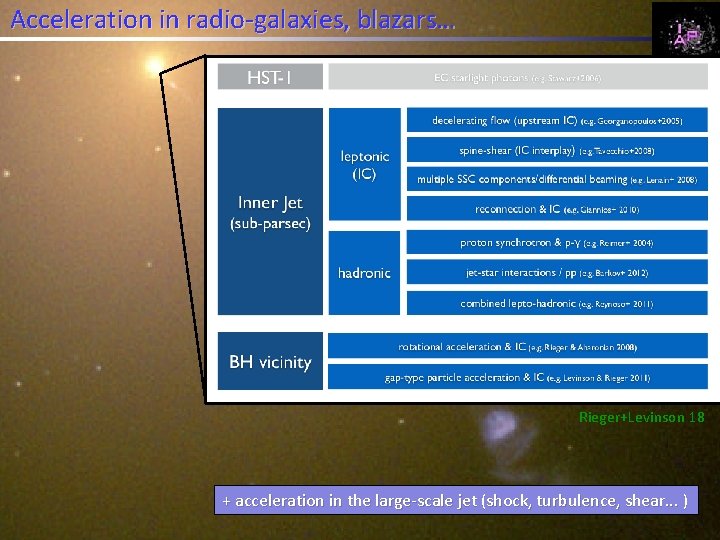
Acceleration in radio-galaxies, blazars… Rieger+Levinson 18 + acceleration in the large-scale jet (shock, turbulence, shear. . . )
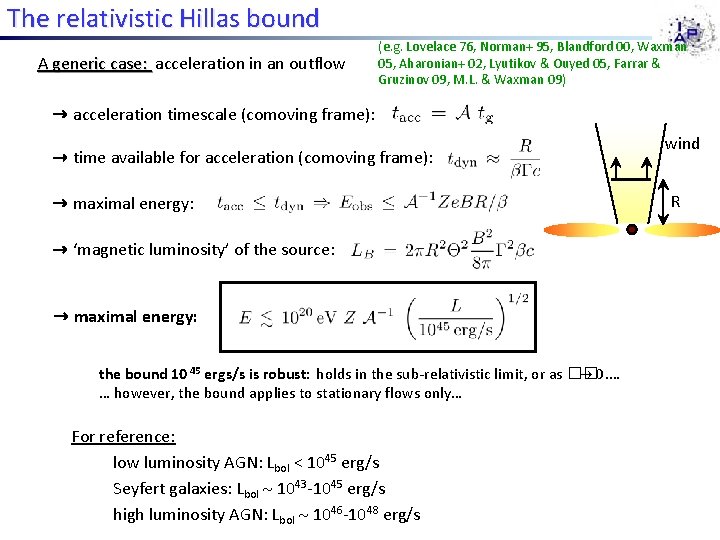
The relativistic Hillas bound A generic case: acceleration in an outflow (e. g. Lovelace 76, Norman+ 95, Blandford 00, Waxman 05, Aharonian+ 02, Lyutikov & Ouyed 05, Farrar & Gruzinov 09, M. L. & Waxman 09) → acceleration timescale (comoving frame): → time available for acceleration (comoving frame): → maximal energy: → ‘magnetic luminosity’ of the source: → maximal energy: the bound 10 45 ergs/s is robust: holds in the sub-relativistic limit, or as �� → 0…. … however, the bound applies to stationary flows only… For reference: low luminosity AGN: Lbol < 1045 erg/s Seyfert galaxies: Lbol 1043 -1045 erg/s high luminosity AGN: Lbol 1046 -1048 erg/s wind R
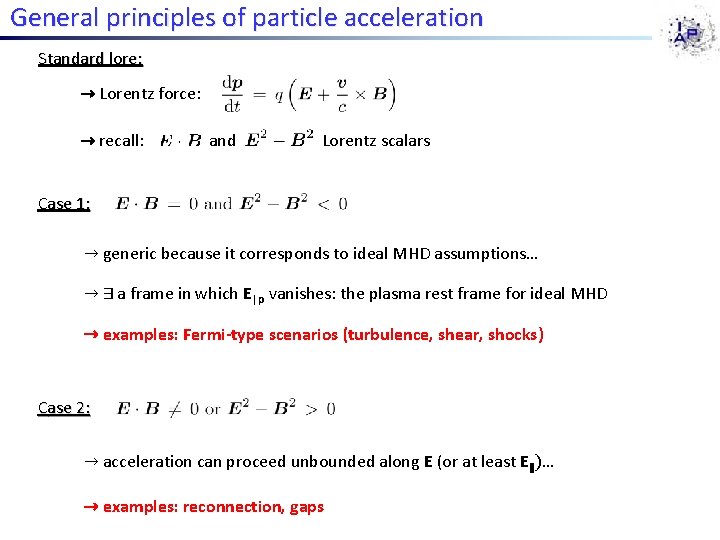
General principles of particle acceleration Standard lore: → Lorentz force: → recall: and Lorentz scalars Case 1: → generic because it corresponds to ideal MHD assumptions… → ∃ a frame in which E|p vanishes: the plasma rest frame for ideal MHD → examples: Fermi-type scenarios (turbulence, shear, shocks) Case 2: → acceleration can proceed unbounded along E (or at least E∥)… → examples: reconnection, gaps
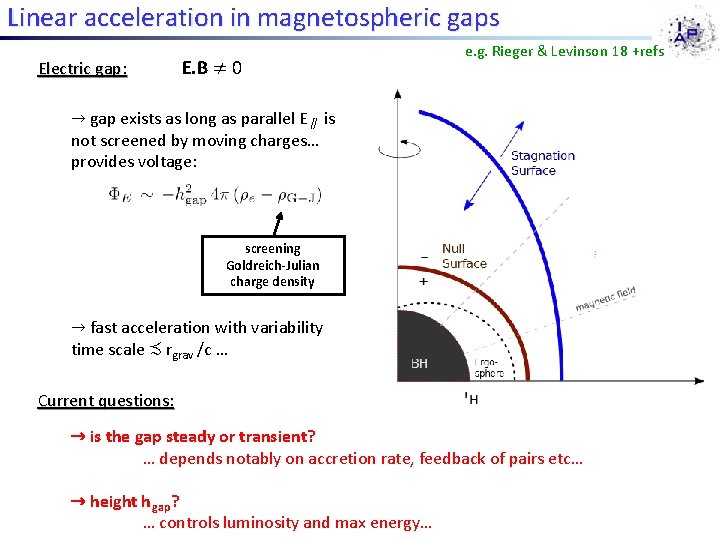
Linear acceleration in magnetospheric gaps Electric gap: E. B ≠ 0 e. g. Rieger & Levinson 18 +refs → gap exists as long as parallel E∥ is not screened by moving charges… provides voltage: screening Goldreich-Julian charge density → fast acceleration with variability time scale ≾ rgrav /c … Current questions: → is the gap steady or transient? … depends notably on accretion rate, feedback of pairs etc… → height h gap? … controls luminosity and max energy…
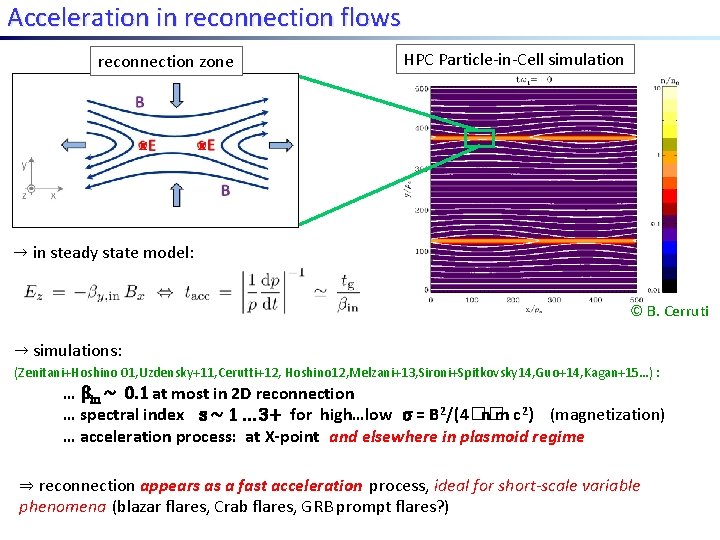
Acceleration in reconnection flows reconnection zone x HPC Particle-in-Cell simulation x Kagan+15 → in steady state model: © B. Cerruti → simulations: (Zenitani+Hoshino 01, Uzdensky+11, Cerutti+12, Hoshino 12, Melzani+13, Sironi+Spitkovsky 14, Guo+14, Kagan+15…) : … βin ~ 0. 1 at most in 2 D reconnection … spectral index s ~ 1 … 3+ for high…low σ = B 2/(4�� n m c 2) (magnetization) … acceleration process: at X-point and elsewhere in plasmoid regime ⇒ reconnection appears as a fast acceleration process, ideal for short-scale variable phenomena (blazar flares, Crab flares, GRB prompt flares? )
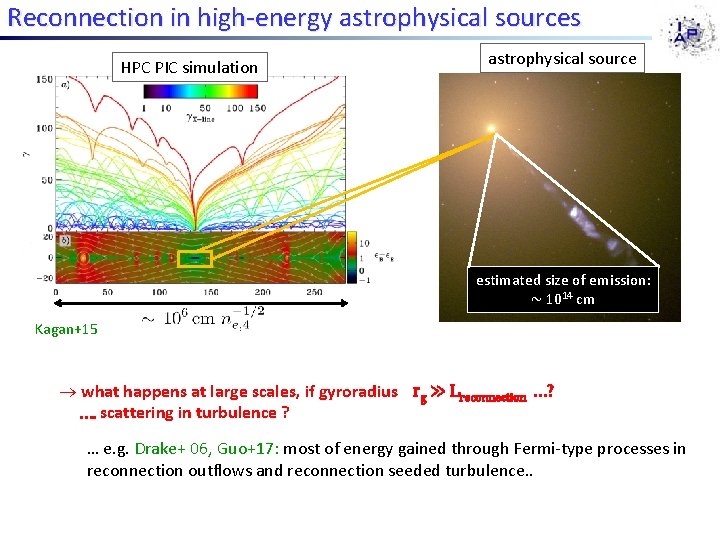
Reconnection in high-energy astrophysical sources HPC PIC simulation astrophysical source estimated size of emission: ~ 1014 cm Kagan+15 what happens at large scales, if gyroradius rg ≫ Lreconnection …? …. scattering in turbulence ? … e. g. Drake+ 06, Guo+17: most of energy gained through Fermi-type processes in reconnection outflows and reconnection seeded turbulence. .
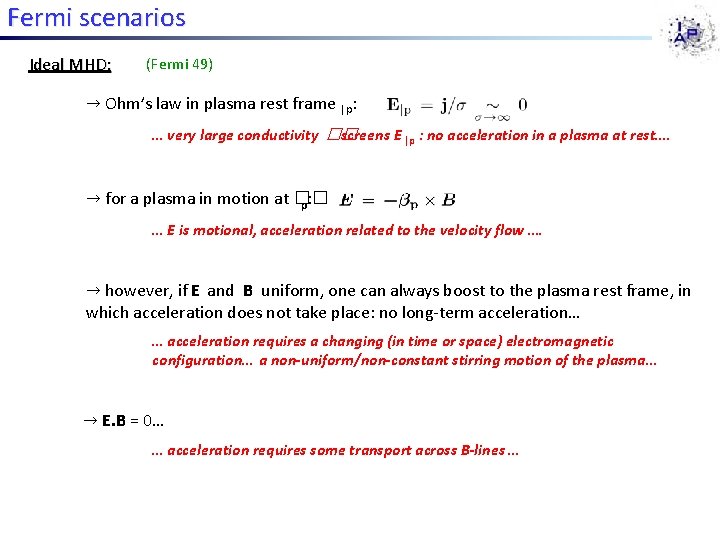
Fermi scenarios Ideal MHD: (Fermi 49) → Ohm’s law in plasma rest frame |p: … very large conductivity �� screens E |p : no acceleration in a plasma at rest…. → for a plasma in motion at �� p: … E is motional, acceleration related to the velocity flow …. → however, if E and B uniform, one can always boost to the plasma rest frame, in which acceleration does not take place: no long-term acceleration… … acceleration requires a changing (in time or space) electromagnetic configuration… a non-uniform/non-constant stirring motion of the plasma… → E. B = 0… … acceleration requires some transport across B-lines …
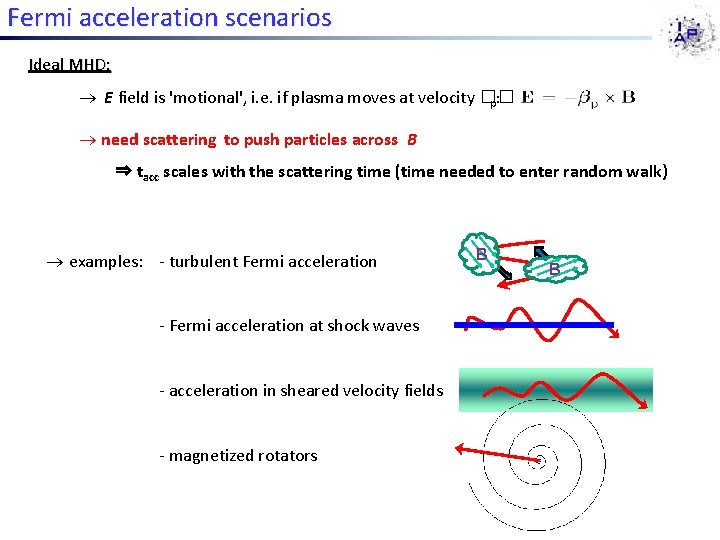
Fermi acceleration scenarios Ideal MHD: E field is 'motional', i. e. if plasma moves at velocity �� p: need scattering to push particles across B ⇒ tacc scales with the scattering time (time needed to enter random walk) examples: - turbulent Fermi acceleration - Fermi acceleration at shock waves - acceleration in sheared velocity fields - magnetized rotators B B
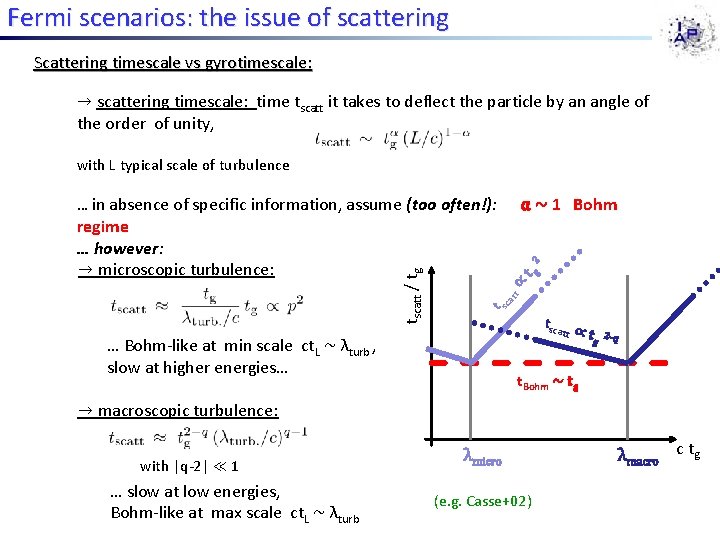
Fermi scenarios: the issue of scattering Scattering timescale vs gyrotimescale: → scattering timescale: time tscatt it takes to deflect the particle by an angle of the order of unity, with L typical scale of turbulence tg ∝ tt ca ts tscatt / tg regime … however: → microscopic turbulence: α ~ 1 Bohm 2 … in absence of specific information, assume (too often!): tsca tt … Bohm-like at min scale ct. L ~ λturb , slow at higher energies… ∝t g 2 -q t. Bohm ~ tg → macroscopic turbulence: with |q-2| ≪ 1 … slow at low energies, Bohm-like at max scale ct. L ~ λturb λmicro (e. g. Casse+02) λmacro c tg
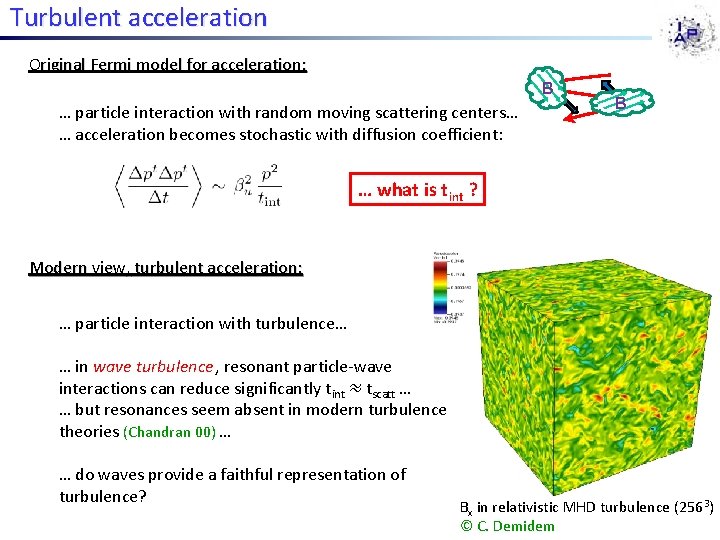
Turbulent acceleration Original Fermi model for acceleration: B … particle interaction with random moving scattering centers… … acceleration becomes stochastic with diffusion coefficient: B … what is t int ? Modern view, turbulent acceleration: … particle interaction with turbulence… … in wave turbulence, resonant particle-wave interactions can reduce significantly tint ≈ tscatt … … but resonances seem absent in modern turbulence theories (Chandran 00) … … do waves provide a faithful representation of turbulence? Bx in relativistic MHD turbulence (2563) © C. Demidem
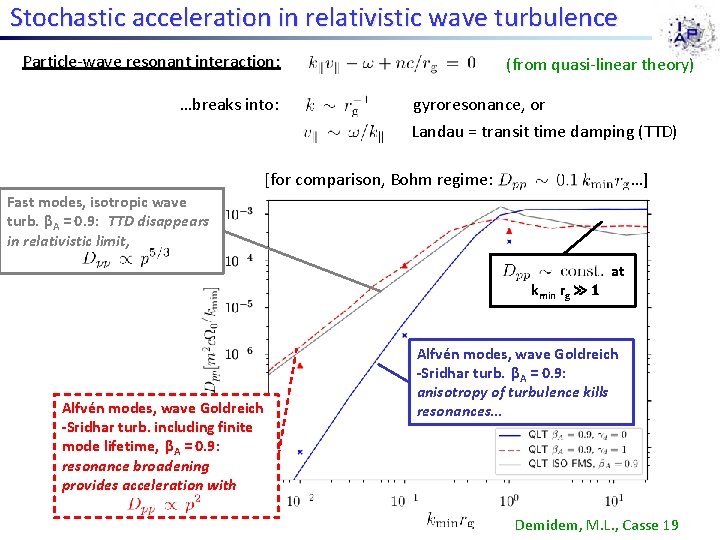
Stochastic acceleration in relativistic wave turbulence Particle-wave resonant interaction: …breaks into: (from quasi-linear theory) gyroresonance, or Landau = transit time damping (TTD) [for comparison, Bohm regime: …] Fast modes, isotropic wave turb. βA = 0. 9: TTD disappears in relativistic limit, kmin rg ≫ 1 Alfvén modes, wave Goldreich -Sridhar turb. including finite mode lifetime, βA = 0. 9: resonance broadening provides acceleration with at Alfvén modes, wave Goldreich -Sridhar turb. βA = 0. 9: anisotropy of turbulence kills resonances… Demidem, M. L. , Casse 19
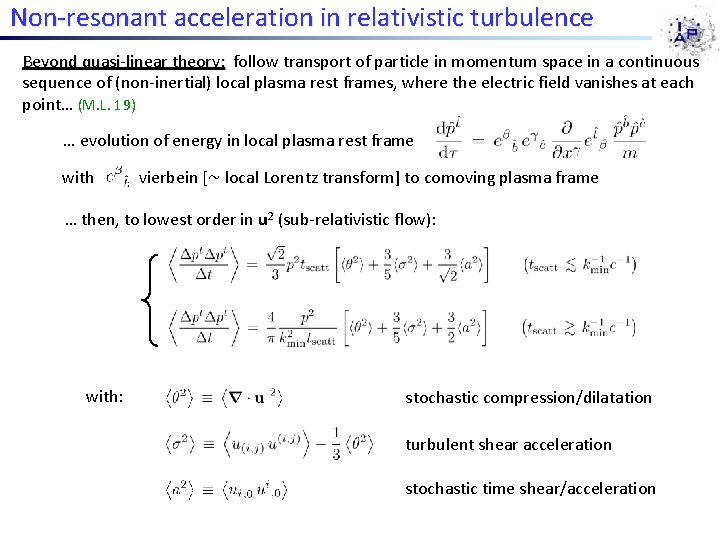
Non-resonant acceleration in relativistic turbulence Beyond quasi-linear theory: follow transport of particle in momentum space in a continuous sequence of (non-inertial) local plasma rest frames, where the electric field vanishes at each point… (M. L. 19) … evolution of energy in local plasma rest frame with vierbein [~ local Lorentz transform] to comoving plasma frame … then, to lowest order in u 2 (sub-relativistic flow): with: stochastic compression/dilatation turbulent shear acceleration stochastic time shear/acceleration
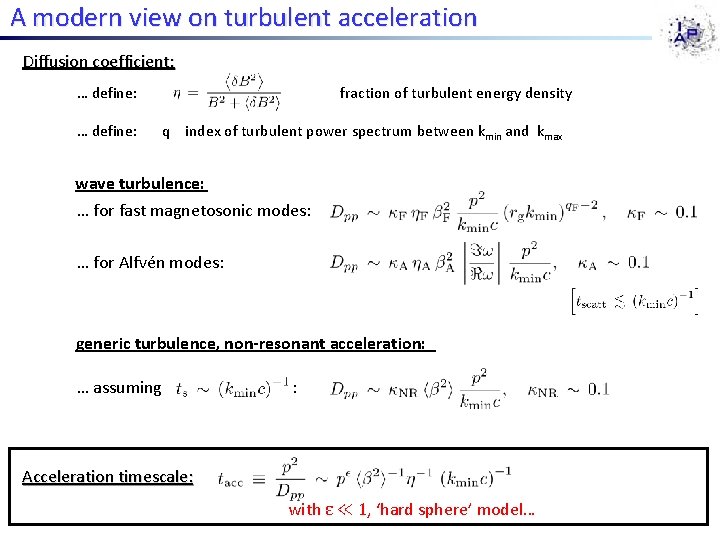
A modern view on turbulent acceleration Diffusion coefficient: … define: fraction of turbulent energy density q index of turbulent power spectrum between kmin and kmax wave turbulence: … for fast magnetosonic modes: … for Alfvén modes: generic turbulence, non-resonant acceleration: … assuming : Acceleration timescale: with ε ≪ 1, ‘hard sphere’ model. . .
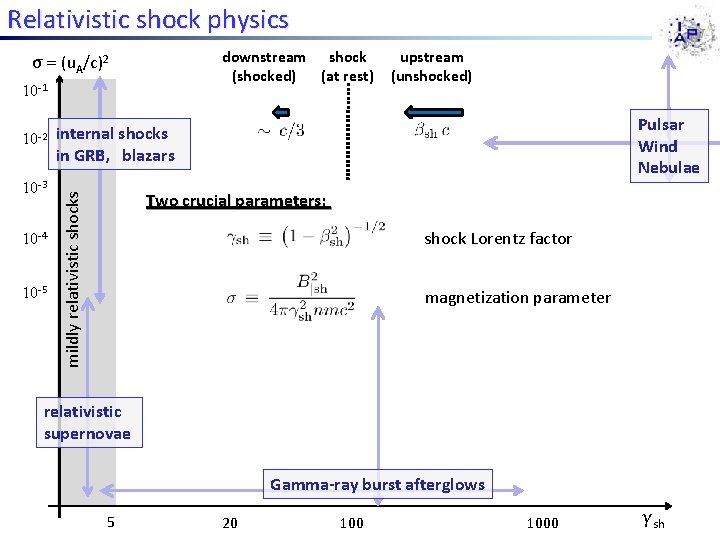
Relativistic shock physics downstream shock (shocked) (at rest) σ = (u. A/c)2 10 -1 10 -3 10 -4 10 -5 Pulsar Wind Nebulae internal shocks in GRB, blazars Two crucial parameters: mildly relativistic shocks 10 -2 upstream (unshocked) shock Lorentz factor magnetization parameter relativistic supernovae Gamma-ray burst afterglows 5 20 1000 γsh
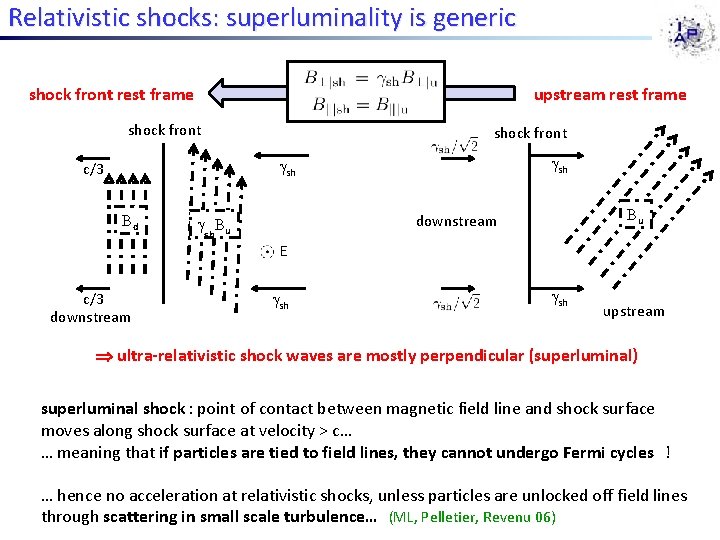
Relativistic shocks: superluminality is generic shock front rest frame upstream rest frame shock front sh c/3 Bd Bu downstream sh. Bu E c/3 downstream sh upstream ultra-relativistic shock waves are mostly perpendicular (superluminal) superluminal shock : point of contact between magnetic field line and shock surface moves along shock surface at velocity > c… … meaning that if particles are tied to field lines, they cannot undergo Fermi cycles ! … hence no acceleration at relativistic shocks, unless particles are unlocked off field lines through scattering in small scale turbulence… (ML, Pelletier, Revenu 06)
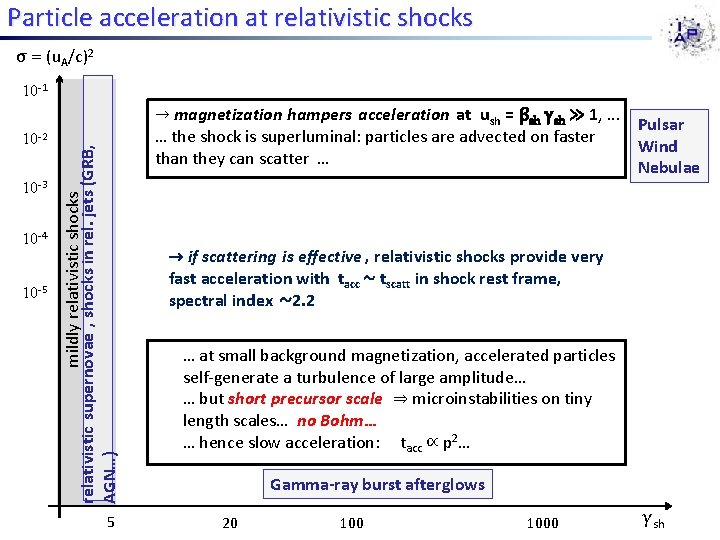
Particle acceleration at relativistic shocks σ = (u. A/c)2 10 -3 10 -4 10 -5 mildly relativistic shocks relativistic supernovae , shocks in rel. jets (GRB, AGN…) 10 -1 5 → magnetization hampers acceleration at ush = βsh γsh ≫ 1, . . . Pulsar … the shock is superluminal: particles are advected on faster Wind than they can scatter … Nebulae → if scattering is effective , relativistic shocks provide very fast acceleration with tacc ~ tscatt in shock rest frame, spectral index ~2. 2 … at small background magnetization, accelerated particles self-generate a turbulence of large amplitude… … but short precursor scale ⇒ microinstabilities on tiny length scales… no Bohm… … hence slow acceleration: tacc ∝ p 2… Gamma-ray burst afterglows 20 1000 γsh
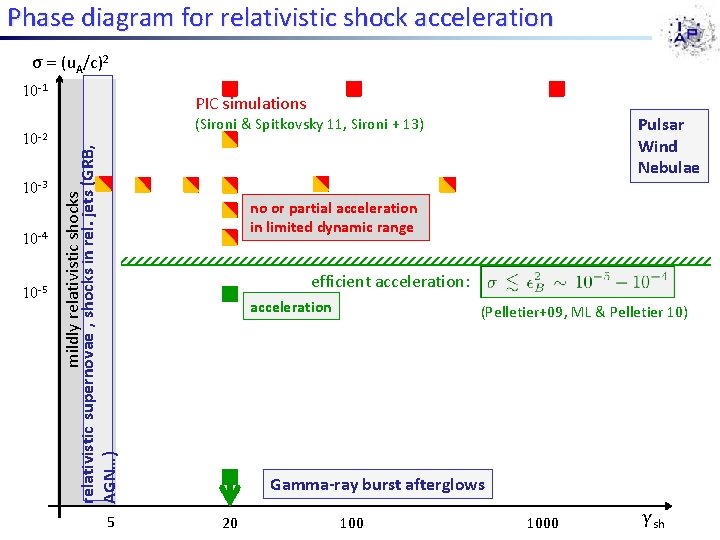
Phase diagram for relativistic shock acceleration σ = (u. A/c)2 10 -1 10 -3 10 -4 10 -5 Pulsar Wind Nebulae (Sironi & Spitkovsky 11, Sironi + 13) mildly relativistic shocks relativistic supernovae , shocks in rel. jets (GRB, AGN…) 10 -2 PIC simulations 5 no or partial acceleration in limited dynamic range efficient acceleration: acceleration (Pelletier+09, ML & Pelletier 10) Gamma-ray burst afterglows 20 1000 γsh
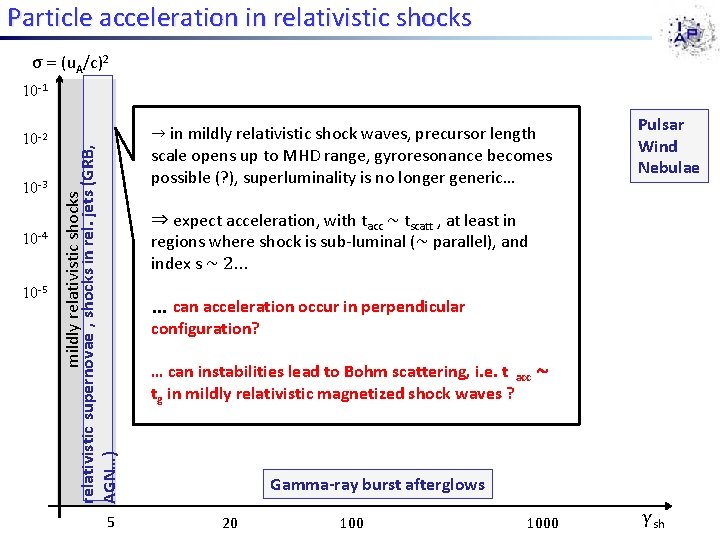
Particle acceleration in relativistic shocks σ = (u. A/c)2 10 -3 10 -4 10 -5 mildly relativistic shocks relativistic supernovae , shocks in rel. jets (GRB, AGN…) 10 -1 5 → in mildly relativistic shock waves, precursor length scale opens up to MHD range, gyroresonance becomes possible (? ), superluminality is no longer generic… Pulsar Wind Nebulae ⇒ expect acceleration, with tacc ~ tscatt , at least in regions where shock is sub-luminal (~ parallel), and index s ~ 2… … can acceleration occur in perpendicular configuration? … can instabilities lead to Bohm scattering, i. e. t acc ~ tg in mildly relativistic magnetized shock waves ? Gamma-ray burst afterglows 20 1000 γsh
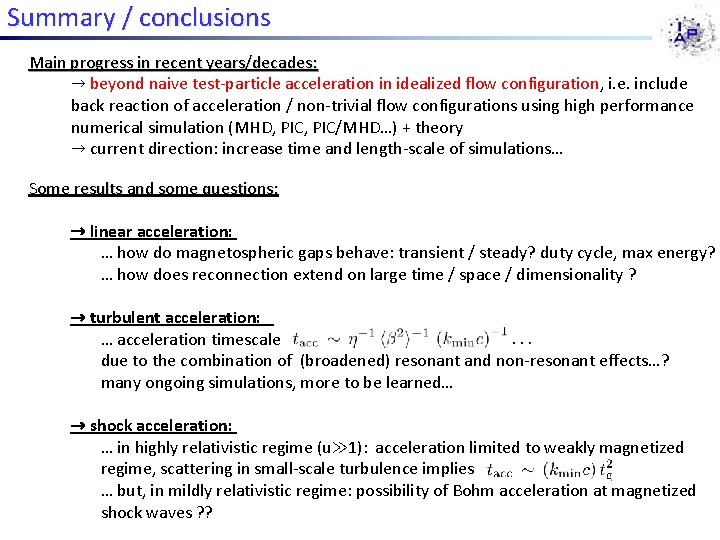
Summary / conclusions Main progress in recent years/decades: → beyond naive test-particle acceleration in idealized flow configuration, i. e. include back reaction of acceleration / non-trivial flow configurations using high performance numerical simulation (MHD, PIC/MHD…) + theory → current direction: increase time and length-scale of simulations… Some results and some questions: → linear acceleration: … how do magnetospheric gaps behave: transient / steady? duty cycle, max energy? … how does reconnection extend on large time / space / dimensionality ? → turbulent acceleration: … acceleration timescale due to the combination of (broadened) resonant and non-resonant effects…? many ongoing simulations, more to be learned… → shock acceleration: … in highly relativistic regime (u≫ 1): acceleration limited to weakly magnetized regime, scattering in small-scale turbulence implies … but, in mildly relativistic regime: possibility of Bohm acceleration at magnetized shock waves ? ?