
Participles and Participial Phrases Learning Objective To use
Participles and Participial Phrases Learning Objective: To use participles and participial phrases as an adjective in a sentence.
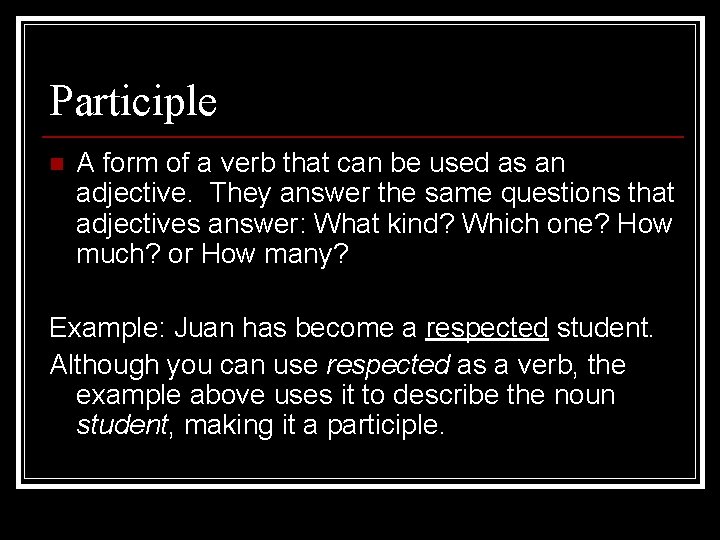
Participle n A form of a verb that can be used as an adjective. They answer the same questions that adjectives answer: What kind? Which one? How much? or How many? Example: Juan has become a respected student. Although you can use respected as a verb, the example above uses it to describe the noun student, making it a participle.
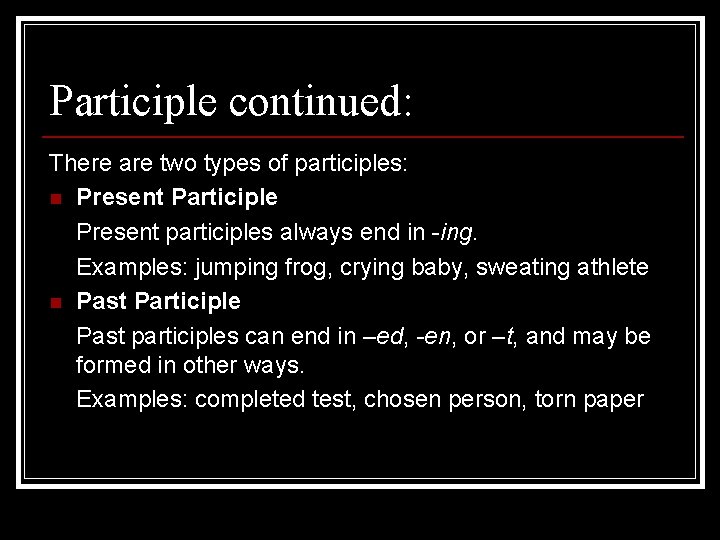
Participle continued: There are two types of participles: n Present Participle Present participles always end in -ing. Examples: jumping frog, crying baby, sweating athlete n Past Participle Past participles can end in –ed, -en, or –t, and may be formed in other ways. Examples: completed test, chosen person, torn paper
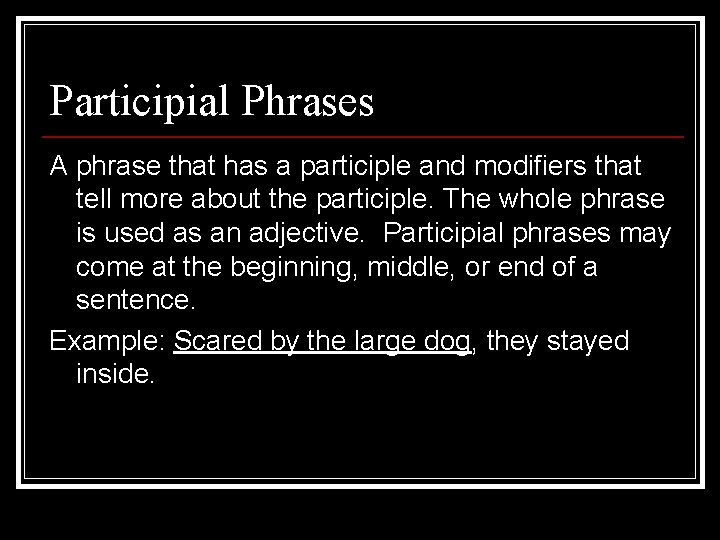
Participial Phrases A phrase that has a participle and modifiers that tell more about the participle. The whole phrase is used as an adjective. Participial phrases may come at the beginning, middle, or end of a sentence. Example: Scared by the large dog, they stayed inside.
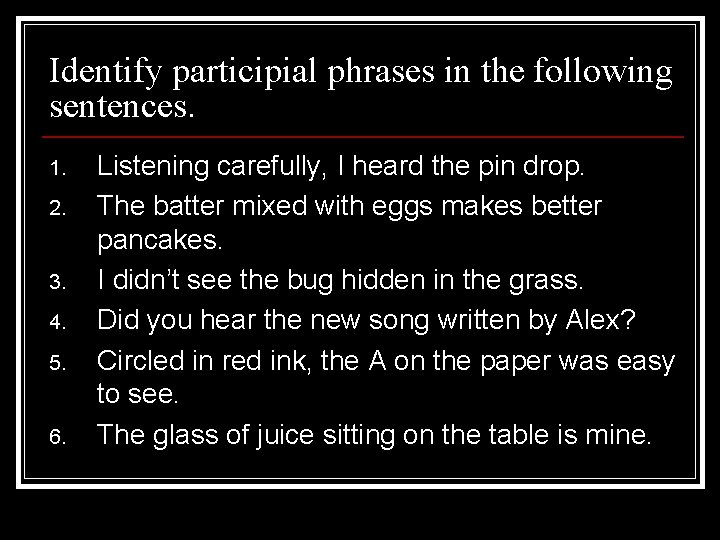
Identify participial phrases in the following sentences. 1. 2. 3. 4. 5. 6. Listening carefully, I heard the pin drop. The batter mixed with eggs makes better pancakes. I didn’t see the bug hidden in the grass. Did you hear the new song written by Alex? Circled in red ink, the A on the paper was easy to see. The glass of juice sitting on the table is mine.
Summary Questions What is a participle? n What are the two types of participles? n What is a participial phrase? n
- Slides: 6