
ParticipatoryGIS and Mapping for Local Level Spatial Planning
- Slides: 9
Participatory-GIS and Mapping for Local Level Spatial Planning Course Structure and Rationale INTERNATIONAL INSTITUTE FOR GEO-INFORMATION SCIENCE AND EARTH OBSERVATION
Rationale The module brings together 3 current threads in spatial planning: § Participatory spatial planning & management (PSP) in land & land resources has a new dynamic of empowerment and good governance imperatives. § dynamics of land resource changes cause planners to deal with many conflicts; shifting interests, changes in power balance and spatial economies. § Participatory mapping & P-GIS, together with appropriate visualisation techniques, give insight into spatial conflicts problems.
Context These threads will be your guidance within the context of: § issues in participatory spatial planning & management. § concepts of indigenous spatial knowledge. § “good practice” in using information tools and participatory approaches with local/indigenous communities.
Concepts § Concepts behind PSP : Ø Participation, Ø Participatory (spatial) planning, Ø Local-level community spatial planning, Ø Local or indigenous knowledge Ø Indigenous spatial knowledge (ISK).
Tools and techniques § participatory spatial data acquisition, participatory mapping, PRA. § GPS, mobile GIS, Arc-Pad, field data recording. § visualisation of spatial relationships, spatial conflicts, interactive mapping. § Applications of participatory mapping & P-GIS to e. g. conflict mapping, customary entitlements to land & NRM; community environmental mapping.
Objectives § Understand the context of PSP & collaborative management. § Recognise the value of indigenous spatial knowledge. § Use various tools/techniques to elicit spatial indigenous knowledge, including participatory mapping. § Understand utilise the basics of GPS, and Arc. Pad in a Mobile GIS, for field data recording.
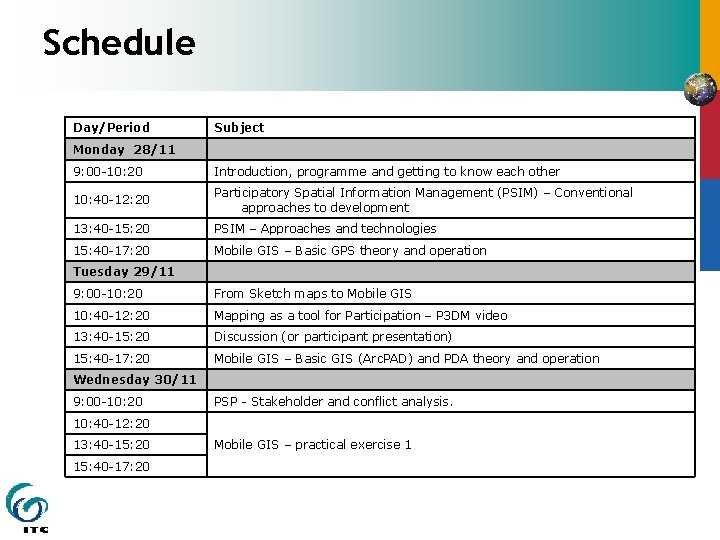
Schedule Day/Period Subject Monday 28/11 9: 00 -10: 20 Introduction, programme and getting to know each other 10: 40 -12: 20 Participatory Spatial Information Management (PSIM) – Conventional approaches to development 13: 40 -15: 20 PSIM – Approaches and technologies 15: 40 -17: 20 Mobile GIS – Basic GPS theory and operation Tuesday 29/11 9: 00 -10: 20 From Sketch maps to Mobile GIS 10: 40 -12: 20 Mapping as a tool for Participation – P 3 DM video 13: 40 -15: 20 Discussion (or participant presentation) 15: 40 -17: 20 Mobile GIS – Basic GIS (Arc. PAD) and PDA theory and operation Wednesday 30/11 9: 00 -10: 20 PSP - Stakeholder and conflict analysis. 10: 40 -12: 20 13: 40 -15: 20 15: 40 -17: 20 Mobile GIS – practical exercise 1
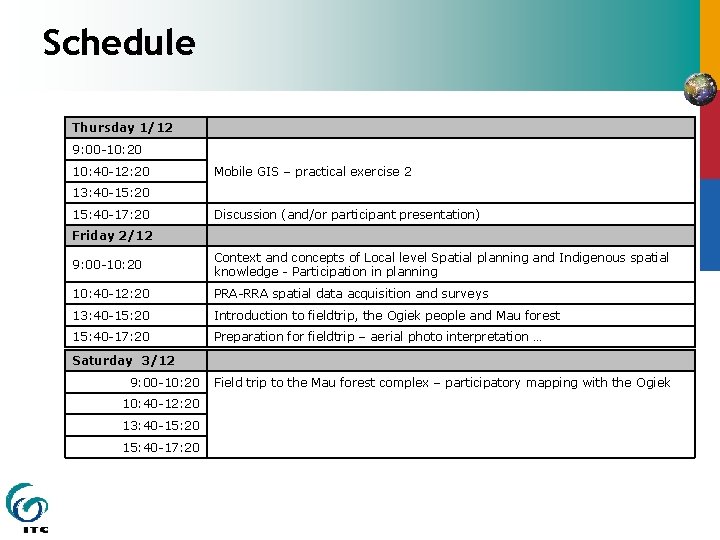
Schedule Thursday 1/12 9: 00 -10: 20 10: 40 -12: 20 Mobile GIS – practical exercise 2 13: 40 -15: 20 15: 40 -17: 20 Discussion (and/or participant presentation) Friday 2/12 9: 00 -10: 20 Context and concepts of Local level Spatial planning and Indigenous spatial knowledge - Participation in planning 10: 40 -12: 20 PRA-RRA spatial data acquisition and surveys 13: 40 -15: 20 Introduction to fieldtrip, the Ogiek people and Mau forest 15: 40 -17: 20 Preparation for fieldtrip – aerial photo interpretation … Saturday 3/12 9: 00 -10: 20 10: 40 -12: 20 13: 40 -15: 20 15: 40 -17: 20 Field trip to the Mau forest complex – participatory mapping with the Ogiek
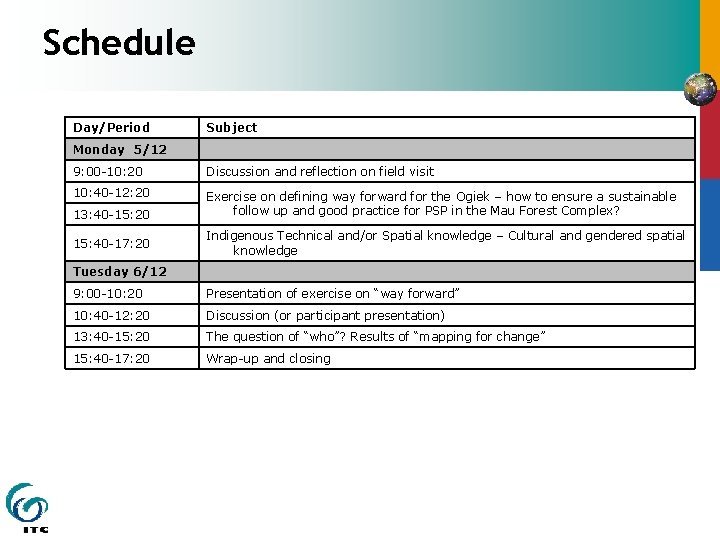
Schedule Day/Period Subject Monday 5/12 9: 00 -10: 20 Discussion and reflection on field visit 10: 40 -12: 20 Exercise on defining way forward for the Ogiek – how to ensure a sustainable follow up and good practice for PSP in the Mau Forest Complex? 13: 40 -15: 20 15: 40 -17: 20 Indigenous Technical and/or Spatial knowledge – Cultural and gendered spatial knowledge Tuesday 6/12 9: 00 -10: 20 Presentation of exercise on “way forward” 10: 40 -12: 20 Discussion (or participant presentation) 13: 40 -15: 20 The question of “who”? Results of “mapping for change” 15: 40 -17: 20 Wrap-up and closing