
Participatory budgeting and budget transparency Delphine Moretti Acting
Participatory budgeting and budget transparency Delphine Moretti Acting Deputy Head – Budgeting and Public Expenditures, OECD Knesset - Jerusalem, Israel 17 July 2018
Transparency Accessibility Participation? • What are the benefits of budget participation? • What are the modalities and limits? – – LISTEN & RESPOND DIRECTLY TO CITIZENS – municipal models CSOs CAN MEDIATE CITIZENS’ CONCERNS – Social partnership ISN’T THIS THE ROLE OF PARLIAMENT? – more engagement OPEN GOVERNMENT MEANS OPEN DATA – let citizens and CSOs find their own way – make their own paths • Country-specific solutions versus international norms
Potential benefits (and risks? ) Benefits • Responsive, agile policymaking • More direct input from vulnerable groups • A sign of openness and engagement by government • Improved trust in government Risks and fears • Marginalising or bypassing role of parliament • Risks to overall public finances • Potential for “capture” by interest groups • Failure to engage “hard to reach” citizens • Seen as “party-political” or “populist”?
Participative budgeting – born in municipalities • Porto Alegre, Brazil (from 1989) – Ideological beginnings … public assemblies – Evolved over time to “principles” and “local priorities” – Ideological / party-political complications • Cordoba (2001 -2007), Seville (2003 -2012), Spain – Tensions with established “neighbourhood associations” – Led to “mixed” approaches involving these bodies – Ideological / party-political complications • Chicago (from 2009), NYC (from 2011), USA – Applies in some wards only – linked to local representative – A block of money available for citizen decisions – “brainstorming” new ideas , practical suggestions • Moving to national level…
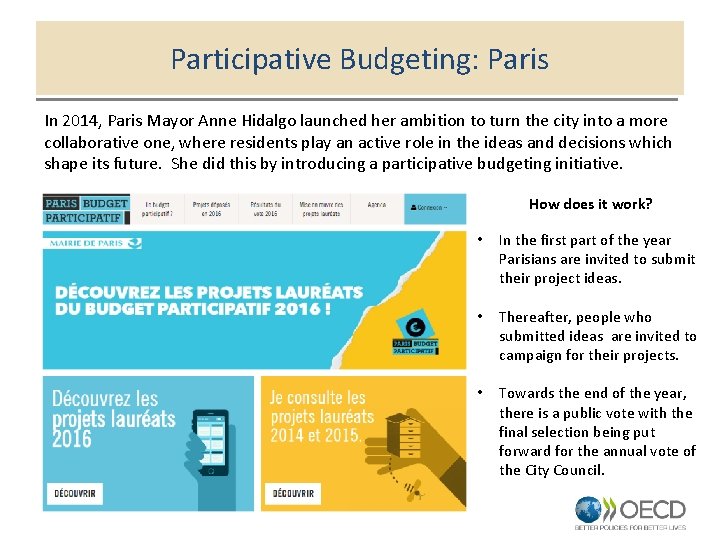
Participative Budgeting: Paris In 2014, Paris Mayor Anne Hidalgo launched her ambition to turn the city into a more collaborative one, where residents play an active role in the ideas and decisions which shape its future. She did this by introducing a participative budgeting initiative. How does it work? • In the first part of the year Parisians are invited to submit their project ideas. • Thereafter, people who submitted ideas are invited to campaign for their projects. • Towards the end of the year, there is a public vote with the final selection being put forward for the annual vote of the City Council.
Participative Budgeting: Canada • Pre-budget consultations – Undertaken by government and parliament – Canadians can submit ideas in a variety of ways • In person and digital Ministerial events across Canada • Finance Committee meetings across Canada • Online Government Portal - www. budget. gc. ca/pbc 18 – Parliament sends pre-budget consultation report to the government in advance of budget
Participative Budgeting: Netherlands • Innovative model: “V-100” – Initiated in 2017 at the Dutch Parliament – Involves 100 participants from society – Participants scrutinise the annual budget reports and provide suggested questions for committees to ask the responsible minister
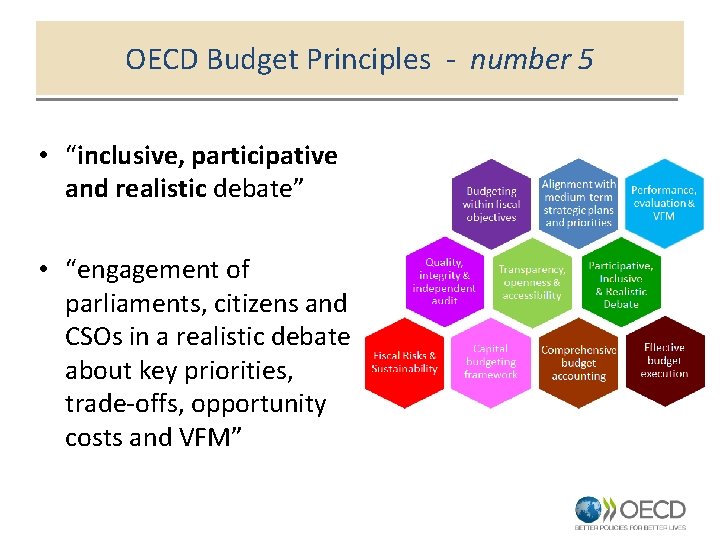
OECD Budget Principles - number 5 • “inclusive, participative and realistic debate” • “engagement of parliaments, citizens and CSOs in a realistic debate about key priorities, trade-offs, opportunity costs and VFM”
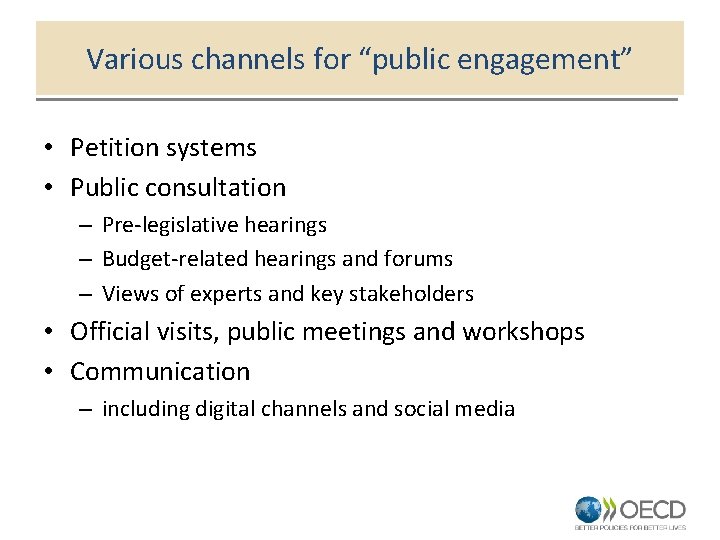
Various channels for “public engagement” • Petition systems • Public consultation – Pre-legislative hearings – Budget-related hearings and forums – Views of experts and key stakeholders • Official visits, public meetings and workshops • Communication – including digital channels and social media
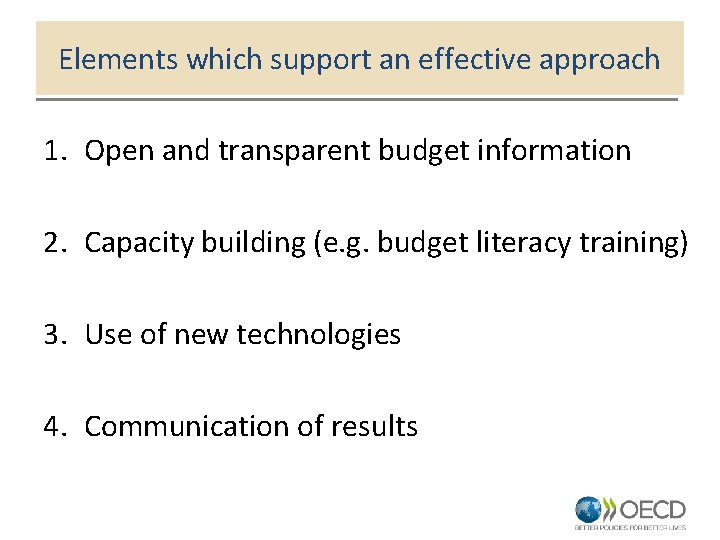
Elements which support an effective approach 1. Open and transparent budget information 2. Capacity building (e. g. budget literacy training) 3. Use of new technologies 4. Communication of results
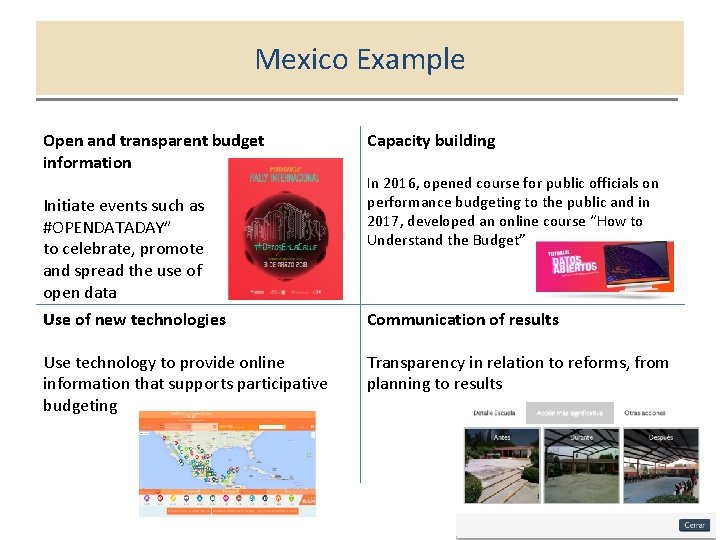
Mexico Example Open and transparent budget information Initiate events such as #OPENDATADAY” to celebrate, promote and spread the use of open data Use of new technologies Use technology to provide online information that supports participative budgeting Capacity building In 2016, opened course for public officials on performance budgeting to the public and in 2017, developed an online course “How to Understand the Budget” Communication of results Transparency in relation to reforms, from planning to results
Thank you delphine. moretti@oecd. org scherie. nicol@oecd. org
- Slides: 12