
PARTICIPATORY APPROACHES TO TEACHING ENGLISH TO ADULT FOREIGN


- Slides: 34
PARTICIPATORY APPROACHES TO TEACHING ENGLISH TO ADULT FOREIGN POLICY PROFESSIONALS Nataliya SHPAK
DO IT YOURSELF ! I hear and I forget I see and I remember I do and I understand Confucius
ENGLISH COURSE PROFILE q Job-related q Content-based q Interactive q Communicative q Skill-focused q Function-focused q Cross-culturally oriented
LEARNERS PROFILE q Adults (from 22 to 40) q Diverse educational background q Diverse professional experience § MFA officers § Public servants from other ministries and governmental agencies § q Post-gradual trainees on contractual basis Diverse English language experience
SOME BASIC FACTS ABOUT LEARNING Students “learn by doing”: the more they are engaged in learning activities, the greater the outcome. Interaction is a core of learning Students “create knowledge”: it is not imposed or transmitted by direct instruction → meaning is personal Students share responsibility for shaping the process of teaching and learning themselves (prepare questions for class, organize working groups, presentations etc. ) Students discuss, ask and develop ideas freely and on an equal basis The teacher serves as manager and facilitator of knowledge rather than as presenter and transmitter of information
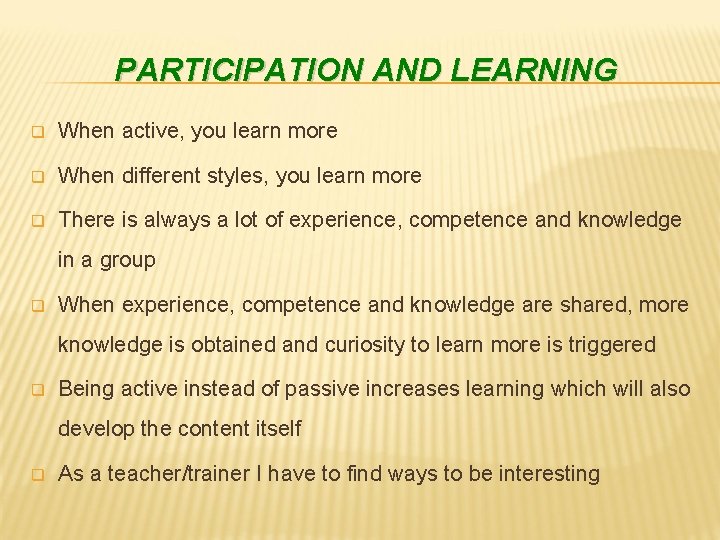
PARTICIPATION AND LEARNING q When active, you learn more q When different styles, you learn more q There is always a lot of experience, competence and knowledge in a group q When experience, competence and knowledge are shared, more knowledge is obtained and curiosity to learn more is triggered q Being active instead of passive increases learning which will also develop the content itself q As a teacher/trainer I have to find ways to be interesting
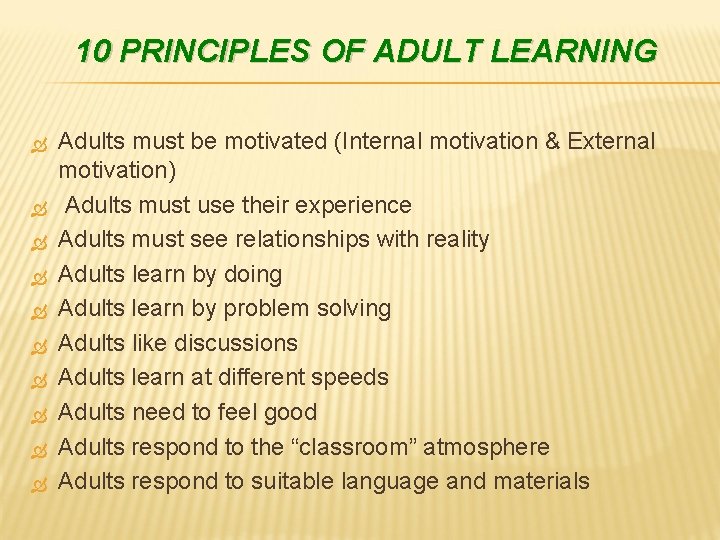
10 PRINCIPLES OF ADULT LEARNING Adults must be motivated (Internal motivation & External motivation) Adults must use their experience Adults must see relationships with reality Adults learn by doing Adults learn by problem solving Adults like discussions Adults learn at different speeds Adults need to feel good Adults respond to the “classroom” atmosphere Adults respond to suitable language and materials
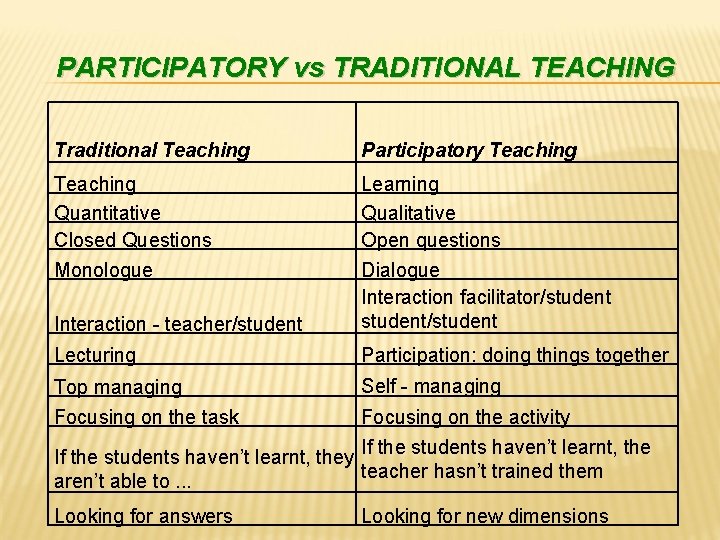
PARTICIPATORY vs TRADITIONAL TEACHING Traditional Teaching Participatory Teaching Quantitative Closed Questions Learning Qualitative Open questions Monologue Interaction - teacher/student Dialogue Interaction facilitator/student/student Lecturing Participation: doing things together Top managing Self - managing Focusing on the task Focusing on the activity If the students haven’t learnt, the teacher hasn’t trained them aren’t able to. . . Looking for answers Looking for new dimensions
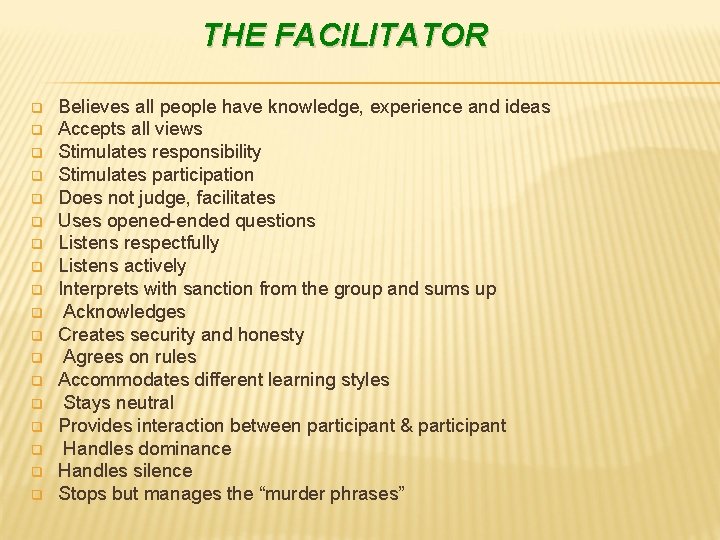
THE FACILITATOR q q q q q Believes all people have knowledge, experience and ideas Accepts all views Stimulates responsibility Stimulates participation Does not judge, facilitates Uses opened-ended questions Listens respectfully Listens actively Interprets with sanction from the group and sums up Acknowledges Creates security and honesty Agrees on rules Accommodates different learning styles Stays neutral Provides interaction between participant & participant Handles dominance Handles silence Stops but manages the “murder phrases”
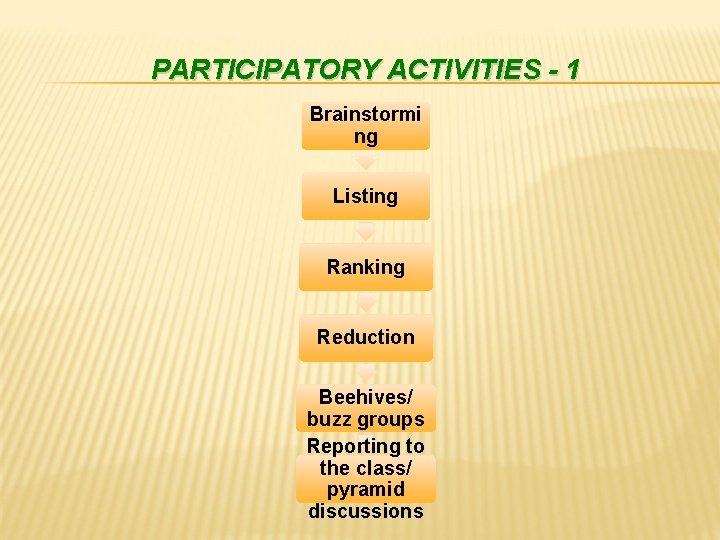
PARTICIPATORY ACTIVITIES - 1 Brainstormi ng Listing Ranking Reduction Beehives/ buzz groups Reporting to the class/ pyramid discussions
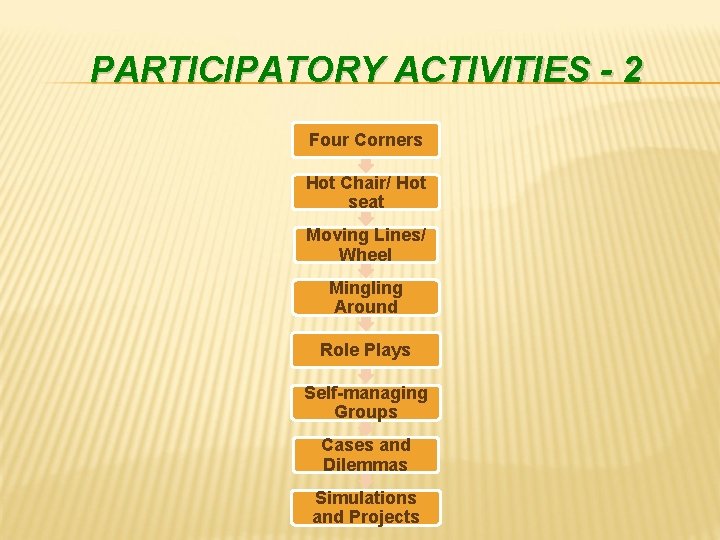
PARTICIPATORY ACTIVITIES - 2 Four Corners Hot Chair/ Hot seat Moving Lines/ Wheel Mingling Around Role Plays Self-managing Groups Cases and Dilemmas Simulations and Projects
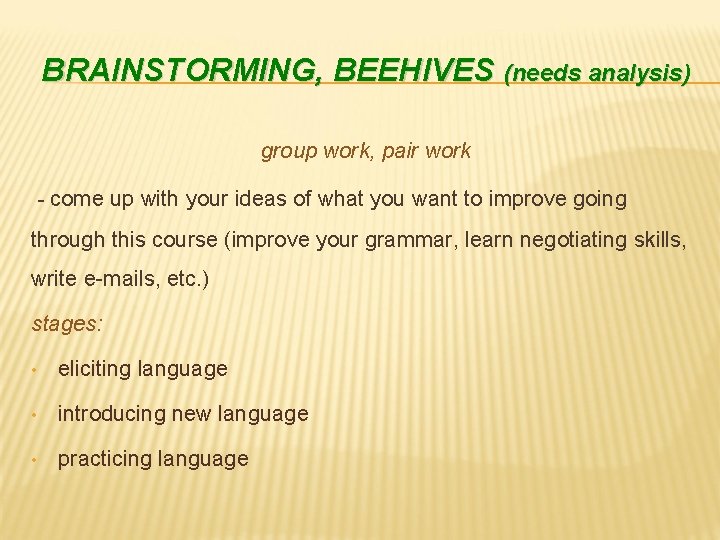
BRAINSTORMING, BEEHIVES (needs analysis) group work, pair work - come up with your ideas of what you want to improve going through this course (improve your grammar, learn negotiating skills, write e-mails, etc. ) stages: • eliciting language • introducing new language • practicing language
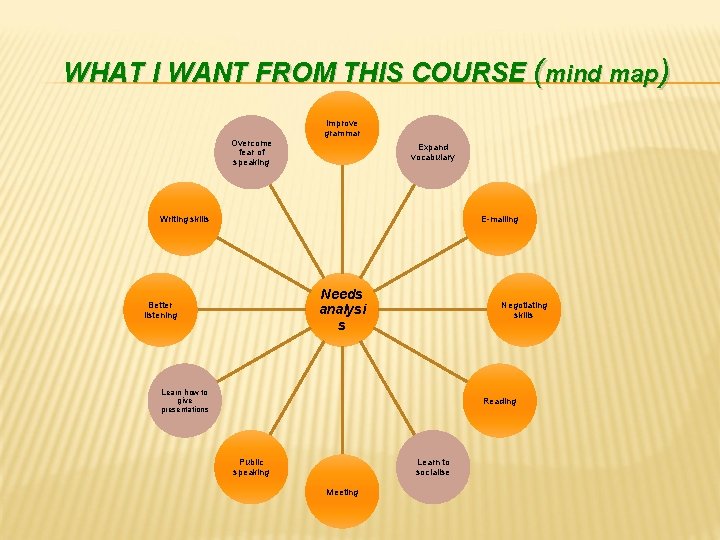
WHAT I WANT FROM THIS COURSE (mind map) Overcome fear of speaking Improve grammar Expand vocabulary Writing skills E-mailing Needs analysi s Better listening Negotiating skills Learn how to give presentations Reading Public speaking Learn to socialise Meeting
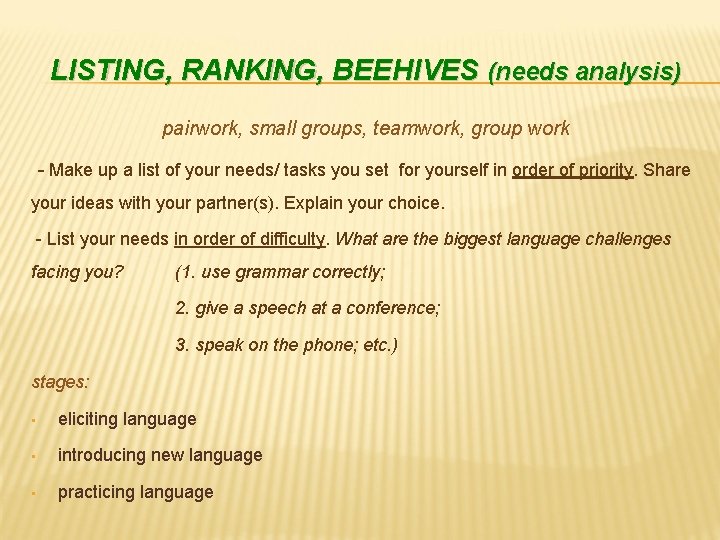
LISTING, RANKING, BEEHIVES (needs analysis) pairwork, small groups, teamwork, group work - Make up a list of your needs/ tasks you set for yourself in order of priority. Share your ideas with your partner(s). Explain your choice. - List your needs in order of difficulty. What are the biggest language challenges facing you? (1. use grammar correctly; 2. give a speech at a conference; 3. speak on the phone; etc. ) stages: • eliciting language • introducing new language • practicing language
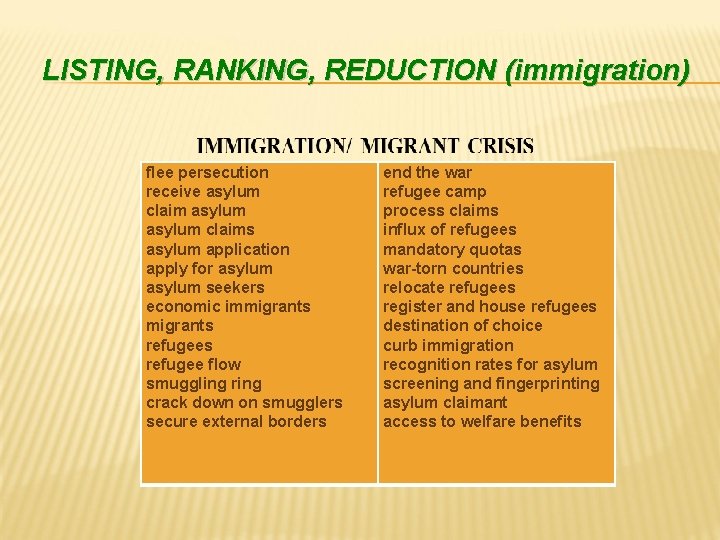
LISTING, RANKING, REDUCTION (immigration) flee persecution receive asylum claims asylum application apply for asylum seekers economic immigrants refugees refugee flow smuggling ring crack down on smugglers secure external borders end the war refugee camp process claims influx of refugees mandatory quotas war-torn countries relocate refugees register and house refugees destination of choice curb immigration recognition rates for asylum screening and fingerprinting asylum claimant access to welfare benefits
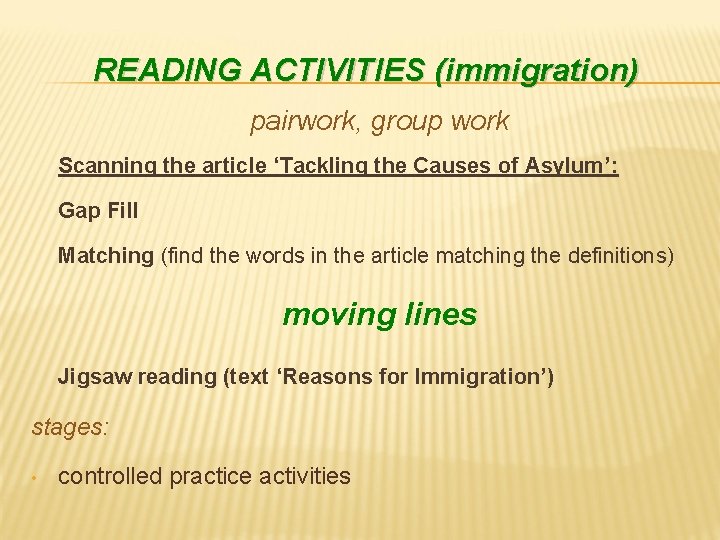
READING ACTIVITIES (immigration) pairwork, group work Scanning the article ‘Tackling the Causes of Asylum’: Gap Fill Matching (find the words in the article matching the definitions) moving lines Jigsaw reading (text ‘Reasons for Immigration’) stages: • controlled practice activities
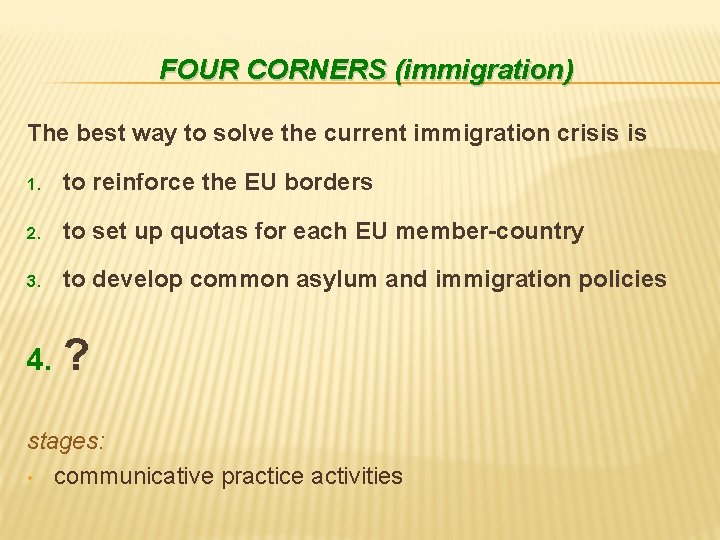
FOUR CORNERS (immigration) The best way to solve the current immigration crisis is 1. to reinforce the EU borders 2. to set up quotas for each EU member-country 3. to develop common asylum and immigration policies 4. ? stages: • communicative practice activities
HOT CHAIR (immigration) The truth “When in Rome, do as Romans do” doesn’t work in today’s immigration crisis. Immigrants have to obey laws and respect traditions of the host country. Host countries have to adapt their legislation and life style so that to cater for the interests of arriving refugees. People never leave the country if they have similar conditions in their state to the ones in the foreign state. In modern globalized world all countries and regions of the world undergo migration processes. The number of people who leave their country to look for better life in other countries has increased.
FLUENCY ACTIVITIES (immigration) Recycling input from different parts of the module teamwork, solo work q role play (Polish Baby, Migrant Orphan) q self-managing groups (Polish Baby, Migrant Orphan) q case study (Polish Baby, Migrant Orphan) qdiscussion qdebate qpresentation (solo or teams) qnegotiations q dilemma(Polish Baby, Migrant Orphan) q simulation (MISMES Conference) qmeetings
CASE STUDY/DILEMMA/ SIMULATION (immigration) Teamwork Migrant Orphan A migrant mother dies in Greece, where she was living illegally. It’s a single-parent family, so her five-year old son is now an orphan. While social service of the host country is taking care of the child, MFA officials of the host country get in touch with the consulate of the home country, and the consulate starts a standard custody procedure, looking for the boy’s relatives. The authorities of the mother’s home country take a decision to award custody to the boy’s grandmother. Suddenly, the boy’s father, who is also an illegal immigrant, turns up and claims custody of his son. The question is: Who will be legally allowed to have custody of the child? stages: communicative practice activity fluency activity reflection and feedback
SIMULATION/ PROJECT (immigration) - 1 conference on ‘MISMES from an Employment and Skills Perspective’ Leaving for work, leaving for good? Background: The European Training Foundation and The Migration Policy Centre are conducting an inventory of migrant support measures from a skills and employment perspective, which are implemented in (or by) migrant -sending countries. The MPC and the ETF are holding a conference on the implementation of the MISMES Project. The Project member-countries present their reports on the development of their national vocational education and training systems, improvement of their national employment policies, and helping their people access the labour market
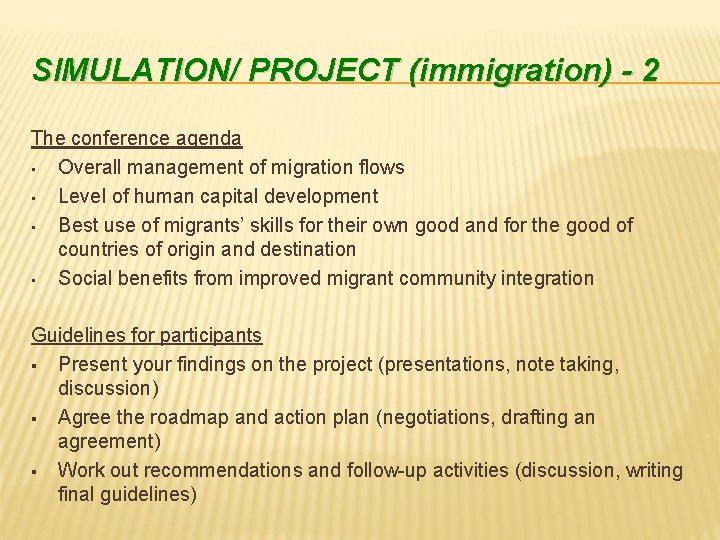
SIMULATION/ PROJECT (immigration) - 2 The conference agenda • Overall management of migration flows • Level of human capital development • Best use of migrants’ skills for their own good and for the good of countries of origin and destination • Social benefits from improved migrant community integration Guidelines for participants § Present your findings on the project (presentations, note taking, discussion) § Agree the roadmap and action plan (negotiations, drafting an agreement) § Work out recommendations and follow-up activities (discussion, writing final guidelines)
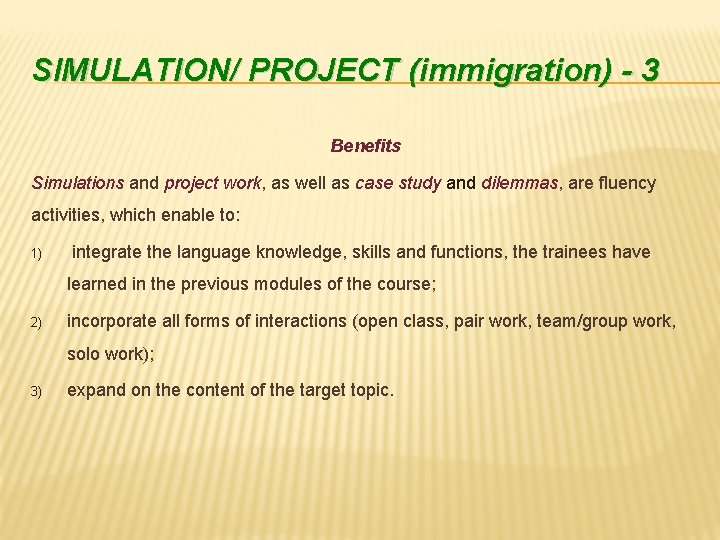
SIMULATION/ PROJECT (immigration) - 3 Benefits Simulations and project work, as well as case study and dilemmas, are fluency activities, which enable to: 1) integrate the language knowledge, skills and functions, the trainees have learned in the previous modules of the course; 2) incorporate all forms of interactions (open class, pair work, team/group work, solo work); 3) expand on the content of the target topic.
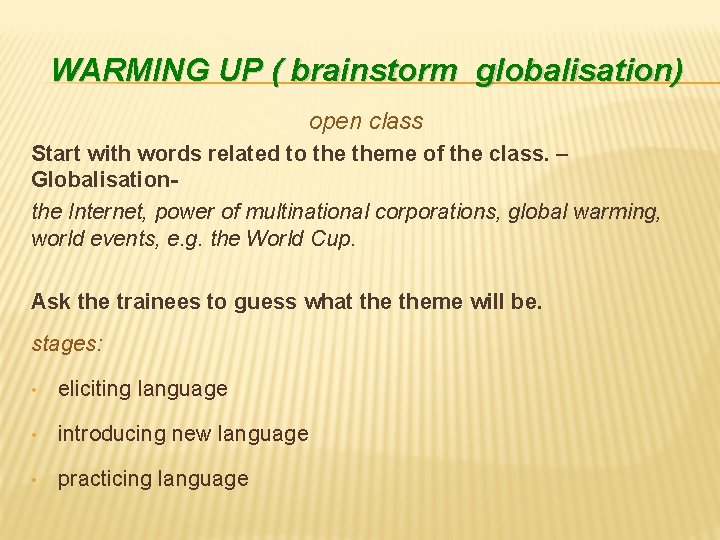
WARMING UP ( brainstorm globalisation) open class Start with words related to theme of the class. – Globalisation- the Internet, power of multinational corporations, global warming, world events, e. g. the World Cup. Ask the trainees to guess what theme will be. stages: • eliciting language • introducing new language • practicing language
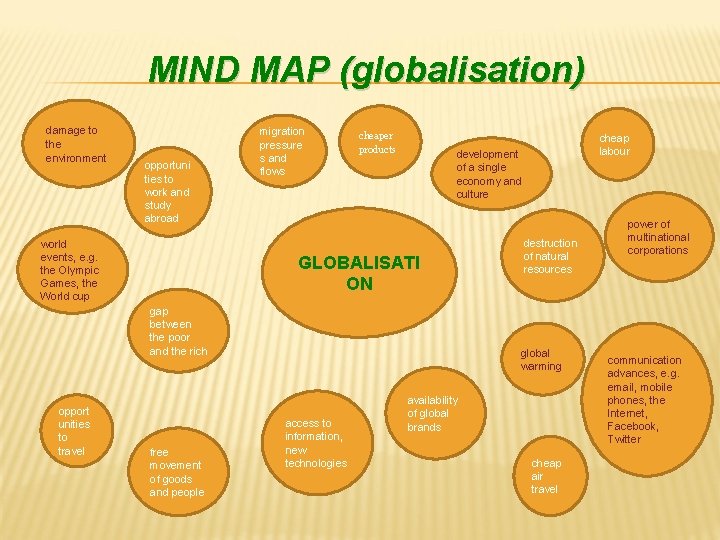
MIND MAP (globalisation) damage to the environment opportuni ties to work and study abroad world events, e. g. the Olympic Games, the World cup migration pressure s and flows cheaper products development of a single economy and culture GLOBALISATI ON gap between the poor and the rich opport unities to travel free movement of goods and people cheap labour destruction of natural resources global warming access to information, new technologies availability of global brands cheap air travel power of multinational corporations communication advances, e. g. email, mobile phones, the Internet, Facebook, Twitter
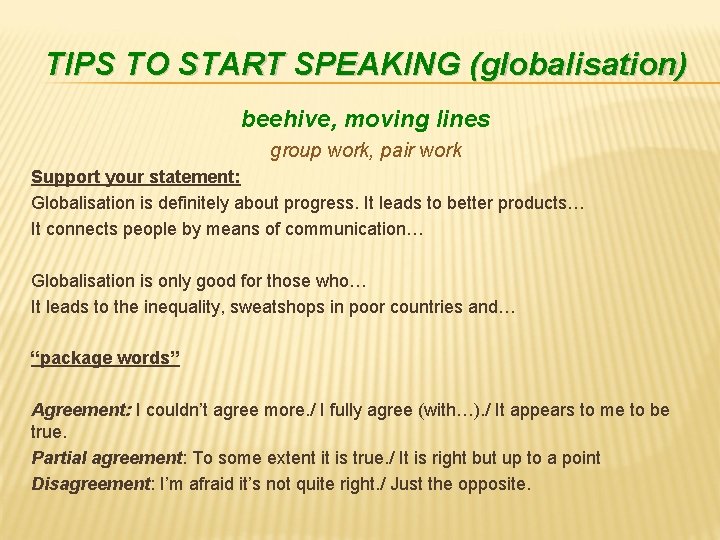
TIPS TO START SPEAKING (globalisation) beehive, moving lines group work, pair work Support your statement: Globalisation is definitely about progress. It leads to better products… It connects people by means of communication… Globalisation is only good for those who… It leads to the inequality, sweatshops in poor countries and… “package words” Agreement: I couldn’t agree more. / I fully agree (with…). / It appears to me to be true. Partial agreement: To some extent it is true. / It is right but up to a point Disagreement: I’m afraid it’s not quite right. / Just the opposite.
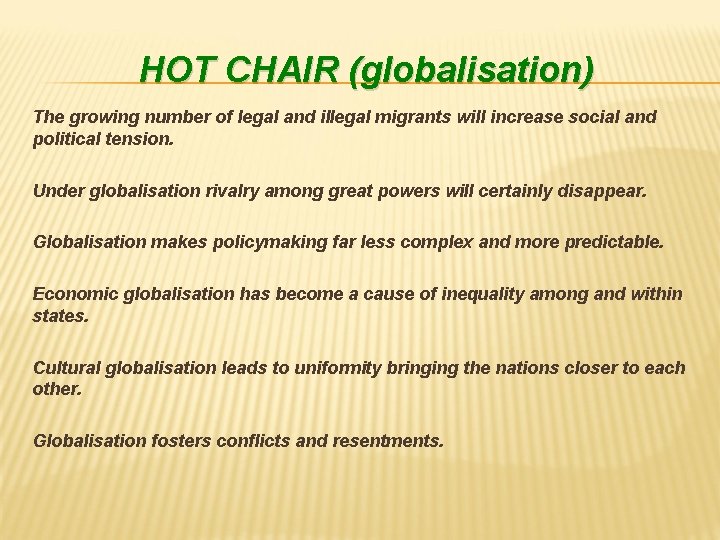
HOT CHAIR (globalisation) The growing number of legal and illegal migrants will increase social and political tension. Under globalisation rivalry among great powers will certainly disappear. Globalisation makes policymaking far less complex and more predictable. Economic globalisation has become a cause of inequality among and within states. Cultural globalisation leads to uniformity bringing the nations closer to each other. Globalisation fosters conflicts and resentments.
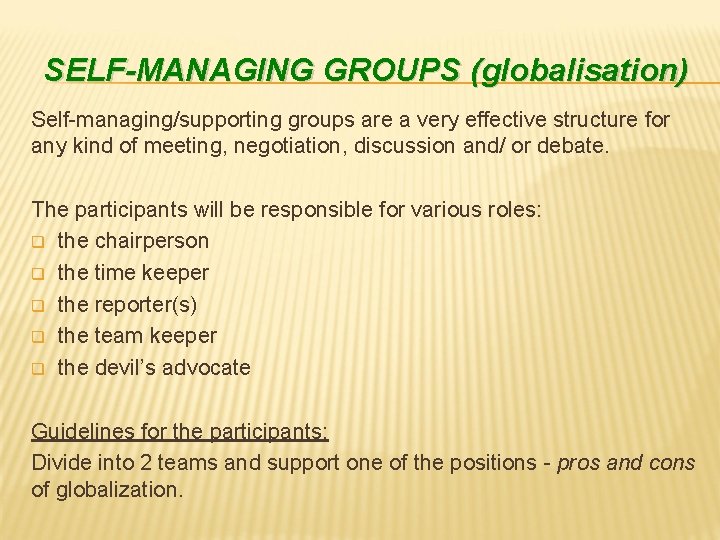
SELF-MANAGING GROUPS (globalisation) Self-managing/supporting groups are a very effective structure for any kind of meeting, negotiation, discussion and/ or debate. The participants will be responsible for various roles: q the chairperson q the time keeper q the reporter(s) q the team keeper q the devil’s advocate Guidelines for the participants: Divide into 2 teams and support one of the positions - pros and cons of globalization.
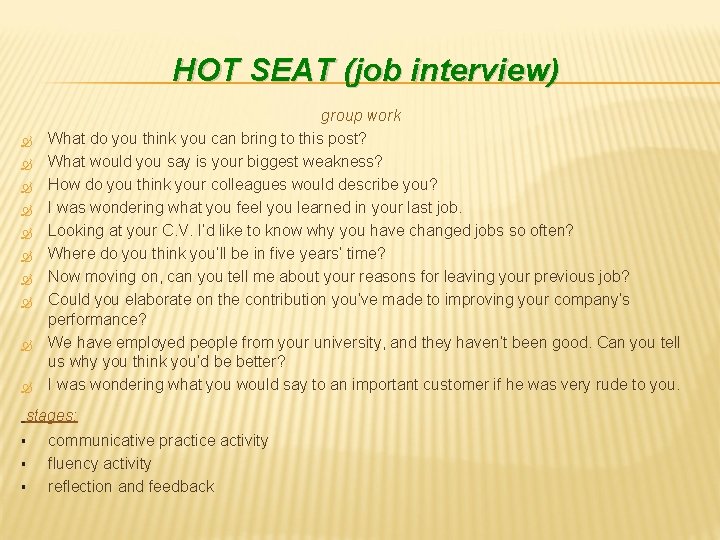
HOT SEAT (job interview) group work What do you think you can bring to this post? What would you say is your biggest weakness? How do you think your colleagues would describe you? I was wondering what you feel you learned in your last job. Looking at your C. V. I’d like to know why you have changed jobs so often? Where do you think you’ll be in five years’ time? Now moving on, can you tell me about your reasons for leaving your previous job? Could you elaborate on the contribution you’ve made to improving your company’s performance? We have employed people from your university, and they haven’t been good. Can you tell us why you think you’d be better? I was wondering what you would say to an important customer if he was very rude to you. stages: § § § communicative practice activity fluency activity reflection and feedback
MINGLING AROUND (the latest news) group work, pair work Ask your partner to tell a news story. Put the following questions: • What happened? • When did it happen? • Who was involved? • Where did it happen? • Why/ how did it happen Change the roles Change the partners Report the stories you have heard to the class
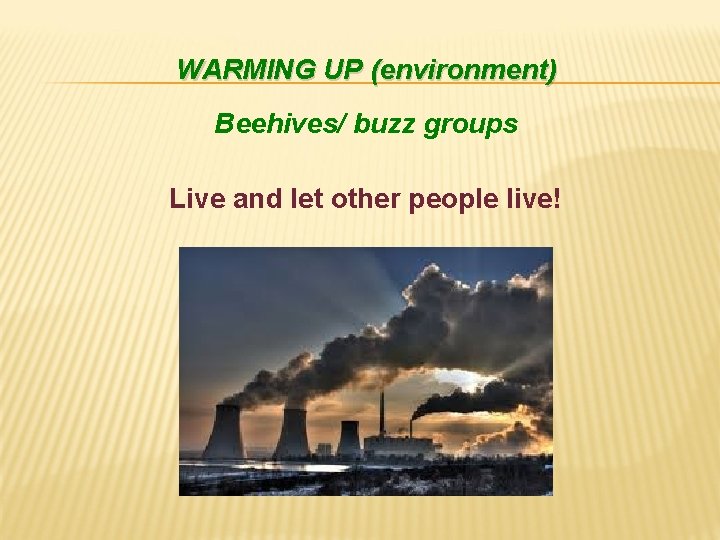
WARMING UP (environment) Beehives/ buzz groups Live and let other people live!
FROM SENTENCE TO TEXT ( environment ) beehives, reporting to the class pairwork, teamwork, There are many environmental problems such as… water pollution It happens because… oil is being spilled into rivers We would be able to solve these problems if… plants didn’t dump chemical wastes into rivers/ atmosphere/ on land In order to protect the environment people must… install antipollution equipment
FLUENCY ACTIVITIES (environment) q opening speech of the Environment Minister at a climate summit q writing a newspaper article q writing a blog entry
THANK YOU FOR YOUR ATTENION