
PARTICIPATIVE PROCESSES FOR MEASURING PROGRESS DELIBERATION CONSULTATION AND

PARTICIPATIVE PROCESSES FOR MEASURING PROGRESS: DELIBERATION, CONSULTATION AND THE ROLE OF CIVIL SOCIETY Tommaso Rondinella , Elisabetta Segre and Duccio Zola
WELL-BEING AND DEMOCRACY Statistical information needs a certain degree of legitimacy in order to be followed by policy makers (relevant, reliable). The choice of the phenomena to monitor coincides with the selection of policy priorities. What we measure affects what we do. (Stiglitz-Sen-Fitoussi report)
THE CRISIS OF DEMOCRACY In the past thirty years, strong crisis signals have emerged in terms of democratic legitimacy exactly where democracy developed – in Europe, in Japan and in the USA. [Norris 1999; Pharr and Putnam 2000]. Symptoms: very low electoral participation declining credibility of political parties and trade unions growing gap between people and élites fading away of traditional socio-cultural points of reference management of power without contacts with voters
THE ROLE OF CIVIL SOCIETY Public choices may not only be legitimized through the formal State bodies (institutional, juridical, constitutional) but necessarily must be based also on contributions from civil society, the autonomous and non-formalised space where public opinions are formed. [Habermas 2001 b; Benhabib 1996; Bohman 1996] It is a political contribution, merging the cognitive and participatory dimensions, the activists and experts' work, protest and proposal. [Pianta 2001; Marcon 2004; Marcon 2005]
![LEGITIMACY AND PUBLIC DELIBERATION “[…] a legitimate decision does not represent the will of](http://slidetodoc.com/presentation_image/55c2cd33f28ec890cd504ecb9d1afbc0/image-5.jpg "LEGITIMACY AND PUBLIC DELIBERATION “[…] a legitimate decision does not represent the will of")
LEGITIMACY AND PUBLIC DELIBERATION “[…] a legitimate decision does not represent the will of all, but is one that results from the deliberation of all. It is the process by which everyone’s will is formed that confers its legitimacy on the outcome. It implies that all participate in the deliberation, and in this sense the decision made can reasonably be considered as emanating from the people […]. The decision also proceeds from the liberty of individuals: those individuals deliberate together, form their opinions through deliberation, and at the close of the process each opts freely for one solution or another […]. [Manin 1987, 352]
CONDITIONS FOR PUBLIC DELIBERATION Equality among participants. Inclusion in the decision-making process of all those who are affected by the deliberation. Free, public and equal representation of interests. Mutual understanding. Pursuing of the common good. For more technical issues see also e-Frame FP 7 project (Work Package 7 - www. eframeproject. eu)
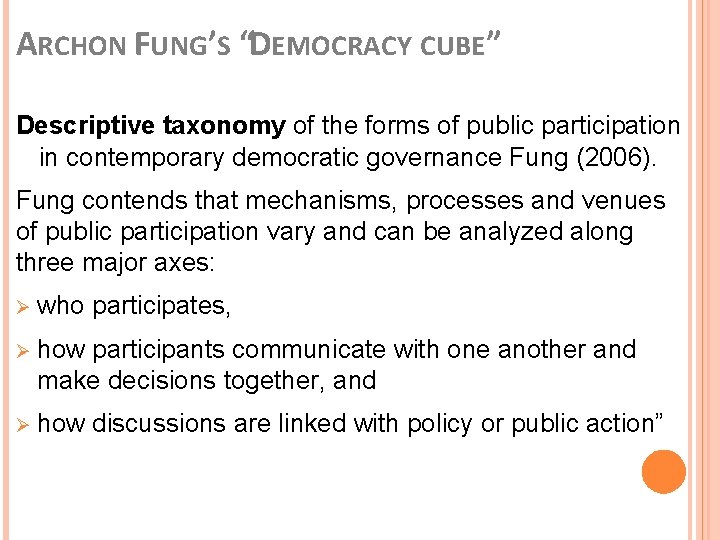
ARCHON FUNG’S “DEMOCRACY CUBE” Descriptive taxonomy of the forms of public participation in contemporary democratic governance Fung (2006). Fung contends that mechanisms, processes and venues of public participation vary and can be analyzed along three major axes: Ø who participates, Ø how participants communicate with one another and make decisions together, and Ø how discussions are linked with policy or public action”

ARCHON FUNG’S “DEMOCRACY CUBE”
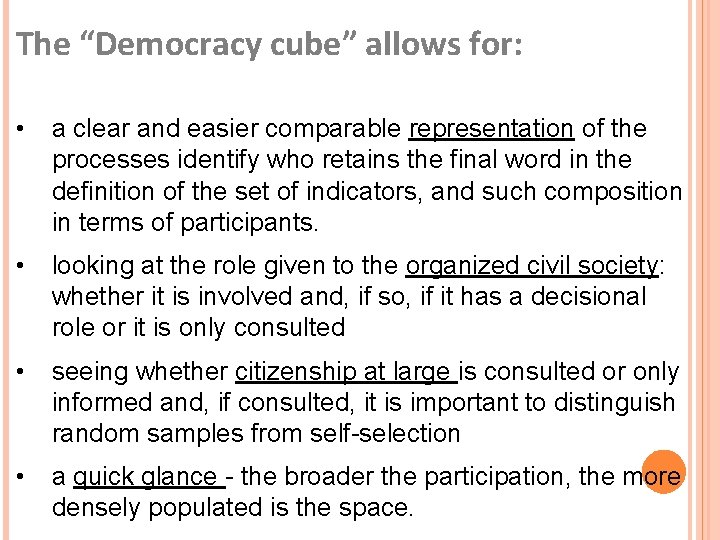
The “Democracy cube” allows for: • a clear and easier comparable representation of the processes identify who retains the final word in the definition of the set of indicators, and such composition in terms of participants. • looking at the role given to the organized civil society: whether it is involved and, if so, if it has a decisional role or it is only consulted • seeing whether citizenship at large is consulted or only informed and, if consulted, it is important to distinguish random samples from self-selection • a quick glance - the broader the participation, the more densely populated is the space.
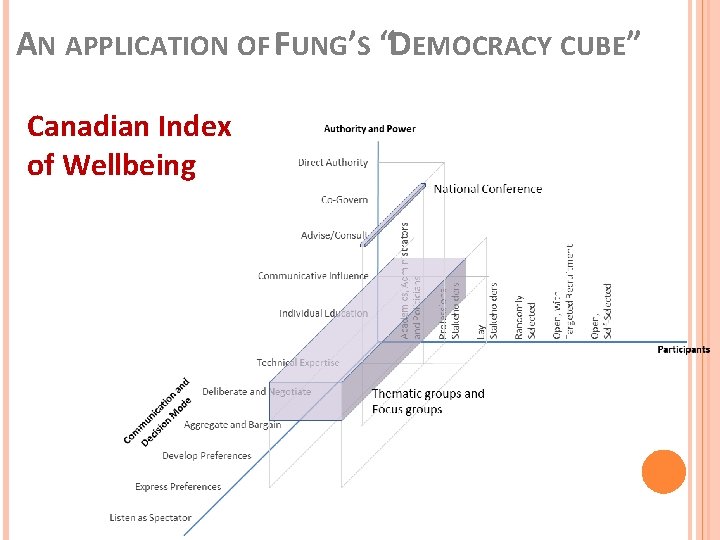
AN APPLICATION OF FUNG’S “DEMOCRACY CUBE” Canadian Index of Wellbeing
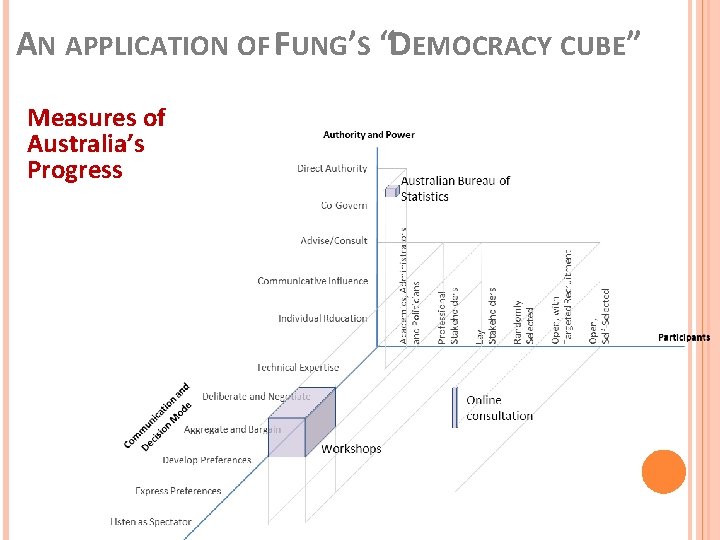
AN APPLICATION OF FUNG’S “DEMOCRACY CUBE” Measures of Australia’s Progress
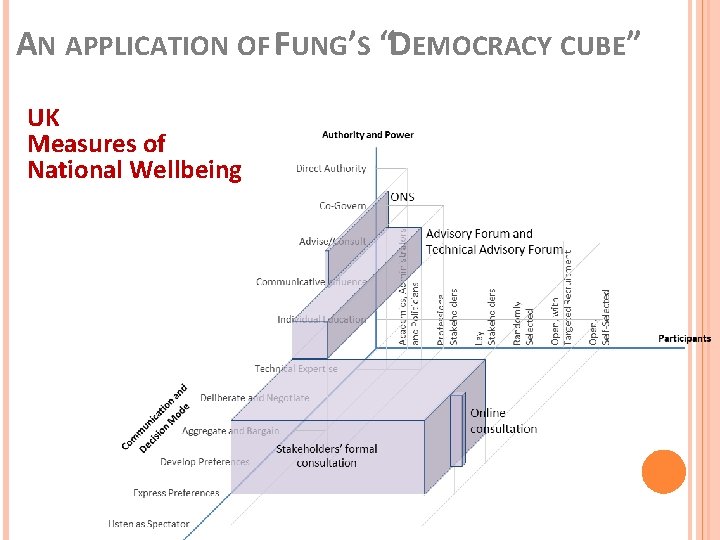
AN APPLICATION OF FUNG’S “DEMOCRACY CUBE” UK Measures of National Wellbeing
AN APPLICATION OF FUNG’S “DEMOCRACY CUBE” Italy’s BES
Conclusions • Set of indicators needs to be democratically (and thus politically) legitimated. • Legitimacy can be effectively granted through a deliberative process able to engage citizens and civil society. • Unfortunately, deliberative processes are quite rare in the panorama of experiences of national projects for measuring progress and well-being. • Consultative processes are more common, but they lack of representativeness and thus of legitimation.
THANK YOU. RONDINELLA@ISTAT. IT PARTICIPATIVE PROCESSES FOR MEASURING PROGRESS: DELIBERATION, CONSULTATION AND THE ROLE OF CIVIL SOCIETY
- Slides: 15