
Participative Monitoring and Evaluation amongst NGOs in Kenya


- Slides: 17
Participative Monitoring and Evaluation amongst NGO’s in Kenya: Towards Lessons of experience and improved practices Erick Mariga 4 th Biennial Conference on Monitoring and Evaluation, South Africa, September 2013
Objectives of the Presentation • Background • Introduction • Demystifying Participative M&E amongst NGO’s in Kenya • Significance of Participative M&E • Key Participative M&E themes • Case Perspective • Lessons of Experience as a result of implementation of PME systems
Background • Kenya is the largest economy in East Africa and is a regional financial and transportation hub. The country’s economic expansion is fairly broadbased and its build on a stable macro-environment fostered by government. • However the country presents a situation where it has slide systematically into the abyss of underdevelopment and poverty, this has been attributed to corruption and bad governance. • As a developing country, Kenya receives large amounts of foreign assistance, most of which is distributed through non-governmental organizations. Many of these NGO’s have offices in Nairobi, which is the capital. • NGOs operate at all levels - grass-roots, national, regional and international. Many conduct high-impact, high-resource projects and operate in the fields of health, refugees, environment, human rights, education, and other key aspects of international development.
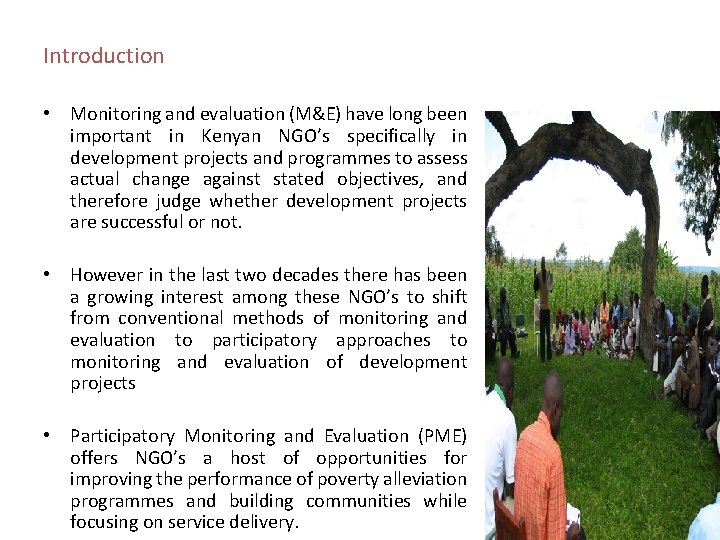
Introduction • Monitoring and evaluation (M&E) have long been important in Kenyan NGO’s specifically in development projects and programmes to assess actual change against stated objectives, and therefore judge whether development projects are successful or not. • However in the last two decades there has been a growing interest among these NGO’s to shift from conventional methods of monitoring and evaluation to participatory approaches to monitoring and evaluation of development projects • Participatory Monitoring and Evaluation (PME) offers NGO’s a host of opportunities for improving the performance of poverty alleviation programmes and building communities while focusing on service delivery.
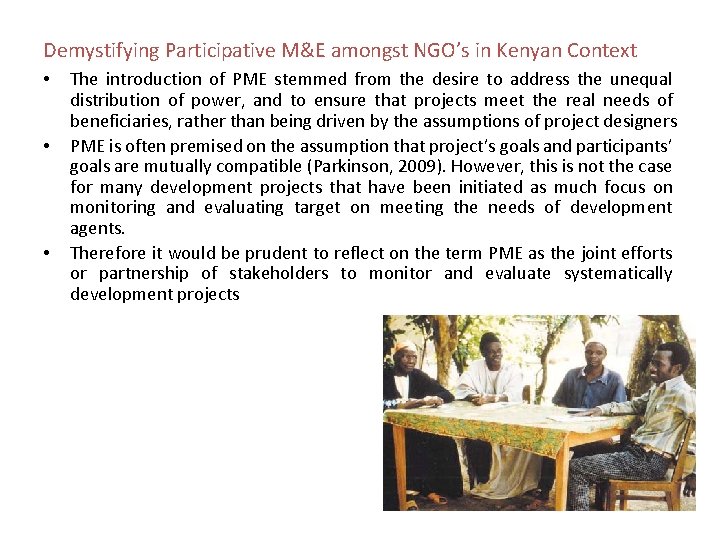
Demystifying Participative M&E amongst NGO’s in Kenyan Context • • • The introduction of PME stemmed from the desire to address the unequal distribution of power, and to ensure that projects meet the real needs of beneficiaries, rather than being driven by the assumptions of project designers PME is often premised on the assumption that project’s goals and participants’ goals are mutually compatible (Parkinson, 2009). However, this is not the case for many development projects that have been initiated as much focus on monitoring and evaluating target on meeting the needs of development agents. Therefore it would be prudent to reflect on the term PME as the joint efforts or partnership of stakeholders to monitor and evaluate systematically development projects
What is the significance of Participative M&E amongst NGO’s “It is useful to be acquainted with history… it keeps repeating itself, as if we liked it” -Linn Hansen. Knowledge about Participative M&E is not lacking but the will to use and implement it appropriately is……. .
Perspectives – An integrated PME system in an organizational system can enable effective planning, monitoring and evaluation of project activities in a coherent manner which would further aid in support of management decision making, accountability, and organizational learning • Holte-Mc. Kenzie, Forde & Theobald, (2006), in their study on ‘Moving the Goalposts Kilifi’ (MTGK) in Kenya implemented PME and found out that MTGK was dedicated to the empowering of girls and young women through football and the decision was made to develop a PME strategy. – Nevertheless, their findings revealed that while program staff, board members and fund providers were involved in the evaluation, design and data analysis, program participants/beneficiaries were the least likely to participate in evaluating, and were often only involved in data collection. – Based on this study, I think it is prudent for us to point out that people who are the beneficiaries of development projects partially participate (co-opted) in the monitoring and evaluation processes.
Key Participatory Monitoring and Evaluation Themes Participatory development approaches including PME have major guiding principles in terms of undertaking NGO projects/programmes in communities. These include: the principles of : vcommunity participation, vaccountability, vtransparency, vempowerment, vcapacity building & vdecision making.
Case Perspective: • Youth Reconciliation Forum of Kenya (YOREF Kenya) is a nonpartisan national nongovernmental organization registered by the registrar of societies of Kenya on 25 th March 2010. • It was started by young leaders of different ethnic community extract drawn from diverse leadership backgrounds in civil society, students union leadership, political parties youth leadership, the media, religious sector, among others. • A remarkable inclusive approach brought on board reputable leaders already in national leadership positions to steer the organization in the desired direction.
Cont: • The near collapse of the state in early 2008 as a result of disputed presidential poll results which gave way to unprecedented Post-Election Violence that left hundreds of Kenyans dead, property worth billions of shillings destroyed and led to deportation of populations, informed the formation of YOREF Kenya. • As it were, the urgent need of peace, reconciliation, harmony, coexistence and return to normalcy bolstered the move to found YOREF Kenya and contribute meaningfully to all peace initiatives and conflict mitigation processes.
YOREF Kenya Thematic Programs • • Conflict Mitigation and Peace Building YOREF Kenya focuses on reconciliation and building new relationships amongst conflicting communities Such activities include inter-ethnic dialogue, cultural exchange programs negotiations, and problem solving workshops, information, education and communication. The organization also involves multiple non-state and state actors such as the government, elders, professional elites, women, religious leaders and youth. Through grass roots involvement YOREF Kenya, gives priority to mobilization of community resources, victims and perceived perpetrators of violent conflict, to nurture community based response mechanisms that pave way for reconciliation amongst conflicting tribes and clans.
Democracy and Good Governance • YOREF Kenya understands that execution of acts of political violence is only possible when electorate have inadequate civic awareness regarding democratic processes and governance issues. • YOREF Kenya designates comprehensive civic education as intervention entry point to curb violence resulting from consequences above. • Timely civic education is carried out before and during campaign periods preceding elections and/or referenda through focused group discussions (FGD), training workshops, seminars/conferences, and roundtable discussions.
Participative Monitoring and Evaluation Process (YOREF) • In the implementation of YOREF Kenya programs routine PME is carried out through out the project period. Implementation Impact Assessment (INIA) is conducted alongside expert monitoring consultants with a view of innovating new approach, adjustments and readjustments. There also quarterly reports on the implementation progress testing preset objectives achievements. • YOREF Kenya in conjunction with donor partners and relevant stakeholders hold regular participatory evaluation sessions and terminal assessments to test indicators and develop future models of implementation plan unique to each project.
Lessons of Experience as a result of implementation of PME systems • PME increases public accountability and transparency amongst NGO’s • There is also improved decision-making where NGO’s fully implement PME systems • Community participation is fostered through PME • Laying the Foundation for building capacity • Empowerment of project beneficiaries.
Areas of Future Research • Documentation versus Sharing of PME Experiences Lack of well-documented experiences in PME can be a limitation to sharing ideas about the process and impact of PME,
Local Opinion! Need for Participation & Ownership “ There are many doctors in Isiolo. Some are Private while others are civil servants. A sick person in this area has choices to make among them and may try all the doctors but only one will cure him. I wonder why, with so many development experts around us and for so long. Still there has been no cure for this disease called “ovati” (read poverty)? Experts have to come to us from all over the world: Europeans, Americans, and Canadians. . from many great nations, to see our ‘Ovati’! It was only the other day they came to our village in twelve vehicles. Now, here you are from Nairobi talking about the same thing. How come with all these brains, still there is no cure, no solution to our ‘ovati’? I am not seeking for any personal gain out of this question, neither am I expecting a ‘quick-fix’ answer. But i am pleased to be able to express this concern in this forum as it has bothered me for a long time now” (KCDF Workshop Report, 2011).
THE END ericomariga@gmail. com