
Participation vs Helping Model Norman Kunc We must
- Slides: 16
Participation vs. Helping Model
Norman Kunc • We must listen to both the verbal and non-verbal messages expressed by someone who may or may not want help. We must use this information to guide our actions and increase our sensitivity. It doesn't sound like much, but the ramifications are enormous. It is often during times that we are hell-bent on helping that we listen least well. We all know stories about people with visual impairments being forcibly "escorted" over crosswalks by well-meaning pedestrians, of people in nursing homes being fed when they are not hungry, of what the participants in the Dembo study aptly called "unexpected attacks" of help (Ladieu, Hanfmann, & Dembo, 1947, in Wright, 1983, pp. 309).
Why is this Important? Group Discussion
Norman Kunc • Professional caretakers are made, not born. How does it happen? Put a third-grade "helper" next to a third grade "helpee". Add a sizable amount of adult approval, and there you have it. • It is not entirely thrilling that kids who take part in friendship circles during school go on to careers in human service. Don't misunderstand. Lots of wonderful people choose this profession. However, an unfortunate result is that lots of children and adults with mental and physical handicaps have legions of professional caregivers, but no friends in their lives. We must guard against merely creating another generation of "professionals" and "clients", with the former group seen as perpetually competent, and the latter, perpetually needy.
What might be some reasons we gravitate toward a helping model? • 30 seconds to write down a few ideas • Share with an elbow partner
Norman Kunc • But what's a teacher to do? To create a helper is relatively easy; to facilitate a friendship is tough. After all, friendship cannot simply be mandated. At best, it seems to be made up of one third proximity and two thirds alchemy! • Perhaps we must begin by acknowledging what should be, but is not always obvious. That is, no one has the power to conjure up friendship at will. Maybe that's just as well. Friendship is about choice and chemistry, and cannot even be readily defined, much less forced. This is precisely its magic. Realizing this, we can acknowledge without any sense of inadequacy that we are not, nor need to be, friendship sorcerers. • Let's "begin at the beginning", and examine what help means to all of us. In most societies today, helping others is viewed as a socially admirable course of action. Those of us who are in a so-called "privileged position" are asked to give to others. We know we should give to our families, our communities, and most of all, to those "less fortunate" than ourselves. Yet, why is it that most of us, while perfectly comfortable offering help, are decidedly uncomfortable receiving it?
Mentor vs. Mentee • What do these words communicate? • Does it sound similar to a helper and helpee relationship? • Complicated because of the Name of the Evidence Based Practice – Peer Mediated Instruction • What terms are used in your program and do your terms tend to convey the helper / helpee relationship? What other terms could be used? TABLE DISCUSSION
The Helping Model… • Creates an unnatural hierarchy between students • Creates an authoritative relationship • Incites power in the relationship • Students are viewed as different
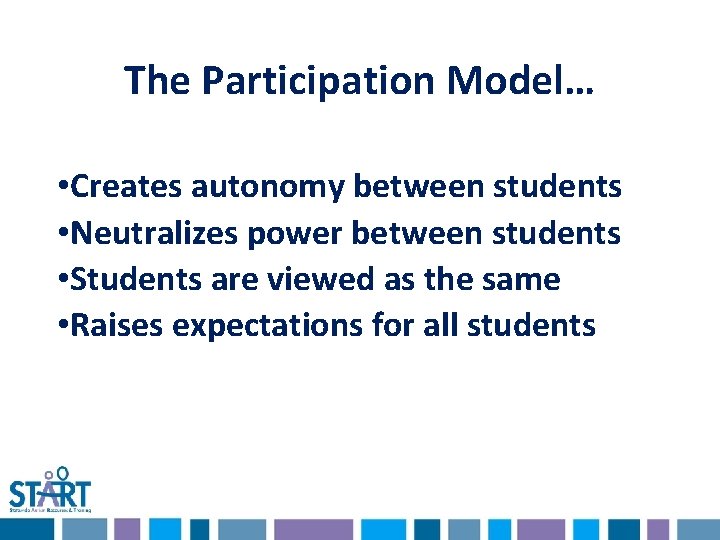
The Participation Model… • Creates autonomy between students • Neutralizes power between students • Students are viewed as the same • Raises expectations for all students
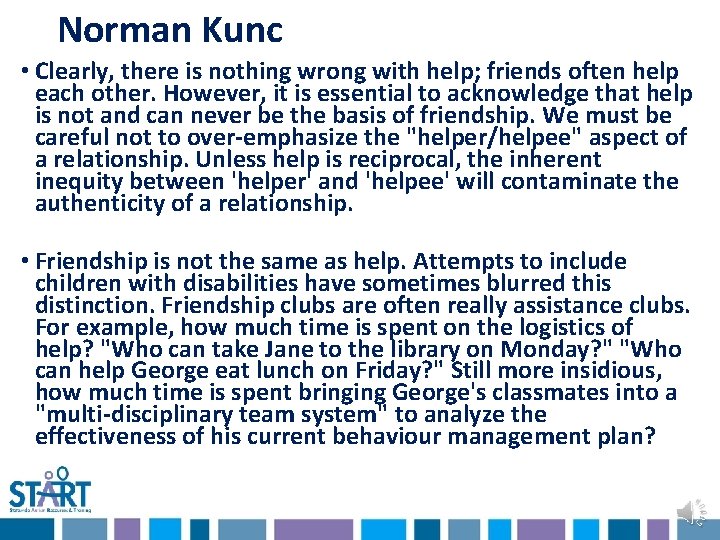
Norman Kunc • Clearly, there is nothing wrong with help; friends often help each other. However, it is essential to acknowledge that help is not and can never be the basis of friendship. We must be careful not to over-emphasize the "helper/helpee" aspect of a relationship. Unless help is reciprocal, the inherent inequity between 'helper' and 'helpee' will contaminate the authenticity of a relationship. • Friendship is not the same as help. Attempts to include children with disabilities have sometimes blurred this distinction. Friendship clubs are often really assistance clubs. For example, how much time is spent on the logistics of help? "Who can take Jane to the library on Monday? " "Who can help George eat lunch on Friday? " Still more insidious, how much time is spent bringing George's classmates into a "multi-disciplinary team system" to analyze the effectiveness of his current behaviour management plan?
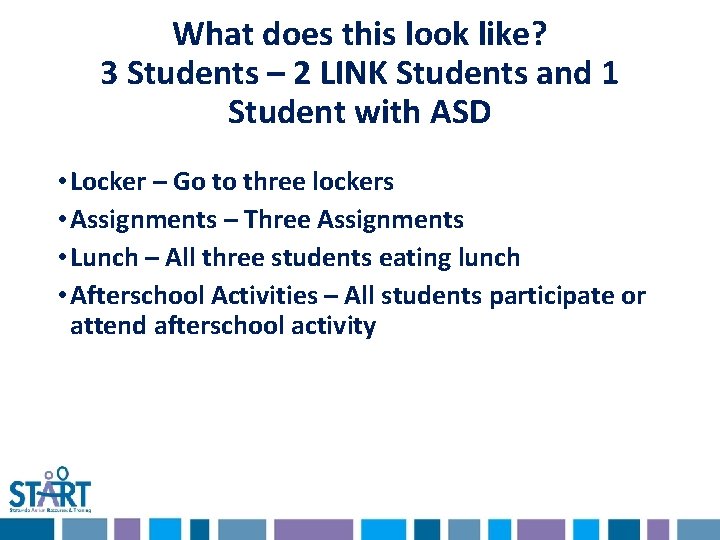
What does this look like? 3 Students – 2 LINK Students and 1 Student with ASD • Locker – Go to three lockers • Assignments – Three Assignments • Lunch – All three students eating lunch • Afterschool Activities – All students participate or attend afterschool activity
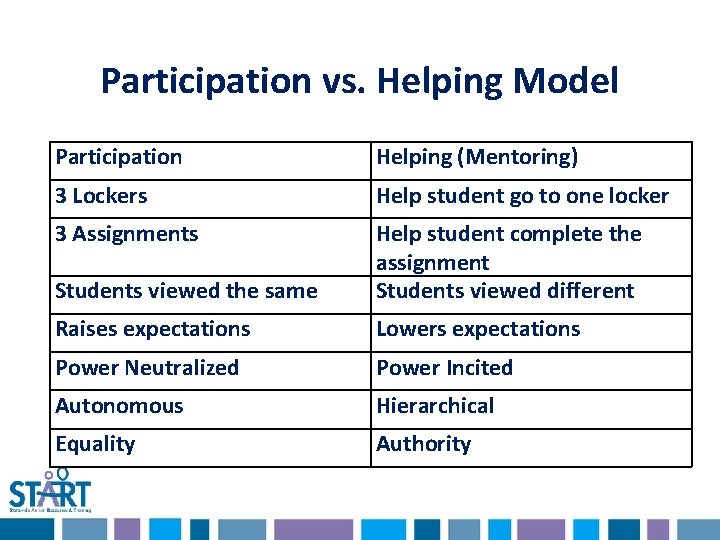
Participation vs. Helping Model Participation Helping (Mentoring) 3 Lockers Help student go to one locker 3 Assignments Students viewed the same Help student complete the assignment Students viewed different Raises expectations Lowers expectations Power Neutralized Power Incited Autonomous Hierarchical Equality Authority
Norman Kunc We must take care not to inadvertently reinforce the notion that those with disabilities are objects of pity. Equitable relationships cannot be built on a foundation of pity. Instead, we must build on the shared experiences, the shared stories between us to create a sense of empathy, a sense of "I know what you mean. " This does not disregard our different experiences. It is certainly true that having a disability and being an immigrant are not completely comparable experiences. Likewise, being left out of games on the playground and being the victim of racist behaviour is not the same. However, where experiences do intersect, we have an opportunity to build connection and understanding that may extrapolate to other situations in unexpected ways.
Give 2 to Get 3 What might be some specific strategies we can use to better ensure we are implementing a participation model? • Identify 1 strategy • Write on a post it note (you will be adding 2 more so write small) • Go share your strategy with a partner and get a strategy from them (add to your post it) • Go share your partner’s strategy with a different partner and get their partner’s strategy (add it to your post it) • Return to your table • Round robin – share all strategies and summarize to Top 3
Report Out • Relax… be a friend… don’t come on too strong – be chill • Communicate with staff what you are, who you are, what the goal is • Make these slides available on the Drive & add to p 2 p module • Make sure extra assignments are available for peers (communication) • Use only friend as vocabulary • Don’t force the help – you can’t help someone who doesn’t want the help • UCS – sports even playing field of participation – use similar model “principle of meaningful involvement” – what is everyone’s ROLE on the team – identify strengths and challenges of all friends and then it is ok to ask for help with challenges • Use IEP process – priorities from peers / families for facilitating • PRESUME COMPETENCE – use this concept – work together as a pair (both names on assignment / get same grade) • Take / letter to the principals to how to take the next step for moving peer to peer forward • Make yourself available but don’t force help • Presentation at a staff meeting – brief PPT slide to differentiate helper vs. participation – will help gen ed to know this • Make sure Links know what they are there for – you are both learning from each other • Final outings – some students don’t want help but outings facilitates relationship which results in cohelping—consider doing it not just at end of the semester but beginning as well (helps build the relationship from the beginning) • Take the term disability out – use learning differences instead– list students and what they do well (go to them for help on THIS)—we are all friends with strengths and challenges and we can authentically “help” each other • Find little moments for Medium of Exchange in which kids can spend time together (pockets where relationships develop) – commonalities • Jobs kids can do together – something small but they can do it together • Chart that outlines information from peers to use in IEP or other contexts • End of year survey – kids say they want MORE – how can we do this during the school day – created peer to peer room (games, sensory, etc. ) —opportunities to go / use for a variety of purposes – really helped those that have a difficult time connecting – created by students (student-led grant)
• Don't Make Friendship a Big Deal • Friendship between children is wonderful. However, it is not a big deal. If we commend and praise children without disabilities for their interactions with their peers with disabilities (either publicly or in other ways), we inadvertently make friendship a big deal and imply that all children are not created equal. We reinforce the idea that it is morally and socially admirable to "help the handicapped, " and, thereby may remove the opportunity for equality and reciprocity. • Respect Personal Boundaries • Adults are seldom comfortable talking about childhood sexuality. But the truth is, children start noticing each other in kindergarten. People with disabilities, however, often receive messages that tell them they are asexual, and these messages begin early. Boundaries of touch that would not be crossed between kids without disabilities should never be crossed with their classmates with disabilities. • An unfortunate side-effect of tolerant or benevolent interaction is a tendency to treat the "different" child like a life-sized doll or pet, or a classroom mascot with whom the usual physical boundaries of touch may be violated. We must always ask, "Do the interactions between children in any way compromise the dignity of the individual with the disability? "