
Participation Questions Chap 3 Which publicly traded Company
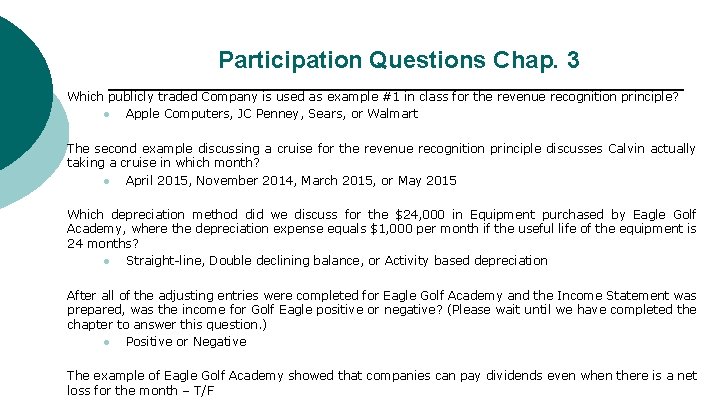
Participation Questions Chap. 3 Which publicly traded Company is used as example #1 in class for the revenue recognition principle? l Apple Computers, JC Penney, Sears, or Walmart The second example discussing a cruise for the revenue recognition principle discusses Calvin actually taking a cruise in which month? l April 2015, November 2014, March 2015, or May 2015 Which depreciation method did we discuss for the $24, 000 in Equipment purchased by Eagle Golf Academy, where the depreciation expense equals $1, 000 per month if the useful life of the equipment is 24 months? l Straight-line, Double declining balance, or Activity based depreciation After all of the adjusting entries were completed for Eagle Golf Academy and the Income Statement was prepared, was the income for Golf Eagle positive or negative? (Please wait until we have completed the chapter to answer this question. ) l Positive or Negative The example of Eagle Golf Academy showed that companies can pay dividends even when there is a net loss for the month – T/F

Announcements ¡ ¡ No Class on Monday 9/26/16 during exam period. Video for salary problem in Webcourses Class Materials for Chapter 3 ¡ Assignments – 9/25/16 ¡ Participation Questions for Chapter #3 questions (Webcourses) – 1 attempt ¡ Connect Homework Assignment #3 (Connect) – unlimited attempts ¡ Materia Homework Assignment #3 (Webcourses) – unlimited attempts ¡ Learn Smart – 5 points Extra Credit for Block 1 ends 9/26/16 at 11: 59 PM ¡ Exam 1 – September 26 th – 28 th from 7 AM – 11: 59 PM CBA Testing Center BA 2 room #104 or Satellite Campus Satellite campus - COBA Pass required l UCF Valencia Osceola l UCF Valencia West l UCF Sanford/Lake Mary (Seminole State College) l UCF Cocoa (East Florida State College) COBA Pass: https: //www. coba. bus. ucf. edu/pass/ ¡ ¡ ¡
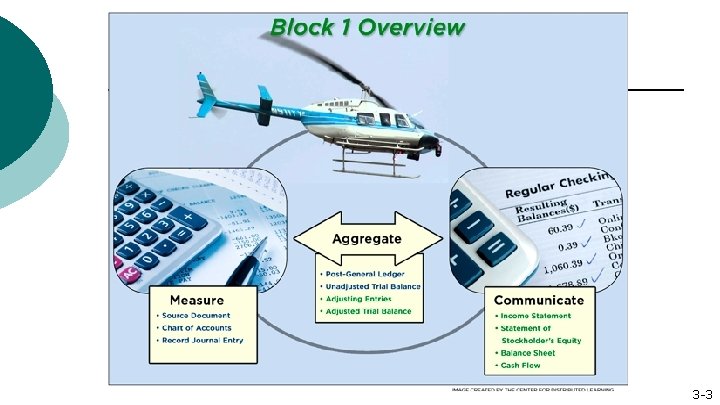
3 -3
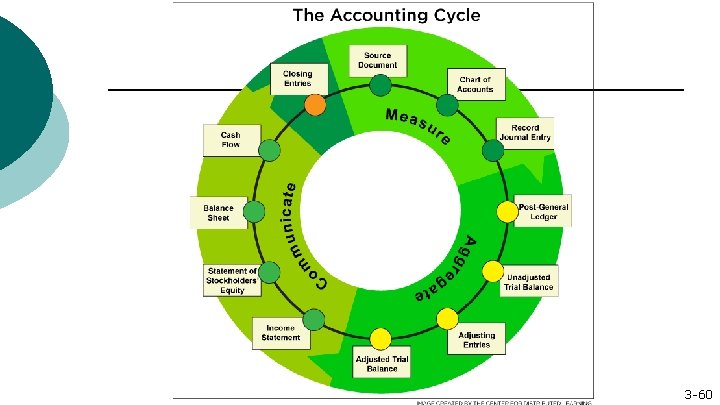
Questions to be Answered Chapter 3 – Once we have all of the transactions aggregated, how do we communicate this information to decisionmakers?
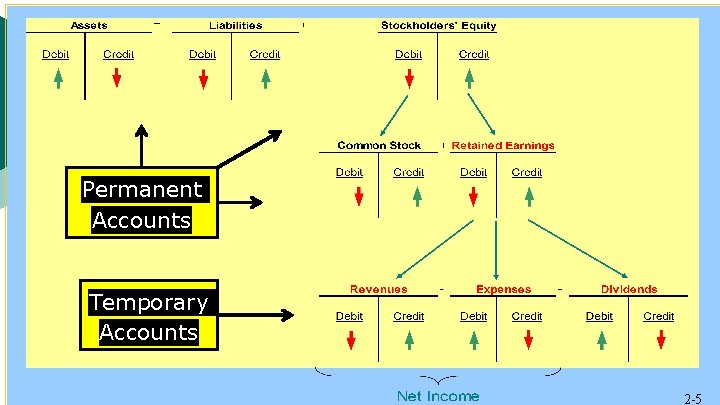
Debit and Credit Effects on Accounts in the Expanded Accounting Equation – Page 56 Permanent Accounts Temporary Accounts 2 -5
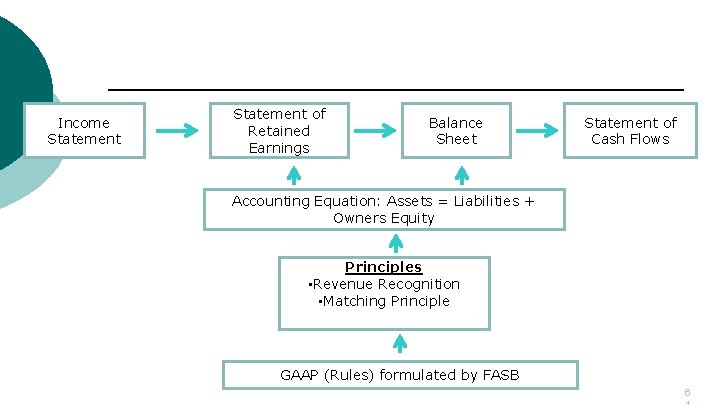
Chapter 3 End of Period (Internal) Transactions Learning Objectives: 1. ) Revenue and expense reporting – Principles 2. ) Accrual versus cash accounting 3. ) Complete the remaining portion of the accounting cycle a. ) Adjusting Entries (end of period – internal transactions) b. ) Adjusted Trial Balance c. ) Financial Statements i. ) Income Statement ii. ) Statement of Stockholders’ Equity iii. ) Balance Sheet iv. ) Statement of Cash Flows d. ) Closing Entries
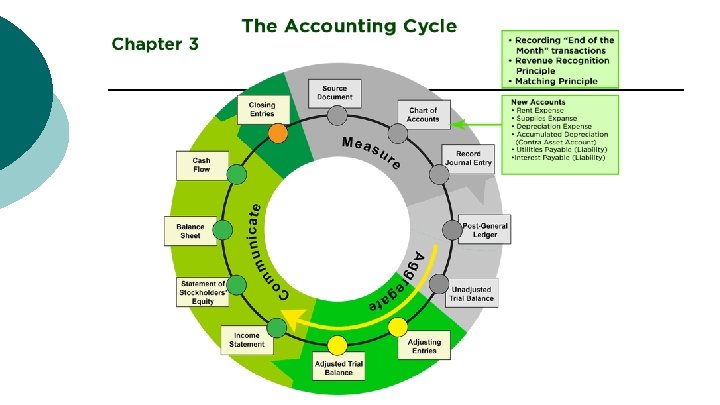
LO 1 Revenue and Expense Reporting Accrual-basis accounting records revenues when product or service is provided (the revenue recognition principle) and expenses with related revenues (the matching principle). 1. ) Revenue Recognition Principle: This principle directs us to record revenues in the period in which the goods or services are provided to customers. 2. ) Matching Principle Recognize expenses in the same period as the revenue they help generate. 3 -8
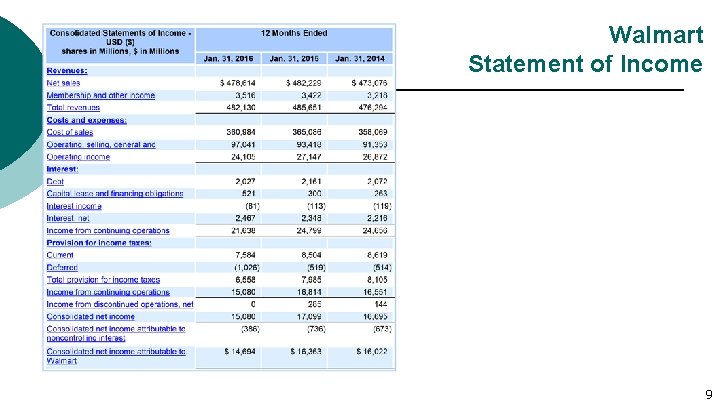
Walmart Statement of Income 9
Walmart – Revenue Recognition – Example #1 (Financial Statement Notes) ¡ ¡ ¡ Sales l Walmart recognizes sales revenue, net of sales taxes and estimated sales returns, at the time it sells merchandise to the customer. Membership Fee Revenue l Walmart recognizes membership fee revenue both in the United States and internationally over the term of the membership, which is typically 12 months. l Membership fee revenue is included in membership and other income in Walmart's Consolidated Statements of Income. The deferred membership fee is included in accrued liabilities in Walmart's Consolidated Balance Sheets. Shopping Cards l Customer purchases of shopping cards are not recognized as revenue until the card is redeemed and the customer purchases merchandise using the shopping card
Revenue Recognition Principle – Example #2 Recognize revenue when product or service is provided to the customer o Calvin books a cruise with Carnival Cruise Lines, the world’s largest cruise line. He makes reservations and pays for the cruise in November 2014, but the cruise is not scheduled to sail until April 2015. o When does Carnival report revenue from the ticket sale? 3 -11
Revenue Recognition Principle – Example #3 Suppose that, anticipating the cruise, Calvin buys a Jimmy Buffet CD from Best Buy. Rather than paying cash, Calvin uses his Best Buy credit card to buy the CD on account. When does Best Buy recognize revenue? 3 -12
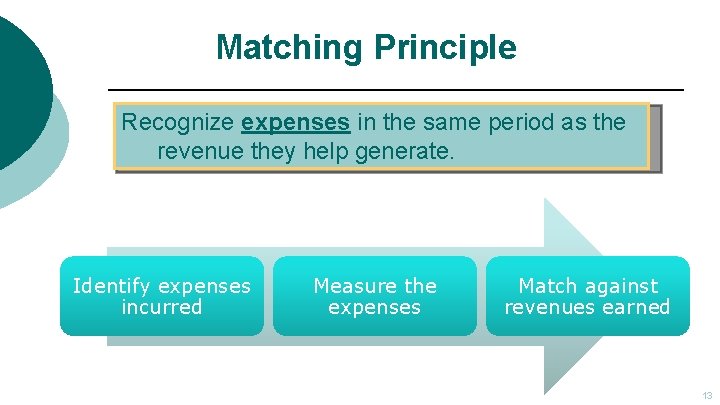
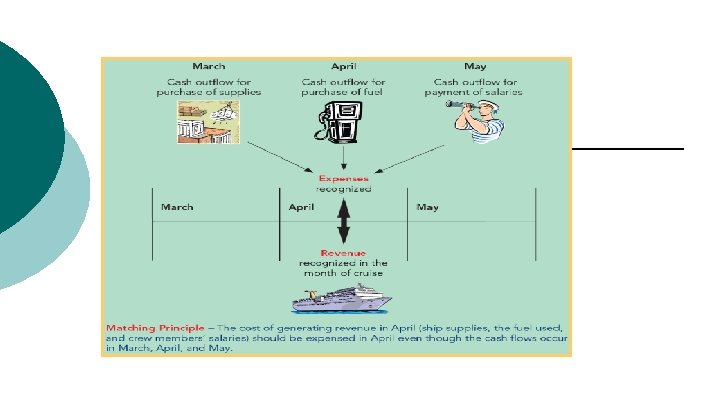
Matching Principle Recognize expenses in the same period as the revenue they help generate. Identify expenses incurred Measure the expenses Match against revenues earned 13
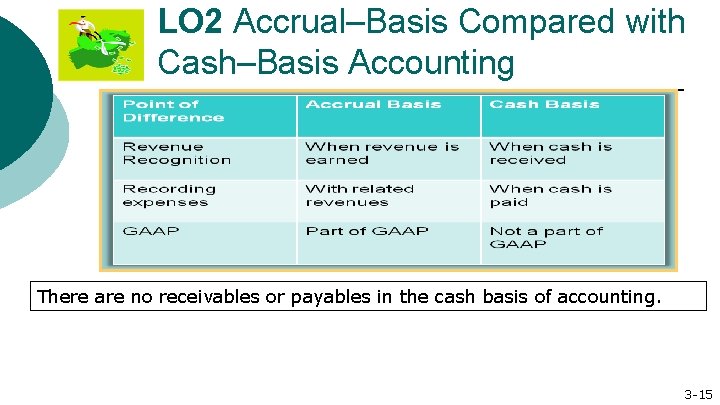
LO 2 Accrual–Basis Compared with Cash–Basis Accounting There are no receivables or payables in the cash basis of accounting. 3 -15

Special Bonus Material – 100 Points for correct answer … What is an extroverted accountant like? He’ll look at your shoes while talking to you instead of his own. Two accountants are in a bank when armed robbers burst in. While several of the robbers take the money from the tellers, others line the customers up against a wall and proceed to take their wallets, watches, and other valuables. In the midst of the chaos, accountant No. 1 jams something in accountant No. 2’s hand. Without looking down, accountant No. 2 whispers, "What is this? " to which accountant number one replies, "It's that $50 I owe you. "
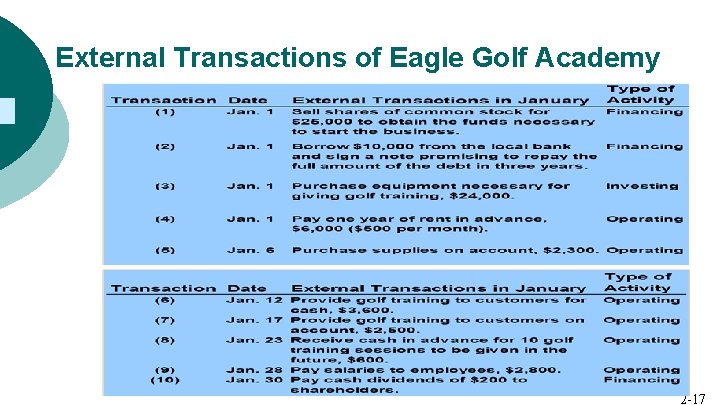
External Transactions of Eagle Golf Academy 2 -17
Accounting Cycle - Adjusting Entries Purpose of Adjusting Entries: To recognize transactions that have occurred in an accounting period but we have not yet recorded. o To record revenues earned in the period, but not yet recorded (Revenue Recognition Principle) o To record expenses in the period they are incurred in the generation of those revenues (Matching Principle). o NEVER involved cash. Types of accounts that will need to be adjusted: 1. ) Prepayments (Cash First): o Prepaid expenses – recognize expense based on usage or passage of time. o Long-term Tangible Assets – Depreciation: The process of allocating the cost of long-term plant assets to expense over estimated useful lives. o Deferred revenues – recognize any revenue that has been earned. 2. ) Accruals (Cash Second): o Accrued expenses – search for expenses that have been incurred but not recorded. Examples include Payables – utilities, interest owed, salaries o Accrued revenues – search for revenue earned but not yet recorded – Examples include accounts receivable and interest receivable. 3 -18
Adjusting Entries - Steps: 1. ) Adjusting entries are typically only completed at the end of the accounting period to update the accounts to prepare the financial statements. 2. ) Look at accounts on the unadjusted trial balance to ascertain which accounts need to be adjusted. a. ) Prepayments (cash first) i. ) Prepaid Expenses – calculate amount of expense based on passage of time or usage. ii. ) Long-term Assets – calculate amount of expense incurred based on asset cost and estimate life. iii. ) Deferred revenue – calculate the value of revenue earned. b. ) Accruals (cash second) i. ) Accrued expenses– record expenses that have been incurred, but not recorded. ii. ) Accrued revenues – record revenues earned, but not recorded. 3. ) Each adjusting entry has different steps for the actual adjusting journal entry, so the steps are contained in the ensuing slides. 4. ) The actual adjusting journal entry is recorded in the original cumulative journal entry book we learned about in Chapter 2 in the ‘Measure’ phase of the Accounting cycle. 3 -19
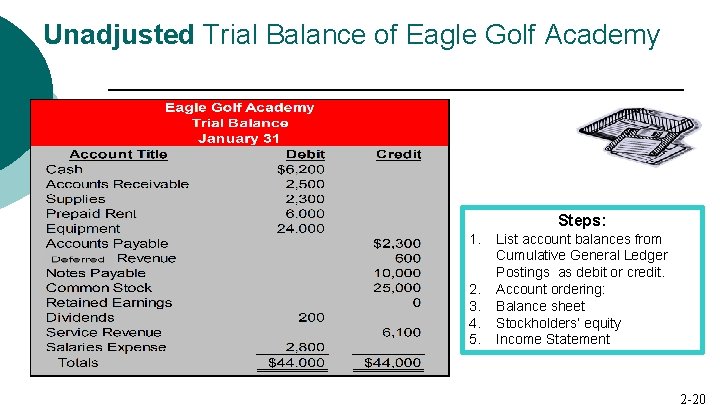
Unadjusted Trial Balance of Eagle Golf Academy Steps: 1. 2. 3. 4. 5. List account balances from Cumulative General Ledger Postings as debit or credit. Account ordering: Balance sheet Stockholders’ equity Income Statement 2 -20
Adjusting Entries - Prepayments (Part 1) - Prepaid Expenses o Assets (resources) acquired in one period may be expensed in a future period based on matching principle. o Examples: Purchase of supplies, payment of rent in advance, payment of insurance in advance. o Steps: o 1. ) Calculate amount of expense incurred through time or usage. o 2. ) Record the expense through a Debit to the appropriate account. o 3. ) Credit the related asset account by the same amount. Adjusting Entry: Debit expense account (increase an expense) Credit original asset account (decrease an asset) 3 -21
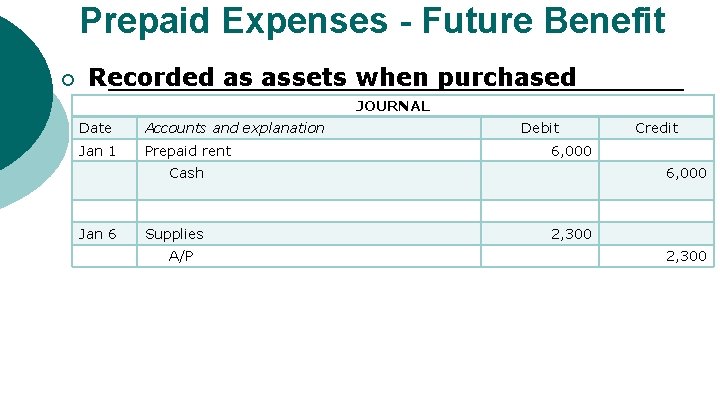
Prepaid Expenses - Future Benefit ¡ Recorded as assets when purchased JOURNAL Date Accounts and explanation Jan 1 Prepaid rent Debit 6, 000 Cash Jan 6 Supplies A/P Credit 6, 000 2, 300
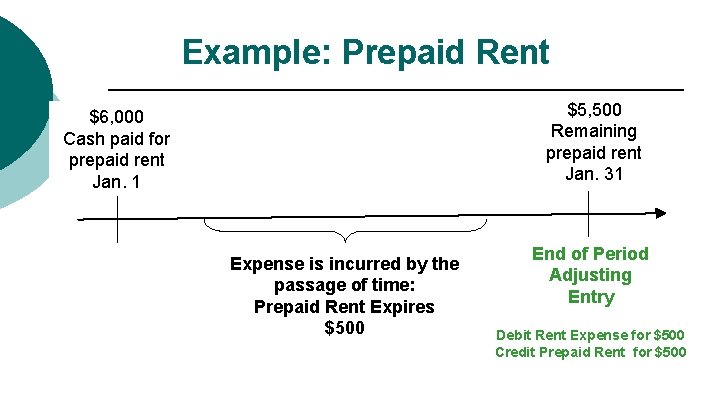
Example: Prepaid Rent $5, 500 Remaining prepaid rent Jan. 31 $6, 000 Cash paid for prepaid rent Jan. 1 Expense is incurred by the passage of time: Prepaid Rent Expires $500 End of Period Adjusting Entry Debit Rent Expense for $500 Credit Prepaid Rent for $500
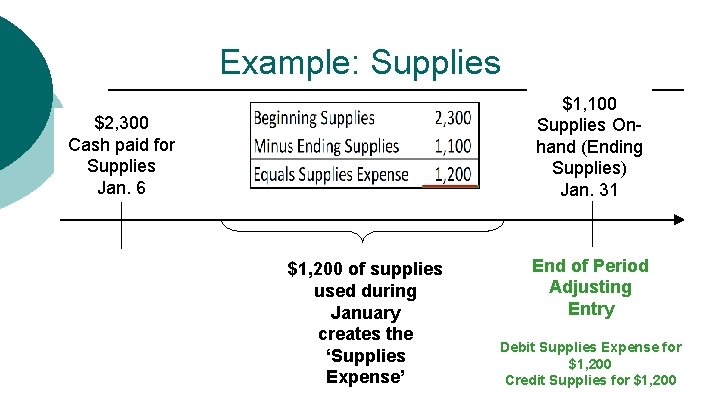
Example: Supplies $1, 100 Supplies Onhand (Ending Supplies) Jan. 31 $2, 300 Cash paid for Supplies Jan. 6 $1, 200 of supplies used during January creates the ‘Supplies Expense’ End of Period Adjusting Entry Debit Supplies Expense for $1, 200 Credit Supplies for $1, 200
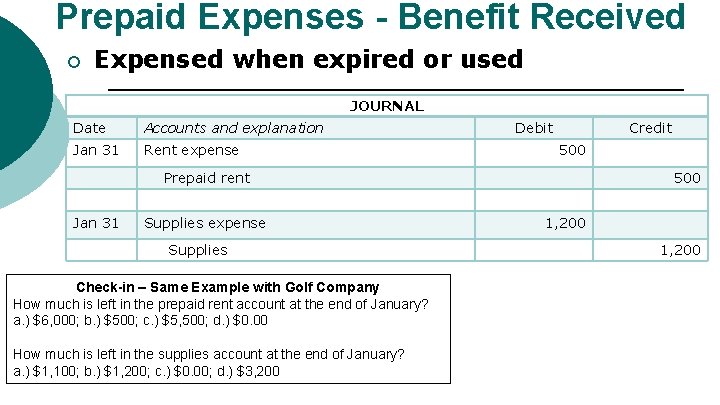
Prepaid Expenses - Benefit Received ¡ Expensed when expired or used JOURNAL Date Accounts and explanation Jan 31 Rent expense Debit Credit 500 Prepaid rent Jan 31 Supplies expense Supplies Check-in – Same Example with Golf Company How much is left in the prepaid rent account at the end of January? a. ) $6, 000; b. ) $500; c. ) $5, 500; d. ) $0. 00 How much is left in the supplies account at the end of January? a. ) $1, 100; b. ) $1, 200; c. ) $0. 00; d. ) $3, 200 500 1, 200
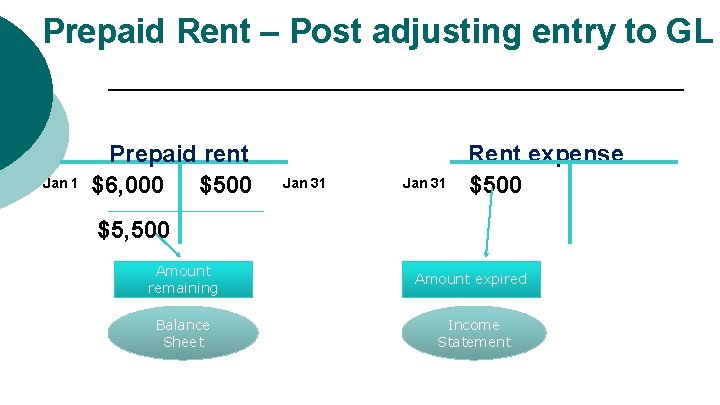
Prepaid Rent – Post adjusting entry to GL Jan 1 Prepaid rent $6, 000 $500 Jan 31 Rent expense $500 $5, 500 Amount remaining Amount expired Balance Sheet Income Statement
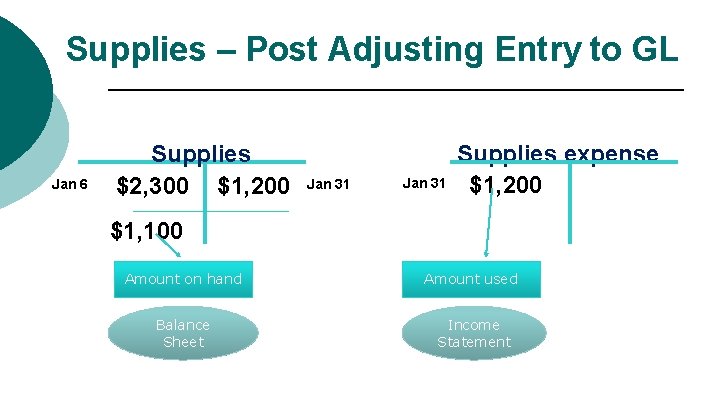
Supplies – Post Adjusting Entry to GL Jan 6 Supplies $2, 300 $1, 200 Jan 31 Supplies expense $1, 200 $1, 100 Amount on hand Amount used Balance Sheet Income Statement
Adjusting Entries - Prepayments (Part 1) - Longterm Assets The process of allocating the cost of a long-term tangible asset to depreciation expense over the useful life of the asset based on the Matching Principle. Two new accounts are introduced and used in this adjustment: l Depreciation expense l Accumulated depreciation ¡ Examples of long-term tangible assets: l Buildings, Equipment, Furniture Steps: ¡ 1. ) Calculate amount of depreciation expense for the period and debit to depreciation expense. l Calculation Method: ¡ ¡ i. ) Straight-line Depreciation Expense calculation = asset cost / useful life of asset 2. ) Credit accumulated depreciation in the same amount.
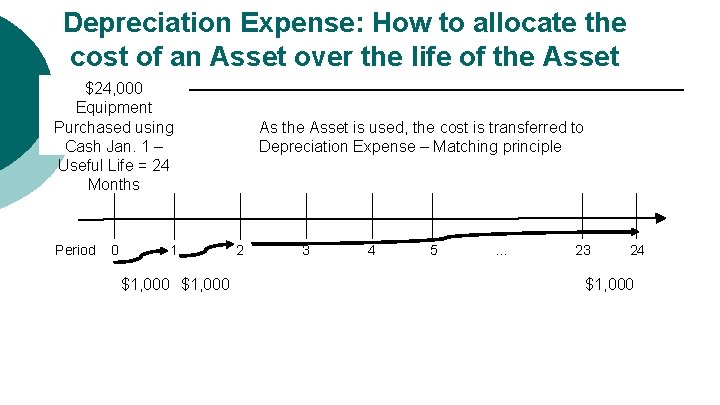
Depreciation Expense: How to allocate the cost of an Asset over the life of the Asset $24, 000 Equipment Purchased using Cash Jan. 1 – Useful Life = 24 Months As the Asset is used, the cost is transferred to Depreciation Expense – Matching principle Period 0 1 2 3 4 5 … 23 24 $1, 000
Accumulated Depreciation Account ¡ Cumulative Sum of all depreciation expense l Increases over plant asset’s life ¡ Contra-asset (New type of account) l Always has a companion account l Normal balance is opposite the companion account ¡ Accumulated Depreciation - Normal credit balance ¡ Book value l Cost of plant asset less accumulated depreciation
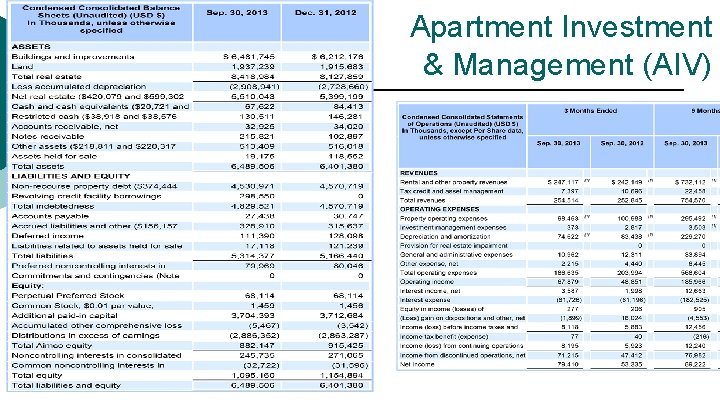
Apartment Investment & Management (AIV)
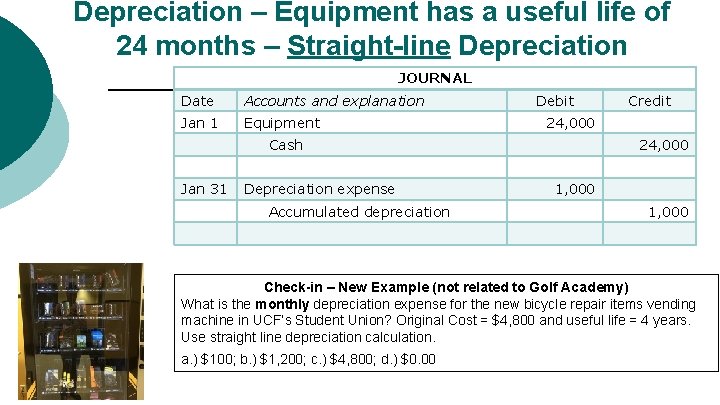
Depreciation – Equipment has a useful life of 24 months – Straight-line Depreciation JOURNAL Date Accounts and explanation Jan 1 Equipment Debit 24, 000 Cash Jan 31 Depreciation expense Accumulated depreciation Credit 24, 000 1, 000 Check-in – New Example (not related to Golf Academy) What is the monthly depreciation expense for the new bicycle repair items vending machine in UCF’s Student Union? Original Cost = $4, 800 and useful life = 4 years. Use straight line depreciation calculation. a. ) $100; b. ) $1, 200; c. ) $4, 800; d. ) $0. 00
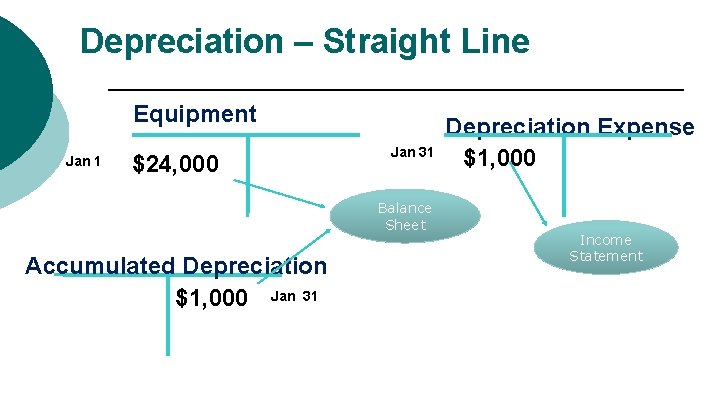
Depreciation – Straight Line Equipment Jan 1 $24, 000 Jan 31 Balance Sheet Accumulated Depreciation $1, 000 Jan 31 Depreciation Expense $1, 000 Income Statement
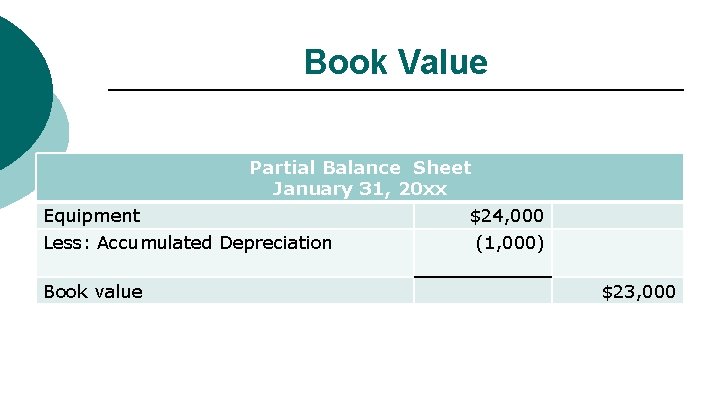
Book Value Partial Balance Sheet January 31, 20 xx Equipment Less: Accumulated Depreciation Book value $24, 000 (1, 000) $23, 000
Adjusting Entries - Prepayments (Part 1) - Unearned Revenues o Received cash first from customer before revenue is earned. Recorded as a liability when original cash payment is received. o Once a company has provided products or services, they can record revenue earned and reduce the obligation to the customer. o Steps: o 1. ) Calculate amount of revenue to recognize and debit deferred revenue. o 2. ) Credit revenue in the same amount to recognize revenue earned. Adjusting entry: Debit liability account (decrease a liability) Credit revenue account (increase a revenue) 3 -35
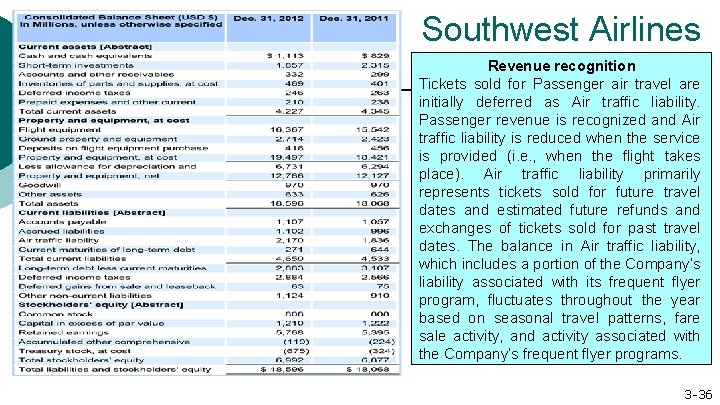
Southwest Airlines Revenue recognition Tickets sold for Passenger air travel are initially deferred as Air traffic liability. Passenger revenue is recognized and Air traffic liability is reduced when the service is provided (i. e. , when the flight takes place). Air traffic liability primarily represents tickets sold for future travel dates and estimated future refunds and exchanges of tickets sold for past travel dates. The balance in Air traffic liability, which includes a portion of the Company’s liability associated with its frequent flyer program, fluctuates throughout the year based on seasonal travel patterns, fare sale activity, and activity associated with the Company’s frequent flyer programs. 3 -36
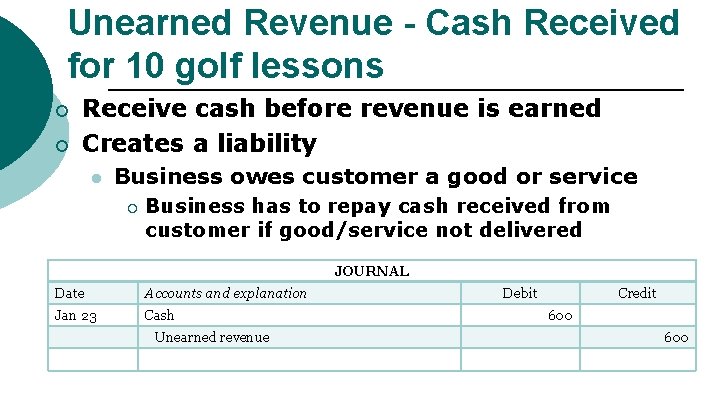
Unearned Revenue - Cash Received for 10 golf lessons ¡ ¡ Receive cash before revenue is earned Creates a liability l Business owes customer a good or service ¡ Business has to repay cash received from customer if good/service not delivered JOURNAL Date Accounts and explanation Jan 23 Cash Unearned revenue Debit Credit 600
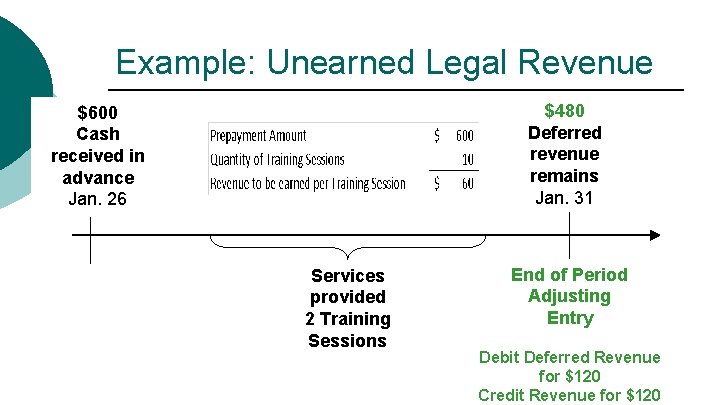
Example: Unearned Legal Revenue $480 $? Deferred revenue remains Jan. 31 $600 Cash received in advance Jan. 26 Services provided 2 Training Sessions End of Period Adjusting Entry Debit Deferred Revenue for $120 Credit Revenue for $120
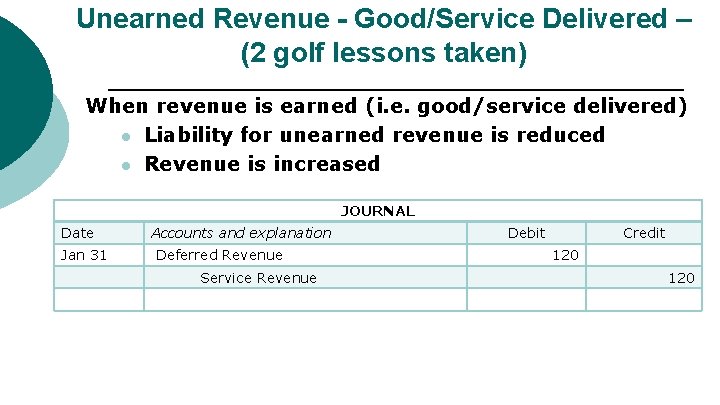
Unearned Revenue - Good/Service Delivered – (2 golf lessons taken) When revenue is earned (i. e. good/service delivered) l Liability for unearned revenue is reduced l Revenue is increased JOURNAL Date Accounts and explanation Jan 31 Deferred Revenue Service Revenue Debit Credit 120
Accounting Cycle - Adjusting Entries Purpose of Adjusting Entries: To recognize transactions that have occurred in an accounting period but we have not yet recorded. o To record revenues earned in the period, but not yet recorded (Revenue Recognition Principle) o To record expenses in the period they are incurred in the generation of those revenues (Matching Principle). o NEVER involved cash. Types of accounts that will need to be adjusted: 1. ) Prepayments (Cash First): o Prepaid expenses – recognize expense based on usage or passage of time. o Long-term Tangible Assets – Depreciation: The process of allocating the cost of long-term plant assets to expense over estimated useful lives. o Unearned revenues – recognize any revenue that has been earned. 2. ) Accruals (Cash Second): o Accrued expenses – search for expenses that have been incurred but not recorded. Examples include Payables – inventory, utilities, interest owed, salaries o Accrued revenues – search for revenue earned but not yet recorded – Examples include accounts receivable and interest receivable. 3 -40
Adjusting Entries – Accruals (Part 2) - Accrued Expenses Record before paying cash o When a company has incurred an expense but hasn’t yet paid cash or recorded an obligation to pay, they still record the expense – matching principle. o Examples: Accrued salaries, accrued interest. Steps: o 1. ) Calculate the amount of the expense incurred, but not recorded and debit the expense account. o 2. ) Credit an associated ‘payable’ account. Adjusting entry: Debit expense account (increase an expense) Credit liability account (increase a liability) 3 -41
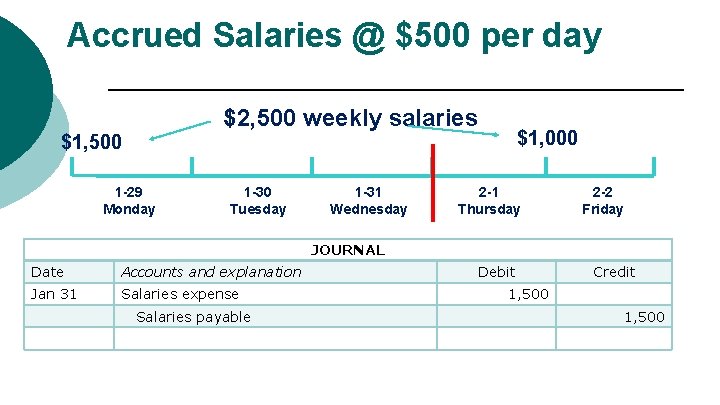
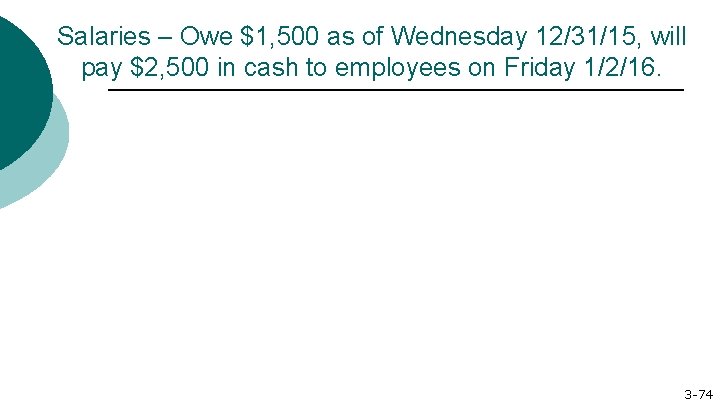
Accrued Salaries @ $500 per day $1, 500 1 -29 Monday $2, 500 weekly salaries 1 -30 Tuesday 1 -31 Wednesday $1, 000 2 -1 Thursday 2 -2 Friday JOURNAL Date Accounts and explanation Jan 31 Salaries expense Salaries payable Debit Credit 1, 500
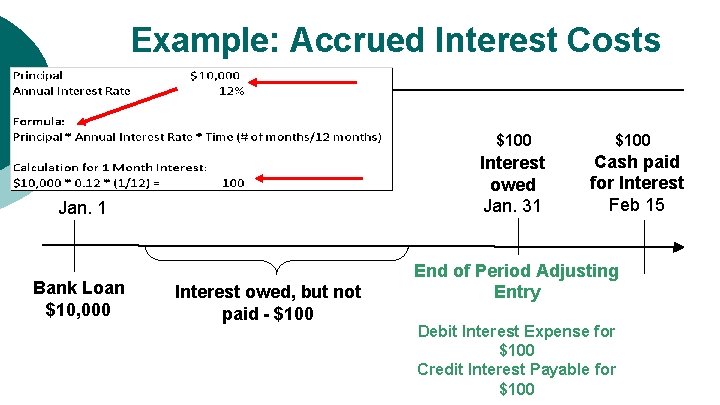
Example: Accrued Interest Costs $100 ? ? Interest owed Jan. 31 Jan. 1 Bank Loan $10, 000 Interest owed, but not paid - $100 ? ? Cash paid for Interest Feb 15 End of Period Adjusting Entry Debit Interest Expense for $100 Credit Interest Payable for $100
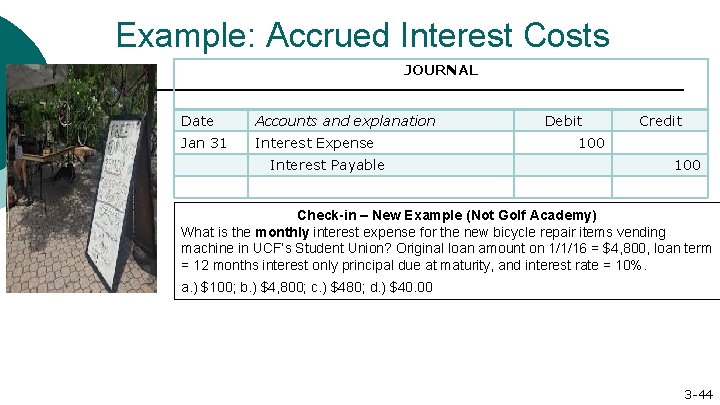
Example: Accrued Interest Costs JOURNAL Date Accounts and explanation Jan 31 Interest Expense Interest Payable Debit Credit 100 Check-in – New Example (Not Golf Academy) What is the monthly interest expense for the new bicycle repair items vending machine in UCF’s Student Union? Original loan amount on 1/1/16 = $4, 800, loan term = 12 months interest only principal due at maturity, and interest rate = 10%. a. ) $100; b. ) $4, 800; c. ) $480; d. ) $40. 00 3 -44
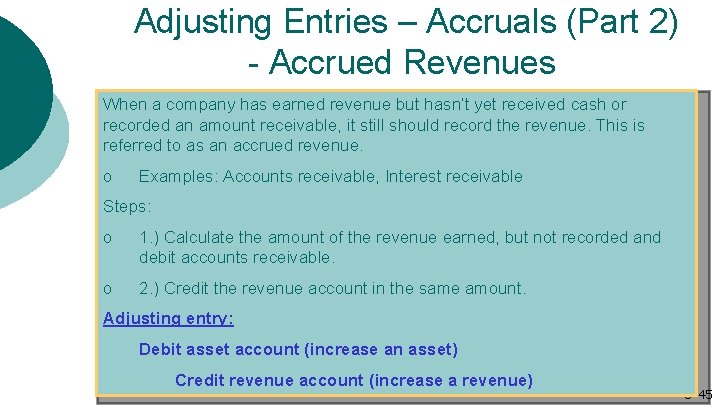
Adjusting Entries – Accruals (Part 2) - Accrued Revenues When a company has earned revenue but hasn’t yet received cash or recorded an amount receivable, it still should record the revenue. This is referred to as an accrued revenue. o Examples: Accounts receivable, Interest receivable Steps: o 1. ) Calculate the amount of the revenue earned, but not recorded and debit accounts receivable. o 2. ) Credit the revenue account in the same amount. Adjusting entry: Debit asset account (increase an asset) Credit revenue account (increase a revenue) 3 -45
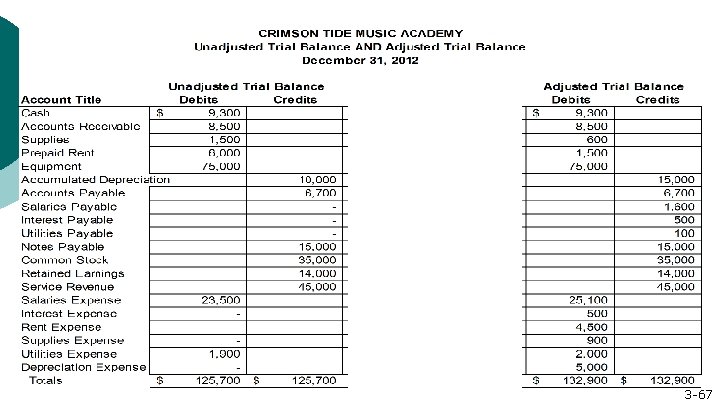
LO 4 Post Adjusting Entries 1. ) In the same fashion we record the during the month journal entries, we also record the end of the month adjusting entries in the same cumulative journal. 2. ) Just as we learned journal entries need to be posted to the general ledger, adjusting journal entries are also posted to the same general ledger account balances. Steps for the next part of the accounting cycle: o Post adjusting entries to the T-accounts in the general ledger to update the account balances. o Prepare an adjusted trial balance. o An adjusted trial balance is a list of all accounts and their debit and credit balances after we have updated account balances for adjusting entries. 3 -46
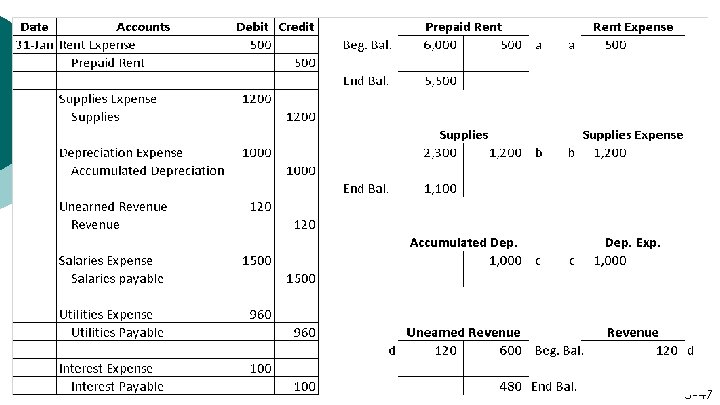
3 -47
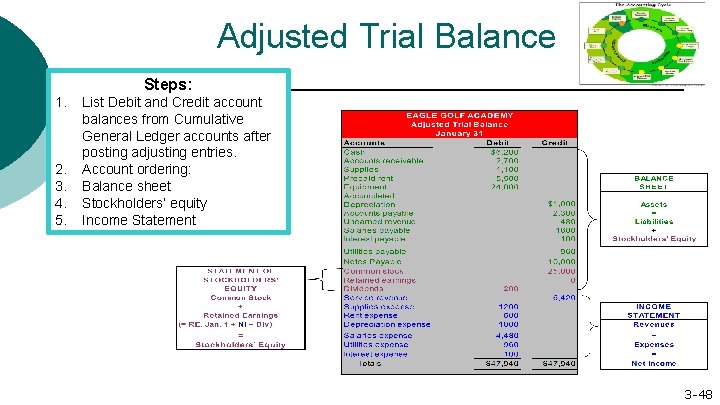
Adjusted Trial Balance Steps: 1. 2. 3. 4. 5. List Debit and Credit account balances from Cumulative General Ledger accounts after posting adjusting entries. Account ordering: Balance sheet Stockholders’ equity Income Statement 3 -48
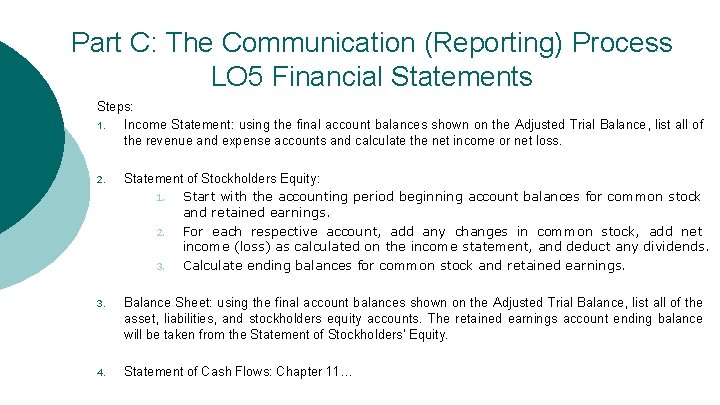
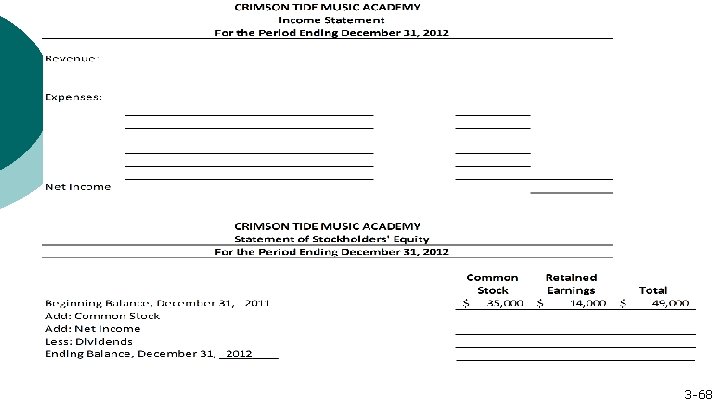
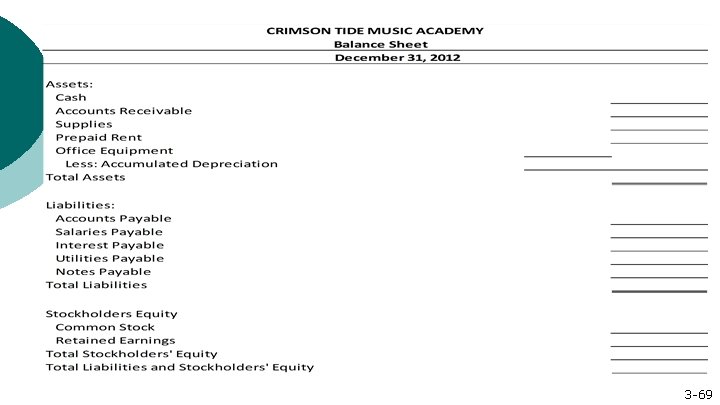
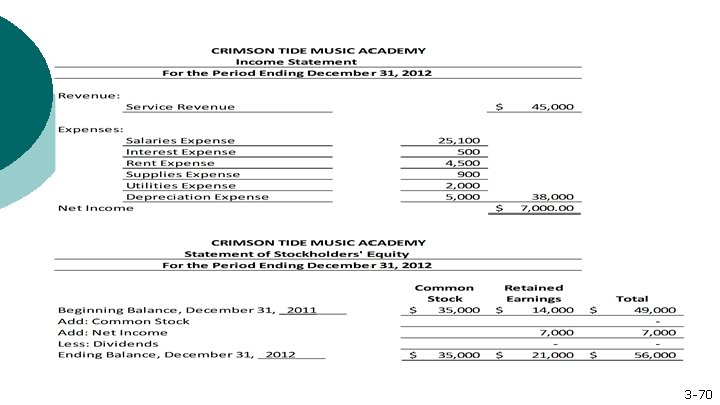
Part C: The Communication (Reporting) Process LO 5 Financial Statements Steps: 1. Income Statement: using the final account balances shown on the Adjusted Trial Balance, list all of the revenue and expense accounts and calculate the net income or net loss. 2. Statement of Stockholders Equity: 1. Start with the accounting period beginning account balances for common stock and retained earnings. 2. For each respective account, add any changes in common stock, add net income (loss) as calculated on the income statement, and deduct any dividends. 3. Calculate ending balances for common stock and retained earnings. 3. Balance Sheet: using the final account balances shown on the Adjusted Trial Balance, list all of the asset, liabilities, and stockholders equity accounts. The retained earnings account ending balance will be taken from the Statement of Stockholders’ Equity. 4. Statement of Cash Flows: Chapter 11…
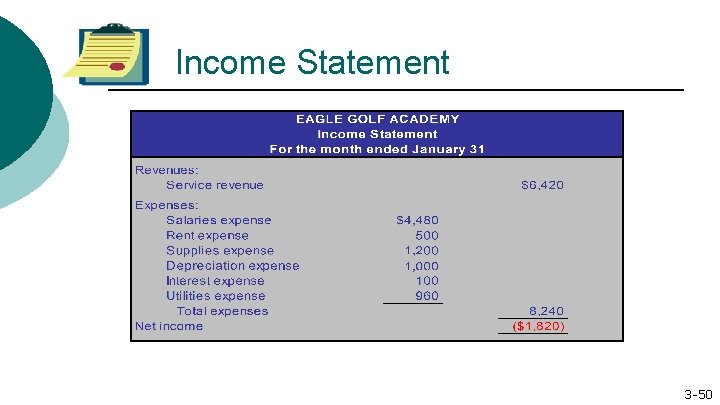
Income Statement 3 -50
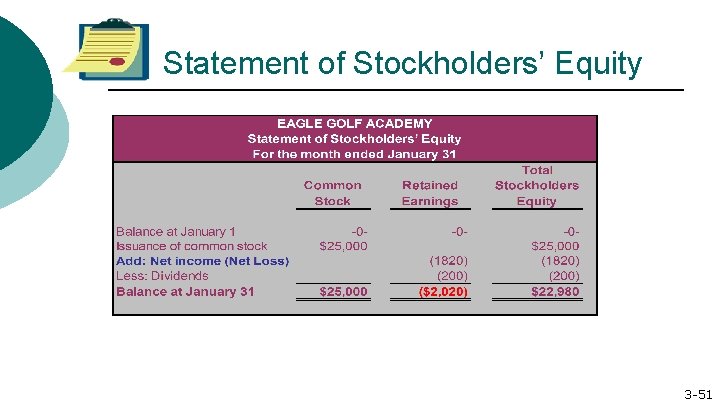
Statement of Stockholders’ Equity 3 -51
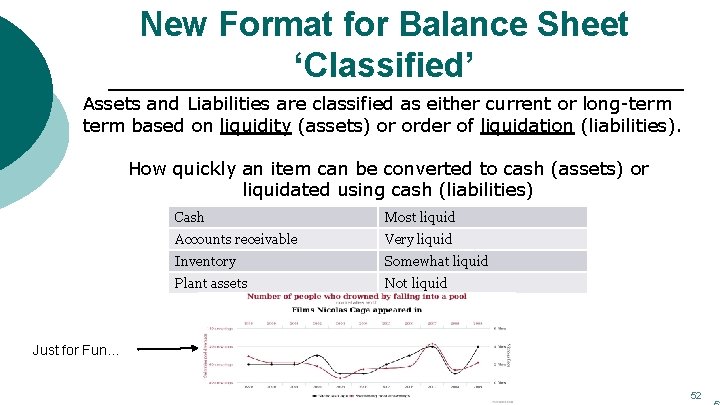
New Format for Balance Sheet ‘Classified’ Assets and Liabilities are classified as either current or long-term based on liquidity (assets) or order of liquidation (liabilities). How quickly an item can be converted to cash (assets) or liquidated using cash (liabilities) Cash Most liquid Accounts receivable Very liquid Inventory Somewhat liquid Plant assets Not liquid Just for Fun… 52
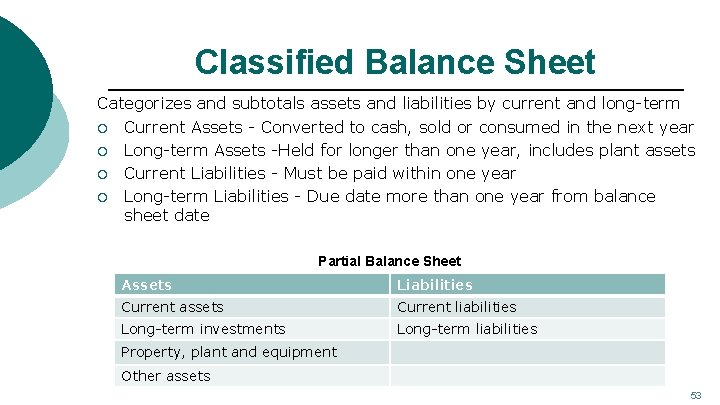
Classified Balance Sheet Categorizes and subtotals assets and liabilities by current and long-term ¡ Current Assets - Converted to cash, sold or consumed in the next year ¡ Long-term Assets -Held for longer than one year, includes plant assets ¡ Current Liabilities - Must be paid within one year ¡ Long-term Liabilities - Due date more than one year from balance sheet date Partial Balance Sheet Assets Liabilities Current assets Current liabilities Long-term investments Long-term liabilities Property, plant and equipment Other assets 53
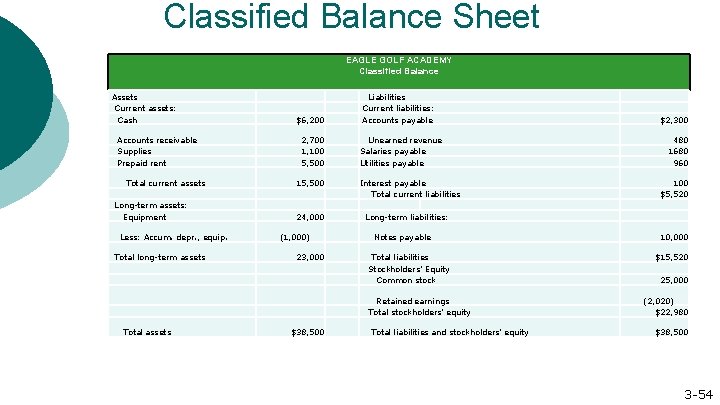
Classified Balance Sheet January 31 Assets Current assets: Cash Accounts receivable Supplies Prepaid rent EAGLE GOLF ACADEMY Classified Balance $6, 200 2, 700 1, 100 5, 500 Liabilities Current liabilities: Accounts payable Unearned revenue Salaries payable Utilities payable Total current assets 15, 500 Interest payable Total current liabilities Long-term assets: Equipment 24, 000 Long-term liabilities: Less: Accum. depr. , equip. Total long-term assets (1, 000) 23, 000 Notes payable Total liabilities Stockholders’ Equity Common stock Retained earnings Total stockholders’ equity Total assets $38, 500 Total liabilities and stockholders’ equity $2, 300 480 1680 960 100 $5, 520 10, 000 $15, 520 25, 000 (2, 020) $22, 980 $38, 500 3 -54
Part D The Closing Process
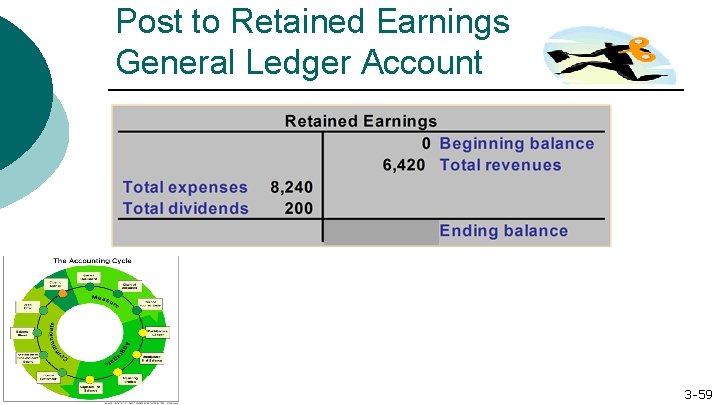
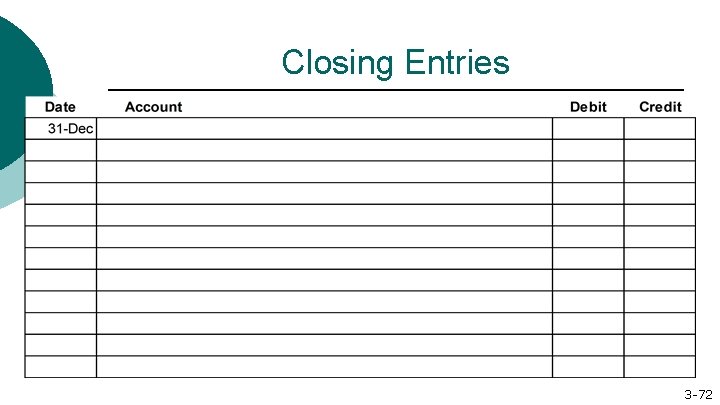
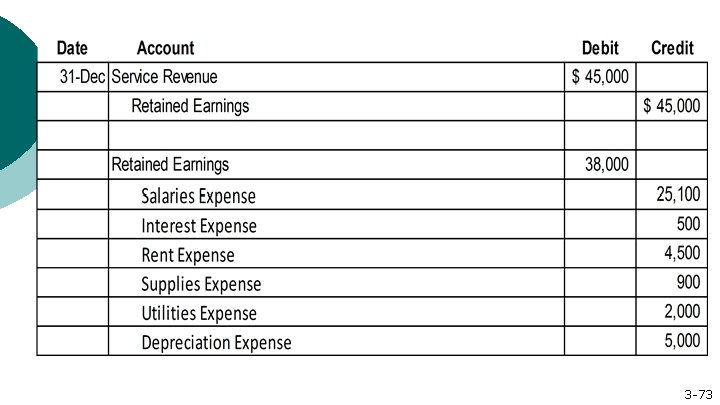
LO 6 Closing Entries Closing Journal Entries - prepares the temporary accounts for the next accounting period. New concept of temporary and permanent accounts: 1. Temporary accounts - revenue, expenses, dividends. These accounts are reset back to zero at the end of each accounting period. Temporary accounts are zeroed out into the Retained Earnings account. ¡ 2. Increase the retained earnings account by the amount of revenues and decrease retained earnings by the amount of expenses and dividends. Permanent Accounts – all other accounts are not affected, except for retained as noted above. 3 -56
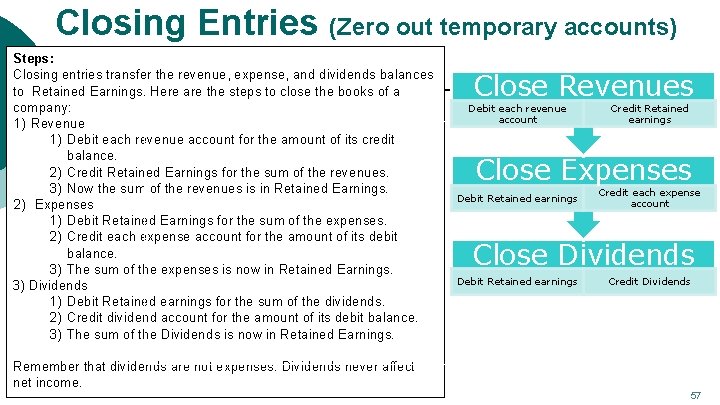
Closing Entries (Zero out temporary accounts) Steps: Closing entries transfer the revenue, expense, and dividends balances to Retained Earnings. Here are the steps to close the books of a company: 1) Revenue 1) Debit each revenue account for the amount of its credit balance. 2) Credit Retained Earnings for the sum of the revenues. 3) Now the sum of the revenues is in Retained Earnings. 2) Expenses 1) Debit Retained Earnings for the sum of the expenses. 2) Credit each expense account for the amount of its debit balance. 3) The sum of the expenses is now in Retained Earnings. 3) Dividends 1) Debit Retained earnings for the sum of the dividends. 2) Credit dividend account for the amount of its debit balance. 3) The sum of the Dividends is now in Retained Earnings. Remember that dividends are not expenses. Dividends never affect net income. Close Revenues Debit each revenue account Credit Retained earnings Close Expenses Debit Retained earnings Credit each expense account Close Dividends Debit Retained earnings Credit Dividends 57
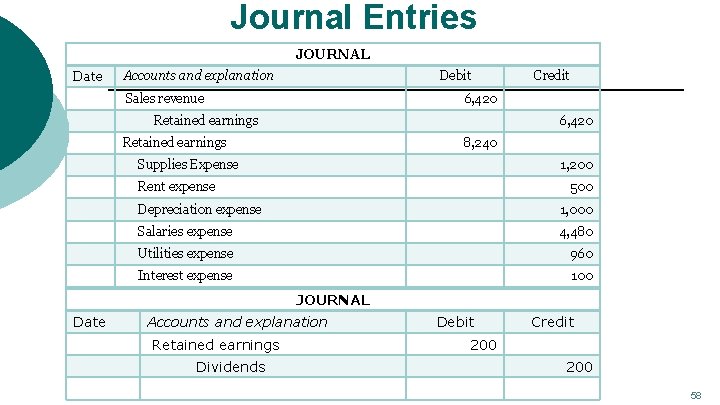
Journal Entries JOURNAL Date Accounts and explanation Debit Sales revenue Credit 6, 420 Retained earnings 8, 240 Supplies Expense 1, 200 Rent expense 500 Depreciation expense 1, 000 Salaries expense 4, 480 Utilities expense 960 Interest expense 100 JOURNAL Date Accounts and explanation Retained earnings Dividends Debit Credit 200 58
Post to Retained Earnings General Ledger Account 3 -59
3 -60
Income Statement of Retained Earnings Balance Sheet Statement of Cash Flows Accounting Equation: Assets = Liabilities + Owners Equity Principles • Revenue Recognition • Matching Principle GAAP (Rules) formulated by FASB 6
3 -62
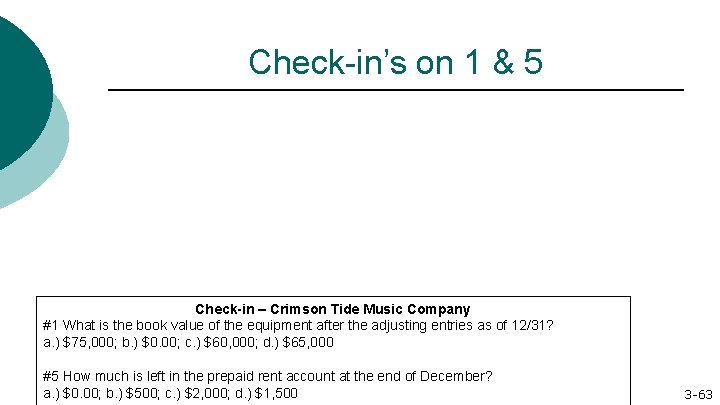
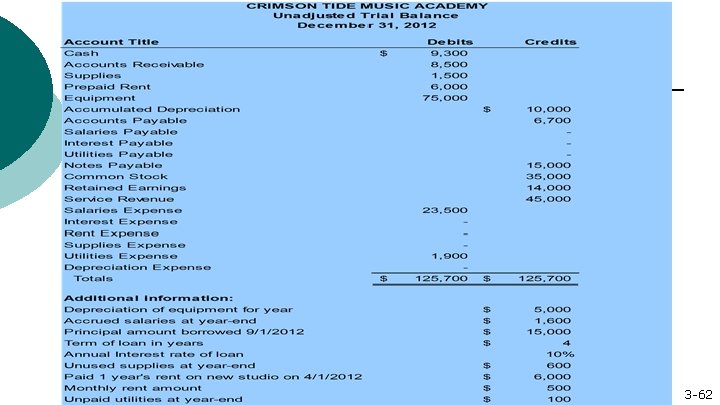
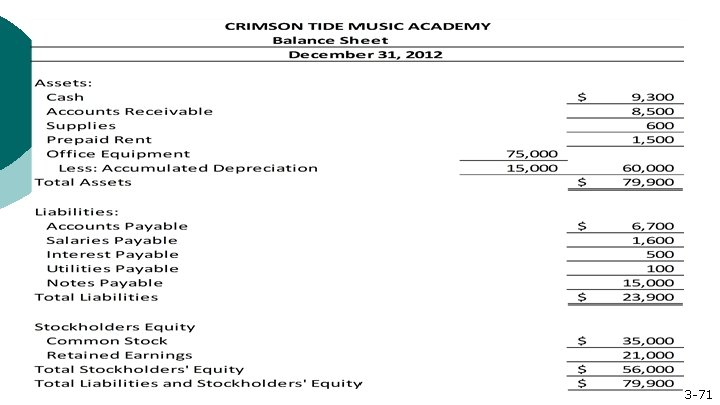
Check-in’s on 1 & 5 Check-in – Crimson Tide Music Company #1 What is the book value of the equipment after the adjusting entries as of 12/31? a. ) $75, 000; b. ) $0. 00; c. ) $60, 000; d. ) $65, 000 #5 How much is left in the prepaid rent account at the end of December? a. ) $0. 00; b. ) $500; c. ) $2, 000; d. ) $1, 500 3 -63
3 -64
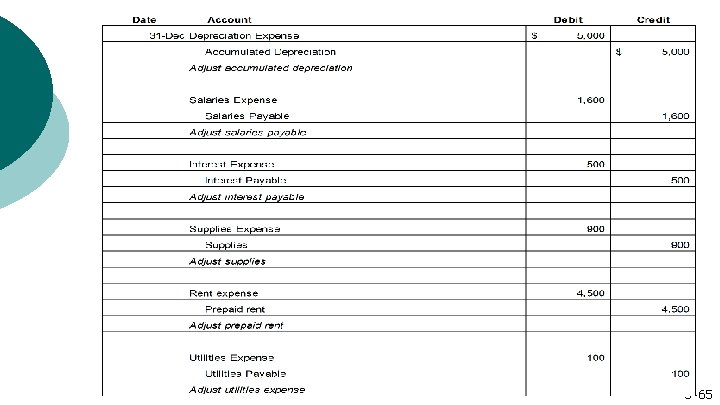
3 -65
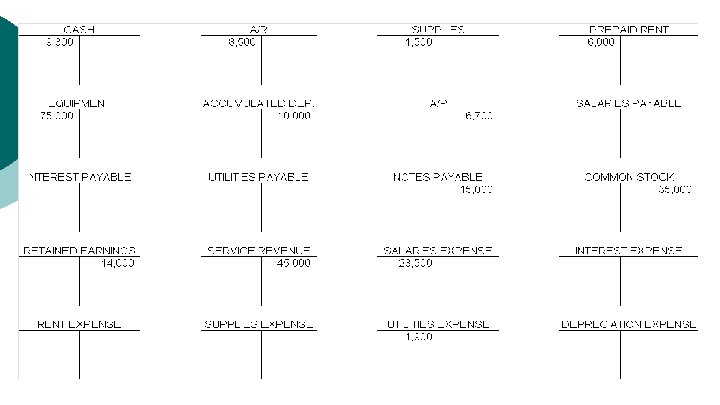
3 -67
3 -68
3 -69
3 -70
3 -71
Closing Entries 3 -72
3 -73
Salaries – Owe $1, 500 as of Wednesday 12/31/15, will pay $2, 500 in cash to employees on Friday 1/2/16. 3 -74
Participation Questions Chap. 3 Which publicly traded Company is used as example #1 in class for the revenue recognition principle? l Apple Computers, JC Penney, Sears, or Walmart The second example discussing a cruise for the revenue recognition principle discusses Calvin actually taking a cruise in which month? l April 2015, November 2014, March 2015, or May 2015 Which depreciation method did we discuss for the $24, 000 in Equipment purchased by Eagle Golf Academy, where the depreciation expense equals $1, 000 per month if the useful life of the equipment is 24 months? l Straight-line, Double declining balance, or Activity based depreciation After all of the adjusting entries were completed for Eagle Golf Academy and the Income Statement was prepared, was the income for Golf Eagle positive or negative? (Please wait until we have completed the chapter to answer this question. ) l Positive or Negative The example of Eagle Golf Academy showed that companies can pay dividends even when there is a net loss for the month – T/F
- Slides: 75