
Participation in Early Childhood Education What and How
- Slides: 12
Participation in Early Childhood Education - What and How? Jonna Leinonen Department of Teacher Education University of Helsinki http: //www. mv. helsinki. fi/home/jonkanga/ Jonna Leinoen jonna. leinonen@helsinki. fi 2/21/2021
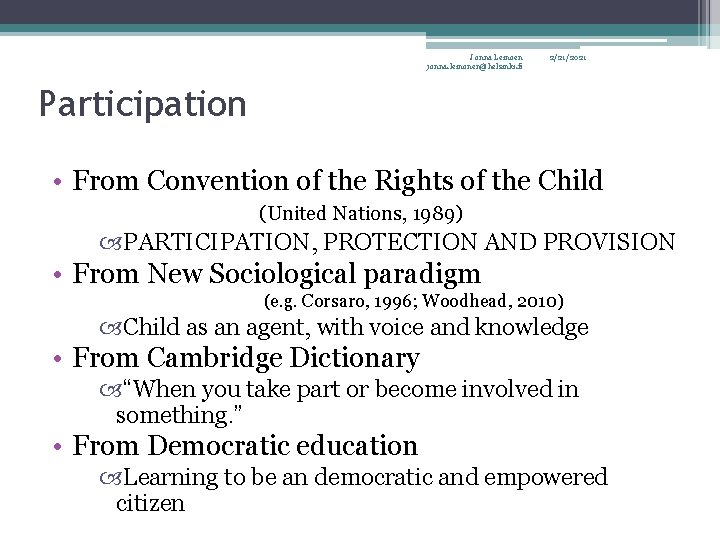
Jonna Leinoen jonna. leinonen@helsinki. fi 2/21/2021 Participation • From Convention of the Rights of the Child (United Nations, 1989) PARTICIPATION, PROTECTION AND PROVISION • From New Sociological paradigm (e. g. Corsaro, 1996; Woodhead, 2010) Child as an agent, with voice and knowledge • From Cambridge Dictionary “When you take part or become involved in something. ” • From Democratic education Learning to be an democratic and empowered citizen
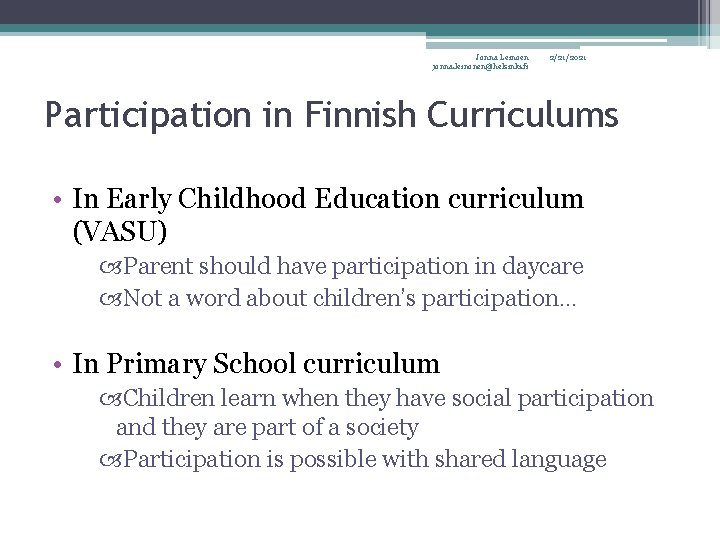
Jonna Leinoen jonna. leinonen@helsinki. fi 2/21/2021 Participation in Finnish Curriculums • In Early Childhood Education curriculum (VASU) Parent should have participation in daycare Not a word about children’s participation… • In Primary School curriculum Children learn when they have social participation and they are part of a society Participation is possible with shared language
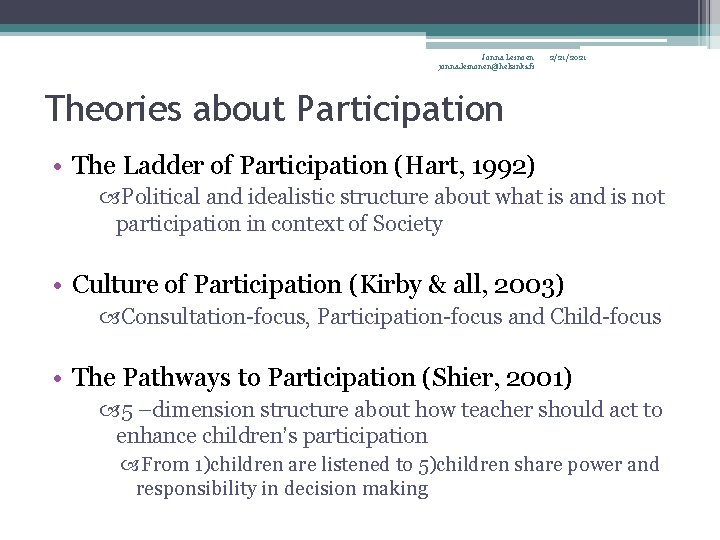
Jonna Leinoen jonna. leinonen@helsinki. fi 2/21/2021 Theories about Participation • The Ladder of Participation (Hart, 1992) Political and idealistic structure about what is and is not participation in context of Society • Culture of Participation (Kirby & all, 2003) Consultation-focus, Participation-focus and Child-focus • The Pathways to Participation (Shier, 2001) 5 –dimension structure about how teacher should act to enhance children’s participation From 1)children are listened to 5)children share power and responsibility in decision making
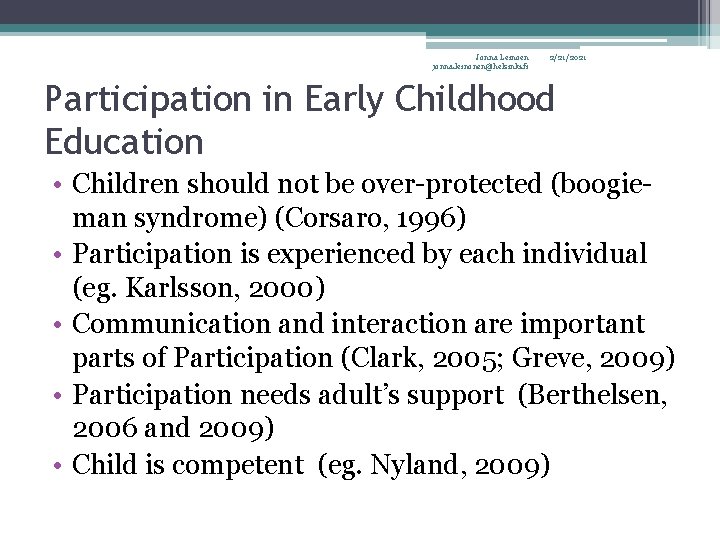
Jonna Leinoen jonna. leinonen@helsinki. fi 2/21/2021 Participation in Early Childhood Education • Children should not be over-protected (boogieman syndrome) (Corsaro, 1996) • Participation is experienced by each individual (eg. Karlsson, 2000) • Communication and interaction are important parts of Participation (Clark, 2005; Greve, 2009) • Participation needs adult’s support (Berthelsen, 2006 and 2009) • Child is competent (eg. Nyland, 2009)
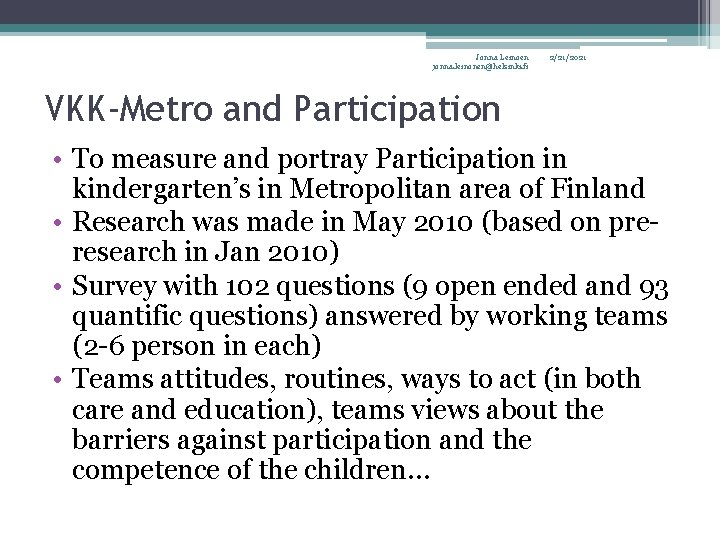
Jonna Leinoen jonna. leinonen@helsinki. fi 2/21/2021 VKK-Metro and Participation • To measure and portray Participation in kindergarten’s in Metropolitan area of Finland • Research was made in May 2010 (based on preresearch in Jan 2010) • Survey with 102 questions (9 open ended and 93 quantific questions) answered by working teams (2 -6 person in each) • Teams attitudes, routines, ways to act (in both care and education), teams views about the barriers against participation and the competence of the children…
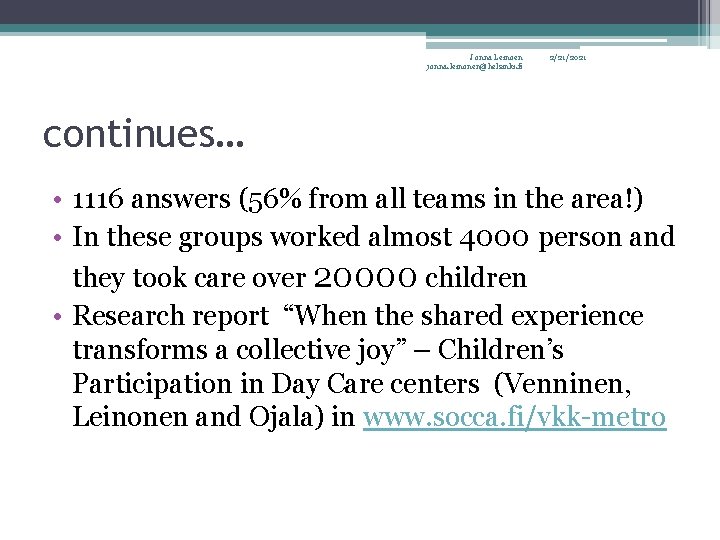
Jonna Leinoen jonna. leinonen@helsinki. fi 2/21/2021 continues… • 1116 answers (56% from all teams in the area!) • In these groups worked almost 4000 person and they took care over 20000 children • Research report “When the shared experience transforms a collective joy” – Children’s Participation in Day Care centers (Venninen, Leinonen and Ojala) in www. socca. fi/vkk-metro
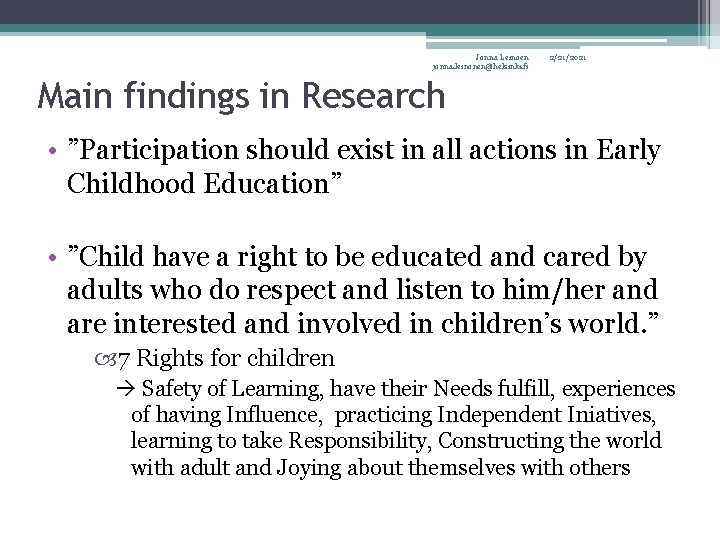
Jonna Leinoen jonna. leinonen@helsinki. fi 2/21/2021 Main findings in Research • ”Participation should exist in all actions in Early Childhood Education” • ”Child have a right to be educated and cared by adults who do respect and listen to him/her and are interested and involved in children’s world. ” 7 Rights for children Safety of Learning, have their Needs fulfill, experiences of having Influence, practicing Independent Iniatives, learning to take Responsibility, Constructing the world with adult and Joying about themselves with others
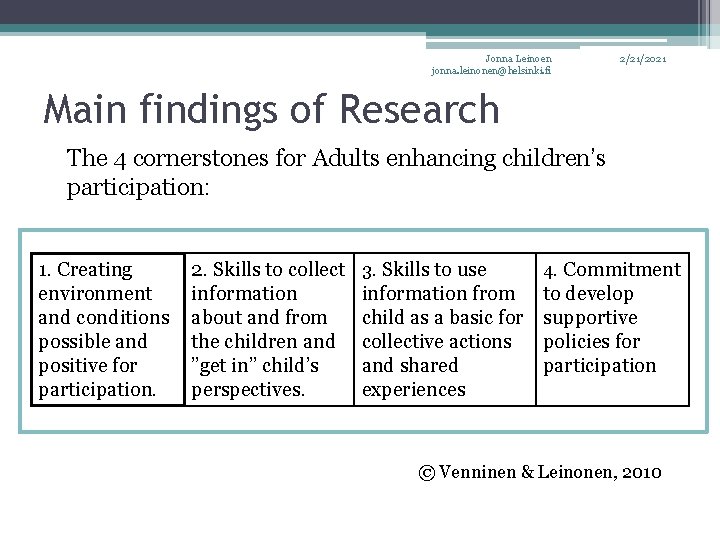
Jonna Leinoen jonna. leinonen@helsinki. fi 2/21/2021 Main findings of Research The 4 cornerstones for Adults enhancing children’s participation: 1. Creating environment and conditions possible and positive for participation. 2. Skills to collect information about and from the children and ”get in” child’s perspectives. 3. Skills to use 4. Commitment information from child as a basic for collective actions and shared experiences to develop supportive policies for participation © Venninen & Leinonen, 2010
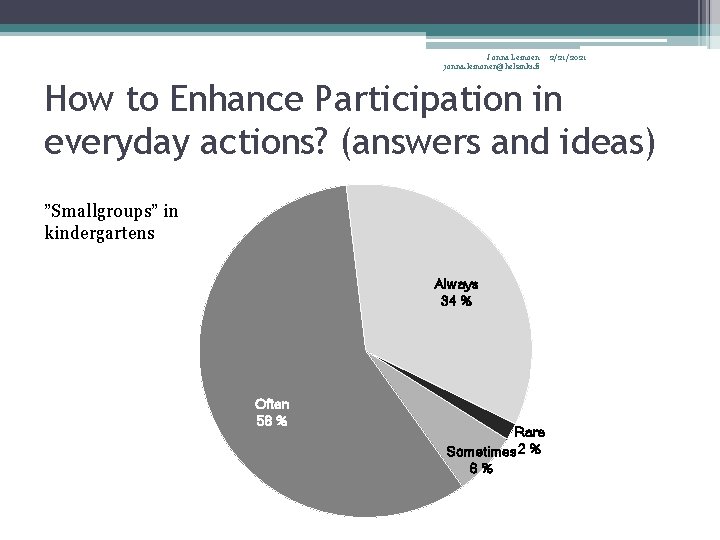
Jonna Leinoen jonna. leinonen@helsinki. fi 2/21/2021 How to Enhance Participation in everyday actions? (answers and ideas) ”Smallgroups” in kindergartens Always 34 % Often 58 % Rare Sometimes 2 % 6%
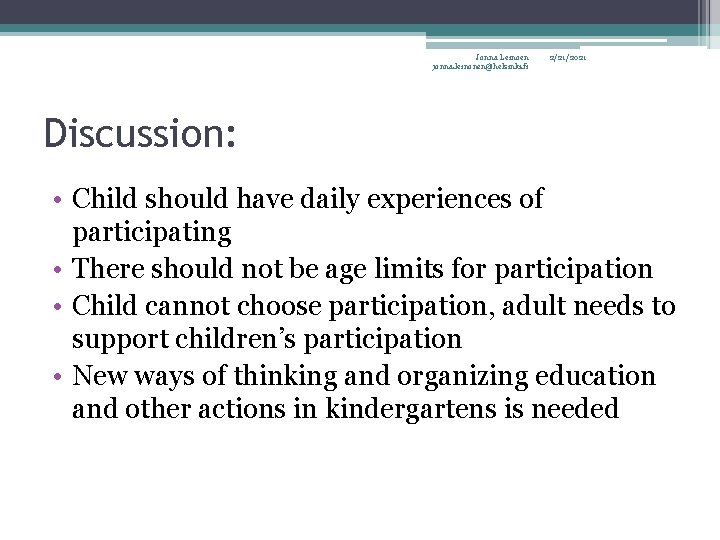
Jonna Leinoen jonna. leinonen@helsinki. fi 2/21/2021 Discussion: • Child should have daily experiences of participating • There should not be age limits for participation • Child cannot choose participation, adult needs to support children’s participation • New ways of thinking and organizing education and other actions in kindergartens is needed
Jonna Leinoen jonna. leinonen@helsinki. fi 2/21/2021 Thank You! jonna. leinonen@helsinki. fi