
Participate in Teams to Benefit Children and Young
Participate in Teams to Benefit Children and Young People in Residential Childcare
AIMS AND OBJECTIVES ØThe aim of this presentation is to deliver a deeper and wider understanding of the need to develop and maintain effective teamwork practices within residential childcare settings
Understanding team work practice Ø The most essential part of any work role is understanding exactly what that entails, who is involved and what methods are utilised to ensure completion of set tasks. Ø It is fair to say that Residential childcare and Youth care is fundamentally about teamwork. Ø Effective practices stem from effective teamwork. As a team, residential care workers deal with serious issues surrounding the children and young people in their care
Effective team work practices Ø As a professional residential support worker, you will need to understand a wide range of issues surrounding: Ø Safeguarding Ø Abuse Ø Mental health issues Ø Drug abuse Ø And all the other issues that accompany children in care
Effective team work practices Ø In a residential care setting good team work and good practice go hand in hand with effective communication and effective lines of reporting. Ø Information and data collected about all looked after children in your care is paramount to good practice. Ø Daily reports and information about activities, issues arising, changes in circumstances all need to be recorded and shared with team members in order that continuity can be retained at all times
Team Dynamics Ø As the word team suggest, it is a group of people brought together to deliver solutions to tasks set or problems that may arise. Ø All good teams have an effective and supportive team leader who instigates harmony, respect and trust within the team Ø Team members all contribute to good practice and bring with them different skill sets and attributes, all of which help form an effective team
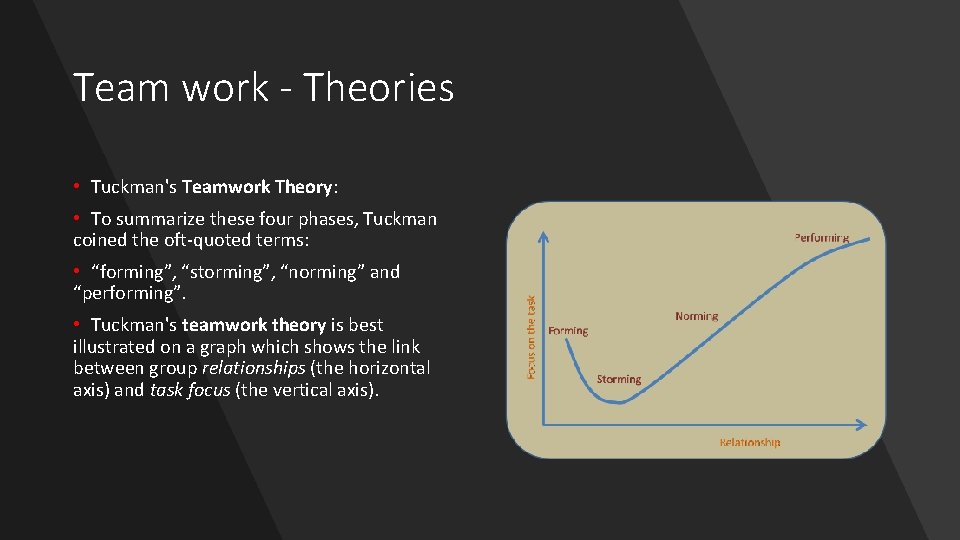
Team work - Theories • Tuckman's Teamwork Theory: • To summarize these four phases, Tuckman coined the oft-quoted terms: • “forming”, “storming”, “norming” and “performing”. • Tuckman's teamwork theory is best illustrated on a graph which shows the link between group relationships (the horizontal axis) and task focus (the vertical axis).
Team management ØTo ensure that all team members are working effectively and as a ‘team’ there has to be a full appraisal or review system in place which monitors individual performances. ØRegular team meetings must be held and must be open and transparent. ØIssues arising must be openly discussed any team member who feels they require additional support or training must identify this to the group
Roles and responsibilities ØTeam members are usually identified through their job titles, manager, team leader etc. This also denotes the type of roles and responsibilities attached to them ØSome of the titles you may be familiar with are managers; deputy managers; shift leaders; support workers; social workers; domestic staff ØMany care workers are awarded specific titles due to the level of qualification and experience they hold, usually higher qualified staff members earn promotion within the team allowing them to support others
Team member abilities ØSome team members hold specialist abilities or qualifications such as teaching social pedagogy, physical and social emotional and wellbeing, or dealing with mental health issues in children. ØOthers may support the links to networks and agencies within the area to discuss and share good practice ØSome team members roles see them act as advocacy or provide access to an advocate ØOthers may promote self-reliance and independence
Team work practices ØIrrespective of your role or title, the key word is “Team” member. ØGood team members ensure knowledge, understanding and adherence to policy and procedures ØGood team members promote and practice effective lines of communication and information gathering ØGood team members develop and share resources. They understand time management and share knowledge ØGood team members advocate training and carryout supervision of other team members
- Slides: 11