
PARTIALLY GALVANIZED STEEL COLUMNS WHAT COULD WASHABLY GO
PARTIALLY GALVANIZED STEEL COLUMNS WHAT COULD WASH-ABLY GO WRONG? Richard A. Burgess, KTA-Tator, Inc.
Learning Objectives Galvanizing Steel a Coating Application Process Apply Liquid Zinc Objective 1 -Partial Galvanizing- An Example of Failure Objective 2 - Understanding Surface Preparation for Galvanizing Objective 3 - Galvanizing Process Objective 4 -Purpose of Galvanizing Flux and how applied
COATING FAILURE INVESTIGATION Background Field Investigation Laboratory Investigation Discussion Questions
BACKGROUND A Steel Fabrication and Erection Company Sought Assistance with an Unusual Coating Failure. Galvanized and Coated Steel Columns Erected as Part of a Chemical Manufacturing Plant Were Rusting The Requirements For The Structural Steel Columns Included Galvanizing The Upper Portion Of Each Column The Remaining Portions of The Columns and Other Structural Members Would Not Be Galvanized Un-Galvanized Portions Were Required To Be Shop Painted.
BACKGROUND Upper Column Sections an Atmospheric Environment near the Gulf Coast. The Lower Columns Sections Inside an Interior, Controlled Environment. Following Partial Galvanizing the Columns were Shop Coated: Automated Blast Cleaning Was Not Performed Steel Surfaces Cleaned By Power Wire Brush (SSPC-SP 3) Spray Application of a Rust Inhibitive Alkyd Shop Coat Primer, DFT of 2. 0 To 4. 0 Mils.
BACKGROUND Following Preparation and Coating the Columns were Shipped to the Chemical Production Facility and Erected. Within A Few Days After Erection it was Reported That Painted Sections of the Columns Below the Galvanizing were Rusting Badly. The Fabricator Requested Assistance - Investigate The Cause Of The Rusting.
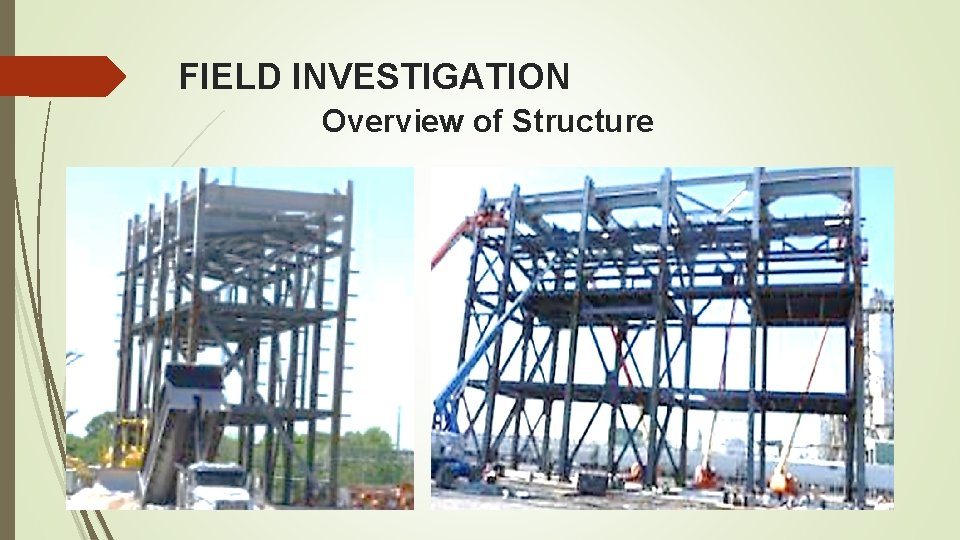
FIELD INVESTIGATION Overview of Structure
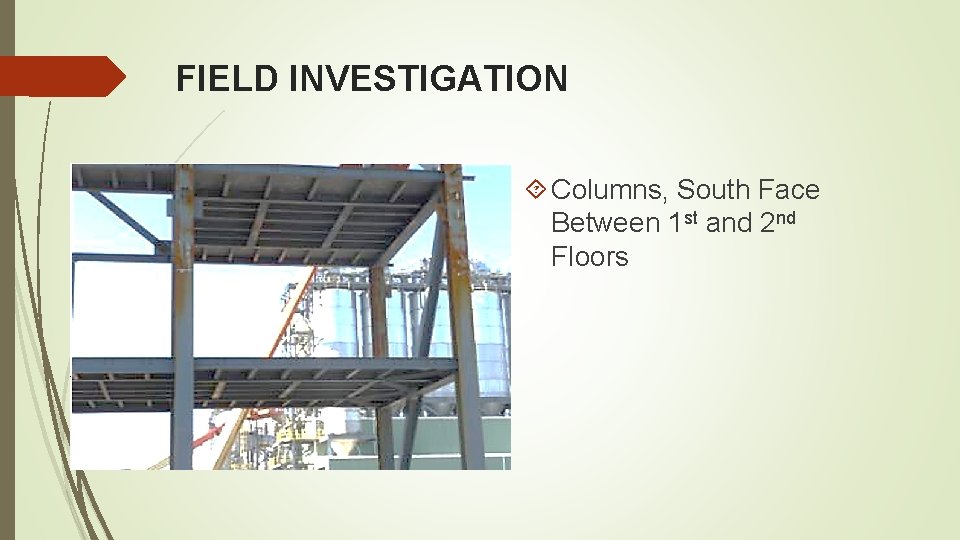
FIELD INVESTIGATION Columns, South Face Between 1 st and 2 nd Floors
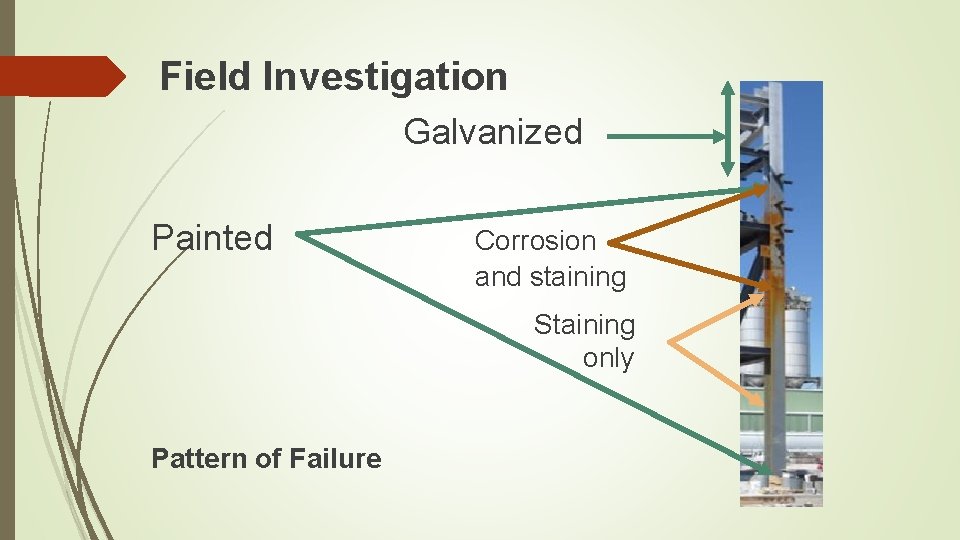
Field Investigation Galvanized Painted Corrosion and staining Staining only Pattern of Failure
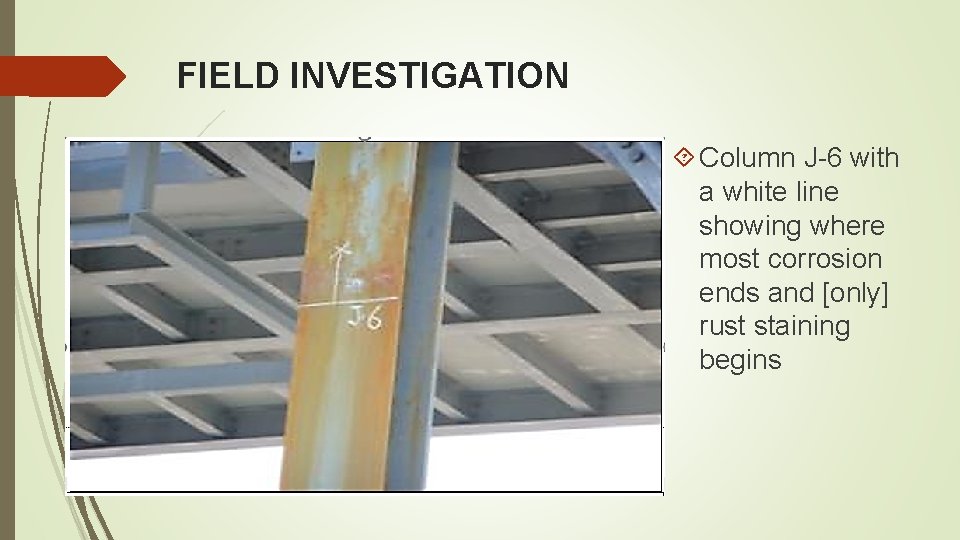
FIELD INVESTIGATION Column J-6 with a white line showing where most corrosion ends and [only] rust staining begins
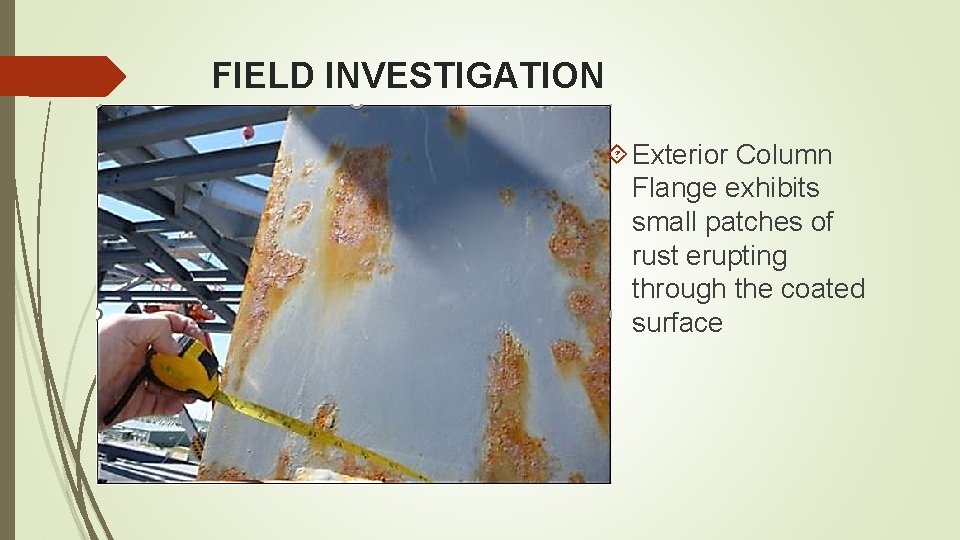
FIELD INVESTIGATION Exterior Column Flange exhibits small patches of rust erupting through the coated surface
FIELD INVESTIGATION
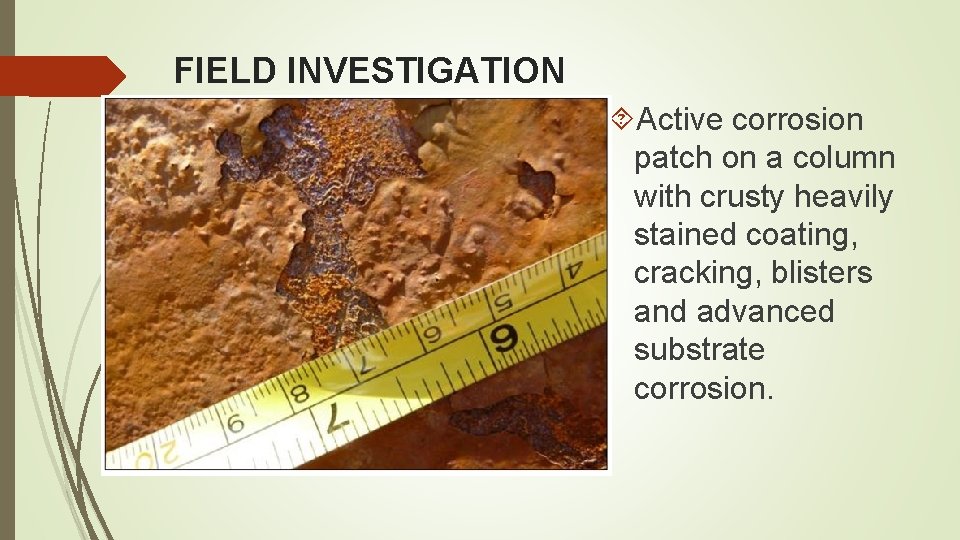
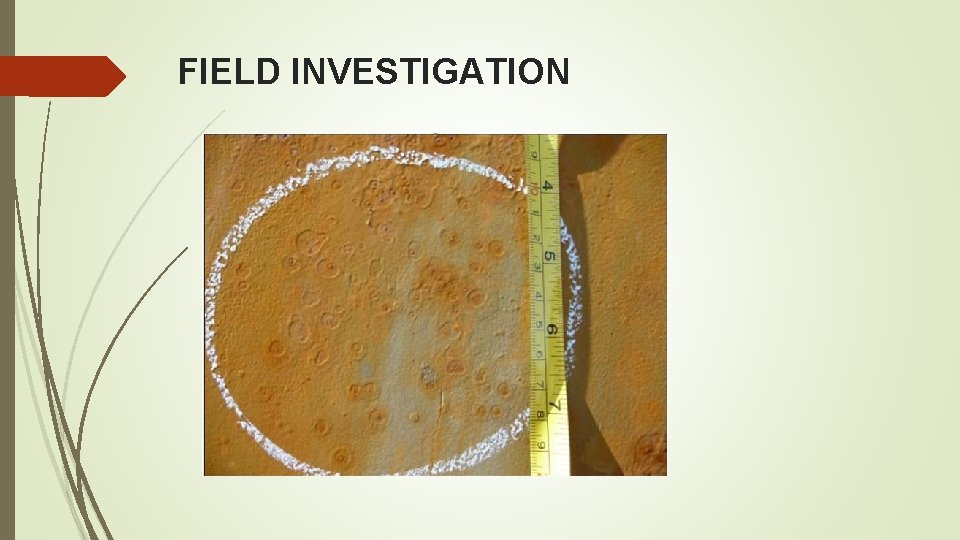
FIELD INVESTIGATION Active corrosion patch on a column with crusty heavily stained coating, cracking, blisters and advanced substrate corrosion.
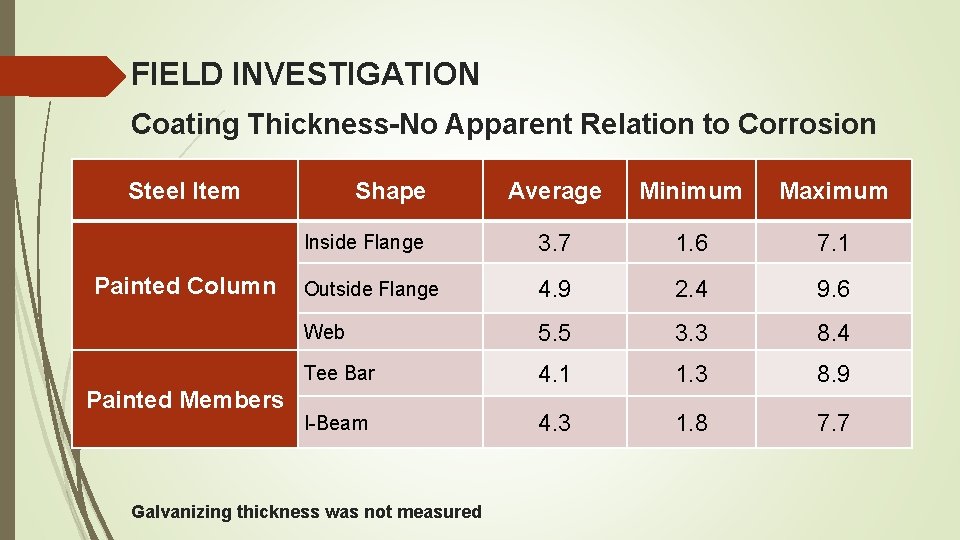
FIELD INVESTIGATION Coating Thickness-No Apparent Relation to Corrosion Steel Item Painted Column Painted Members Shape Average Minimum Maximum Inside Flange 3. 7 1. 6 7. 1 Outside Flange 4. 9 2. 4 9. 6 Web 5. 5 3. 3 8. 4 Tee Bar 4. 1 1. 3 8. 9 I-Beam 4. 3 1. 8 7. 7 Galvanizing thickness was not measured
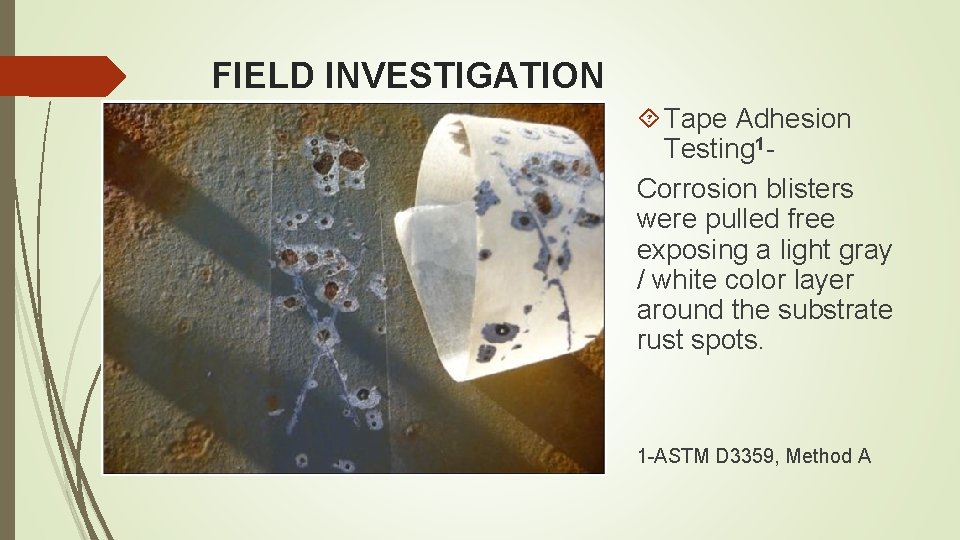
FIELD INVESTIGATION Tape Adhesion Testing 1 Corrosion blisters were pulled free exposing a light gray / white color layer around the substrate rust spots. 1 -ASTM D 3359, Method A
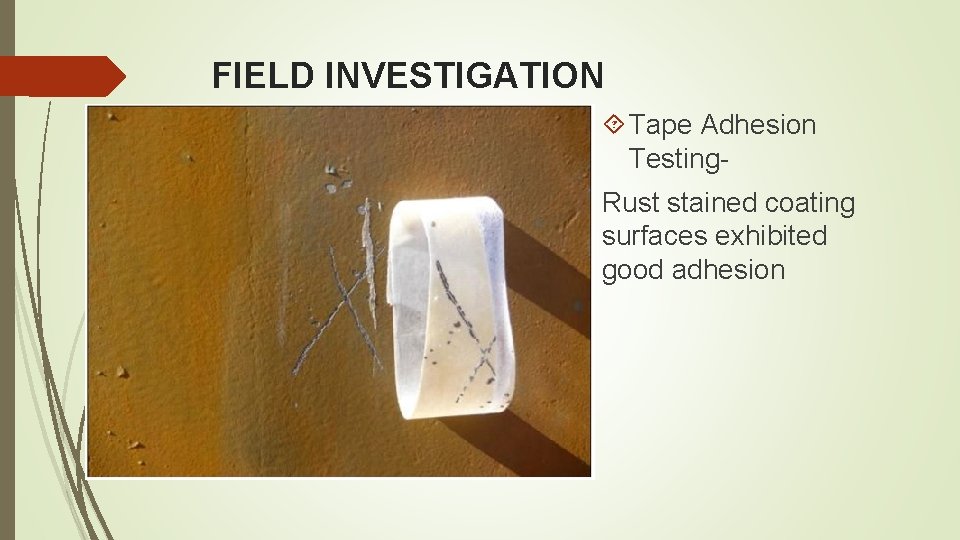
FIELD INVESTIGATION Tape Adhesion Testing. Rust stained coating surfaces exhibited good adhesion
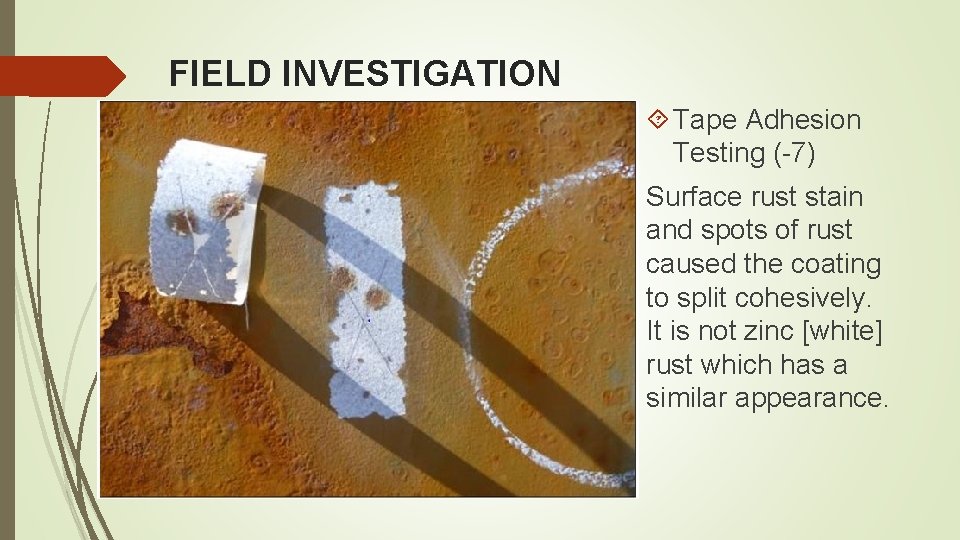
FIELD INVESTIGATION Tape Adhesion Testing (-7) Surface rust stain and spots of rust caused the coating to split cohesively. It is not zinc [white] rust which has a similar appearance.
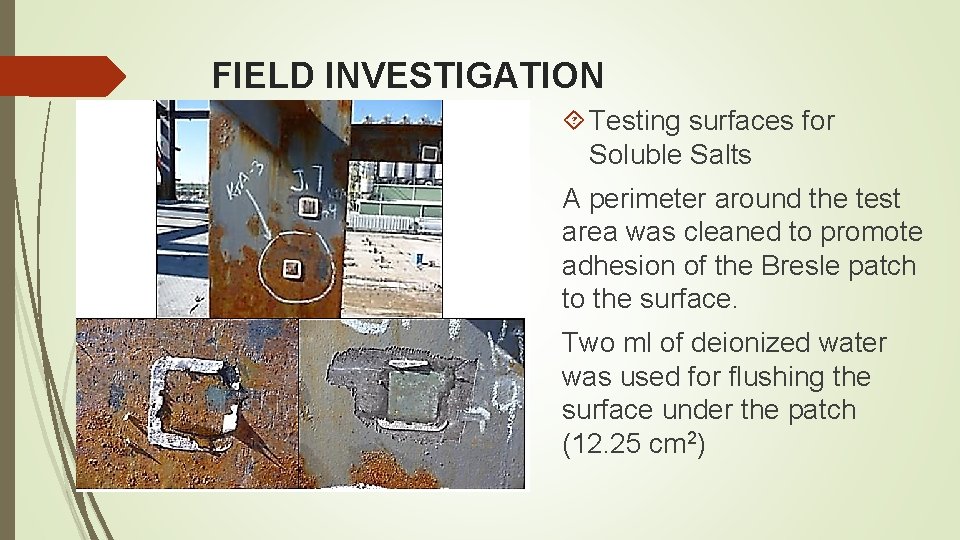
FIELD INVESTIGATION Testing surfaces for Soluble Salts A perimeter around the test area was cleaned to promote adhesion of the Bresle patch to the surface. Two ml of deionized water was used for flushing the surface under the patch (12. 25 cm 2)
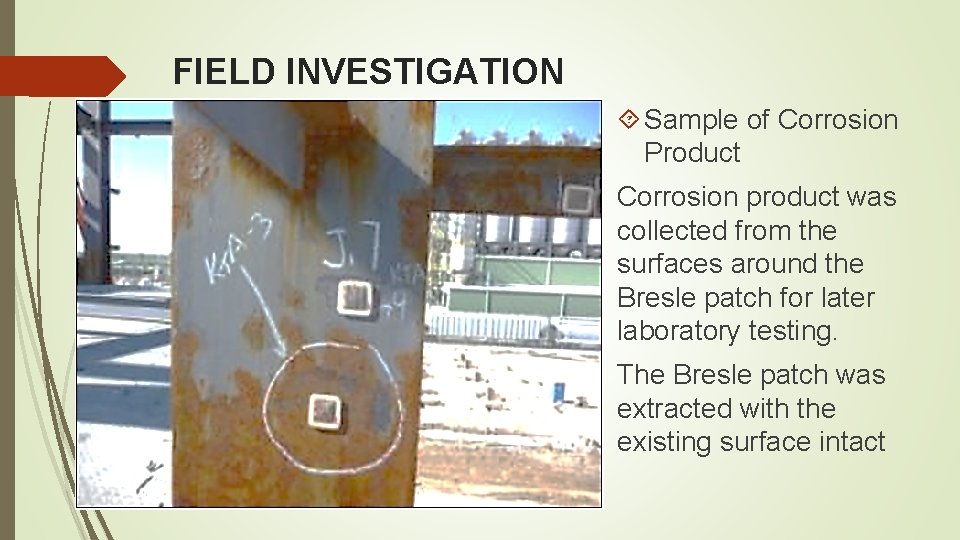
FIELD INVESTIGATION Sample of Corrosion Product Corrosion product was collected from the surfaces around the Bresle patch for later laboratory testing. The Bresle patch was extracted with the existing surface intact
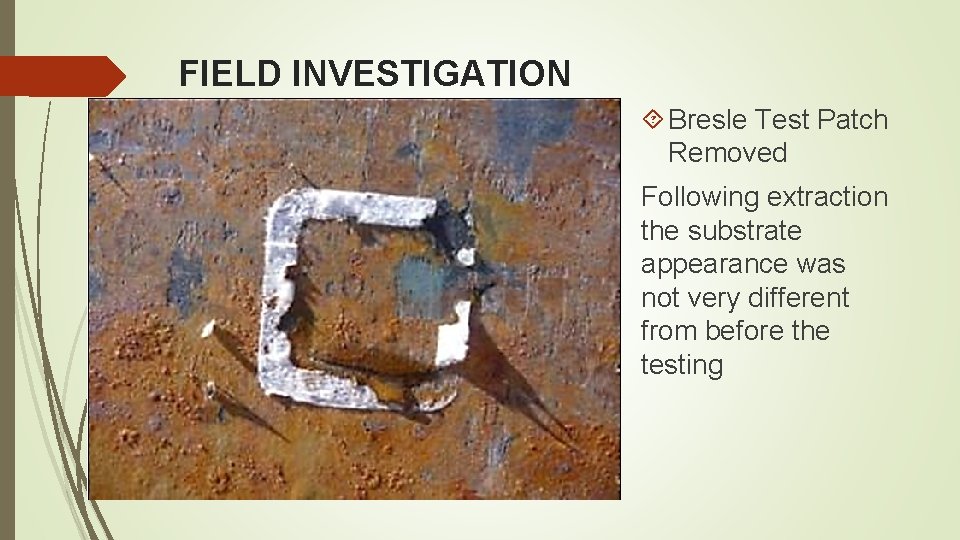
FIELD INVESTIGATION Bresle Test Patch Removed Following extraction the substrate appearance was not very different from before the testing
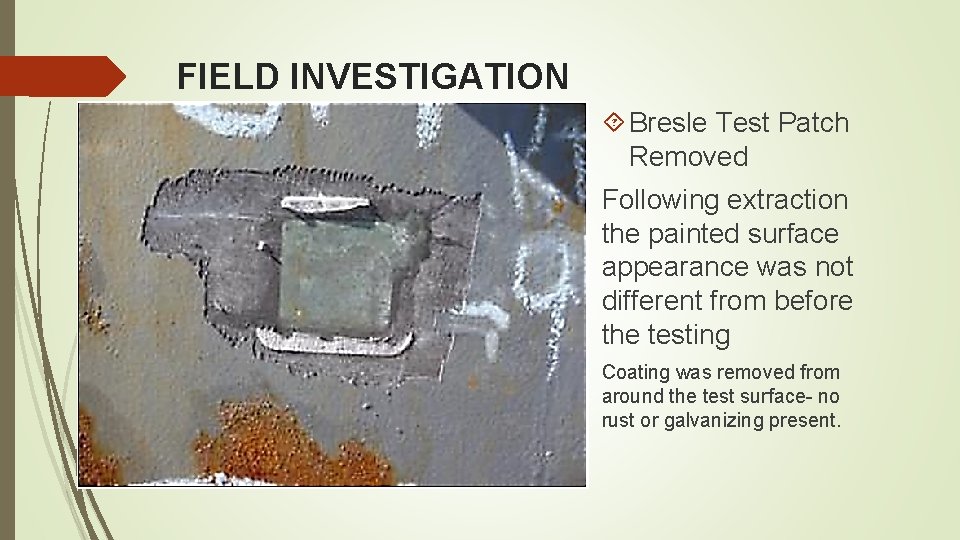
FIELD INVESTIGATION Bresle Test Patch Removed Following extraction the painted surface appearance was not different from before the testing Coating was removed from around the test surface- no rust or galvanizing present.
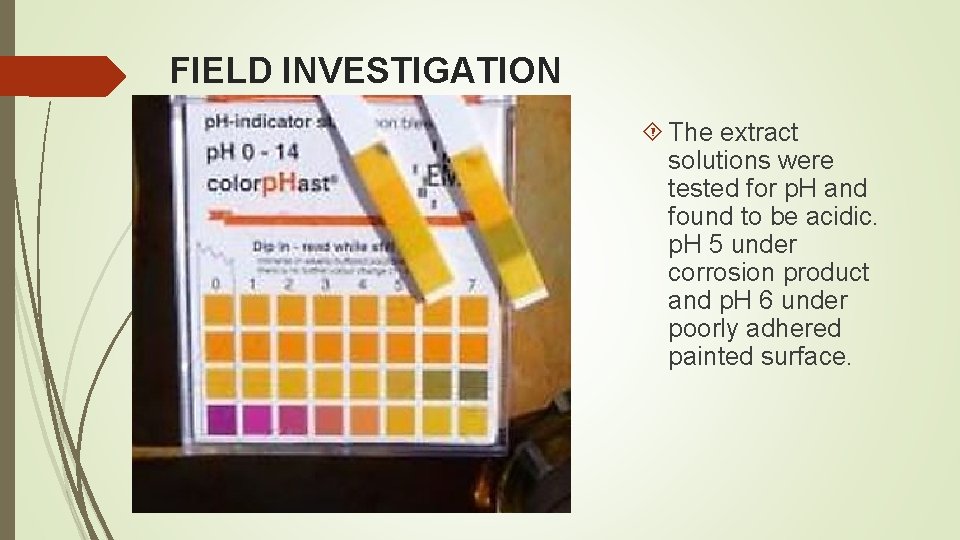
FIELD INVESTIGATION The extract solutions were tested for p. H and found to be acidic. p. H 5 under corrosion product and p. H 6 under poorly adhered painted surface.
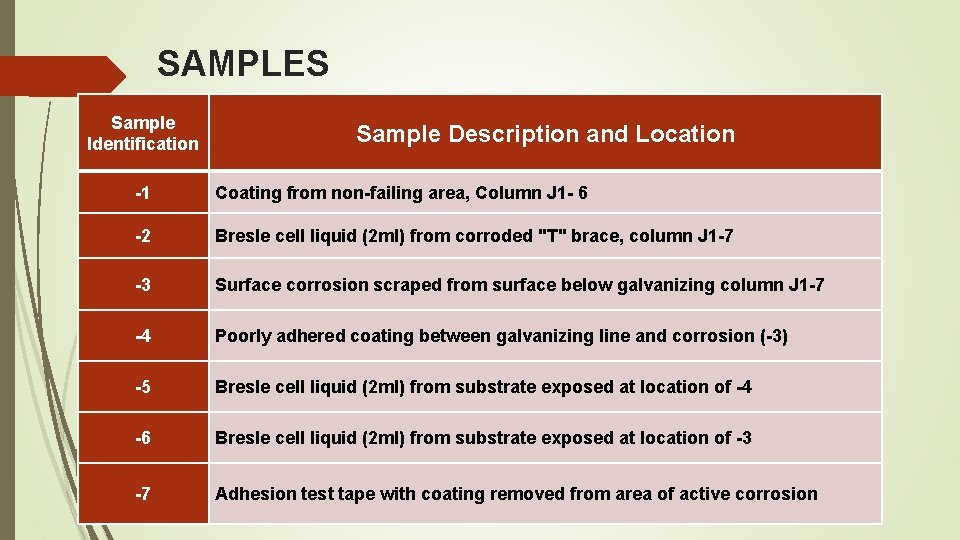
SAMPLES Sample Identification Sample Description and Location -1 Coating from non-failing area, Column J 1 - 6 -2 Bresle cell liquid (2 ml) from corroded "T" brace, column J 1 -7 -3 Surface corrosion scraped from surface below galvanizing column J 1 -7 -4 Poorly adhered coating between galvanizing line and corrosion (-3) -5 Bresle cell liquid (2 ml) from substrate exposed at location of -4 -6 Bresle cell liquid (2 ml) from substrate exposed at location of -3 -7 Adhesion test tape with coating removed from area of active corrosion
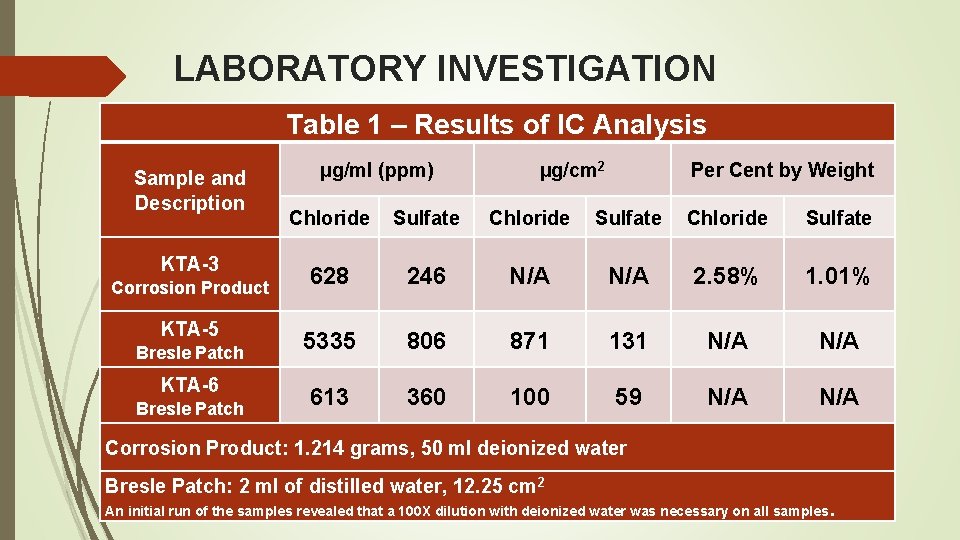
LABORATORY INVESTIGATION Table 1 – Results of IC Analysis Sample and Description KTA-3 Corrosion Product KTA-5 Bresle Patch KTA-6 Bresle Patch µg/ml (ppm) µg/cm 2 Per Cent by Weight Chloride Sulfate 628 246 N/A 2. 58% 1. 01% 5335 806 871 131 N/A 613 360 100 59 N/A Corrosion Product: 1. 214 grams, 50 ml deionized water Bresle Patch: 2 ml of distilled water, 12. 25 cm 2 An initial run of the samples revealed that a 100 X dilution with deionized water was necessary on all samples.
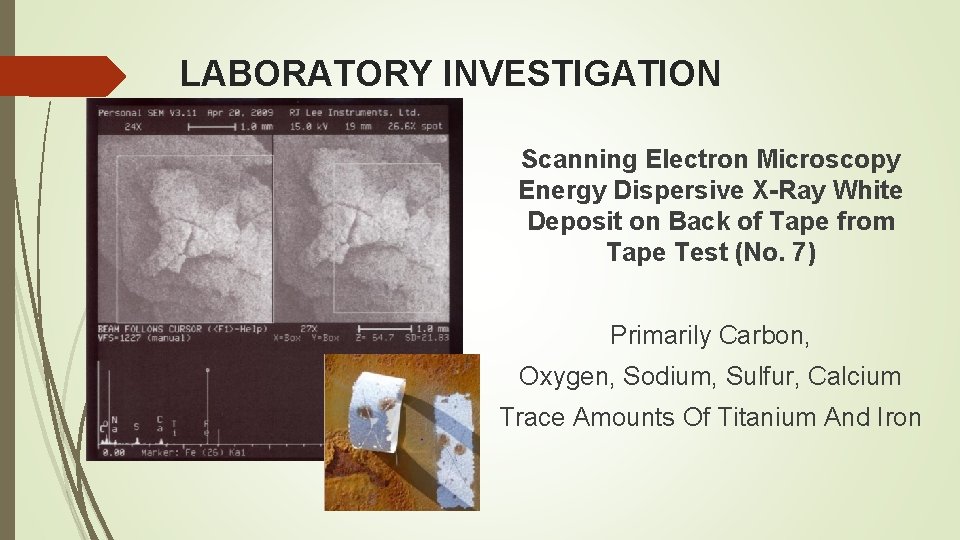
LABORATORY INVESTIGATION Scanning Electron Microscopy Energy Dispersive X-Ray White Deposit on Back of Tape from Tape Test (No. 7) Primarily Carbon, Oxygen, Sodium, Sulfur, Calcium Trace Amounts Of Titanium And Iron
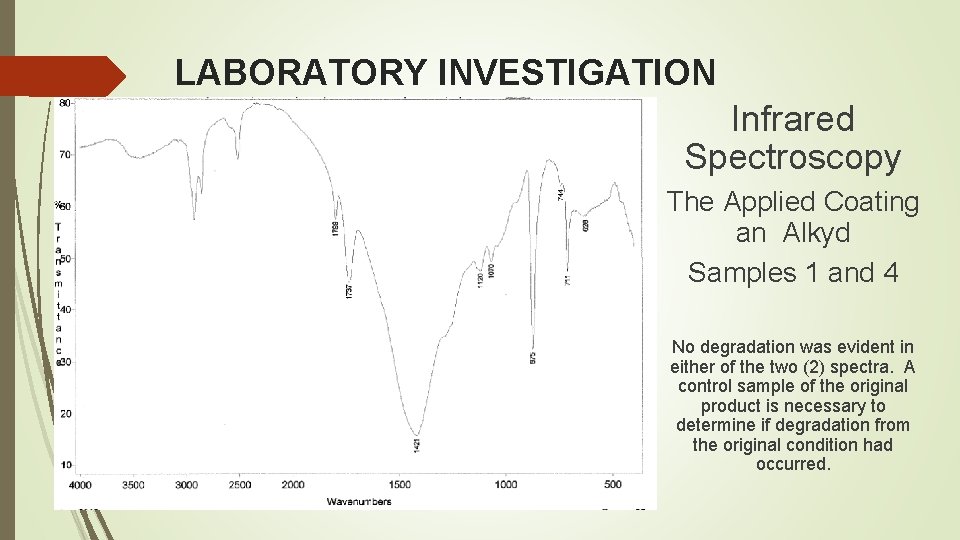
LABORATORY INVESTIGATION Infrared Spectroscopy The Applied Coating an Alkyd Samples 1 and 4 No degradation was evident in either of the two (2) spectra. A control sample of the original product is necessary to determine if degradation from the original condition had occurred.
DISCUSSION The Likely Root Cause of Failure Can be Identified Through Background Information Field Investigation and Laboratory Investigation
BACKGROUND Partial Galvanizing Shop Power Tool Cleaning Shop Primer Application-Partial Non-galvanized steel
Partial Galvanizing Quite common for Petrochemical Industry New Construction Harsh Environments Gulf Coast Partial Galvanizing Exterior Portion of Columns Galvanized Gulf Coast Atmospheric Exposure Building Interior Portions Not Galvanized Controlled, Protected
Galvanizing Cleaning, Flux and Bath Cleaning- Degreasing Acid Pickling Rinse Galvanized Dry Flux or Wet Flux Dry Flux - Dry Component Immerse in Zinc Bath Wet Flux- Immerse Through Flux Layer into Zinc Bath – (Flux Floats on Top)
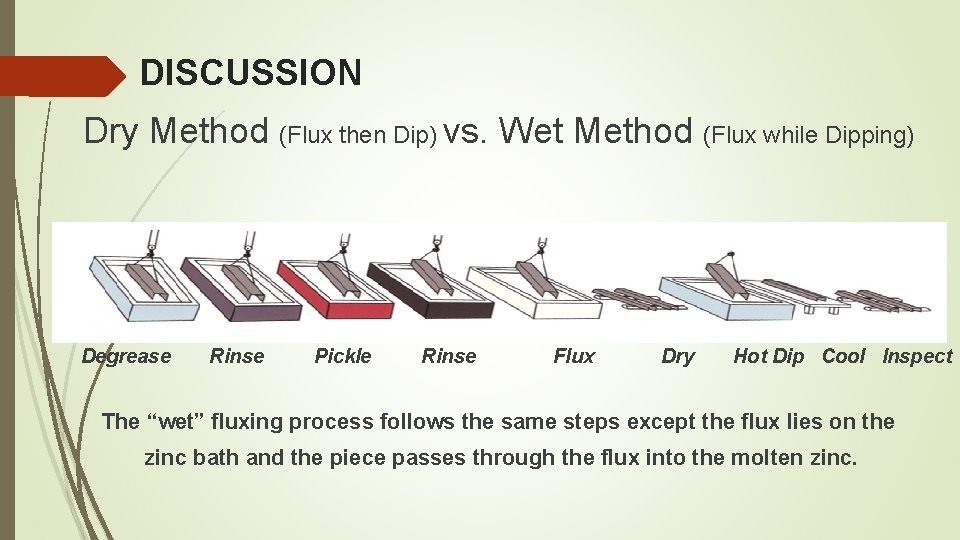
DISCUSSION Dry Method (Flux then Dip) vs. Wet Method (Flux while Dipping) Degrease Rinse Pickle Rinse Flux Dry Hot Dip Cool Inspect The “wet” fluxing process follows the same steps except the flux lies on the zinc bath and the piece passes through the flux into the molten zinc.
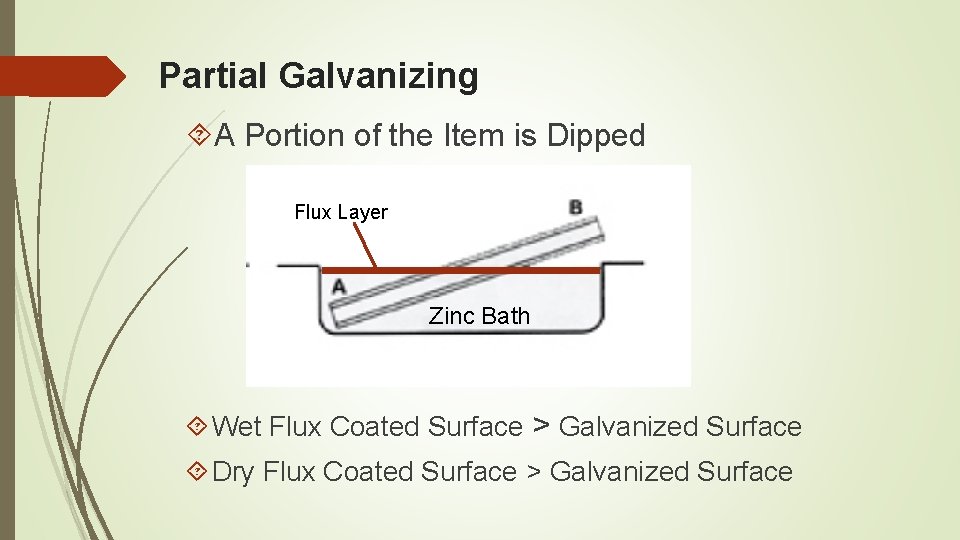
Partial Galvanizing A Portion of the Item is Dipped Flux Layer Zinc Bath Wet Flux Coated Surface > Galvanized Surface Dry Flux Coated Surface > Galvanized Surface
Flux Contaminated Surface The flux deposits may become active corrosion sites if not removed Due to the influence of moisture and atmospheric conditions. The combination of flux and moisture generates hydrochloric acid and attacks the steel.
Field Investigation Rusting, Blisters, Fisheyes Corrosion below Galvanized Sections Lower Coated Surfaces- Stained, Not Failed Soluble Salt Testing Liquid- Acidic p. H Coating Adhesion- Splits Cohesively in a Light Gray Layer
Laboratory Investigation Coating System as Specified Bresle Samples and Corrosion Products High Chloride Content High Sulfate Content White Film- Not Zinc Corrosion,
Corrective Action Power Wash Remove Soluble Salts, Neutralize Surface p. H Remove Coatings and Corrosion in all Rusted Areas. SSPC-SP 6 Commercial Blast / SSPC-SP 15 Commercial Grade Power Tool Cleaning Prepare Lower Edge of Galvanizing on Columns for coating Apply Epoxy Mastic Coating- Additional Coats as Specified (Polyurethane, Acrylic)

Questions?



- Slides: 40