
Partial Wave Analysis and Amplitude Analysis PhenomenologyTheory of
- Slides: 21
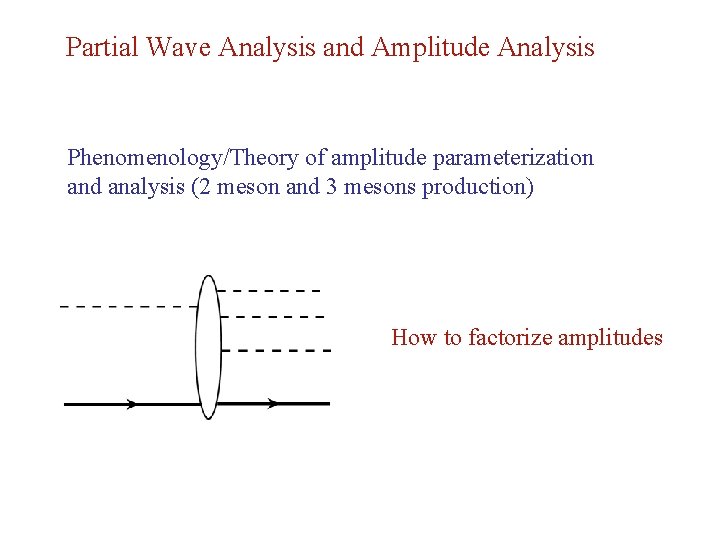
Partial Wave Analysis and Amplitude Analysis Phenomenology/Theory of amplitude parameterization and analysis (2 meson and 3 mesons production) How to factorize amplitudes
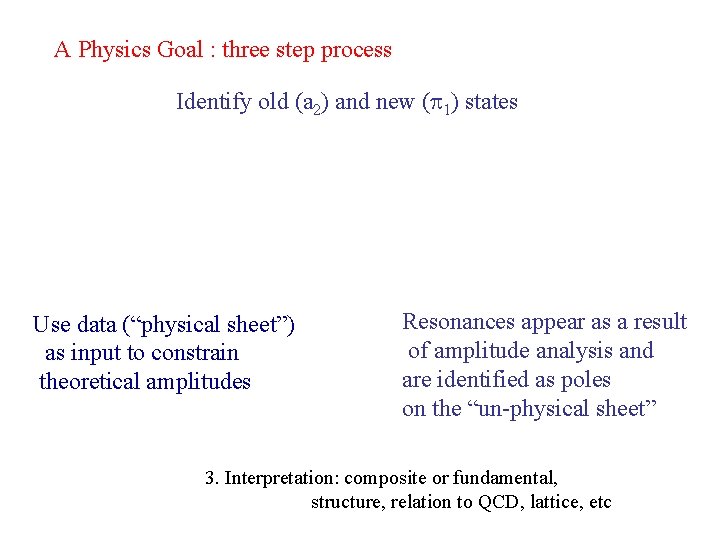
A Physics Goal : three step process Identify old (a 2) and new ( 1) states Use data (“physical sheet”) as input to constrain theoretical amplitudes Resonances appear as a result of amplitude analysis and are identified as poles on the “un-physical sheet” 3. Interpretation: composite or fundamental, structure, relation to QCD, lattice, etc
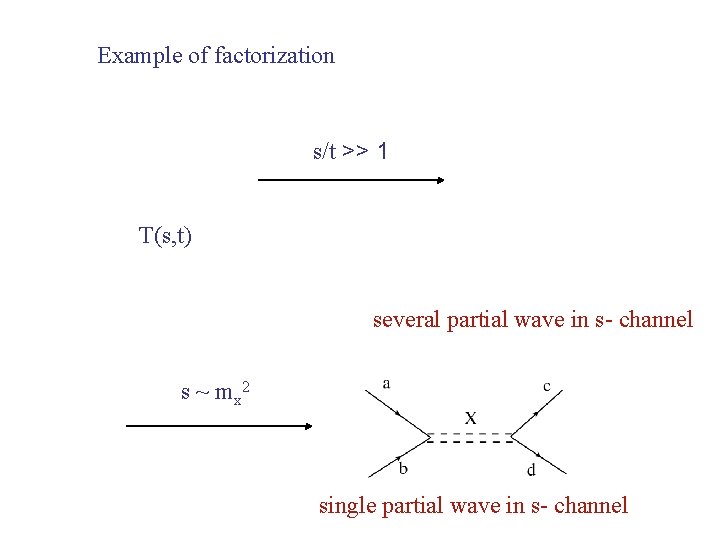
Example of factorization s/t >> 1 T(s, t) several partial wave in s- channel s ~ mx 2 single partial wave in s- channel
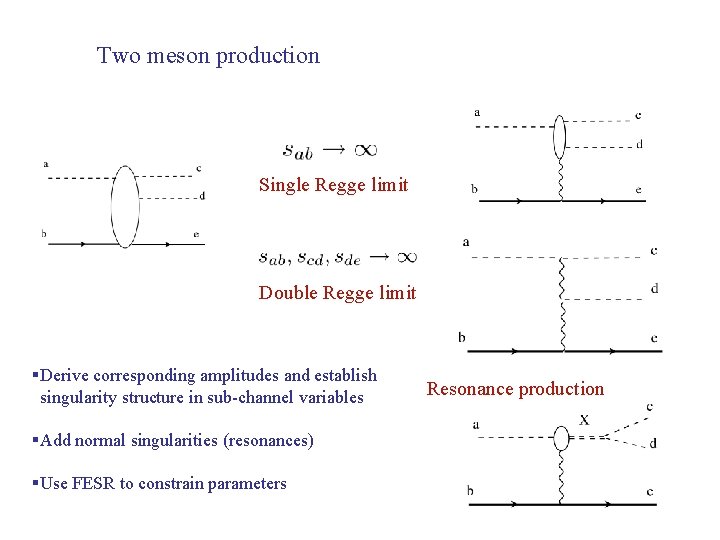
Two meson production Single Regge limit Double Regge limit Derive corresponding amplitudes and establish singularity structure in sub-channel variables Add normal singularities (resonances) Use FESR to constrain parameters Resonance production
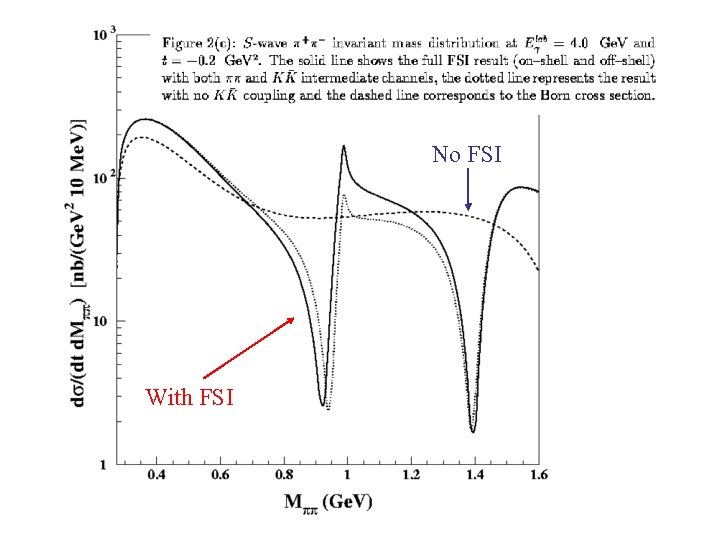
Resonance shape modification ZEUS W=70 Ge. V Szczurek et. al
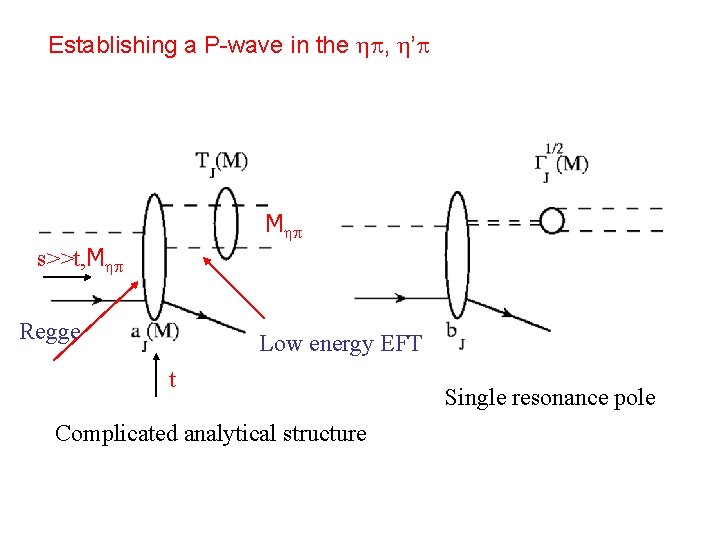
Establishing a P-wave in the , ’ M s>>t, M Regge Low energy EFT t Complicated analytical structure Single resonance pole
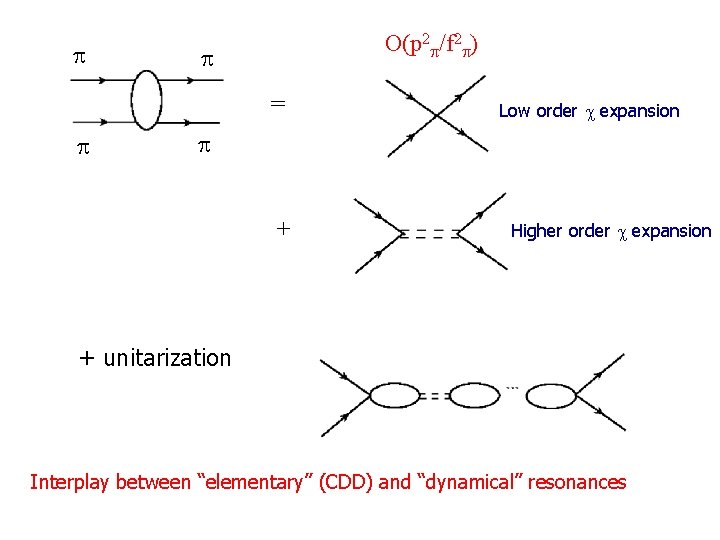
O(p 2 /f 2 ) = Low order expansion + Higher order expansion + unitarization Interplay between “elementary” (CDD) and “dynamical” resonances
Lesniak et al. (98)
No FSI With FSI
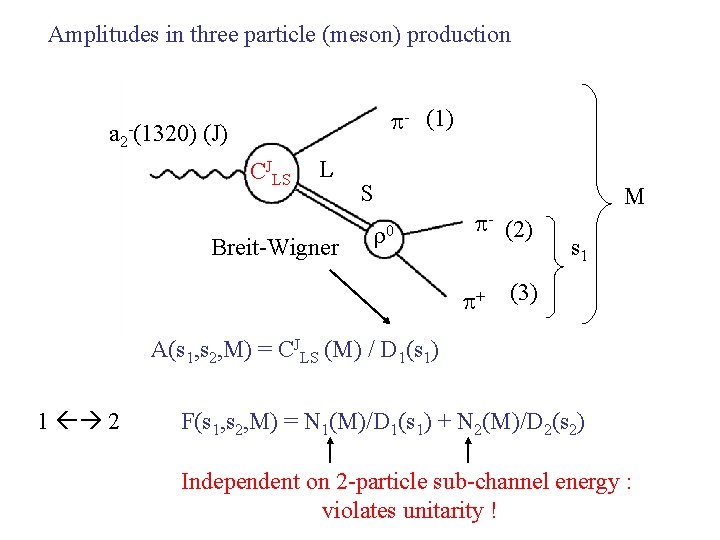
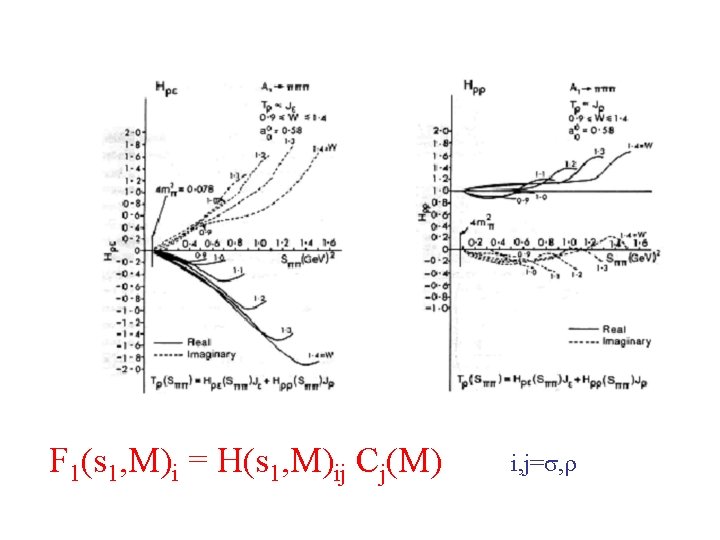
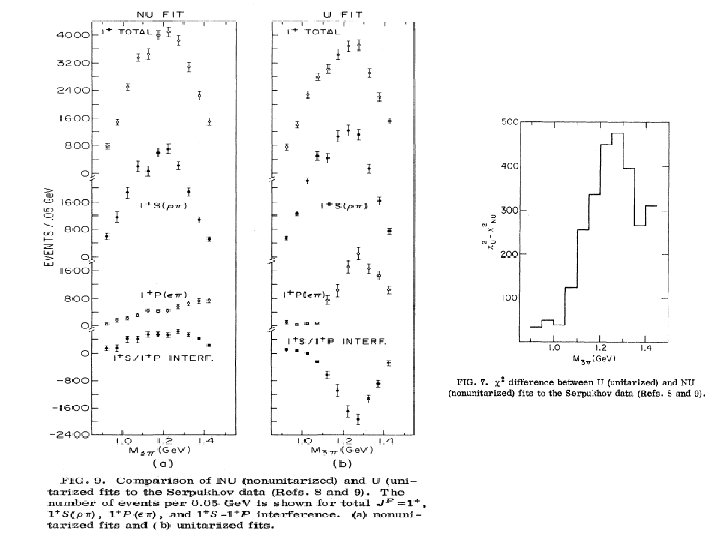
Amplitudes in three particle (meson) production a 2 -(1320) - (1) (J) CJLS L Breit-Wigner S 0 - (2) + M s 1 (3) A(s 1, s 2, M) = CJLS (M) / D 1(s 1) 1 2 F(s 1, s 2, M) = N 1(M)/D 1(s 1) + N 2(M)/D 2(s 2) Independent on 2 -particle sub-channel energy : violates unitarity !
Has to depend on 2 -particle energy
F 1(s 1, M)i = H(s 1, M)ij Cj(M) i, j= ,
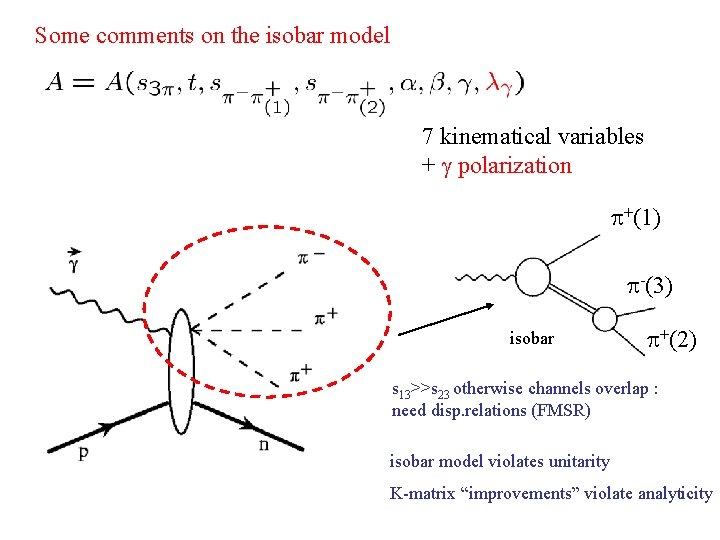
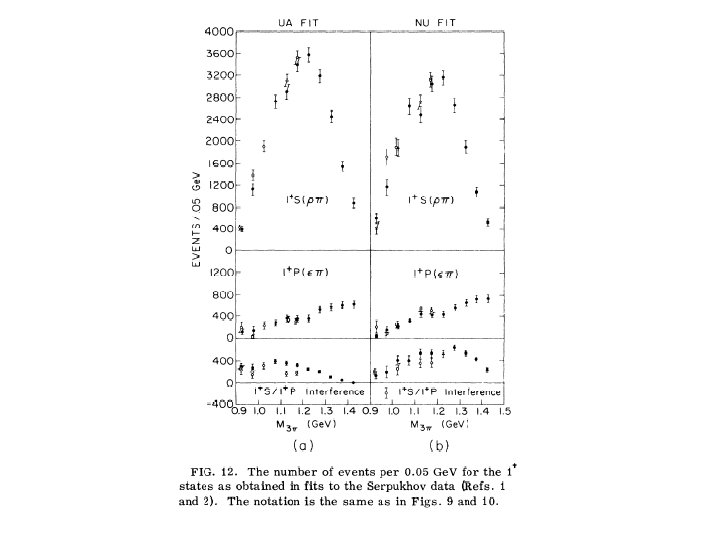
Some comments on the isobar model 7 kinematical variables + polarization +(1) -(3) isobar +(2) s 13>>s 23 otherwise channels overlap : need disp. relations (FMSR) isobar model violates unitarity K-matrix “improvements” violate analyticity
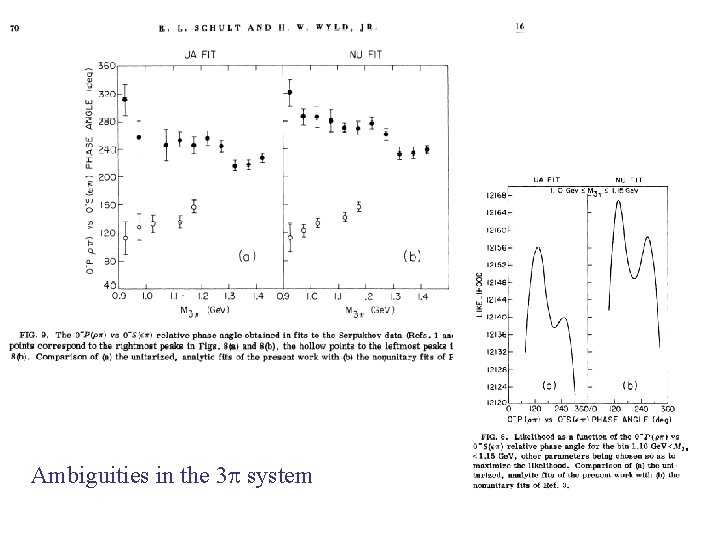
Ambiguities in the 3 system
Methods for constructing amplitudes (amplitude analysis) Analyticity: Data (in principle) allows to determine full (including “unphysical” parts) Amplitudes. Bad news : need data for the entire universe Approximations: Crossing relates “unphysical regions” of a channel with a physical region of another Unitarity relates cuts to physical data Other symmetries (kinematical, dynamical: chiral, U(1), …) constrain low-energy parts of amplitudes (partial wave expansion, fix subtraction constant)
It is important to have a statement from a significant and respected representation of the subatomic community to the effect that the scientific goals of the CLEO-c and Glue. X programs w. r. t. gluonic excitations are fundamental and important and that there is general agreement among theoretical and experimental components of the community as to what defines clear results.
A plan for theory (v. r. t amplitude analysis) Develop amplitude parameterization for selected 2 and 3 meson production amplitudes Interplay between s and t channel physics constrained by analyticity and duality Prepare a review (manual ? ) describing amplitude analysis
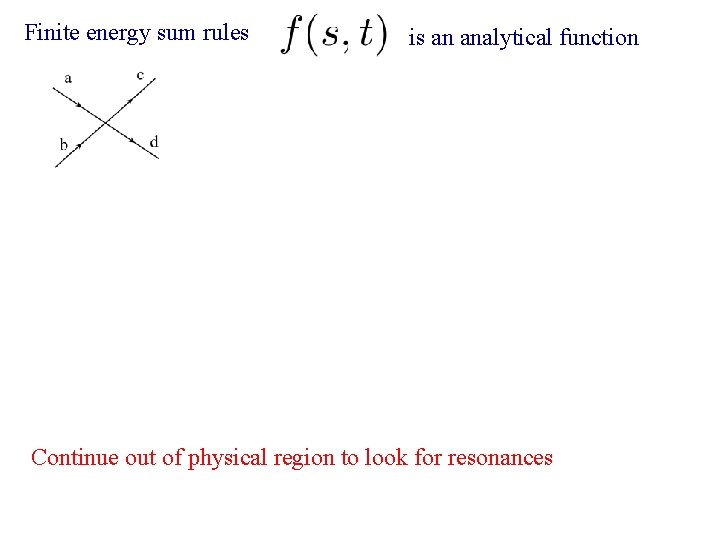
Finite energy sum rules is an analytical function Continue out of physical region to look for resonances