
Partial Orderings Aaron Bloomfield CS 202 Rosen section
Partial Orderings Aaron Bloomfield CS 202 Rosen, section 7. 6 1
Introduction An equivalence relation is a relation that is reflexive, symmetric, and transitive A partial ordering (or partial order) is a relation that is reflexive, antisymmetric, and transitive n n n Recall that antisymmetric means that if (a, b) R, then (b, a) R unless b = a Thus, (a, a) is allowed to be in R But since it’s reflexive, all possible (a, a) must be in R A set S with a partial ordering R is called a partially ordered set, or poset n Denoted by (S, R) 2
Partial ordering examples Show that ≥ is a partial order on the set of integers n n n It is reflexive: a ≥ a for all a Z It is antisymmetric: if a ≥ b then the only way that b ≥ a is when b = a It is transitive: if a ≥ b and b ≥ c, then a ≥ c Note that ≥ is the partial ordering on the set of integers (Z, ≥) is the partially ordered set, or poset 3

Symbol usage The symbol is used to represent any relation when discussing partial orders n n Not just the less than or equals to relation Can represent ≤, ≥, , etc Thus, a b denotes that (a, b) R The poset is (S, ) The symbol is used to denote a b but a ≠ b n If represents ≥, then represents > Fonts for this lecture set (specifically for the and symbols) is available on the course website 4
Comparability The elements a and b of a poset (S, ) are called comparable if either a b or b a. n n Meaning if (a, b) R or (b, a) R It can’t be both because is antisymmetric Unless a = b, of course n If neither a b nor b a, then a and b are incomparable Meaning they are not related to each other n This is definition 2 in the text If all elements in S are comparable, the relation is a total ordering 5
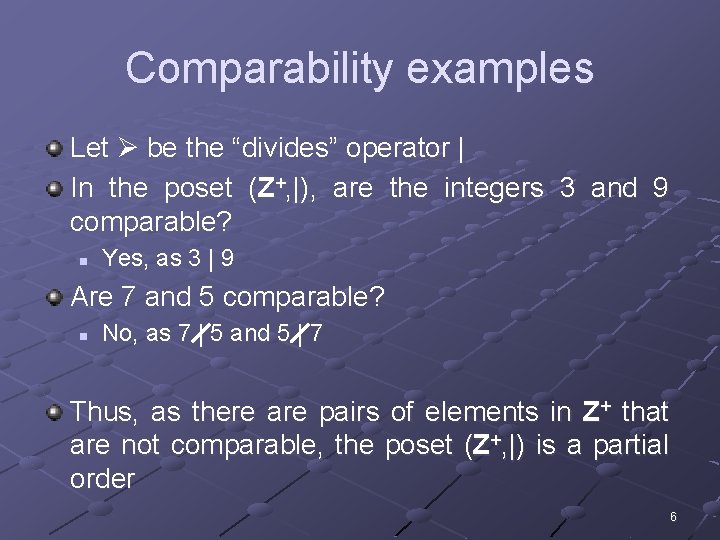
Comparability examples Let be the “divides” operator | In the poset (Z+, |), are the integers 3 and 9 comparable? n Yes, as 3 | 9 Are 7 and 5 comparable? n No, as 7 | 5 and 5 | 7 Thus, as there are pairs of elements in Z+ that are not comparable, the poset (Z+, |) is a partial order 6
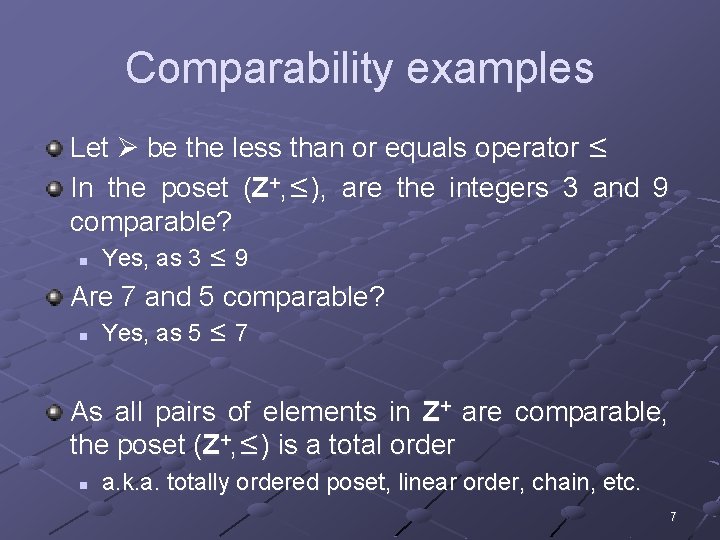
Comparability examples Let be the less than or equals operator ≤ In the poset (Z+, ≤), are the integers 3 and 9 comparable? n Yes, as 3 ≤ 9 Are 7 and 5 comparable? n Yes, as 5 ≤ 7 As all pairs of elements in Z+ are comparable, the poset (Z+, ≤) is a total order n a. k. a. totally ordered poset, linear order, chain, etc. 7

A bit of Star Wars humor… 8

Well-ordered sets (S, ) is a well-ordered set if: n n (S, ) is a totally ordered poset Every non-empty subset of S has at least element Example: (Z, ≤) n n n Is a total ordered poset (every element is comparable to every other element) It has no least element Thus, it is not a well-ordered set Example: (S, ≤) where S = { 1, 2, 3, 4, 5 } n n n Is a total ordered poset (every element is comparable to every other element) Has a least element (1) Thus, it is a well-ordered set 10
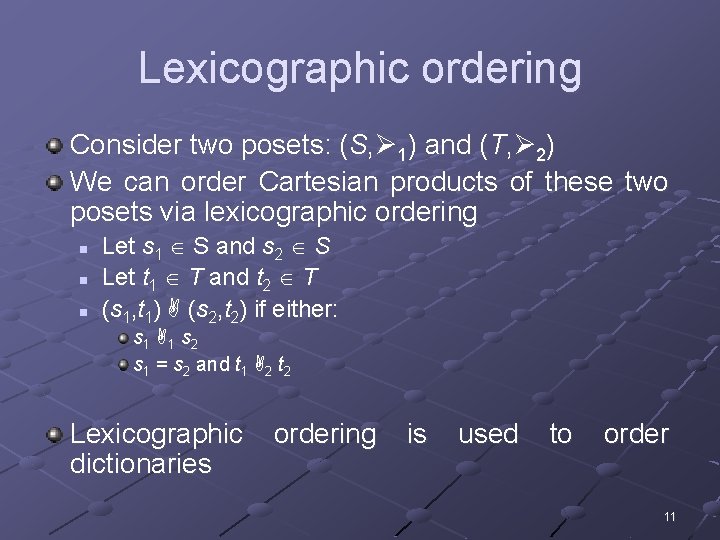
Lexicographic ordering Consider two posets: (S, 1) and (T, 2) We can order Cartesian products of these two posets via lexicographic ordering n n n Let s 1 S and s 2 S Let t 1 T and t 2 T (s 1, t 1) (s 2, t 2) if either: s 1 1 s 2 s 1 = s 2 and t 1 2 t 2 Lexicographic dictionaries ordering is used to order 11
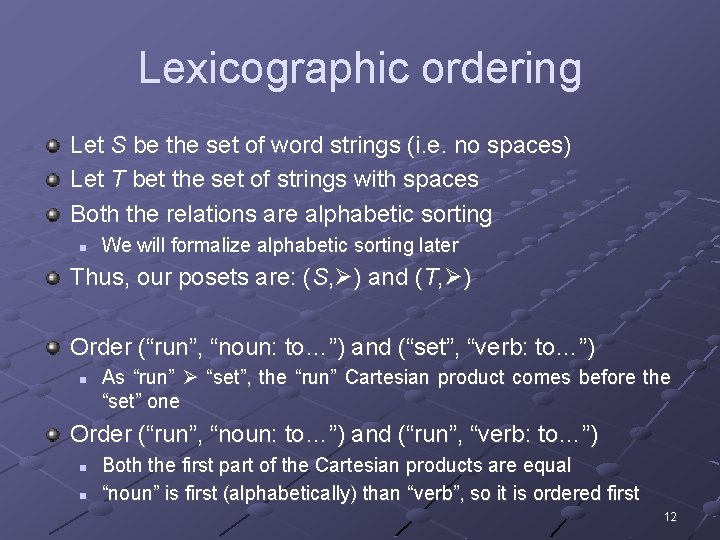
Lexicographic ordering Let S be the set of word strings (i. e. no spaces) Let T bet the set of strings with spaces Both the relations are alphabetic sorting n We will formalize alphabetic sorting later Thus, our posets are: (S, ) and (T, ) Order (“run”, “noun: to…”) and (“set”, “verb: to…”) n As “run” “set”, the “run” Cartesian product comes before the “set” one Order (“run”, “noun: to…”) and (“run”, “verb: to…”) n n Both the first part of the Cartesian products are equal “noun” is first (alphabetically) than “verb”, so it is ordered first 12
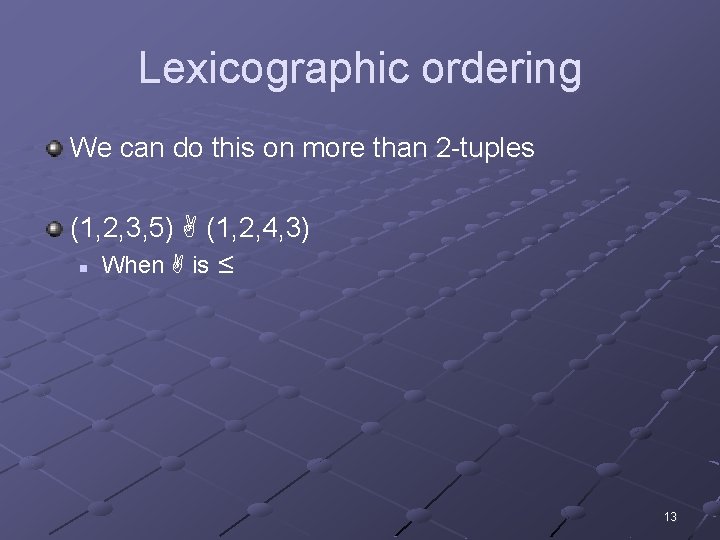
Lexicographic ordering We can do this on more than 2 -tuples (1, 2, 3, 5) (1, 2, 4, 3) n When is ≤ 13
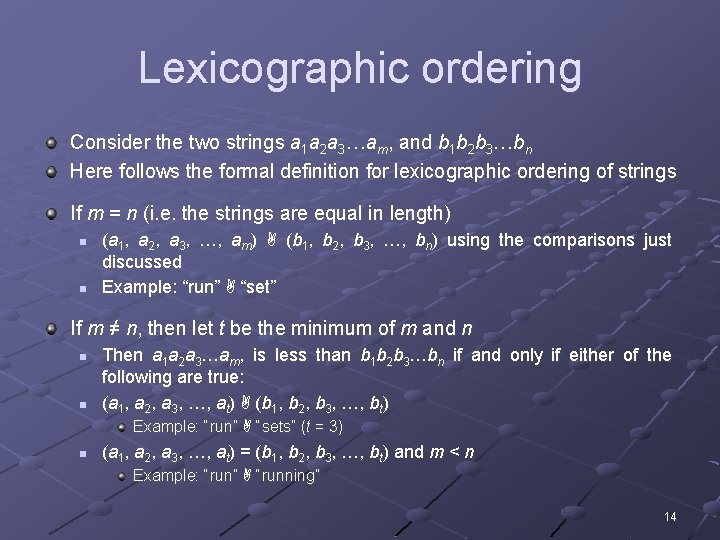
Lexicographic ordering Consider the two strings a 1 a 2 a 3…am, and b 1 b 2 b 3…bn Here follows the formal definition for lexicographic ordering of strings If m = n (i. e. the strings are equal in length) n n (a 1, a 2, a 3, …, am) (b 1, b 2, b 3, …, bn) using the comparisons just discussed Example: “run” “set” If m ≠ n, then let t be the minimum of m and n n n Then a 1 a 2 a 3…am, is less than b 1 b 2 b 3…bn if and only if either of the following are true: (a 1, a 2, a 3, …, at) (b 1, b 2, b 3, …, bt) Example: “run” “sets” (t = 3) n (a 1, a 2, a 3, …, at) = (b 1, b 2, b 3, …, bt) and m < n Example: “run” “running” 14
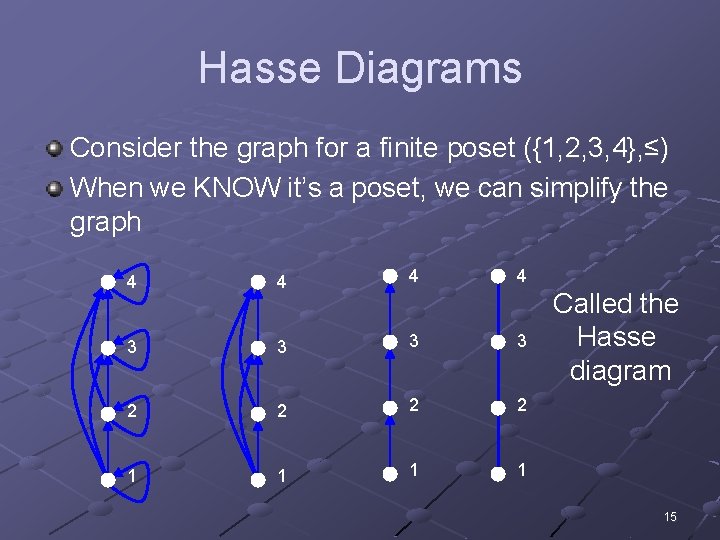
Hasse Diagrams Consider the graph for a finite poset ({1, 2, 3, 4}, ≤) When we KNOW it’s a poset, we can simplify the graph 4 4 3 3 2 2 1 1 Called the Hasse diagram 15
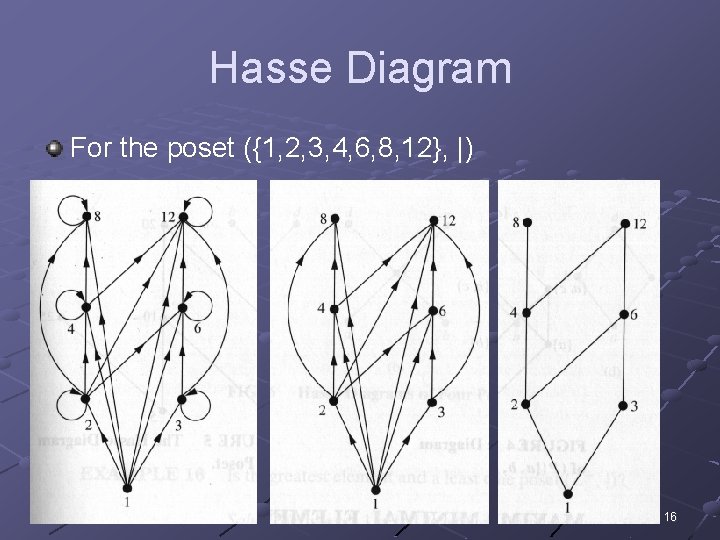
Hasse Diagram For the poset ({1, 2, 3, 4, 6, 8, 12}, |) 16
Not being covered The remainder of 7. 6 is not being covered due to lack of time n n n Maximal and minimal elements Lattices Topological sorting 17

Quick survey n a) b) c) d) I felt I understood the material in this slide set… Very well With some review, I’ll be good Not really Not at all 18

Quick survey n a) b) c) d) The pace of the lecture for this slide set was… Fast About right A little slow Too slow 19
Quick survey n a) b) c) d) How interesting was the material in this slide set? Be honest! Wow! That was SOOOOOO cool! Somewhat interesting Rather borting Zzzzzz 20

A bit of humor… 21
- Slides: 20