
PARTIAL FRACTIONS Learning Outcomes Be able to recognise
PARTIAL FRACTIONS Learning Outcomes: • Be able to recognise when a rational function can be rewritten as a sum of simpler rational functions (Partial fractions) i. e. when the denominator can be factorised • Be able to recognise which type of Partial fractions are required • Be able to express a rational function in partial fractions when possible
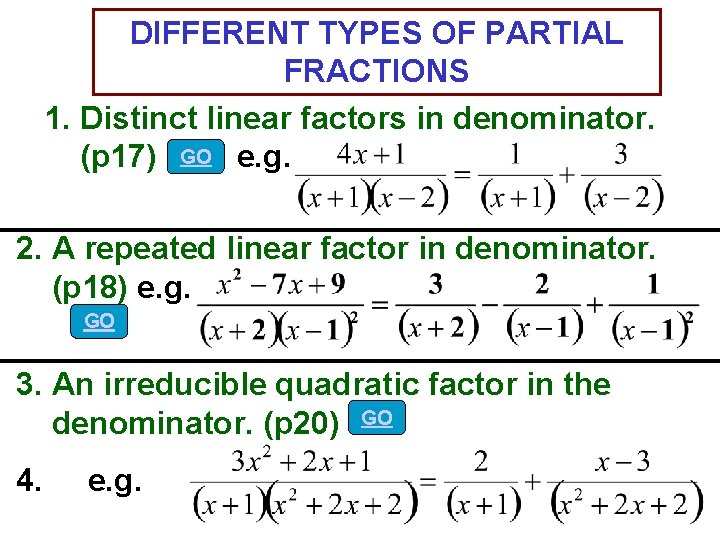
DIFFERENT TYPES OF PARTIAL FRACTIONS 1. Distinct linear factors in denominator. (p 17) GO e. g. 2. A repeated linear factor in denominator. (p 18) e. g. GO 3. An irreducible quadratic factor in the denominator. (p 20) GO 4. e. g.
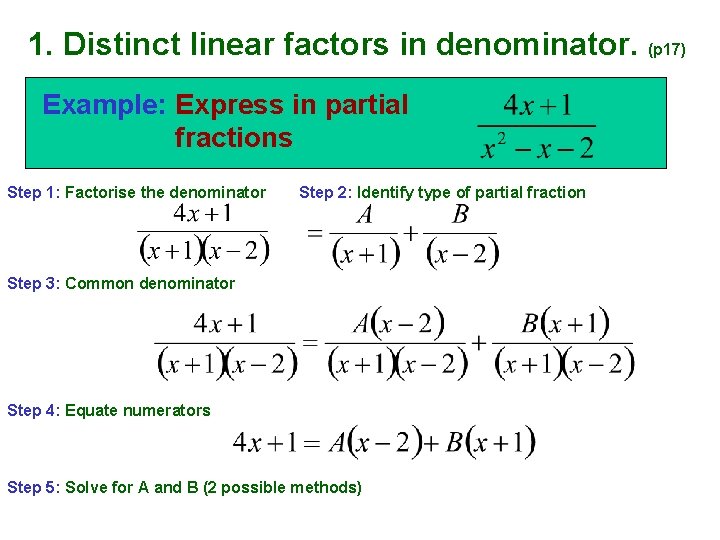
1. Distinct linear factors in denominator. (p 17) Example: Express in partial fractions Step 1: Factorise the denominator Step 2: Identify type of partial fraction Step 3: Common denominator Step 4: Equate numerators Step 5: Solve for A and B (2 possible methods)

1. Distinct linear factors in denominator. (p 17) Step 5: Solve for A and B (2 possible methods) Method 1: Equate coefficients of the powers of x

1. Distinct linear factors in denominator. (p 17) Step 5: Solve for A and B (2 possible methods) 2 -1 -1 0 0 2 Method 2: Choose suitable values of x to eliminate terms When x = 2, When x = -1,
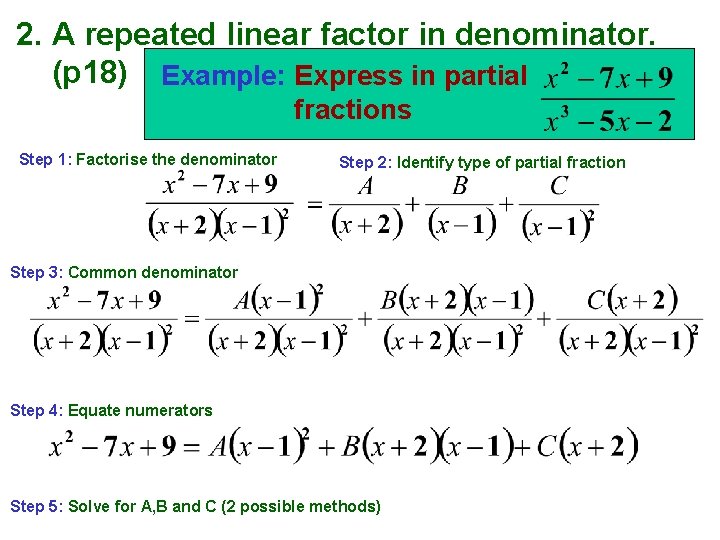
2. A repeated linear factor in denominator. (p 18) Example: Express in partial fractions Step 1: Factorise the denominator Step 2: Identify type of partial fraction Step 3: Common denominator Step 4: Equate numerators Step 5: Solve for A, B and C (2 possible methods)
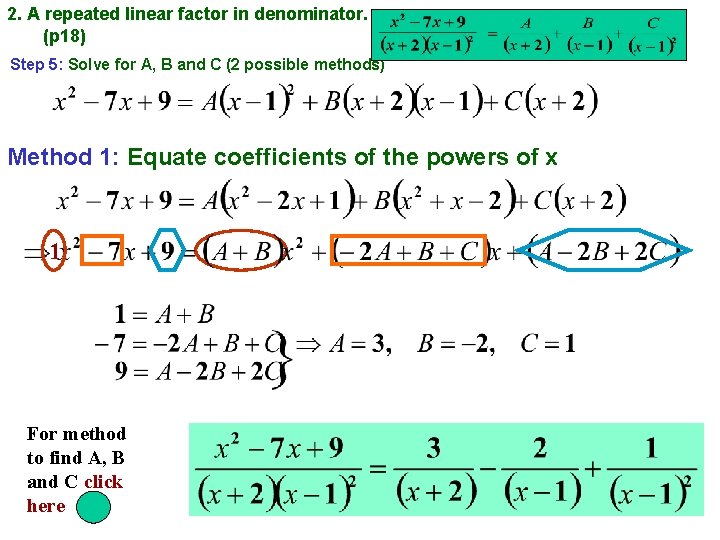
2. A repeated linear factor in denominator. (p 18) Step 5: Solve for A, B and C (2 possible methods) Method 1: Equate coefficients of the powers of x 1 For method to find A, B and C click here
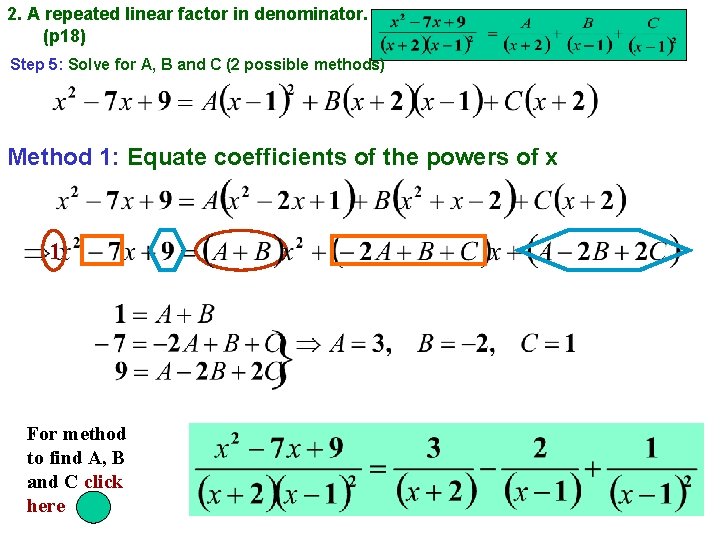
2. A repeated linear factor in denominator. (p 18) Step 5: Solve for A, B and C (2 possible methods) Method 1: Equate coefficients of the powers of x 1 For method to find A, B and C click here
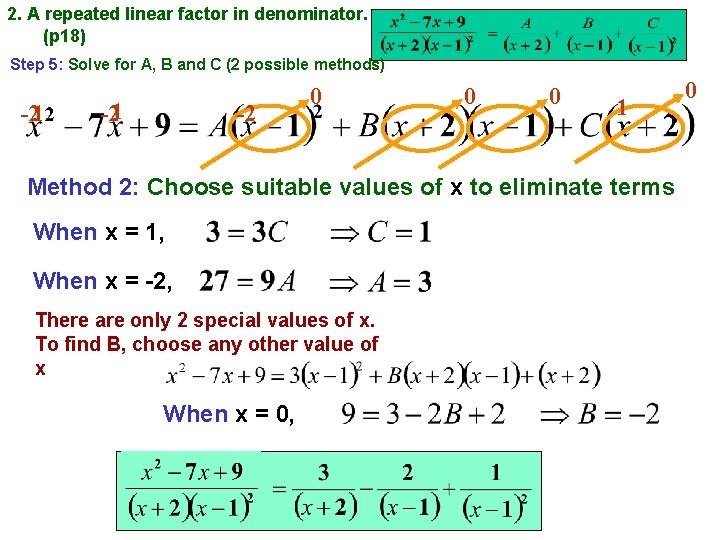
2. A repeated linear factor in denominator. (p 18) Step 5: Solve for A, B and C (2 possible methods) -21 -2 0 0 0 1 Method 2: Choose suitable values of x to eliminate terms When x = 1, When x = -2, There are only 2 special values of x. To find B, choose any other value of x When x = 0, 0
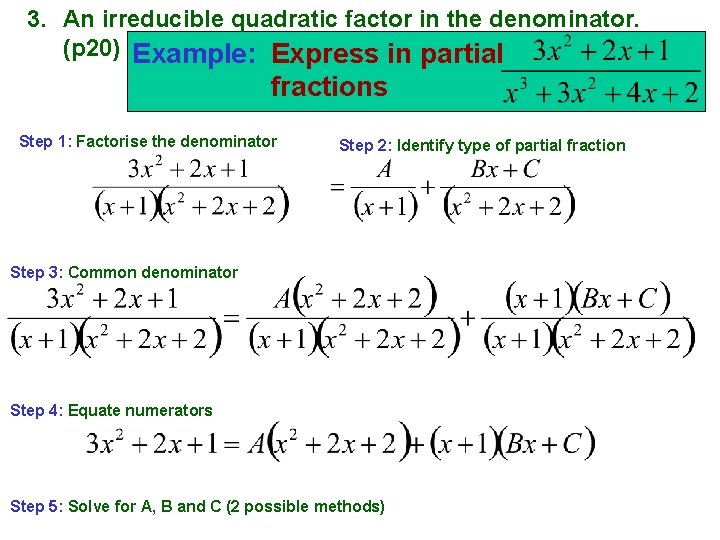
3. An irreducible quadratic factor in the denominator. (p 20) Example: Express in partial fractions Step 1: Factorise the denominator Step 2: Identify type of partial fraction Step 3: Common denominator Step 4: Equate numerators Step 5: Solve for A, B and C (2 possible methods)
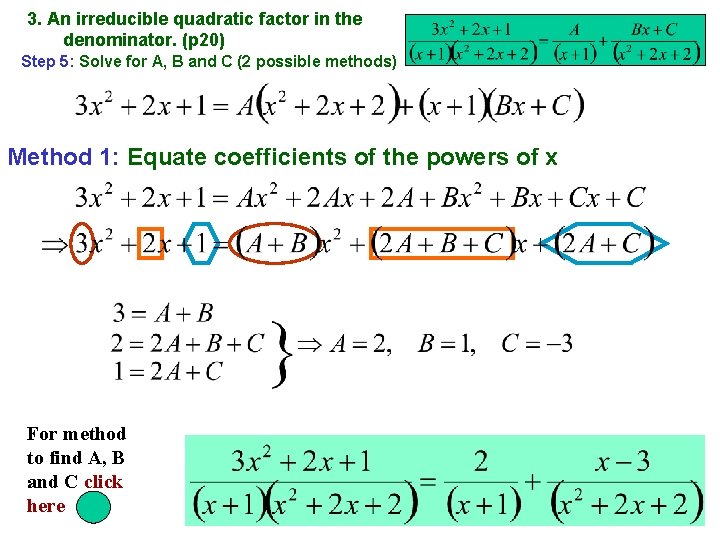
3. An irreducible quadratic factor in the denominator. (p 20) Step 5: Solve for A, B and C (2 possible methods) Method 1: Equate coefficients of the powers of x For method to find A, B and C click here
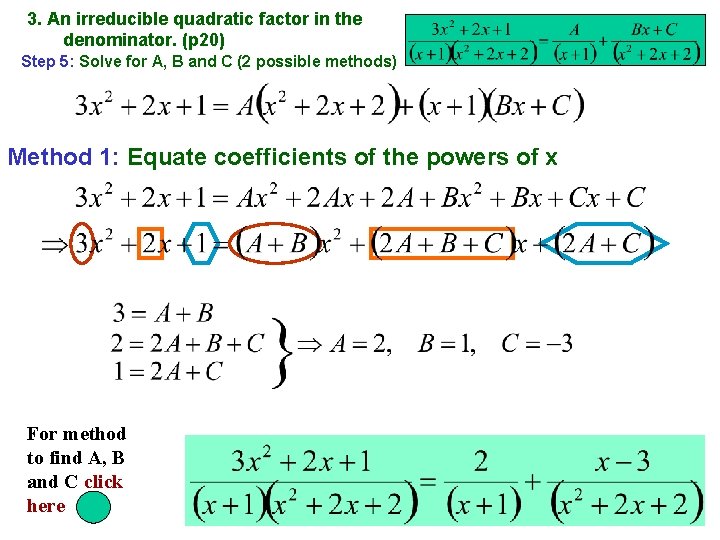
3. An irreducible quadratic factor in the denominator. (p 20) Step 5: Solve for A, B and C (2 possible methods) Method 1: Equate coefficients of the powers of x For method to find A, B and C click here
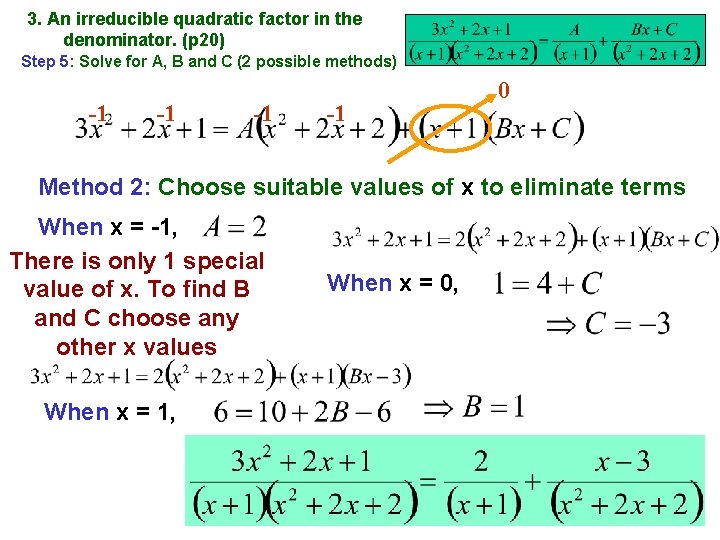
3. An irreducible quadratic factor in the denominator. (p 20) Step 5: Solve for A, B and C (2 possible methods) -1 -1 0 Method 2: Choose suitable values of x to eliminate terms When x = -1, There is only 1 special value of x. To find B and C choose any other x values When x = 1, When x = 0,
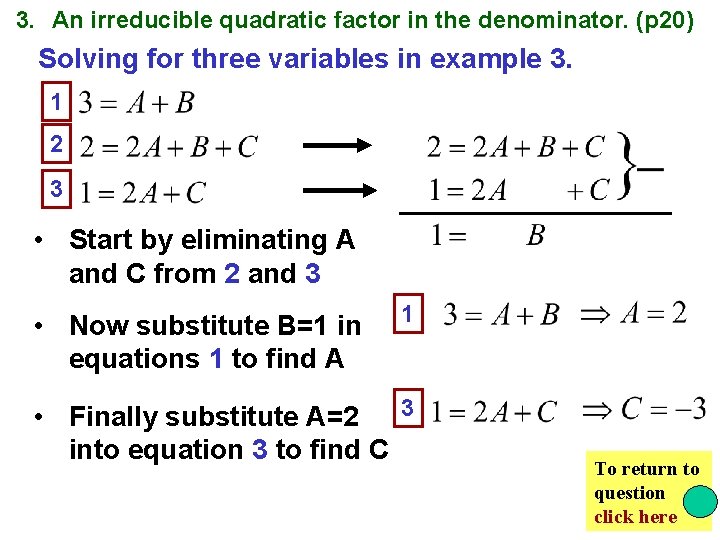
3. An irreducible quadratic factor in the denominator. (p 20) Solving for three variables in example 3. 1 2 3 • Start by eliminating A and C from 2 and 3 • Now substitute B=1 in equations 1 to find A 1 • Finally substitute A=2 3 into equation 3 to find C To return to question click here
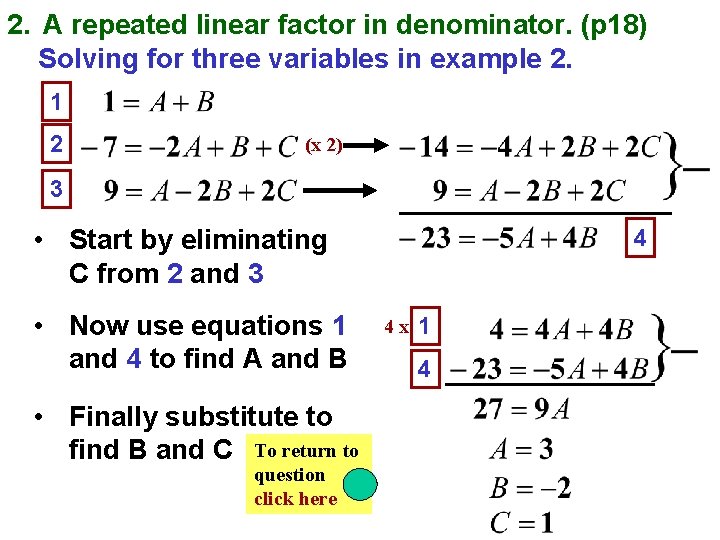
2. A repeated linear factor in denominator. (p 18) Solving for three variables in example 2. 1 2 (x 2) 3 • Start by eliminating C from 2 and 3 • Now use equations 1 and 4 to find A and B • Finally substitute to find B and C To return to question click here 4 4 x 1 4
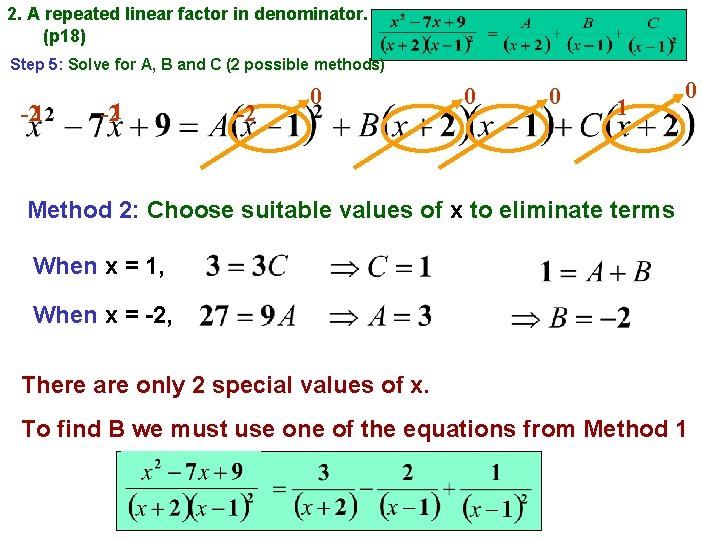
2. A repeated linear factor in denominator. (p 18) Step 5: Solve for A, B and C (2 possible methods) -21 -2 0 0 0 1 0 Method 2: Choose suitable values of x to eliminate terms When x = 1, When x = -2, There are only 2 special values of x. To find B we must use one of the equations from Method 1
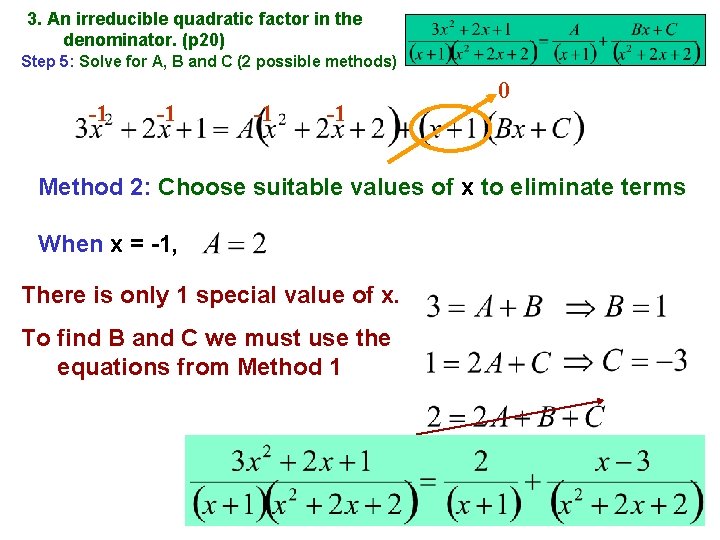
3. An irreducible quadratic factor in the denominator. (p 20) Step 5: Solve for A, B and C (2 possible methods) -1 -1 0 Method 2: Choose suitable values of x to eliminate terms When x = -1, There is only 1 special value of x. To find B and C we must use the equations from Method 1
- Slides: 17