
Partial Face Recognition Shengcai Liao NLPR CASIA April



- Slides: 40
Partial Face Recognition Shengcai Liao NLPR, CASIA April 29, 2015
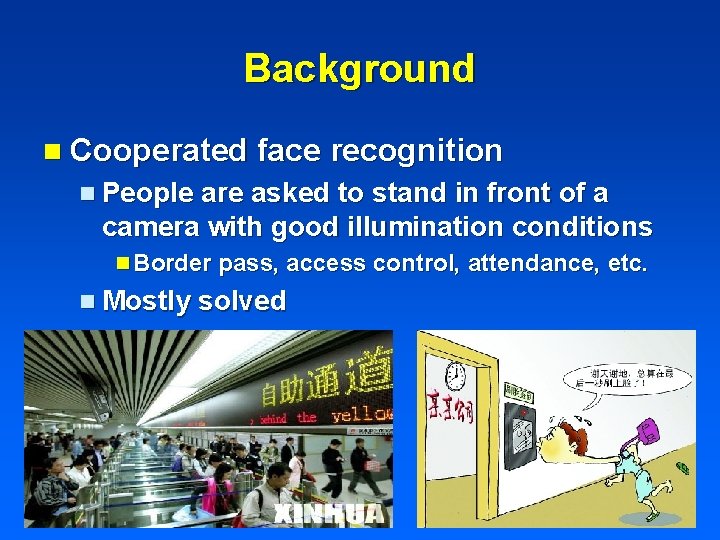
Background n Cooperated face recognition n People are asked to stand in front of a camera with good illumination conditions n Border pass, access control, attendance, etc. n Mostly solved
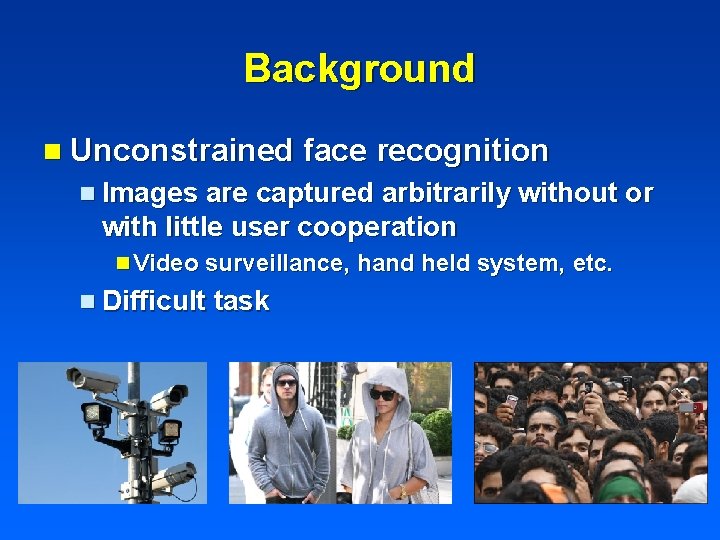
Background n Unconstrained face recognition n Images are captured arbitrarily without or with little user cooperation n Video surveillance, hand held system, etc. n Difficult task
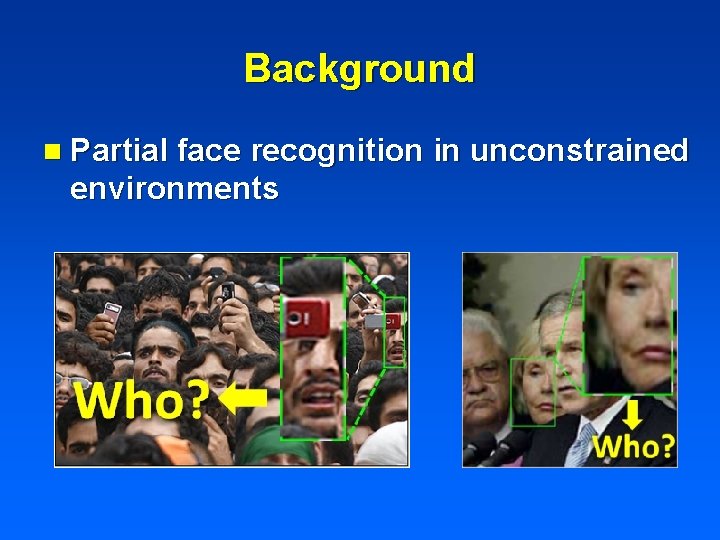
Background n Partial face recognition in unconstrained environments
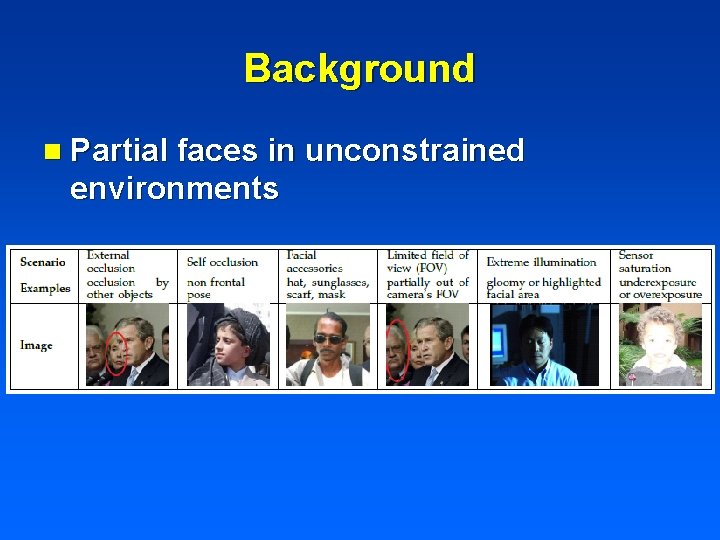
Background n Partial faces in unconstrained environments
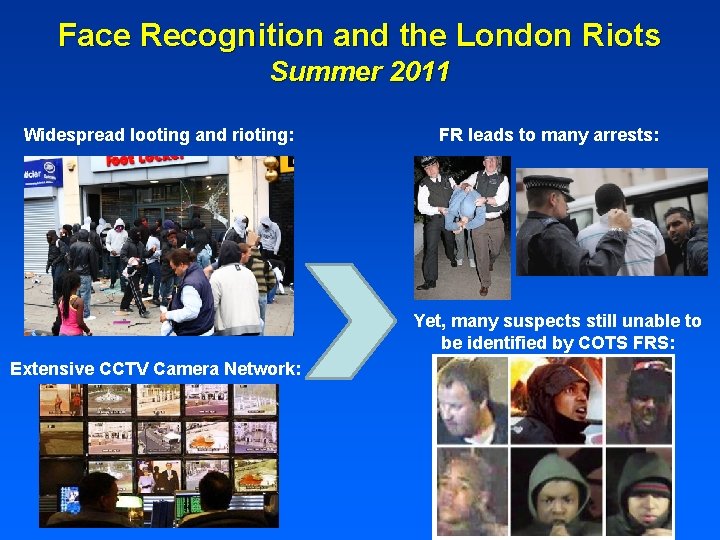
Face Recognition and the London Riots Summer 2011 Widespread looting and rioting: FR leads to many arrests: Yet, many suspects still unable to be identified by COTS FRS: Extensive CCTV Camera Network:
Partial Face Recognition (PFR) n Problem n Recognize an arbitrary partial face image captured in uncontrolled environment n Importance n Recognize a suspect in crowd n Identify a face from its partial image n Difference from traditional face recognition n Alignment? n Feature representation? n Classification?
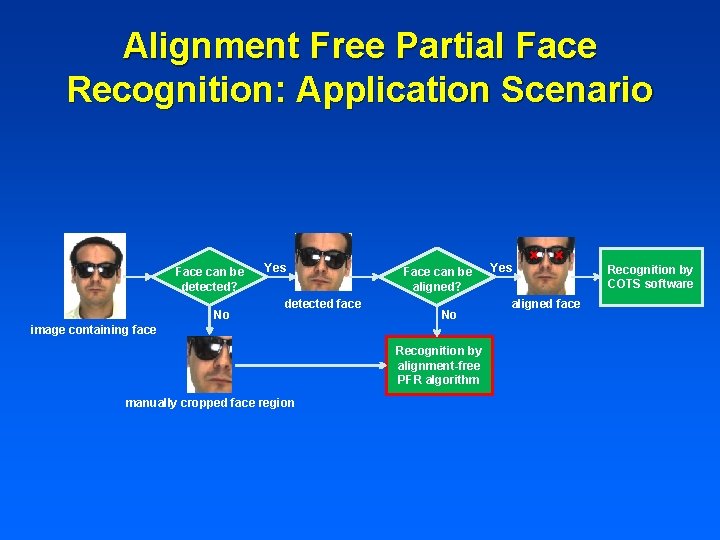
Alignment Free Partial Face Recognition: Application Scenario Face can be detected? No Yes detected face Face can be aligned? No image containing face Recognition by alignment-free PFR algorithm manually cropped face region Yes × × aligned face Recognition by COTS software
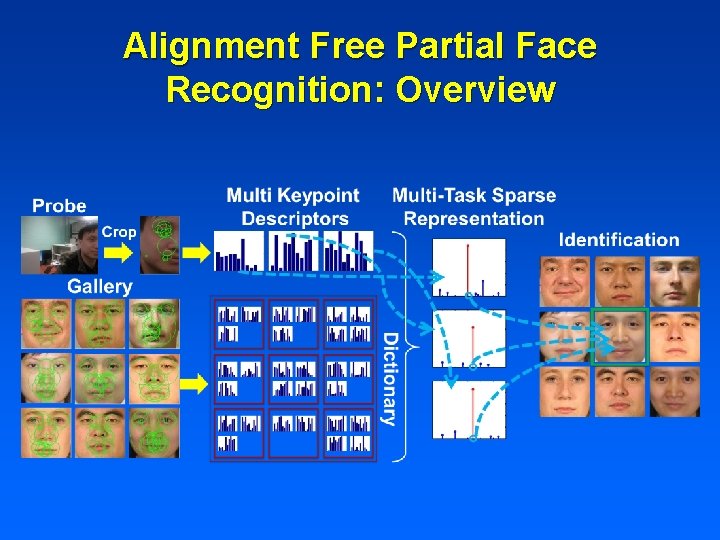
Alignment Free Partial Face Recognition: Overview
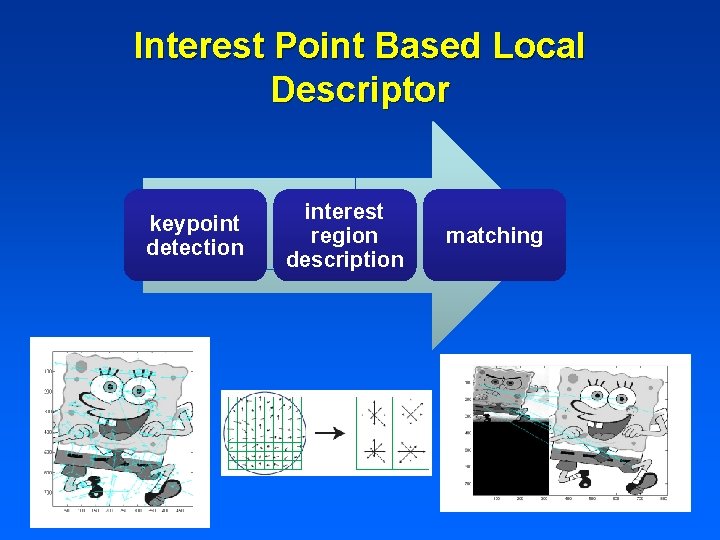
Interest Point Based Local Descriptor keypoint detection interest region description matching
Interest Point Based Local Descriptor n Image retrieval n Image matching n Object recognition n Texture recognition n Robot localization n…
Interest Point Based Local Descriptor n Intensity histogram n SIFT n HOG n GLOH n PCA-SIFT n SURF
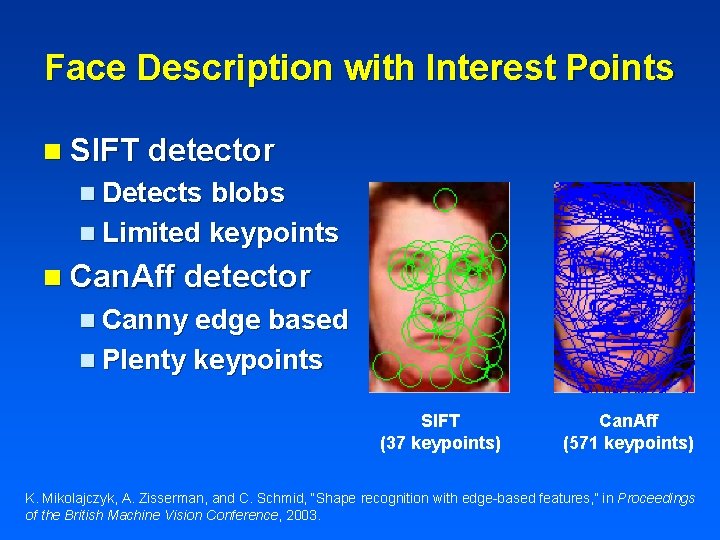
Face Description with Interest Points n SIFT detector n Detects blobs n Limited keypoints n Can. Aff detector n Canny edge based n Plenty keypoints SIFT (37 keypoints) Can. Aff (571 keypoints) K. Mikolajczyk, A. Zisserman, and C. Schmid, “Shape recognition with edge-based features, ” in Proceedings of the British Machine Vision Conference, 2003.
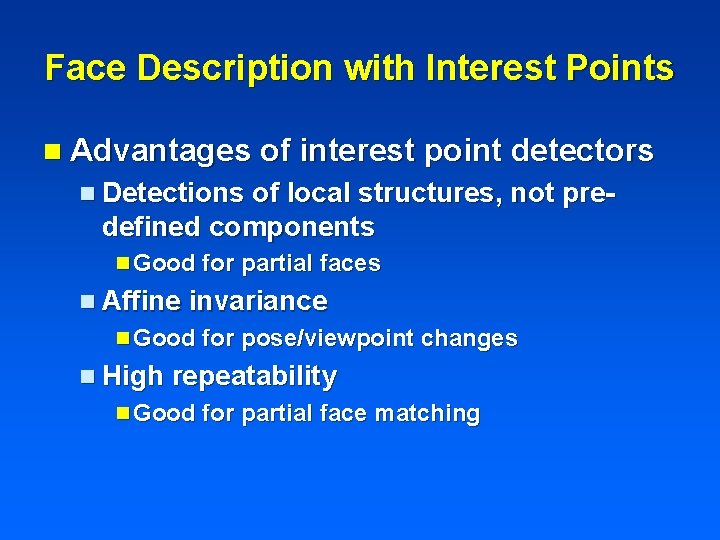
Face Description with Interest Points n Advantages of interest point detectors n Detections of local structures, not pre- defined components n Good for partial faces n Affine invariance n Good for pose/viewpoint changes n High repeatability n Good for partial face matching
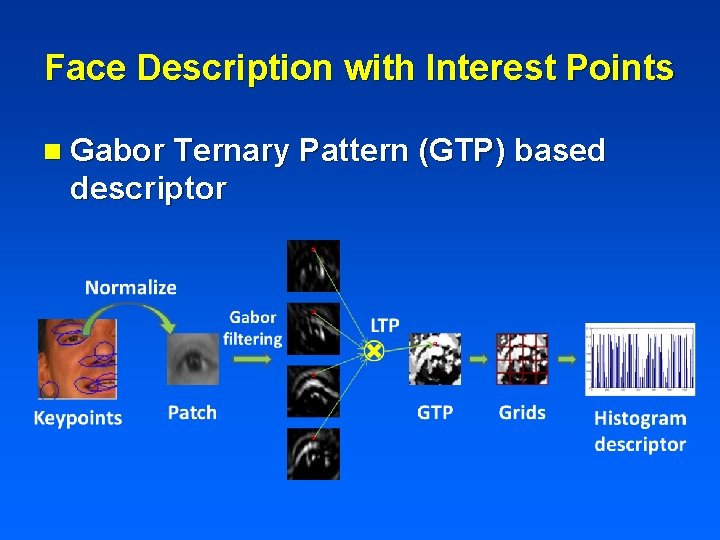
Face Description with Interest Points n Gabor Ternary Pattern (GTP) based descriptor
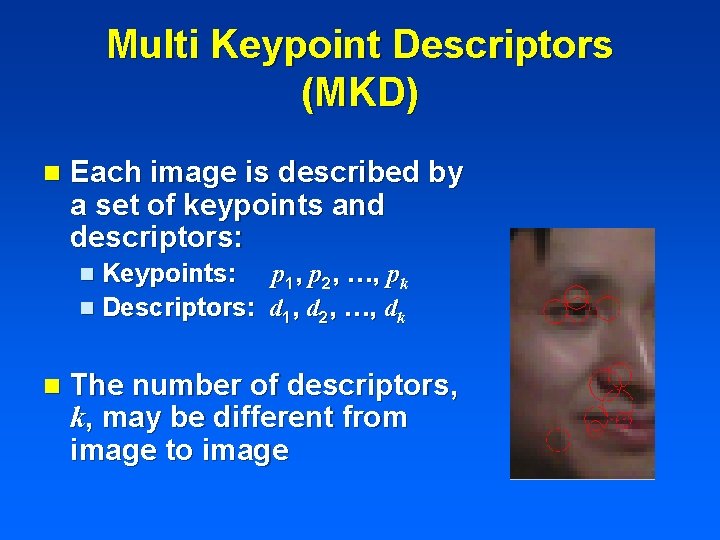
Multi Keypoint Descriptors (MKD) n Each image is described by a set of keypoints and descriptors: n Keypoints: p 1, p 2, …, pk n Descriptors: d 1, d 2, …, dk n The number of descriptors, k, may be different from image to image
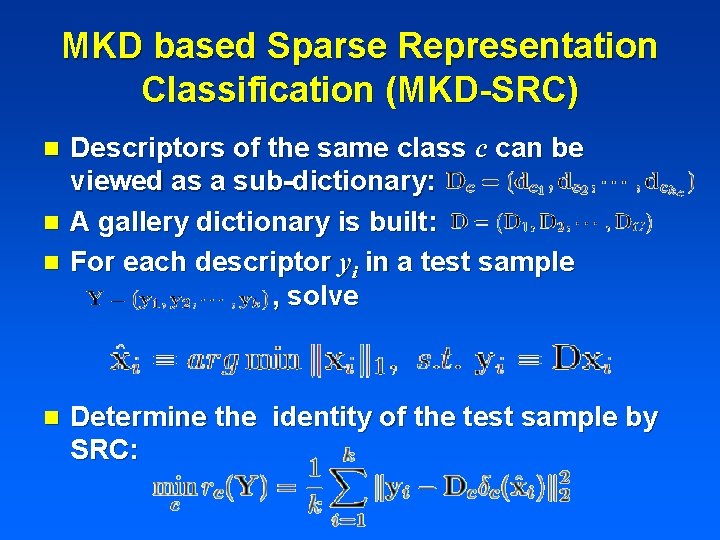
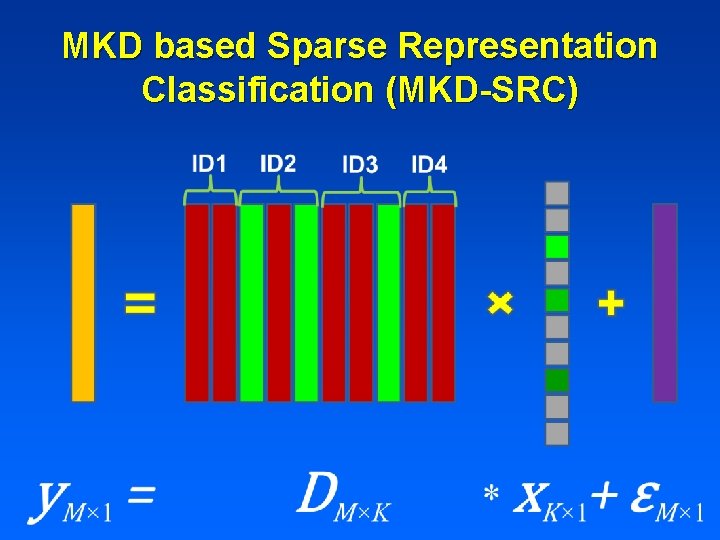
MKD based Sparse Representation Classification (MKD-SRC) Descriptors of the same class c can be viewed as a sub-dictionary: n A gallery dictionary is built: n For each descriptor yi in a test sample , solve n n Determine the identity of the test sample by SRC:
MKD based Sparse Representation Classification (MKD-SRC)
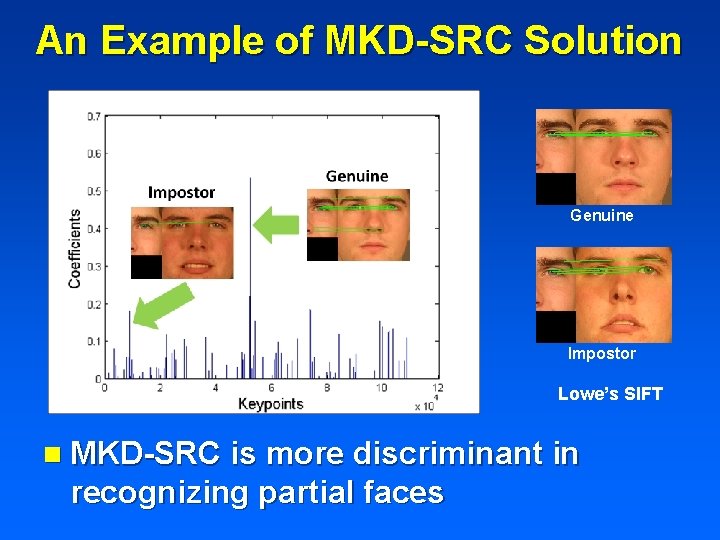
An Example of MKD-SRC Solution Genuine Impostor Lowe’s SIFT n MKD-SRC is more discriminant in recognizing partial faces
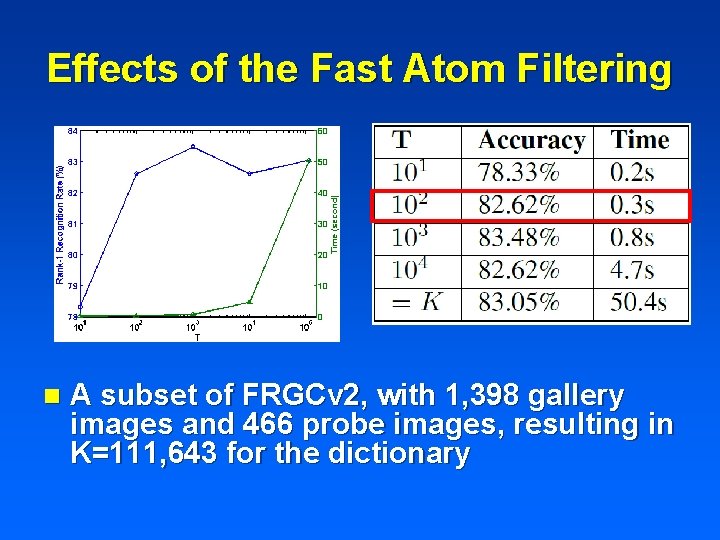
Fast Atom Filtering In the dictionary, the number of atoms, K, can be of the order of millions n Fast atom filtering n For each yi, filter out T (T<<K) atoms, i. e. T largest values of ci, resulting in a small sub-dictionary n The filtering scales linearly w. r. t. K, while the remaining MKD-SRC task takes a constant time
Effects of the Fast Atom Filtering n A subset of FRGCv 2, with 1, 398 gallery images and 466 probe images, resulting in K=111, 643 for the dictionary
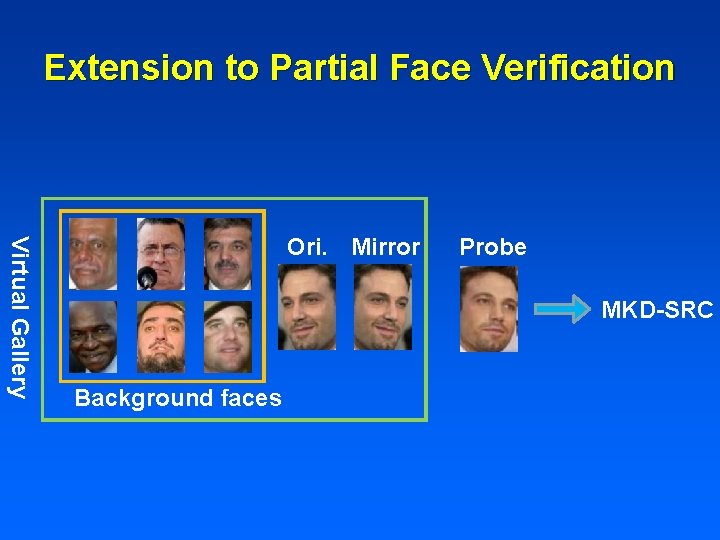
Extension to Partial Face Verification Virtual Gallery Ori. Mirror Probe MKD-SRC Background faces
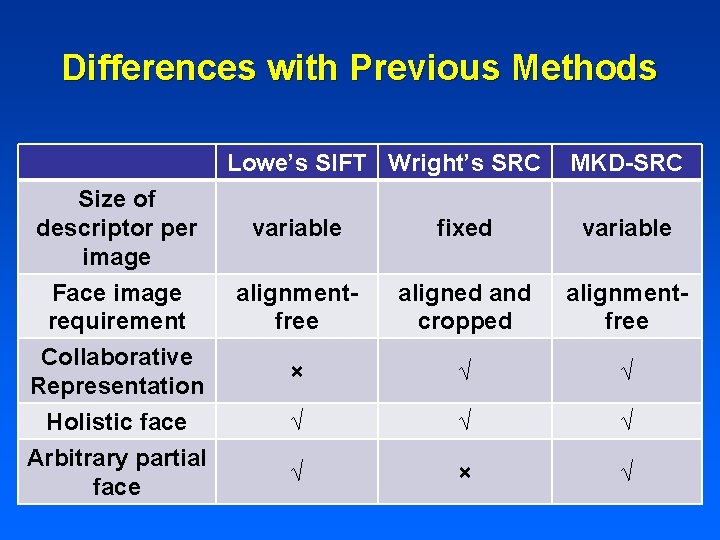
Differences with Previous Methods Lowe’s SIFT Wright’s SRC Size of descriptor per image Face image requirement Collaborative Representation Holistic face Arbitrary partial face MKD-SRC variable fixed variable alignmentfree aligned and cropped alignmentfree × √ √ √ × √
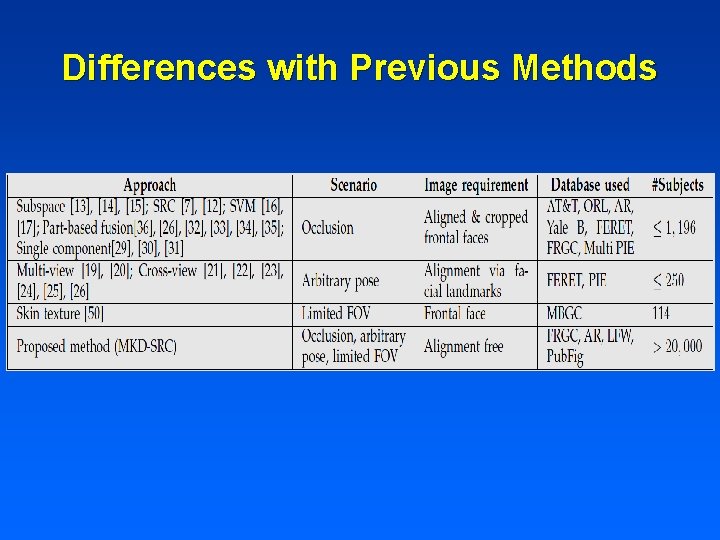
Differences with Previous Methods
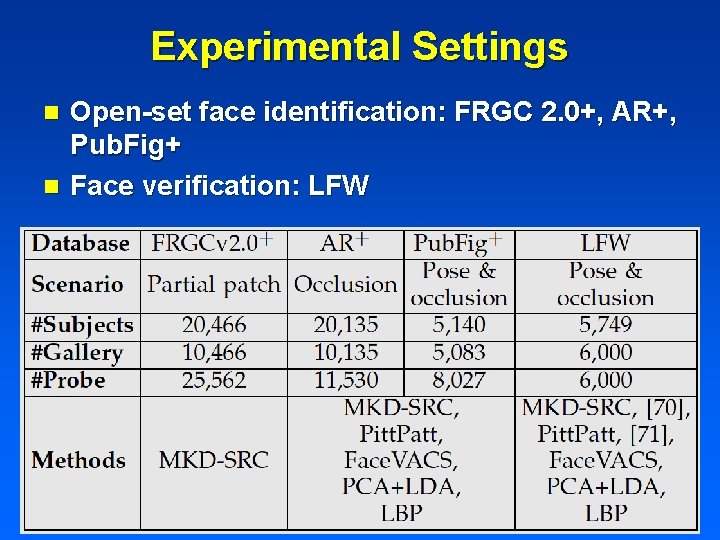
Experimental Settings Open-set face identification: FRGC 2. 0+, AR+, Pub. Fig+ n Face verification: LFW n
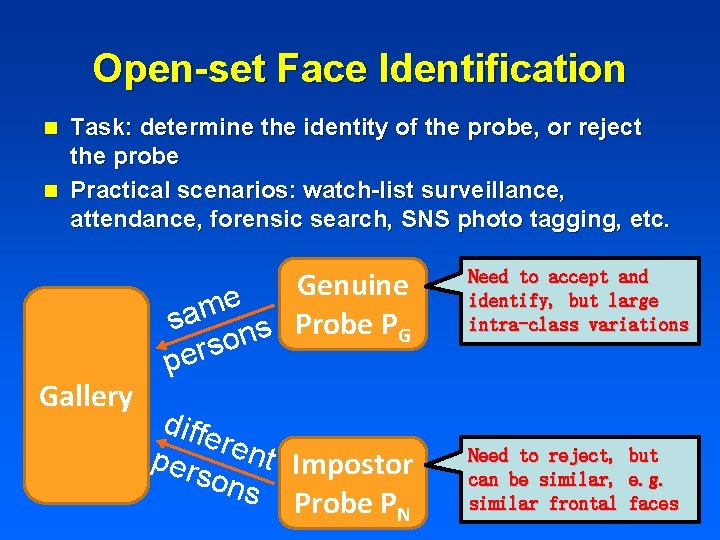
Open-set Face Identification Task: determine the identity of the probe, or reject the probe n Practical scenarios: watch-list surveillance, attendance, forensic search, SNS photo tagging, etc. n Gallery Genuine e m sa ns Probe PG o s r pe diffe r e pers nt Impostor ons Probe PN Need to accept and identify, but large intra-class variations Need to reject, but can be similar, e. g. similar frontal faces
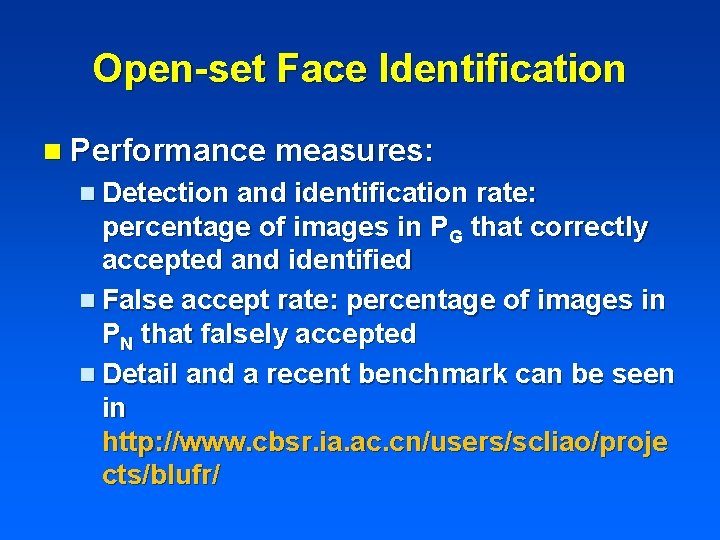
Open-set Face Identification n Performance measures: n Detection and identification rate: percentage of images in PG that correctly accepted and identified n False accept rate: percentage of images in PN that falsely accepted n Detail and a recent benchmark can be seen in http: //www. cbsr. ia. ac. cn/users/scliao/proje cts/blufr/
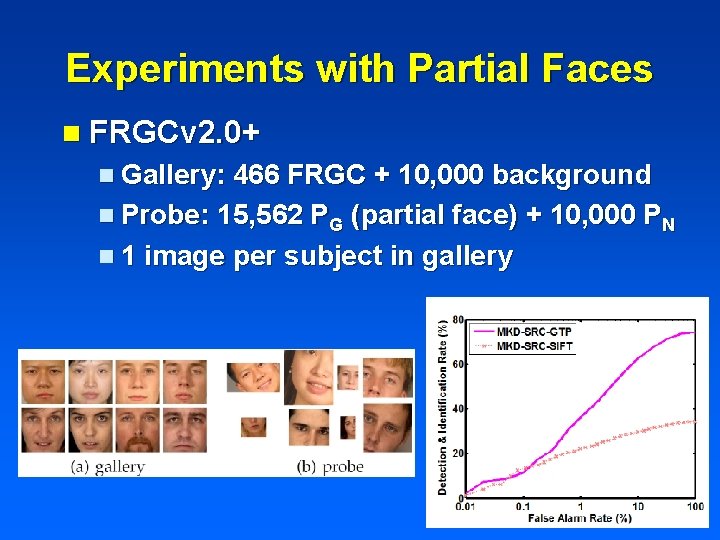
Experiments with Partial Faces n FRGCv 2. 0+ n Gallery: 466 FRGC + 10, 000 background n Probe: 15, 562 PG (partial face) + 10, 000 PN n 1 image per subject in gallery
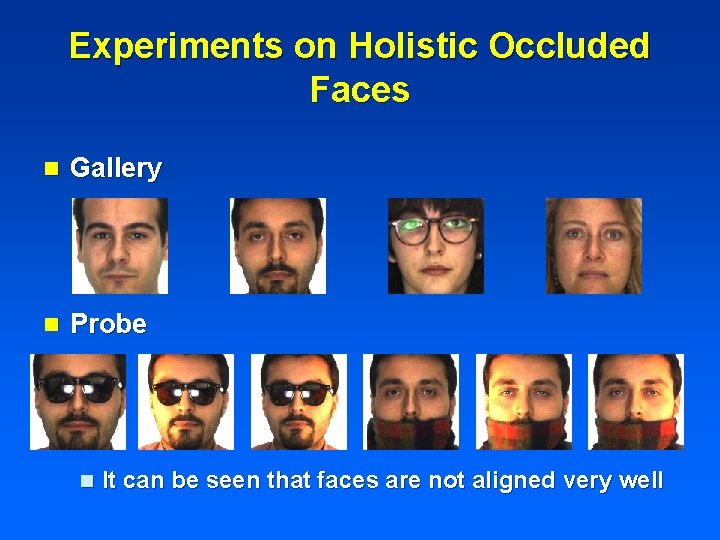
Experiments on Holistic Occluded Faces n AR+ n Gallery: 135 AR + 10, 000 background n Probe: 1530 PG (occluded) + 10, 000 PN n 1 image per subject in gallery n each subject has 6 (one session) or 12 (two sessions) images n All images in PG are with sunglasses or scarf, and illumination variations
Experiments on Holistic Occluded Faces n Gallery n Probe n It can be seen that faces are not aligned very well
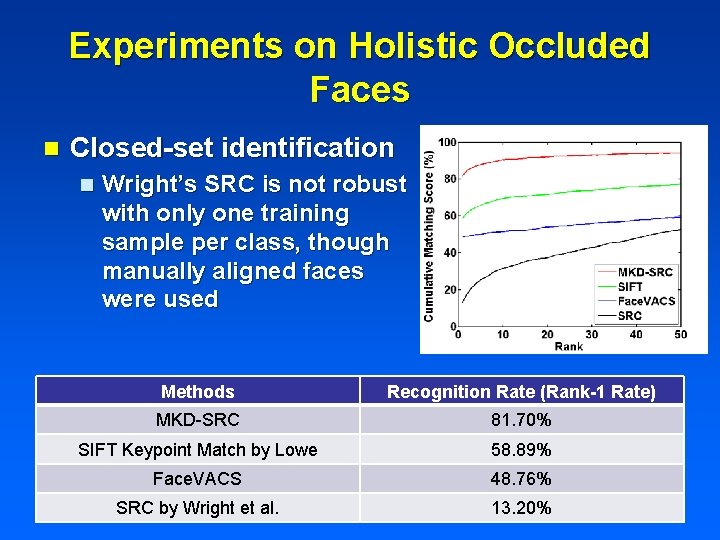
Experiments on Holistic Occluded Faces n Closed-set identification n Wright’s SRC is not robust with only one training sample per class, though manually aligned faces were used Methods Recognition Rate (Rank-1 Rate) MKD-SRC 81. 70% SIFT Keypoint Match by Lowe 58. 89% Face. VACS 48. 76% SRC by Wright et al. 13. 20%
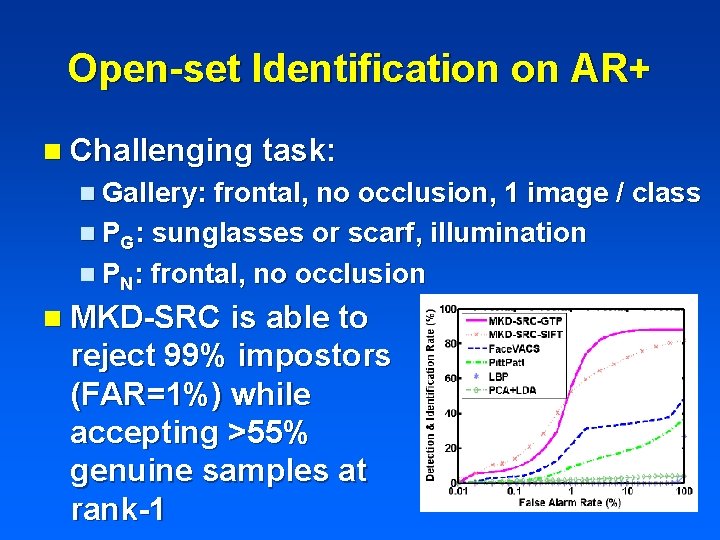
Open-set Identification on AR+ n Challenging task: n Gallery: frontal, no occlusion, 1 image / class n PG: sunglasses or scarf, illumination n PN: frontal, no occlusion n MKD-SRC is able to reject 99% impostors (FAR=1%) while accepting >55% genuine samples at rank-1
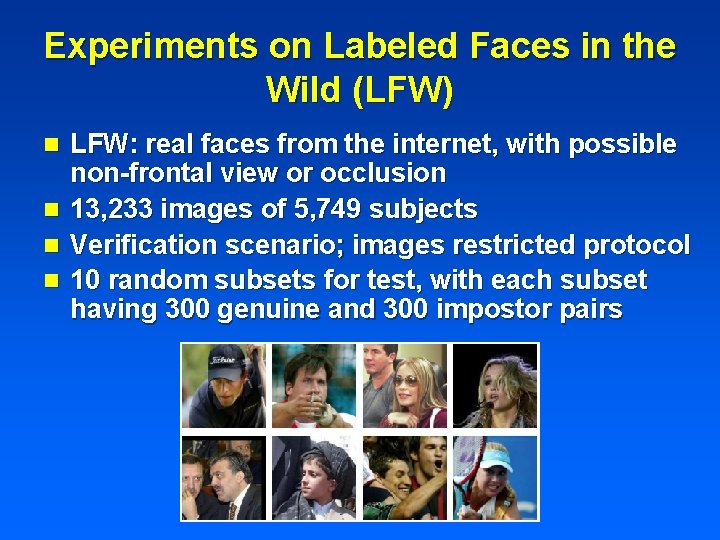
Experiments on Labeled Faces in the Wild (LFW) LFW: real faces from the internet, with possible non-frontal view or occlusion n 13, 233 images of 5, 749 subjects n Verification scenario; images restricted protocol n 10 random subsets for test, with each subset having 300 genuine and 300 impostor pairs n
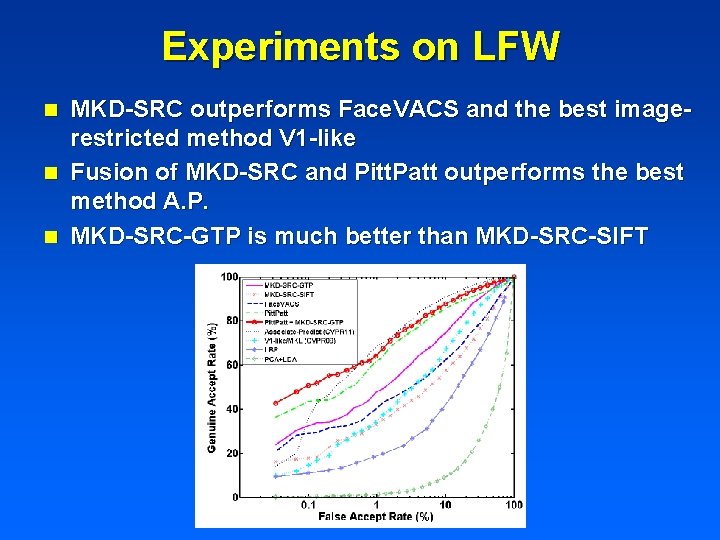
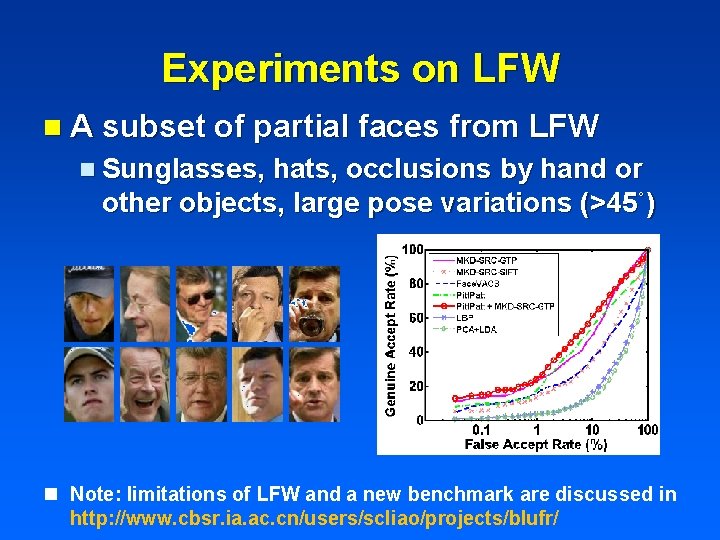
Experiments on LFW MKD-SRC outperforms Face. VACS and the best imagerestricted method V 1 -like n Fusion of MKD-SRC and Pitt. Patt outperforms the best method A. P. n MKD-SRC-GTP is much better than MKD-SRC-SIFT n
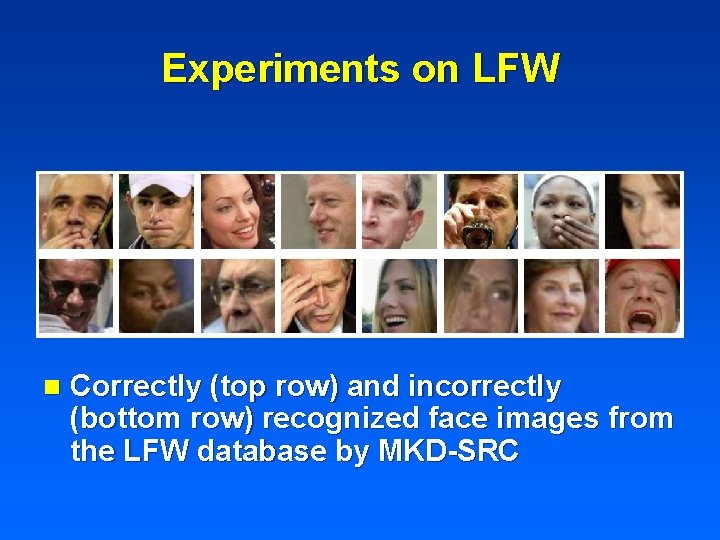
Experiments on LFW n Correctly (top row) and incorrectly (bottom row) recognized face images from the LFW database by MKD-SRC
Experiments on LFW n A subset of partial faces from LFW n Sunglasses, hats, occlusions by hand or other objects, large pose variations (>45˚) n Note: limitations of LFW and a new benchmark are discussed in http: //www. cbsr. ia. ac. cn/users/scliao/projects/blufr/
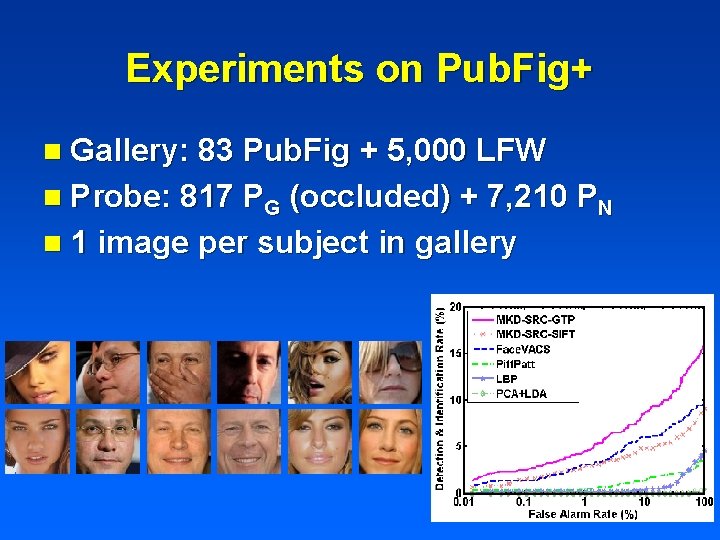
Experiments on Pub. Fig+ n Gallery: 83 Pub. Fig + 5, 000 LFW n Probe: 817 PG (occluded) + 7, 210 PN n 1 image per subject in gallery
Summary n Addressing the general partial face recognition problem without alignment n A unified face recognition framework for both holistic and partial faces n Improves SRC for the one-sample-perclass problem n Multi keypoint descriptors enables variable-length face description
Suggestions for Future Work n PFR is important but difficult. The proposed matching framework is not the only way to recognize partial faces. There are other possibilities, e. g. Weng et al. Robust feature set matching for partial face recognition, ICCV 2013 n There may be other elegant partial face description methods n Automatic PFR is even more difficult. Partial face detection is still missing
Thank you!