
Partial Coalescence at Liquid Interfaces Franois Blanchette Terry
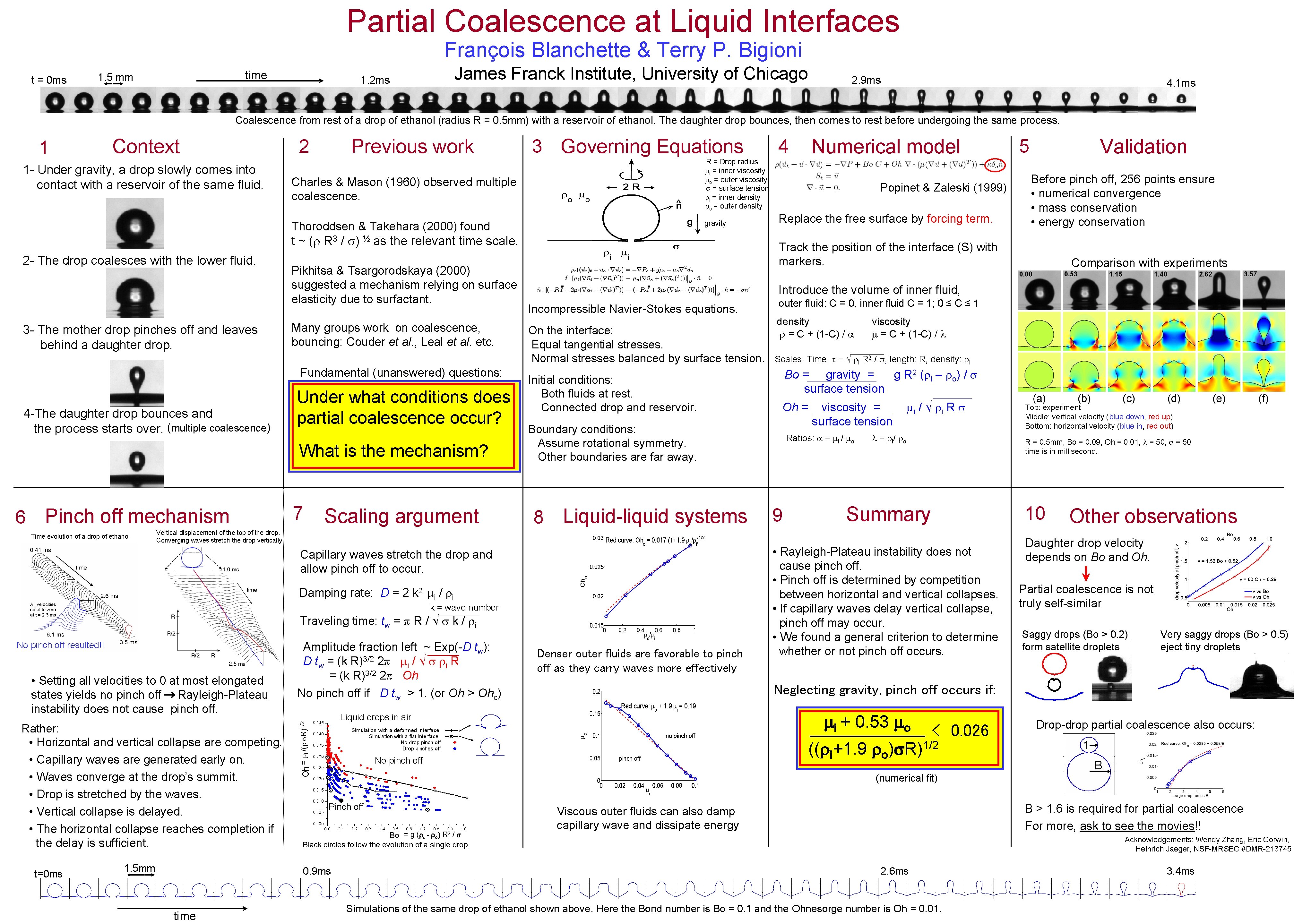
Partial Coalescence at Liquid Interfaces François Blanchette & Terry P. Bigioni t = 0 ms time 1. 5 mm James Franck Institute, University of Chicago 1. 2 ms 2. 9 ms 4. 1 ms Coalescence from rest of a drop of ethanol (radius R = 0. 5 mm) with a reservoir of ethanol. The daughter drop bounces, then comes to rest before undergoing the same process. 1 Context 1 - Under gravity, a drop slowly comes into contact with a reservoir of the same fluid. 2 Previous work 3 Governing Equations Charles & Mason (1960) observed multiple coalescence. gravity t ~ (r R 3 / s) ½ as the relevant time scale. 3 - The mother drop pinches off and leaves behind a daughter drop. Pikhitsa & Tsargorodskaya (2000) suggested a mechanism relying on surface elasticity due to surfactant. Many groups work on coalescence, bouncing: Couder et al. , Leal et al. etc. Fundamental (unanswered) questions: 4 -The daughter drop bounces and the process starts over. (multiple coalescence) Under what conditions does partial coalescence occur? What is the mechanism? 6 Pinch off mechanism Time evolution of a drop of ethanol 7 Scaling argument Popinet & Zaleski (1999) Replace the free surface by forcing term. Incompressible Navier-Stokes equations. On the interface: Equal tangential stresses. Normal stresses balanced by surface tension. Initial conditions: Both fluids at rest. Connected drop and reservoir. 8 Liquid-liquid systems k = wave number Traveling time: tw = p R / √ s k / ri Rather: • Horizontal and vertical collapse are competing. • Capillary waves are generated early on. • Waves converge at the drop’s summit. • Drop is stretched by the waves. • Vertical collapse is delayed. • The horizontal collapse reaches completion if the delay is sufficient. 1. 5 mm Comparison with experiments density r = C + (1 -C) / a viscosity m = C + (1 -C) / l Scales: Time: t = √ ri R 3 / s, length: R, density: ri Bo = gravity = g R 2 (ri – ro) / s surface tension Oh = viscosity = surface tension Ratios: a = mi / mo 9 mi / √ r i R s l = r i/ r o Top: experiment Middle: vertical velocity (blue down, red up) Bottom: horizontal velocity (blue in, red out) R = 0. 5 mm, Bo = 0. 09, Oh = 0. 01, l = 50, a = 50 time is in millisecond. 10 Summary • Rayleigh-Plateau instability does not cause pinch off. • Pinch off is determined by competition between horizontal and vertical collapses. • If capillary waves delay vertical collapse, pinch off may occur. • We found a general criterion to determine whether or not pinch off occurs. Other observations Daughter drop velocity depends on Bo and Oh. Partial coalescence is not truly self-similar Saggy drops (Bo > 0. 2) form satellite droplets Very saggy drops (Bo > 0. 5) eject tiny droplets Neglecting gravity, pinch off occurs if: mi + 0. 53 mo ((ri+1. 9 ro No pinch off < 0. 026 1/2 )s. R) Drop-drop partial coalescence also occurs: 1 B (numerical fit) Pinch off = g (ri - ro) R 2 / s Black circles follow the evolution of a single drop. 0. 9 ms time Denser outer fluids are favorable to pinch off as they carry waves more effectively Liquid drops in air = mi /(ris. R)1/2 • Setting all velocities to 0 at most elongated states yields no pinch off Rayleigh-Plateau instability does not cause pinch off. Before pinch off, 256 points ensure • numerical convergence • mass conservation • energy conservation outer fluid: C = 0, inner fluid C = 1; 0 ≤ C ≤ 1 Boundary conditions: Assume rotational symmetry. Other boundaries are far away. Damping rate: D = 2 k 2 mi / ri Amplitude fraction left ~ Exp(-D tw): D tw = (k R)3/2 2 p mi / √ s ri R = (k R)3/2 2 p Oh No pinch off if D tw > 1. (or Oh > Ohc) Validation Introduce the volume of inner fluid, Vertical displacement of the top of the drop. Converging waves stretch the drop vertically No pinch off resulted!! 5 Track the position of the interface (S) with markers. Capillary waves stretch the drop and allow pinch off to occur. t=0 ms Numerical model R = Drop radius mi = inner viscosity mo = outer viscosity s = surface tension ri = inner density ro = outer density Thoroddsen & Takehara (2000) found 2 - The drop coalesces with the lower fluid. 4 B > 1. 6 is required for partial coalescence For more, ask to see the movies!! Viscous outer fluids can also damp capillary wave and dissipate energy Acknowledgements: Wendy Zhang, Eric Corwin, Heinrich Jaeger, NSF-MRSEC #DMR-213745 2. 6 ms Simulations of the same drop of ethanol shown above. Here the Bond number is Bo = 0. 1 and the Ohnesorge number is Oh = 0. 01. 3. 4 ms
- Slides: 1