
PARTIAL AND GENERAL EQUILIBRIUM ANALYSIS Economics B A
PARTIAL AND GENERAL EQUILIBRIUM ANALYSIS Economics B. A ECONOMICS D. P-3 QUQNTITATIVE TECHNIQUE ALOK KUMAR DEPARTMENT OF ECONOMICS R. M COLLEGE SAHARSA
PARTIAL AND GENERAL EQUILIBRIUM ANALYSIS Introduction: Partial and general equilibrium is a type of economic analysis in economics. Equilibrium is a state of balance that occur in a model. In regard to pricing under perfect competition, two main approaches have been adopted: One approach has been followed by famous english economist Alfred Marshall who adopted the partial equilibrium approach Second approach has been adopted by Walras and is called general equilibrium approach.
PARTIAL AND GENERAL EQUILIBRIUM ANALYSIS The type of analysis where we do not take into account the interrelati interdependence between prices of commodities and factors of production partial equilibrium analysis. Partial equilibrium analysis focuses on e determination of price and quantity in a given product or factor market is viewed as independent of other markets. However partial equilibrium is not useful and relevant to apply when ther relationshipbetween commodities or between factors. Thus when mark various commodities and factors are interdependent of that a commodity or a factor has important repercussions on the demand for is when changes in the commodities or factors, partial equilibrium analysis would not yield correct other results. In such cases when there is such interrelationships between various markets or that the changes in one market would significantly affect others, we should employ general equilibrium analysis which considers simultaneous equilibrium of all markets taking into account all effects of changes in price in one market over others.
PARTIAL EQUILIBRIUM ANALYSIS This approach is the determination of the price and quantity in each market demand supply curves drawn on the ceterus peribus clause. It was introduced by Marshallian Approach. It studies the internal outcome of any policy action in a single marke The effects are examines only in the markets which is directly affected other markets. We refer to partial equilibrium analysis when a single firm or a single firm single consumer is in equilibrium other firms may not be in equilibrium. It studies the behavior of individual decision making units and the working of individual market in isolation. It ignore interdependence and inter-connections among different market. It takes into account of Impact effect.
EXPLANATION OF PARTIAL EQUILIBRIUM http: //www. yourarticlelibrary. com/economics/marshalls-partialequilibrium-analysis-and-walras-general-equilibrium-analysis/37162 https: //link. springer. com/chapter/10. 1057/978 -1 -137 -47529 -9_4
GENERAL EQUILIBRIUM ANALYSIS HTTPS: //YOUTU. BE/CUT-X 2 RQQLM It was introduced in 1874 by Leon Walras. It attempts to explain the functioning of the macroeconomy as a whol than as collections of individual market phenomena. It is a branch of economics that seeks to explain economic phenomena production, consumption and prices in the economy as a whole. General equilibrium analysis deals with explaining simultaneous equil markets when prices and quantities of all products and factors are consi as variables. According to Walras if there are markets in the economy out of them if N-1 market are in equilibrium then Nth market have to be in equilibrium. This equilibrium is established on the basic of linear simultaneous equation. It considers inter-dependents and inter-connections among different markets. It takes into account Impact effect, spill over effect, ripples effect, repercussion effect.
ASSUMPTIO NS http: //www. yourarticlelibrary. com/economics/general-equilibrium-ineconomics-meaning-assumptions-working-and-limitations/28937 Limitations http: //www. yourarticlelibrary. com/economics/general-equilibrium-ineconomics-meaning-assumptions-working-and-limitations/28937 Working of the General equilibrium analysis http: //www. yourarticlelibrary. com/economics/general-equilibrium-ineconomics-meaning-assumptions-working-and-limitations/28937
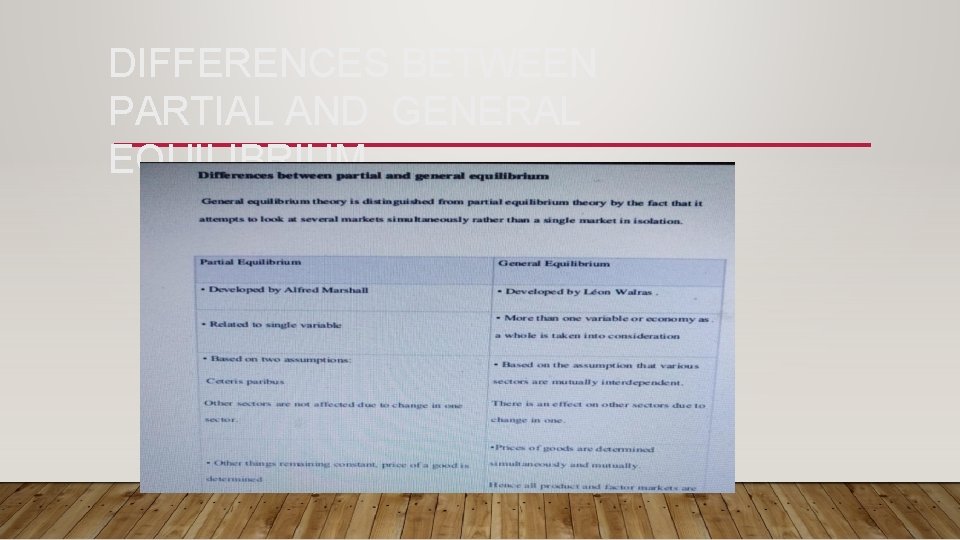
DIFFERENCES BETWEEN PARTIAL AND GENERAL EQUILIBRIUM
- Slides: 8