
Part VI Designing the Content Linking Chart and



- Slides: 59
Part VI: Designing the Content Linking Chart and Supporting Documents Content Linking Tools Page 1 Part VI: Linking Document
Outcomes for Part VI: Content Linking Tools • Define assessment terminology used in linking process Use “tools” to build common understanding among stakeholders about appropriate instruction/assessment content Provide professional development materials that link to grade-level content Identify content for instruction & assessment Produce a Content Linking Chart • • 2 Part VI: Linking Document
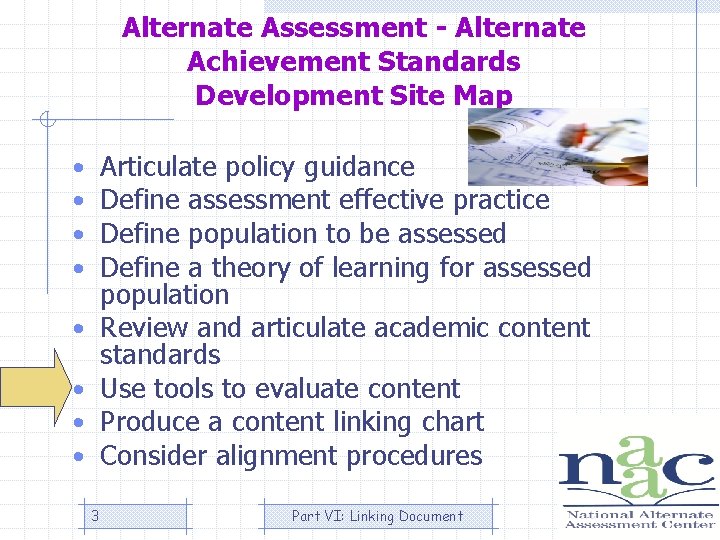
Alternate Assessment - Alternate Achievement Standards Development Site Map Articulate policy guidance Define assessment effective practice Define population to be assessed Define a theory of learning for assessed population Review and articulate academic content standards Use tools to evaluate content Produce a content linking chart Consider alignment procedures • • 3 Part VI: Linking Document
The content linking document will be helpful for: 1. in-service and pre-service training for teachers, 2. parent information, 3. individual student planning, 4. school improvement processes, and 5. developing the assessment plan. 4 Part VI: Linking Document
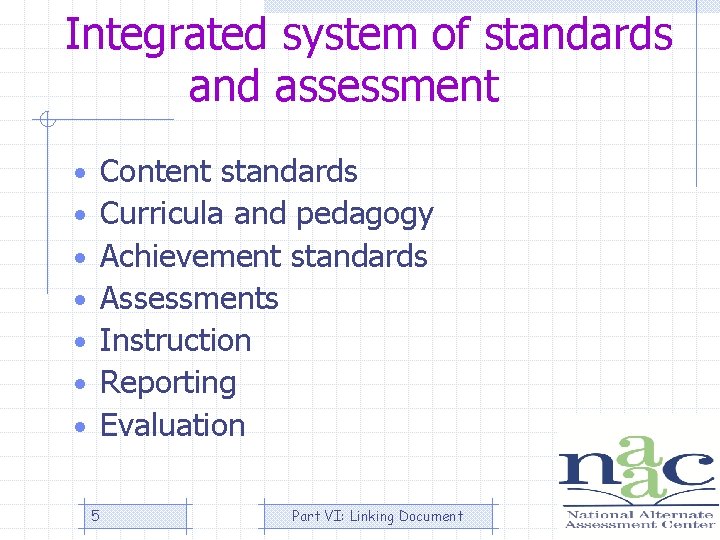
Integrated system of standards and assessment Content standards Curricula and pedagogy Achievement standards Assessments Instruction Reporting Evaluation • • 5 Part VI: Linking Document
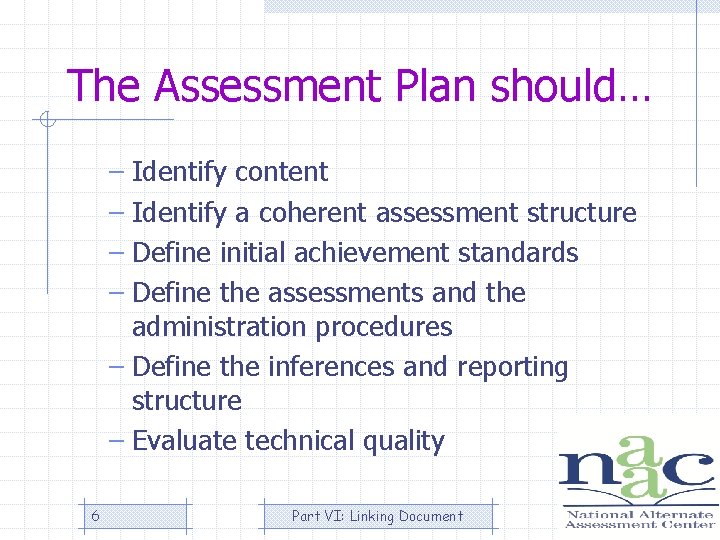
The Assessment Plan should… – Identify content – Identify a coherent assessment structure – Define initial achievement standards – Define the assessments and the administration procedures – Define the inferences and reporting structure – Evaluate technical quality 6 Part VI: Linking Document
Purpose • For the purpose of THIS module (Part VI: Designing the Content Linking Document), we will: – complete the first step of the assessment plan (Identify Content), – being thinking about how the rest of the design will be built on the foundation of the identified content, and – ensure a COHERENT assessment system as a foundation for the other steps in the assessment plan. 7 Part VI: Linking Document
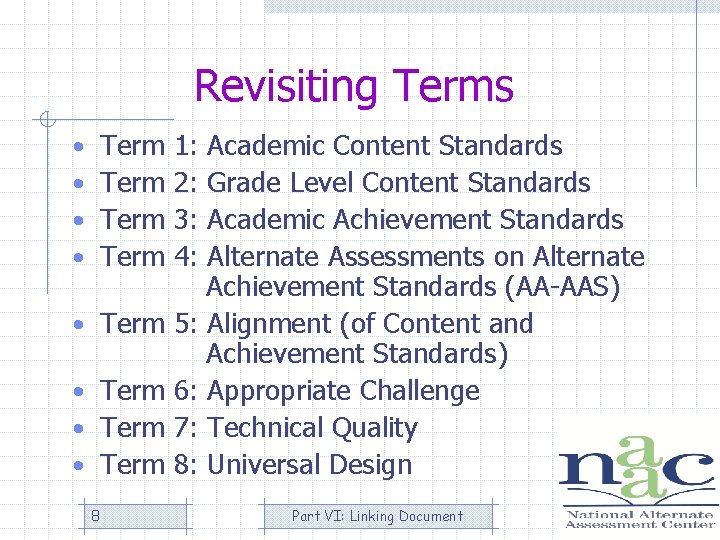
Revisiting Terms Term • • • Term 8 1: 2: 3: 4: Academic Content Standards Grade Level Content Standards Academic Achievement Standards Alternate Assessments on Alternate Achievement Standards (AA-AAS) 5: Alignment (of Content and Achievement Standards) 6: Appropriate Challenge 7: Technical Quality 8: Universal Design Part VI: Linking Document
Revisiting Terms • Why? – We are revisiting terms because these will be necessary to clearly understand effectively use the content “tools” in order to produce the content linking chart. 9 Part VI: Linking Document
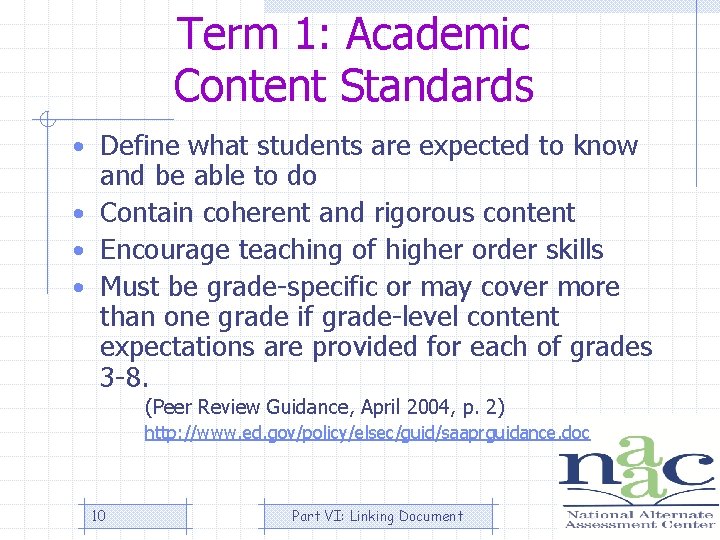
Term 1: Academic Content Standards • Define what students are expected to know and be able to do • Contain coherent and rigorous content • Encourage teaching of higher order skills • Must be grade-specific or may cover more than one grade if grade-level content expectations are provided for each of grades 3 -8. (Peer Review Guidance, April 2004, p. 2) http: //www. ed. gov/policy/elsec/guid/saaprguidance. doc 10 Part VI: Linking Document
Term 1: Examples of Academic Content Standards in Reading • Read a variety of print and non-print text to obtain new information. • Read and understand a variety of materials. • Read narrative and expository text aloud with grade-appropriate fluency and accuracy and with appropriate pacing, intonation, and expression. 11 Part VI: Linking Document
Term 1: Examples of Academic Content Standards in Mathematics • Students develop number sense and use numbers and number relationships in problem-solving situations. • Identify patterns and apply pattern recognition to reason mathematically. • Represent and analyze mathematical situations and structures using algebraic representations. 12 Part VI: Linking Document
Term 2: Grade-Level Content Standards • Each content standard must be articulated to identify the learning outcomes/expectations at each grade level. • States have many different names for these expectations such as benchmarks, objectives, performance indicators, etc. 13 Part VI: Linking Document
Term 2: Examples of Grade-Level Content Standards in Reading • 3 rd Grade Decoding and Word Recognition 1. 1: Know and use complex word families when reading (e. g. , -ight) to decode unfamiliar words. 1. 2: Decode regular multisyllabic words. 1. 3: Read aloud narrative and expository text fluently and accurately with appropriate pacing, intonation, and expression. 14 Part VI: Linking Document
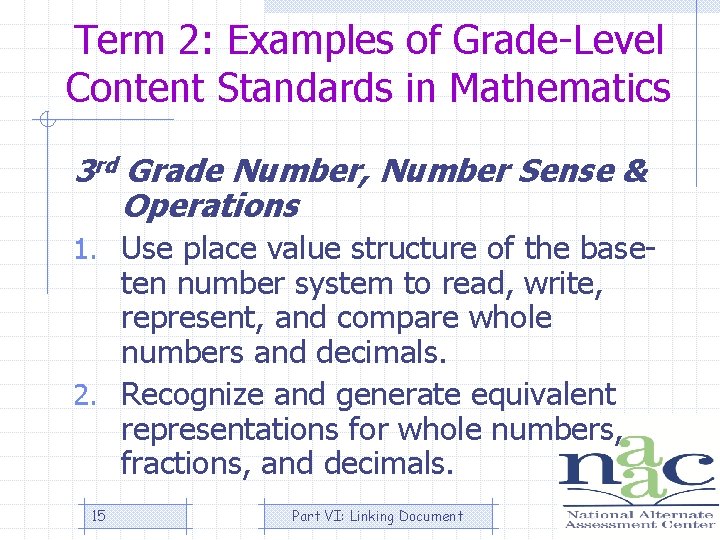
Term 2: Examples of Grade-Level Content Standards in Mathematics 3 rd Grade Number, Number Sense & Operations 1. Use place value structure of the base- ten number system to read, write, represent, and compare whole numbers and decimals. 2. Recognize and generate equivalent representations for whole numbers, fractions, and decimals. 15 Part VI: Linking Document
Access to ALL • All students should have access to and make progress in the curriculum based on grade-level content standards. • All assessment options should be linked to the student's grade-level content standards. 16 Part VI: Linking Document
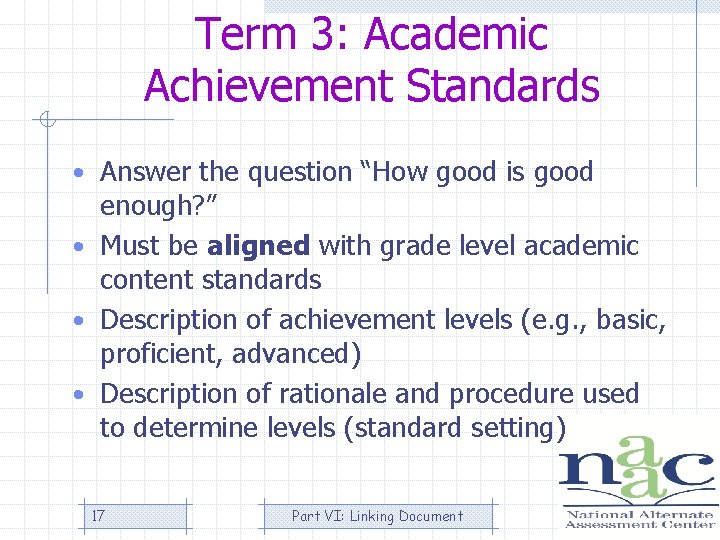
Term 3: Academic Achievement Standards • Answer the question “How good is good enough? ” • Must be aligned with grade level academic content standards • Description of achievement levels (e. g. , basic, proficient, advanced) • Description of rationale and procedure used to determine levels (standard setting) 17 Part VI: Linking Document
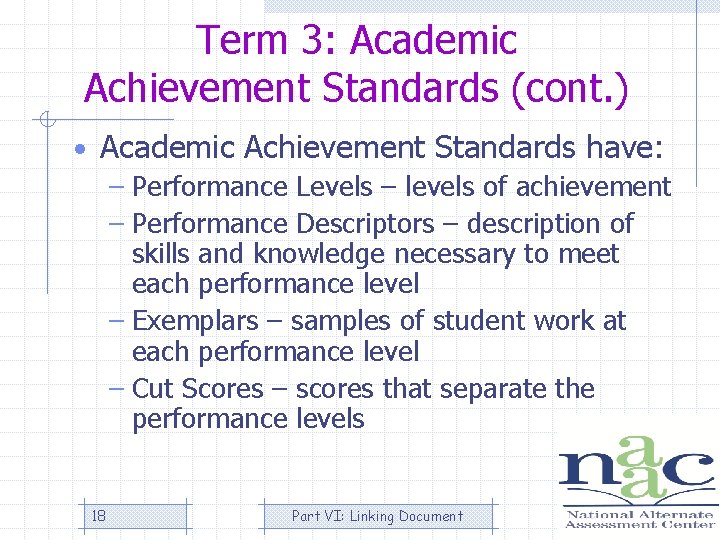
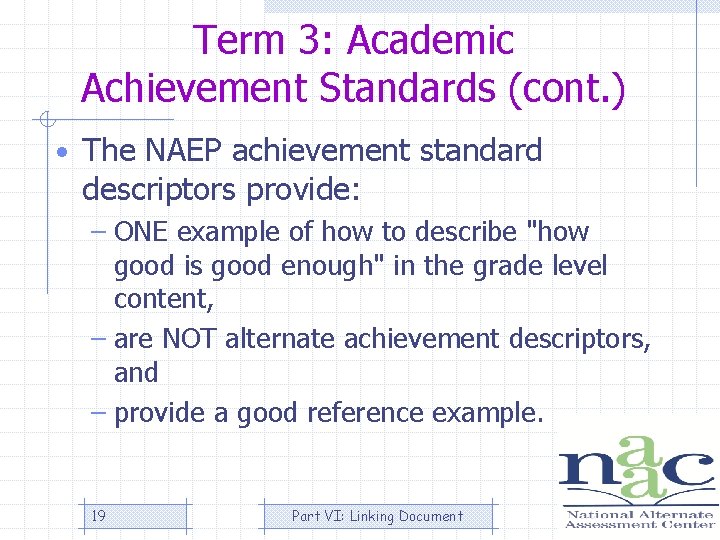
Term 3: Academic Achievement Standards (cont. ) • Academic Achievement Standards have: – Performance Levels – levels of achievement – Performance Descriptors – description of skills and knowledge necessary to meet each performance level – Exemplars – samples of student work at each performance level – Cut Scores – scores that separate the performance levels 18 Part VI: Linking Document
Term 3: Academic Achievement Standards (cont. ) • The NAEP achievement standard descriptors provide: – ONE example of how to describe "how good is good enough" in the grade level content, – are NOT alternate achievement descriptors, and – provide a good reference example. 19 Part VI: Linking Document
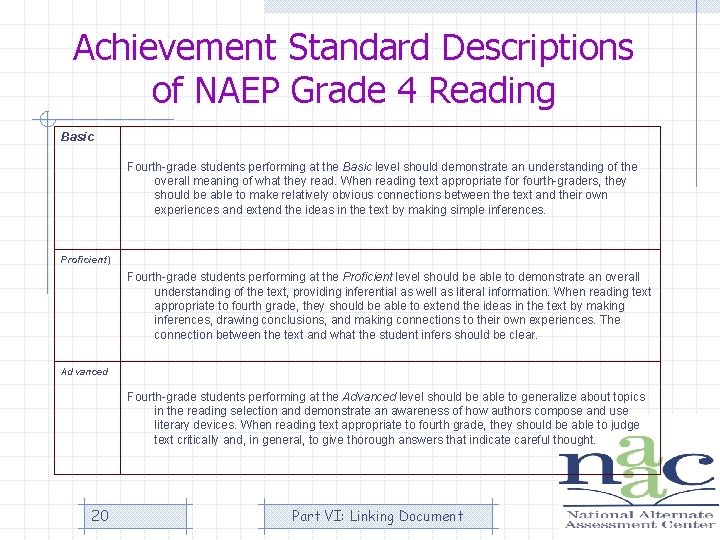
Achievement Standard Descriptions of NAEP Grade 4 Reading Basic Fourth-grade students performing at the Basic level should demonstrate an understanding of the overall meaning of what they read. When reading text appropriate for fourth-graders, they should be able to make relatively obvious connections between the text and their own experiences and extend the ideas in the text by making simple inferences. Proficient) Fourth-grade students performing at the Proficient level should be able to demonstrate an overall understanding of the text, providing inferential as well as literal information. When reading text appropriate to fourth grade, they should be able to extend the ideas in the text by making inferences, drawing conclusions, and making connections to their own experiences. The connection between the text and what the student infers should be clear. Advanced Fourth-grade students performing at the Advanced level should be able to generalize about topics in the reading selection and demonstrate an awareness of how authors compose and use literary devices. When reading text appropriate to fourth grade, they should be able to judge text critically and, in general, to give thorough answers that indicate careful thought. 20 Part VI: Linking Document
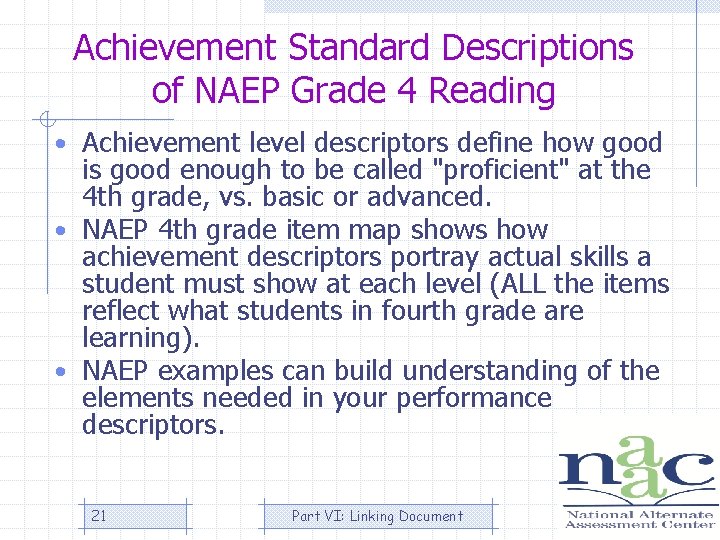
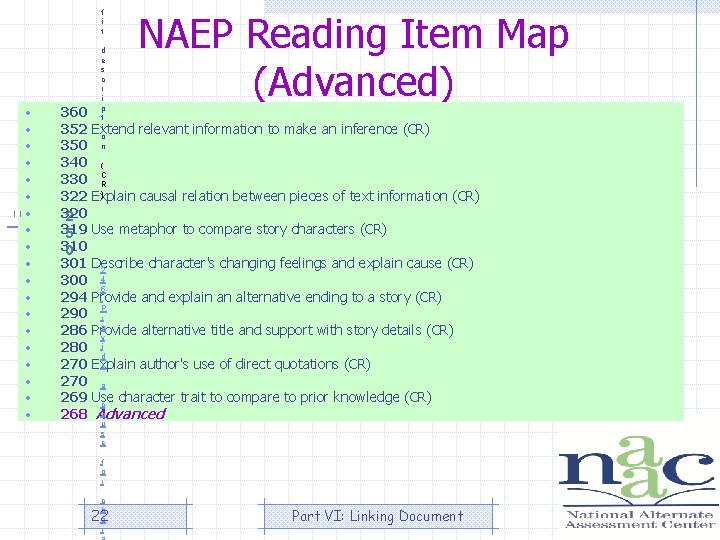
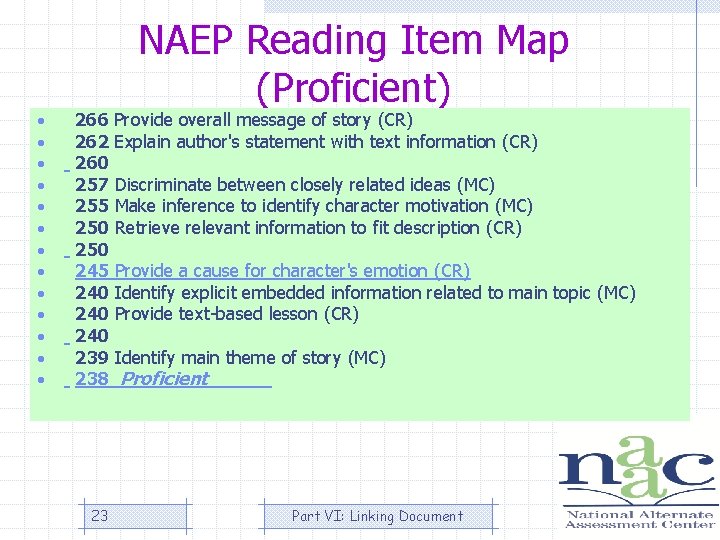
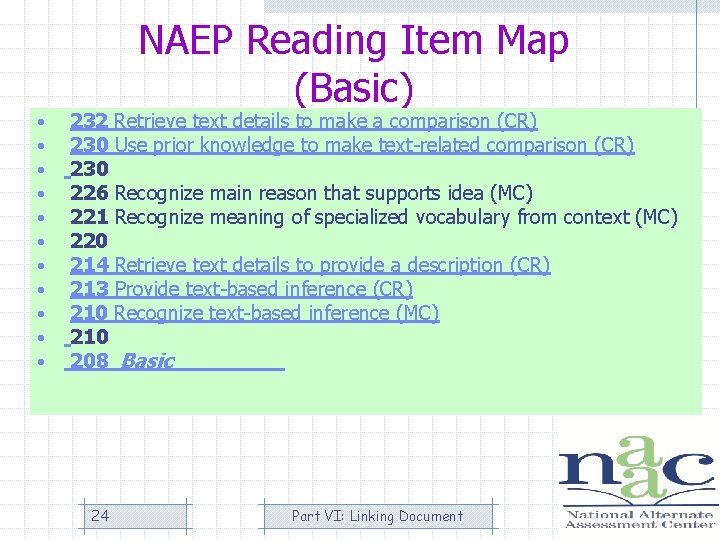
Achievement Standard Descriptions of NAEP Grade 4 Reading • Achievement level descriptors define how good is good enough to be called "proficient" at the 4 th grade, vs. basic or advanced. • NAEP 4 th grade item map shows how achievement descriptors portray actual skills a student must show at each level (ALL the items reflect what students in fourth grade are learning). • NAEP examples can build understanding of the elements needed in your performance descriptors. 21 Part VI: Linking Document
f i t • • • • • d e s c r i p t i o n NAEP Reading Item Map (Advanced) 360 352 Extend relevant information to make an inference (CR) 350 340 ( 330 CR ) 322 Explain causal relation between pieces of text information (CR) 320 2 319 5 Use metaphor to compare story characters (CR) 310 0 301 Describe character's changing feelings and explain cause (CR) 2 300 45 294 Provide and explain an alternative ending to a story (CR) P 290 r o 286 Provide alternative title and support with story details (CR) v 280 id e 270 Explain author's use of direct quotations (CR) 270 a 269 Use character trait to compare to prior knowledge (CR) c a 268 Advanced u s e f o r c h a r 22 Part VI: Linking Document
• • • • NAEP Reading Item Map (Proficient) 266 Provide overall message of story (CR) 262 Explain author's statement with text information (CR) 260 257 Discriminate between closely related ideas (MC) 255 Make inference to identify character motivation (MC) 250 Retrieve relevant information to fit description (CR) 250 245 Provide a cause for character's emotion (CR) 240 Identify explicit embedded information related to main topic (MC) 240 Provide text-based lesson (CR) 240 239 Identify main theme of story (MC) 238 Proficient 23 Part VI: Linking Document
• • • NAEP Reading Item Map (Basic) 232 Retrieve text details to make a comparison (CR) 230 Use prior knowledge to make text-related comparison (CR) 230 226 Recognize main reason that supports idea (MC) 221 Recognize meaning of specialized vocabulary from context (MC) 220 214 Retrieve text details to provide a description (CR) 213 Provide text-based inference (CR) 210 Recognize text-based inference (MC) 210 208 Basic 24 Part VI: Linking Document
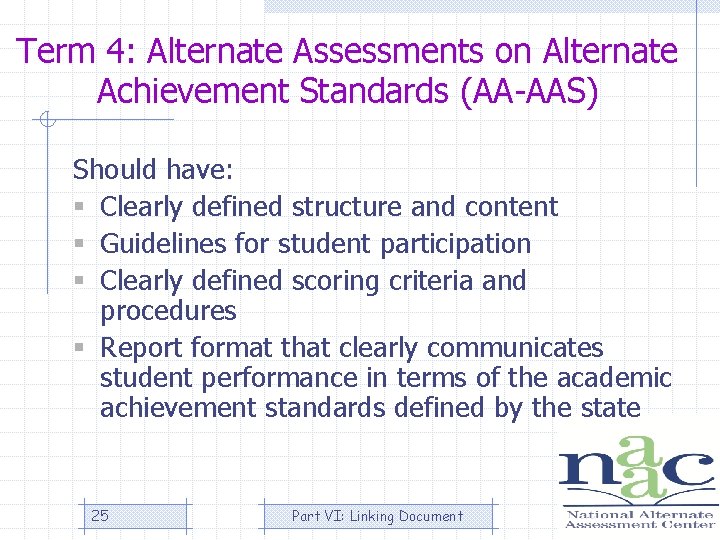
Term 4: Alternate Assessments on Alternate Achievement Standards (AA-AAS) Should have: § Clearly defined structure and content § Guidelines for student participation § Clearly defined scoring criteria and procedures § Report format that clearly communicates student performance in terms of the academic achievement standards defined by the state 25 Part VI: Linking Document
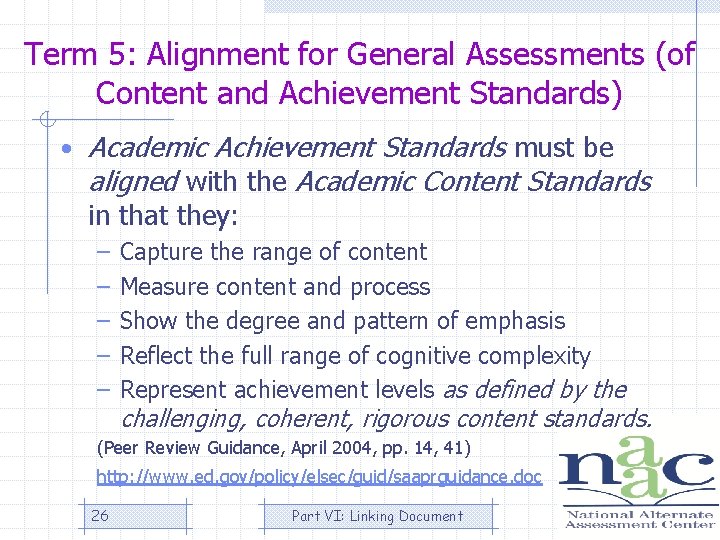
Term 5: Alignment for General Assessments (of Content and Achievement Standards) • Academic Achievement Standards must be aligned with the Academic Content Standards in that they: – – – Capture the range of content Measure content and process Show the degree and pattern of emphasis Reflect the full range of cognitive complexity Represent achievement levels as defined by the challenging, coherent, rigorous content standards. (Peer Review Guidance, April 2004, pp. 14, 41) http: //www. ed. gov/policy/elsec/guid/saaprguidance. doc 26 Part VI: Linking Document
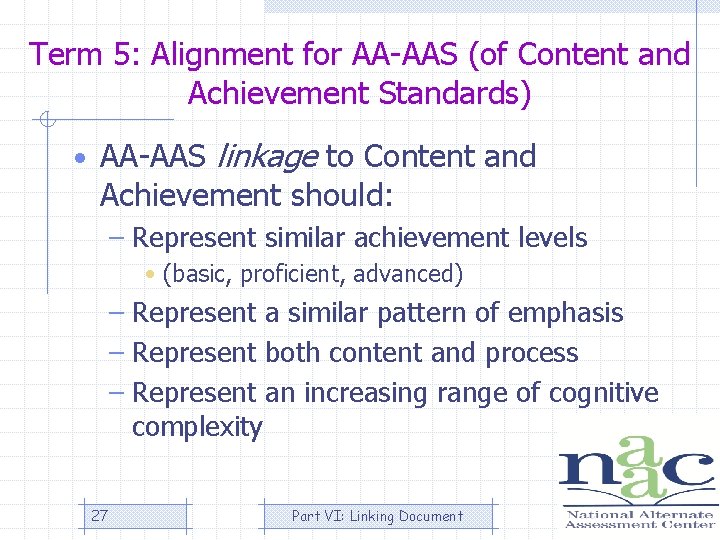
Term 5: Alignment for AA-AAS (of Content and Achievement Standards) • AA-AAS linkage to Content and Achievement should: – Represent similar achievement levels • (basic, proficient, advanced) – Represent a similar pattern of emphasis – Represent both content and process – Represent an increasing range of cognitive complexity 27 Part VI: Linking Document
Term 6: Appropriate Challenge • Rely on the judgment of experienced special educators [and general educators], administrators, higher education representatives, and parents of students with disabilities. 28 Part VI: Linking Document
Term 6: Appropriate Challenge (cont. ) • As you have learned in previous training modules, our understanding of what students with significant cognitive disabilities can learn in the grade level content has dramatically expanded the past few years. Thus, up until now, we have not defined what proficiency on grade level content is - "how good is good enough in 4 th grade or 8 th grade or 10 th grade- for students with significant cognitive disabilities. 29 Part VI: Linking Document
Term 6: Appropriate Challenge (cont. ) • In order to do so, you need a stakeholder group that includes people who know the students, people who know the grade level curriculum, as well as researchers, parents, administrators and policymakers. You also will have to prepare them to understand our past expectations may have been too limiting that we hope for in the future is more than what we have seen in the past. 30 Part VI: Linking Document
Term 7: Technical Quality • Content validity • Relationship of assessment to other variables • Consistency of student responses – Item analysis • Internal structure – Statistical techniques used to verify reliability and validity • Reliability (Peer Review Guidance, April 2004, pp. 32, 33) http: //www. ed. gov/policy/elsec/guid/saaprguidance. doc 31 Part VI: Linking Document
Term 8: Universal Design for Learning for AA-AAS • Multiple means of expression. – Students must be able to show what they know and can do • Multiple means of representation. – Students must be able to access the content of the assessment • Multiple means of engagement. – Students may need more time, meaningful activities, and contextual orientation (CAST, 2002) 32 Part VI: Linking Document
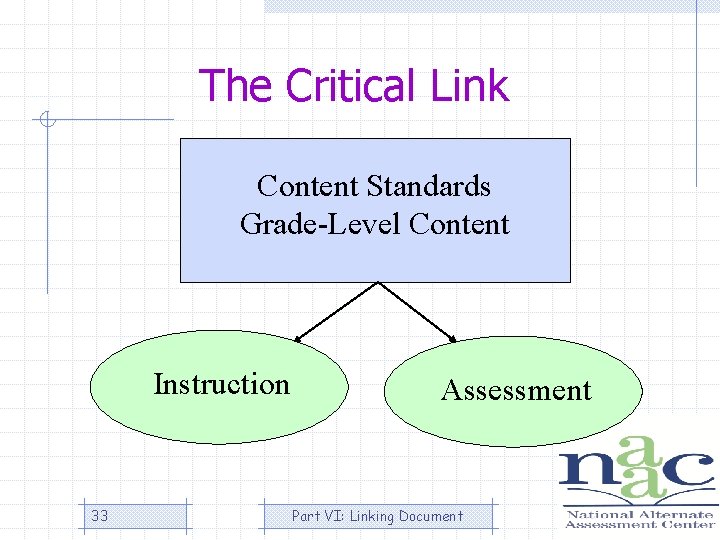
The Critical Link Content Standards Grade-Level Content Instruction 33 Assessment Part VI: Linking Document
Content Linking Process and Documentation Outcomes • Use “tools” to build common understanding among stakeholders about appropriate instruction/assessment content • Provides professional development materials that link to grade-level content • Identify content for instruction & assessment • Produce a Content Linking Chart 34 Part VI: Linking Document
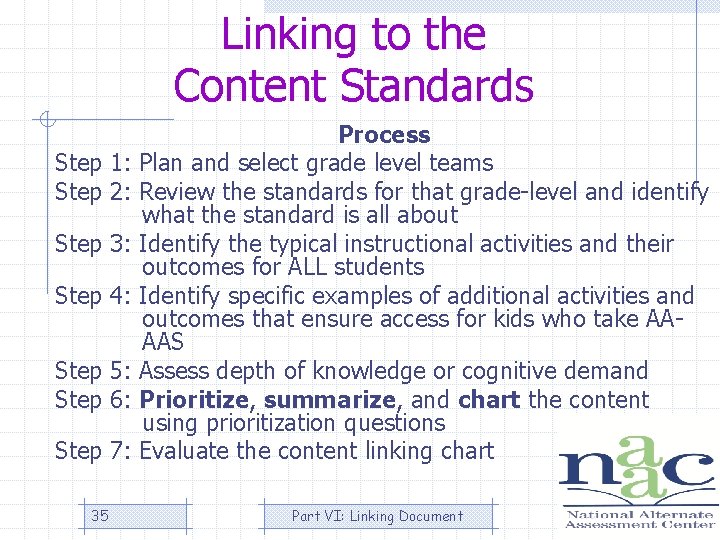
Linking to the Content Standards Step 1: Step 2: Step 3: Step 4: Step 5: Step 6: Step 7: 35 Process Plan and select grade level teams Review the standards for that grade-level and identify what the standard is all about Identify the typical instructional activities and their outcomes for ALL students Identify specific examples of additional activities and outcomes that ensure access for kids who take AAAAS Assess depth of knowledge or cognitive demand Prioritize, summarize, and chart the content using prioritization questions Evaluate the content linking chart Part VI: Linking Document
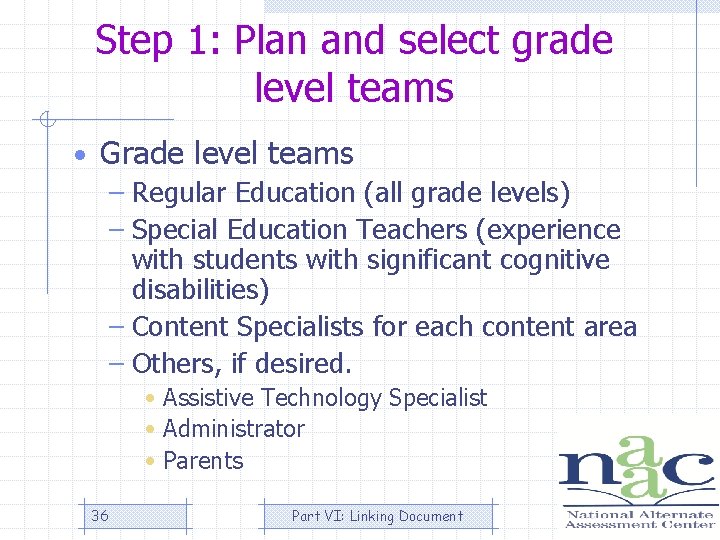
Step 1: Plan and select grade level teams • Grade level teams – Regular Education (all grade levels) – Special Education Teachers (experience with students with significant cognitive disabilities) – Content Specialists for each content area – Others, if desired. • Assistive Technology Specialist • Administrator • Parents 36 Part VI: Linking Document
CAUTION • DO NOT ATTEMPT THIS WITHOUT YOUR VERY BEST CURRICULUM PARTNERS AND SPECIAL EDUCATORS WORKING WITH YOU ON EVERY STEP! • WHO you have do this work makes a big difference in the quality of the product. 37 Part VI: Linking Document
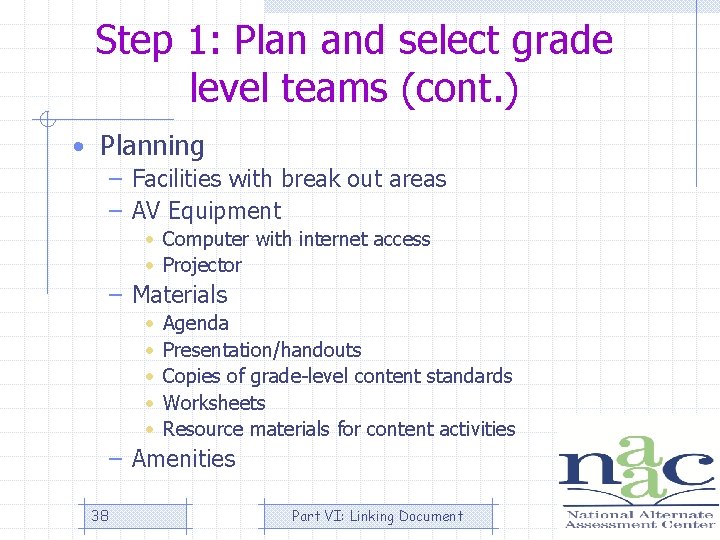
Step 1: Plan and select grade level teams (cont. ) • Planning – Facilities with break out areas – AV Equipment • Computer with internet access • Projector – Materials • • • Agenda Presentation/handouts Copies of grade-level content standards Worksheets Resource materials for content activities – Amenities 38 Part VI: Linking Document
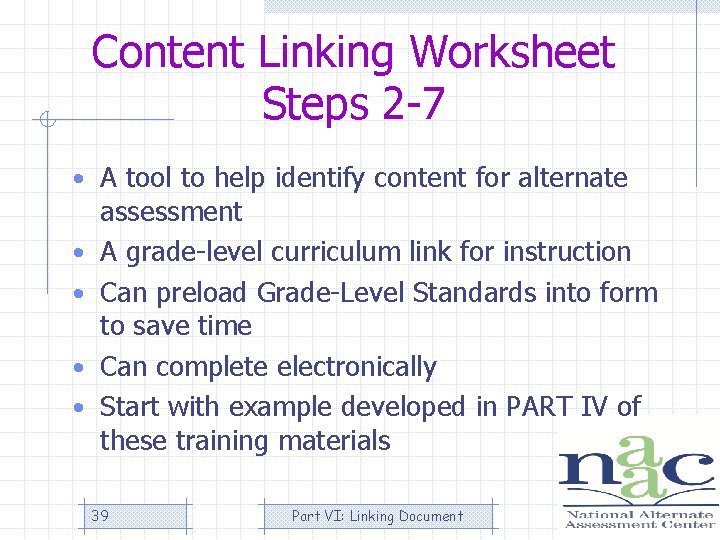
Content Linking Worksheet Steps 2 -7 • A tool to help identify content for alternate • • assessment A grade-level curriculum link for instruction Can preload Grade-Level Standards into form to save time Can complete electronically Start with example developed in PART IV of these training materials 39 Part VI: Linking Document
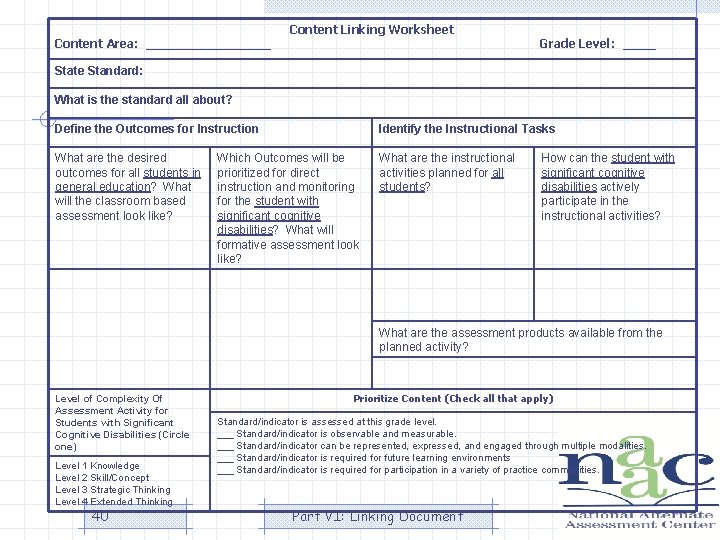
Content Area: __________ Content Linking Worksheet Grade Level: _____ State Standard: What is the standard all about? Define the Outcomes for Instruction Identify the Instructional Tasks What are the desired outcomes for all students in general education? What will the classroom based assessment look like? What are the instructional activities planned for all students? Which Outcomes will be prioritized for direct instruction and monitoring for the student with significant cognitive disabilities? What will formative assessment look like? How can the student with significant cognitive disabilities actively participate in the instructional activities? What are the assessment products available from the planned activity? Level of Complexity Of Assessment Activity for Students with Significant Cognitive Disabilities (Circle one) Level 1 Knowledge Level 2 Skill/Concept Level 3 Strategic Thinking Level 4 Extended Thinking 40 Prioritize Content (Check all that apply) Standard/indicator is assessed at this grade level. ___ Standard/indicator is observable and measurable. ___ Standard/indicator can be represented, expressed, and engaged through multiple modalities. ___ Standard/indicator is required for future learning environments ___ Standard/indicator is required for participation in a variety of practice communities. Part VI: Linking Document
Example of Step 2 Content Linking Worksheet Content Area: Reading Grade Level: 3 What is the State Standard? Reading and Literature: B. Vocabulary Expansion; The student will use a variety of strategies to expand reading, listening and speaking vocabularies. What is the standard all about? Use a variety of strategies to increase vocabulary. 41 Part VI: Linking Document
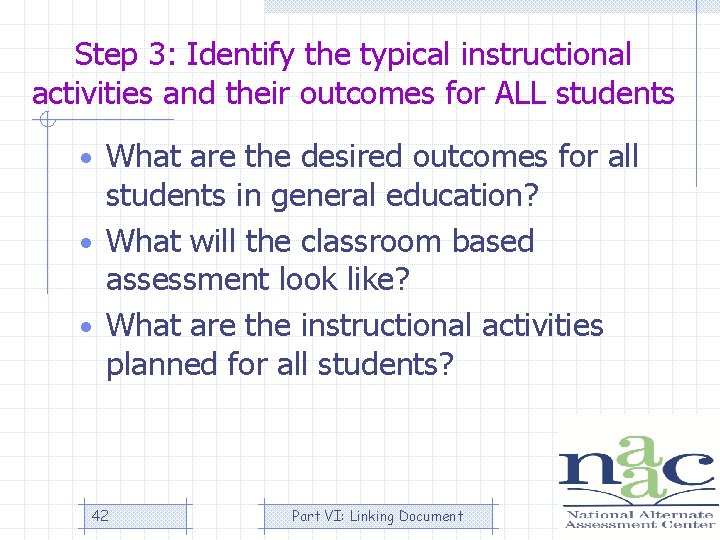
Step 3: Identify the typical instructional activities and their outcomes for ALL students • What are the desired outcomes for all students in general education? • What will the classroom based assessment look like? • What are the instructional activities planned for all students? 42 Part VI: Linking Document
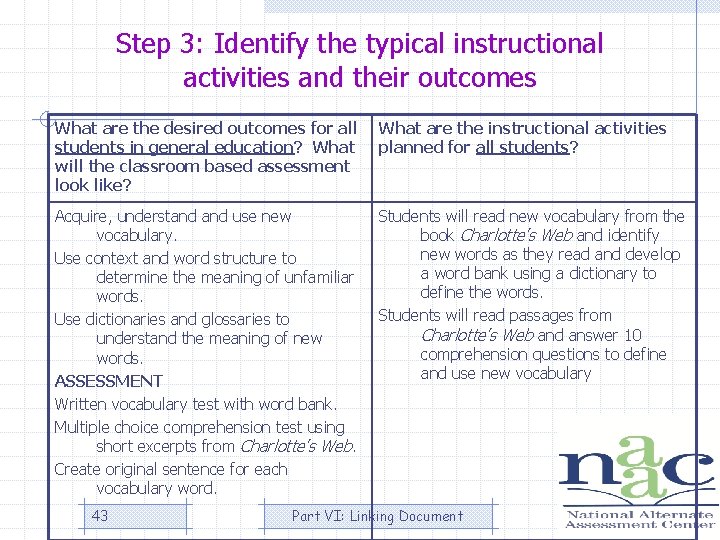
Step 3: Identify the typical instructional activities and their outcomes What are the desired outcomes for all students in general education? What will the classroom based assessment look like? What are the instructional activities planned for all students? Acquire, understand use new vocabulary. Use context and word structure to determine the meaning of unfamiliar words. Use dictionaries and glossaries to understand the meaning of new words. ASSESSMENT Written vocabulary test with word bank. Multiple choice comprehension test using short excerpts from Charlotte’s Web. Create original sentence for each vocabulary word. Students will read new vocabulary from the book Charlotte’s Web and identify new words as they read and develop a word bank using a dictionary to define the words. Students will read passages from Charlotte’s Web and answer 10 comprehension questions to define and use new vocabulary 43 Part VI: Linking Document
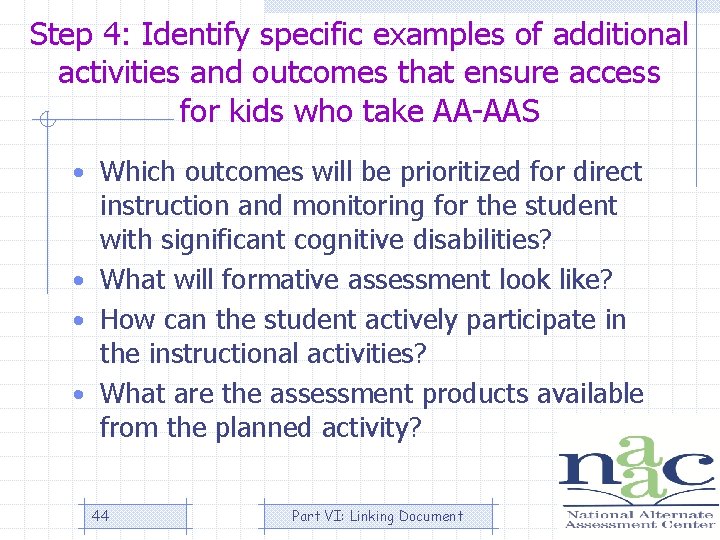
Step 4: Identify specific examples of additional activities and outcomes that ensure access for kids who take AA-AAS • Which outcomes will be prioritized for direct instruction and monitoring for the student with significant cognitive disabilities? • What will formative assessment look like? • How can the student actively participate in the instructional activities? • What are the assessment products available from the planned activity? 44 Part VI: Linking Document
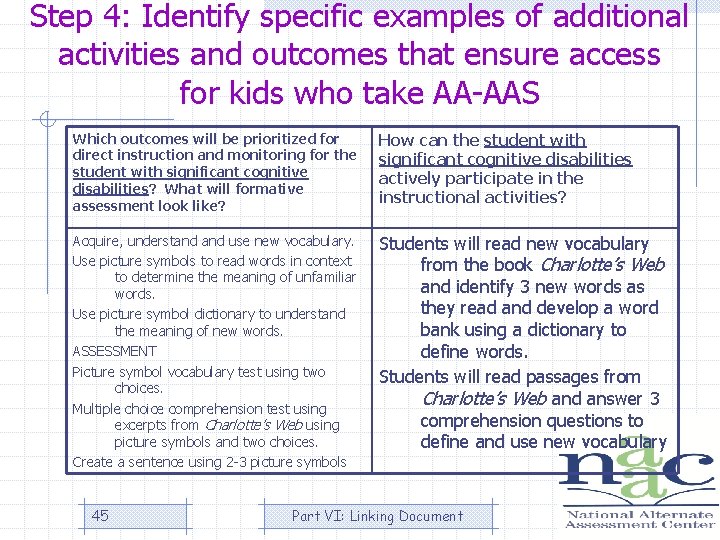
Step 4: Identify specific examples of additional activities and outcomes that ensure access for kids who take AA-AAS Which outcomes will be prioritized for direct instruction and monitoring for the student with significant cognitive disabilities? What will formative assessment look like? How can the student with significant cognitive disabilities actively participate in the instructional activities? Acquire, understand use new vocabulary. Use picture symbols to read words in context to determine the meaning of unfamiliar words. Use picture symbol dictionary to understand the meaning of new words. ASSESSMENT Picture symbol vocabulary test using two choices. Multiple choice comprehension test using excerpts from Charlotte’s Web using picture symbols and two choices. Create a sentence using 2 -3 picture symbols Students will read new vocabulary from the book Charlotte’s Web and identify 3 new words as they read and develop a word bank using a dictionary to define words. Students will read passages from Charlotte’s Web and answer 3 comprehension questions to define and use new vocabulary 45 Part VI: Linking Document
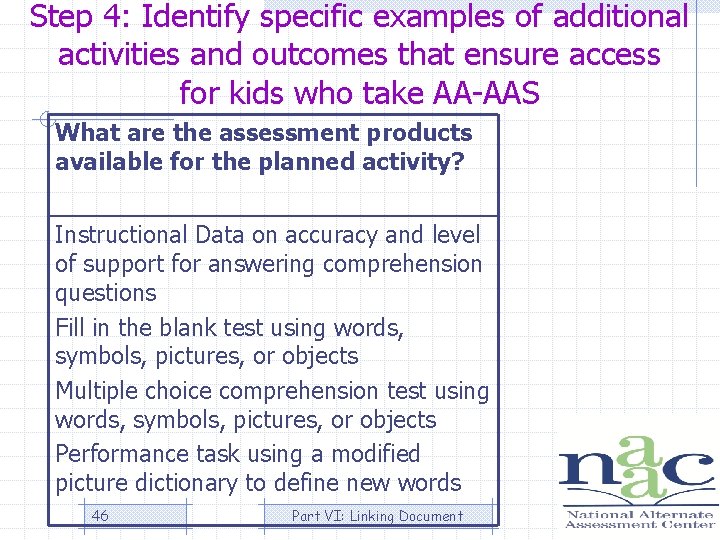
Step 4: Identify specific examples of additional activities and outcomes that ensure access for kids who take AA-AAS What are the assessment products available for the planned activity? Instructional Data on accuracy and level of support for answering comprehension questions Fill in the blank test using words, symbols, pictures, or objects Multiple choice comprehension test using words, symbols, pictures, or objects Performance task using a modified picture dictionary to define new words 46 Part VI: Linking Document
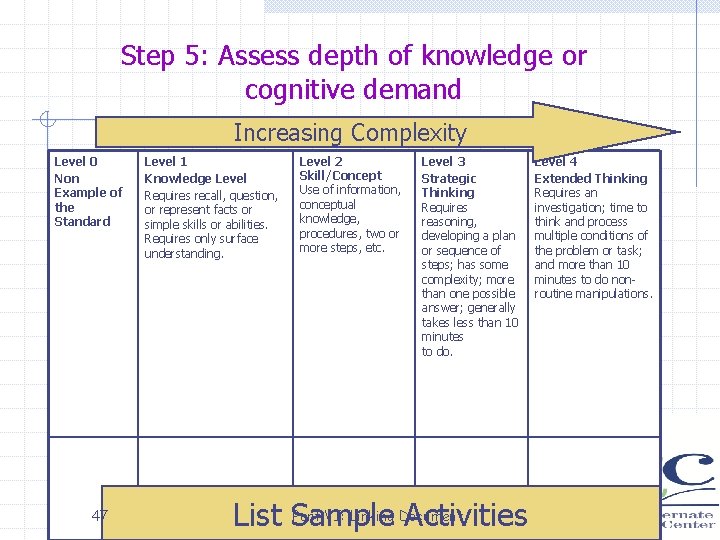
Step 5: Assess depth of knowledge or cognitive demand Increasing Complexity Level 0 Non Example of the Standard 47 Level 1 Knowledge Level Requires recall, question, or represent facts or simple skills or abilities. Requires only surface understanding. Level 2 Skill/Concept Use of information, conceptual knowledge, procedures, two or more steps, etc. Level 3 Strategic Thinking Requires reasoning, developing a plan or sequence of steps; has some complexity; more than one possible answer; generally takes less than 10 minutes to do. Part VI: Linking Document List Sample Activities Level 4 Extended Thinking Requires an investigation; time to think and process multiple conditions of the problem or task; and more than 10 minutes to do nonroutine manipulations.
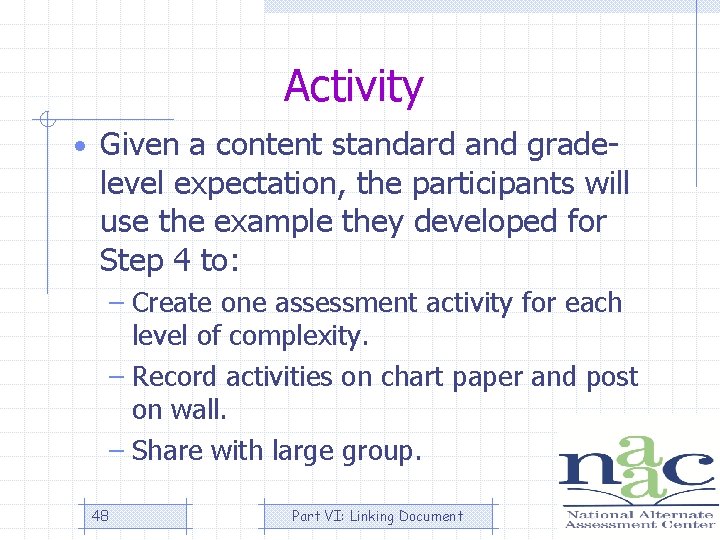
Activity • Given a content standard and grade- level expectation, the participants will use the example they developed for Step 4 to: – Create one assessment activity for each level of complexity. – Record activities on chart paper and post on wall. – Share with large group. 48 Part VI: Linking Document
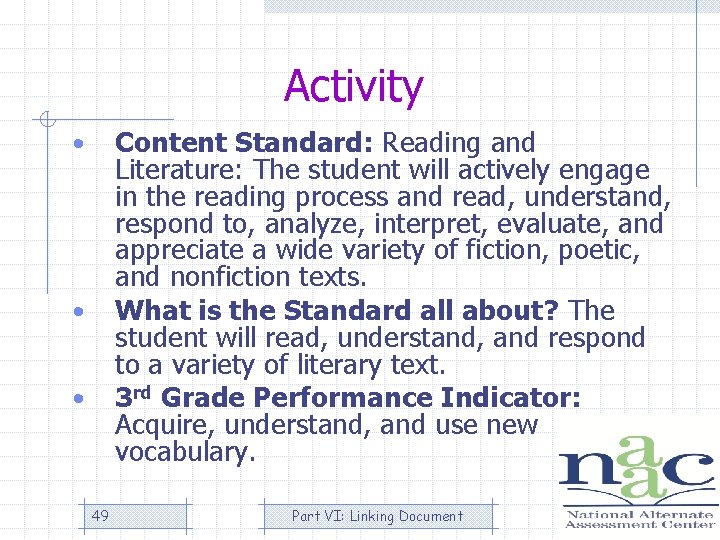
Activity Content Standard: Reading and Literature: The student will actively engage in the reading process and read, understand, respond to, analyze, interpret, evaluate, and appreciate a wide variety of fiction, poetic, and nonfiction texts. What is the Standard all about? The student will read, understand, and respond to a variety of literary text. 3 rd Grade Performance Indicator: Acquire, understand, and use new vocabulary. • • • 49 Part VI: Linking Document
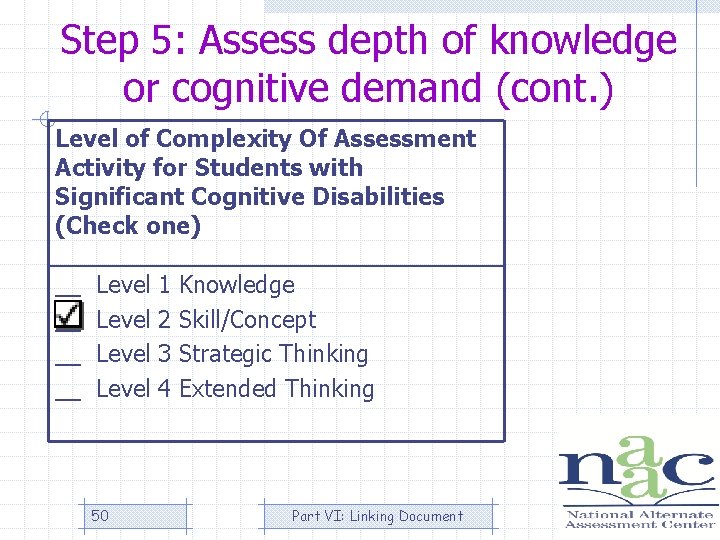
Step 5: Assess depth of knowledge or cognitive demand (cont. ) Level of Complexity Of Assessment Activity for Students with Significant Cognitive Disabilities (Check one) __ __ Level 50 1 2 3 4 Knowledge Skill/Concept Strategic Thinking Extended Thinking Part VI: Linking Document
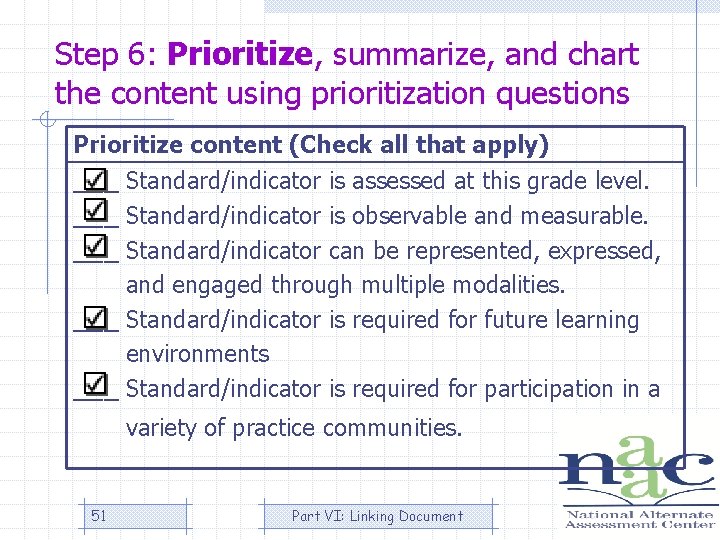
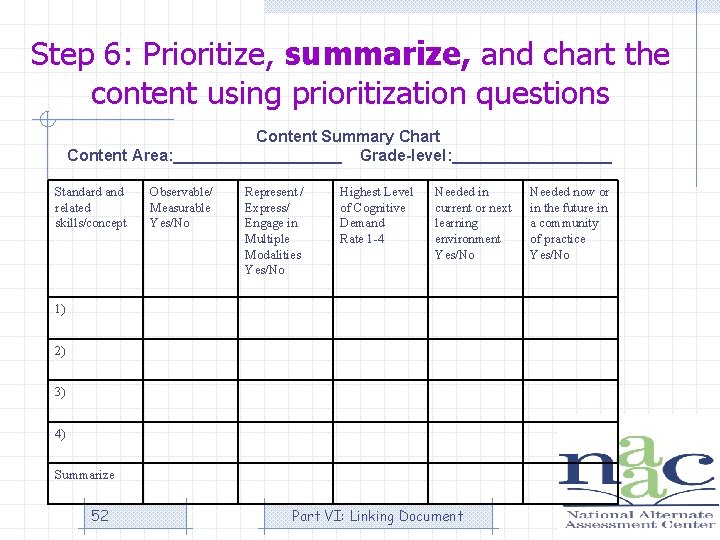
Step 6: Prioritize, summarize, and chart the content using prioritization questions Prioritize content (Check all that apply) ___ Standard/indicator is assessed at this grade level. ___ Standard/indicator is observable and measurable. ___ Standard/indicator can be represented, expressed, and engaged through multiple modalities. ___ Standard/indicator is required for future learning environments ___ Standard/indicator is required for participation in a variety of practice communities. 51 Part VI: Linking Document
Step 6: Prioritize, summarize, and chart the content using prioritization questions Content Summary Chart Content Area: __________ Grade-level: _________ Standard and related skills/concept Observable/ Measurable Yes/No Represent / Express/ Engage in Multiple Modalities Yes/No Highest Level of Cognitive Demand Rate 1 -4 Needed in current or next learning environment Yes/No 1) 2) 3) 4) Summarize 52 Part VI: Linking Document Needed now or in the future in a community of practice Yes/No
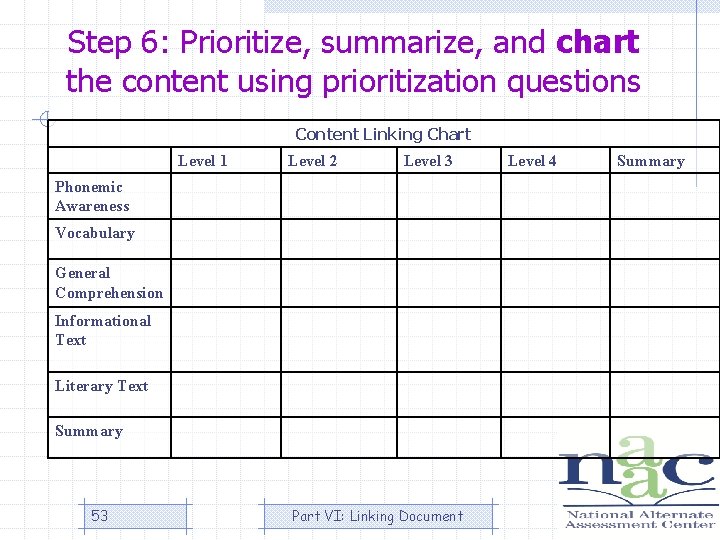
Step 6: Prioritize, summarize, and chart the content using prioritization questions Content Linking Chart Level 1 Level 2 Level 3 Phonemic Awareness Vocabulary General Comprehension Informational Text Literary Text Summary 53 Part VI: Linking Document Level 4 Summary
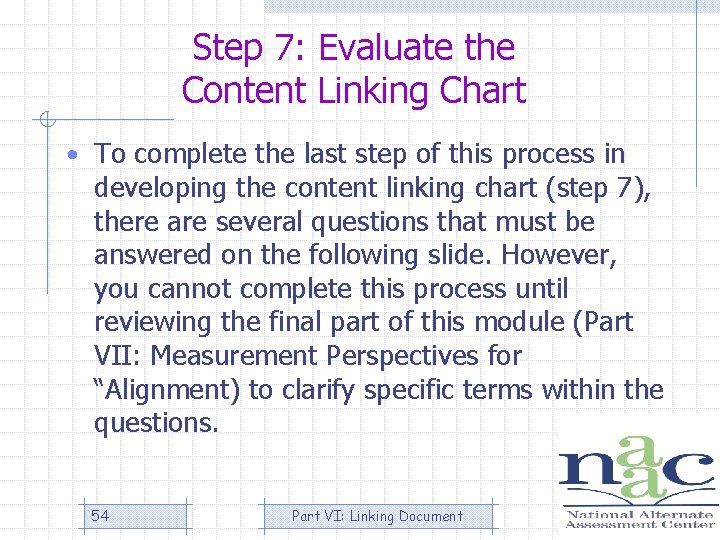
Step 7: Evaluate the Content Linking Chart • To complete the last step of this process in developing the content linking chart (step 7), there are several questions that must be answered on the following slide. However, you cannot complete this process until reviewing the final part of this module (Part VII: Measurement Perspectives for “Alignment) to clarify specific terms within the questions. 54 Part VI: Linking Document
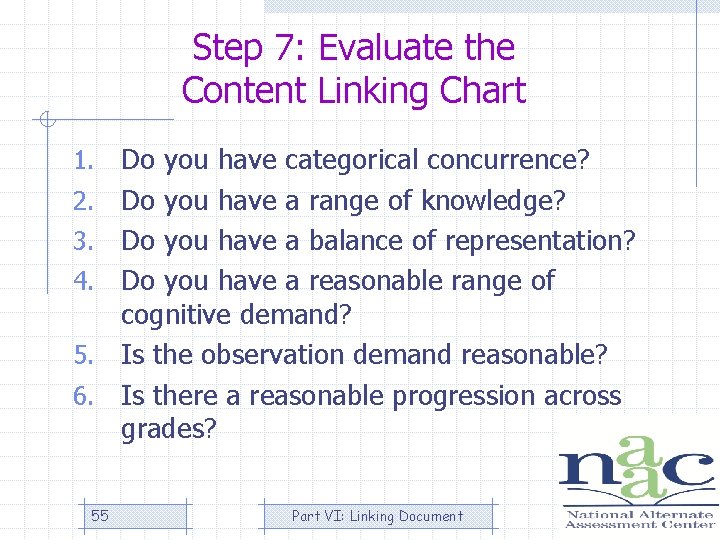
Step 7: Evaluate the Content Linking Chart 1. 2. 3. 4. 5. 6. 55 Do you have categorical concurrence? Do you have a range of knowledge? Do you have a balance of representation? Do you have a reasonable range of cognitive demand? Is the observation demand reasonable? Is there a reasonable progression across grades? Part VI: Linking Document
REMEMBER… Your content linking chart and supporting document(s): • Must be linked to grade-level content standards. • Promote access to the general curriculum. • Reflect professional judgment of the highest learning standards possible. • Grade-level content may be reduced in complexity • Should be defined in a way that supports individual growth because of their linkage to different content across grades. 56 Part VI: Linking Document
Checkpoint • Do we clearly understand assessment terminology • • (e. g. Can we differentiate between content and achievement standards)? Did we find ways to link instruction to grade-level content standards? Did the principles of UDL help us find ways to make the content accessible for all students? Were we able to find a range of cognitive demand? Did the content prioritization questions help us think about the most important content? 57 Part VI: Linking Document
Next Steps: The Assessment Blueprint should… – – – – – 58 Identify content Identify a coherent assessment structure Define initial achievement standards Define the assessments and the administration procedures Define the inferences and reporting structure Implement the assessment Score the assessment Set the standards Evaluate technical quality Part VI: Linking Document
References Arizona State Department of Education (2005). http: //www. ade. state. az. us/standards/math/articulated/Final. Math. Strand 3. doc California State Department of Education (2005). http: //www. cde. state. co. us/index_stnd. htm. California State Department of Education (2005). http: //www. cde. ca. gov/be/st/ss/enggrade 3. asp Center for Applied Special Technology. (CAST). (2002). www. cast. org. Hansche, L. N. (1998). Handbook for the Development of Performance Standards: Meeting the Requirements of Title I. Ohio State Department of Education (2005). http: //www. ode. state. oh. us/academic_content_standards/acsenglish. asp? #Draft %20 of%20 the%20 Academic%20 Content%20 Standards SOURCE: U. S. Department of Education, Institute of Education Sciences, National Center for Education Statistics, National Assessment of Educational Progress (NAEP), 2003 Reading Assessment. http: //nces. ed. gov/nationsreportcard/reading/achieveall. asp U. S. Department of Education. (2004). Standards and assessments: Peer review guidance: Information and examples for meeting requirements of the No Child Left Behind Act of 2001. Office of Elementary and Secondary Education Washington, D. C. 59 Part VI: Linking Document