
Part Two Optimizing Pintools Robert Cohn Kim Hazelwood

Part Two: Optimizing Pintools Robert Cohn Kim Hazelwood
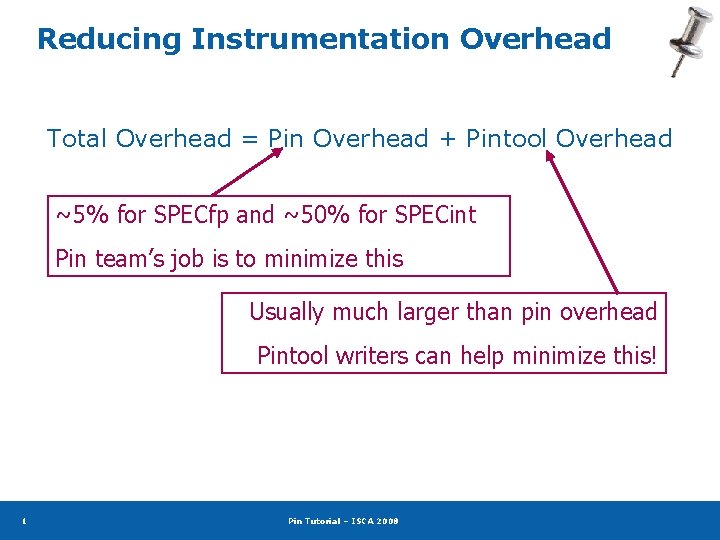
Reducing Instrumentation Overhead Total Overhead = Pin Overhead + Pintool Overhead ~5% for SPECfp and ~50% for SPECint Pin team’s job is to minimize this Usually much larger than pin overhead Pintool writers can help minimize this! 1 Pin Tutorial – ISCA 2008
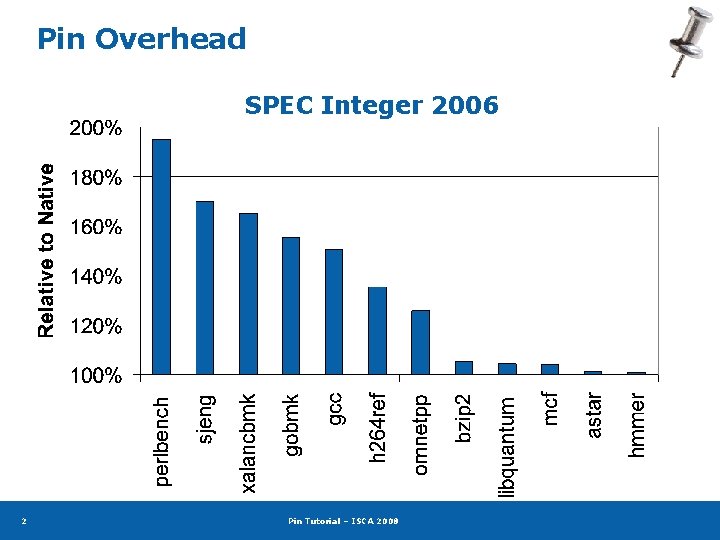
Pin Overhead SPEC Integer 2006 2 Pin Tutorial – ISCA 2008
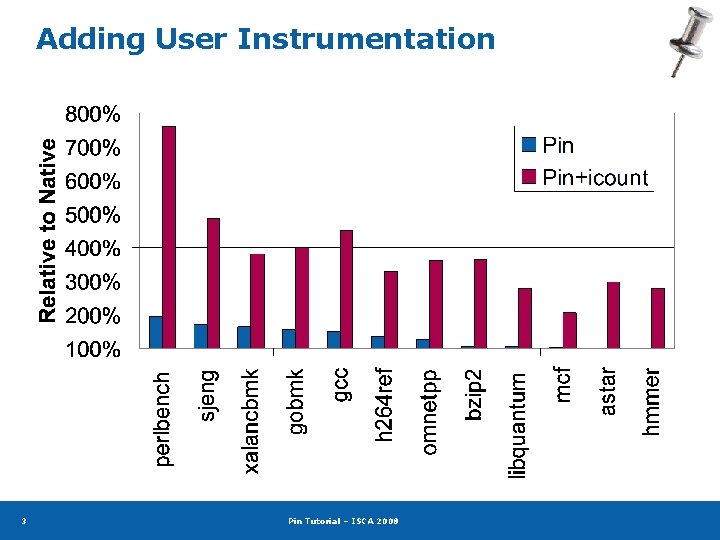
Adding User Instrumentation 3 Pin Tutorial – ISCA 2008
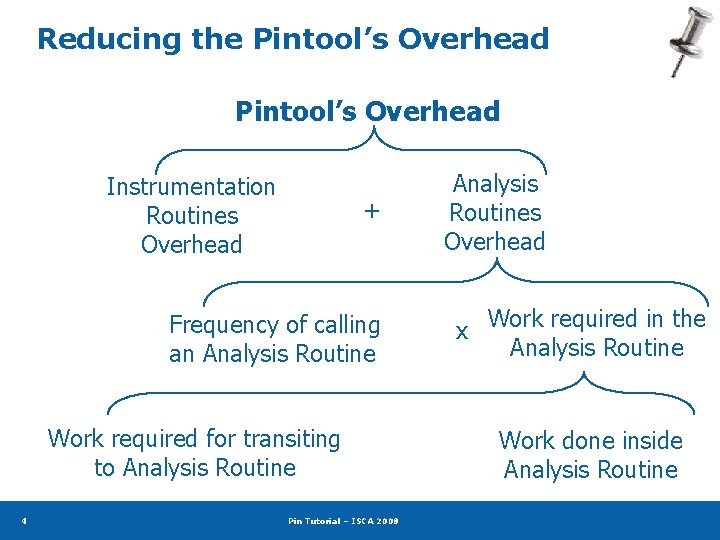
Reducing the Pintool’s Overhead Instrumentation Routines Overhead + Frequency of calling an Analysis Routine Work required for transiting to Analysis Routine 4 Pin Tutorial – ISCA 2008 Analysis Routines Overhead x Work required in the Analysis Routine Work done inside Analysis Routine
Reducing Work in Analysis Routines Key: Shift computation from analysis routines to instrumentation routines whenever possible This usually has the largest speedup 5 Pin Tutorial – ISCA 2008
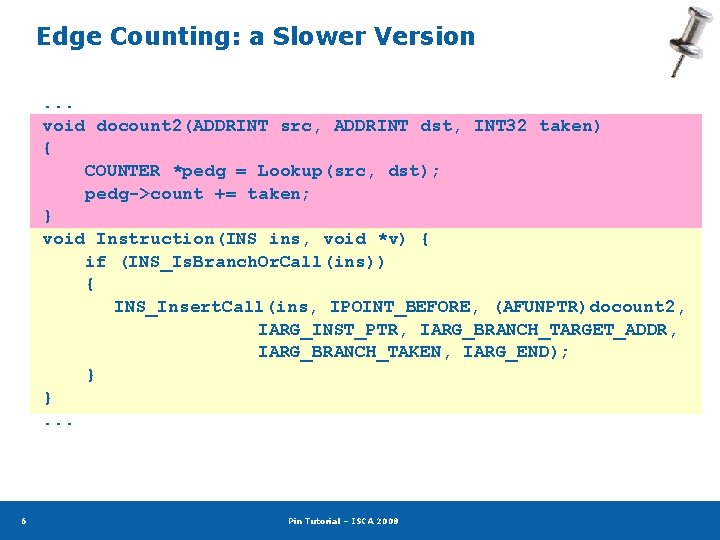
Edge Counting: a Slower Version. . . void docount 2(ADDRINT src, ADDRINT dst, INT 32 taken) { COUNTER *pedg = Lookup(src, dst); pedg->count += taken; } void Instruction(INS ins, void *v) { if (INS_Is. Branch. Or. Call(ins)) { INS_Insert. Call(ins, IPOINT_BEFORE, (AFUNPTR)docount 2, IARG_INST_PTR, IARG_BRANCH_TARGET_ADDR, IARG_BRANCH_TAKEN, IARG_END); } }. . . 6 Pin Tutorial – ISCA 2008
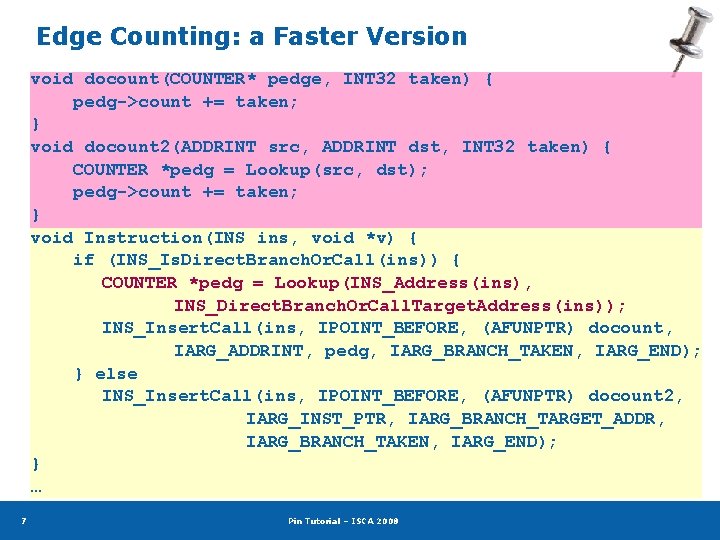
Edge Counting: a Faster Version void docount(COUNTER* pedge, INT 32 taken) { pedg->count += taken; } void docount 2(ADDRINT src, ADDRINT dst, INT 32 taken) { COUNTER *pedg = Lookup(src, dst); pedg->count += taken; } void Instruction(INS ins, void *v) { if (INS_Is. Direct. Branch. Or. Call(ins)) { COUNTER *pedg = Lookup(INS_Address(ins), INS_Direct. Branch. Or. Call. Target. Address(ins)); INS_Insert. Call(ins, IPOINT_BEFORE, (AFUNPTR) docount, IARG_ADDRINT, pedg, IARG_BRANCH_TAKEN, IARG_END); } else INS_Insert. Call(ins, IPOINT_BEFORE, (AFUNPTR) docount 2, IARG_INST_PTR, IARG_BRANCH_TARGET_ADDR, IARG_BRANCH_TAKEN, IARG_END); } … 7 Pin Tutorial – ISCA 2008
Analysis Routines: Reduce Call Frequency Key: Instrument at the largest granularity whenever possible Instead of inserting one call per instruction Insert one call per basic block or trace 8 Pin Tutorial – ISCA 2008
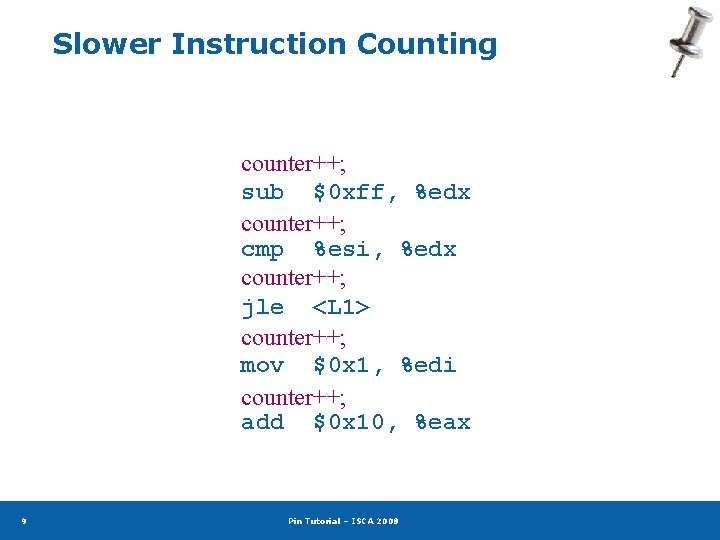
Slower Instruction Counting counter++; sub $0 xff, %edx counter++; cmp %esi, %edx counter++; jle <L 1> counter++; mov $0 x 1, %edi counter++; add $0 x 10, %eax 9 Pin Tutorial – ISCA 2008
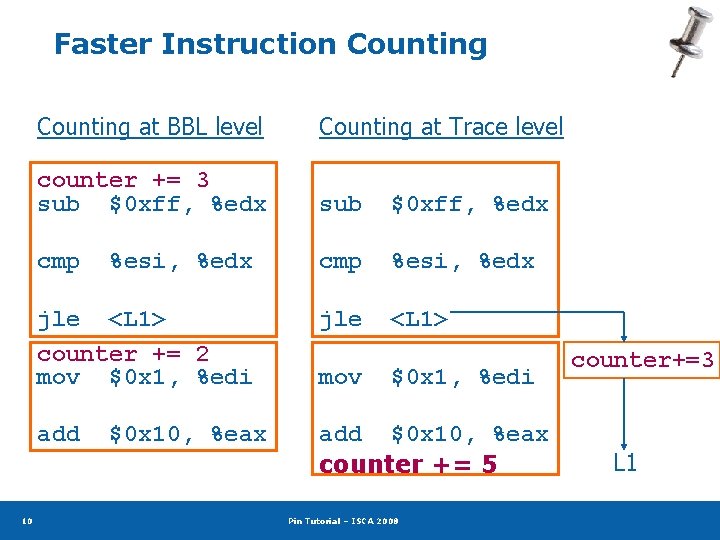
Faster Instruction Counting 10 Counting at BBL level Counting at Trace level counter += 3 sub $0 xff, %edx cmp %esi, %edx jle <L 1> counter += 2 mov $0 x 1, %edi jle <L 1> add $0 x 10, %eax counter += 5 $0 x 10, %eax mov $0 x 1, %edi Pin Tutorial – ISCA 2008 counter+=3 L 1
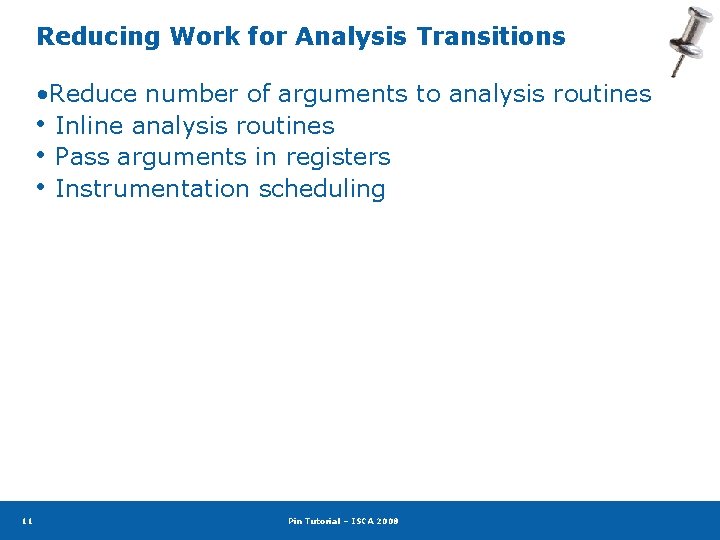
Reducing Work for Analysis Transitions • Reduce number of arguments to analysis routines • Inline analysis routines • Pass arguments in registers • Instrumentation scheduling 11 Pin Tutorial – ISCA 2008
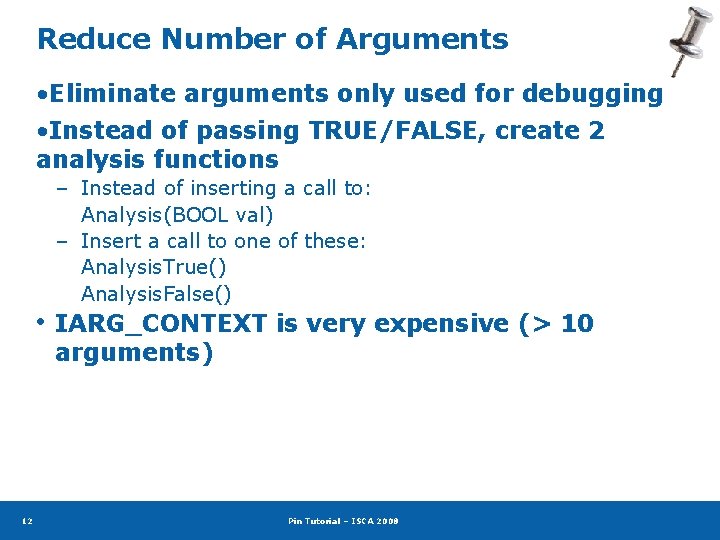
Reduce Number of Arguments • Eliminate arguments only used for debugging • Instead of passing TRUE/FALSE, create 2 analysis functions – Instead of inserting a call to: Analysis(BOOL val) – Insert a call to one of these: Analysis. True() Analysis. False() • IARG_CONTEXT is very expensive (> 10 arguments) 12 Pin Tutorial – ISCA 2008
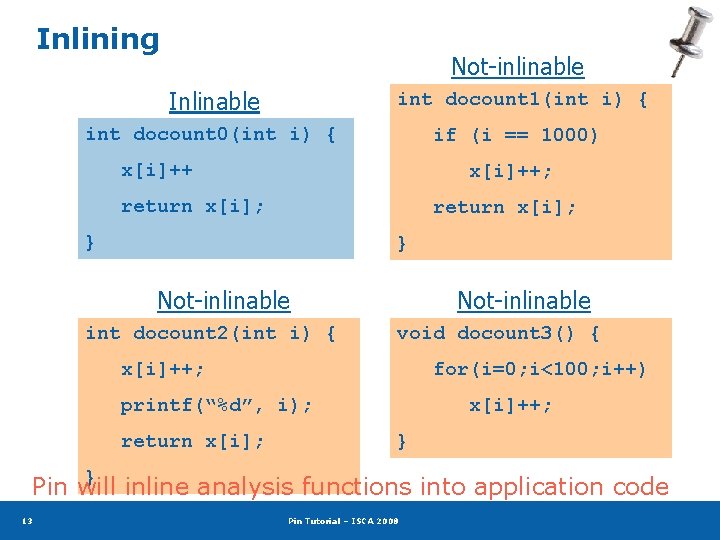
Inlining Not-inlinable Inlinable int docount 1(int i) { int docount 0(int i) { if (i == 1000) x[i]++; return x[i]; } } Not-inlinable int docount 2(int i) { Not-inlinable void docount 3() { x[i]++; for(i=0; i<100; i++) printf(“%d”, i); return x[i]; x[i]++; } } Pin will inline analysis functions into application code 13 Pin Tutorial – ISCA 2008
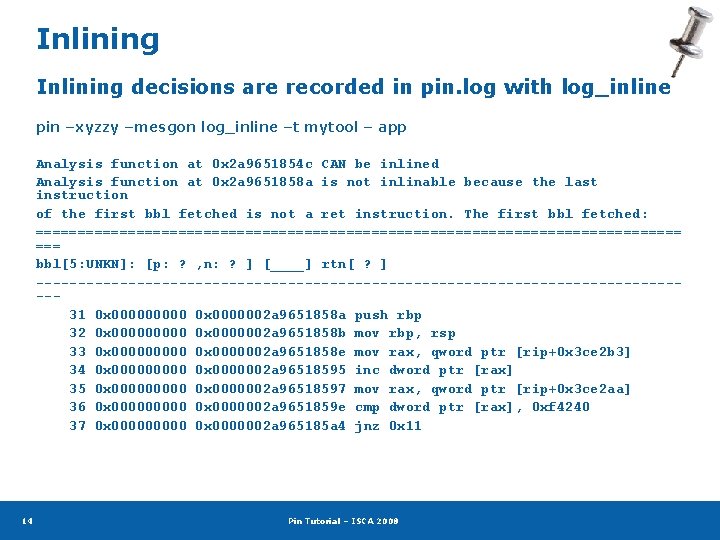
Inlining decisions are recorded in pin. log with log_inline pin –xyzzy –mesgon log_inline –t mytool – app Analysis function at 0 x 2 a 9651854 c CAN be inlined Analysis function at 0 x 2 a 9651858 a is not inlinable because the last instruction of the first bbl fetched is not a ret instruction. The first bbl fetched: ======================================= === bbl[5: UNKN]: [p: ? , n: ? ] [____] rtn[ ? ] ---------------------------------------31 0 x 0000002 a 9651858 a push rbp 32 0 x 0000002 a 9651858 b mov rbp, rsp 33 0 x 0000002 a 9651858 e mov rax, qword ptr [rip+0 x 3 ce 2 b 3] 34 0 x 0000002 a 96518595 inc dword ptr [rax] 35 0 x 0000002 a 96518597 mov rax, qword ptr [rip+0 x 3 ce 2 aa] 36 0 x 0000002 a 9651859 e cmp dword ptr [rax], 0 xf 4240 37 0 x 0000002 a 965185 a 4 jnz 0 x 11 14 Pin Tutorial – ISCA 2008
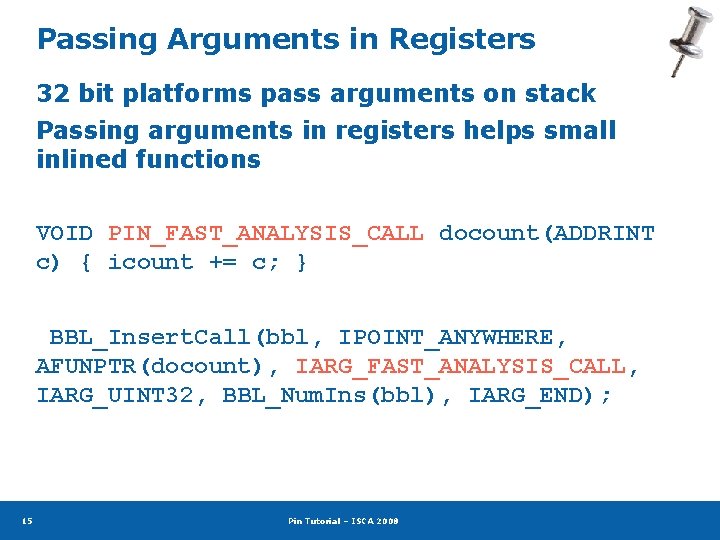
Passing Arguments in Registers 32 bit platforms pass arguments on stack Passing arguments in registers helps small inlined functions VOID PIN_FAST_ANALYSIS_CALL docount(ADDRINT c) { icount += c; } BBL_Insert. Call(bbl, IPOINT_ANYWHERE, AFUNPTR(docount), IARG_FAST_ANALYSIS_CALL, IARG_UINT 32, BBL_Num. Ins(bbl), IARG_END); 15 Pin Tutorial – ISCA 2008
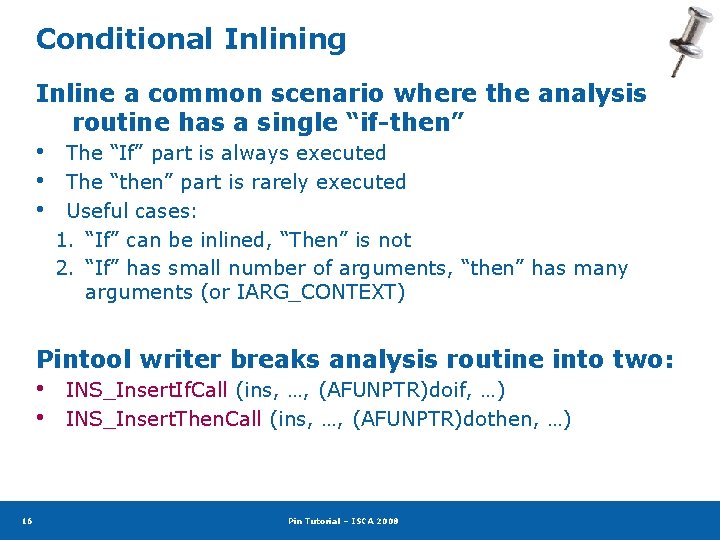
Conditional Inlining Inline a common scenario where the analysis routine has a single “if-then” • • • The “If” part is always executed The “then” part is rarely executed Useful cases: 1. “If” can be inlined, “Then” is not 2. “If” has small number of arguments, “then” has many arguments (or IARG_CONTEXT) Pintool writer breaks analysis routine into two: • • 16 INS_Insert. If. Call (ins, …, (AFUNPTR)doif, …) INS_Insert. Then. Call (ins, …, (AFUNPTR)dothen, …) Pin Tutorial – ISCA 2008
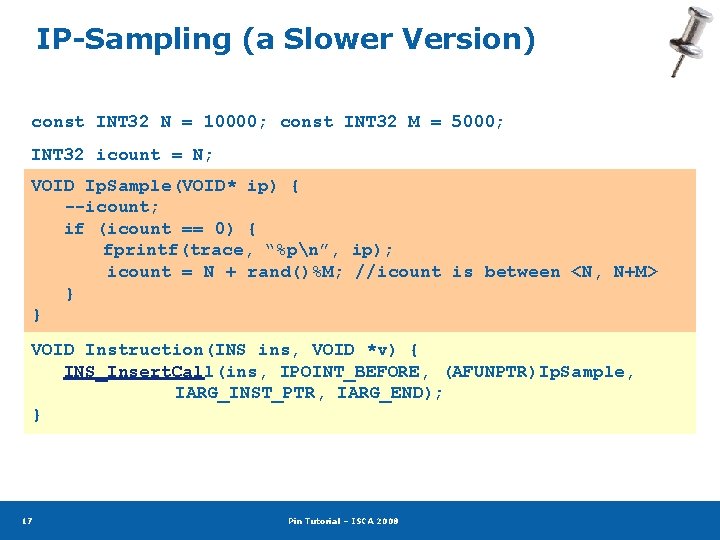
IP-Sampling (a Slower Version) const INT 32 N = 10000; const INT 32 M = 5000; INT 32 icount = N; VOID Ip. Sample(VOID* ip) { --icount; if (icount == 0) { fprintf(trace, “%pn”, ip); icount = N + rand()%M; //icount is between <N, N+M> } } VOID Instruction(INS ins, VOID *v) { INS_Insert. Call(ins, IPOINT_BEFORE, (AFUNPTR)Ip. Sample, IARG_INST_PTR, IARG_END); } 17 Pin Tutorial – ISCA 2008
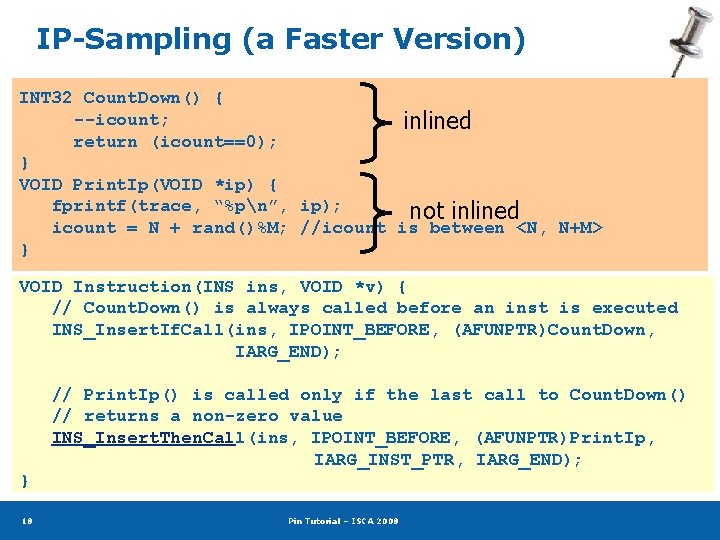
IP-Sampling (a Faster Version) INT 32 Count. Down() { --icount; inlined return (icount==0); } VOID Print. Ip(VOID *ip) { fprintf(trace, “%pn”, ip); not inlined icount = N + rand()%M; //icount is between <N, N+M> } VOID Instruction(INS ins, VOID *v) { // Count. Down() is always called before an inst is executed INS_Insert. If. Call(ins, IPOINT_BEFORE, (AFUNPTR)Count. Down, IARG_END); // Print. Ip() is called only if the last call to Count. Down() // returns a non-zero value INS_Insert. Then. Call(ins, IPOINT_BEFORE, (AFUNPTR)Print. Ip, IARG_INST_PTR, IARG_END); } 18 Pin Tutorial – ISCA 2008
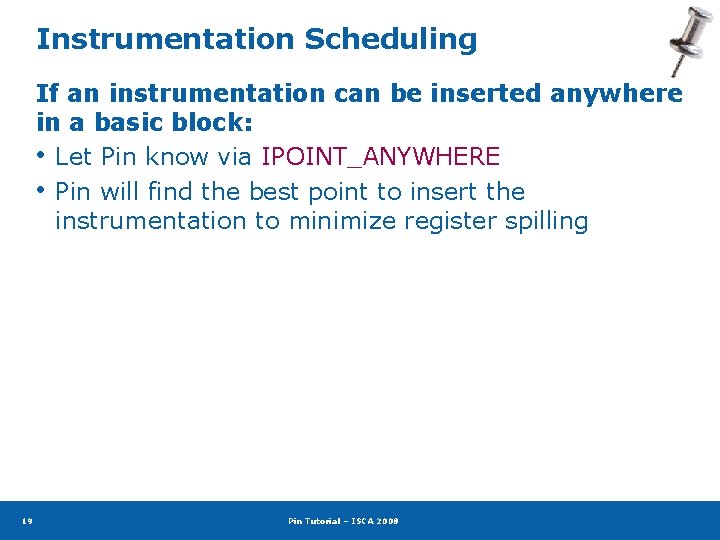
Instrumentation Scheduling If an instrumentation can be inserted anywhere in a basic block: • Let Pin know via IPOINT_ANYWHERE • Pin will find the best point to insert the instrumentation to minimize register spilling 19 Pin Tutorial – ISCA 2008
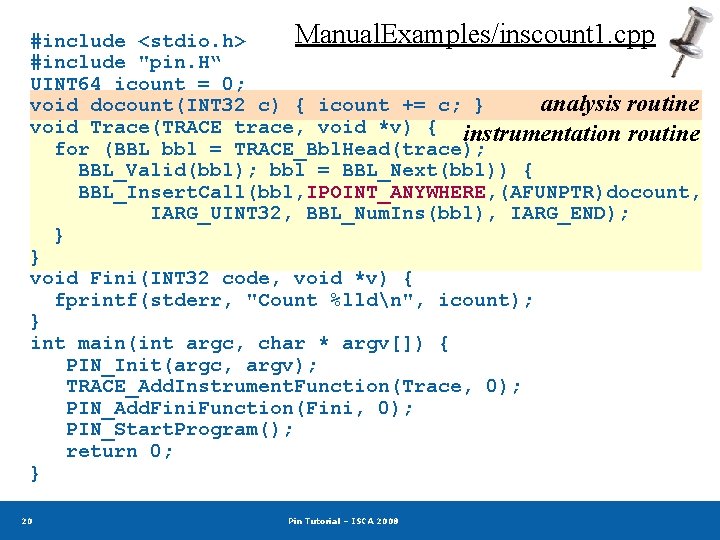
Manual. Examples/inscount 1. cpp #include <stdio. h> #include "pin. H“ UINT 64 icount = 0; analysis routine void docount(INT 32 c) { icount += c; } void Trace(TRACE trace, void *v) { instrumentation routine for (BBL bbl = TRACE_Bbl. Head(trace); BBL_Valid(bbl); bbl = BBL_Next(bbl)) { BBL_Insert. Call(bbl, IPOINT_ANYWHERE, (AFUNPTR)docount, IARG_UINT 32, BBL_Num. Ins(bbl), IARG_END); } } void Fini(INT 32 code, void *v) { fprintf(stderr, "Count %lldn", icount); } int main(int argc, char * argv[]) { PIN_Init(argc, argv); TRACE_Add. Instrument. Function(Trace, 0); PIN_Add. Fini. Function(Fini, 0); PIN_Start. Program(); return 0; } 20 Pin Tutorial – ISCA 2008
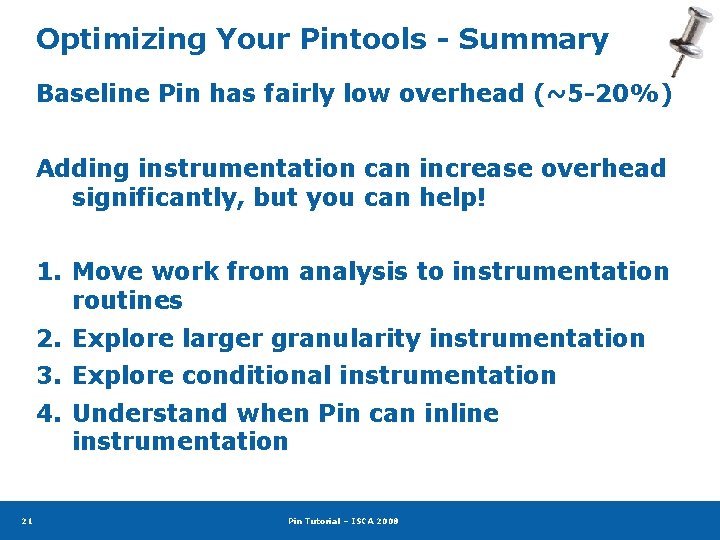
Optimizing Your Pintools - Summary Baseline Pin has fairly low overhead (~5 -20%) Adding instrumentation can increase overhead significantly, but you can help! 1. Move work from analysis to instrumentation routines 2. Explore larger granularity instrumentation 3. Explore conditional instrumentation 4. Understand when Pin can inline instrumentation 21 Pin Tutorial – ISCA 2008

Part Three: Analyzing Parallel Programs Robert Cohn Kim Hazelwood
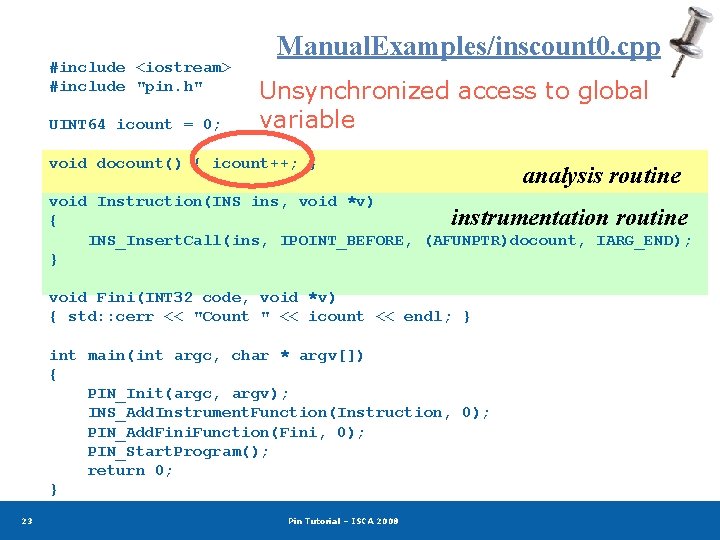
#include <iostream> #include "pin. h" UINT 64 icount = 0; Manual. Examples/inscount 0. cpp Unsynchronized access to global variable void docount() { icount++; } analysis routine void Instruction(INS ins, void *v) instrumentation routine { INS_Insert. Call(ins, IPOINT_BEFORE, (AFUNPTR)docount, IARG_END); } void Fini(INT 32 code, void *v) { std: : cerr << "Count " << icount << endl; } int main(int argc, char * argv[]) { PIN_Init(argc, argv); INS_Add. Instrument. Function(Instruction, 0); PIN_Add. Fini. Function(Fini, 0); PIN_Start. Program(); return 0; } 23 Pin Tutorial – ISCA 2008
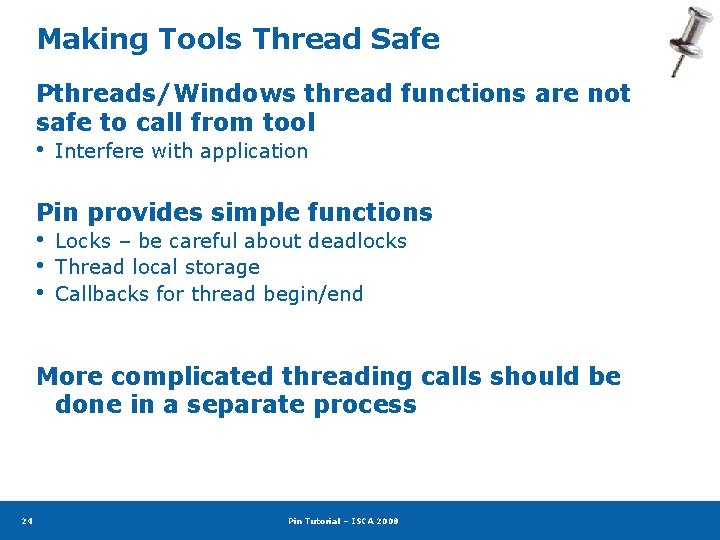
Making Tools Thread Safe Pthreads/Windows thread functions are not safe to call from tool • Interfere with application Pin provides simple functions • • • Locks – be careful about deadlocks Thread local storage Callbacks for thread begin/end More complicated threading calls should be done in a separate process 24 Pin Tutorial – ISCA 2008
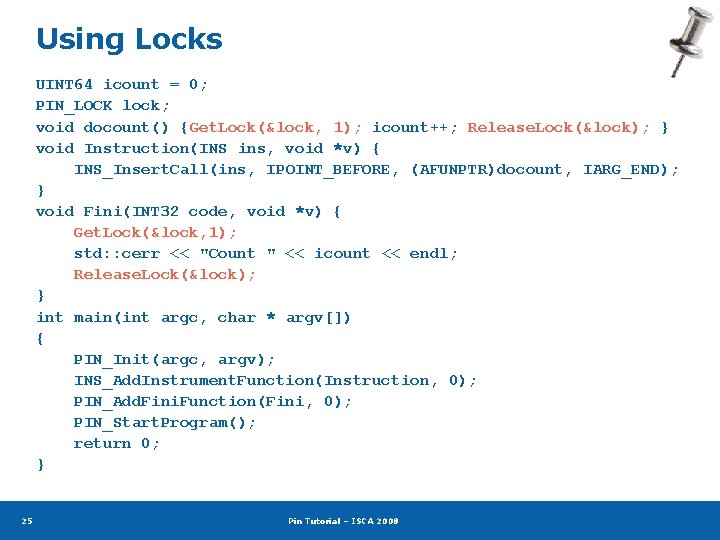
Using Locks UINT 64 icount = 0; PIN_LOCK lock; void docount() {Get. Lock(&lock, 1); icount++; Release. Lock(&lock); } void Instruction(INS ins, void *v) { INS_Insert. Call(ins, IPOINT_BEFORE, (AFUNPTR)docount, IARG_END); } void Fini(INT 32 code, void *v) { Get. Lock(&lock, 1); std: : cerr << "Count " << icount << endl; Release. Lock(&lock); } int main(int argc, char * argv[]) { PIN_Init(argc, argv); INS_Add. Instrument. Function(Instruction, 0); PIN_Add. Fini. Function(Fini, 0); PIN_Start. Program(); return 0; } 25 Pin Tutorial – ISCA 2008
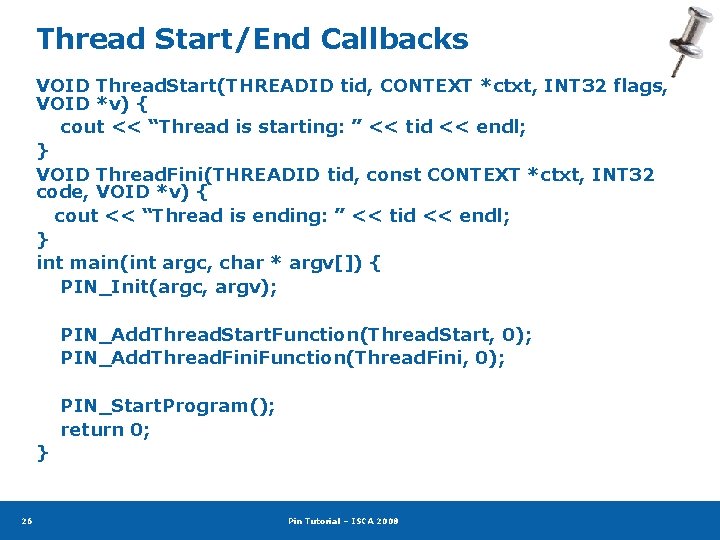
Thread Start/End Callbacks VOID Thread. Start(THREADID tid, CONTEXT *ctxt, INT 32 flags, VOID *v) { cout << “Thread is starting: ” << tid << endl; } VOID Thread. Fini(THREADID tid, const CONTEXT *ctxt, INT 32 code, VOID *v) { cout << “Thread is ending: ” << tid << endl; } int main(int argc, char * argv[]) { PIN_Init(argc, argv); PIN_Add. Thread. Start. Function(Thread. Start, 0); PIN_Add. Thread. Fini. Function(Thread. Fini, 0); PIN_Start. Program(); return 0; } 26 Pin Tutorial – ISCA 2008
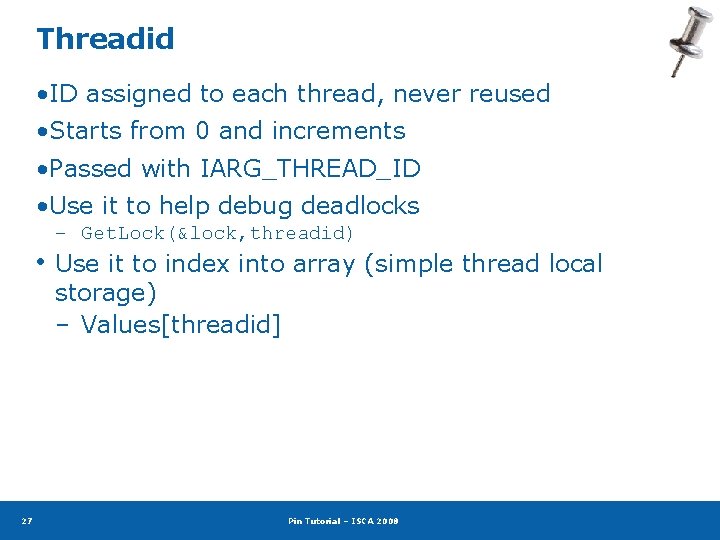
Threadid • ID assigned to each thread, never reused • Starts from 0 and increments • Passed with IARG_THREAD_ID • Use it to help debug deadlocks – Get. Lock(&lock, threadid) • Use it to index into array (simple thread local storage) – Values[threadid] 27 Pin Tutorial – ISCA 2008
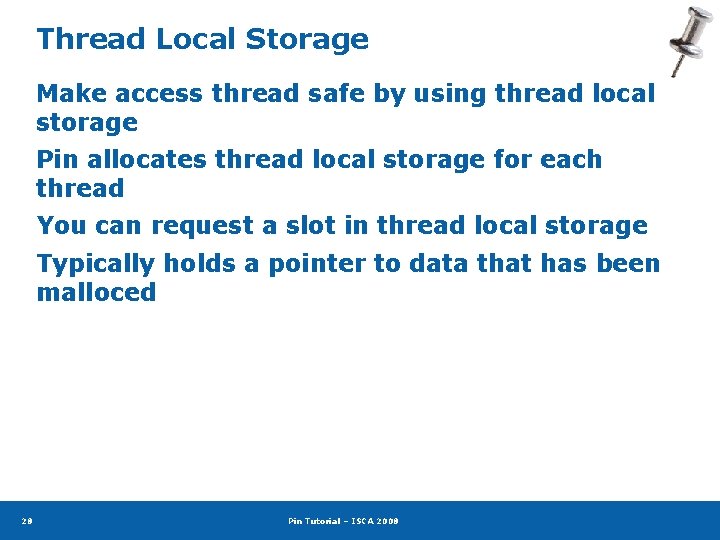
Thread Local Storage Make access thread safe by using thread local storage Pin allocates thread local storage for each thread You can request a slot in thread local storage Typically holds a pointer to data that has been malloced 28 Pin Tutorial – ISCA 2008
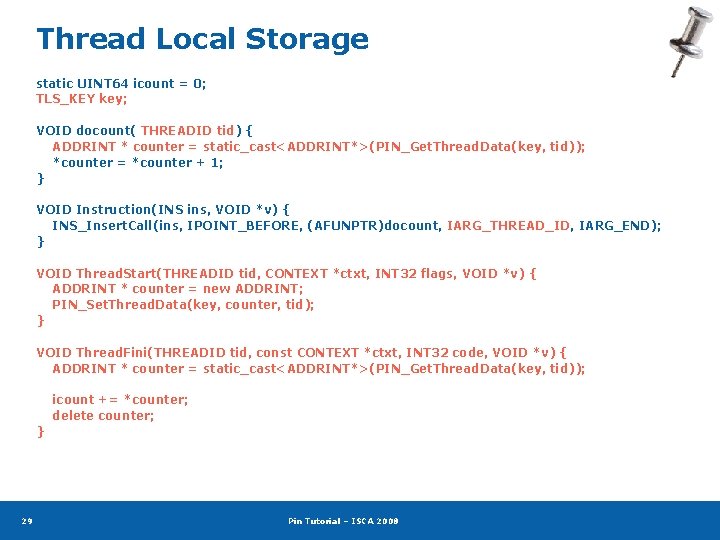
Thread Local Storage static UINT 64 icount = 0; TLS_KEY key; VOID docount( THREADID tid) { ADDRINT * counter = static_cast<ADDRINT*>(PIN_Get. Thread. Data(key, tid)); *counter = *counter + 1; } VOID Instruction(INS ins, VOID *v) { INS_Insert. Call(ins, IPOINT_BEFORE, (AFUNPTR)docount, IARG_THREAD_ID, IARG_END); } VOID Thread. Start(THREADID tid, CONTEXT *ctxt, INT 32 flags, VOID *v) { ADDRINT * counter = new ADDRINT; PIN_Set. Thread. Data(key, counter, tid); } VOID Thread. Fini(THREADID tid, const CONTEXT *ctxt, INT 32 code, VOID *v) { ADDRINT * counter = static_cast<ADDRINT*>(PIN_Get. Thread. Data(key, tid)); icount += *counter; delete counter; } 29 Pin Tutorial – ISCA 2008
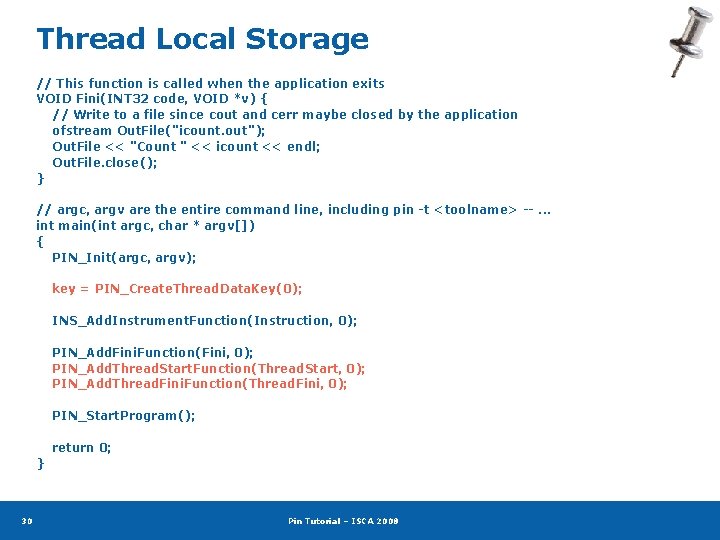
Thread Local Storage // This function is called when the application exits VOID Fini(INT 32 code, VOID *v) { // Write to a file since cout and cerr maybe closed by the application ofstream Out. File("icount. out"); Out. File << "Count " << icount << endl; Out. File. close(); } // argc, argv are the entire command line, including pin -t <toolname> --. . . int main(int argc, char * argv[]) { PIN_Init(argc, argv); key = PIN_Create. Thread. Data. Key(0); INS_Add. Instrument. Function(Instruction, 0); PIN_Add. Fini. Function(Fini, 0); PIN_Add. Thread. Start. Function(Thread. Start, 0); PIN_Add. Thread. Fini. Function(Thread. Fini, 0); PIN_Start. Program(); return 0; } 30 Pin Tutorial – ISCA 2008
- Slides: 31