
Part One Preparation 1 Human and Animal Communication
- Slides: 23
Part One Preparation 1. Human and Animal Communication 2. Functions of Language 3. Interpreting Body Language 4. Proverbs & Quotations
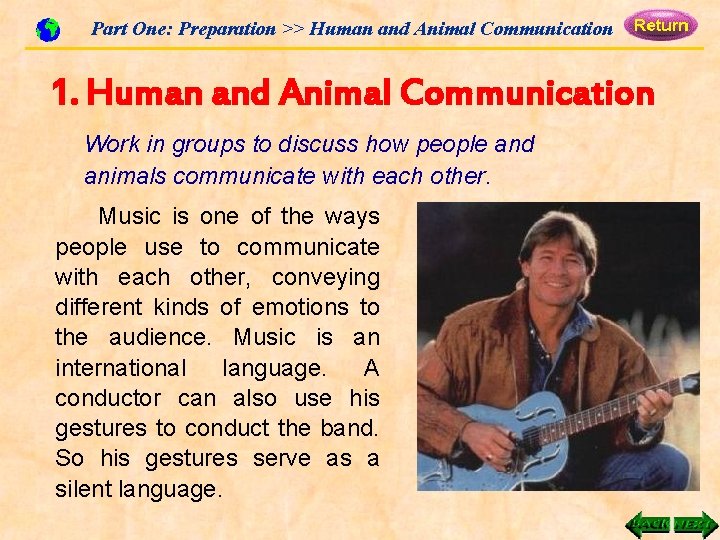
Part One: Preparation >> Human and Animal Communication 1. Human and Animal Communication Work in groups to discuss how people and animals communicate with each other. Music is one of the ways people use to communicate with each other, conveying different kinds of emotions to the audience. Music is an international language. A conductor can also use his gestures to conduct the band. So his gestures serve as a silent language.
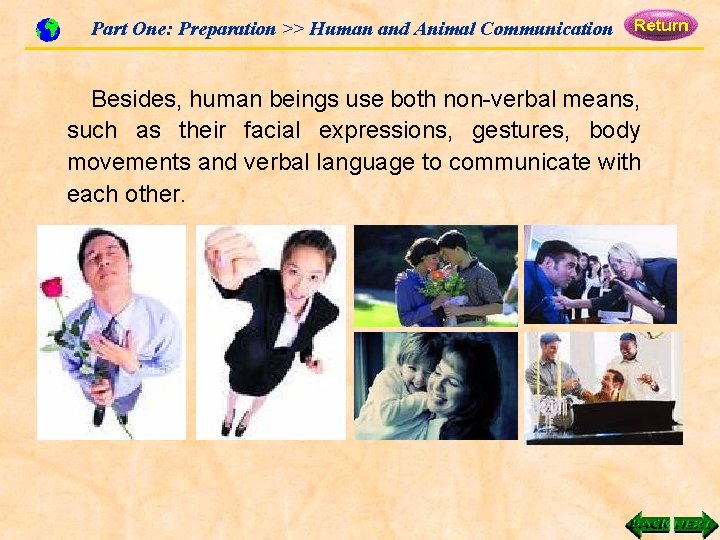
Part One: Preparation >> Human and Animal Communication Besides, human beings use both non-verbal means, such as their facial expressions, gestures, body movements and verbal language to communicate with each other.
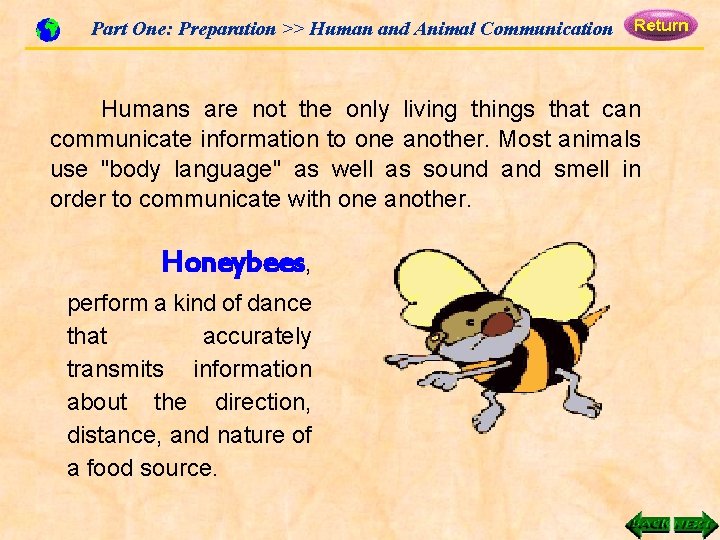
Part One: Preparation >> Human and Animal Communication Humans are not the only living things that can communicate information to one another. Most animals use "body language" as well as sound and smell in order to communicate with one another. Honeybees, perform a kind of dance that accurately transmits information about the direction, distance, and nature of a food source.
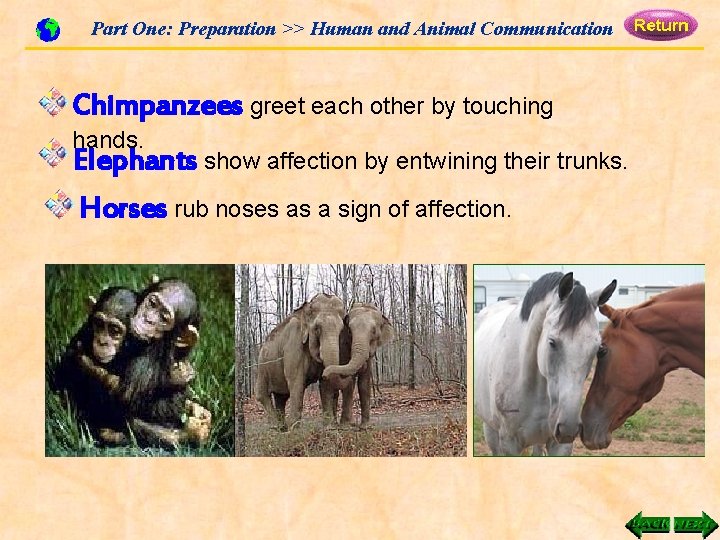
Part One: Preparation >> Human and Animal Communication Chimpanzees greet each other by touching hands. Elephants show affection by entwining their trunks. Horses rub noses as a sign of affection.
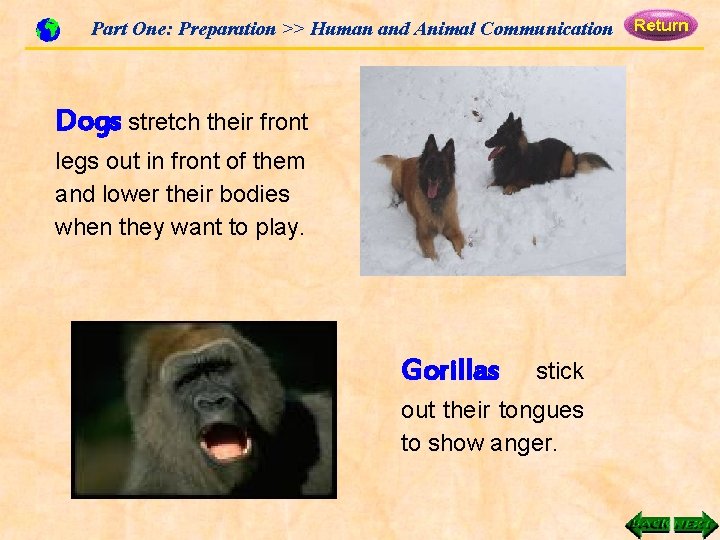
Part One: Preparation >> Human and Animal Communication Dogs stretch their front legs out in front of them and lower their bodies when they want to play. Gorillas stick out their tongues to show anger.
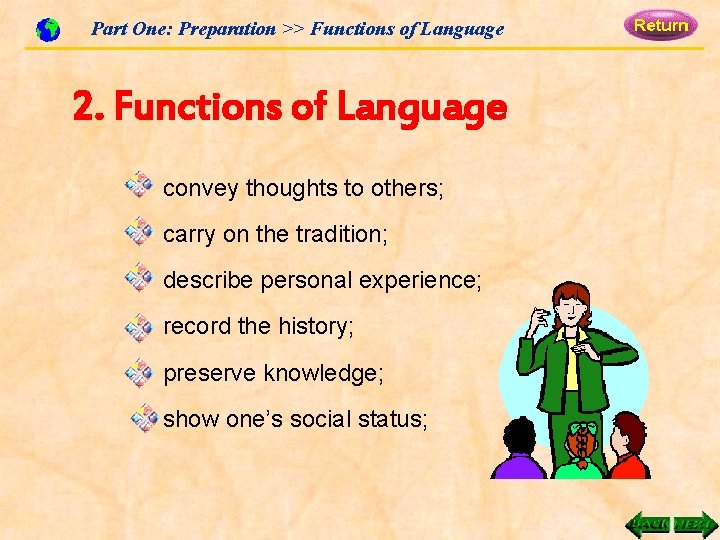
Part One: Preparation >> Functions of Language 2. Functions of Language convey thoughts to others; carry on the tradition; describe personal experience; record the history; preserve knowledge; show one’s social status;
Part One: Preparation >> Functions of Language express one’s emotions or feelings; distinguish social groups; send information in distance; improve the relationship,overcome obstacles in space and time; play the social role.
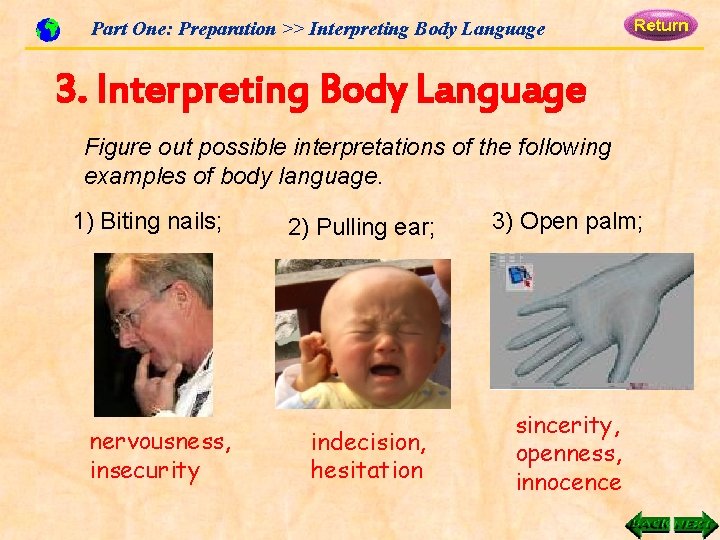
Part One: Preparation >> Interpreting Body Language 3. Interpreting Body Language Figure out possible interpretations of the following examples of body language. 1) Biting nails; nervousness, insecurity 2) Pulling ear; 3) Open palm; indecision, hesitation sincerity, openness, innocence
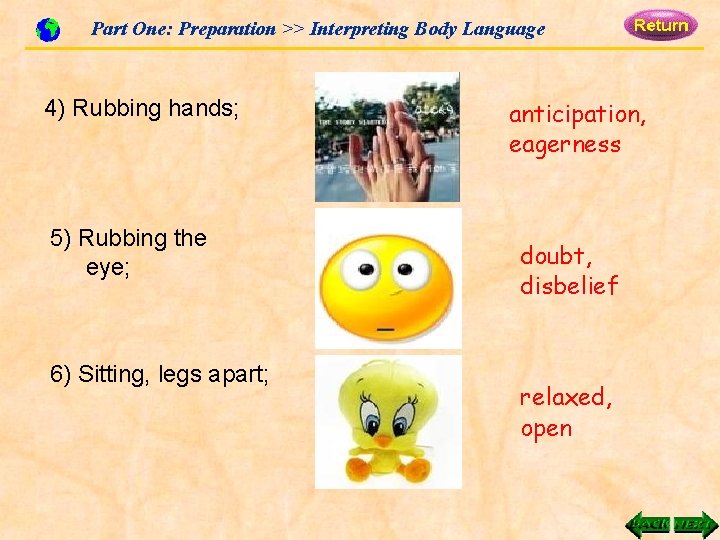
Part One: Preparation >> Interpreting Body Language 4) Rubbing hands; 5) Rubbing the eye; 6) Sitting, legs apart; anticipation, eagerness doubt, disbelief relaxed, open
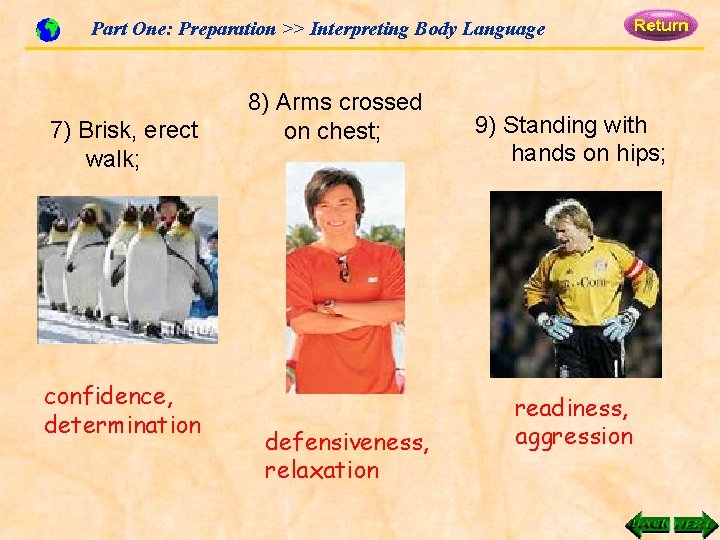
Part One: Preparation >> Interpreting Body Language 7) Brisk, erect walk; confidence, determination 8) Arms crossed on chest; defensiveness, relaxation 9) Standing with hands on hips; readiness, aggression
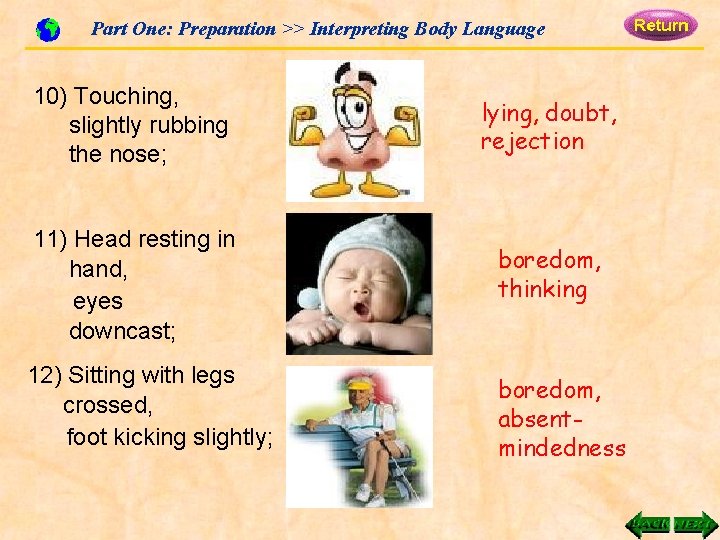
Part One: Preparation >> Interpreting Body Language 10) Touching, slightly rubbing the nose; 11) Head resting in hand, eyes downcast; 12) Sitting with legs crossed, foot kicking slightly; lying, doubt, rejection boredom, thinking boredom, absentmindedness
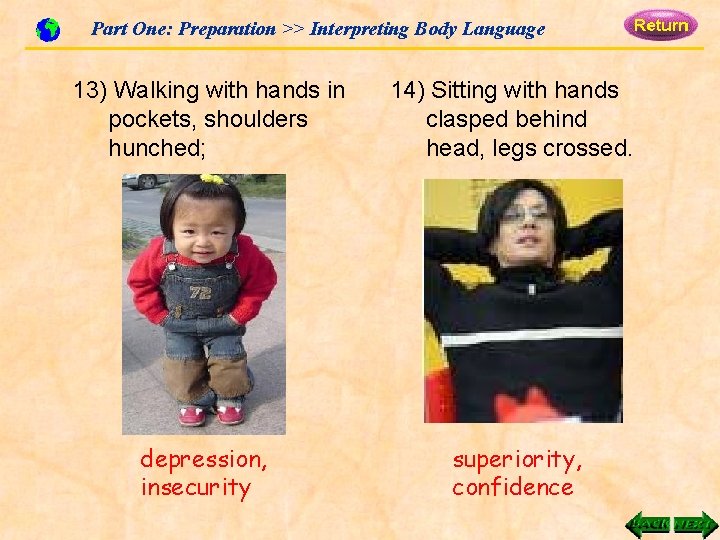
Part One: Preparation >> Interpreting Body Language 13) Walking with hands in pockets, shoulders hunched; 14) Sitting with hands clasped behind head, legs crossed. depression, insecurity superiority, confidence
Part One: Preparation >> Proverbs & Quotations 4. Proverbs & Quotations Words, as is well known, are the great foes of reality. —Joseph Conrad 众所周知,语言是现实最大的敌人。 ——约瑟夫·康拉德
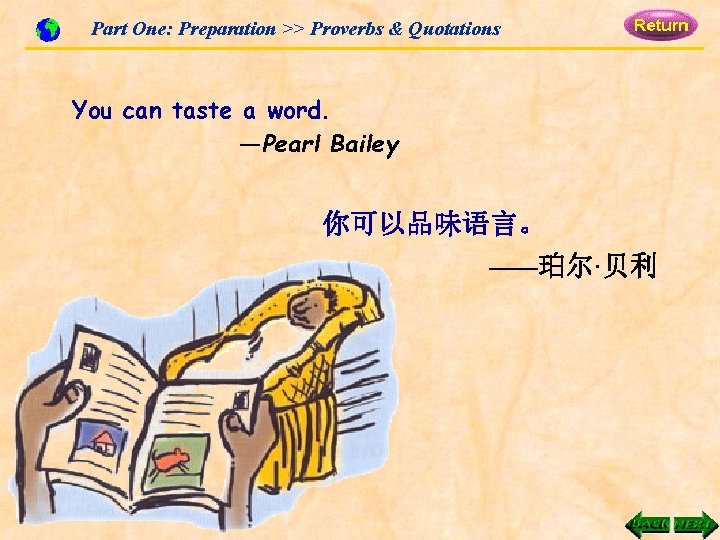
Part One: Preparation >> Proverbs & Quotations You can taste a word. —Pearl Bailey 你可以品味语言。 ——珀尔·贝利
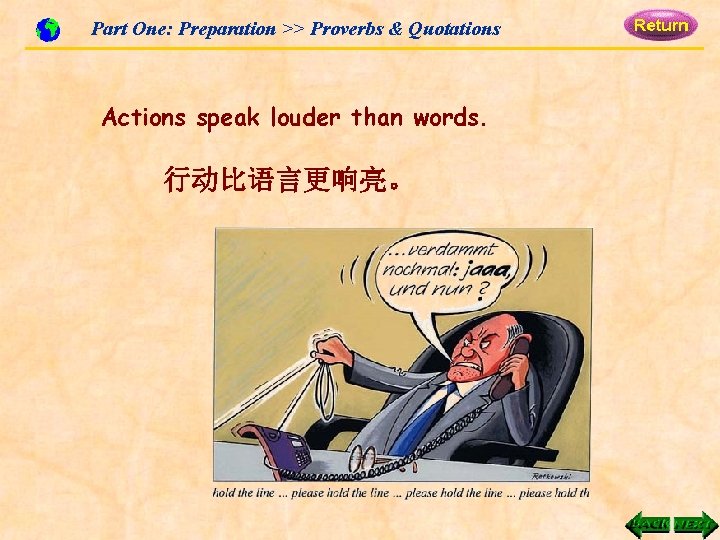
Part One: Preparation >> Proverbs & Quotations Actions speak louder than words. 行动比语言更响亮。
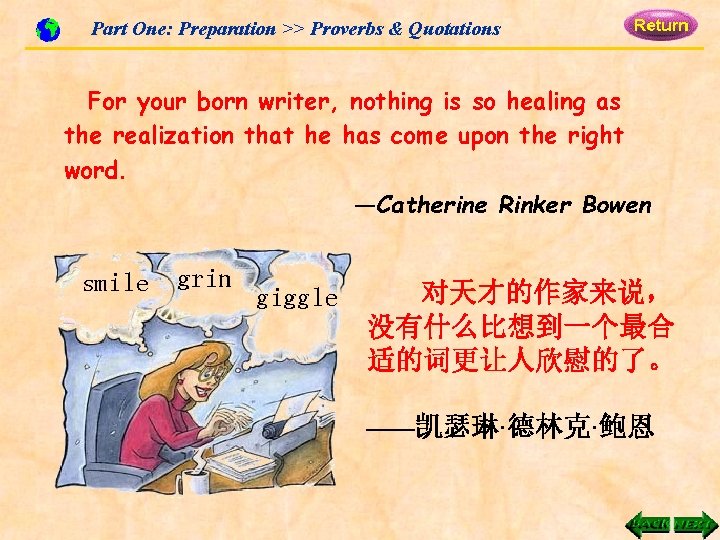
Part One: Preparation >> Proverbs & Quotations For your born writer, nothing is so healing as the realization that he has come upon the right word. —Catherine Rinker Bowen 对天才的作家来说, 没有什么比想到一个最合 适的词更让人欣慰的了。 ——凯瑟琳·德林克·鲍恩
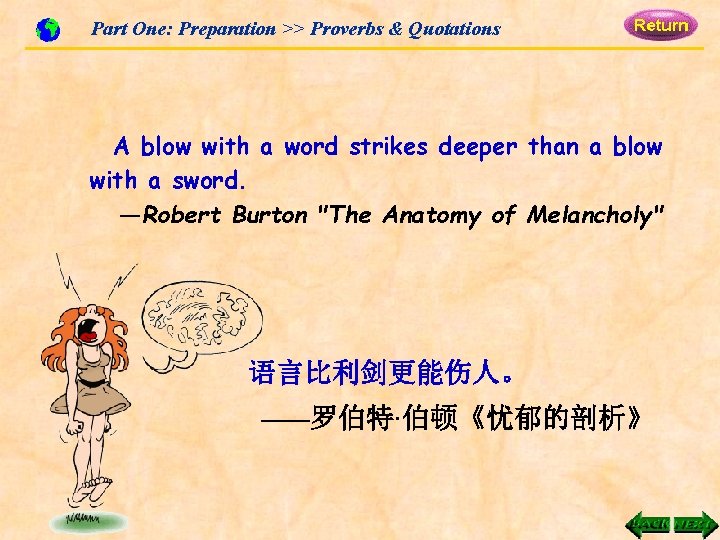
Part One: Preparation >> Proverbs & Quotations A blow with a word strikes deeper than a blow with a sword. —Robert Burton "The Anatomy of Melancholy" 语言比利剑更能伤人。 ——罗伯特·伯顿《忧郁的剖析》
Part One: Preparation >> Proverbs & Quotations A word is not a crystal, transparent and unchanged; it is the skin of a living thought, and may vary greatly in color and content according to the circumstances and the time in which it is used. —Oliver Wendell Holmes 词汇不是水晶,永远透明,永不改变。它是活 跃思维的皮肤,它的颜色和内容在不同的环境 和时间内发生着巨大的变化。 ——奥利弗·温德尔·霍姆 斯
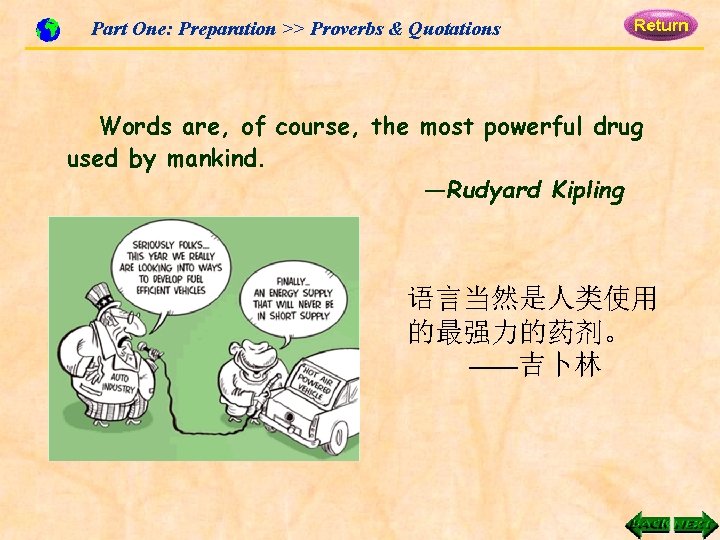
Part One: Preparation >> Proverbs & Quotations Words are, of course, the most powerful drug used by mankind. —Rudyard Kipling 语言当然是人类使用 的最强力的药剂。 ——吉卜林
Part One: Preparation >> Proverbs & Quotations Colors fade, temples crumble, empires fall, but wise words endure. —Edward Thorndike 色彩褪去,神殿坍塌,帝国 陨落,但是智慧的语言永存。 ——爱德华·桑代克
Part One: Preparation >> Proverbs & Quotations Words have a magical power. They can bring either the greatest happiness or deepest despair; can transfer knowledge from teacher to students. Words enable the orator to sway his audience and dictate its decisions. Words are capable of arousing the strongest emotions and prompting all man's actions. —Sigmund Freud 言辞具有不可思议的力量。它们能带来最大 的幸福,也能带来最深的失望。它们能把知识从 教师传给学生。言辞能使演说者左右他的听众, 并强行代替他们作出决定。言辞能激起最大强烈 的情感,促进人的一切行动。 ——西格蒙德·弗洛伊德
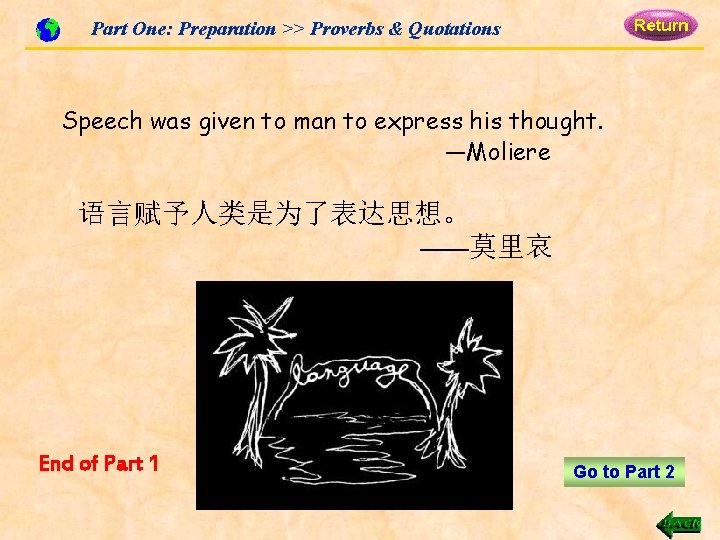
Part One: Preparation >> Proverbs & Quotations Speech was given to man to express his thought. —Moliere 语言赋予人类是为了表达思想。 ——莫里哀 End of Part 1 Go to Part 2