
Part One Introduction to Graphs Mathematics and Economics
- Slides: 65
Part One: Introduction to Graphs
Mathematics and Economics • In economics many relationships are represented graphically. • Following examples demonstrate the types of skills you will be required to know and use in introductory economics courses.
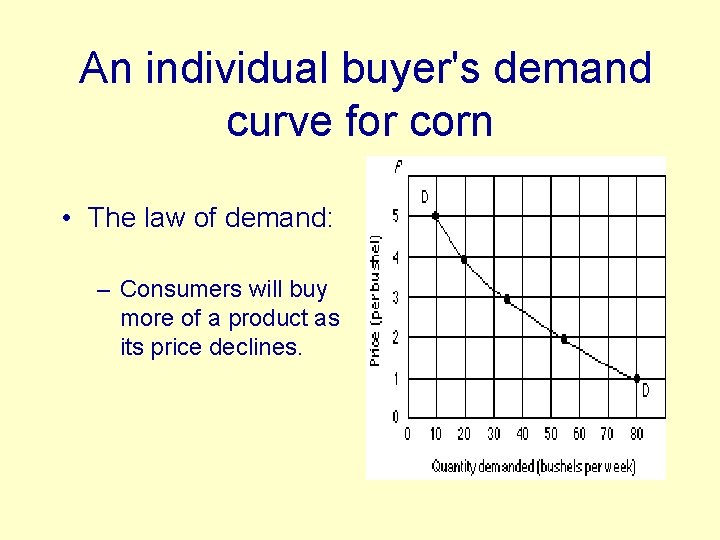
An individual buyer's demand curve for corn • The law of demand: – Consumers will buy more of a product as its price declines.
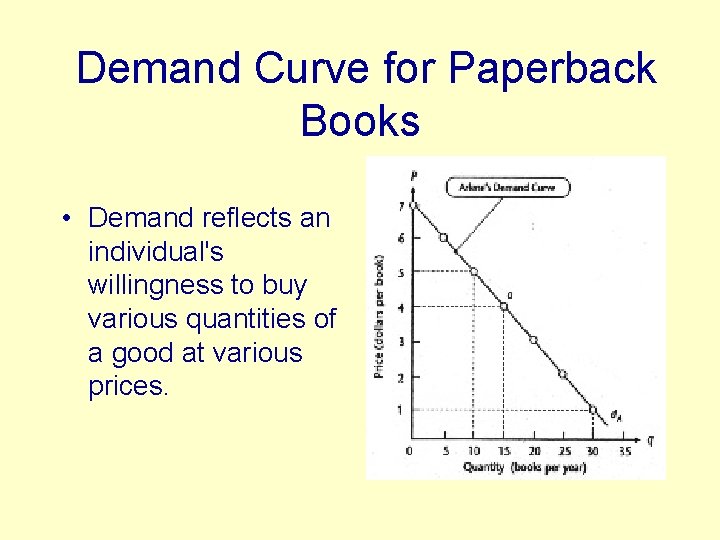
Demand Curve for Paperback Books • Demand reflects an individual's willingness to buy various quantities of a good at various prices.
The concepts you will learn in this section are: • • • Constant vs. variable. Dependent vs. independent variable. x and y axes. The origin on a graph. x and y coordinates of a point. Plot points on a graph.
Variables, Constants, and Their Relationships • After reviewing this unit, you will be able to: – Define the terms constant and variable. – Identify whether an item is a constant or a variable. – Identify whether an item is a dependent or independent variable
Variables and Constants • Characteristics or elements such as prices, outputs, income, etc. , are measured by numerical values. • The characteristic or element that remains the same is called a constant. • For example, the number of donuts in a dozen is a constant.
• Some of these values can vary. • The price of a dozen donuts can change from $2. 50 to $3. 00. • We call these characteristics or elements variables.
• Which of the following are variables and which are constants? – The temperature outside your house. – The number of square feet in a room that is 12 ft by 12 ft. – The noise level at a concert.
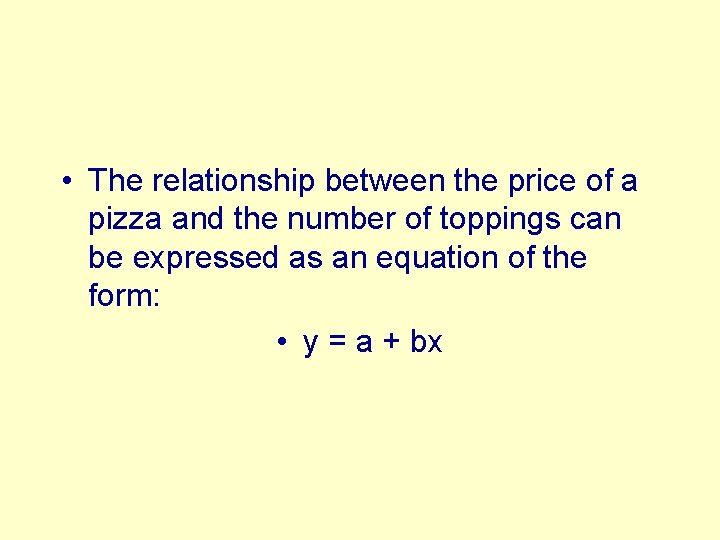
Relationships Between Variables • We express a relationship between two variables by stating the following: The value of the variable y depends upon the value of the variable x. • We can write the relationship between variables in an equation. • y = a + bx
• The equation also has an "a" and "b" in it. • These are constants that help define the relationship between the two variables.
• y = a + bx • In this equation the y variable is dependent on the values of x, a, and b. The y is the dependent variable. • The value of x, on the other hand, is independent of the values y, a, and b. The x is the independent variable.
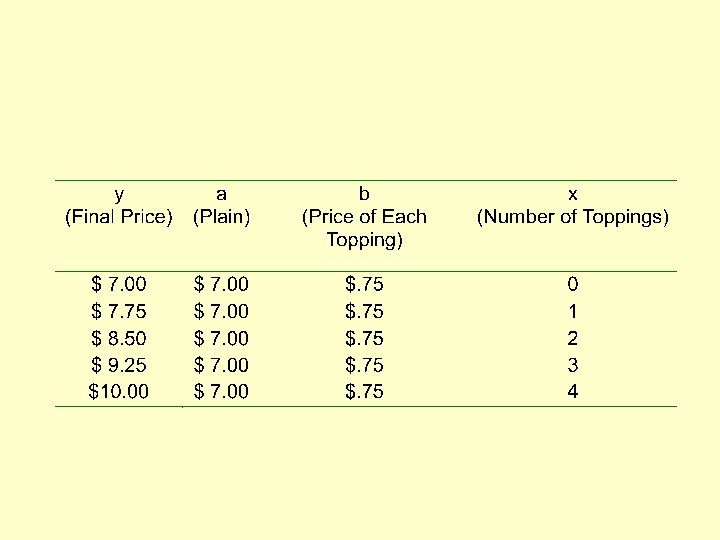
An Example. . . • A pizza shop charges 7 dollars for a plain pizza with no toppings and 75 cents for each additional topping added. • The total price of a pizza (y) depends upon the number of toppings (x) you order.
• Price of a pizza is a dependent variable and number of toppings is the independent variable. • Both the price and the number of toppings can change, therefore both are variables.
• The total price of the pizza also depends on the price of a plain pizza and the price per topping. • The price of a plain pizza and the price per topping do not change, therefore these are constants.
• The relationship between the price of a pizza and the number of toppings can be expressed as an equation of the form: • y = a + bx
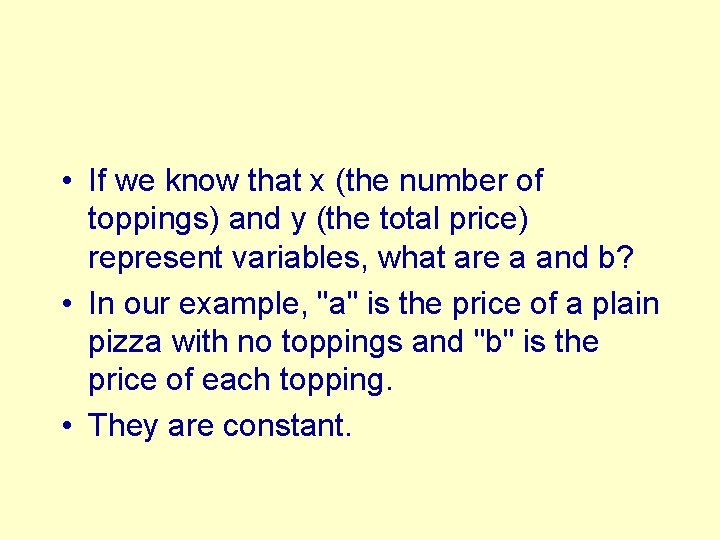
• If we know that x (the number of toppings) and y (the total price) represent variables, what are a and b? • In our example, "a" is the price of a plain pizza with no toppings and "b" is the price of each topping. • They are constant.
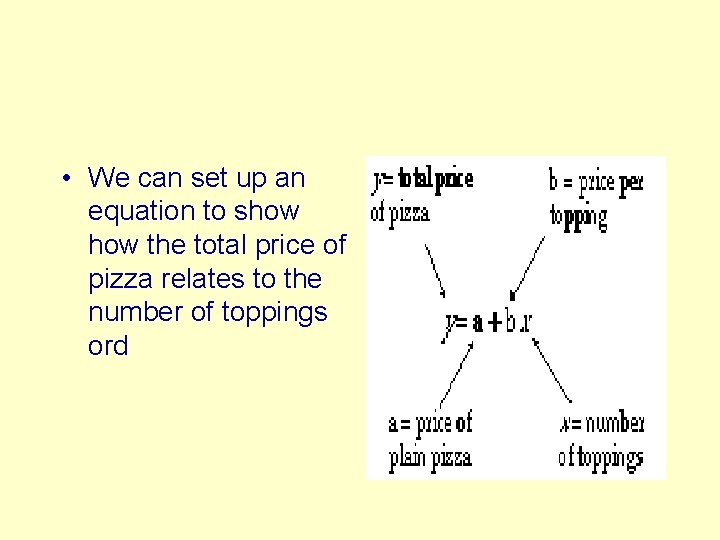
• We can set up an equation to show the total price of pizza relates to the number of toppings ord
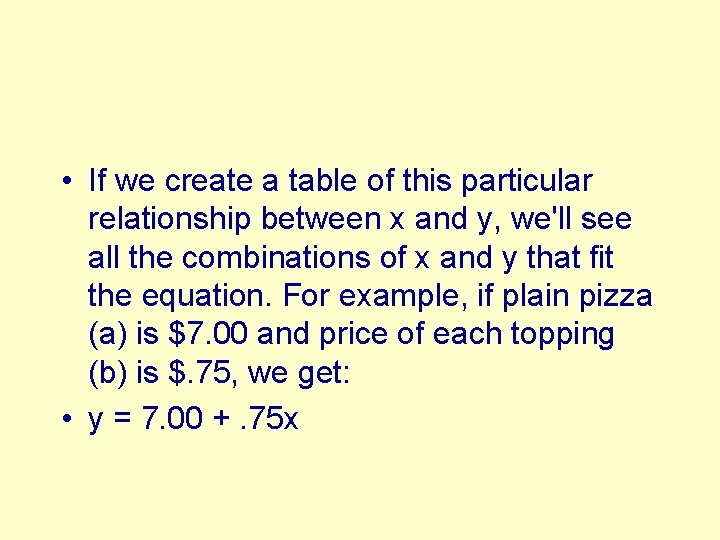
• If we create a table of this particular relationship between x and y, we'll see all the combinations of x and y that fit the equation. For example, if plain pizza (a) is $7. 00 and price of each topping (b) is $. 75, we get: • y = 7. 00 +. 75 x
Graphs • After reviewing this unit you will be able to: – Identify the x and y axes. – Identify the origin. on a graph. – Identify x and y coordinates of a point. – Plot points on a graph.
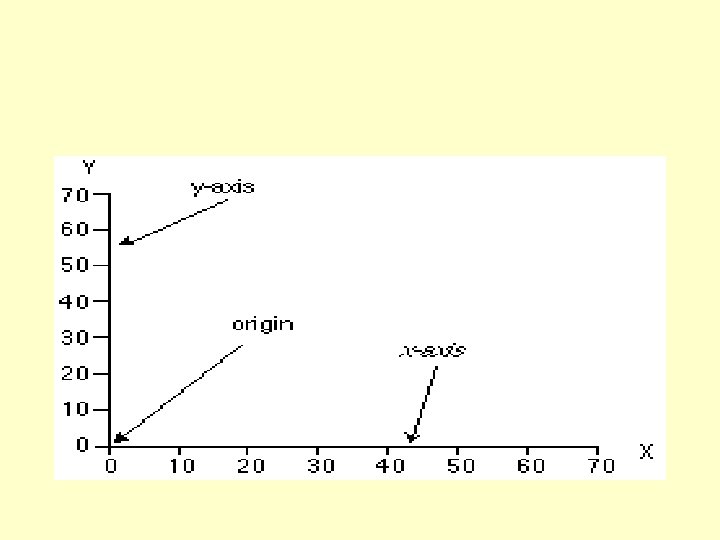
• A graph is a visual representation of a relationship between two variables, x and y. • A graph consists of two axes called the x (horizontal) and y (vertical) axes. • The point where the two axes intersect is called the origin. The origin is also identified as the point (0, 0).
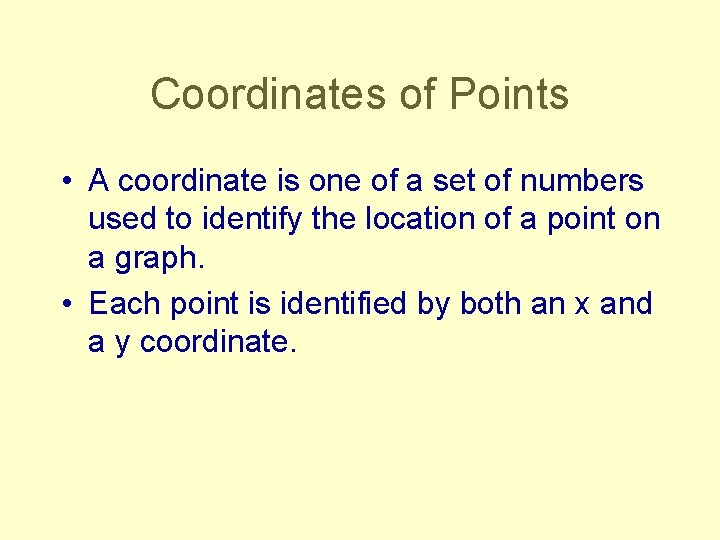
Coordinates of Points • A coordinate is one of a set of numbers used to identify the location of a point on a graph. • Each point is identified by both an x and a y coordinate.
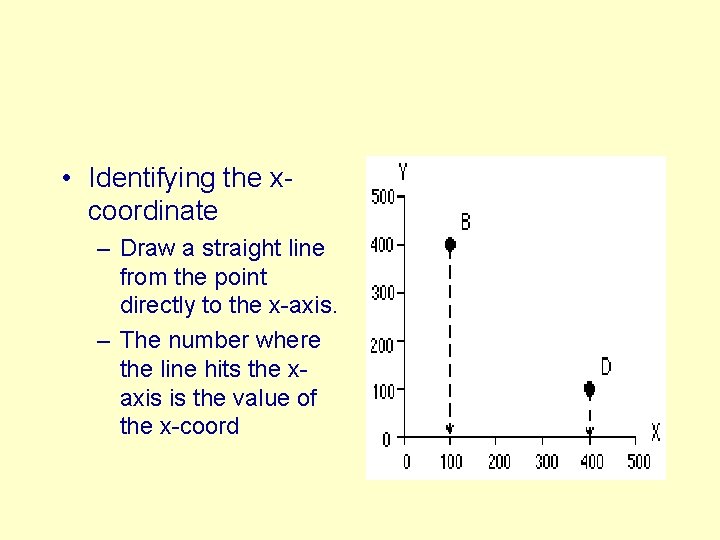
• Identifying the xcoordinate – Draw a straight line from the point directly to the x-axis. – The number where the line hits the xaxis is the value of the x-coord
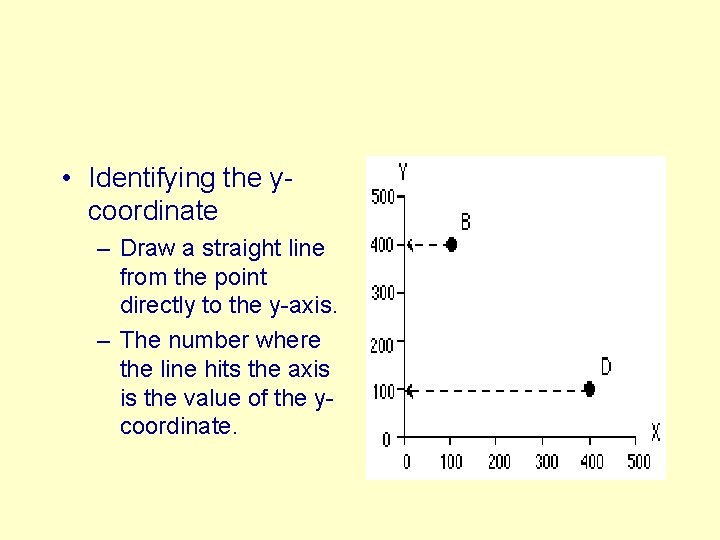
• Identifying the ycoordinate – Draw a straight line from the point directly to the y-axis. – The number where the line hits the axis is the value of the ycoordinate.
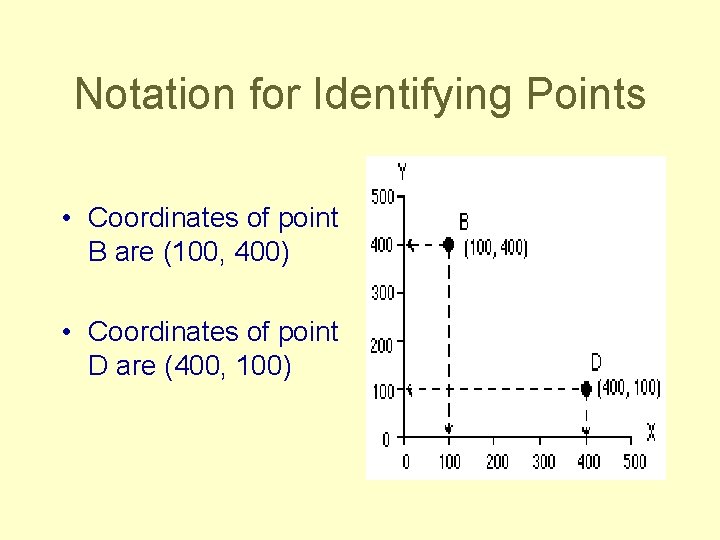
Notation for Identifying Points • Coordinates of point B are (100, 400) • Coordinates of point D are (400, 100)
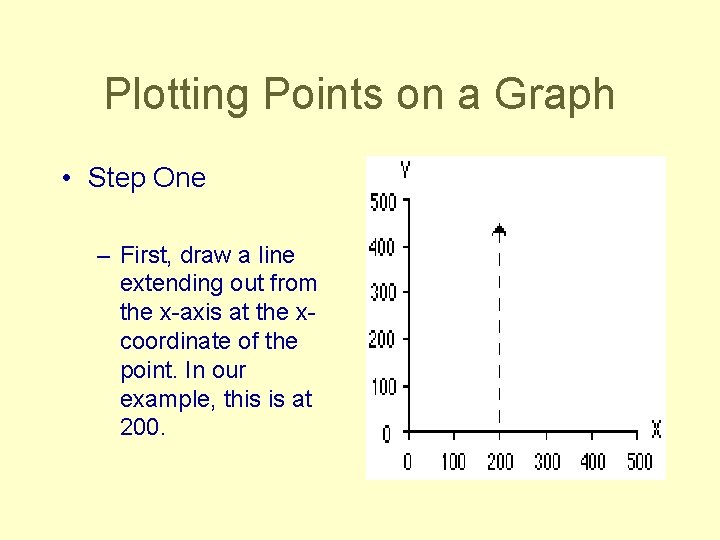
Plotting Points on a Graph • Step One – First, draw a line extending out from the x-axis at the xcoordinate of the point. In our example, this is at 200.
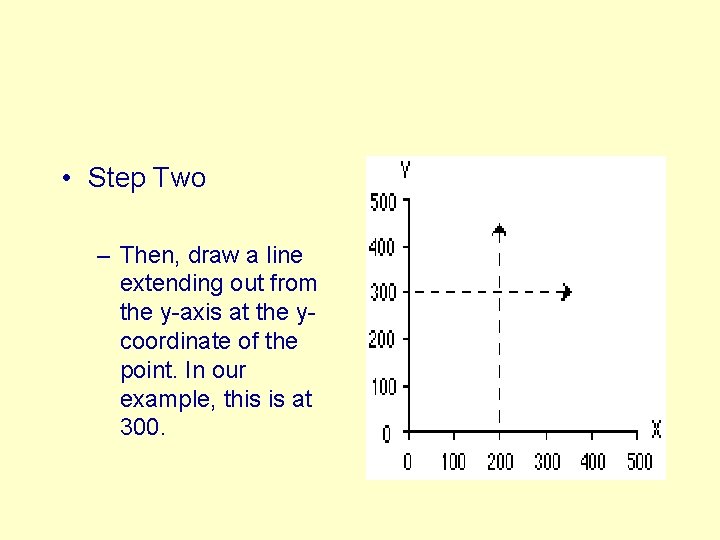
• Step Two – Then, draw a line extending out from the y-axis at the ycoordinate of the point. In our example, this is at 300.
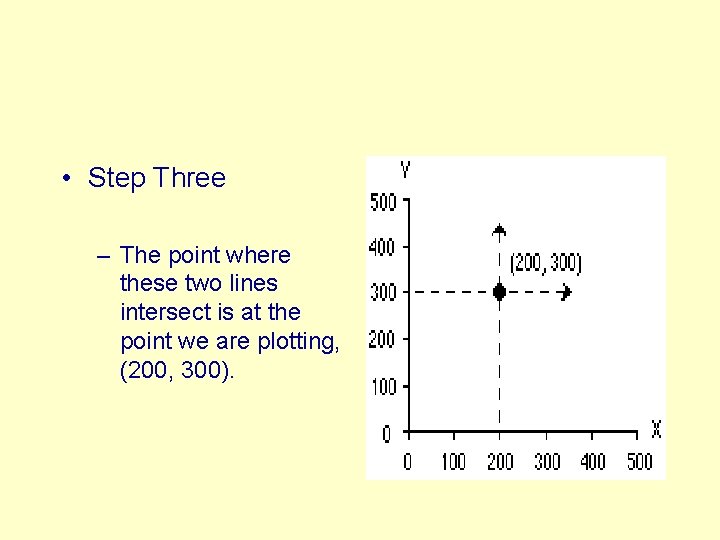
• Step Three – The point where these two lines intersect is at the point we are plotting, (200, 300).
Part Two: Equations and Graphs of Straight Lines
Economics and Linear Relationships • One of the most basic types of relationships is the linear relationship. • Many graphs in economics will display linear relationships, and you will need to use graphs to make interpretations about what is happening in a relationship.
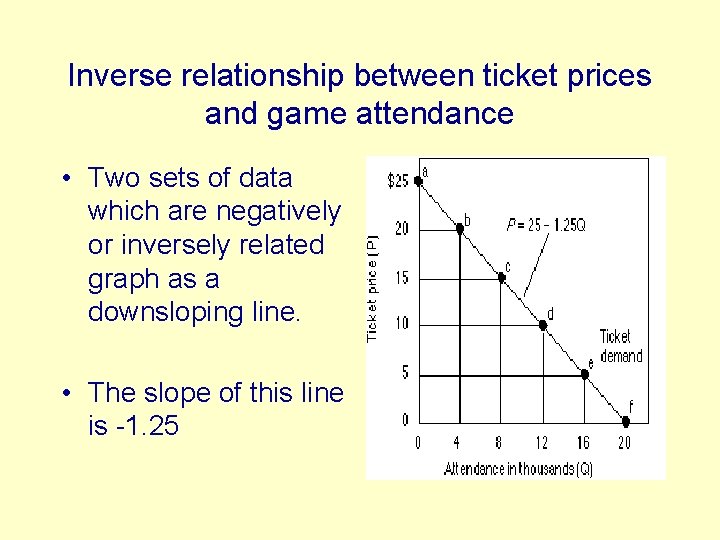
Inverse relationship between ticket prices and game attendance • Two sets of data which are negatively or inversely related graph as a downsloping line. • The slope of this line is -1. 25
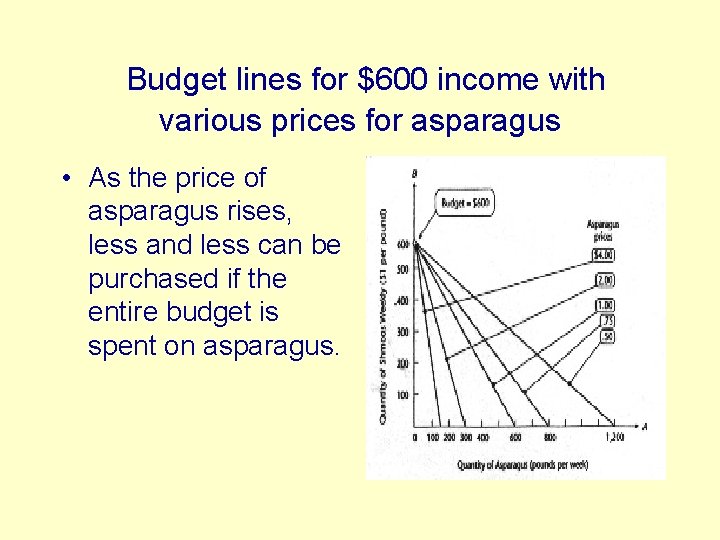
Budget lines for $600 income with various prices for asparagus • As the price of asparagus rises, less and less can be purchased if the entire budget is spent on asparagus.
You will learn in this section to. . . • Draw a graph from a given equation. • Determine whether a given point lies on the graph of a given equation. • Define slope. • Calculate the slope of a straight line from its graph.
• Be able to identify if a slope is positive, negative, zero, or infinite. • Identify the slope and y-intercept from the equation of a line. • Identify y-intercept from the graph of a line. • Match a graph with its equation.
Equations and Their Graphs • After reviewing this unit, you will be able to: – Draw a graph from a given equation. – Determine whether a given point lies on the graph of a given equation.
Graphing an Equation • Generate a list of points for the relationship. • Draw a set of axes and define the scale. • Plot the points on the axes. • Draw the line by connecting the points.
1. Generate a list of points for the relationship • In the pizza example, the equation is y = 7. 00 +. 75 x. • You first select values of x you will solve for. • You then substitute these values into the equation and solve for they values.
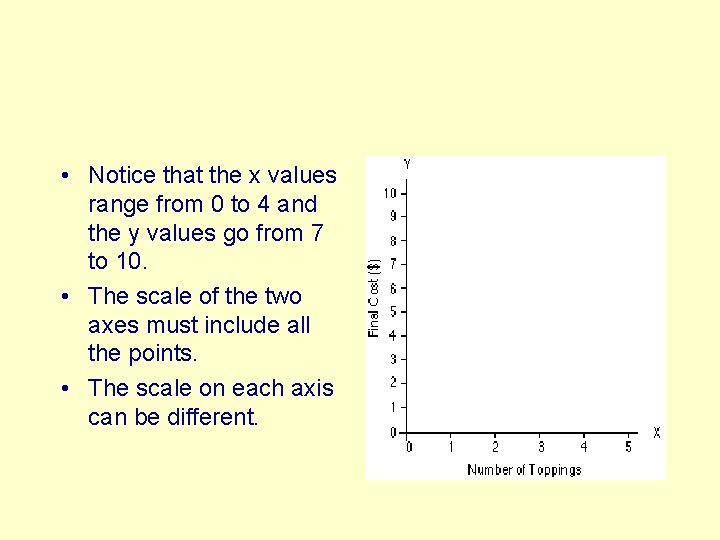
2. Draw a set of axes and define the scale • Once you have your list of points you are ready to plot them on a graph. • The first step in drawing the graph is setting up the axes and determining the scale. • The points you have to plot are: • (0, 7. 00), (1, 7. 75), (2, 8. 50), (3, 9. 25), (4, 10. 00)
• Notice that the x values range from 0 to 4 and the y values go from 7 to 10. • The scale of the two axes must include all the points. • The scale on each axis can be different.
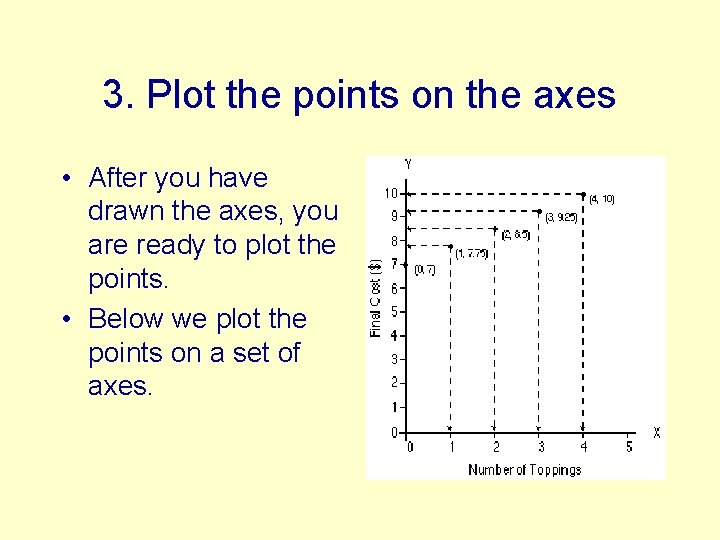
3. Plot the points on the axes • After you have drawn the axes, you are ready to plot the points. • Below we plot the points on a set of axes.
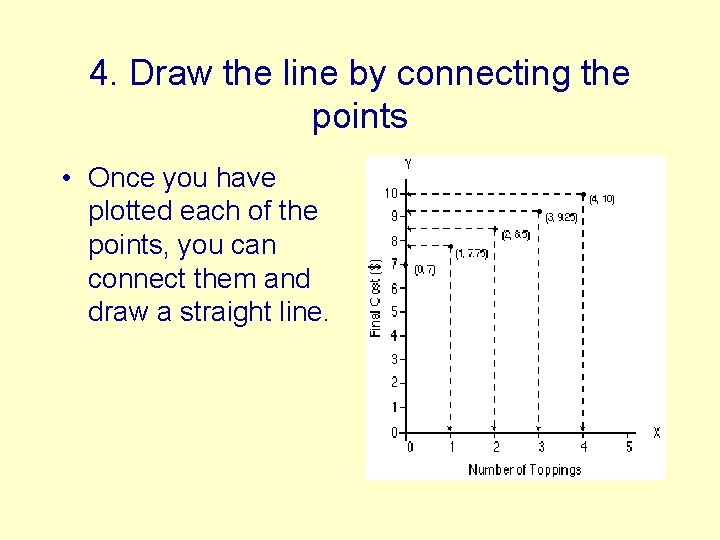
4. Draw the line by connecting the points • Once you have plotted each of the points, you can connect them and draw a straight line.
Checking a Point in the Equation • If, by chance, you have a point and you wish to determine if it lies on the line, you simply go through the same process as generating points. • Use the x value given in the point and insert it into the equation. • Compare the y value calculated with the one given in the point.
Example • Does point (6, 10) lie on the line y = 7. 00 +. 75 x given in our pizza example? • To determine this, we need to plug the point (6, 10) into the equation. • The point with an x value of 6 that does lie on the line is (6, 11. 5). • This means that the point (6, 10) does not lie on our line
Slope • After reviewing the unit you will be able to: – Define slope. – Calculate the slope of a straight line from its graph. – Identify if a slope is positive, negative, zero, or infinite. – Identify the slope and y-intercept from the equation of a line. – Identify the y-intercept from the graph of a line.
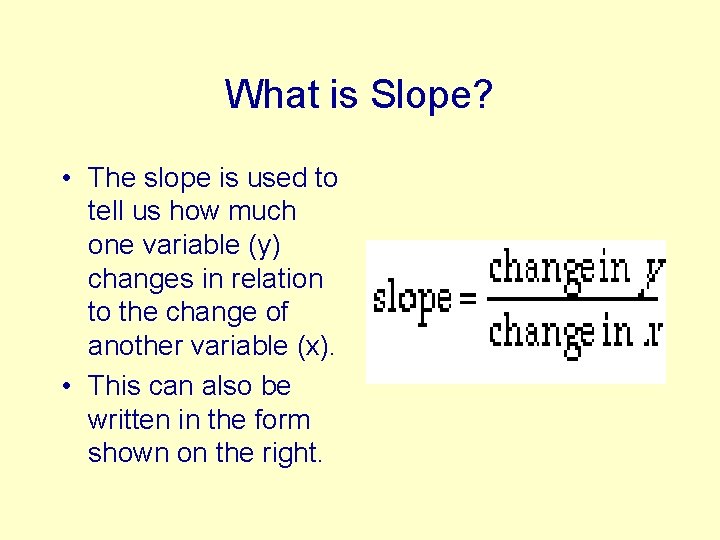
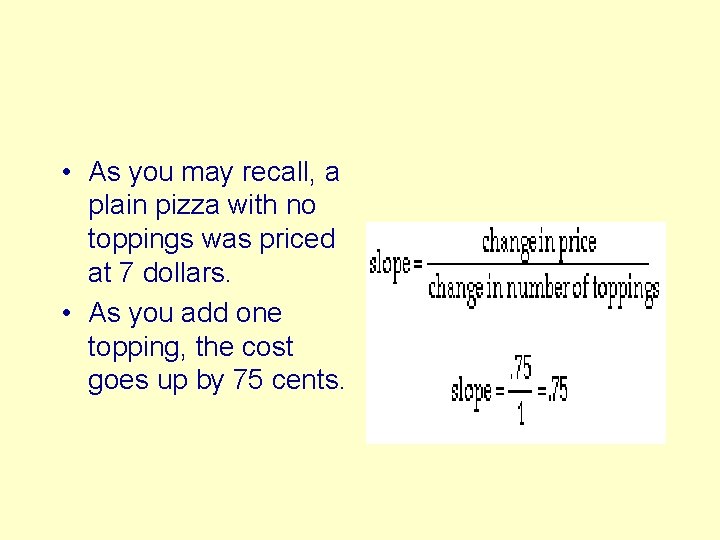
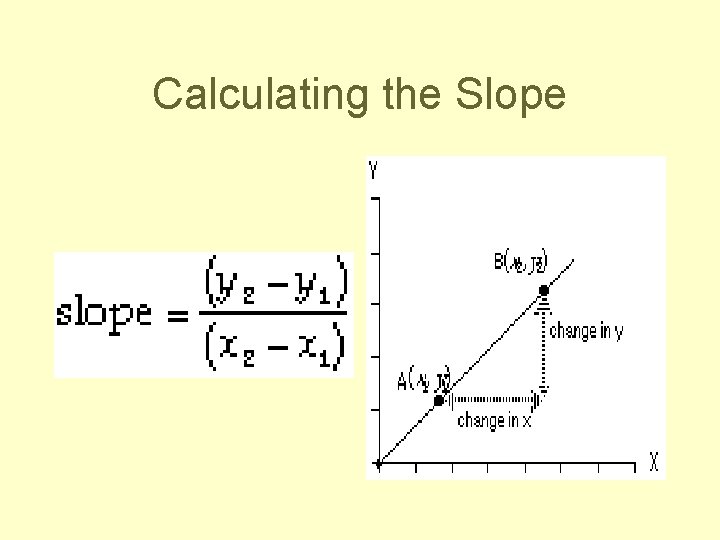
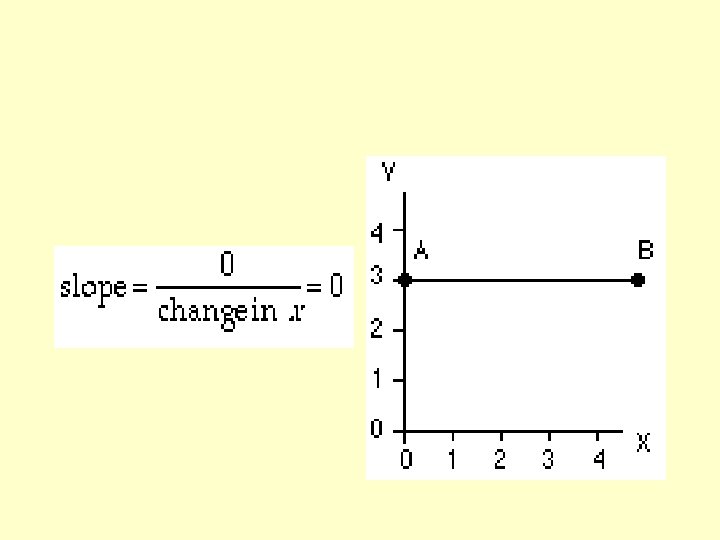
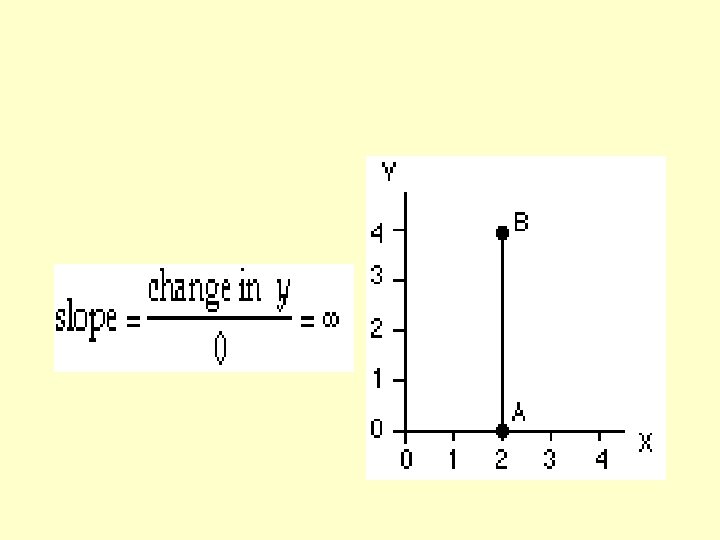
What is Slope? • The slope is used to tell us how much one variable (y) changes in relation to the change of another variable (x). • This can also be written in the form shown on the right.
• As you may recall, a plain pizza with no toppings was priced at 7 dollars. • As you add one topping, the cost goes up by 75 cents.
Calculating the Slope
Three steps in calculating the slope of a straight line • Step One: Identify two points on the line. • Step Two: Select one to be (x 1, y 1) and the other to be (x 2, y 2). • Step Three: Use the slope equation to calculate slope.
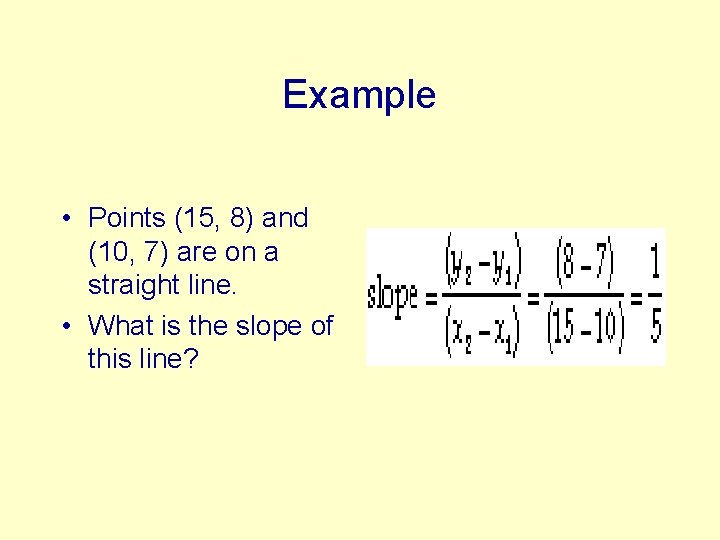
Example • Points (15, 8) and (10, 7) are on a straight line. • What is the slope of this line?
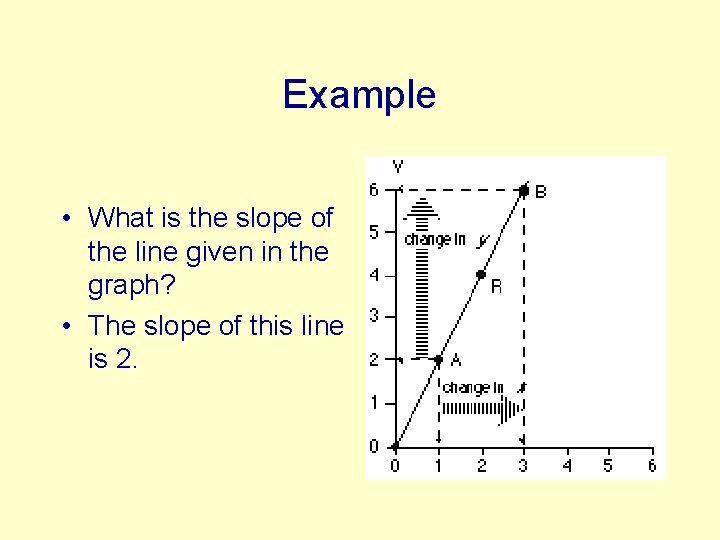
Example • What is the slope of the line given in the graph? • The slope of this line is 2.
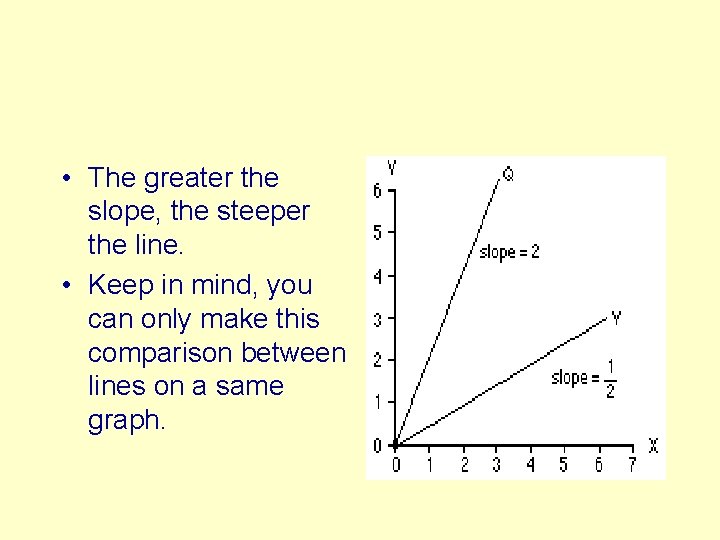
• The greater the slope, the steeper the line. • Keep in mind, you can only make this comparison between lines on a same graph.
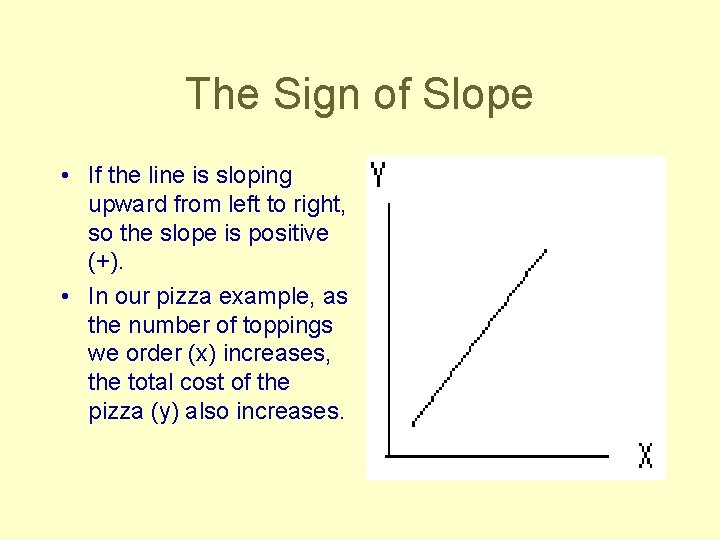
The Sign of Slope • If the line is sloping upward from left to right, so the slope is positive (+). • In our pizza example, as the number of toppings we order (x) increases, the total cost of the pizza (y) also increases.
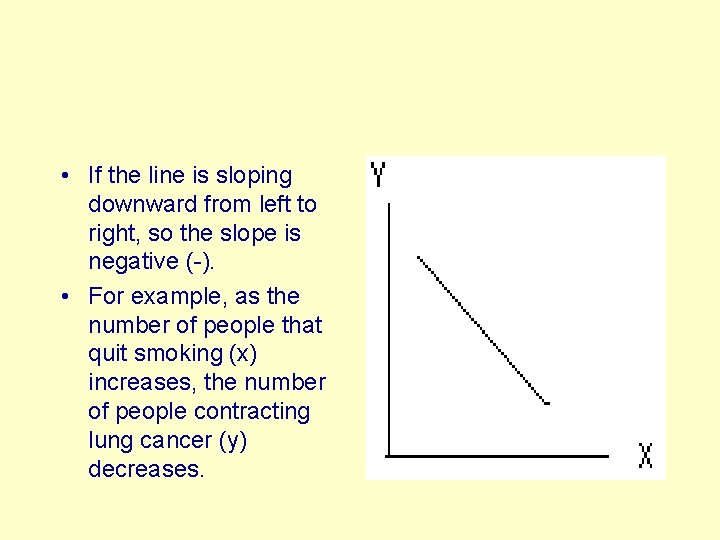
• If the line is sloping downward from left to right, so the slope is negative (-). • For example, as the number of people that quit smoking (x) increases, the number of people contracting lung cancer (y) decreases.
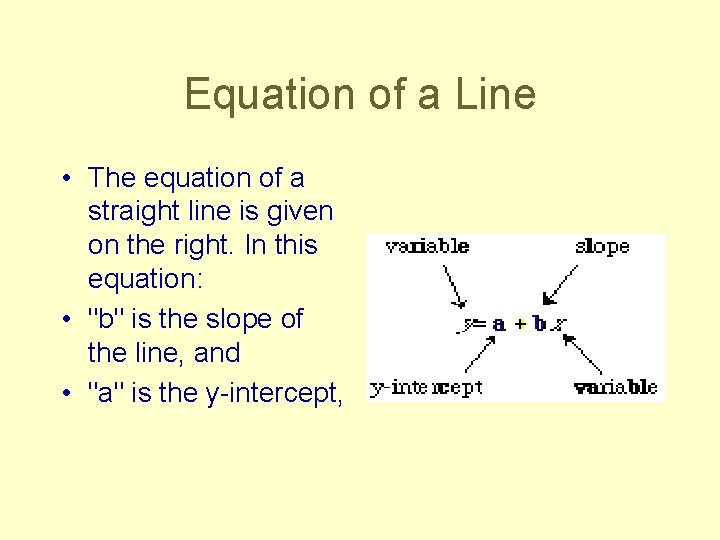
Equation of a Line • The equation of a straight line is given on the right. In this equation: • "b" is the slope of the line, and • "a" is the y-intercept,
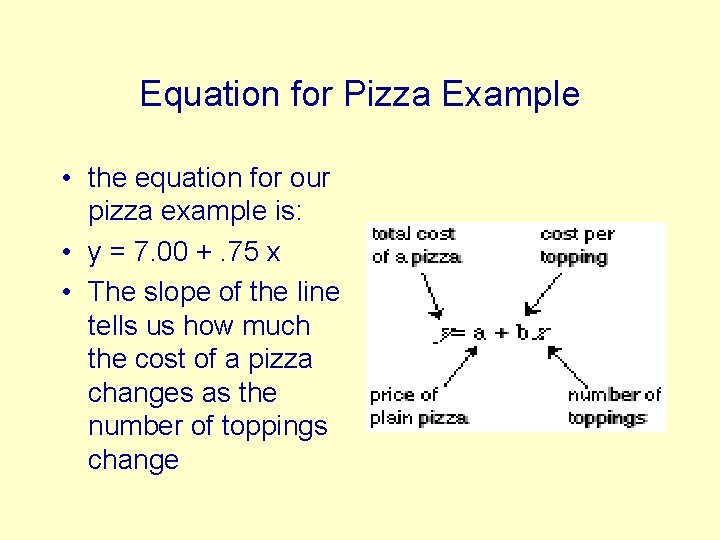
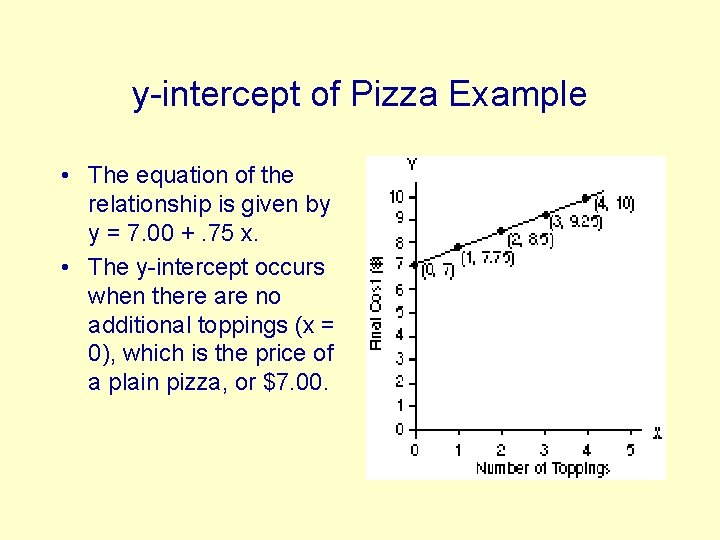
Equation for Pizza Example • the equation for our pizza example is: • y = 7. 00 +. 75 x • The slope of the line tells us how much the cost of a pizza changes as the number of toppings change
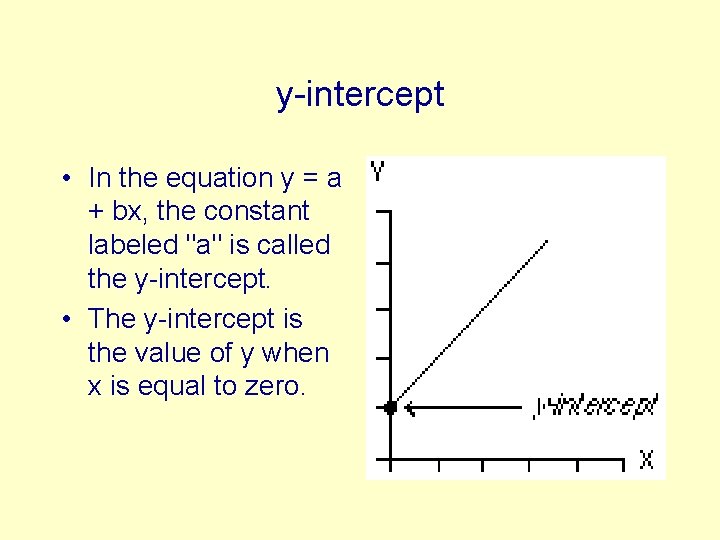
y-intercept • In the equation y = a + bx, the constant labeled "a" is called the y-intercept. • The y-intercept is the value of y when x is equal to zero.
y-intercept of Pizza Example • The equation of the relationship is given by y = 7. 00 +. 75 x. • The y-intercept occurs when there are no additional toppings (x = 0), which is the price of a plain pizza, or $7. 00.
Matching a Graph of a Straight Line with Its Equation • After reviewing this unit you will be able to: – Match a graph with its equation
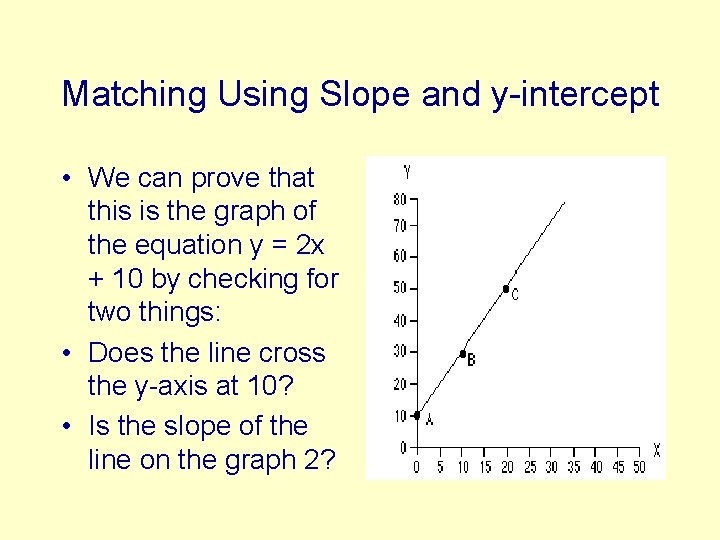
Matching Using Slope and y-intercept • We can prove that this is the graph of the equation y = 2 x + 10 by checking for two things: • Does the line cross the y-axis at 10? • Is the slope of the line on the graph 2?
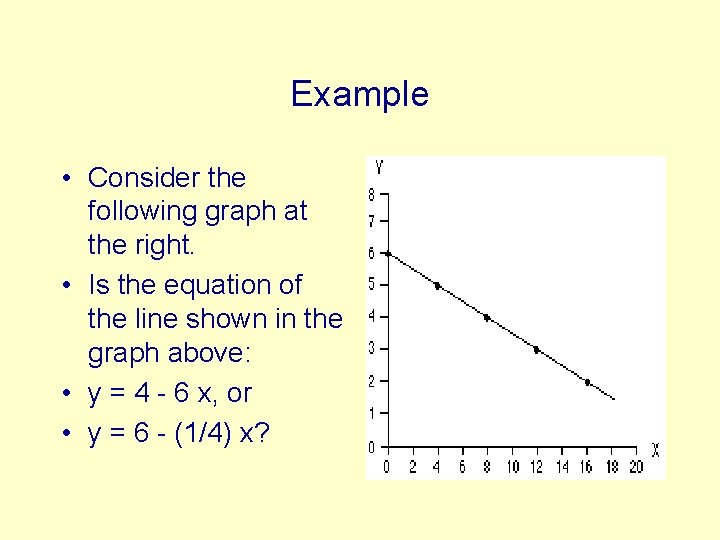
Example • Consider the following graph at the right. • Is the equation of the line shown in the graph above: • y = 4 - 6 x, or • y = 6 - (1/4) x?