
PART ONE Introduction to Ecommerce Chapter 1 The
- Slides: 32
PART ONE Introduction to E-commerce Chapter 1: The evolution of E-commerce Chapter 2: E-commerce business models and concepts Norton University Introduction to E-commerce 1
Chapter 1: The evolution of E-commerce Norton University Introduction to E-commerce 2
Learning Objectives - Define E-commerce and describe how it differs from E-business. - Identify and describe the unique features of E-commerce technology and discuss their business significance. - Describe the major types of E-commerce. - Discuss the origins and growth of E-commerce. - Understand the evolution of E-commerce from its early years to today. - Identify the factor that will define the future of E-commerce. - Describe the major themes underlying the study of E-commerce. to E-commerce Norton. University Identify the major. Introduction academic disciplines contributing 3 to
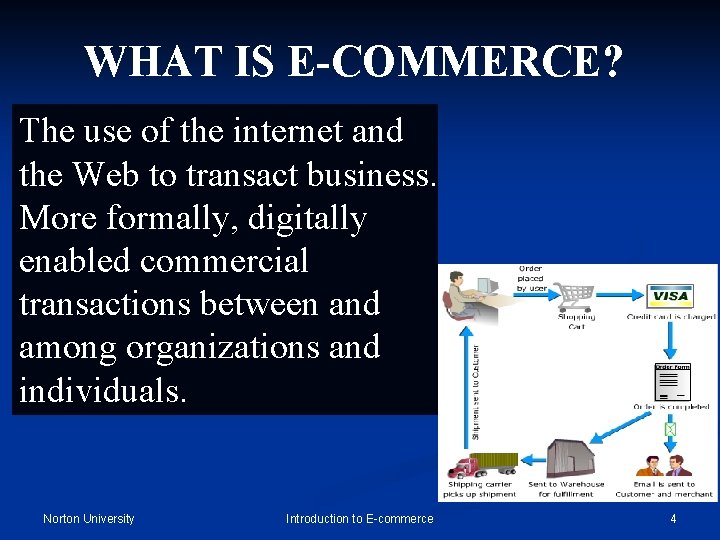
WHAT IS E-COMMERCE? The use of the internet and the Web to transact business. More formally, digitally enabled commercial transactions between and among organizations and individuals. Norton University Introduction to E-commerce 4
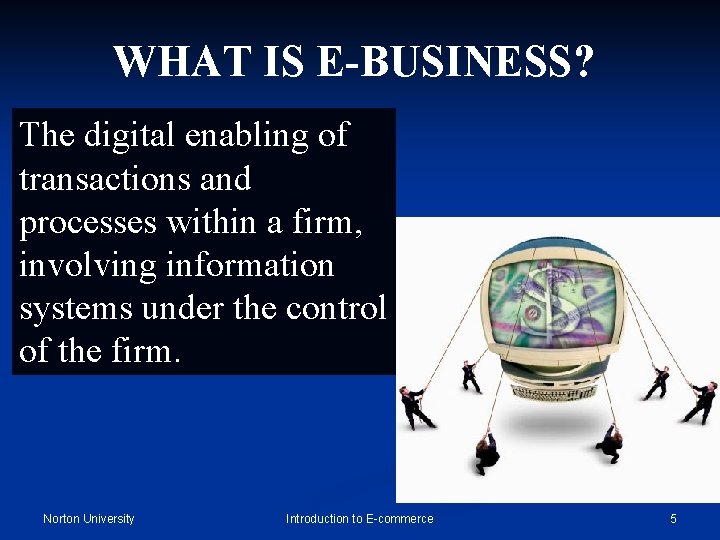
WHAT IS E-BUSINESS? The digital enabling of transactions and processes within a firm, involving information systems under the control of the firm. Norton University Introduction to E-commerce 5
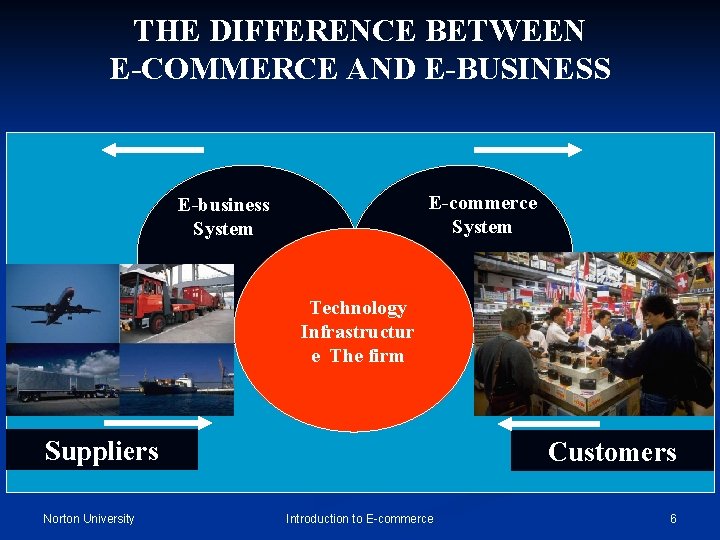
THE DIFFERENCE BETWEEN E-COMMERCE AND E-BUSINESS E-commerce System E-business System Technology Infrastructur e The firm Suppliers Norton University Customers Introduction to E-commerce 6
THE DIFFERENCE BETWEEN E-COMMERCE AND E-BUSINESS (Cont. ) E-commerce primarily involves transactions that cross firm boundaries. E-business primarily involves the application of digital technologies to business processes within the firm. Norton University Introduction to E-commerce 7
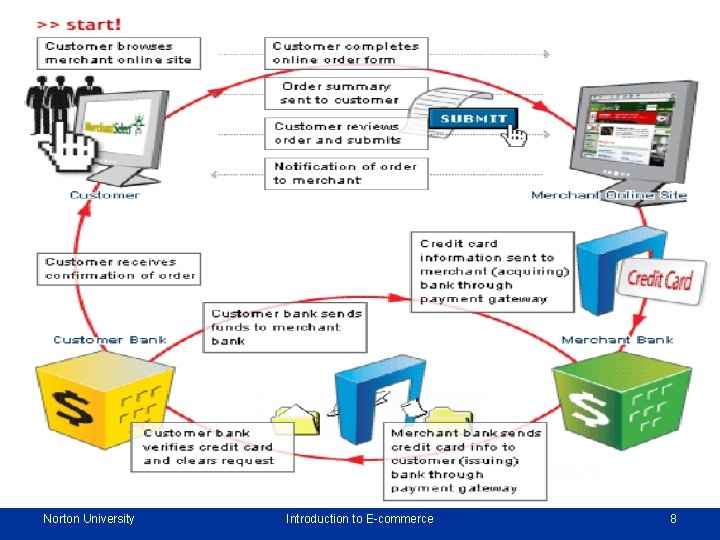
Norton University Introduction to E-commerce 8
WHY STUDY E-COMMERCE? * To understand the differentiation of technology which more powerful than any of the other technologies we have seen in the past century. * To understand the digital markets, fundamental, unprecedented shifts in commerce. * To understand the Information Asymmetry. Norton University Introduction to E-commerce 9
WHY STUDY E-COMMERCE? (Cont. ) Information Asymmetry refers to any disparity in relevant market information among parties in a transaction. (Prices, Costs, Fees and Profitable) Norton University Introduction to E-commerce 10
Eight Unique Features of E-commerce Technology 1 - Ubiquity: Available just about everywhere, at all times, making it possible to shop from your desktop, at home, at work, or even from your car. 2 - Global reach: Permit commercial transactions to cross cultural and national boundaries far more conveniently and cost-effectively that is true in traditional commerce. Norton University Introduction to E-commerce 11
Eight Unique Features of E-commerce Technology (Cont. ) 3 - Universal standards: Shard by all nations around the world. In contrast, most traditional commerce technologies differ from one nation to the next. 4 - Richness: Refers to the complexity and content of a message. It enables an online merchant to deliver marketing message with text, video, and audio to an audience of millions, in a way not possible with traditional commerce technologies such as radio, television, or magazines. Norton University Introduction to E-commerce 12
Eight Unique Features of E-commerce Technology (Cont. ) 5 - Interactivity: Allows for two-way communication between merchant and consumer and enabling the merchant to engage a consumer in ways similar to a face-to-face experience, but on a much more massive, global scale. 6 - Information density: Is the total amount and quality of information available to all market participants. The internet reduces information collection, storage, processing, and communication cost while increasing the currency, accuracy and timeliness of information. Norton University Introduction to E-commerce 13
Eight Unique Features of E-commerce Technology (Cont. ) 7 - Personalization and Customization: Merchant can target their marketing messages to specific individuals by adjusting the message to a person’s name, interest, and past purchase. The result is a level of personalization and customization unthinkable with existing commerce technologies. 8 - Social technology: Provides a many-to-many model of mass communications. Millions of users are able to generate content consumed by millions of other users. The result is the formation of social networks on a wide scale and the aggregation of large audiences on social network platforms. Norton University Introduction to E-commerce 14
Major Types of Ecommerce B 2 C: Business-to-Consumer B 2 B: Business-to-Business C 2 C: Consumer-to-Consumer P 2 P: Peer-to-Peer M-commerce: Mobile commerce Norton University Introduction to E-commerce 15
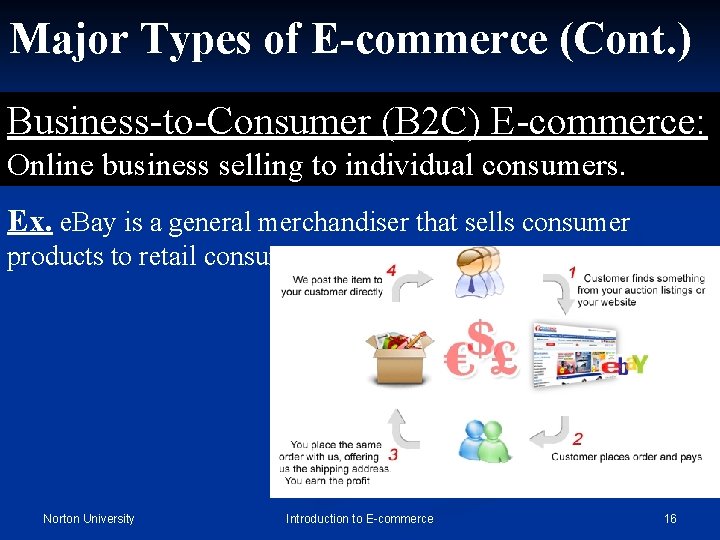
Major Types of E-commerce (Cont. ) Business-to-Consumer (B 2 C) E-commerce: Online business selling to individual consumers. Ex. e. Bay is a general merchandiser that sells consumer products to retail consumers. Norton University Introduction to E-commerce 16
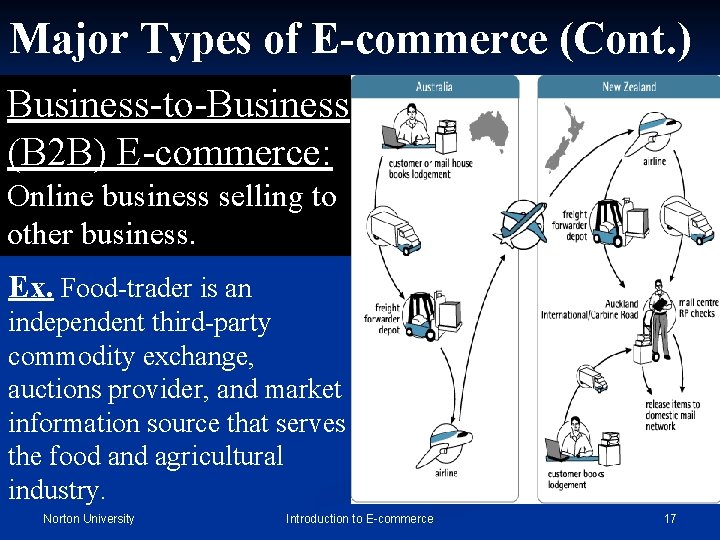
Major Types of E-commerce (Cont. ) Business-to-Business (B 2 B) E-commerce: Online business selling to other business. Ex. Food-trader is an independent third-party commodity exchange, auctions provider, and market information source that serves the food and agricultural industry. Norton University Introduction to E-commerce 17
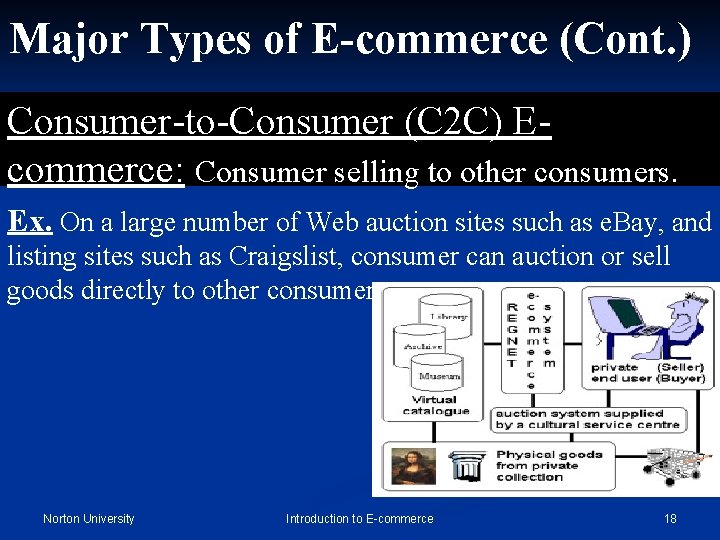
Major Types of E-commerce (Cont. ) Consumer-to-Consumer (C 2 C) Ecommerce: Consumer selling to other consumers. Ex. On a large number of Web auction sites such as e. Bay, and listing sites such as Craigslist, consumer can auction or sell goods directly to other consumers. Norton University Introduction to E-commerce 18
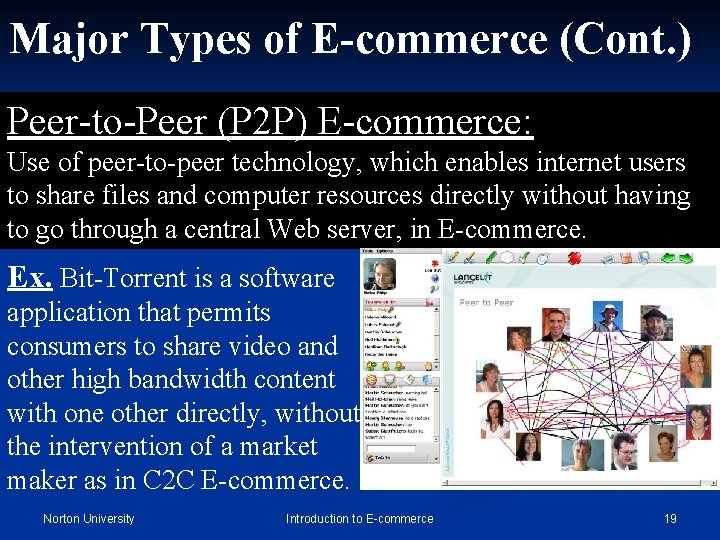
Major Types of E-commerce (Cont. ) Peer-to-Peer (P 2 P) E-commerce: Use of peer-to-peer technology, which enables internet users to share files and computer resources directly without having to go through a central Web server, in E-commerce. Ex. Bit-Torrent is a software application that permits consumers to share video and other high bandwidth content with one other directly, without the intervention of a market maker as in C 2 C E-commerce. Norton University Introduction to E-commerce 19
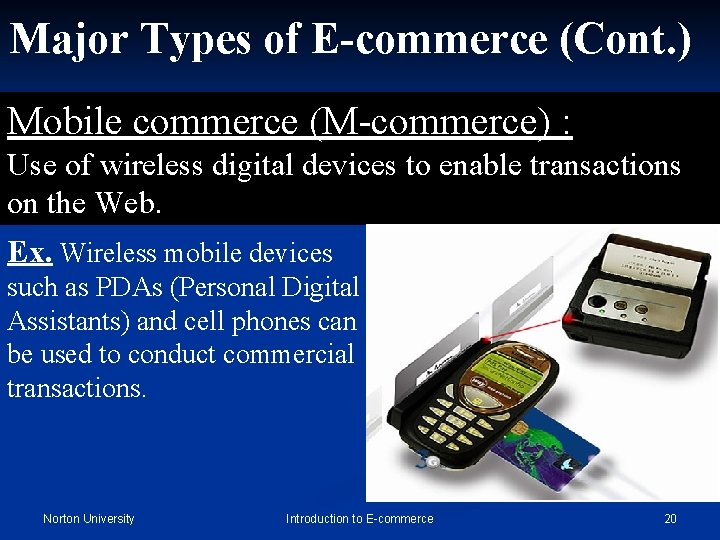
Major Types of E-commerce (Cont. ) Mobile commerce (M-commerce) : Use of wireless digital devices to enable transactions on the Web. Ex. Wireless mobile devices such as PDAs (Personal Digital Assistants) and cell phones can be used to conduct commercial transactions. Norton University Introduction to E-commerce 20
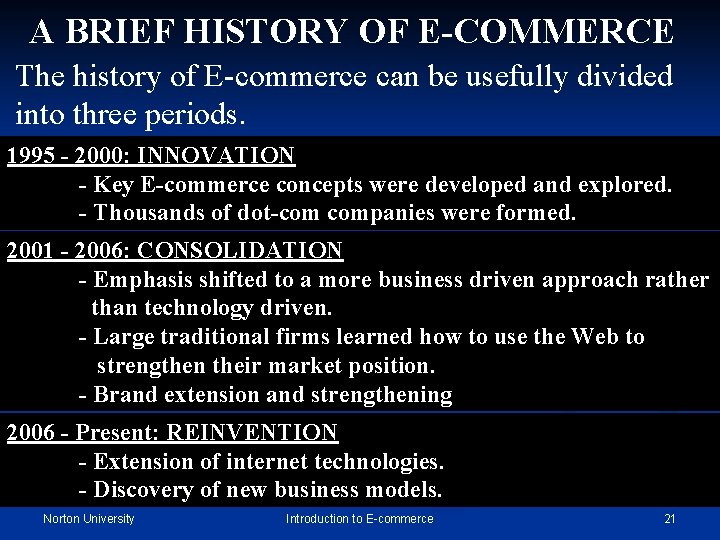
A BRIEF HISTORY OF E-COMMERCE The history of E-commerce can be usefully divided into three periods. 1995 - 2000: INNOVATION - Key E-commerce concepts were developed and explored. - Thousands of dot-com companies were formed. 2001 - 2006: CONSOLIDATION - Emphasis shifted to a more business driven approach rather than technology driven. - Large traditional firms learned how to use the Web to strengthen their market position. - Brand extension and strengthening 2006 - Present: REINVENTION - Extension of internet technologies. - Discovery of new business models. Norton University Introduction to E-commerce 21
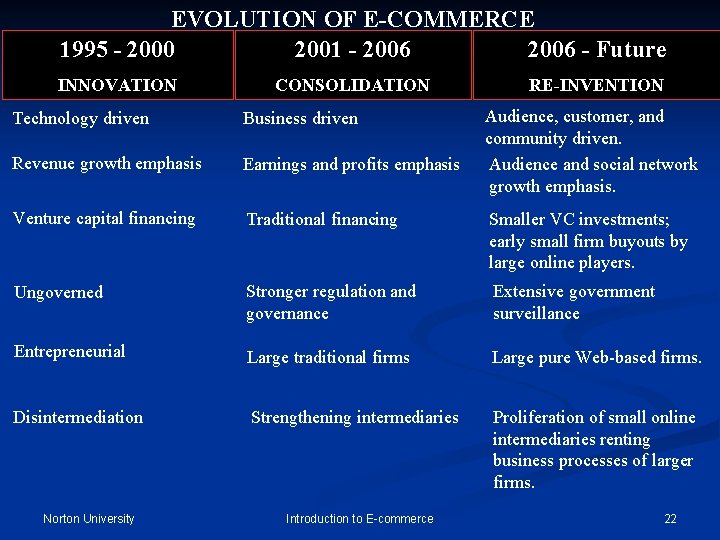
EVOLUTION OF E-COMMERCE 1995 - 2000 2001 - 2006 - Future INNOVATION CONSOLIDATION RE-INVENTION Audience, customer, and community driven. Audience and social network growth emphasis. Technology driven Business driven Revenue growth emphasis Earnings and profits emphasis Venture capital financing Traditional financing Smaller VC investments; early small firm buyouts by large online players. Ungoverned Stronger regulation and governance Extensive government surveillance Entrepreneurial Large traditional firms Large pure Web-based firms. Disintermediation Strengthening intermediaries Proliferation of small online intermediaries renting business processes of larger firms. Norton University Introduction to E-commerce 22
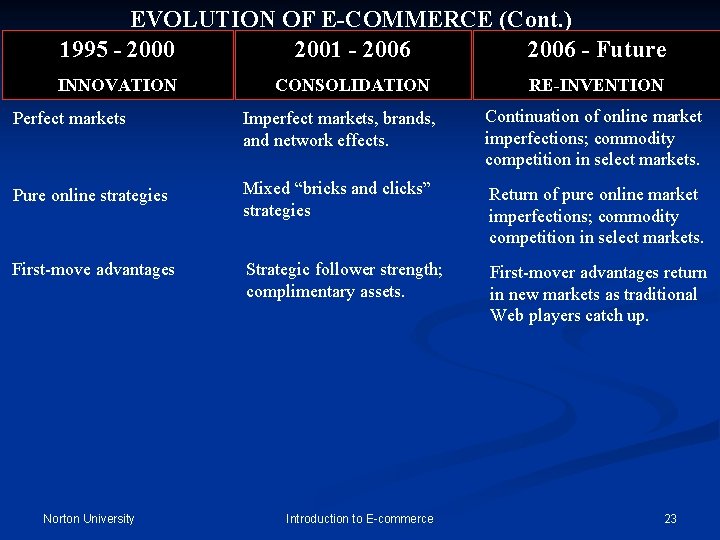
EVOLUTION OF E-COMMERCE (Cont. ) 1995 - 2000 2001 - 2006 - Future INNOVATION CONSOLIDATION RE-INVENTION Perfect markets Imperfect markets, brands, and network effects. Continuation of online market imperfections; commodity competition in select markets. Pure online strategies Mixed “bricks and clicks” strategies Return of pure online market imperfections; commodity competition in select markets. First-move advantages Strategic follower strength; complimentary assets. First-mover advantages return in new markets as traditional Web players catch up. Norton University Introduction to E-commerce 23
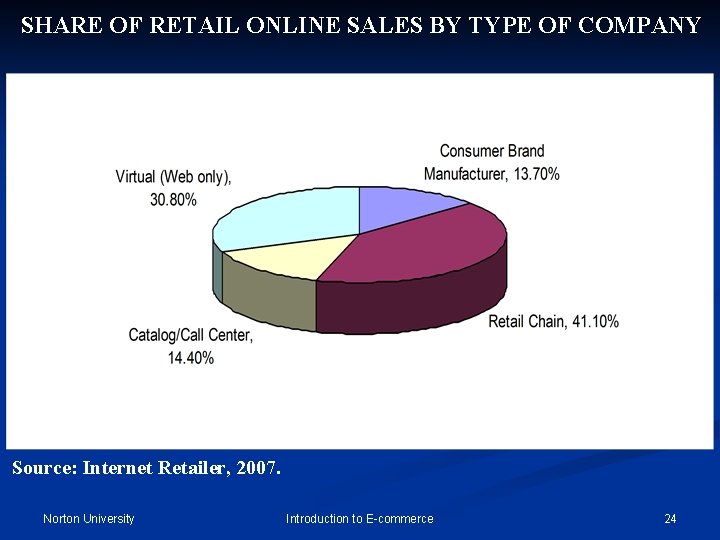
SHARE OF RETAIL ONLINE SALES BY TYPE OF COMPANY Source: Internet Retailer, 2007. Norton University Introduction to E-commerce 24
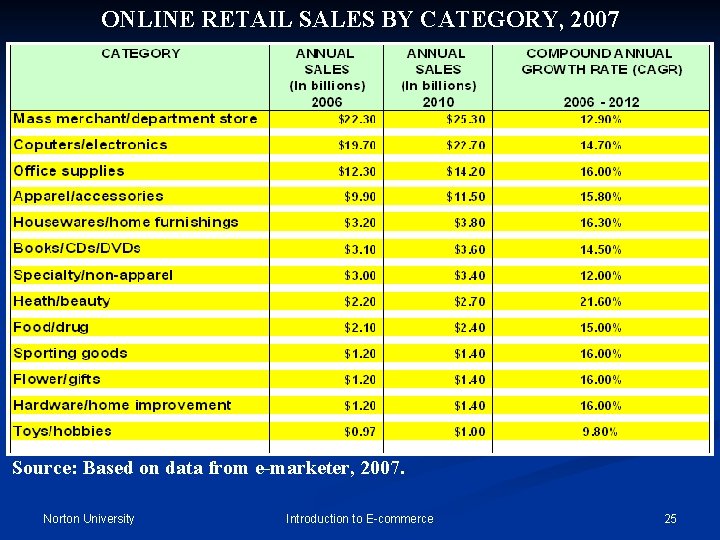
ONLINE RETAIL SALES BY CATEGORY, 2007 Source: Based on data from e-marketer, 2007. Norton University Introduction to E-commerce 25
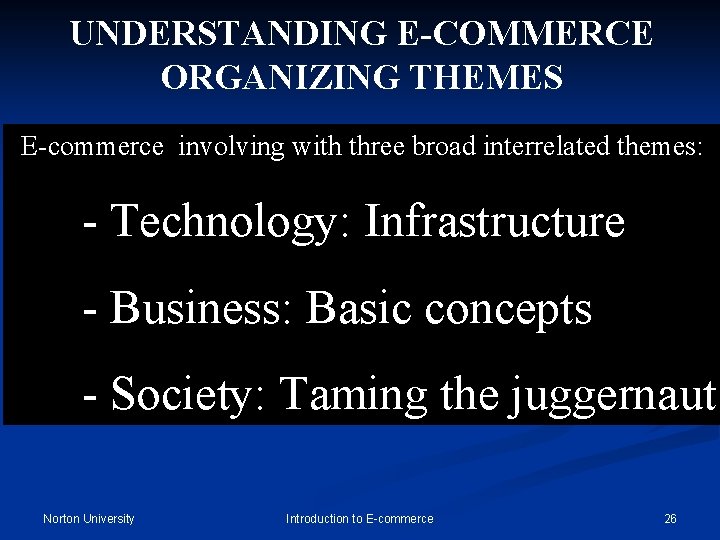
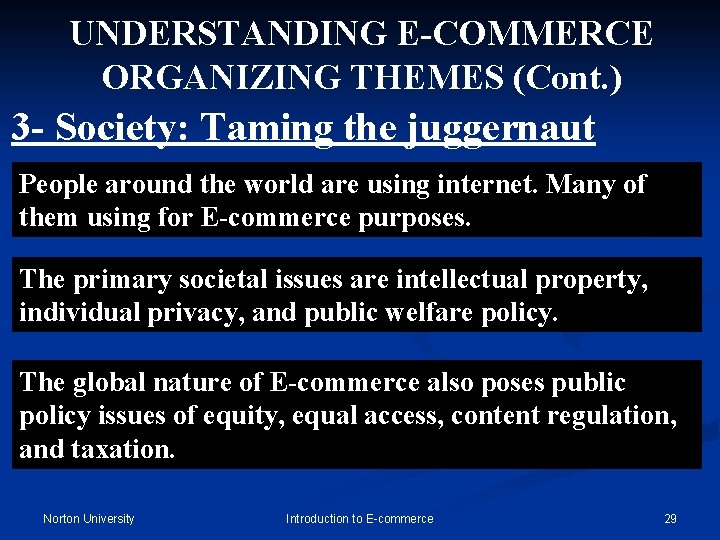
UNDERSTANDING E-COMMERCE ORGANIZING THEMES E-commerce involving with three broad interrelated themes: - Technology: Infrastructure - Business: Basic concepts - Society: Taming the juggernaut Norton University Introduction to E-commerce 26
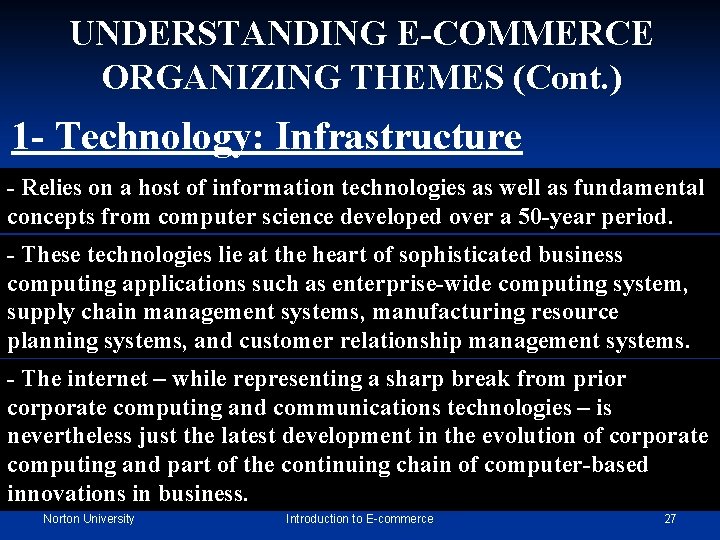
UNDERSTANDING E-COMMERCE ORGANIZING THEMES (Cont. ) 1 - Technology: Infrastructure - Relies on a host of information technologies as well as fundamental concepts from computer science developed over a 50 -year period. - These technologies lie at the heart of sophisticated business computing applications such as enterprise-wide computing system, supply chain management systems, manufacturing resource planning systems, and customer relationship management systems. - The internet – while representing a sharp break from prior corporate computing and communications technologies – is nevertheless just the latest development in the evolution of corporate computing and part of the continuing chain of computer-based innovations in business. Norton University Introduction to E-commerce 27
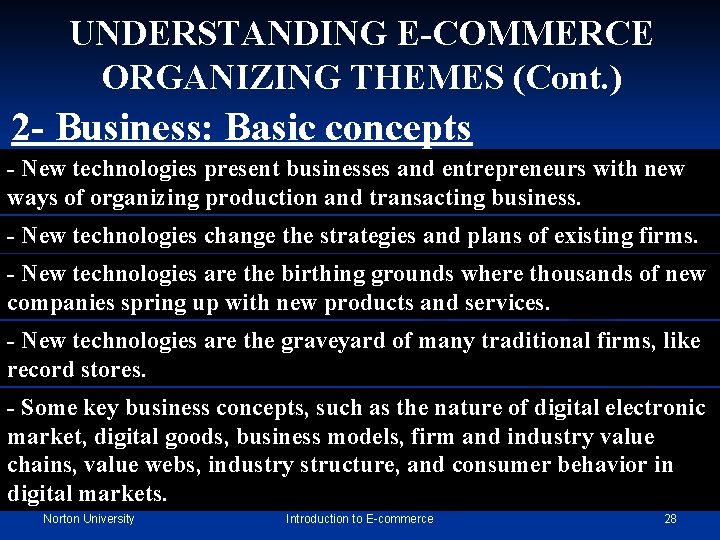
UNDERSTANDING E-COMMERCE ORGANIZING THEMES (Cont. ) 2 - Business: Basic concepts - New technologies present businesses and entrepreneurs with new ways of organizing production and transacting business. - New technologies change the strategies and plans of existing firms. - New technologies are the birthing grounds where thousands of new companies spring up with new products and services. - New technologies are the graveyard of many traditional firms, like record stores. - Some key business concepts, such as the nature of digital electronic market, digital goods, business models, firm and industry value chains, value webs, industry structure, and consumer behavior in digital markets. Norton University Introduction to E-commerce 28
UNDERSTANDING E-COMMERCE ORGANIZING THEMES (Cont. ) 3 - Society: Taming the juggernaut People around the world are using internet. Many of them using for E-commerce purposes. The primary societal issues are intellectual property, individual privacy, and public welfare policy. The global nature of E-commerce also poses public policy issues of equity, equal access, content regulation, and taxation. Norton University Introduction to E-commerce 29
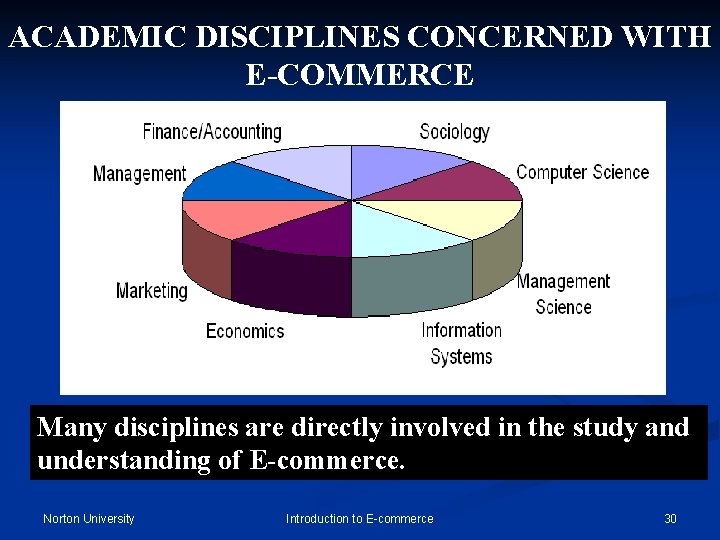
ACADEMIC DISCIPLINES CONCERNED WITH E-COMMERCE Many disciplines are directly involved in the study and understanding of E-commerce. Norton University Introduction to E-commerce 30
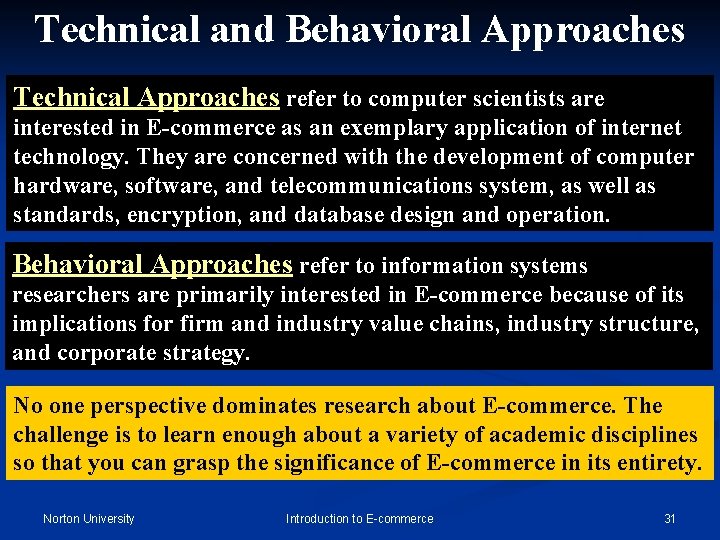
Technical and Behavioral Approaches Technical Approaches refer to computer scientists are interested in E-commerce as an exemplary application of internet technology. They are concerned with the development of computer hardware, software, and telecommunications system, as well as standards, encryption, and database design and operation. Behavioral Approaches refer to information systems researchers are primarily interested in E-commerce because of its implications for firm and industry value chains, industry structure, and corporate strategy. No one perspective dominates research about E-commerce. The challenge is to learn enough about a variety of academic disciplines so that you can grasp the significance of E-commerce in its entirety. Norton University Introduction to E-commerce 31
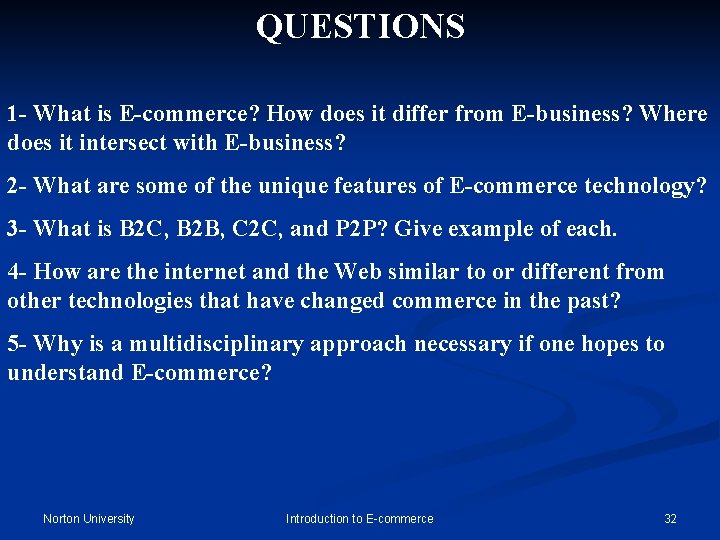
QUESTIONS 1 - What is E-commerce? How does it differ from E-business? Where does it intersect with E-business? 2 - What are some of the unique features of E-commerce technology? 3 - What is B 2 C, B 2 B, C 2 C, and P 2 P? Give example of each. 4 - How are the internet and the Web similar to or different from other technologies that have changed commerce in the past? 5 - Why is a multidisciplinary approach necessary if one hopes to understand E-commerce? Norton University Introduction to E-commerce 32