
Part One Introduction 1 People and their work

- Slides: 25
Part One Introduction
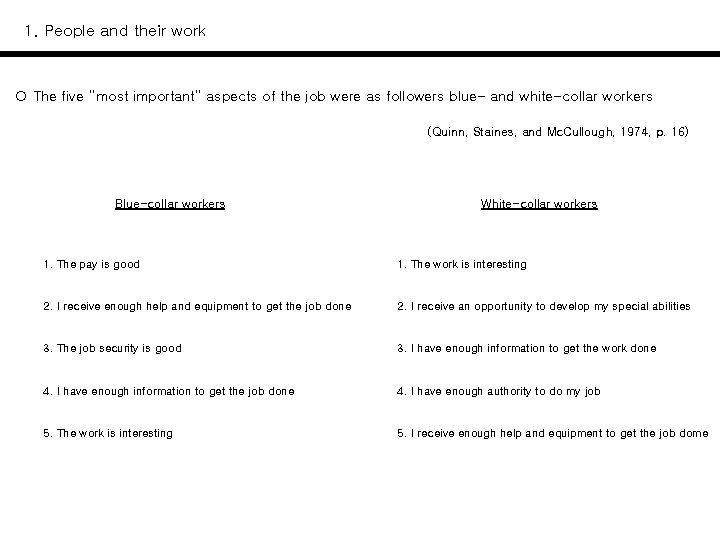
1. People and their work The five “most important” aspects of the job were as followers blue- and white-collar workers (Quinn, Staines, and Mc. Cullough, 1974, p. 16) Blue-collar workers White-collar workers 1. The pay is good 1. The work is interesting 2. I receive enough help and equipment to get the job done 2. I receive an opportunity to develop my special abilities 3. The job security is good 3. I have enough information to get the work done 4. I have enough information to get the job done 4. I have enough authority to do my job 5. The work is interesting 5. I receive enough help and equipment to get the job dome
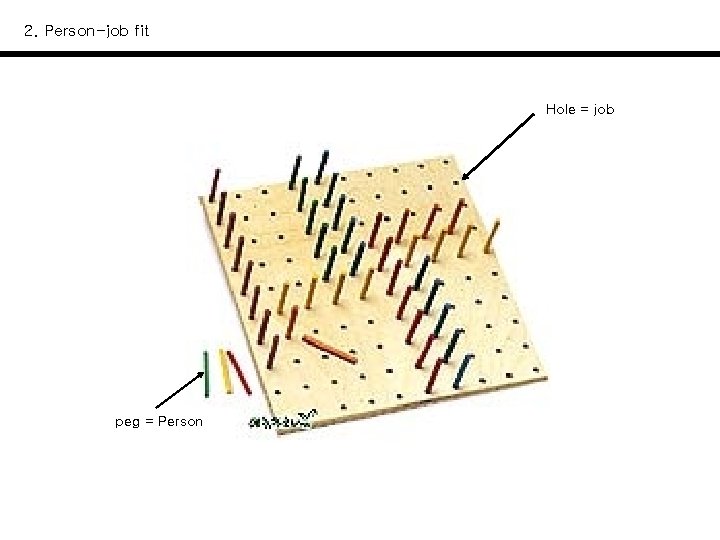
2. Person-job fit Hole = job peg = Person
Part Two Designing work for individuals
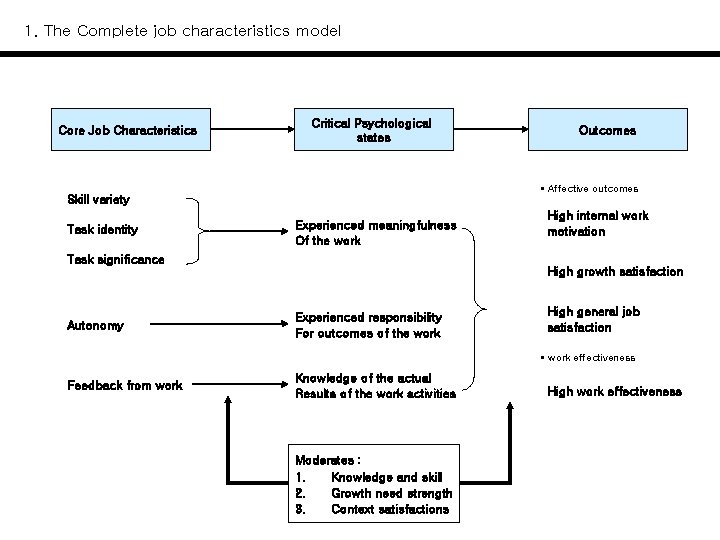
1. The Complete job characteristics model Core Job Characteristics Critical Psychological states Affective outcomes Skill variety Task identity Outcomes Experienced meaningfulness Of the work High internal work motivation Task significance High growth satisfaction Autonomy Experienced responsibility For outcomes of the work High general job satisfaction work effectiveness Feedback from work Knowledge of the actual Results of the work activities Moderates : 1. Knowledge and skill 2. Growth need strength 3. Context satisfactions High work effectiveness
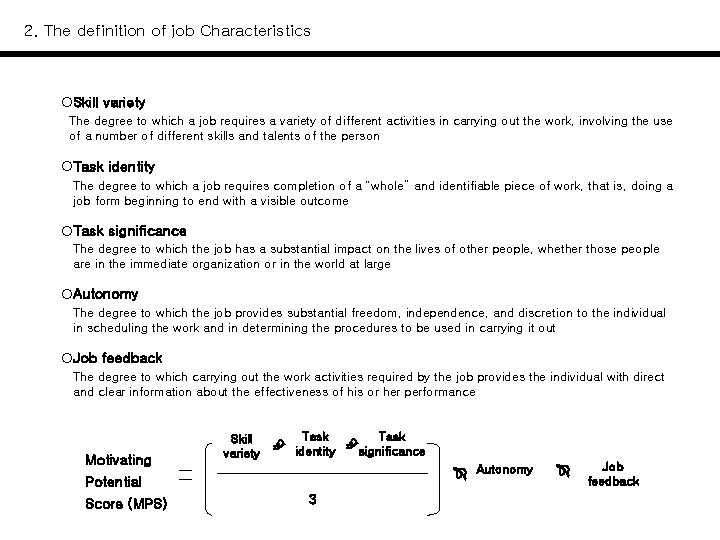
2. The definition of job Characteristics Skill variety The degree to which a job requires a variety of different activities in carrying out the work, involving the use of a number of different skills and talents of the person Task identity The degree to which a job requires completion of a “whole” and identifiable piece of work, that is, doing a job form beginning to end with a visible outcome Task significance The degree to which the job has a substantial impact on the lives of other people, whether those people are in the immediate organization or in the world at large Autonomy The degree to which the job provides substantial freedom, independence, and discretion to the individual in scheduling the work and in determining the procedures to be used in carrying it out Job feedback The degree to which carrying out the work activities required by the job provides the individual with direct and clear information about the effectiveness of his or her performance Motivating Skill variety Task Autonomy Potential Score (MPS) Task identity significance 3 Job feedback
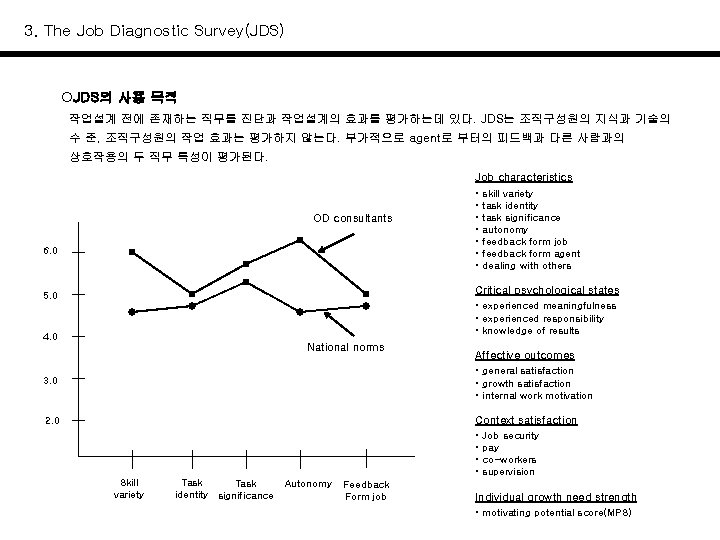
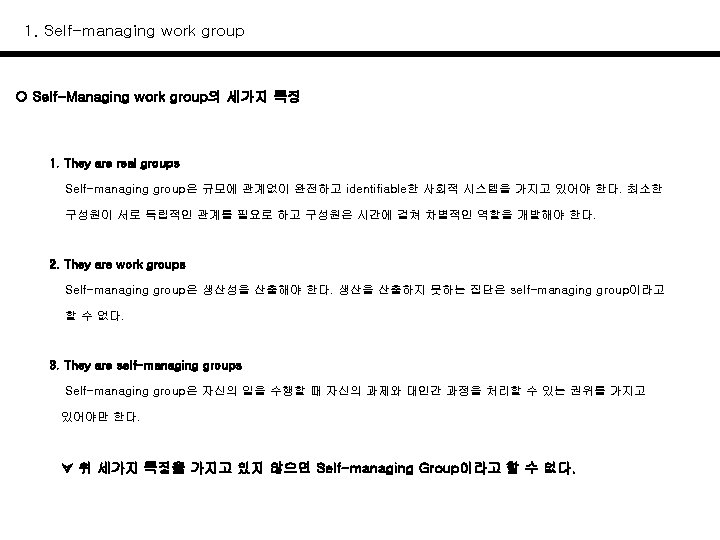
3. The Job Diagnostic Survey(JDS) JDS의 사용 목적 작업설계 전에 존재하는 직무를 진단과 작업설계의 효과를 평가하는데 있다. JDS는 조직구성원의 지식과 기술의 수 준, 조직구성원의 작업 효과는 평가하지 않는다. 부가적으로 agent로 부터의 피드백과 다른 사람과의 상호작용의 두 직무 특성이 평가된다. OD consultants 6. 0 Job characteristics • skill variety • task identity • task significance • autonomy • feedback form job • feedback form agent • dealing with others Critical psychological states • experienced meaningfulness • experienced responsibility • knowledge of results 5. 0 4. 0 National norms 3. 0 Affective outcomes • general satisfaction • growth satisfaction • internal work motivation Context satisfaction • Job security • pay • co-workers • supervision 2. 0 Skill variety Task identity significance Autonomy Feedback Form job Individual growth need strength • motivating potential score(MPS)
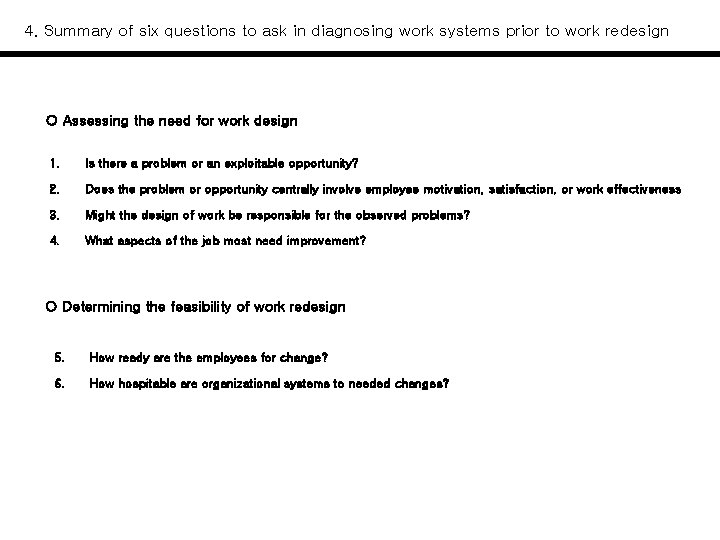
4. Summary of six questions to ask in diagnosing work systems prior to work redesign Assessing the need for work design 1. Is there a problem or an exploitable opportunity? 2. Does the problem or opportunity centrally involve employee motivation, satisfaction, or work effectiveness 3. Might the design of work be responsible for the observed problems? 4. What aspects of the job most need improvement? Determining the feasibility of work redesign 5. How ready are the employees for change? 6. How hospitable are organizational systems to needed changes?
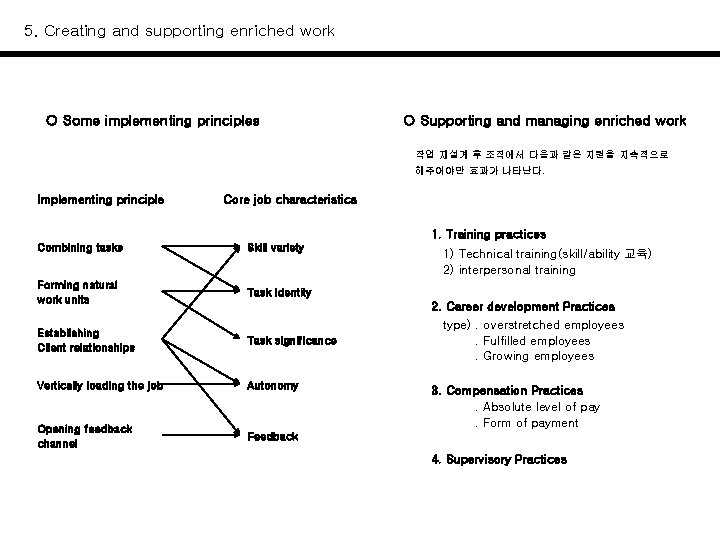
5. Creating and supporting enriched work Some implementing principles Supporting and managing enriched work 작업 재설계 후 조직에서 다음과 같은 지원을 지속적으로 해주어야만 효과가 나타난다. Implementing principle Core job characteristics 1. Training practices Combining tasks Skill variety Forming natural work units Task identity Establishing Client relationships Task significance Vertically loading the job Autonomy Opening feedback channel Feedback 1) Technical training(skill/ability 교육) 2) interpersonal training 2. Career development Practices type). overstretched employees. Fulfilled employees. Growing employees 3. Compensation Practices. Absolute level of pay. Form of payment 4. Supervisory Practices
Part Three Designing work for Groups
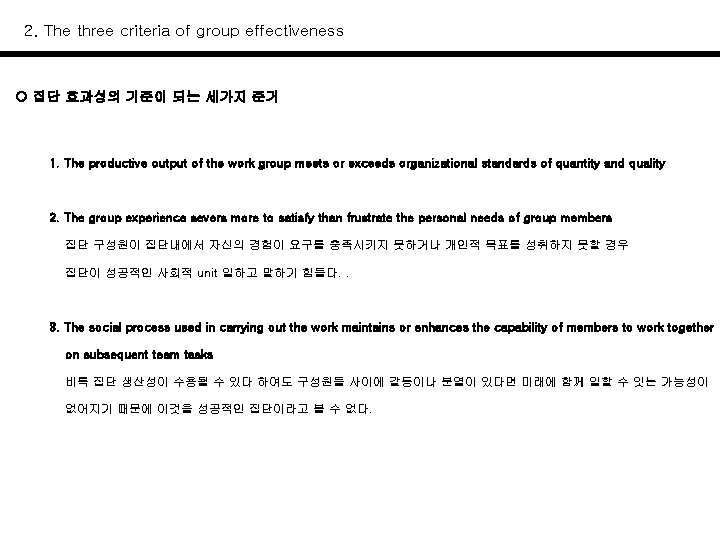
2. The three criteria of group effectiveness 집단 효과성의 기준이 되는 세가지 준거 1. The productive output of the work group meets or exceeds organizational standards of quantity and quality 2. The group experience severs more to satisfy than frustrate the personal needs of group members 집단 구성원이 집단내에서 자신의 경험이 요구를 충족시키지 못하거나 개인적 목표를 성취하지 못할 경우 집단이 성공적인 사회적 unit 일하고 말하기 힘들다. . 3. The social process used in carrying out the work maintains or enhances the capability of members to work together on subsequent team tasks 비록 집단 생산성이 수용될 수 있다 하여도 구성원들 사이에 갈등이나 분열이 있다면 미래에 함께 일할 수 잇는 가능성이 없어지기 때문에 이것을 성공적인 집단이라고 볼 수 없다.
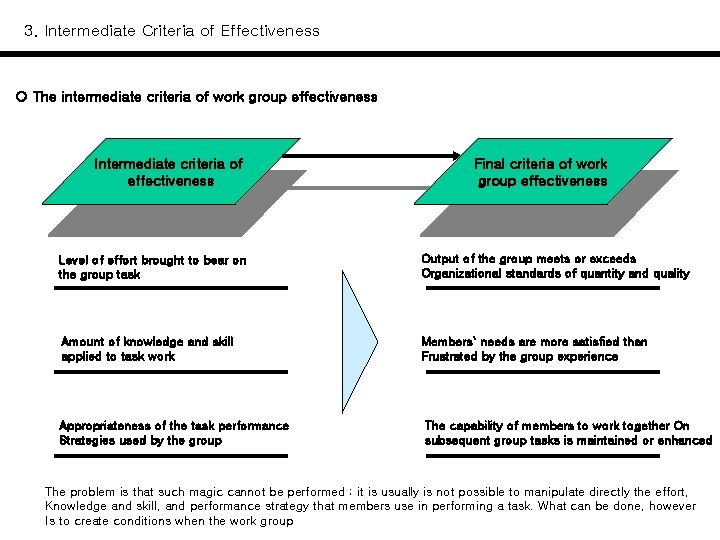
3. Intermediate Criteria of Effectiveness The intermediate criteria of work group effectiveness Intermediate criteria of effectiveness Final criteria of work group effectiveness Level of effort brought to bear on the group task Output of the group meets or exceeds Organizational standards of quantity and quality Amount of knowledge and skill applied to task work Members` needs are more satisfied than Frustrated by the group experience Appropriateness of the task performance Strategies used by the group The capability of members to work together On subsequent group tasks is maintained or enhanced The problem is that such magic cannot be performed ; it is usually is not possible to manipulate directly the effort, Knowledge and skill, and performance strategy that members use in performing a task. What can be done, however Is to create conditions when the work group
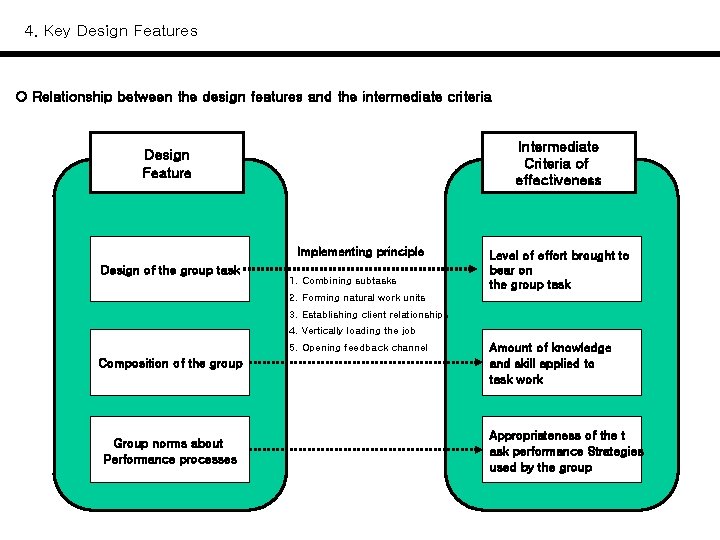
4. Key Design Features Relationship between the design features and the intermediate criteria Intermediate Criteria of effectiveness Design Feature Implementing principle Design of the group task 1. Combining subtasks Level of effort brought to bear on the group task 2. Forming natural work units 3. Establishing client relationships 4. Vertically loading the job 5. Opening feedback channel Composition of the group Group norms about Performance processes Amount of knowledge and skill applied to task work Appropriateness of the t ask performance Strategies used by the group
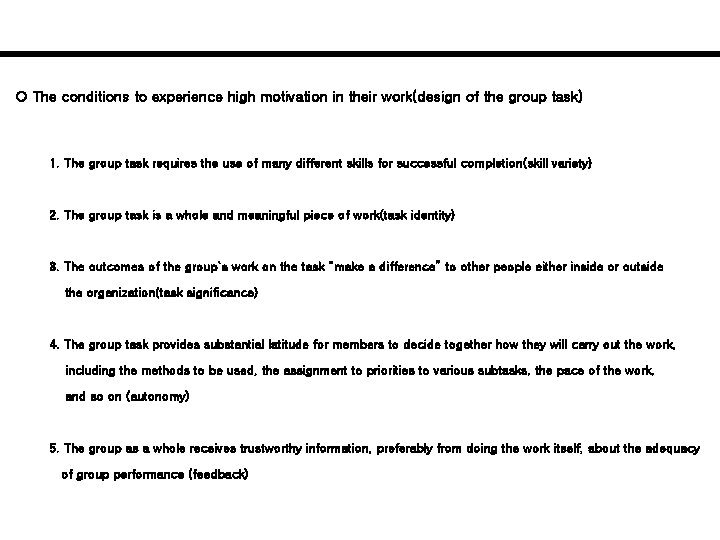
The conditions to experience high motivation in their work(design of the group task) 1. The group task requires the use of many different skills for successful completion(skill variety) 2. The group task is a whole and meaningful piece of work(task identity) 3. The outcomes of the group`s work on the task “make a difference” to other people either inside or outside the organization(task significance) 4. The group task provides substantial latitude for members to decide together how they will carry out the work, including the methods to be used, the assignment to priorities to various subtasks, the pace of the work, and so on (autonomy) 5. The group as a whole receives trustworthy information, preferably from doing the work itself, about the adequacy of group performance (feedback)
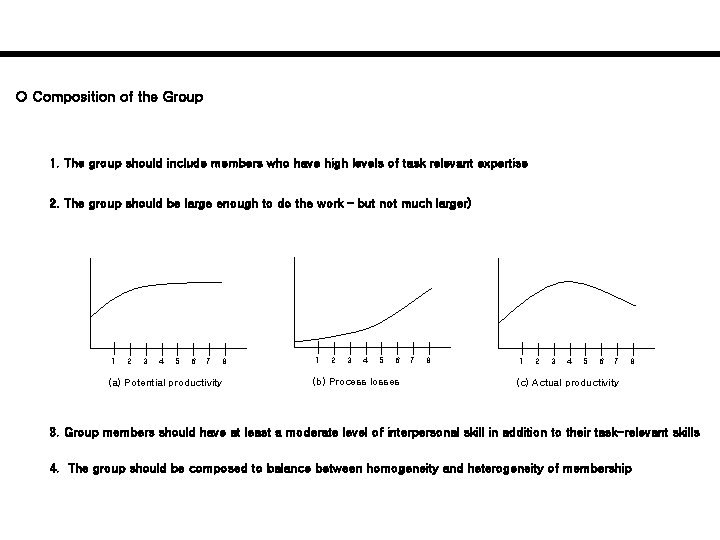
Composition of the Group 1. The group should include members who have high levels of task relevant expertise 2. The group should be large enough to do the work – but not much larger) 1 2 3 4 5 6 7 (a) Potential productivity 8 1 2 3 4 5 6 (b) Process losses 7 8 1 2 3 4 5 6 7 8 (c) Actual productivity 3. Group members should have at least a moderate level of interpersonal skill in addition to their task-relevant skills 4. The group should be composed to balance between homogeneity and heterogeneity of membership
Group norms about performance process
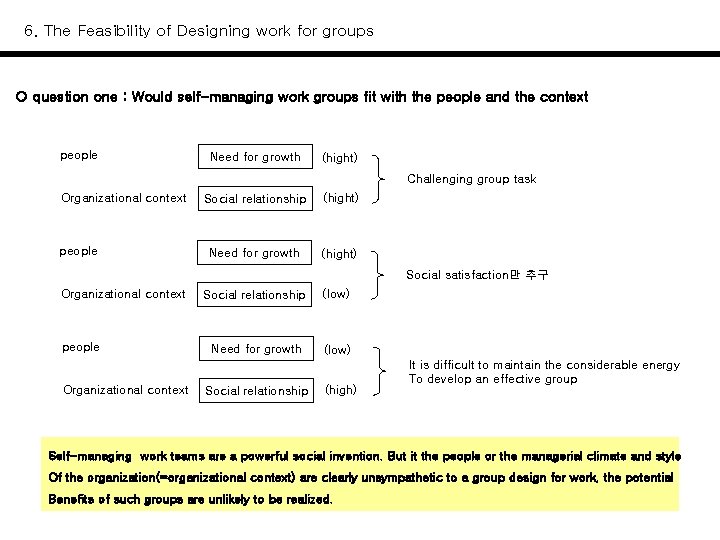
6. The Feasibility of Designing work for groups question one : Would self-managing work groups fit with the people and the context people Need for growth (hight) Challenging group task Organizational context people Social relationship (hight) Need for growth (hight) Social satisfaction만 추구 Organizational context people Organizational context Social relationship (low) Need for growth (low) Social relationship (high) It is difficult to maintain the considerable energy To develop an effective group Self-managing work teams are a powerful social invention. But it the people or the managerial climate and style Of the organization(=organizational context) are clearly unsympathetic to a group design for work, the potential Benefits of such groups are unlikely to be realized.
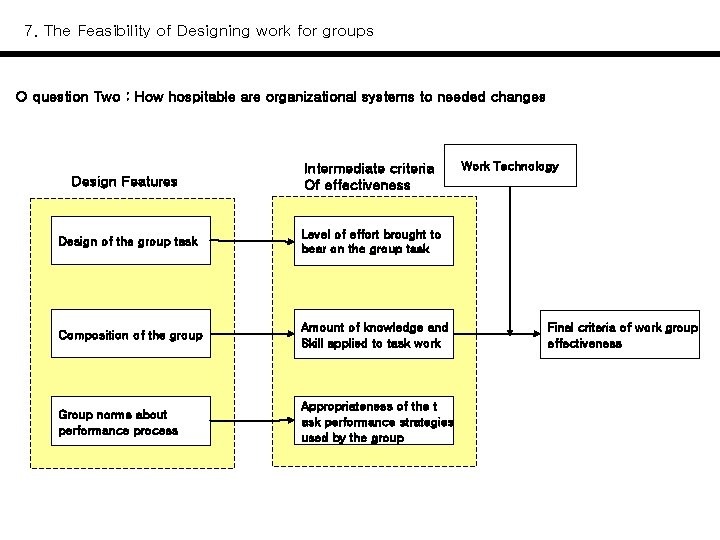
7. The Feasibility of Designing work for groups question Two : How hospitable are organizational systems to needed changes Design Features Intermediate criteria Of effectiveness Design of the group task Level of effort brought to bear on the group task Composition of the group Amount of knowledge and Skill applied to task work Group norms about performance process Appropriateness of the t ask performance strategies used by the group Work Technology Final criteria of work group effectiveness
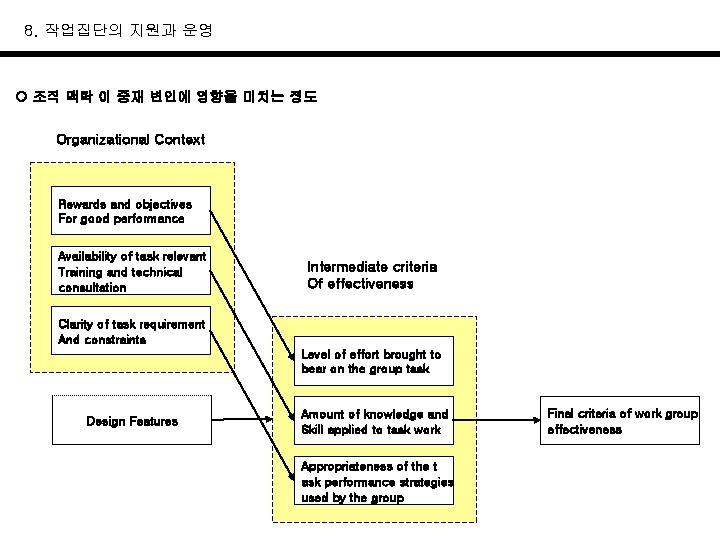
8. 작업집단의 지원과 운영 조직 맥락 이 중재 변인에 영향을 미치는 정도 Organizational Context Rewards and objectives For good performance Availability of task relevant Training and technical consultation Intermediate criteria Of effectiveness Clarity of task requirement And constraints Level of effort brought to bear on the group task Design Features Amount of knowledge and Skill applied to task work Appropriateness of the t ask performance strategies used by the group Final criteria of work group effectiveness
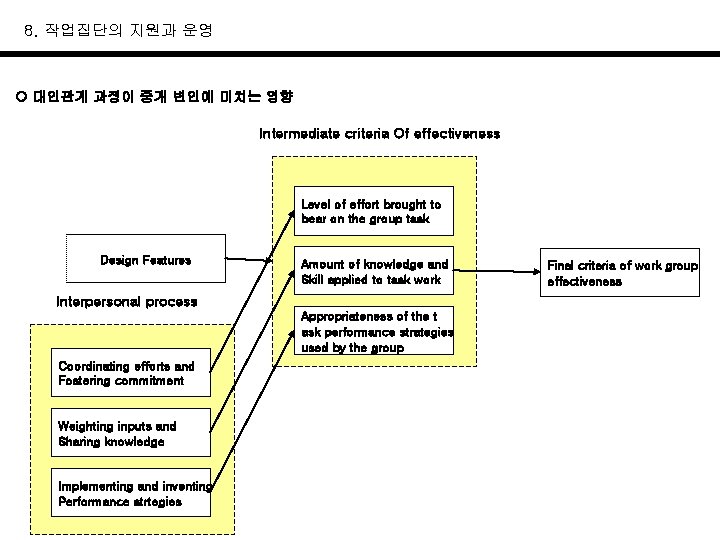
8. 작업집단의 지원과 운영 대인관계 과정이 중개 변인에 미치는 영향 Intermediate criteria Of effectiveness Level of effort brought to bear on the group task Design Features Amount of knowledge and Skill applied to task work Interpersonal process Appropriateness of the t ask performance strategies used by the group Coordinating efforts and Fostering commitment Weighting inputs and Sharing knowledge Implementing and inventing Performance strtegies Final criteria of work group effectiveness