
PART IV DEMOCRACY Political Stratification Discrimination and Exclusion
- Slides: 61
PART IV: DEMOCRACY Political Stratification Discrimination and Exclusion
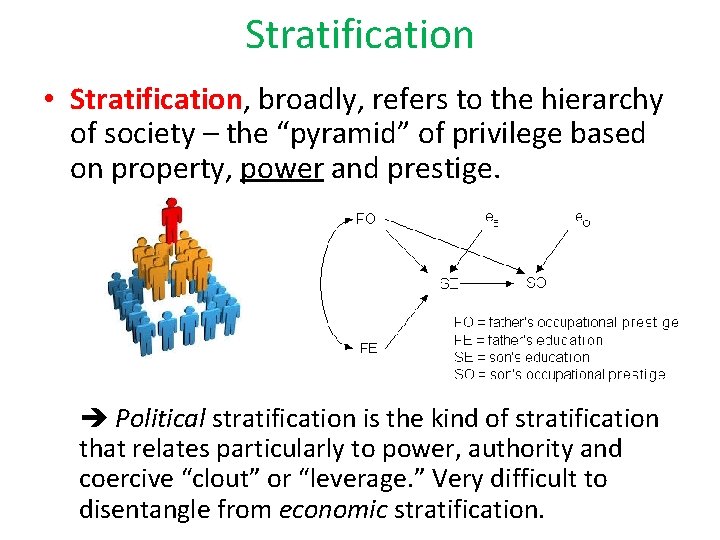
Stratification • Stratification, broadly, refers to the hierarchy of society – the “pyramid” of privilege based on property, power and prestige. Political stratification is the kind of stratification that relates particularly to power, authority and coercive “clout” or “leverage. ” Very difficult to disentangle from economic stratification.
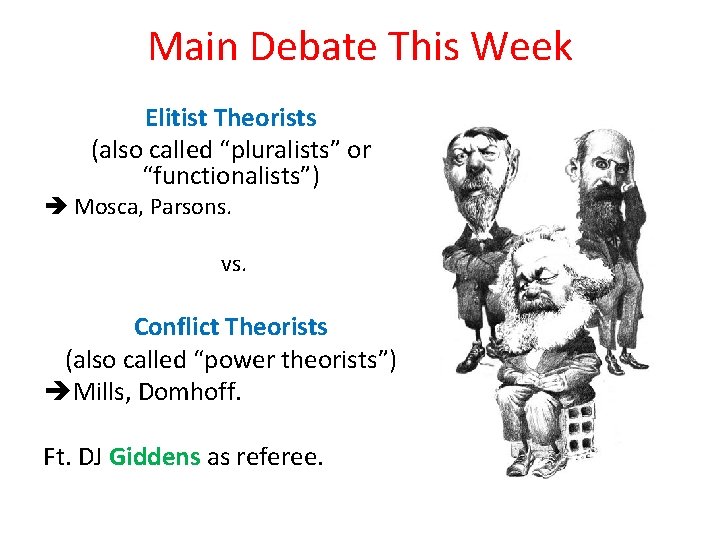
Main Debate This Week Elitist Theorists (also called “pluralists” or “functionalists”) Mosca, Parsons. vs. Conflict Theorists (also called “power theorists”) Mills, Domhoff. Ft. DJ Giddens as referee.
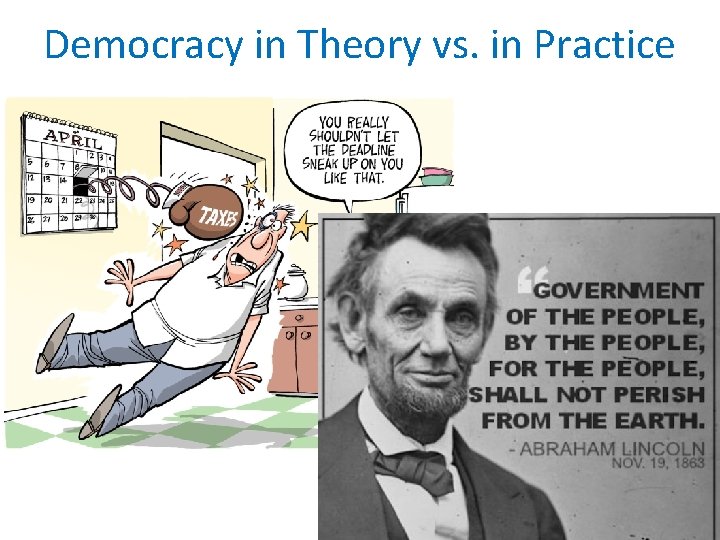
Democracy in Theory vs. in Practice
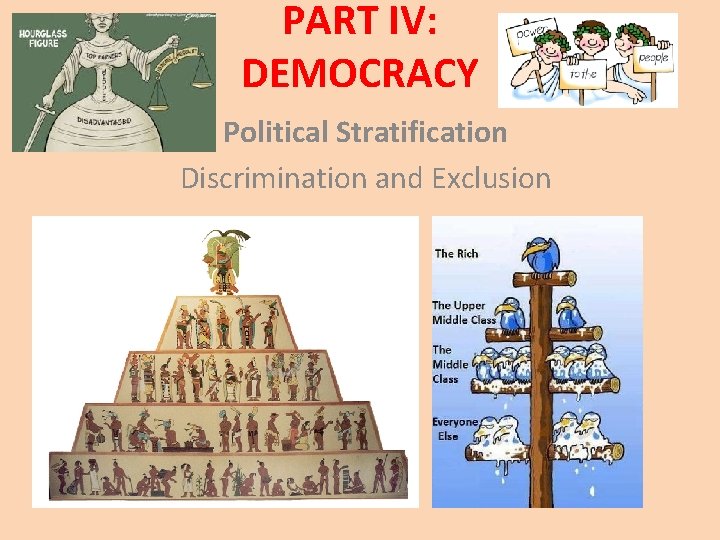
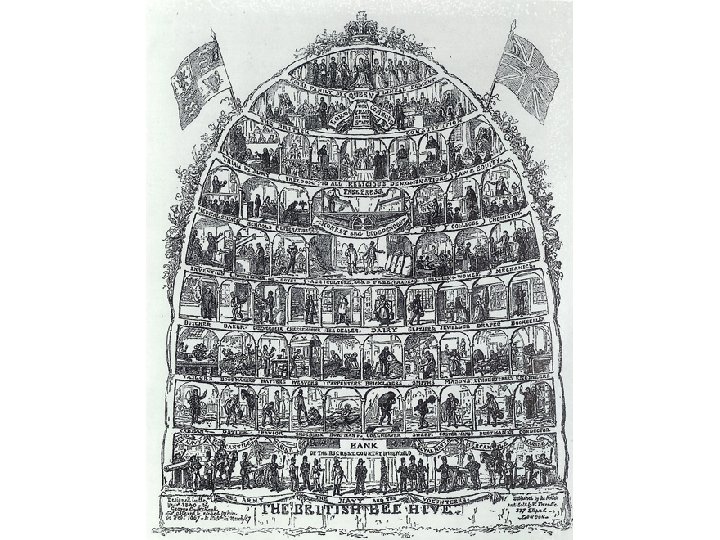
Democracy Historically Associated with a Class Stratification System • Slavery system: people owning people. (e. g. Ancient Egypt) • Caste system: status determined by birth, hereditary and lifelong privilege (e. g. India) • Estate system: nobility, clergy and peasants (feudal Europe); Class system – primarily based on money and material possessions (e. g. our societies). One of the key questions that should concern you in this week’s readings is: to what extent and how is democracy in tension with the class system, and to what extent is it naturally compatible?
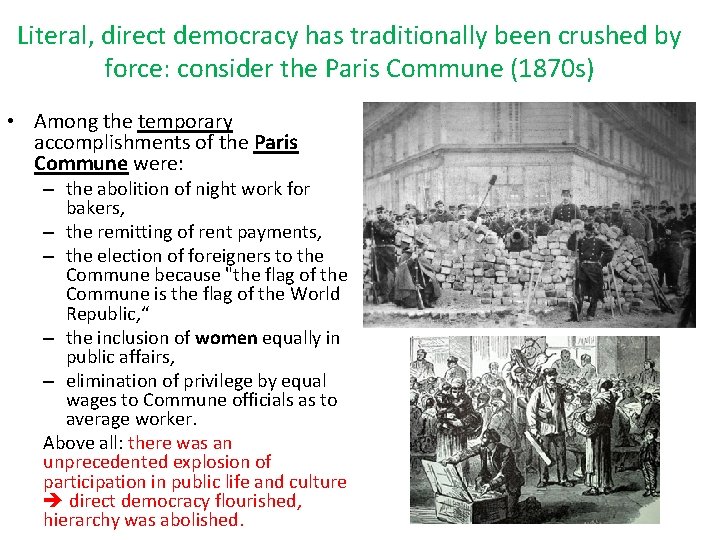
Literal, direct democracy has traditionally been crushed by force: consider the Paris Commune (1870 s) • Among the temporary accomplishments of the Paris Commune were: – the abolition of night work for bakers, – the remitting of rent payments, – the election of foreigners to the Commune because "the flag of the Commune is the flag of the World Republic, “ – the inclusion of women equally in public affairs, – elimination of privilege by equal wages to Commune officials as to average worker. Above all: there was an unprecedented explosion of participation in public life and culture direct democracy flourished, hierarchy was abolished.
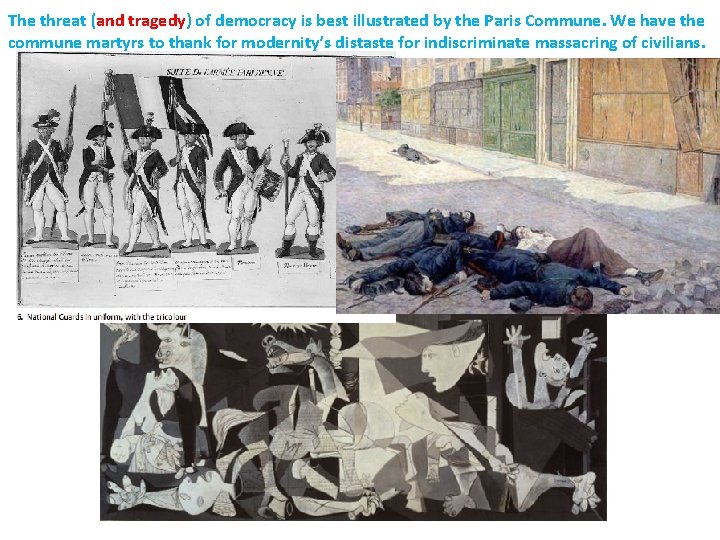
The threat (and tragedy) of democracy is best illustrated by the Paris Commune. We have the commune martyrs to thank for modernity’s distaste for indiscriminate massacring of civilians.
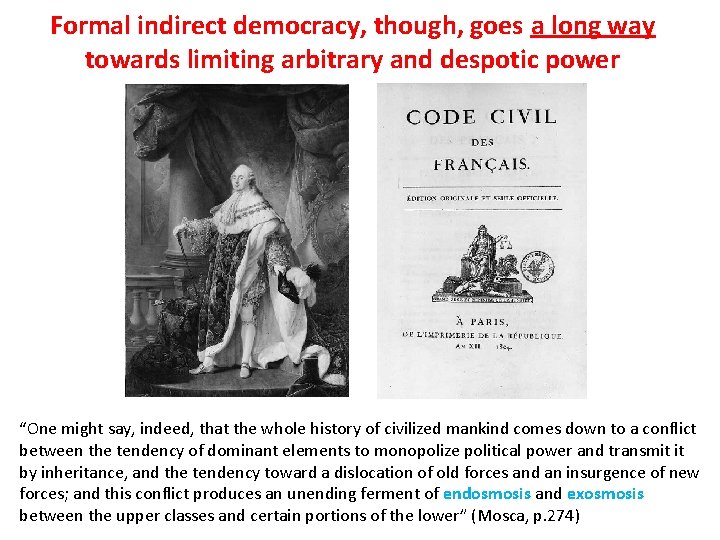
Formal indirect democracy, though, goes a long way towards limiting arbitrary and despotic power “One might say, indeed, that the whole history of civilized mankind comes down to a conflict between the tendency of dominant elements to monopolize political power and transmit it by inheritance, and the tendency toward a dislocation of old forces and an insurgence of new forces; and this conflict produces an unending ferment of endosmosis and exosmosis between the upper classes and certain portions of the lower” (Mosca, p. 274)
Mosca (1939): The Ruling Class Mosca's enduring contribution to political science is the observation that all but the most primitive societies are ruled in fact, if not in theory, by a numerical minority. He named this minority the political class (p. 268). Far from being incompatible with democracy, then, political hierarchy is inherent to it.
Org. Skills Determine Stratification Mosca defined modern elites in term of their superior organisational skills. These organisational skills were especially useful in gaining political power in modern bureaucratic society. Contrary to much confusion, in Mosca's conception elites are not hereditary in nature and peoples from all classes of society can in principle become "elites. " He also adhered to the concept of "the circulation of elites, " which is a dialectical theory of constant competition between elites, with one elite group replacing another repeatedly over time. In this vision, politics is a GAME – the political analogy to the market in the economic sphere.
Hierarchy is Natural, Inevitable Society is divided into the rulers and the ruled. It is inevitable that the domination of an organized minority, obeying a single impulse, rules over the unorganized majority. In every political organism there is one individual who is chief among the leaders. - The ruling minorities are distinguished from the mass by qualities that give them a certain material, intellectual, or even moral superiority; or else they are heirs for individuals who possessed such qualities. - The masses are a check to power and they can influence the policies of the ruling class. The varying structure of the ruling classes has importance in determining the political type, and level of civilization, of different people. - Resource along which stratification is done can be military valor, land, wealth, knowledge… so long as the political order is such that it rewards power to those who have the resource in question, then to be X is to become powerful.
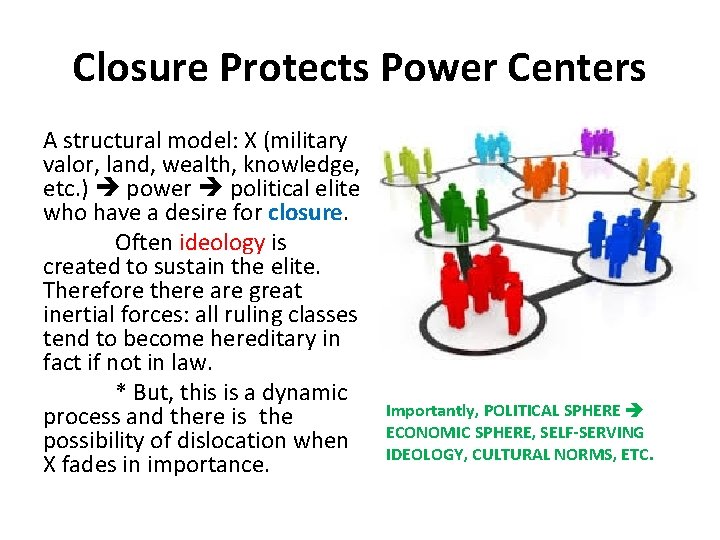
Closure Protects Power Centers A structural model: X (military valor, land, wealth, knowledge, etc. ) power political elite who have a desire for closure. Often ideology is created to sustain the elite. Therefore there are great inertial forces: all ruling classes tend to become hereditary in fact if not in law. * But, this is a dynamic process and there is the possibility of dislocation when X fades in importance. Importantly, POLITICAL SPHERE ECONOMIC SPHERE, SELF-SERVING IDEOLOGY, CULTURAL NORMS, ETC.
Vivian ". . . a very important social transformation occurs. Wealth, rather than military valor comes to be the characteristic feature of the dominant class" (Mosca, 271) As soon as I read this, I automatically thought back to Tilly and his theory's emphasis on the importance of war in the development of states: first in helping those in power concentrate it and then the creation of many beneficial organizations. To a certain extent, this seems like an extension of Tilly's war theory. Mosca mentions that military dominance once characterized the dominant class (Tilly's concentration of power in those who controlled the means war); however, there was a change. This change occurs due to the fact that people preferred protection offered by public authority through laws, rather than protection through the military (Tilly) and Mosca ends with the idea that "wealth produces political power. " (271).
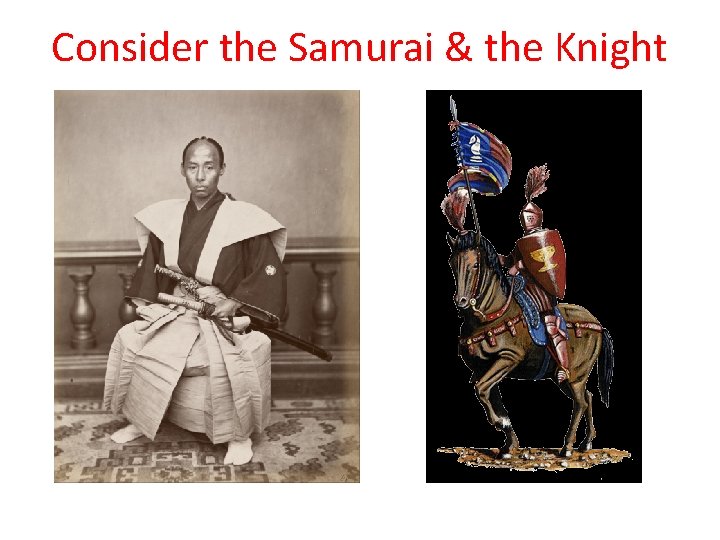
Consider the Samurai & the Knight
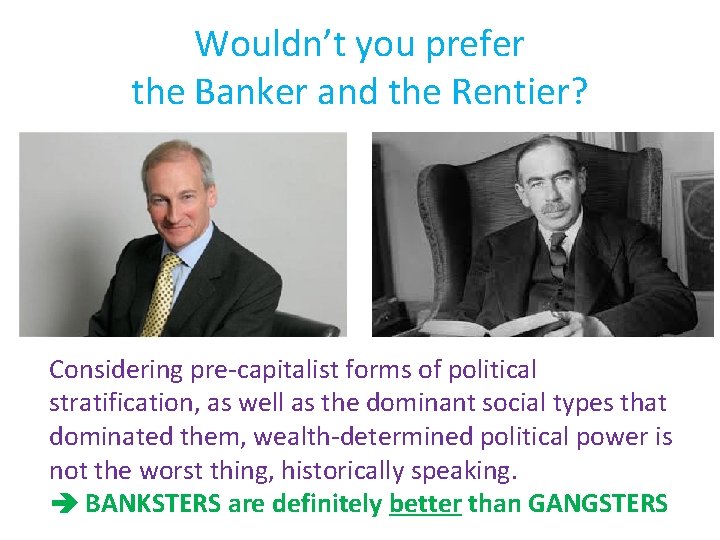
Wouldn’t you prefer the Banker and the Rentier? Considering pre-capitalist forms of political stratification, as well as the dominant social types that dominated them, wealth-determined political power is not the worst thing, historically speaking. BANKSTERS are definitely better than GANGSTERS
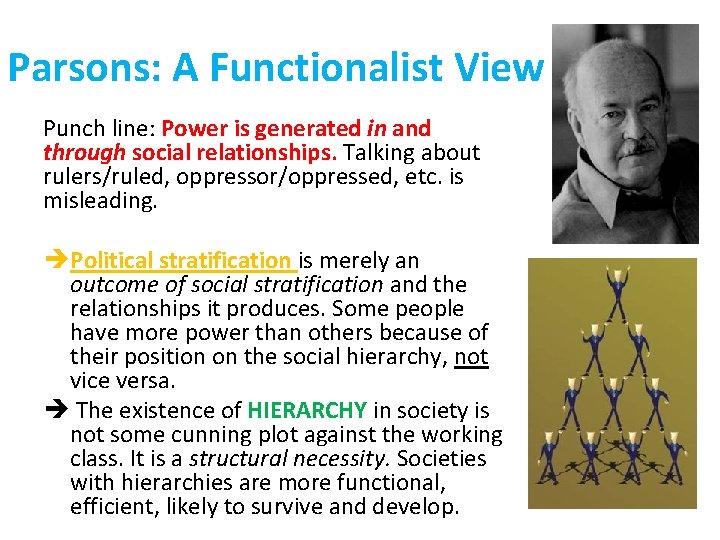
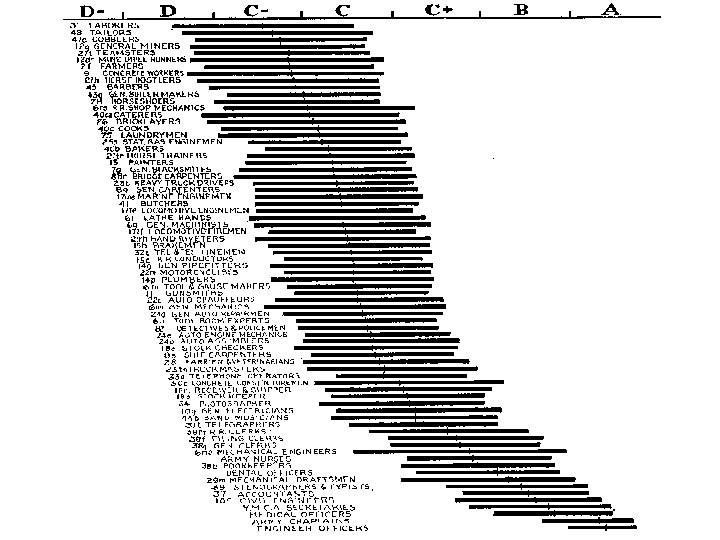
Parsons: A Functionalist View Punch line: Power is generated in and through social relationships. Talking about rulers/ruled, oppressor/oppressed, etc. is misleading. Political stratification is merely an outcome of social stratification and the relationships it produces. Some people have more power than others because of their position on the social hierarchy, not vice versa. The existence of HIERARCHY in society is not some cunning plot against the working class. It is a structural necessity. Societies with hierarchies are more functional, efficient, likely to survive and develop.
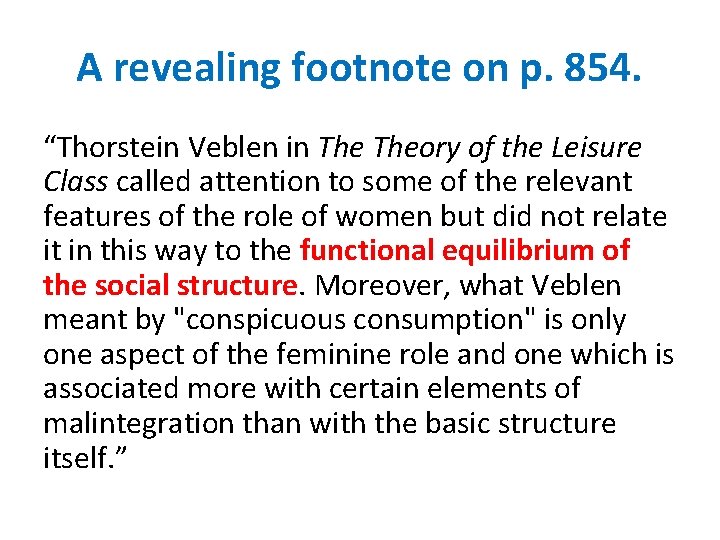
A revealing footnote on p. 854. “Thorstein Veblen in Theory of the Leisure Class called attention to some of the relevant features of the role of women but did not relate it in this way to the functional equilibrium of the social structure. Moreover, what Veblen meant by "conspicuous consumption" is only one aspect of the feminine role and one which is associated more with certain elements of malintegration than with the basic structure itself. ”
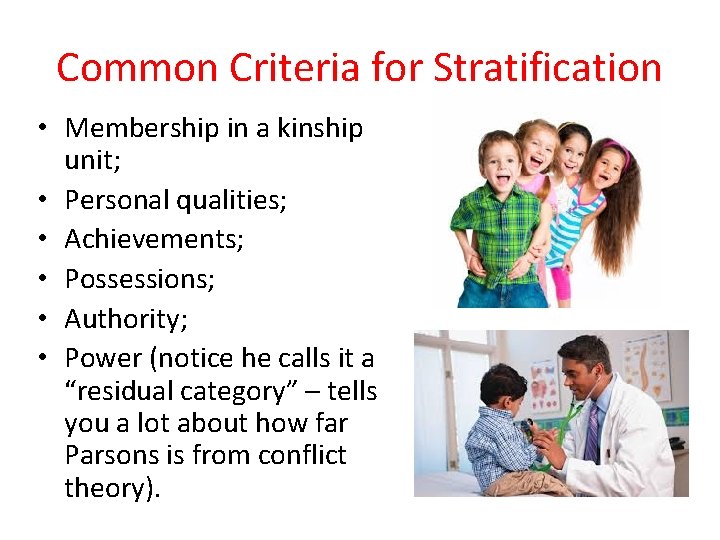
Common Criteria for Stratification • Membership in a kinship unit; • Personal qualities; • Achievements; • Possessions; • Authority; • Power (notice he calls it a “residual category” – tells you a lot about how far Parsons is from conflict theory).
Clara I really appreciated Parsons' discussion of the emphasis on the individual in our society's particular social stratification system. He recognizes wealth as an important (but, interestingly, not a primary) criterion of status -- and attributes the significance of wealth to social grouping as a result of a societal emphasis on individual achievement which in turn supports the capitalist basis of our economic system. He also notes that income (wealth) becomes an easy indicator of an individual's place in other value systems (i. e. Family status)--again crediting this special significance of wealth to our individualist, capitalist mindset (i. e. , successful businesses have high financial status; so do "successful" individuals. ) There is thus a clear relationship between capitalism and individualism, which makes wealth an important criterion in our society's social stratification system: I thought this made an interesting and convincing argument that wealth in and of itself is not a common value system but a criterion specifically valuable to our societal context.
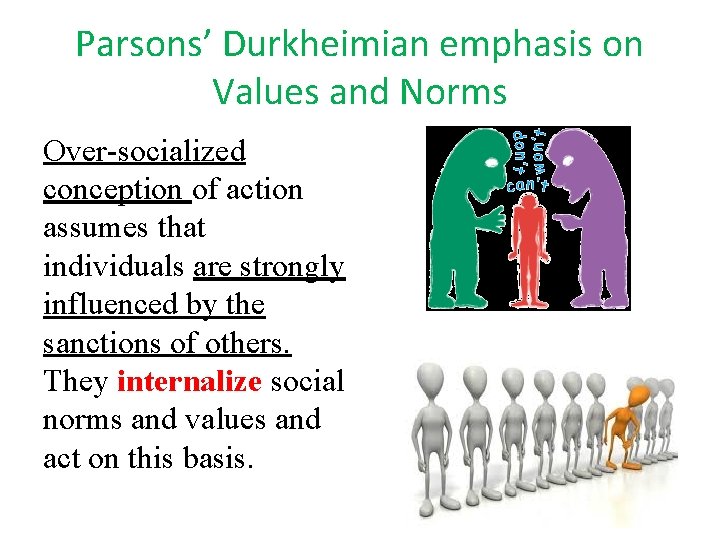
Parsons’ Durkheimian emphasis on Values and Norms Over-socialized conception of action assumes that individuals are strongly influenced by the sanctions of others. They internalize social norms and values and act on this basis.
Andrea "The separation of the sex roles in our society is such as, for the most part, to remove women from the kind of occupational status which is important for the determination of the status of a family. Where married women are employed outside the home, it is, for the great majority, in occupations which are not in direct competition for status with those of men of their own class" (Parsons, p. 853) This quote may be from 1940, but I find that it still holds up today. Even with an increasing number of women entering the workplace, the man is still largely seen as the primary wage-earner of the family. Husbands determine the social status of the family and wives become symbols of that status (i. e. the "trophy wife"). This idea is so ingrained in our society that I think men are taught to be threatened by women who are high wage-earners, an embodiment of the fear of the disruption of family solidarity that Parsons was discussing. I believe that gradually we will shift away from this as women continue to earn more and more, but it does raise questions concerning the consequences for family status: how is family status determined with two wageearners in the family? Do the two parents have to be of comparable status? Do they have to earn the same amount if in the same field? Or is it better for them to be in different fields so that their relative success is hard to compare? If not of similar status, does one parent always have to take the role as the wage-earner, and the other the caretaker and the "trophy"?
Clara (contd. ) A couple of other notes on the article: On page 853/4, Parsons notes that "the separation of the sex roles in our society. . . is functionally related to maintaining family solidarity in our class structure", because there is a lack of direct competition between husband wife. He notes also that this explains why "married women. . . employed outside the home. . . [fill] occupations which are not in direct competition for status with those of men of their own class". While at first mildly outraged by this section, I realized the article was published in 1940 --so the question becomes, now that feminist movements have seen success, and the distinction between male and female roles has been blurred, what has been the impact on social stratification and, particularly, family solidarity, in the Western world? Is it important to preserve family solidarity--or any of the elements of hierarchal status over another? How does (not) doing so impact the economics/politics of a society (and does influence also flow in the opposite direction)? Additionally, on page 851, Parsons writes that "equality of opportunity" is the opposite of the "caste system" -- he does qualify this by saying this "equality of opportunity" does not assume any combination of or emphasis on any of the "other five elements of hierarchal status", but does it imply that these elements lack rigidity? More interestingly, how can we understand the genuine commingling/influence of different hierarchical elements -- ie, can "achievements" ever be fully separated from (or understood outside the context of) membership in a kinship unit?
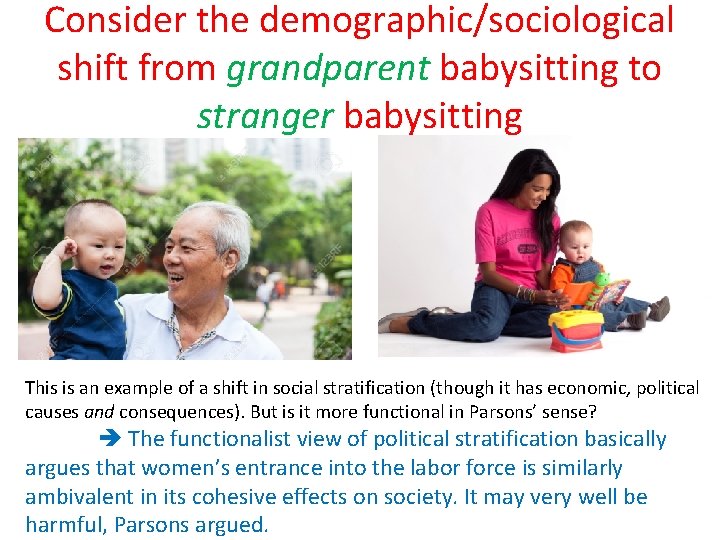
Consider the demographic/sociological shift from grandparent babysitting to stranger babysitting This is an example of a shift in social stratification (though it has economic, political causes and consequences). But is it more functional in Parsons’ sense? The functionalist view of political stratification basically argues that women’s entrance into the labor force is similarly ambivalent in its cohesive effects on society. It may very well be harmful, Parsons argued.
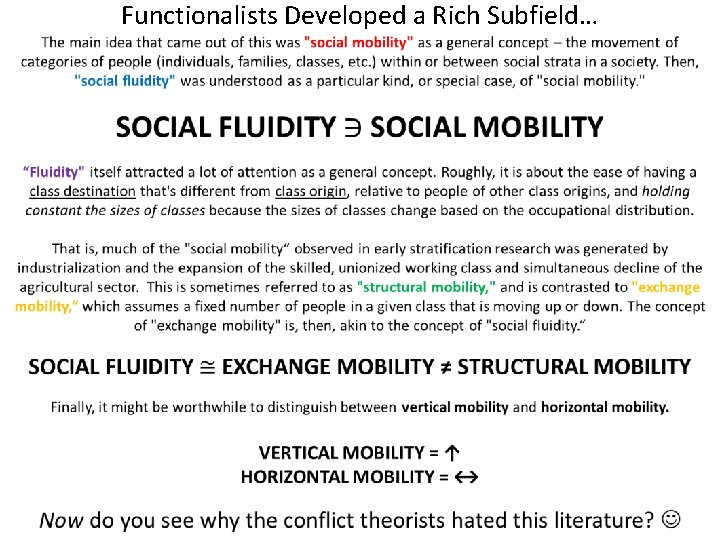
• Functionalists Developed a Rich Subfield…
In reaction, Conflict Theorists Argued: • No evidence of general and abiding trends toward either higher levels of total mobility or of social fluidity. • No evidence that mobility rates – absolute or relative – are changing with any consistent direction. • No evidence of convergence over time crossnationally. • Some evidence with absolute rates of trendless, though often quite wide, fluctuation, but with relative rates evidence of considerable stability.
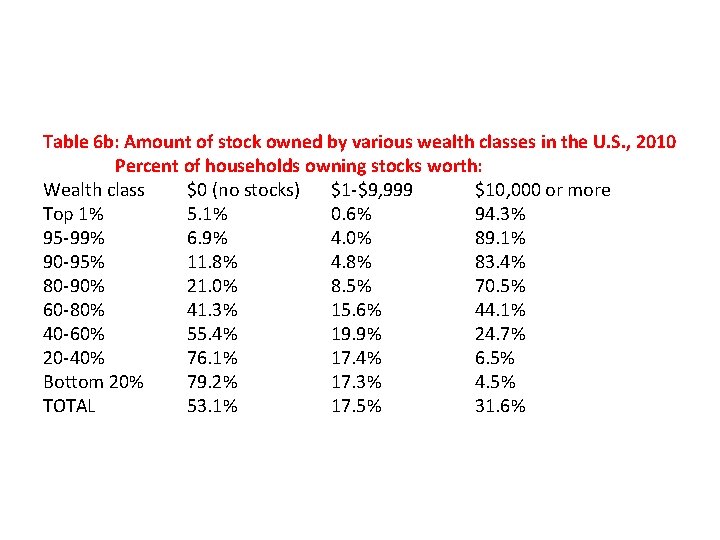
Table 6 b: Amount of stock owned by various wealth classes in the U. S. , 2010 Percent of households owning stocks worth: Wealth class $0 (no stocks) $1 -$9, 999 $10, 000 or more Top 1% 5. 1% 0. 6% 94. 3% 95 -99% 6. 9% 4. 0% 89. 1% 90 -95% 11. 8% 4. 8% 83. 4% 80 -90% 21. 0% 8. 5% 70. 5% 60 -80% 41. 3% 15. 6% 44. 1% 40 -60% 55. 4% 19. 9% 24. 7% 20 -40% 76. 1% 17. 4% 6. 5% Bottom 20% 79. 2% 17. 3% 4. 5% TOTAL 53. 1% 17. 5% 31. 6%
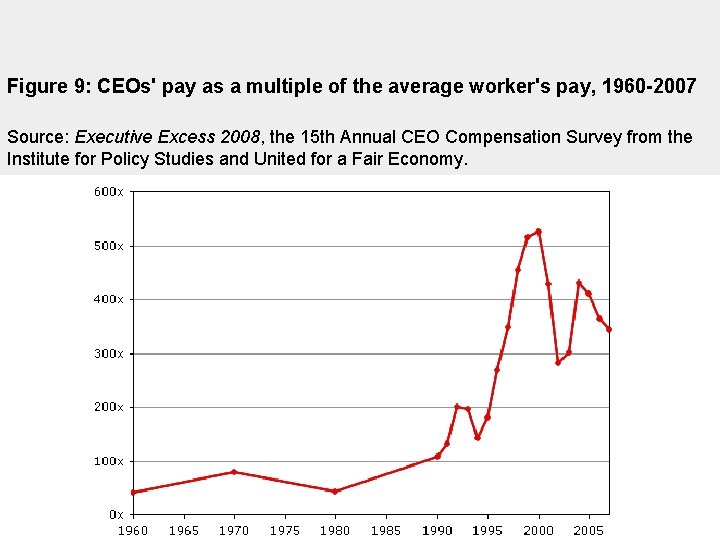
Figure 9: CEOs' pay as a multiple of the average worker's pay, 1960 -2007 Source: Executive Excess 2008, the 15 th Annual CEO Compensation Survey from the Institute for Policy Studies and United for a Fair Economy.
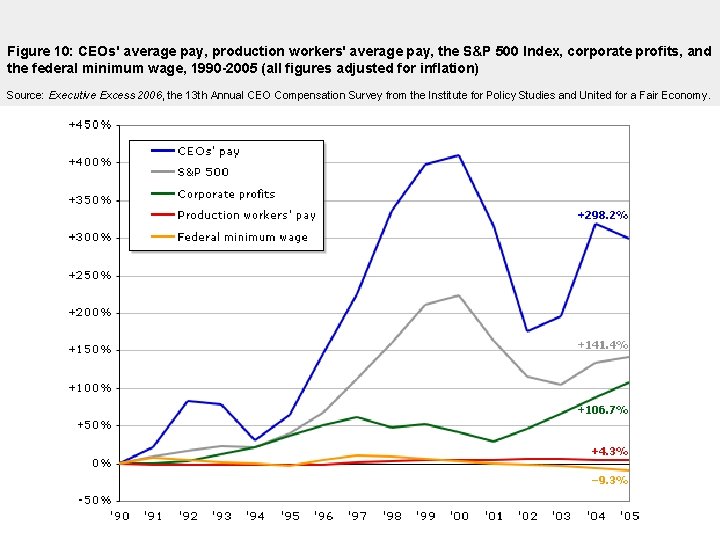
Figure 10: CEOs' average pay, production workers' average pay, the S&P 500 Index, corporate profits, and the federal minimum wage, 1990 -2005 (all figures adjusted for inflation) Source: Executive Excess 2006, the 13 th Annual CEO Compensation Survey from the Institute for Policy Studies and United for a Fair Economy.
Michael "As the means of information and of power are centralized, some men come to occupy positions in American society from which they can look down upon, so to speak, and by their decisions mightily affect, the everyday worlds of ordinary men and women" (Mills, 3). Obviously, much of the influence of the power elite comes from a vast accumulation of material wealth and inherent positions in the highest classes of society. It only follows that these men would be acting on their "best interests" to try to influence the political sphere as this passage implies. It is thus easy to realize that being in the power elite would correlate not only to a certain level of conspicuous consumption, but also to a progressively more oligarchical system, the type of which Bernie Sanders and Jimmy Carter deride the United States Government as currently being.
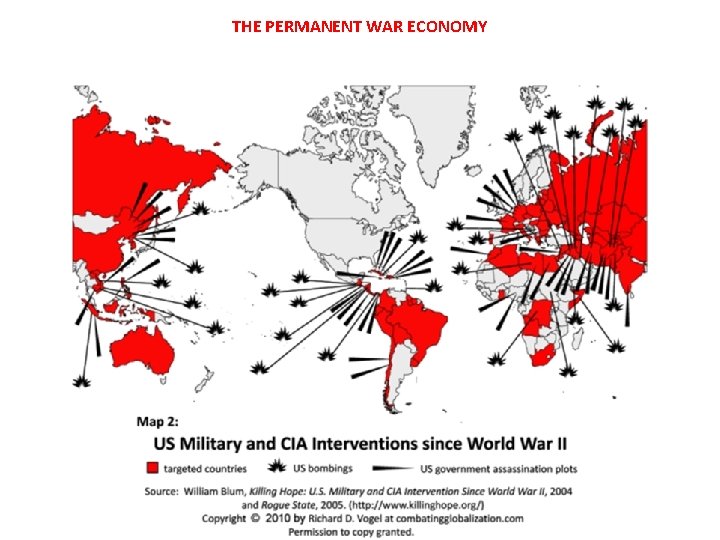
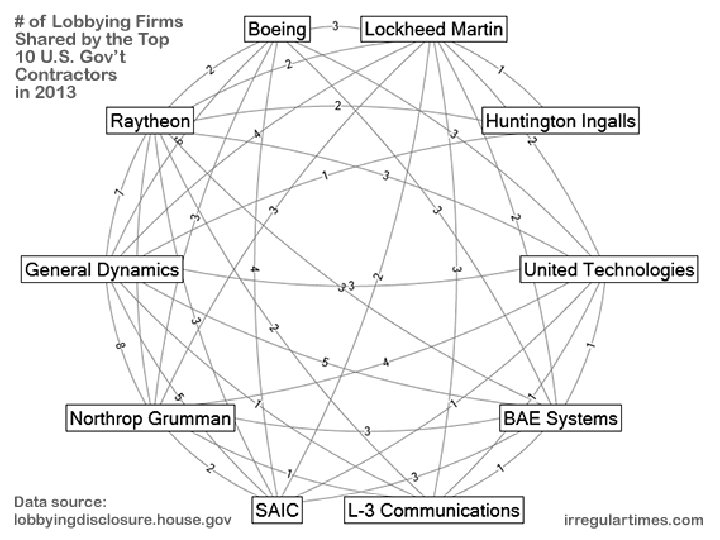
C. W. MILLS Mills describes the relationship between the political, military, and economic elite (people at the pinnacles of these three institutions), noting that these people share a common world view: • the military metaphysic: a military definition of reality; • possess class identity: recognizing themselves separate and superior to the rest of society; • have interchangeability: they move within and between the three institutional structures and hold interlocking directorates; • cooptation / socialization: socialization of prospective new members is done based on how well they "clone" themselves socially after such elites; • These elites in the "big three" institutional orders have an "uneasy" alliance based upon their "community of interests" driven by the military metaphysic, which has transformed the economy into a 'permanent war economy. ’
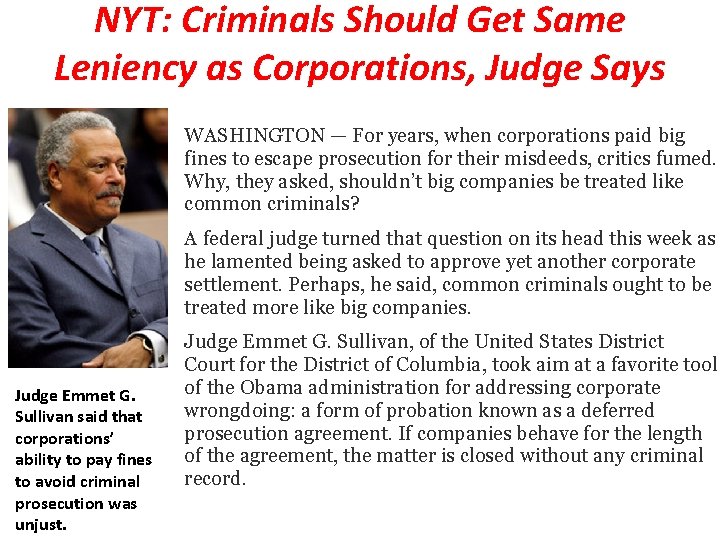
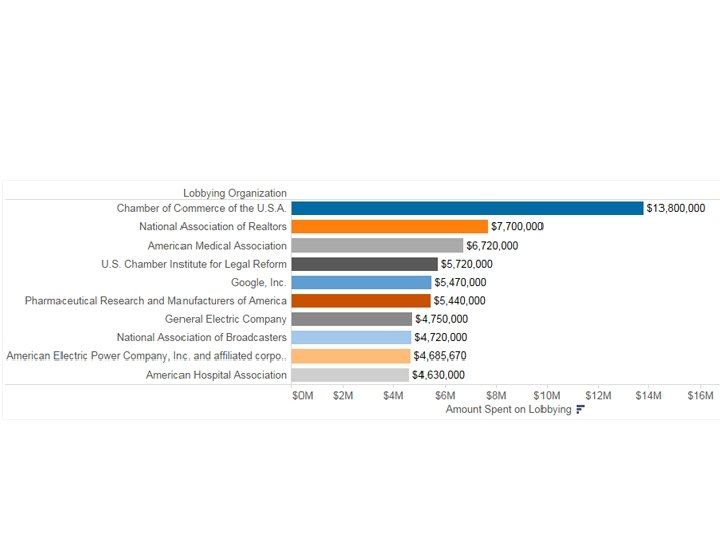
Julia Mills referneces Charles Erwin Wilson's quote "What is good for the United States is good for the General Motors Corporation and vice versa" (Wilson in Mills 285). This reminded me of an article I recently read in the nytimes titled "Criminals Should Get Same Leniency as Corporations, Judge Says" (October 23, 2015). The author explains that corporations often successfully evade the negative consequences of their immoral or inaccurate decisions by simply paying a fine instead of being prosecuted. Judge Sullivan highlights the gross inconsistency in how individuals are punished vs. powerful, dominating corporations are punished. Similarly, Mills brings up the "highlevel lobbying" that exists.
NYT: Criminals Should Get Same Leniency as Corporations, Judge Says • WASHINGTON — For years, when corporations paid big fines to escape prosecution for their misdeeds, critics fumed. Why, they asked, shouldn’t big companies be treated like common criminals? • A federal judge turned that question on its head this week as he lamented being asked to approve yet another corporate settlement. Perhaps, he said, common criminals ought to be treated more like big companies. • Judge Emmet G. Sullivan, of the United States District Court for the District of Columbia, took aim at a favorite tool of the Obama administration for addressing corporate Judge Emmet G. wrongdoing: a form of probation known as a deferred Sullivan said that prosecution agreement. If companies behave for the length corporations’ of the agreement, the matter is closed without any criminal ability to pay fines record. to avoid criminal prosecution was unjust.
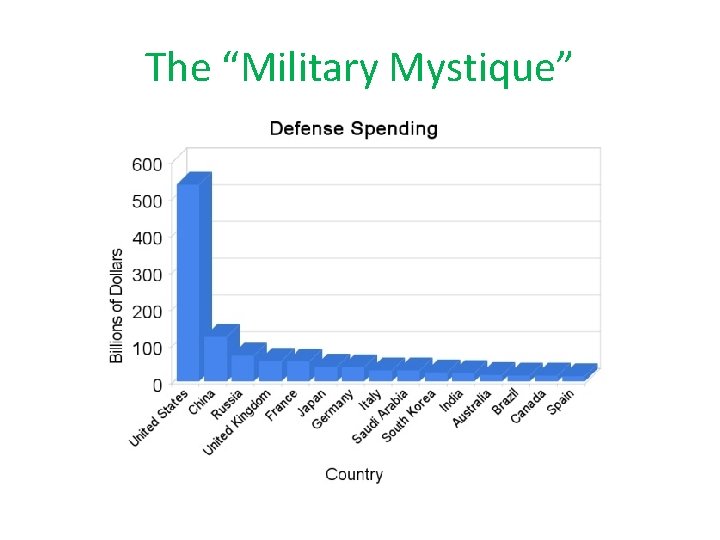
The “Military Mystique”
THE PERMANENT WAR ECONOMY
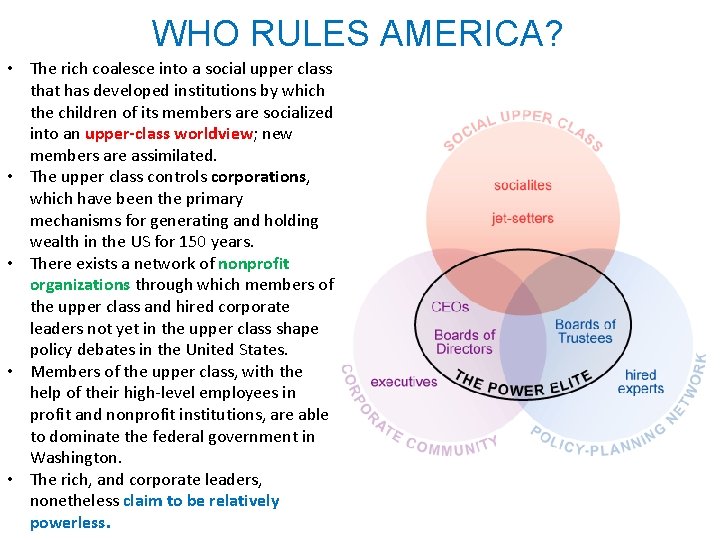
WHO RULES AMERICA? • The rich coalesce into a social upper class that has developed institutions by which the children of its members are socialized into an upper-class worldview; new members are assimilated. • The upper class controls corporations, which have been the primary mechanisms for generating and holding wealth in the US for 150 years. • There exists a network of nonprofit organizations through which members of the upper class and hired corporate leaders not yet in the upper class shape policy debates in the United States. • Members of the upper class, with the help of their high-level employees in profit and nonprofit institutions, are able to dominate the federal government in Washington. • The rich, and corporate leaders, nonetheless claim to be relatively powerless.
Kate “The upper class at any given historical moment consists of a complex network of overlapping social circles knit together by the members they have in common and by the numerous signs of equal social status that emerge from a similar lifestyle. Viewed from the standpoint of social psychology, the upper class is made up of innumerable face-to-face small groups that are constantly changing in their composition as people move from one social setting to another. ” –Domhoff, pg. 294 This passage reminds me a lot of the concept of a co-optable communications network that Goodwin and Jasper established in the social movements week. Both speak to the power of face-to-face interaction and communication between individuals – such interaction, both authors argue, creates solidarity and unity among members of the group, whatever that group may be. While the upper class is not a ‘social movement’, so to speak, the fact that it is a group of similar individuals with common backgrounds, experiences, and points of view means that it is structured very similarly to the prerequisites Goodwin and Jasper outline for social movements to occur. The only thing missing is the third proposition, which is the existence of one or more precipitants among a background of strain. I do not think that Domhoff would say that the upper class is experiencing much strain or likely any precipitants for social movements, given their relative social and class privilege in society, but it is interesting to note the commonalities in the requirements of theories nonetheless.
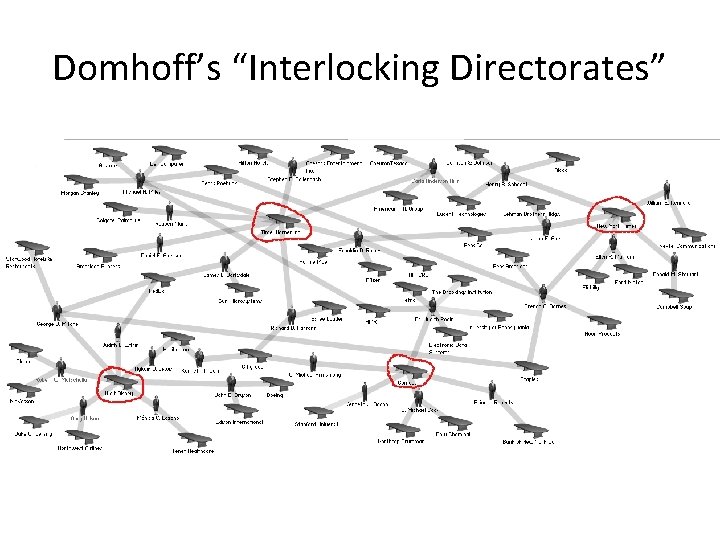
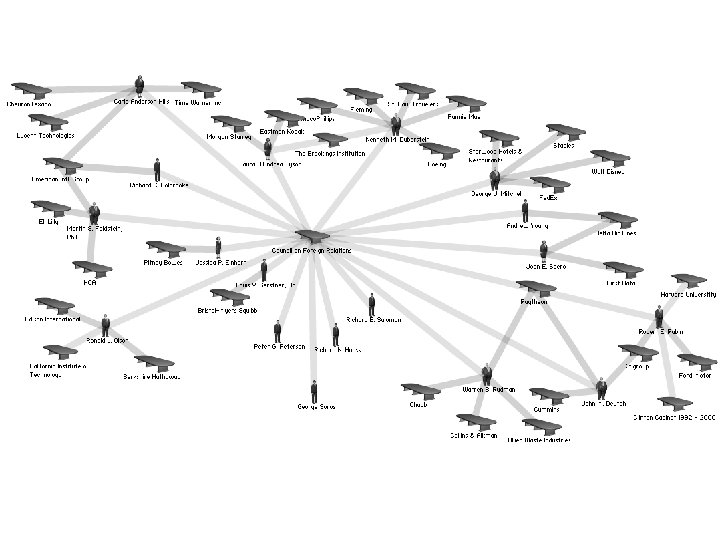
Ruling Elite Consists of Institutional (Mostly Corporate) Interlocks • Interlocking directorates — defined as the linkages among corporations created by individuals who sit on two or more corporate boards — have been a source of research attention since the Progressive Era at the turn of the 20 th century, when they were used by Supreme Court Justice Louis Brandeis and others to claim that a few large commercial and investment banks controlled most major corporations. • Today corporate interlocks are analyzed with bigger databases and matrices that contain information on the linkages between persons and groups. Either a corporate/organizational network, based on common directors, or an interpersonal/social network, based on shared board memberships, can be derived from these matrices.
Melvin “The nationwide social upper class has its own exclusive social institutions and is based in the ownership of great wealth” (Domhoff 291). I felt like this tied back somewhat to Marx’s economic determinism but actually more to Lukes and Gramsci. Particularly Gramsci believed that a class would stay in power both through exploitation and the use of institutions. Except here, they’re not really using institutions to “brainwash” others to accept the status of the wealthy as being deserved but rather using these institutions to provide the upper class with distinct advantages (better education), social exclusivity (social clubs), and organizational stability (class awareness).
Domhoff’s “Interlocking Directorates”
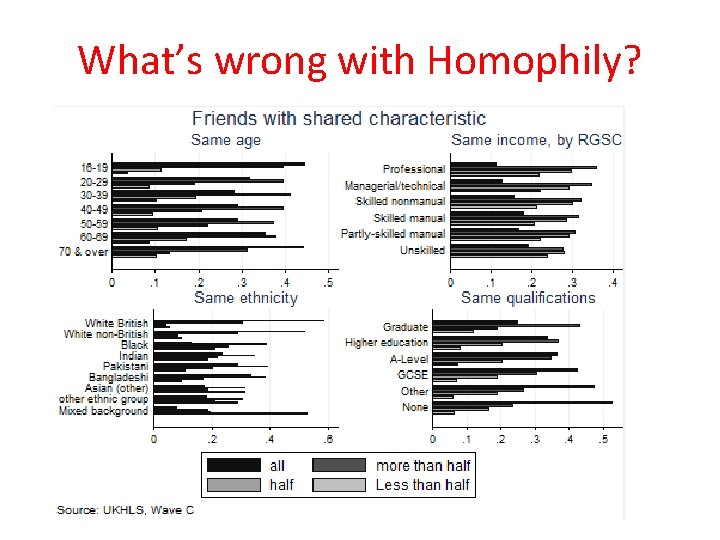
What’s wrong with Homophily?
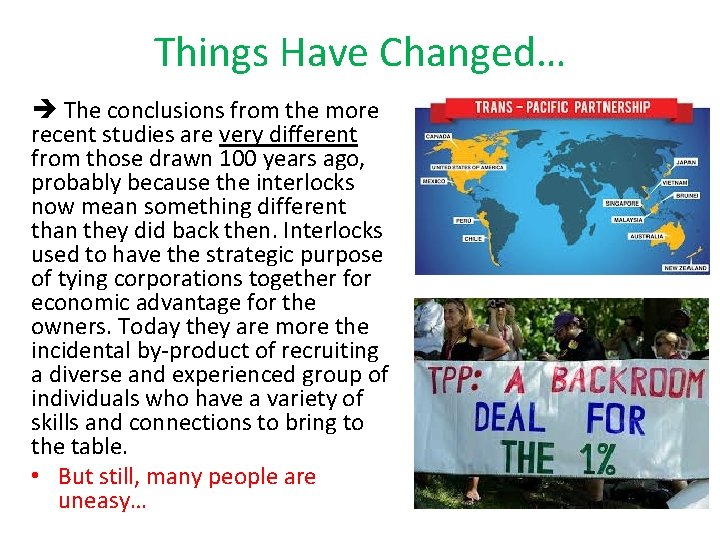
Things Have Changed… The conclusions from the more recent studies are very different from those drawn 100 years ago, probably because the interlocks now mean something different than they did back then. Interlocks used to have the strategic purpose of tying corporations together for economic advantage for the owners. Today they are more the incidental by-product of recruiting a diverse and experienced group of individuals who have a variety of skills and connections to bring to the table. • But still, many people are uneasy…
Kirsi “. . . the system of formal schooling is so insulated that many upper-class students never see the inside of a public school in all their years of education” (Domhoff pg. 291). Perhaps intentionally or perhaps not, Domhoff puts of lot of attention on sharing the same spaces as people outside of your social class. Especially in his talk of schooling and social clubs, it is apparent that in insulated elite class has been created in America partly because they do not operate in a space that isn’t heterogeneous. This only begs the questions how can we change this system when it is already so ingrained, or if we can’t, how can we mitigate its effects?
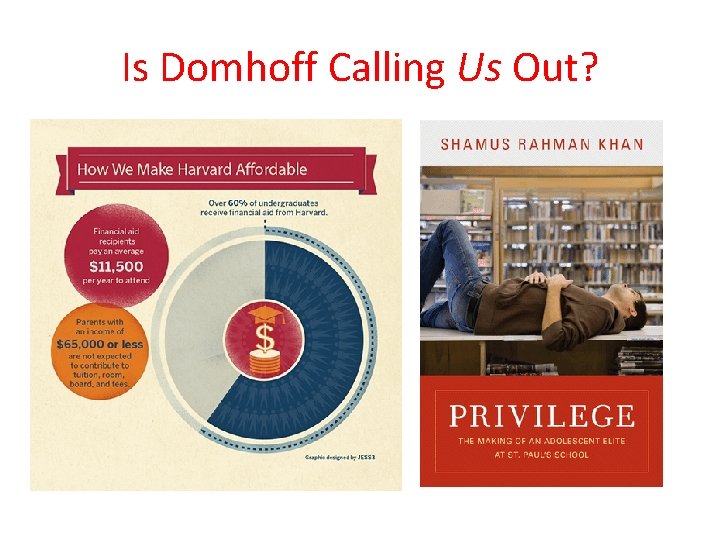
Is Domhoff Calling Us Out?
Ted "The institutions that establish the owners and high-level executives of corporations as a national upper class transcend the presence or absence of any given person or family. Families can rise and fall in the class structure, but the institutions of the upper class persist [. . . ] Involvement in these institutions usually instills a class awareness that includes feelings of superiority, pride, and justified privilege" (Domhoff 294). The argument for the role of institutions in class reproduction in America illustrates both class-based structural issues as well as the micro-level effects of a system that reproduces class standing. From going to a selected number of private schools from the start of one's education, to the few corporations with substantial economic and political power, the system from the start of one's upbringing ultimately affects their trajectory in life. This makes me think about individuals that are able to permeate this concrete system. For example, I think about low-income students being able to, despite a lack of similar resources and opportunities compared to more privileged students, are able to get accepted to schools like Harvard. While this can be seen as progress to somewhat dismantling institutional class reproduction, I wonder if individual triumphs just works to up hold these institutions. If an essence of "equality of opportunity" is shown through individual underdog stories, does this work in favor of retaining class-based structures in America?
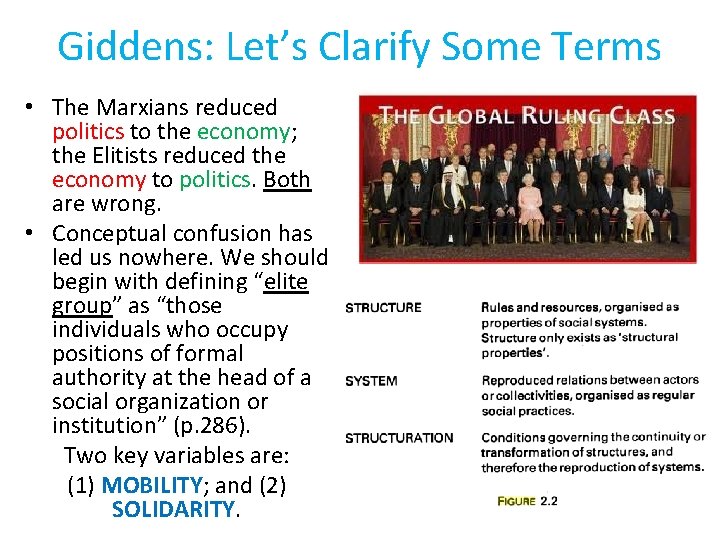
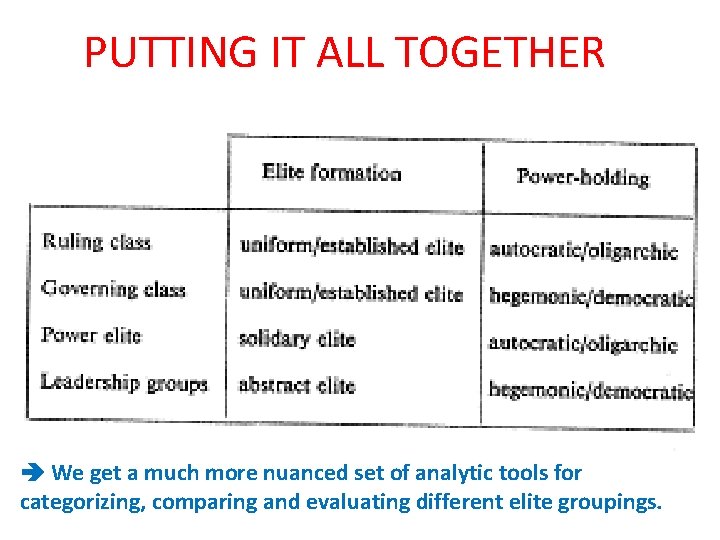
Giddens: Let’s Clarify Some Terms • The Marxians reduced politics to the economy; the Elitists reduced the economy to politics. Both are wrong. • Conceptual confusion has led us nowhere. We should begin with defining “elite group” as “those individuals who occupy positions of formal authority at the head of a social organization or institution” (p. 286). Two key variables are: (1) MOBILITY; and (2) SOLIDARITY.
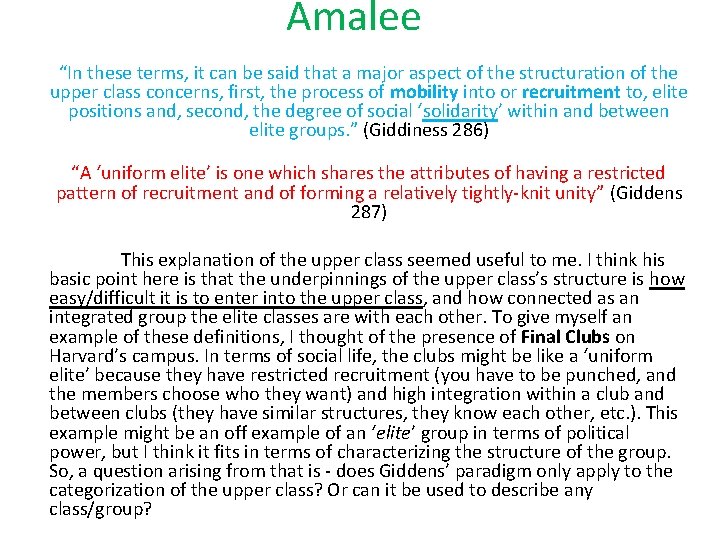
Amalee “In these terms, it can be said that a major aspect of the structuration of the upper class concerns, first, the process of mobility into or recruitment to, elite positions and, second, the degree of social ‘solidarity’ within and between elite groups. ” (Giddiness 286) “A ‘uniform elite’ is one which shares the attributes of having a restricted pattern of recruitment and of forming a relatively tightly-knit unity” (Giddens 287) This explanation of the upper class seemed useful to me. I think his basic point here is that the underpinnings of the upper class’s structure is how easy/difficult it is to enter into the upper class, and how connected as an integrated group the elite classes are with each other. To give myself an example of these definitions, I thought of the presence of Final Clubs on Harvard’s campus. In terms of social life, the clubs might be like a ‘uniform elite’ because they have restricted recruitment (you have to be punched, and the members choose who they want) and high integration within a club and between clubs (they have similar structures, they know each other, etc. ). This example might be an off example of an ‘elite’ group in terms of political power, but I think it fits in terms of characterizing the structure of the group. So, a question arising from that is - does Giddens’ paradigm only apply to the categorization of the upper class? Or can it be used to describe any class/group?
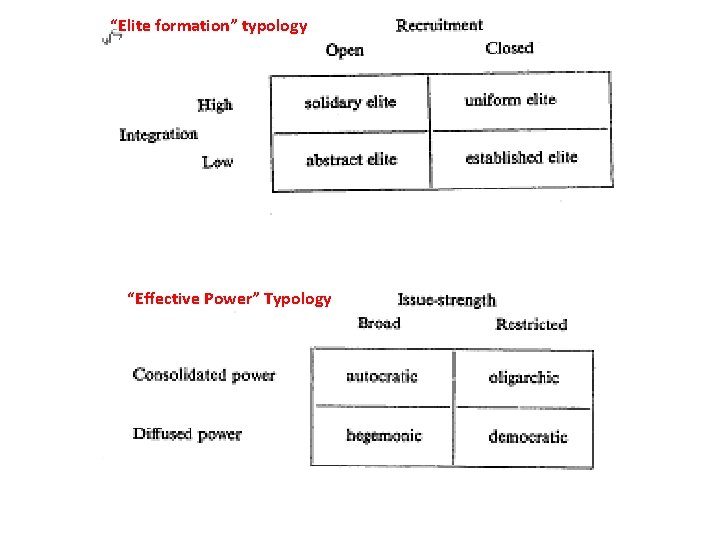
“Elite formation” typology “Effective Power” Typology
PUTTING IT ALL TOGETHER We get a much more nuanced set of analytic tools for categorizing, comparing and evaluating different elite groupings.