
Part IV Control Processes in Police Management Chapter
- Slides: 55
Part IV Control Processes in Police Management Chapter 12 Control and Productivity in the Police Setting CJFS 4870 Chapter 12 - Control & Productivity in the Police Setting 1 © 2011 Delmar, Cengage Learning
NOTICE TO STUDENTS • The material contained herein is for your personal use only and is not to be disseminated to anyone not enrolled in this class. – This Power. Point is not for public posting on any professional or nonprofessional websites. – Copyright laws apply to this material. – Use of this material is strictly limited to this class only. – In short, this material is for your eyes only. 2 © 2011 Delmar, Cengage Learning
Learning Objectives 1. 2. 3. 4. 5. Understand the roles of control. List the levels of control. Understand the various types of control. Explain the control process. Understand performance evaluation and methods of corrective action. 6. Understand the definition of productivity. 7. Measure productivity. 8. Discuss how to improve productivity. CJFS 4870 Chapter 12 - Control & Productivity in the Police Setting 3 © 2011 Delmar, Cengage Learning
Introduction • Organizational control is an important issue in policing. Administrators must control the department to ensure that departmental goals are achieved and that officers are not engaged in inappropriate behavior or activities that otherwise undermine the effectiveness of the department. • This chapter focuses on control from the perspective of making the department as effective as possible in achieving its goals and objectives. CJFS 4870 Chapter 12 - Control & Productivity in the Police Setting 4 © 2011 Delmar, Cengage Learning
Control • The efficient accomplishment of goals and objectives depends on effective control. • “Control is the process of regulating organizational activities so that performance conforms to expectations. ” • Maintaining a balance between undercontrol and overcontrol is a challenge. • Police organizations are thought to employ excessive control because of their quasi-military nature. • It is critical to decide how much control to have in the department. CJFS 4870 Chapter 12 - Control & Productivity in the Police Setting 5 © 2011 Delmar, Cengage Learning
Control • Police administrators must maintain a balance between over-control and under-control so as not to reduce employee initiative and morale. – Along with maintaining balance, both formal and informal constraints influence the control function. CJFS 4870 Chapter 12 - Control & Productivity in the Police Setting 6 © 2011 Delmar, Cengage Learning
Management by Exception 357 • Management by Exception is the technique of reserving top executive attention for those few instances involving significant deviations from anticipated performance. – The top executive should reserve only non-routine matters of control for attention – Police administrators must ensure the establishment of policies, procedures, and rules that allow and facilitate exceptional issues to surface for executive attention only. CJFS 4870 Chapter 12 - Control & Productivity in the Police Setting 7 © 2011 Delmar, Cengage Learning
The Roles of Control 358 • Control procedures assist managers in dealing with administrative challenges. • Bartol and Martin (1998) describe five administrative challenges that can be dealt with by appropriate control mechanisms. 1. 2. 3. 4. 5. Coping with uncertainty Detecting irregularities Identifying opportunities Handling complex situations Decentralizing authority CJFS 4870 Chapter 12 - Control & Productivity in the Police Setting 8 © 2011 Delmar, Cengage Learning
358 The Roles of Control 1. Coping with Uncertainty • There are three sources of uncertainty for organizations: technical, managerial, and institutional. – Technical uncertainty arises from performance of daily functions, i. e. , patrol, investigation, and service delivery. – Managerial uncertainty arises during the course of attempting to coordinate the activities of various units and ensure that they have adequate resources to get the job done. – Institutional uncertainty comes from those organizational elements of the environment over which they have no formal authority, i. e. , the law, public interest, and political sentiment and activities within a department's political jurisdiction. CJFS 4870 Chapter 12 - Control & Productivity in the Police Setting 9 © 2011 Delmar, Cengage Learning
359 The Roles of Control 2. Detecting Irregularities – Administrators rely on control to assist in detecting irregularities and help to ensure small problems do not explode out of control. – Control, then, helps administrators identify problems so steps can be taken to minimize harmful consequences. 3. Identifying Opportunities – Control also helps administrators identify opportunities. For example: high-crimes areas. CJFS 4870 Chapter 12 - Control & Productivity in the Police Setting 10 © 2011 Delmar, Cengage Learning
359 The Roles of Control 4. Handling Complex Situations – Control procedures are especially important for handling complex situations. Control enhances coordination, particularly in large organizations. 5. Decentralizing Authority – Control also provides administrators with the ability to decentralize command. Delegation of authority is required for this happen. This involves decentralizing decision, or moving them out to the margins of the organizational hierarchy, where they can be more readily and reasonably made. CJFS 4870 Chapter 12 - Control & Productivity in the Police Setting 11 © 2011 Delmar, Cengage Learning
Difference Between Strategic and Tactical • The word strategy derives form the Greek word strategos which translates to the art of the general. – This is often confused with tactics, from the Greek taktike. Taktike translates as organizing the army. In modern usage, strategy and tactics might refer not only to warfare, but to a variety of business practices. • Essentially, strategy is the thinking aspect of planning a change, organizing something, or planning a war. – Strategy lays out the goals that need to be accomplished and the ideas for achieving those goals. Strategy can be complex multi-layered plans for accomplishing objectives and may give consideration to tactics. CJFS 4870 Chapter 12 - Control & Productivity in the Police Setting 12 © 2011 Delmar, Cengage Learning
Difference Between Strategic and Tactical • Tactics are the meat and bread of the strategy. They are the “doing” aspect that follows the planning. – Tactics refer specifically to action. In the strategy phase of a plan, the thinkers decide how to achieve their goals. In other words they think about how people will act, i. e. , tactics. They decide on what tactics will be employed to fulfill the strategy. – The tactics themselves are things that get the job done. • Strategies can comprise numerous tactics, with many people involved in attempting to reach an overall goal. While strategy tends to involve the higher ups of an organization, tactics tend to involve all members of the organization. CJFS 4870 Chapter 12 - Control & Productivity in the Police Setting 13 © 2011 Delmar, Cengage Learning
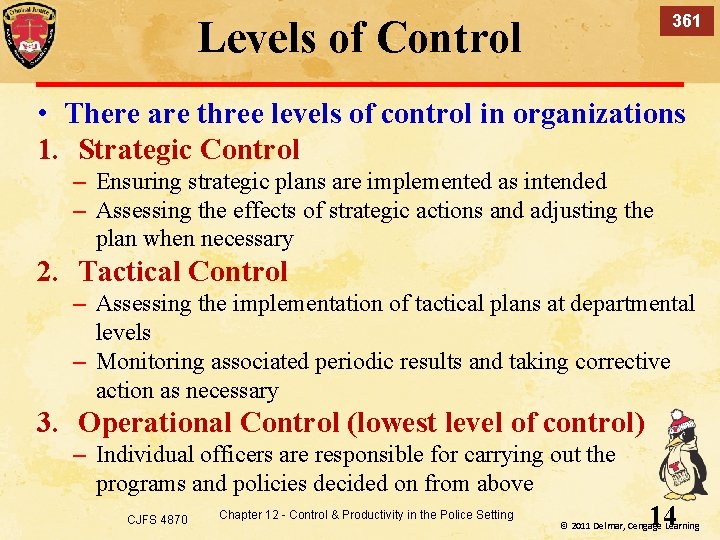
361 Levels of Control • There are three levels of control in organizations 1. Strategic Control – Ensuring strategic plans are implemented as intended – Assessing the effects of strategic actions and adjusting the plan when necessary 2. Tactical Control – Assessing the implementation of tactical plans at departmental levels – Monitoring associated periodic results and taking corrective action as necessary 3. Operational Control (lowest level of control) – Individual officers are responsible for carrying out the programs and policies decided on from above CJFS 4870 Chapter 12 - Control & Productivity in the Police Setting 14 © 2011 Delmar, Cengage Learning
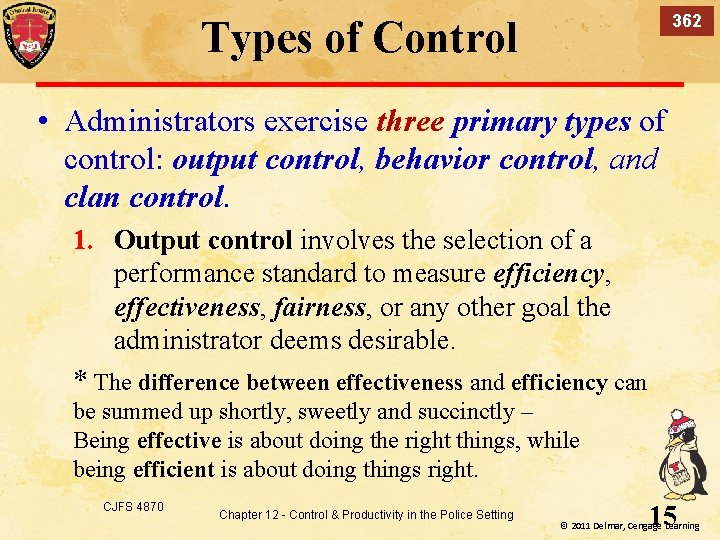
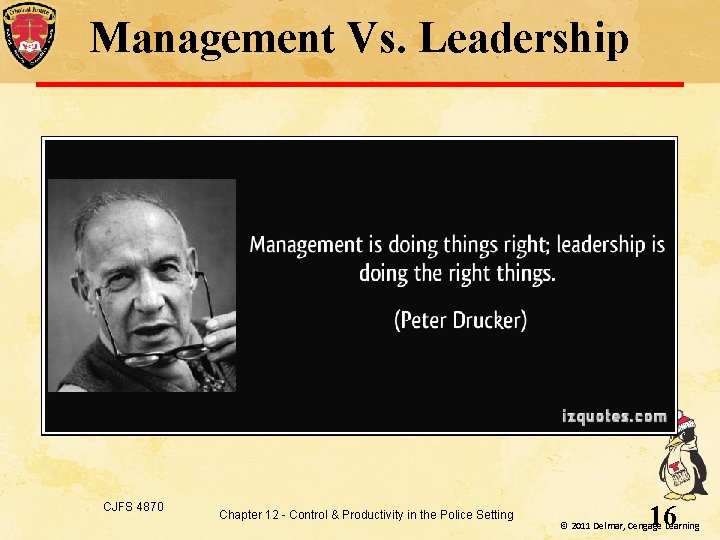
362 Types of Control • Administrators exercise three primary types of control: output control, behavior control, and clan control. 1. Output control involves the selection of a performance standard to measure efficiency, effectiveness, fairness, or any other goal the administrator deems desirable. * The difference between effectiveness and efficiency can be summed up shortly, sweetly and succinctly – Being effective is about doing the right things, while being efficient is about doing things right. CJFS 4870 Chapter 12 - Control & Productivity in the Police Setting 15 © 2011 Delmar, Cengage Learning
Management Vs. Leadership CJFS 4870 Chapter 12 - Control & Productivity in the Police Setting 16 © 2011 Delmar, Cengage Learning
362 Types of Control 2. Behavior control is a type of control system that permits managers to influence employee behavior. – It can be accomplished by direct supervision, through management by objectives, or with rules and standard operating procedures. CJFS 4870 Chapter 12 - Control & Productivity in the Police Setting 17 © 2011 Delmar, Cengage Learning
Types of Control 3. Clan or Employee Group Control goes hand in hand with the notion of organizational culture —the values, expectations, and standards that shape how individuals within the organization interact with one another. – Clan control is unwritten and informal, whereas output and behavioral control are somewhat more concrete, codified, and quantifiable. CJFS 4870 Chapter 12 - Control & Productivity in the Police Setting 18 © 2011 Delmar, Cengage Learning
The Control Process • Managers and supervisors perform the vast majority of the control function in a police department: – Departmental regulations enumerate the acceptable standards and expectations for behavior. – Rules essentially outline how everyone is to perform their assigned tasks and responsibilities. CJFS 4870 Chapter 12 - Control & Productivity in the Police Setting 19 © 2011 Delmar, Cengage Learning
364 The Control Process • The control process involves four essential elements: 1. 2. 3. 4. Determining areas to be controlled, Establishing of standards and expectations, Measuring performance, and Maintain Control Taking corrective action to bring back into line behavior or operations judged to be significantly divergent from established requirements. CJFS 4870 Chapter 12 - Control & Productivity in the Police Setting 20 © 2011 Delmar, Cengage Learning
364 The Control Process I Determining areas to be controlled – Administrators need to choose among areas to control. Excessive control may cause subordinates to be resentful over what they perceive as micromanaging. CJFS 4870 Chapter 12 - Control & Productivity in the Police Setting 21 © 2011 Delmar, Cengage Learning
364 The Control Process II Establishing of standards and expectations – Policies – Procedures – General orders or rules and regulations – External Standards and Expectations: Since police have been vested with a great deal authority and discretion in maintaining social order, preventing criminal acts, and apprehending suspected law violators, public expectations and standards related to the use of this authority are high. The regulation of police employees is much more stringent than that leveled against private business employees or other public officials. CJFS 4870 Chapter 12 - Control & Productivity in the Police Setting 22 © 2011 Delmar, Cengage Learning
364 The Control Process – Internal Standards and Expectations: Police behavior cannot be left to external devices. The police executive should develop internally written documents that define appropriate standards and expectations. CJFS 4870 Chapter 12 - Control & Productivity in the Police Setting 23 © 2011 Delmar, Cengage Learning
367 The Control Process III Measuring Performance and Maintaining Control – Staff Inspections are conducted by specialized staff units. They are the eyes and ears of the department. • Personnel, training, records, communications, planning, criminalistics, and internal affairs – Staff inspection unit is independent of line command, its sole responsibility is to conduct periodic evaluations of departmental possessions, and activities. CJFS 4870 Chapter 12 - Control & Productivity in the Police Setting 24 © 2011 Delmar, Cengage Learning
367 The Control Process III Measuring performance and Maintaining Control – Line supervision involves the inspection of subordinates, activities, equipment, and physical facilities over which the manager or supervisor has responsibility. – Supervisors observe subordinate behavior—or the results of behavior—and gauge the extent to which it matches established standards. CJFS 4870 Chapter 12 - Control & Productivity in the Police Setting 25 © 2011 Delmar, Cengage Learning
368 The Control Process • Measuring performance – Staff inspections are established in large departments for the purpose of examining and evaluating line operations. • The staff inspection unit is normally situated structurally independent of line command, either in the chief’s office or as a major unit that reports directly to the chief. This unit’s sole responsibility is to conduct periodic evaluations of departmental possessions, personnel, and activities. Some departments use a single -function inspection to determine the state of a narrow phase of a unit’s responsibility. CJFS 4870 Chapter 12 - Control & Productivity in the Police Setting 26 © 2011 Delmar, Cengage Learning
371 The Control Process • Measuring performance – Inspection plans include the identification of all areas and items to be inspected and the identification of who is responsible for the inspection. – Audits and research are the most neglected areas of information collection available to police managers and yet are valuable to managers because the collect and analyze quantitative date related to operational performance. – Confidential reports of the findings CJFS 4870 Chapter 12 - Control & Productivity in the Police Setting 27 © 2011 Delmar, Cengage Learning
372 The Control Process IV Taking Corrective Action – Final stage in the control process – It is aimed at rectifying impediments to optimum organizational performance CJFS 4870 Chapter 12 - Control & Productivity in the Police Setting 28 © 2011 Delmar, Cengage Learning
372 The Control Process IV Taking corrective action – The final stage in the control process is corrective action, which consists of the supervisory or management measure undertaken to bring unacceptable conditions in line with standards and expectations. • Circle the problem, consult people and records with information about the problem • Write a clear statement of the problem • Analyze the problem, seeking out multiple solutions CJFS 4870 Chapter 12 - Control & Productivity in the Police Setting 29 © 2011 Delmar, Cengage Learning
365 The Control Process • There are twelve steps for sound development of standard police policies: 1. The department should acknowledge and discuss the role of discretion in police work. 2. All policies should embody a commitment to democratic values, to the legitimacy and appropriateness of constitutional limitations, and to the fundamental goals of community service and responsiveness. CJFS 4870 Chapter 12 - Control & Productivity in the Police Setting 30 © 2011 Delmar, Cengage Learning
The Control Process 3. The department should use the policymaking process as a framework in which to examine or set basic goals and priorities. 4. The department should use the policymaking process to explore new roles and areas of service that traditionally have not been considered police business. 5. The issues to be addressed should be carefully considered, especially during early efforts at establishing policy. 6. The department should develop and enforce a strict policy governing the use of deadly force. CJFS 4870 Chapter 12 - Control & Productivity in the Police Setting 31 © 2011 Delmar, Cengage Learning
The Control Process 7. The department should involve beat officers in policy development. 8. The department should experiment with community participation in policy development. 9. The department must circulate policy to its members in a form that makes it useful, comprehensive, and credible. 10. The department should use the policymaking process to eliminate petty rules. CJFS 4870 Chapter 12 - Control & Productivity in the Police Setting 32 © 2011 Delmar, Cengage Learning
365 The Control Process 11. The department should take advantage of the experience of other cities. 12. The department should adopt a process of regular, automatic policy review so that outdated, inappropriate policy is eliminated or replaced. CJFS 4870 Chapter 12 - Control & Productivity in the Police Setting 33 © 2011 Delmar, Cengage Learning
365 The Control Process • Police administrators use four methods in developing formal policies and written guidelines: 1. Policies developed by professional organizations such as the International Association of Chiefs of Police or a state training agency are incorporated into the department’s procedural guidelines. 2. A police official or planner is given the responsibility of reviewing the police operations and written guidelines. CJFS 4870 Chapter 12 - Control & Productivity in the Police Setting 34 © 2011 Delmar, Cengage Learning
The Control Process 3. Policymaking task forces, usually consisting of both non-police and police members, are established to assist a planner in developing the guidelines. 4. Community-based teams of police officers working in conjunction with other social service agencies and residents of the community write the guidelines. CJFS 4870 Chapter 12 - Control & Productivity in the Police Setting 35 © 2011 Delmar, Cengage Learning
The Control Process 366 • Documentation of standards and expectations provides both a yardstick against which supervisors can measure actions and a basis for learning appropriate self -control. • High-risk activities emphasize the importance of clearly articulated standards and expectations, especially in the area of the use of deadly force. – Another activity that involves high-risk is that of high-speed pursuits. There are four essential elements of a pursuit driving policy: clear and understandable written guidelines, specific training geared toward reinforcing the policy, a detached supervisor who takes control over the pursuit, and CJFS 4870 accountability. Chapter 12 - Control & Productivity in the Police Setting 36 © 2011 Delmar, Cengage Learning
373 Productivity Defined • Productivity can be defined as the targeted level of activity or the relationship between the resources used and the results obtained. To increase productivity means to obtain a greater return for a given investment. • Productivity for police departments can be increased in four general ways: 1. Improve current practices to the best level known 2. Allocate resources to activities that give the highest return for each dollar spent 3. Increase the probability that a given goal will be met 4. Make the most of the police talent CJFS 4870 Chapter 12 - Control & Productivity in the Police Setting 37 © 2011 Delmar, Cengage Learning
Increasing Police Productivity • Improve current practices to the best level known, to obtain better performance without a proportionate increase in cost • Allocate resources to the activities that give the highest return for each dollar spent • Increase the probability that a given goal will be met • Make the most of the police personnel’s talent CJFS 4870 Chapter 12 - Control & Productivity in the Police Setting 38 © 2011 Delmar, Cengage Learning
375 Increasing Police Productivity • Hyde (1985) developed the notion of the “productivity environment. ” • Managers have identified – inadequate resources, – inappropriate organizational structure, and – insufficient motivation as the three most common impediments to productivity. – If people are to be productive, they must work in an environment that is conducive to performance. CJFS 4870 Chapter 12 - Control & Productivity in the Police Setting 39 © 2011 Delmar, Cengage Learning
Uses for Productivity Measures 375 1. By identifying current levels of productivity, measurement can indicate the existence of particular problems. 2. When productivity is measured over time, measurement can indicate the progress or lack of progress in improving productivity. 3. When collected by geographical areas within a jurisdiction, productivity data can help identify areas in particular need of attention. 4. Measurement can serve as a basis for evaluating specific activities. Measurement may indicate activities that need to be modified or personnel who need special attention, such as training or selection practices. CJFS 4870 Chapter 12 - Control & Productivity in the Police Setting 40 © 2011 Delmar, Cengage Learning
Uses for Productivity Measures 375 5. Measurements of existing productivity can provide agencies with the information necessary to set productivity targets. Actual performance can subsequently be compared to the targets to indicate degree of accomplishment—for example, the stated goal of burglary reduction by 35 percent or reducing drug trafficking in a neighborhood. 6. Performance incentives for both managerial and nonmanagerial employees might be established. 7. Measurement of data can be used for in-depth productivity studies on ways to improve specific aspects of productivity, such as the appropriateness of new programs over old ones. CJFS 4870 Chapter 12 - Control & Productivity in the Police Setting 41 © 2011 Delmar, Cengage Learning
Uses for Productivity Measures 375 8. Productivity measurement information can be a major way to account for government operations to the public. Accountability is a growing concern that refers not only to the legal use of funds but also to the broader question of what is actually being accomplished by government operations. • The net effect of using productivity indexes is to improve the ability of the department to serve the public. CJFS 4870 Chapter 12 - Control & Productivity in the Police Setting 42 © 2011 Delmar, Cengage Learning
Traditional Measures of Police Productivity 377 • Time spent at work • Arrest rates/citations issued • Percentage of arrests that lead to convictions • Citizen complaints against officers CJFS 4870 Chapter 12 - Control & Productivity in the Police Setting 43 © 2011 Delmar, Cengage Learning
Traditional Measures of Police Productivity 378 • The most effective way to develop and retain individual officer productivity information is through a standardized reporting system. – This is usually accomplished through some type of officer daily or weekly activity report. – All types of activity should be included in such monitoring system. CJFS 4870 Chapter 12 - Control & Productivity in the Police Setting 44 © 2011 Delmar, Cengage Learning
Individual Unit Productivity 380 • Unit productivity is monitored using the officers’ daily reports. – Commanders can compile weekly, monthly, and annual summaries of their unit’s activity through this reporting system. – These reports can then be compared with reports covering previous periods of time. CJFS 4870 Chapter 12 - Control & Productivity in the Police Setting 45 © 2011 Delmar, Cengage Learning
Productivity of Dissimilar Units • The chief and other top administrators may want to compare the productivity of particular units in dissimilar divisions. • This task is difficult since the goals and activities across dissimilar units are usually totally different. When such comparisons are desired, the basic productivity measure of • time can be used (i. e. , efficiency). CJFS 4870 Chapter 12 - Control & Productivity in the Police Setting 46 © 2011 Delmar, Cengage Learning
Measures of Departmental Productivity 381 • The sum of the numerous productivity measurements compiled for units within a department constitutes a measure of how well the department is performing. Information gained as a result of the monitoring is used in strategic and tactical planning. • It is extremely difficult to measure the productivity of a particular police department since there are no standards for comparison. CJFS 4870 Chapter 12 - Control & Productivity in the Police Setting 47 © 2011 Delmar, Cengage Learning
Contemporary Measures of Police Productivity 382 • Measures of productivity examine the police organization at the micro level; that is, productivity is measured by examining the many “pieces” that compose the whole. Traditional measurement is referred to as “bean counting”—such measures may evaluate police activity, but they do not tell how productive the department is. – A better measure is how well the police were able to respond to community problems. CJFS 4870 Chapter 12 - Control & Productivity in the Police Setting 48 © 2011 Delmar, Cengage Learning
Contemporary Measures of Police Productivity 382 • There are five degrees of effectiveness the police should consider: 1. Totally eliminate the problem 2. Reduce the number of incidents (e. g. , crime and disorder) that occur as a result of the problem 3. Reduce the seriousness of the incidents 4. Implement police procedures that handle incidents more effectively 5. “Co-actively” deal with the problem by enlisting the assistance of an agency better suited to deal with it CJFS 4870 Chapter 12 - Control & Productivity in the Police Setting 49 © 2011 Delmar, Cengage Learning
Contemporary Measures of Police Productivity 382 • Another overarching measurement of police productivity is citizen satisfaction with police services. Citizen satisfaction or approval of the police did not affect police thinking until after the Flint, Michigan Foot Patrol Studies (2001). • Citizen surveys are fairly widespread today. Departments can even customize surveys for different neighborhoods. Since citizens are the consumers of police services, the police should attempt to ensure that they provide those services that best reduce citizen concerns and problems. CJFS 4870 Chapter 12 - Control & Productivity in the Police Setting 50 © 2011 Delmar, Cengage Learning
Contemporary Measures of Police Productivity 382 • Comparative Performance Measurement is the process of comparing an agency’s performance over different time periods, comparing the agency’s performance to other similar agencies, or comparing the performance between units within the agency. CJFS 4870 Chapter 12 - Control & Productivity in the Police Setting 51 © 2011 Delmar, Cengage Learning
384 Improving Police Productivity • Morgan (1975) outlined four criteria used to identify where productivity can be improved: 1. Operations that involve large numbers of employees who perform routine and repetitive tasks 2. Functions that require a large number of hours 3. Functions that normally result in work backlogs 4. High unit costs CJFS 4870 Chapter 12 - Control & Productivity in the Police Setting 52 © 2011 Delmar, Cengage Learning
Strategies for Improving Productivity 385 • Productivity bargaining refers to negotiating increased productivity with police employee unions or fraternal organizations. All units in a police department have idiosyncrasies that can be addressed to improve productivity. • Police administrators should use principled negotiations by attempting to remove personalities from the negotiations and focus on issues when dealing with unions and employee associations. CJFS 4870 Chapter 12 - Control & Productivity in the Police Setting 53 © 2011 Delmar, Cengage Learning
Strategies for Improving Productivity 385 • Capital investment plays an important role in productivity, especially as technology increases. The police manager must examine needs and, where possible, supplement traditional methods of policing with automation to reduce costs. • The management audit is another tool used to increase productivity. This type of audit focuses on the efficiency and effectiveness of operations in terms of productivity. It examines how personnel are allocated, management style, distribution of rank, task assignments within the department, and the reporting system. Chapter 12 - Control & Productivity in the Police Setting CJFS 4870 54 © 2011 Delmar, Cengage Learning
Strategies for Improving Productivity 385 • Finally, the sound application of principles of management enhances productivity. • If managers within a department do not proactively seek ways of improvement, then the department becomes stagnant, and stagnation leads to a situation in which the department is ineffective in meeting community needs. CJFS 4870 Chapter 12 - Control & Productivity in the Police Setting 55 © 2011 Delmar, Cengage Learning