
Part III GPS MAJOR COMPONENTS AND THE SIGNAL
- Slides: 31
Part III GPS: MAJOR COMPONENTS AND THE SIGNAL STRUCTURE GS 608 Civil and Environmental Engineering and Geodetic Science
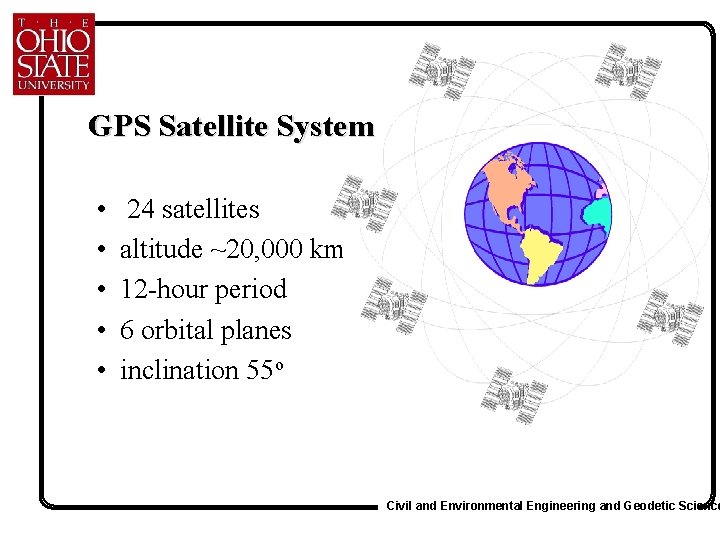
GPS Satellite System • • • 24 satellites altitude ~20, 000 km 12 -hour period 6 orbital planes inclination 55 o Civil and Environmental Engineering and Geodetic Science
GPS Time System Precise time measurement is behind the success of GPS • GPS uses its own time system that is based on the atomic time scale • Basic units: second of the week (second since the beginning of the week) and a week number • The initial GPS epoch (week 0) is 0 h UTC of January 6, 1980 • Universal Coordinated Time (UTC) is the time scale based on atomic second that corresponds to Greenwich time, and is the basis for most radio time signals and legal time systems Civil and Environmental Engineering and Geodetic Science
Time Systems • Since TAI (atomic time) is independent of the Earth’s rotation, the concept of Coordinated Universal Time (UTC), that is in some prescribed way connected to the rotational time, was introduced in 1961, taking advantage of the stability, predictability and almost immediate accessibility of TAI. • UTC is based on the atomic second, thus its rate is uniform. Also, its epoch is manipulated accordingly so that the difference between the time based on Earth diurnal rotation and UTC is maintained on a level less than or equal to 0. 7 s. • For that purpose UTC is modified by introducing a leap second, when required, e. g. , on December 31 and/or June 30. As a result, UTC and TAI always differ by an integer number of seconds that can change only every year or one-half year Civil and Environmental Engineering and Geodetic Science
GPS Time System • Since UTC is altered to keep it synchronized with the rotational time (based on Earth rotation rate), the difference (in seconds) between UTC and GPS time grows • Consequently, what you see on most of GPS receiver displays is the GPS time, which is close to UTC (Greenwich time), which is 5 hours ahead from our time zone • One can usually set up the receiver to display local time if needed Civil and Environmental Engineering and Geodetic Science
GPS Time System • The Global Positioning System (GPS) experienced the first rollover of its internal clock, termed the End of Week (EOW) Rollover, on August 21, 1999 • The EOW rollover exists because the largest increment for counting GPS system time is one week, and weeks are accumulated in a 10 -bit register • GPS time started Jan. 6, 1980 with week "0000" and continued until 23: 59: 47 Universal Time Coordinated (UTC), Aug. 21. • After the rollover, the GPS clock reset itself to "0000. " This was the first EOW rollover since the GPS constellation was established. Civil and Environmental Engineering and Geodetic Science
GPS Satellite System • continuous signal transmit • fundamental frequency 10. 23 MHz • almost circular orbit (e = 0. 02) • at least 4 satellites visible at all times from any point on the Earth’s surface (5 -7 most of the time) Civil and Environmental Engineering and Geodetic Science
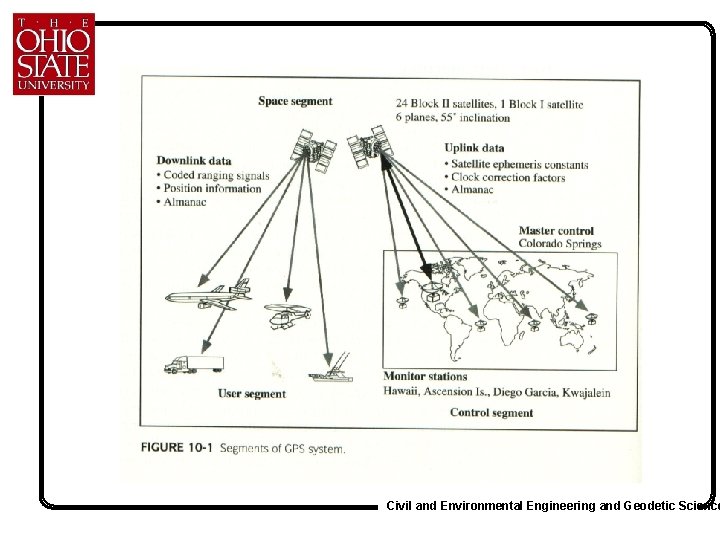
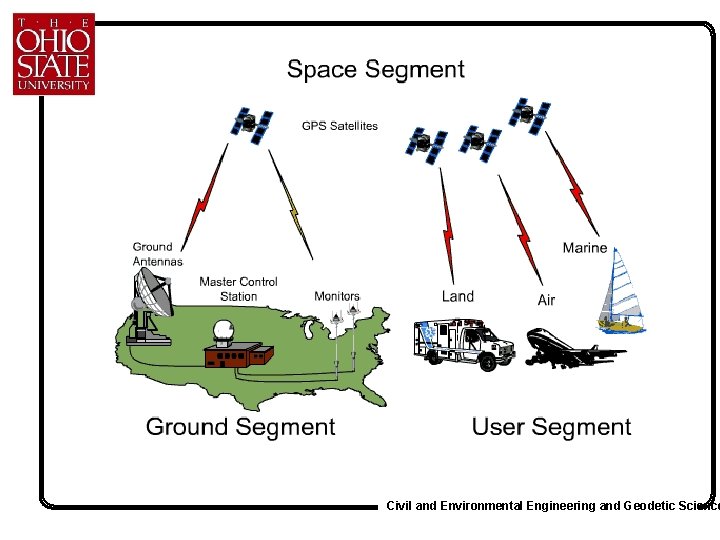
GPS - Major Components • Space Segment - responsible for satellite development, manufacturing and launching • Control Segment - continuous monitoring and controlling the system, determining GPS time, prediction of satellite ephemeris and the clock behavior, as well as updating the navigation message for every satellite • User Segment - numerous types of GPS receivers, providing navigators, surveyors, geodesists and other users with precise positioning and timing data Civil and Environmental Engineering and Geodetic Science
Civil and Environmental Engineering and Geodetic Science
Civil and Environmental Engineering and Geodetic Science
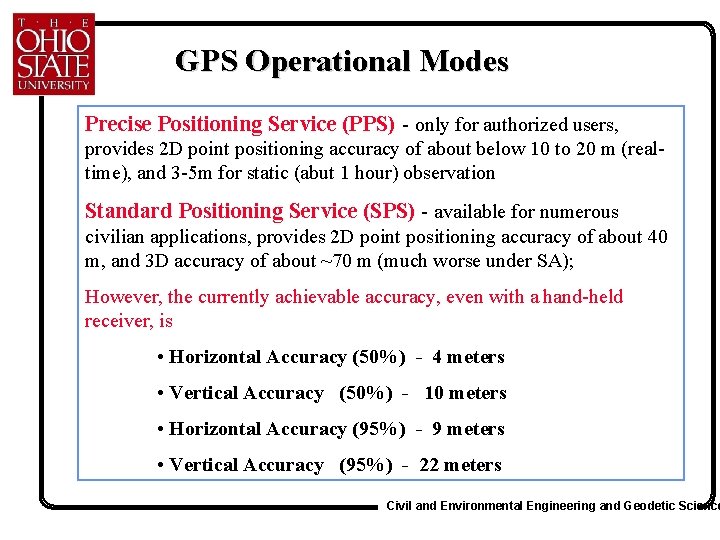
GPS Operational Modes Precise Positioning Service (PPS) - only for authorized users, provides 2 D point positioning accuracy of about below 10 to 20 m (realtime), and 3 -5 m for static (abut 1 hour) observation Standard Positioning Service (SPS) - available for numerous civilian applications, provides 2 D point positioning accuracy of about 40 m, and 3 D accuracy of about ~70 m (much worse under SA); However, the currently achievable accuracy, even with a hand-held receiver, is • Horizontal Accuracy (50%) - 4 meters • Vertical Accuracy (50%) - 10 meters • Horizontal Accuracy (95%) - 9 meters • Vertical Accuracy (95%) - 22 meters Civil and Environmental Engineering and Geodetic Science
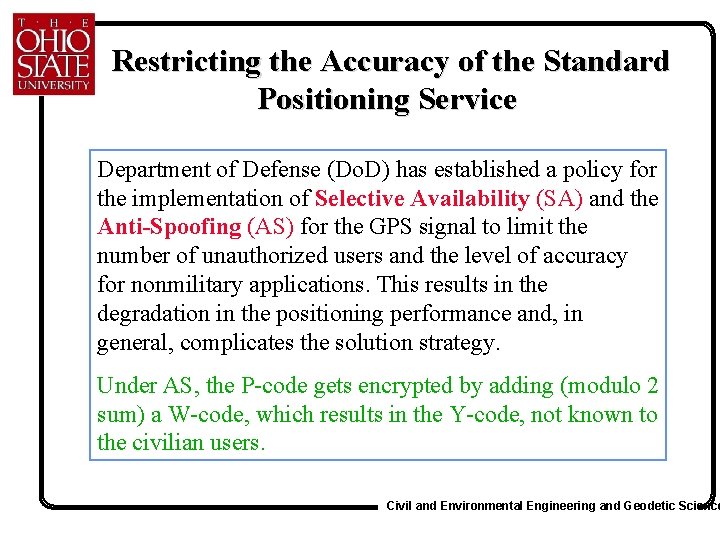
Restricting the Accuracy of the Standard Positioning Service Department of Defense (Do. D) has established a policy for the implementation of Selective Availability (SA) and the Anti-Spoofing (AS) for the GPS signal to limit the number of unauthorized users and the level of accuracy for nonmilitary applications. This results in the degradation in the positioning performance and, in general, complicates the solution strategy. Under AS, the P-code gets encrypted by adding (modulo 2 sum) a W-code, which results in the Y-code, not known to the civilian users. Civil and Environmental Engineering and Geodetic Science
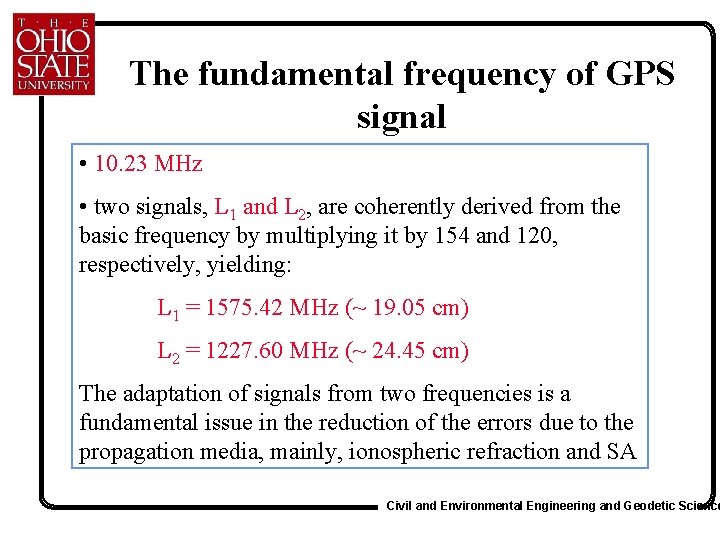
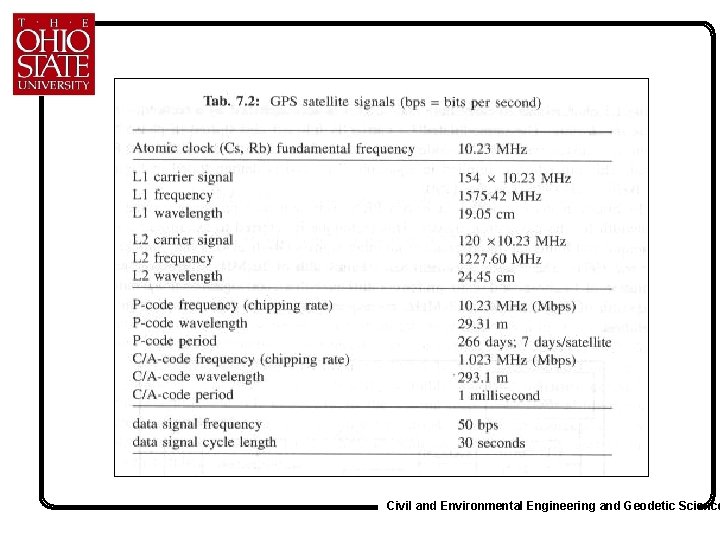
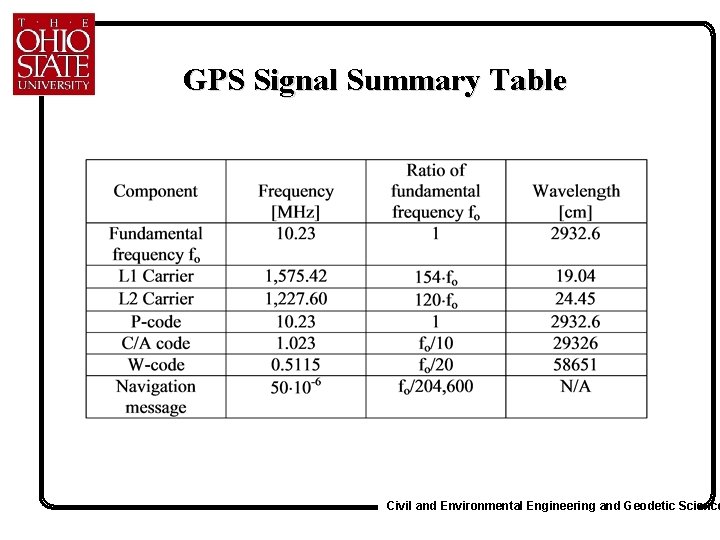
The fundamental frequency of GPS signal • 10. 23 MHz • two signals, L 1 and L 2, are coherently derived from the basic frequency by multiplying it by 154 and 120, respectively, yielding: L 1 = 1575. 42 MHz (~ 19. 05 cm) L 2 = 1227. 60 MHz (~ 24. 45 cm) The adaptation of signals from two frequencies is a fundamental issue in the reduction of the errors due to the propagation media, mainly, ionospheric refraction and SA Civil and Environmental Engineering and Geodetic Science
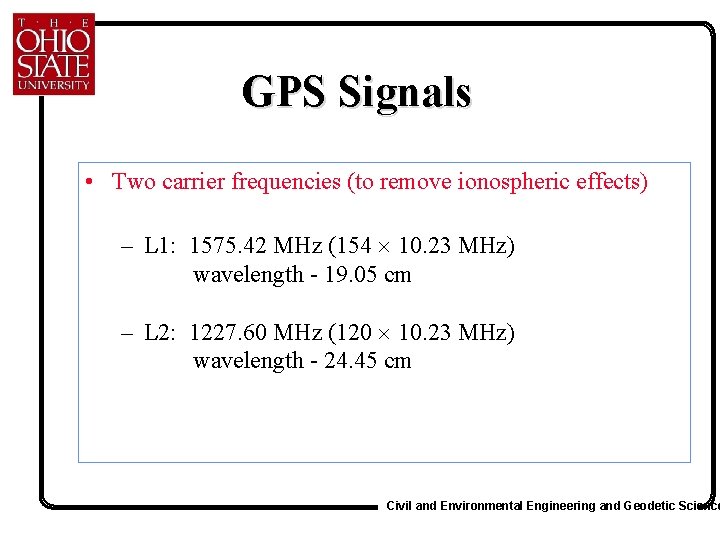
GPS Signals • Two carrier frequencies (to remove ionospheric effects) – L 1: 1575. 42 MHz (154 10. 23 MHz) wavelength - 19. 05 cm – L 2: 1227. 60 MHz (120 10. 23 MHz) wavelength - 24. 45 cm Civil and Environmental Engineering and Geodetic Science
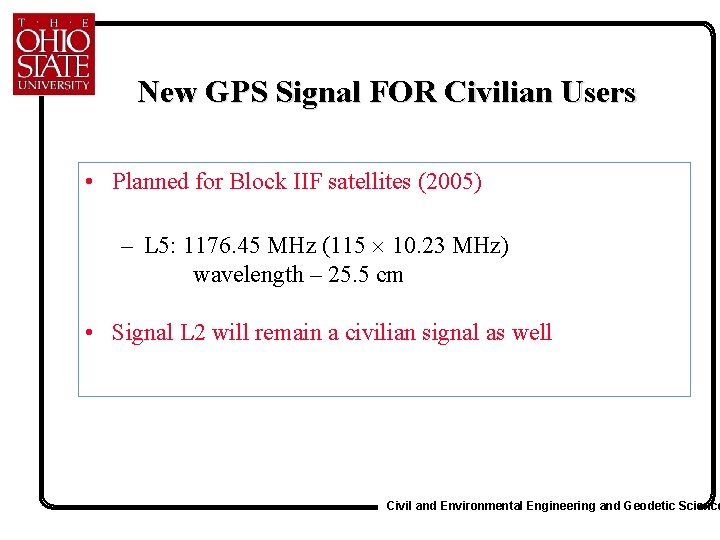
New GPS Signal FOR Civilian Users • Planned for Block IIF satellites (2005) – L 5: 1176. 45 MHz (115 10. 23 MHz) wavelength – 25. 5 cm • Signal L 2 will remain a civilian signal as well Civil and Environmental Engineering and Geodetic Science
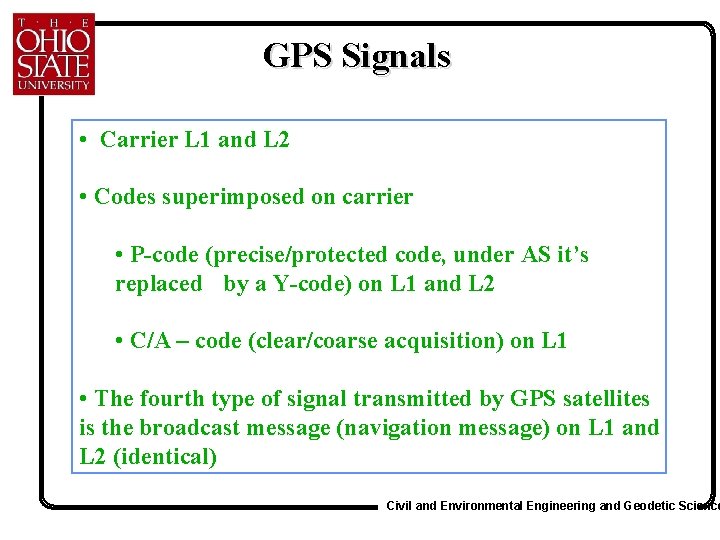
GPS Signals • Carrier L 1 and L 2 • Codes superimposed on carrier • P-code (precise/protected code, under AS it’s replaced by a Y-code) on L 1 and L 2 • C/A – code (clear/coarse acquisition) on L 1 • The fourth type of signal transmitted by GPS satellites is the broadcast message (navigation message) on L 1 and L 2 (identical) Civil and Environmental Engineering and Geodetic Science
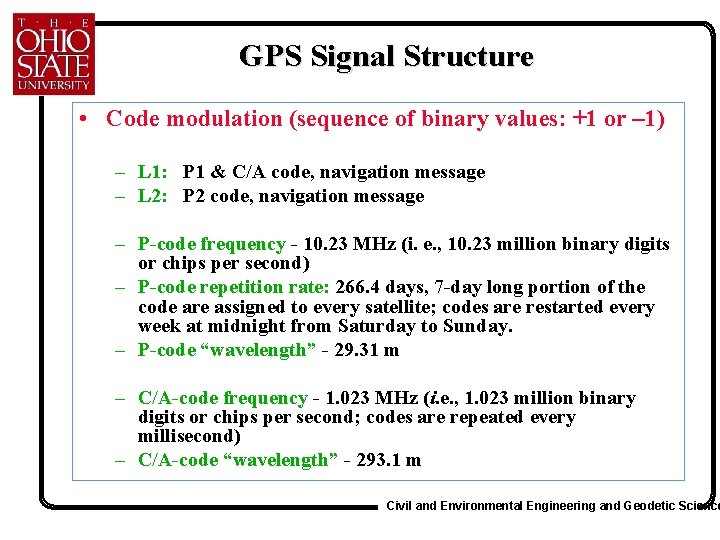
GPS Signal Structure • Code modulation (sequence of binary values: +1 or – 1) – L 1: P 1 & C/A code, navigation message – L 2: P 2 code, navigation message – P-code frequency - 10. 23 MHz (i. e. , 10. 23 million binary digits or chips per second) – P-code repetition rate: 266. 4 days, 7 -day long portion of the code are assigned to every satellite; codes are restarted every week at midnight from Saturday to Sunday. – P-code “wavelength” - 29. 31 m – C/A-code frequency - 1. 023 MHz (i. e. , 1. 023 million binary digits or chips per second; codes are repeated every millisecond) – C/A-code “wavelength” - 293. 1 m Civil and Environmental Engineering and Geodetic Science
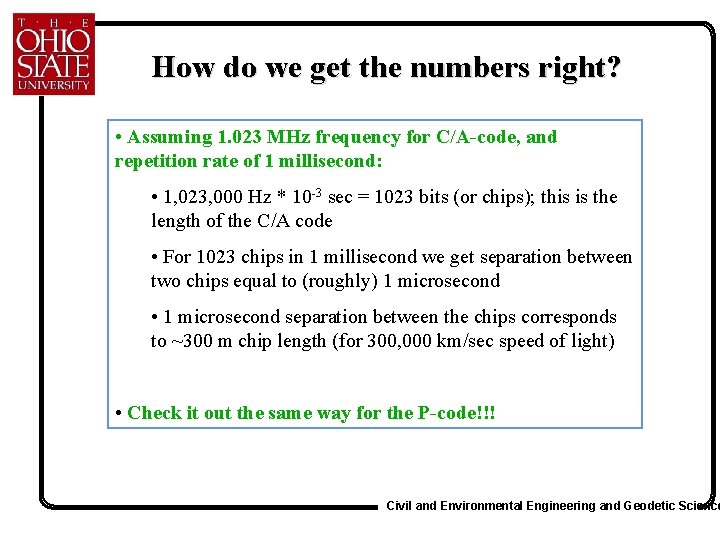
How do we get the numbers right? • Assuming 1. 023 MHz frequency for C/A-code, and repetition rate of 1 millisecond: • 1, 023, 000 Hz * 10 -3 sec = 1023 bits (or chips); this is the length of the C/A code • For 1023 chips in 1 millisecond we get separation between two chips equal to (roughly) 1 microsecond • 1 microsecond separation between the chips corresponds to ~300 m chip length (for 300, 000 km/sec speed of light) • Check it out the same way for the P-code!!! Civil and Environmental Engineering and Geodetic Science
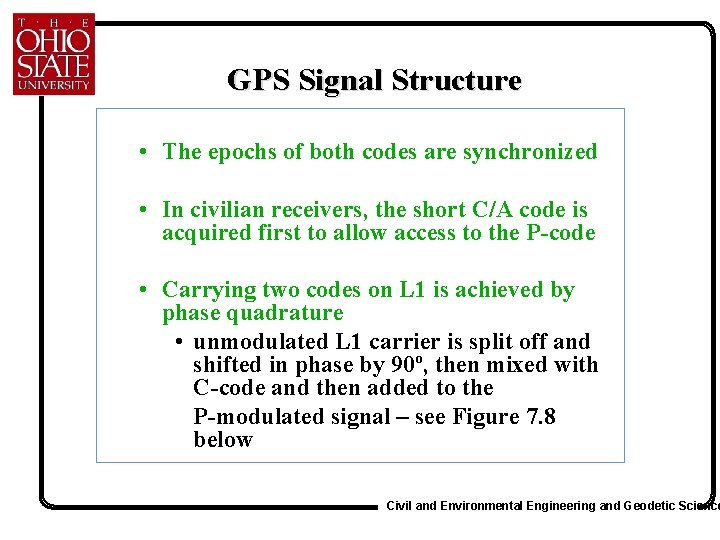
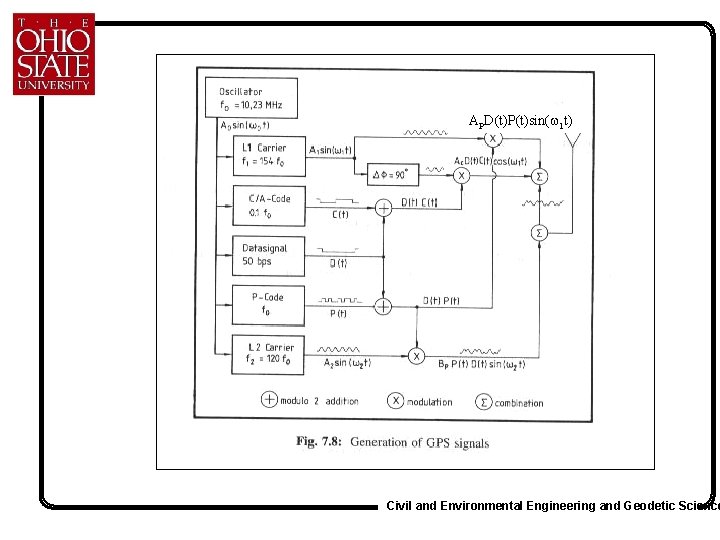
GPS Signal Structure • The epochs of both codes are synchronized • In civilian receivers, the short C/A code is acquired first to allow access to the P-code • Carrying two codes on L 1 is achieved by phase quadrature • unmodulated L 1 carrier is split off and shifted in phase by 90º, then mixed with C-code and then added to the P-modulated signal – see Figure 7. 8 below Civil and Environmental Engineering and Geodetic Science
APD(t)P(t)sin( 1 t) Civil and Environmental Engineering and Geodetic Science
Civil and Environmental Engineering and Geodetic Science
GPS Signal Summary Table Civil and Environmental Engineering and Geodetic Science
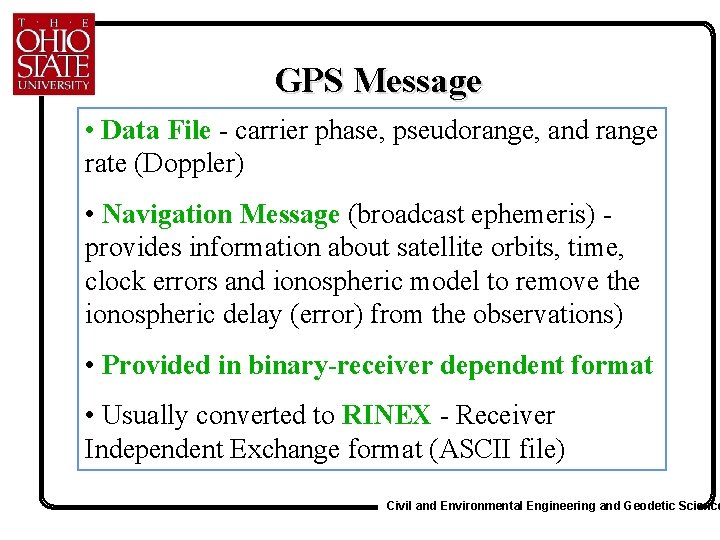
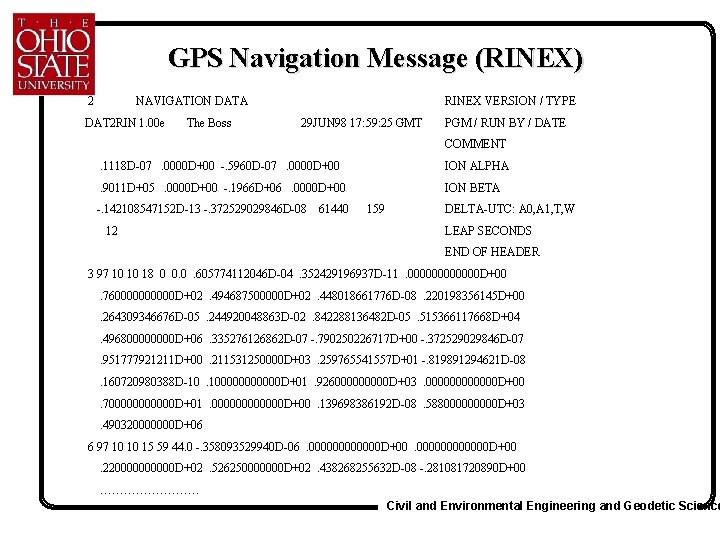
GPS Message • Data File - carrier phase, pseudorange, and range rate (Doppler) • Navigation Message (broadcast ephemeris) provides information about satellite orbits, time, clock errors and ionospheric model to remove the ionospheric delay (error) from the observations) • Provided in binary-receiver dependent format • Usually converted to RINEX - Receiver Independent Exchange format (ASCII file) Civil and Environmental Engineering and Geodetic Science
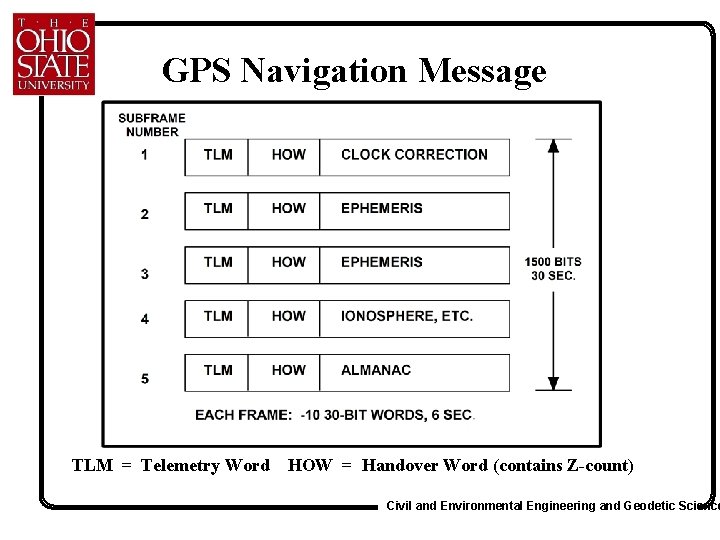
GPS Navigation Message TLM = Telemetry Word HOW = Handover Word (contains Z-count) Civil and Environmental Engineering and Geodetic Science
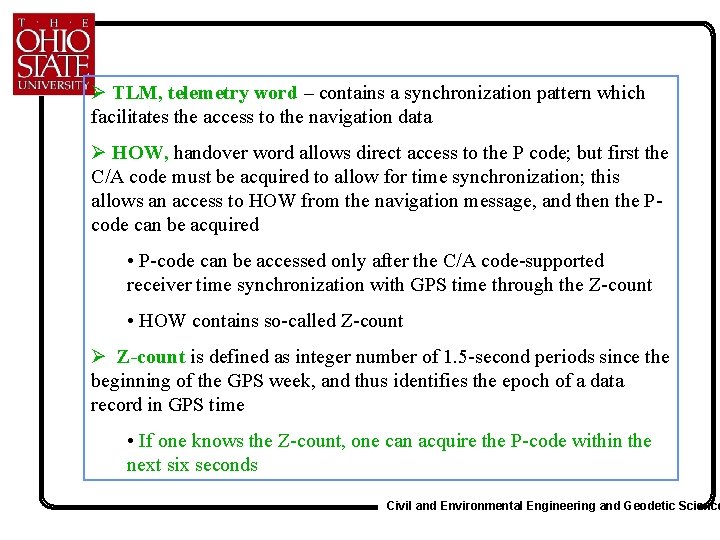
Ø TLM, telemetry word – contains a synchronization pattern which facilitates the access to the navigation data Ø HOW, handover word allows direct access to the P code; but first the C/A code must be acquired to allow for time synchronization; this allows an access to HOW from the navigation message, and then the Pcode can be acquired • P-code can be accessed only after the C/A code-supported receiver time synchronization with GPS time through the Z-count • HOW contains so-called Z-count Ø Z-count is defined as integer number of 1. 5 -second periods since the beginning of the GPS week, and thus identifies the epoch of a data record in GPS time • If one knows the Z-count, one can acquire the P-code within the next six seconds Civil and Environmental Engineering and Geodetic Science
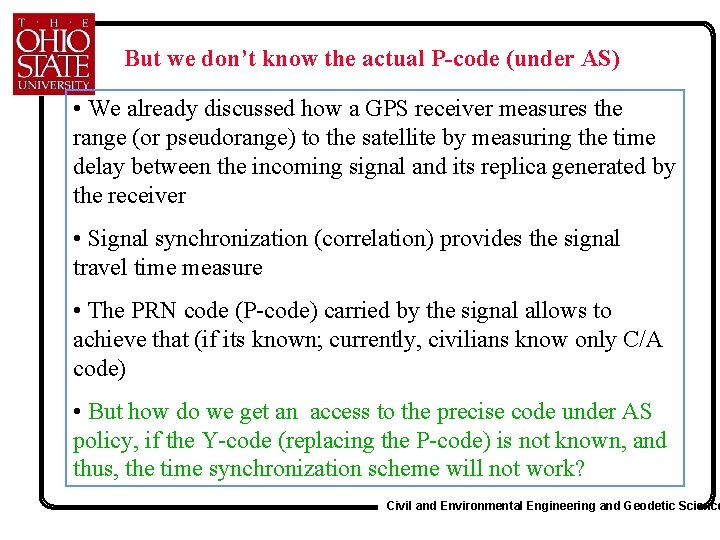
But we don’t know the actual P-code (under AS) • We already discussed how a GPS receiver measures the range (or pseudorange) to the satellite by measuring the time delay between the incoming signal and its replica generated by the receiver • Signal synchronization (correlation) provides the signal travel time measure • The PRN code (P-code) carried by the signal allows to achieve that (if its known; currently, civilians know only C/A code) • But how do we get an access to the precise code under AS policy, if the Y-code (replacing the P-code) is not known, and thus, the time synchronization scheme will not work? Civil and Environmental Engineering and Geodetic Science
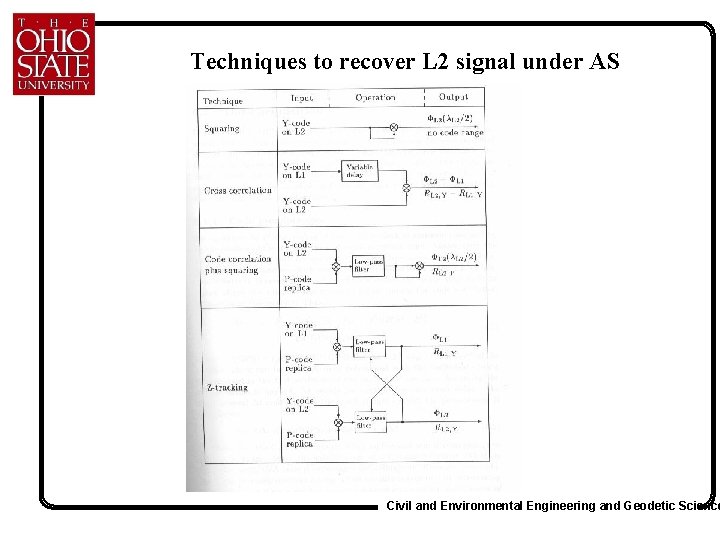
Techniques to recover L 2 signal under AS Civil and Environmental Engineering and Geodetic Science
GPS Navigation Message (RINEX) 2 NAVIGATION DATA DAT 2 RIN 1. 00 e The Boss RINEX VERSION / TYPE 29 JUN 98 17: 59: 25 GMT PGM / RUN BY / DATE COMMENT . 1118 D-07. 0000 D+00 -. 5960 D-07. 0000 D+00 ION ALPHA . 9011 D+05. 0000 D+00 -. 1966 D+06. 0000 D+00 ION BETA -. 142108547152 D-13 -. 372529029846 D-08 12 61440 159 DELTA-UTC: A 0, A 1, T, W LEAP SECONDS END OF HEADER 3 97 10 10 18 0 0. 0. 605774112046 D-04. 352429196937 D-11. 000000 D+00. 7600000 D+02. 494687500000 D+02. 448018661776 D-08. 220198356145 D+00. 264309346676 D-05. 244920048863 D-02. 842288136482 D-05. 515366117668 D+04. 49680000 D+06. 335276126862 D-07 -. 790250226717 D+00 -. 372529029846 D-07. 951777921211 D+00. 211531250000 D+03. 259765541557 D+01 -. 819891294621 D-08. 160720980388 D-10. 1000000 D+01. 92600000 D+03. 000000 D+00. 7000000 D+01. 000000 D+00. 139698386192 D-08. 58800000 D+03. 490320000000 D+06 6 97 10 10 15 59 44. 0 -. 358093529940 D-06. 000000000000 D+00. 2200000 D+02. 526250000000 D+02. 438268255632 D-08 -. 281081720890 D+00 …………. Civil and Environmental Engineering and Geodetic Science
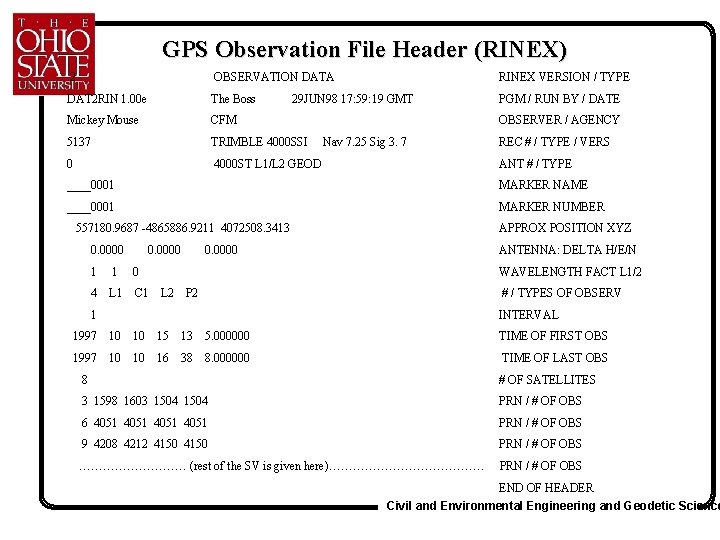
GPS Observation File Header (RINEX) 2 OBSERVATION DATA RINEX VERSION / TYPE DAT 2 RIN 1. 00 e The Boss PGM / RUN BY / DATE Mickey Mouse CFM 5137 TRIMBLE 4000 SSI 0 4000 ST L 1/L 2 GEOD 29 JUN 98 17: 59: 19 GMT OBSERVER / AGENCY Nav 7. 25 Sig 3. 7 REC # / TYPE / VERS ANT # / TYPE ____0001 MARKER NAME ____0001 MARKER NUMBER 557180. 9687 -4865886. 9211 4072508. 3413 0. 0000 1 1 0 4 L 1 C 1 APPROX POSITION XYZ 0. 0000 ANTENNA: DELTA H/E/N WAVELENGTH FACT L 1/2 L 2 P 2 # / TYPES OF OBSERV 1 INTERVAL 1997 10 10 15 13 5. 000000 TIME OF FIRST OBS 1997 10 10 16 38 8. 000000 TIME OF LAST OBS 8 # OF SATELLITES 3 1598 1603 1504 PRN / # OF OBS 6 4051 PRN / # OF OBS 9 4208 4212 4150 PRN / # OF OBS …………… (rest of the SV is given here)………………… PRN / # OF OBS END OF HEADER Civil and Environmental Engineering and Geodetic Science
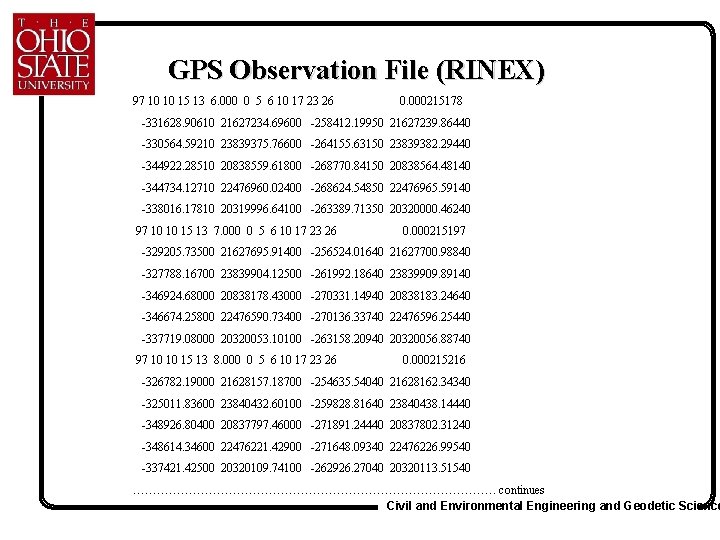
GPS Observation File (RINEX) 97 10 10 15 13 6. 000 0 5 6 10 17 23 26 0. 000215178 -331628. 90610 21627234. 69600 -258412. 19950 21627239. 86440 -330564. 59210 23839375. 76600 -264155. 63150 23839382. 29440 -344922. 28510 20838559. 61800 -268770. 84150 20838564. 48140 -344734. 12710 22476960. 02400 -268624. 54850 22476965. 59140 -338016. 17810 20319996. 64100 -263389. 71350 20320000. 46240 97 10 10 15 13 7. 000 0 5 6 10 17 23 26 0. 000215197 -329205. 73500 21627695. 91400 -256524. 01640 21627700. 98840 -327788. 16700 23839904. 12500 -261992. 18640 23839909. 89140 -346924. 68000 20838178. 43000 -270331. 14940 20838183. 24640 -346674. 25800 22476590. 73400 -270136. 33740 22476596. 25440 -337719. 08000 20320053. 10100 -263158. 20940 20320056. 88740 97 10 10 15 13 8. 000 0 5 6 10 17 23 26 0. 000215216 -326782. 19000 21628157. 18700 -254635. 54040 21628162. 34340 -325011. 83600 23840432. 60100 -259828. 81640 23840438. 14440 -348926. 80400 20837797. 46000 -271891. 24440 20837802. 31240 -348614. 34600 22476221. 42900 -271648. 09340 22476226. 99540 -337421. 42500 20320109. 74100 -262926. 27040 20320113. 51540 ………………………………………. continues Civil and Environmental Engineering and Geodetic Science
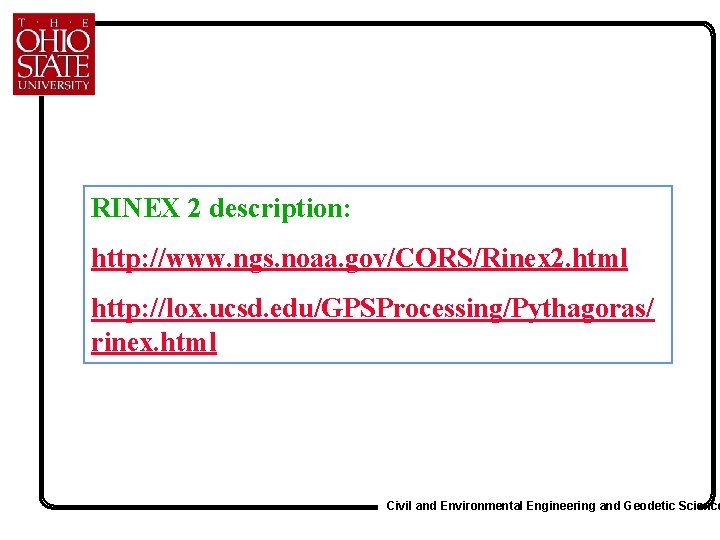
RINEX 2 description: http: //www. ngs. noaa. gov/CORS/Rinex 2. html http: //lox. ucsd. edu/GPSProcessing/Pythagoras/ rinex. html Civil and Environmental Engineering and Geodetic Science