
PART III DATA ANALYSIS Structure PART I PREPARATION



- Slides: 17
PART III: DATA ANALYSIS
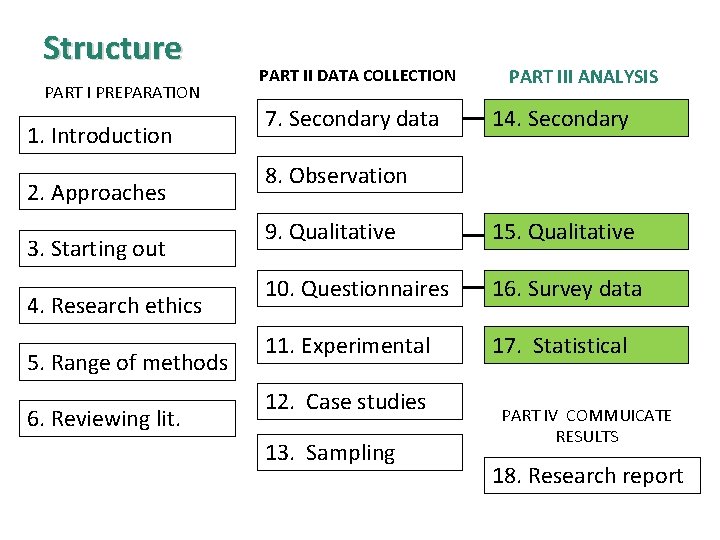
Structure PART I PREPARATION 1. Introduction 2. Approaches 3. Starting out 4. Research ethics 5. Range of methods 6. Reviewing lit. PART II DATA COLLECTION 7. Secondary data PART III ANALYSIS 14. Secondary 8. Observation 9. Qualitative 15. Qualitative 10. Questionnaires 16. Survey data 11. Experimental 17. Statistical 12. Case studies 13. Sampling PART IV COMMUICATE RESULTS 18. Research report
Chapter 14: Analysing secondary data
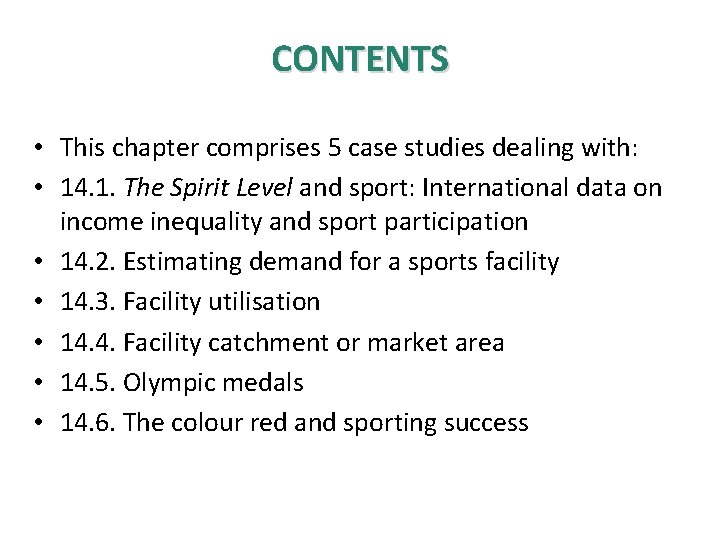
CONTENTS • This chapter comprises 5 case studies dealing with: • 14. 1. The Spirit Level and sport: International data on income inequality and sport participation • 14. 2. Estimating demand for a sports facility • 14. 3. Facility utilisation • 14. 4. Facility catchment or market area • 14. 5. Olympic medals • 14. 6. The colour red and sporting success
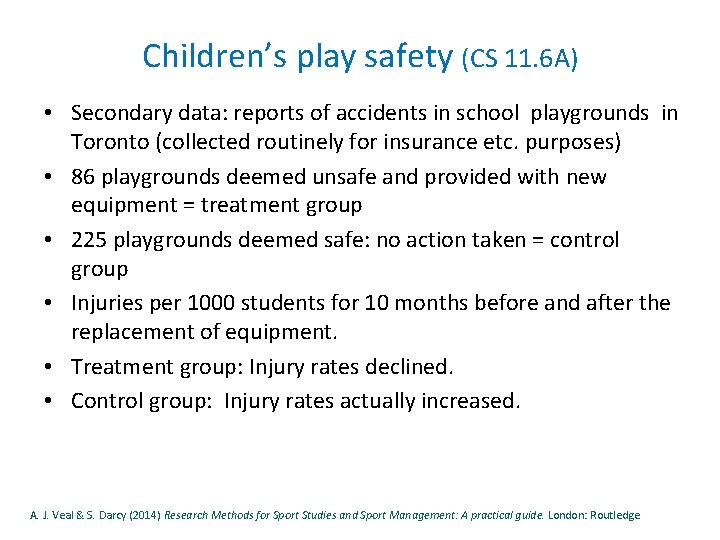
Children’s play safety (CS 11. 6 A) • Secondary data: reports of accidents in school playgrounds in Toronto (collected routinely for insurance etc. purposes) • 86 playgrounds deemed unsafe and provided with new equipment = treatment group • 225 playgrounds deemed safe: no action taken = control group • Injuries per 1000 students for 10 months before and after the replacement of equipment. • Treatment group: Injury rates declined. • Control group: Injury rates actually increased. A. J. Veal & S. Darcy (2014) Research Methods for Sport Studies and Sport Management: A practical guide. London: Routledge
CS 14. 1 The Spirit Level and sport • The Spirit Level Wilkinson & Pickett (2009): – secondary data from UN etc. – countries with more equal income distribution perform better on a wide range of human welfare measures – sport not covered • Sport participation data explored here A. J. Veal & S. Darcy (2014) Research Methods for Sport Studies and Sport Management: A practical guide. London: Routledge
Income inequality & sport participation: Europe, 2009 (Fig. 14. 1) 100 R 2 = 0. 3748 DEN 90 % participating in sport SWE 80 NL GER FIN FRA AUT 70 60 IRE SPA UK BEL GRE 50 40 POR ITA 30 3. 0 4. 0 More equal 5. 0 6. 0 Income distribution 7. 0 8. 0 More unequal 9. 0 A. J. Veal & S. Darcy (2014) Research Methods for Sport Studies and Sport Management: A practical guide. London: Routledge
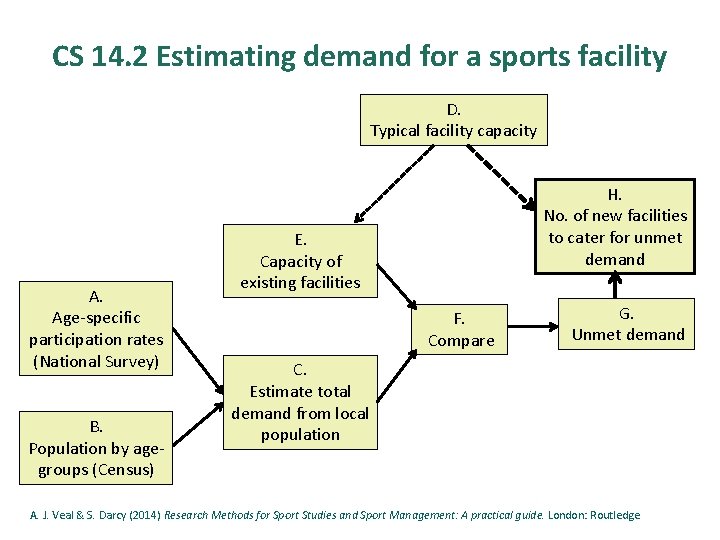
CS 14. 2 Estimating demand for a sports facility D. Typical facility capacity A. Age-specific participation rates (National Survey) B. Population by agegroups (Census) H. No. of new facilities to cater for unmet demand E. Capacity of existing facilities F. Compare G. Unmet demand C. Estimate total demand from local population A. J. Veal & S. Darcy (2014) Research Methods for Sport Studies and Sport Management: A practical guide. London: Routledge
Estimating demand for a sports facility contd C. D. D. E. F. G. H. Secondary data: National survey + Census Estimated total demand: 4600 visits per week Typical facility capacity: 500 visits/week Capacity of 4 existing facilities: 2000 visits/week Comparison: 4600 and 2000 visits/week Unmet demand: 2600 visits/week No. of new facilities to cater for unmet demand: 2600/500 = 5. 2. Five courts. A. J. Veal & S. Darcy (2014) Research Methods for Sport Studies and Sport Management: A practical guide. London: Routledge
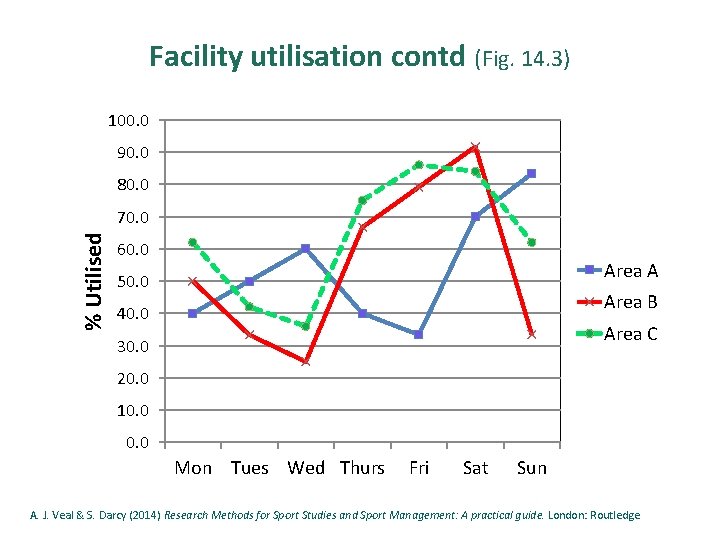
CS 14. 3 Facility utilisation • Secondary data: ticket/bookings data for different areas in a multi-purpose facility • See Table 14. 4 and Fig. 14. 4 A. J. Veal & S. Darcy (2014) Research Methods for Sport Studies and Sport Management: A practical guide. London: Routledge
Facility utilisation contd (Fig. 14. 3) 100. 0 90. 0 80. 0 % Utilised 70. 0 60. 0 Area A 50. 0 Area B 40. 0 Area C 30. 0 20. 0 10. 0 Mon Tues Wed Thurs Fri Sat Sun A. J. Veal & S. Darcy (2014) Research Methods for Sport Studies and Sport Management: A practical guide. London: Routledge
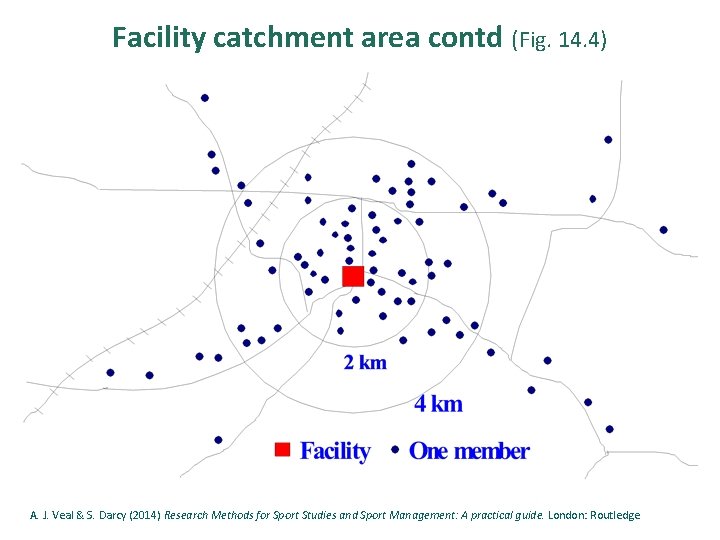
CS 14. 4 Facility catchment area: • Secondary data: customer address data – from bookings or membership records • See Fig. 14. 4 A. J. Veal & S. Darcy (2014) Research Methods for Sport Studies and Sport Management: A practical guide. London: Routledge
Facility catchment area contd (Fig. 14. 4) A. J. Veal & S. Darcy (2014) Research Methods for Sport Studies and Sport Management: A practical guide. London: Routledge
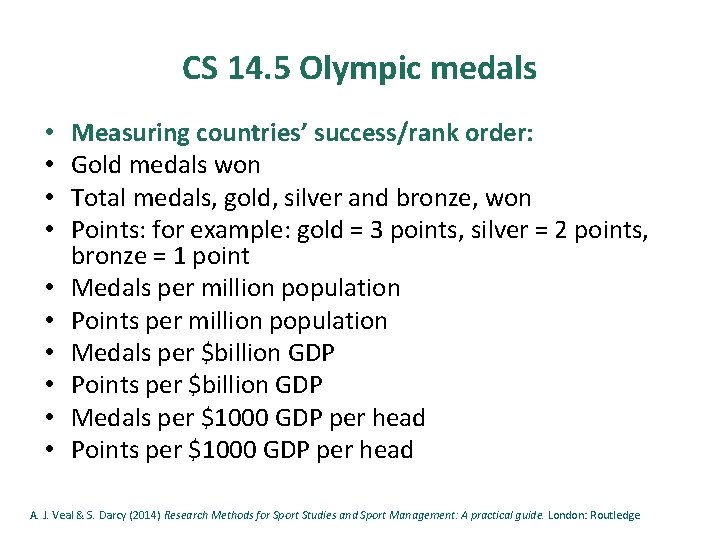
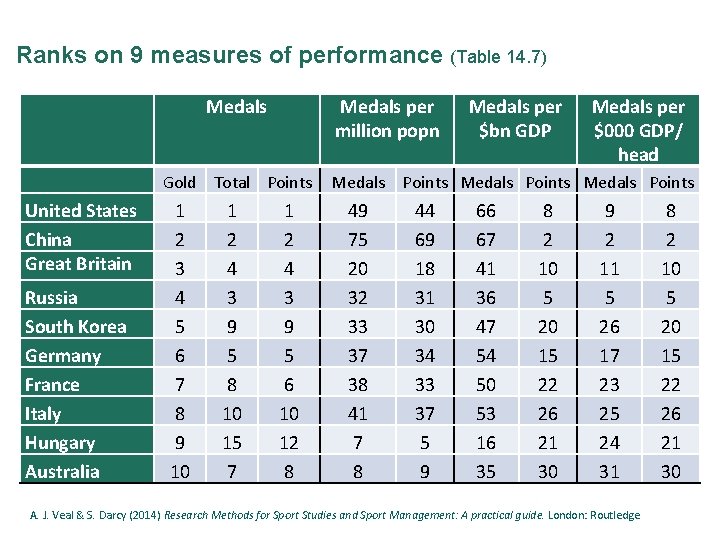
CS 14. 5 Olympic medals • • • Measuring countries’ success/rank order: Gold medals won Total medals, gold, silver and bronze, won Points: for example: gold = 3 points, silver = 2 points, bronze = 1 point Medals per million population Points per million population Medals per $billion GDP Points per $billion GDP Medals per $1000 GDP per head Points per $1000 GDP per head A. J. Veal & S. Darcy (2014) Research Methods for Sport Studies and Sport Management: A practical guide. London: Routledge
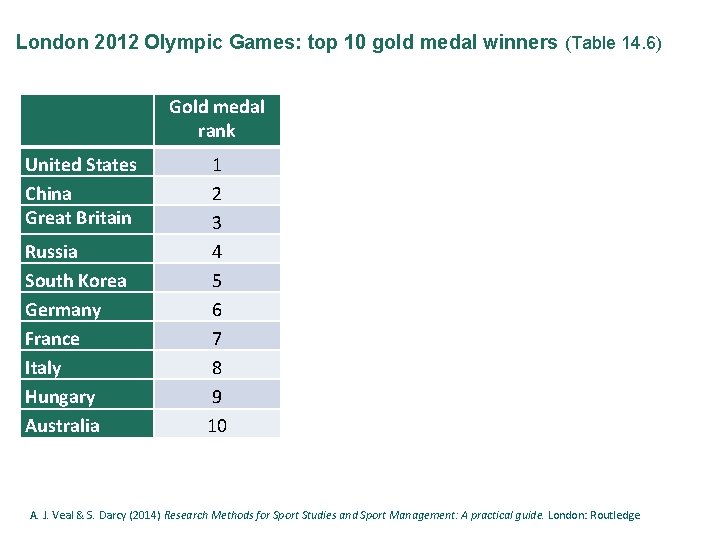
London 2012 Olympic Games: top 10 gold medal winners (Table 14. 6) Gold medal rank United States China Great Britain Russia South Korea Germany France Italy Hungary Australia 1 2 3 4 5 6 7 8 9 10 A. J. Veal & S. Darcy (2014) Research Methods for Sport Studies and Sport Management: A practical guide. London: Routledge
Ranks on 9 measures of performance (Table 14. 7) Medals per million popn Gold Total Points United States China Great Britain Russia South Korea Germany France Italy Hungary Australia 1 2 3 4 5 6 7 8 9 10 1 2 4 3 9 5 8 10 15 7 1 2 4 3 9 5 6 10 12 8 Medals per $bn GDP Medals per $000 GDP/ head Medals Points 49 75 20 32 33 37 38 41 7 8 44 69 18 31 30 34 33 37 5 9 66 67 41 36 47 54 50 53 16 35 8 2 10 5 20 15 22 26 21 30 9 2 11 5 26 17 23 25 24 31 A. J. Veal & S. Darcy (2014) Research Methods for Sport Studies and Sport Management: A practical guide. London: Routledge 8 2 10 5 20 15 22 26 21 30
CS 14. 6 The colour red and sporting success • • Hill and Barton (2005): Red = ‘maleness’ in many animals Anger associated with red Analysis of 4 combat sports in the 2004 Olympics, where contestants are randomly assigned red and blue outfits. Contestants wearing red consistently won more fights. Confirmed using English soccer league data from 1947 Challenged by Rowe et al. See also CS 11. 6 b A. J. Veal & S. Darcy (2014) Research Methods for Sport Studies and Sport Management: A practical guide. London: Routledge