
Part II What are my main use cases


- Slides: 16
Part II: - What are my main use cases? - What IETF work is in progress? July 7 th, 2017 version Main Use Cases and Gap Analysis for Network Slicing draft-netslices-usecases-01 draft-qiang-netslices-gap-analysis-01 Cristina QIANG
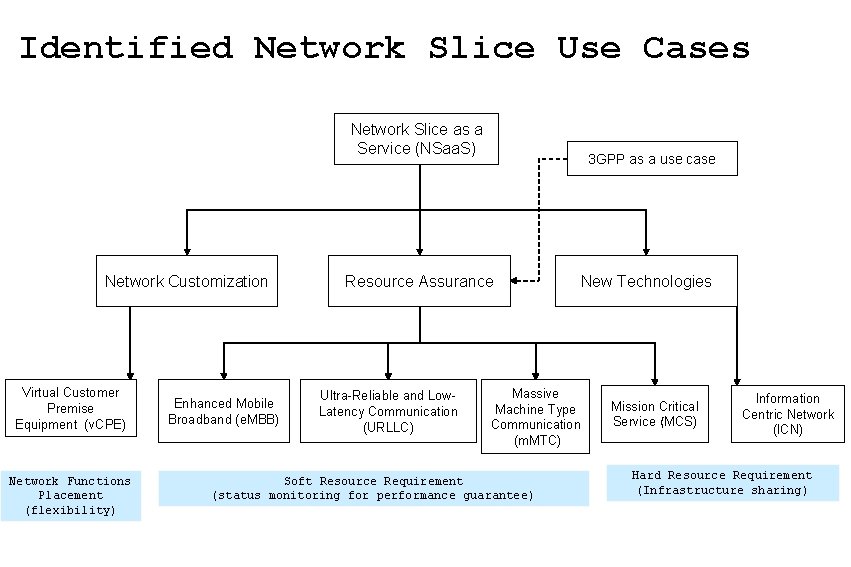
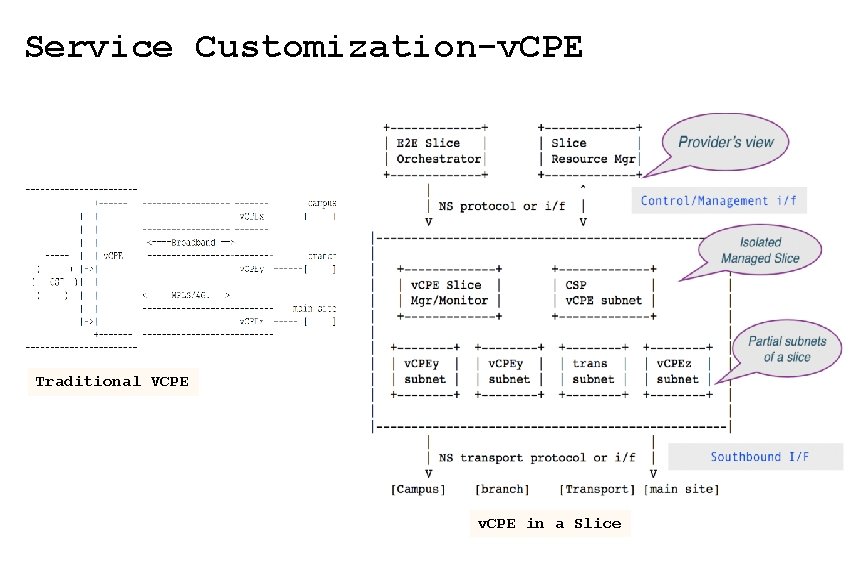
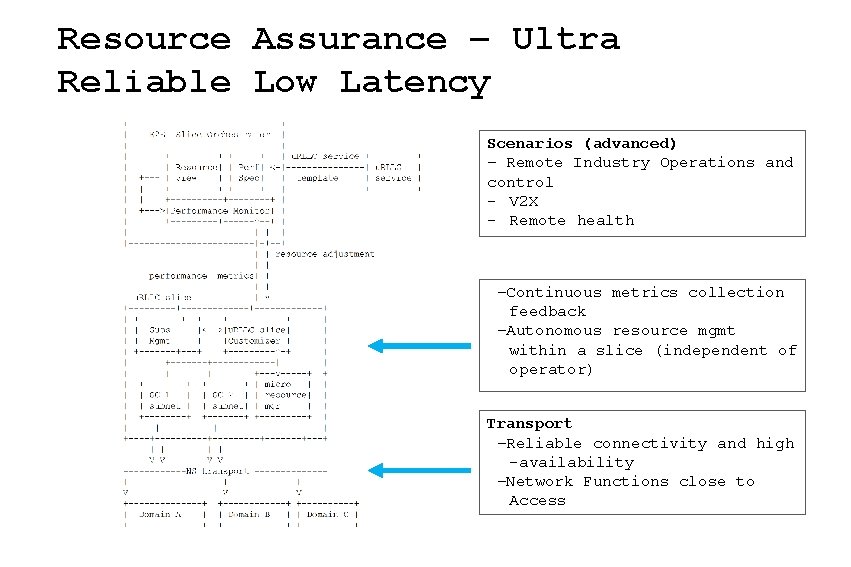
Identified Network Slice Use Cases Network Slice as a Service (NSaa. S) Network Customization Virtual Customer Premise Equipment (v. CPE) Network Functions Placement (flexibility) Enhanced Mobile Broadband (e. MBB) 3 GPP as a use case Resource Assurance Ultra-Reliable and Low. Latency Communication (URLLC) New Technologies Massive Machine Type Communication (m. MTC) Soft Resource Requirement (status monitoring for performance guarantee) Mission Critical Service (MCS) Information Centric Network (ICN) Hard Resource Requirement (Infrastructure sharing)
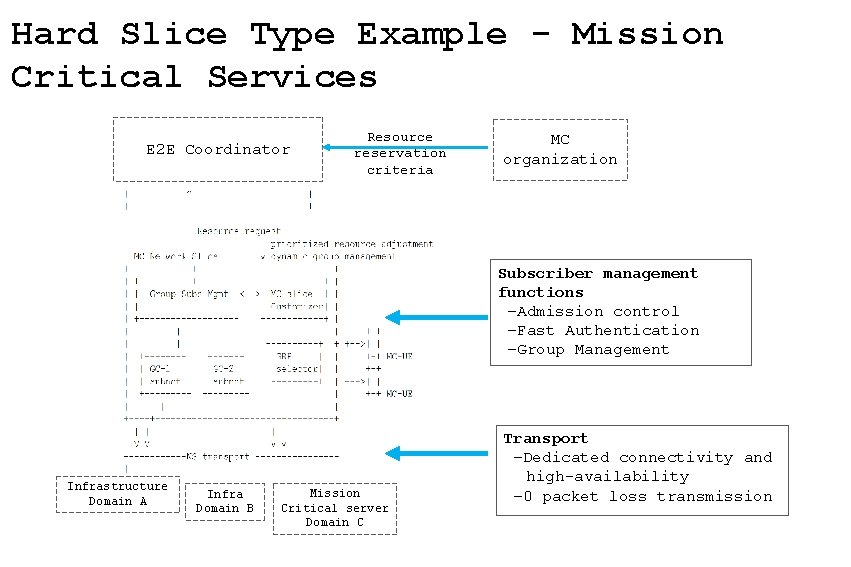
Hard Slice Type Example - Mission Critical Services E 2 E Coordinator Resource reservation criteria MC organization Subscriber management functions –Admission control –Fast Authentication –Group Management Infrastructure Domain A Infra Domain B Mission Critical server Domain C Transport –Dedicated connectivity and high-availability – 0 packet loss transmission
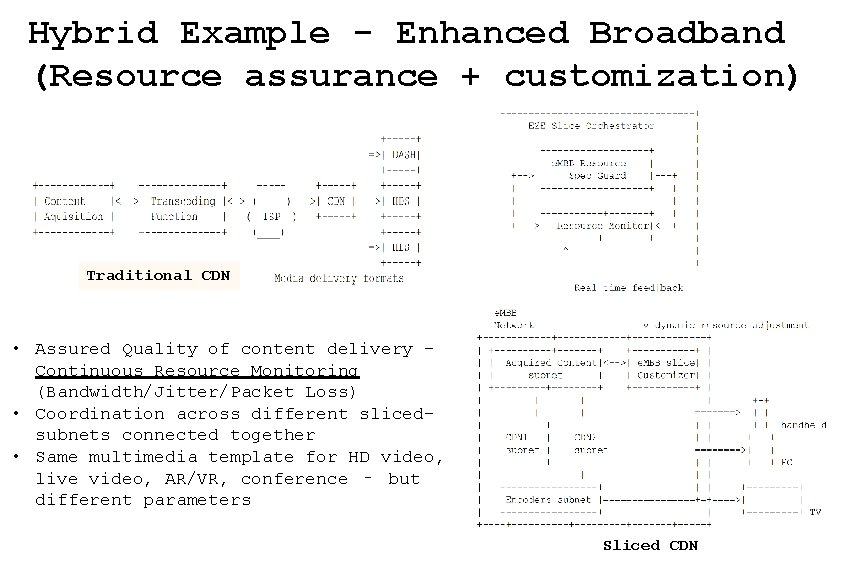
Hybrid Example - Enhanced Broadband (Resource assurance + customization) Traditional CDN • Assured Quality of content delivery Continuous Resource Monitoring (Bandwidth/Jitter/Packet Loss) • Coordination across different slicedsubnets connected together • Same multimedia template for HD video, live video, AR/VR, conference – but different parameters Sliced CDN
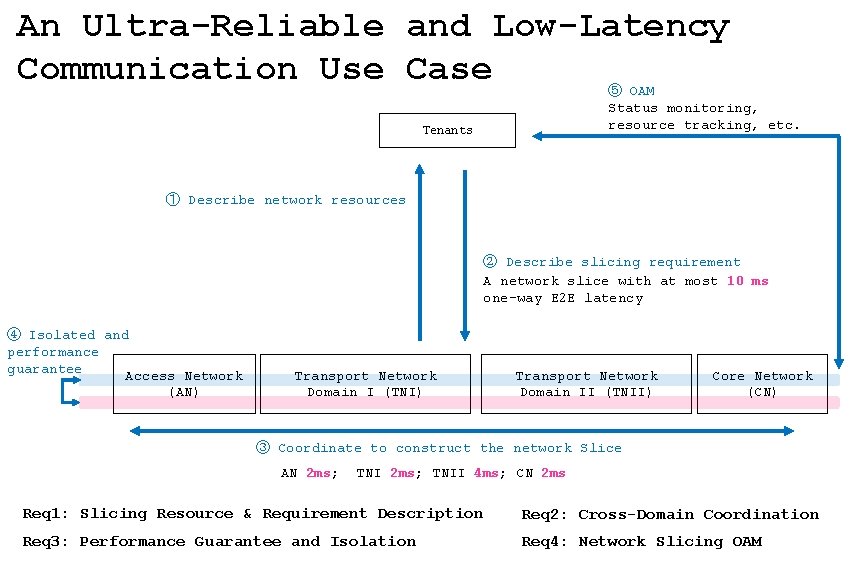
An Ultra-Reliable and Low-Latency Communication Use Case ⑤ OAM Status monitoring, resource tracking, etc. Tenants ① Describe network resources ② Describe slicing requirement A network slice with at most 10 ms one-way E 2 E latency ④ Isolated and performance guarantee Access Network (AN) Transport Network Domain I (TNI) Transport Network Domain II (TNII) Core Network (CN) ③ Coordinate to construct the network Slice AN 2 ms; TNI 2 ms; TNII 4 ms; CN 2 ms Req 1: Slicing Resource & Requirement Description Req 2: Cross-Domain Coordination Req 3: Performance Guarantee and Isolation Req 4: Network Slicing OAM
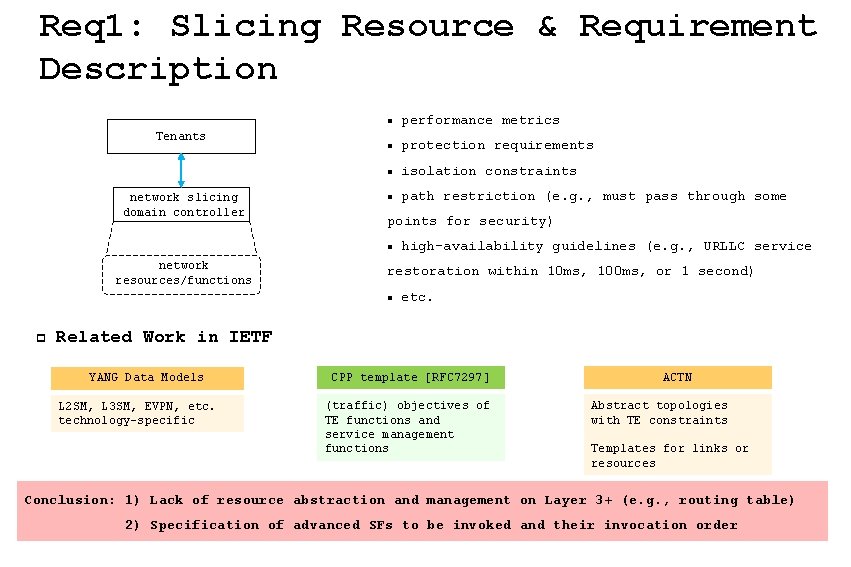
Req 1: Slicing Resource & Requirement Description Tenants network slicing domain controller n performance metrics n protection requirements n isolation constraints n path restriction (e. g. , must pass through some points for security) n network resources/functions restoration within 10 ms, 100 ms, or 1 second) n p high-availability guidelines (e. g. , URLLC service etc. Related Work in IETF YANG Data Models L 2 SM, L 3 SM, EVPN, etc. technology-specific CPP template [RFC 7297] (traffic) objectives of TE functions and service management functions ACTN Abstract topologies with TE constraints Templates for links or resources Conclusion: 1) Lack of resource abstraction and management on Layer 3+ (e. g. , routing table) 2) Specification of advanced SFs to be invoked and their invocation order
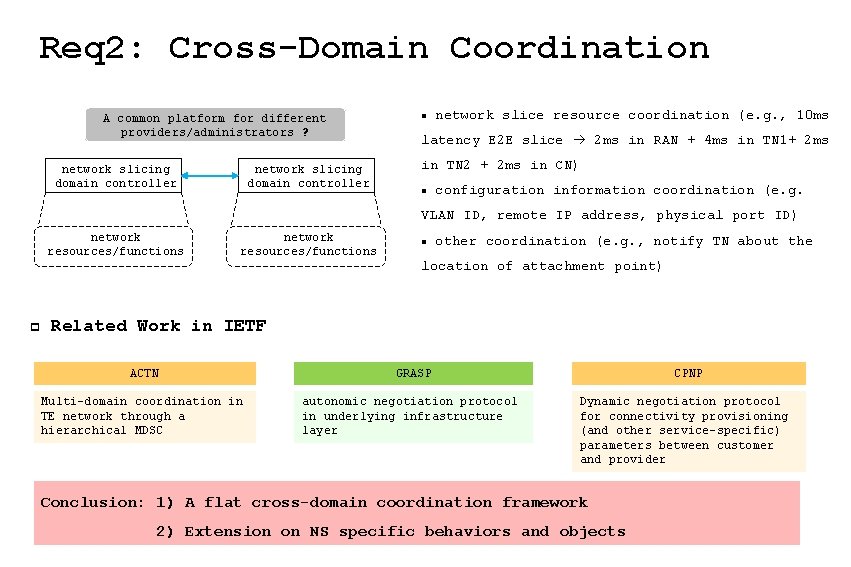
Req 2: Cross-Domain Coordination A common platform for different providers/administrators ? network slicing domain controller n network slice resource coordination (e. g. , 10 ms latency E 2 E slice 2 ms in RAN + 4 ms in TN 1+ 2 ms in TN 2 + 2 ms in CN) n configuration information coordination (e. g. VLAN ID, remote IP address, physical port ID) network resources/functions p network resources/functions n other coordination (e. g. , notify TN about the location of attachment point) Related Work in IETF ACTN Multi-domain coordination in TE network through a hierarchical MDSC GRASP autonomic negotiation protocol in underlying infrastructure layer CPNP Dynamic negotiation protocol for connectivity provisioning (and other service-specific) parameters between customer and provider Conclusion: 1) A flat cross-domain coordination framework 2) Extension on NS specific behaviors and objects
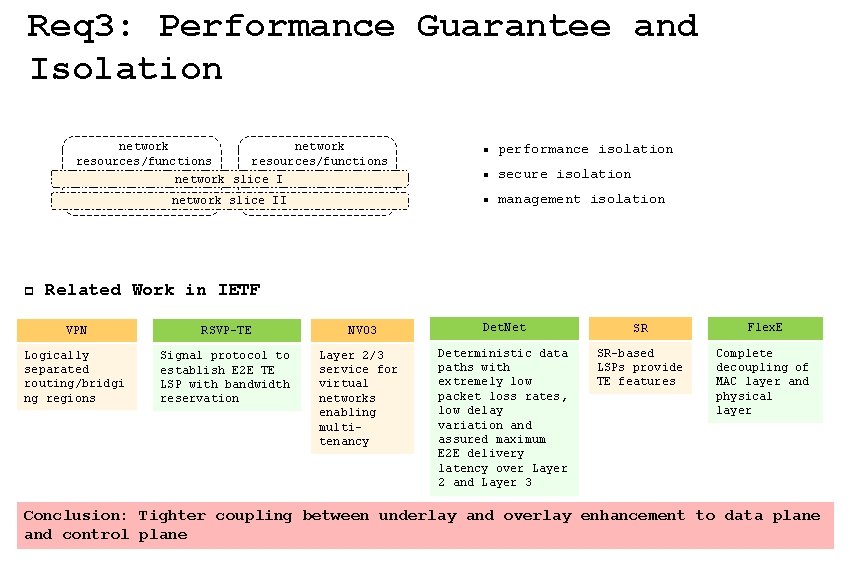
Req 3: Performance Guarantee and Isolation network resources/functions network slice II p n performance isolation n secure isolation n management isolation Related Work in IETF VPN RSVP-TE Logically separated routing/bridgi ng regions Signal protocol to establish E 2 E TE LSP with bandwidth reservation NVO 3 Layer 2/3 service for virtual networks enabling multitenancy Det. Net SR Flex. E Deterministic data paths with extremely low packet loss rates, low delay variation and assured maximum E 2 E delivery latency over Layer 2 and Layer 3 SR-based LSPs provide TE features Complete decoupling of MAC layer and physical layer Conclusion: Tighter coupling between underlay and overlay enhancement to data plane and control plane
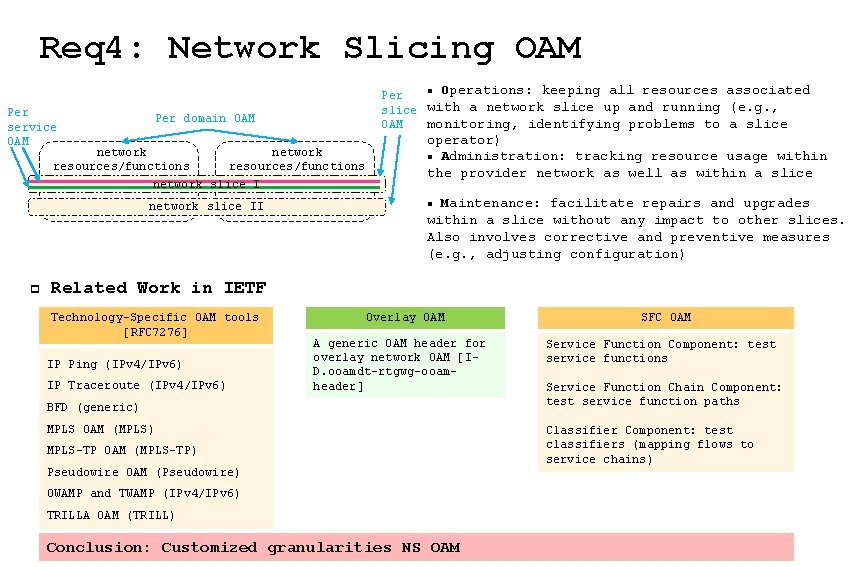
Req 4: Network Slicing OAM Per service OAM n Operations: keeping all resources associated Per slice with a network slice up and running (e. g. , monitoring, identifying problems to a slice OAM Per domain OAM network resources/functions network slice II p operator) n Administration: tracking resource usage within the provider network as well as within a slice Maintenance: facilitate repairs and upgrades within a slice without any impact to other slices. Also involves corrective and preventive measures (e. g. , adjusting configuration) n Related Work in IETF Technology-Specific OAM tools [RFC 7276] IP Ping (IPv 4/IPv 6) IP Traceroute (IPv 4/IPv 6) Overlay OAM A generic OAM header for overlay network OAM [ID. ooamdt-rtgwg-ooamheader] BFD (generic) MPLS OAM (MPLS) MPLS-TP OAM (MPLS-TP) Pseudowire OAM (Pseudowire) OWAMP and TWAMP (IPv 4/IPv 6) TRILLA OAM (TRILL) Conclusion: Customized granularities NS OAM SFC OAM Service Function Component: test service functions Service Function Chain Component: test service function paths Classifier Component: test classifiers (mapping flows to service chains)
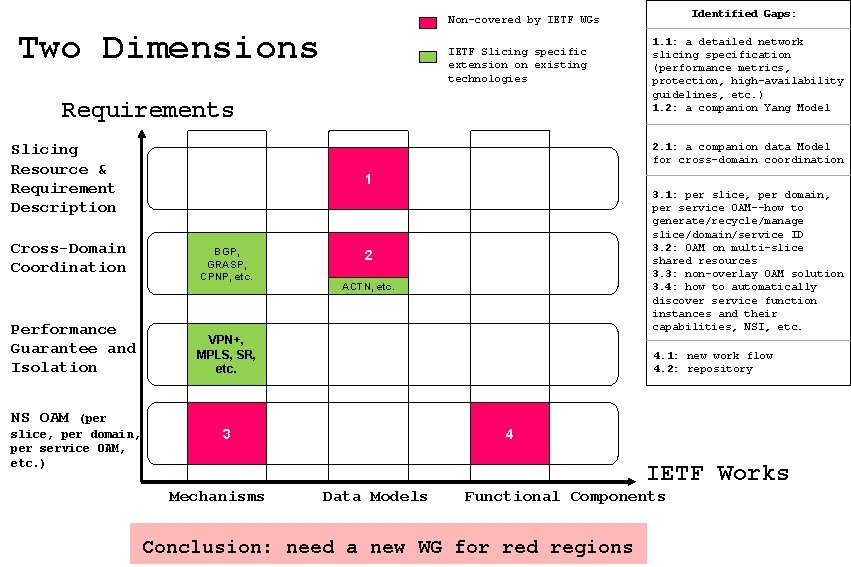
Identified Gaps: Non-covered by IETF WGs Two Dimensions IETF Slicing specific extension on existing technologies Requirements 2. 1: a companion data Model for cross-domain coordination Slicing Resource & Requirement Description Cross-Domain Coordination Performance Guarantee and Isolation NS OAM (per slice, per domain, per service OAM, etc. ) 1. 1: a detailed network slicing specification (performance metrics, protection, high-availability guidelines, etc. ) 1. 2: a companion Yang Model 1 BGP, GRASP, CPNP, etc. 3. 1: per slice, per domain, per service OAM--how to generate/recycle/manage slice/domain/service ID 3. 2: OAM on multi-slice shared resources 3. 3: non-overlay OAM solution 3. 4: how to automatically discover service function instances and their capabilities, NSI, etc. 2 ACTN, etc. VPN+, MPLS, SR, etc. 4. 1: new work flow 4. 2: repository 3 Mechanisms 4 Data Models IETF Works Functional Components Conclusion: need a new WG for red regions
Thank you!
Spare Slides
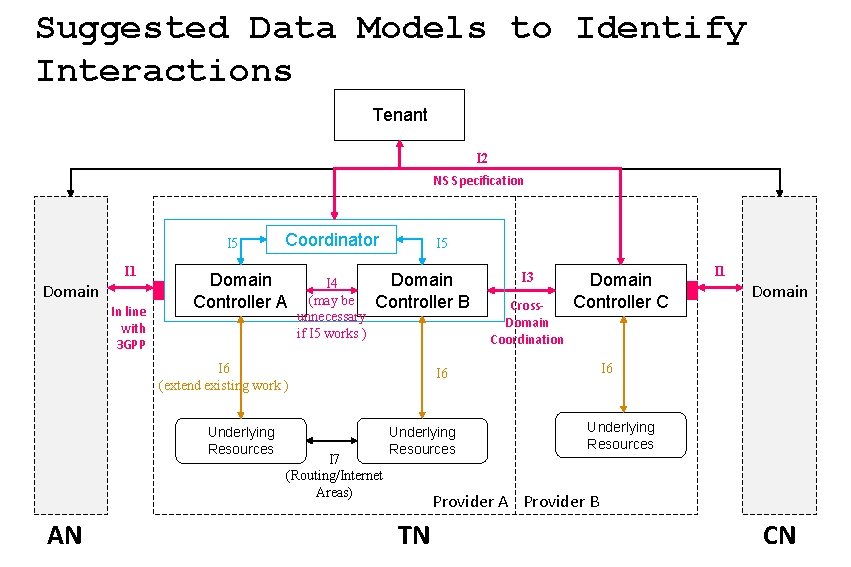
Suggested Data Models to Identify Interactions Tenant I 2 NS Specification I 5 I 1 Domain In line with 3 GPP Coordinator Domain Controller A I 4 (may be unnecessary if I 5 works ) I 5 Domain Controller B I 6 (extend existing work ) Underlying Resources AN I 7 (Routing/Internet Areas) I 3 Cross. Domain Coordination Domain Controller C Domain I 6 Underlying Resources I 1 Underlying Resources Provider A Provider B TN CN
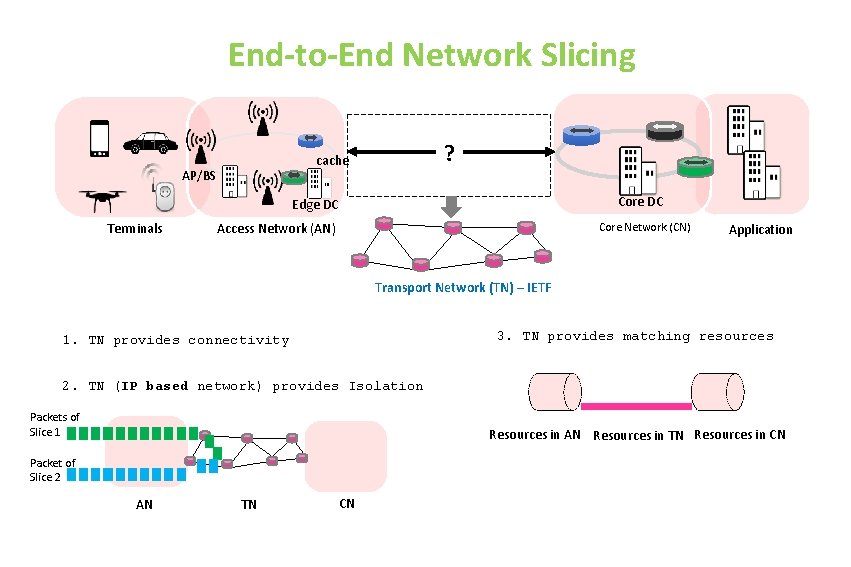
End-to-End Network Slicing ? cache AP/BS Core DC Edge DC Terminals Access Network (AN) Core Network (CN) Application Transport Network (TN) – IETF 3. TN provides matching resources 1. TN provides connectivity 2. TN (IP based network) provides Isolation Packets of Slice 1 Resources in AN Resources in TN Resources in CN Packet of Slice 2 AN TN CN
Service Customization-v. CPE Traditional VCPE v. CPE in a Slice
Resource Assurance – Ultra Reliable Low Latency Scenarios (advanced) – Remote Industry Operations and control - V 2 X - Remote health –Continuous metrics collection feedback –Autonomous resource mgmt within a slice (independent of operator) Transport –Reliable connectivity and high -availability –Network Functions close to Access