
Part II THE SYSTEM AND EARLY DECISION MAKING
- Slides: 64
Part II THE SYSTEM AND EARLY DECISION MAKING Juvenile Justice in America, 5 th Edition Bartollas/Miller © 2008 Pearson Education, Inc. Pearson Prentice Hall Upper Saddle River, NJ 07458
Chapter 4: The Police Juvenile Justice in America, 5 th Edition Bartollas/Miller © 2008 Pearson Education, Inc. Pearson Prentice Hall Upper Saddle River, NJ 07458
Outline • What Is the History of Police-Juvenile Relations? • What Are the Juveniles’ Attitudes Toward the Police? • How Does Police Discretion Affect the Police Response to Juveniles? – Factors That Influence Police Discretion Juvenile Justice in America, 5 th Edition Bartollas/Miller © 2008 Pearson Education, Inc. Pearson Prentice Hall Upper Saddle River, NJ 07458
Outline (cont. ) • How Do Police Process Juveniles? – – Informal Options: On the Streets Informal Options: At the Station (Stationhouse Adjustment) Combined Informal and Formal Processing: At the Station • What Legal Rights Do Juveniles Have with the Police? – – Search and Seizure Interrogation and Confession Fingerprinting Lineups and Photographs Juvenile Justice in America, 5 th Edition Bartollas/Miller © 2008 Pearson Education, Inc. Pearson Prentice Hall Upper Saddle River, NJ 07458
Outline (cont. ) • How Are Police Organized to Fight Juvenile Crime? – Departments without Specialized Units of Personnel – Departments with Specialized Units of Personnel • How Is Community-Oriented Policing Being Used to Tackle Problems in Today’s Communities? • Problem-Oriented Policing in the Mall Juvenile Justice in America, 5 th Edition Bartollas/Miller © 2008 Pearson Education, Inc. Pearson Prentice Hall Upper Saddle River, NJ 07458
Objectives 1. To examine juveniles’ attitudes toward the police 2. To discuss police intervention with the various types of juvenile offenders 3. To examine the legal rights of arrested juveniles 4. To show the various ways that police departments handle juvenile crime Juvenile Justice in America, 5 th Edition Bartollas/Miller © 2008 Pearson Education, Inc. Pearson Prentice Hall Upper Saddle River, NJ 07458
1. Trace the history of police-juvenile relations. Juvenile Justice in America, 5 th Edition Bartollas/Miller © 2008 Pearson Education, Inc. Pearson Prentice Hall Upper Saddle River, NJ 07458
Hints (pp. 95– 96): Ø Puritan times: • Controlled through socialization. Juveniles were taught the rules from birth until they were internalized. Ø 1830 s to 1840 s: • Social control moved from the family to the police who used coercive force to keep delinquent juveniles in line. Ø Industrialization: • Increase in urban juvenile crime created ongoing tension between police and youth. Juvenile Justice in America, 5 th Edition Bartollas/Miller © 2008 Pearson Education, Inc. Pearson Prentice Hall Upper Saddle River, NJ 07458
Ø Informal enforcement: • Some officers used informal means to deal with youth. • Officer would reprimand or turn juveniles into their parents. Ø Prevention: • Prevention became a popular philosophy and by 1924, 90% of the nation’s largest department has started juvenile programs. Juvenile Justice in America, 5 th Edition Bartollas/Miller © 2008 Pearson Education, Inc. Pearson Prentice Hall Upper Saddle River, NJ 07458
Ø Juvenile programs: • • Police athletic league was created in 1920’s. Some large department assigned welfare officers to difficult districts Policewomen were hired to patrol area where delinquent youth might frequent. A few departments established employment bureaus for youthful males. Officers were assigned to juvenile court In the 1920’s, August Vollmer created the first juvenile bureau. In 1955, the Central States Juvenile Officer’s Association and, in 1957, the International Juvenile Officer’s Association were formed. Both associations help establish standards, responsibilities, and procedures for handling youth. Ø Budgetary problems • During the 1970’s, 1980’s and 1990’s, budget restrictions forced many department to reduce their emphasis on juvenile programs. Juvenile Justice in America, 5 th Edition Bartollas/Miller © 2008 Pearson Education, Inc. Pearson Prentice Hall Upper Saddle River, NJ 07458
2. What are the attitudes of different types of juveniles toward the police? Juvenile Justice in America, 5 th Edition Bartollas/Miller © 2008 Pearson Education, Inc. Pearson Prentice Hall Upper Saddle River, NJ 07458
Hints (pp. 96– 99): Ø 1960 s, Portune, Bouma • Robert Portune conducted a study of one thousand junior high school students in Cincinnati. • Donald Bouman administered 10, 000 questionnaires to Michigan school children in ten cities. Ø Increasing age of students. • Portune found that hostility increased from grade 7 through 9. • Bouma found that hostility increased with age, but most students said they would cooperate with police. Ø Perception of friends’ attitudes: Bouma reported that there friends were more antagonistic than they were. Juvenile Justice in America, 5 th Edition Bartollas/Miller © 2008 Pearson Education, Inc. Pearson Prentice Hall Upper Saddle River, NJ 07458
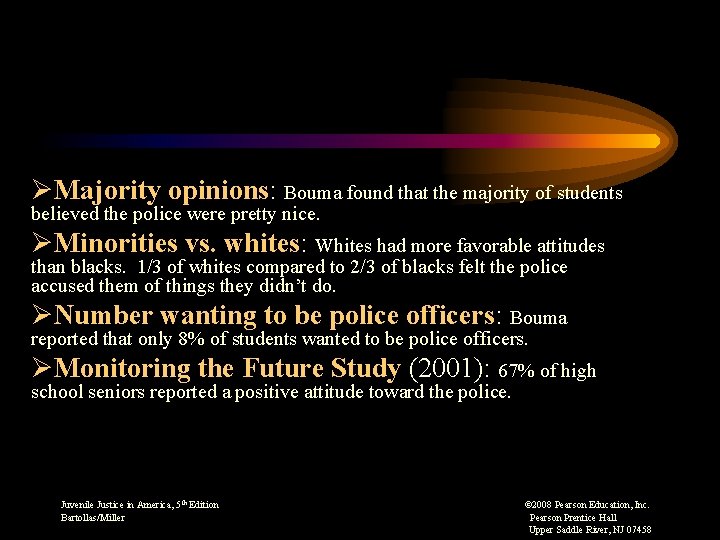
ØMajority opinions: Bouma found that the majority of students believed the police were pretty nice. ØMinorities vs. whites: Whites had more favorable attitudes than blacks. 1/3 of whites compared to 2/3 of blacks felt the police accused them of things they didn’t do. ØNumber wanting to be police officers: Bouma reported that only 8% of students wanted to be police officers. ØMonitoring the Future Study (2001): 67% of high school seniors reported a positive attitude toward the police. Juvenile Justice in America, 5 th Edition Bartollas/Miller © 2008 Pearson Education, Inc. Pearson Prentice Hall Upper Saddle River, NJ 07458
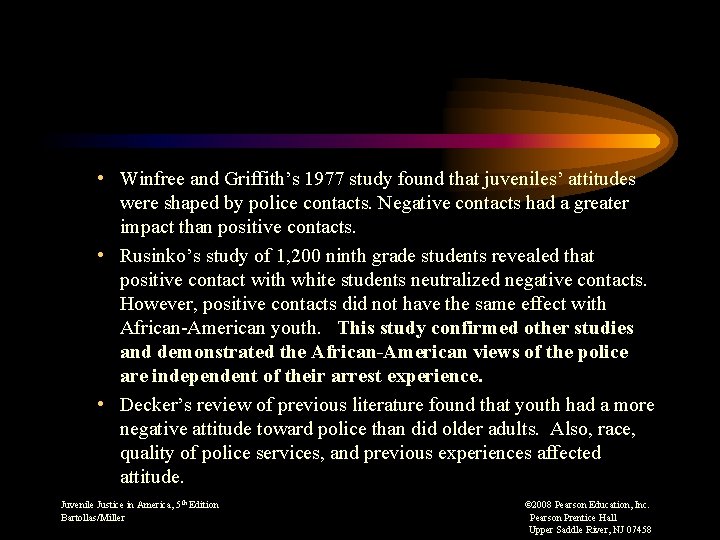
• Winfree and Griffith’s 1977 study found that juveniles’ attitudes were shaped by police contacts. Negative contacts had a greater impact than positive contacts. • Rusinko’s study of 1, 200 ninth grade students revealed that positive contact with white students neutralized negative contacts. However, positive contacts did not have the same effect with African-American youth. This study confirmed other studies and demonstrated the African-American views of the police are independent of their arrest experience. • Decker’s review of previous literature found that youth had a more negative attitude toward police than did older adults. Also, race, quality of police services, and previous experiences affected attitude. Juvenile Justice in America, 5 th Edition Bartollas/Miller © 2008 Pearson Education, Inc. Pearson Prentice Hall Upper Saddle River, NJ 07458
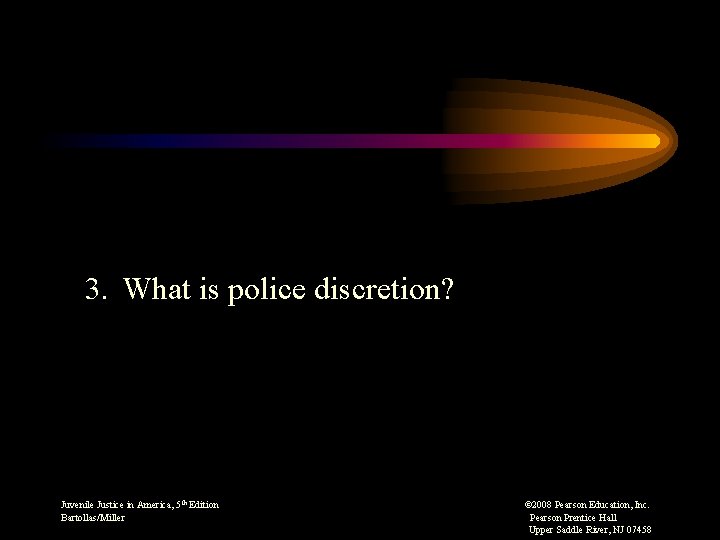
3. What is police discretion? Juvenile Justice in America, 5 th Edition Bartollas/Miller © 2008 Pearson Education, Inc. Pearson Prentice Hall Upper Saddle River, NJ 07458
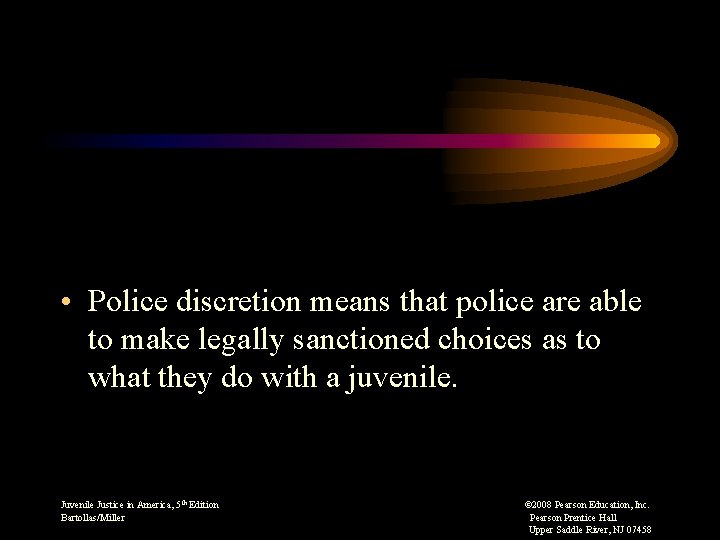
• Police discretion means that police are able to make legally sanctioned choices as to what they do with a juvenile. Juvenile Justice in America, 5 th Edition Bartollas/Miller © 2008 Pearson Education, Inc. Pearson Prentice Hall Upper Saddle River, NJ 07458
• What are the factors that most influence police discretion? Juvenile Justice in America, 5 th Edition Bartollas/Miller © 2008 Pearson Education, Inc. Pearson Prentice Hall Upper Saddle River, NJ 07458
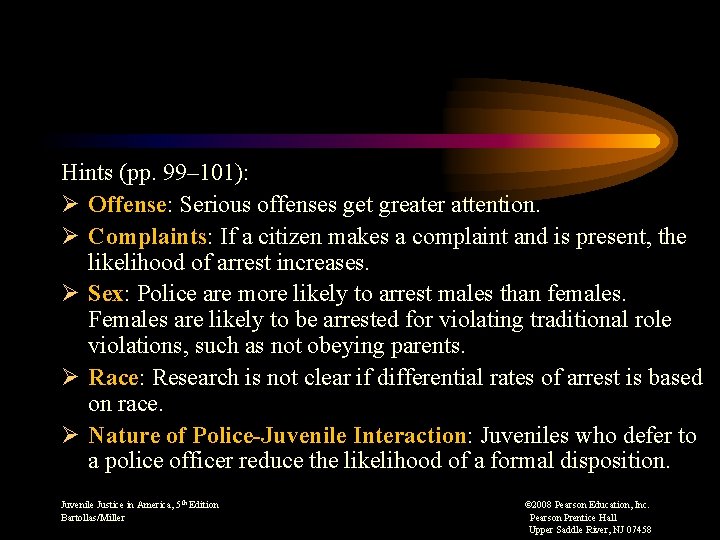
Hints (pp. 99– 101): Ø Offense: Serious offenses get greater attention. Ø Complaints: If a citizen makes a complaint and is present, the likelihood of arrest increases. Ø Sex: Police are more likely to arrest males than females. Females are likely to be arrested for violating traditional role violations, such as not obeying parents. Ø Race: Research is not clear if differential rates of arrest is based on race. Ø Nature of Police-Juvenile Interaction: Juveniles who defer to a police officer reduce the likelihood of a formal disposition. Juvenile Justice in America, 5 th Edition Bartollas/Miller © 2008 Pearson Education, Inc. Pearson Prentice Hall Upper Saddle River, NJ 07458
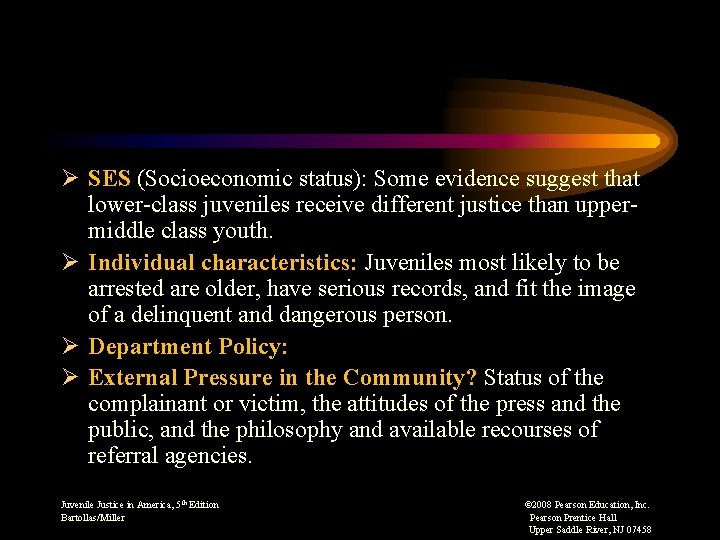
Ø SES (Socioeconomic status): Some evidence suggest that lower-class juveniles receive different justice than uppermiddle class youth. Ø Individual characteristics: Juveniles most likely to be arrested are older, have serious records, and fit the image of a delinquent and dangerous person. Ø Department Policy: Ø External Pressure in the Community? Status of the complainant or victim, the attitudes of the press and the public, and the philosophy and available recourses of referral agencies. Juvenile Justice in America, 5 th Edition Bartollas/Miller © 2008 Pearson Education, Inc. Pearson Prentice Hall Upper Saddle River, NJ 07458
• What are the different ways police process juveniles? Juvenile Justice in America, 5 th Edition Bartollas/Miller © 2008 Pearson Education, Inc. Pearson Prentice Hall Upper Saddle River, NJ 07458
Hints (pp. 101– 104): Ø Informal: on the Streets Ø Informal: at the Station Ø Combined informal and formal processing Ø Formal processing: at the station Juvenile Justice in America, 5 th Edition Bartollas/Miller © 2008 Pearson Education, Inc. Pearson Prentice Hall Upper Saddle River, NJ 07458
• Give examples of informal options on the streets. Juvenile Justice in America, 5 th Edition Bartollas/Miller © 2008 Pearson Education, Inc. Pearson Prentice Hall Upper Saddle River, NJ 07458
Hints (p. 102): Ø An officer talks to a youth bully about changing his or her ways Ø An officer becomes friends with local youths Ø An officer writes down a juvenile’s name and address for future reference Juvenile Justice in America, 5 th Edition Bartollas/Miller © 2008 Pearson Education, Inc. Pearson Prentice Hall Upper Saddle River, NJ 07458
• Give examples of informal options at the station (stationhouse adjustment). Juvenile Justice in America, 5 th Edition Bartollas/Miller © 2008 Pearson Education, Inc. Pearson Prentice Hall Upper Saddle River, NJ 07458
Hints (p. 103): Ø A youth is taken to the station to discuss situation with parents. The youth is later sent home with his or her parents. Ø Officers unofficially direct parents or youth to an anger management class or another program to deal with any problems they may have. Ø Officers work with schools to get juveniles back into school or into other special programs. Juvenile Justice in America, 5 th Edition Bartollas/Miller © 2008 Pearson Education, Inc. Pearson Prentice Hall Upper Saddle River, NJ 07458
• Give examples of combined informal and formal processing. Juvenile Justice in America, 5 th Edition Bartollas/Miller © 2008 Pearson Education, Inc. Pearson Prentice Hall Upper Saddle River, NJ 07458
Hints (p. 103): Ø Juvenile is taken into custody or arrested; he or she is then booked, talked to, and released without further action. Ø Juvenile is taken into custody; community agencies are then notified that a youth needs their services and the youth is either sent to the agency or the agency picks up the youth. Juvenile Justice in America, 5 th Edition Bartollas/Miller © 2008 Pearson Education, Inc. Pearson Prentice Hall Upper Saddle River, NJ 07458
• Give examples of formal processing at the station. Juvenile Justice in America, 5 th Edition Bartollas/Miller © 2008 Pearson Education, Inc. Pearson Prentice Hall Upper Saddle River, NJ 07458
Hints (pp. 103– 104): Ø Youth taken into custody is booked, fingerprinted, and then referred to juvenile intake. The youth may then be placed in a secure detention center. Ø Parents of youth are called to the police station and, after booking, the youth is released into their care. Juvenile Justice in America, 5 th Edition Bartollas/Miller © 2008 Pearson Education, Inc. Pearson Prentice Hall Upper Saddle River, NJ 07458
4. What does the Fourth Amendment to the Constitution of the United States protect? Juvenile Justice in America, 5 th Edition Bartollas/Miller © 2008 Pearson Education, Inc. Pearson Prentice Hall Upper Saddle River, NJ 07458
• The Fourth Amendment protects citizens from unauthorized search and seizure. Juvenile Justice in America, 5 th Edition Bartollas/Miller © 2008 Pearson Education, Inc. Pearson Prentice Hall Upper Saddle River, NJ 07458
• What are some important Supreme Court cases concerning the Fourth Amendment, and what do they say? Juvenile Justice in America, 5 th Edition Bartollas/Miller © 2008 Pearson Education, Inc. Pearson Prentice Hall Upper Saddle River, NJ 07458
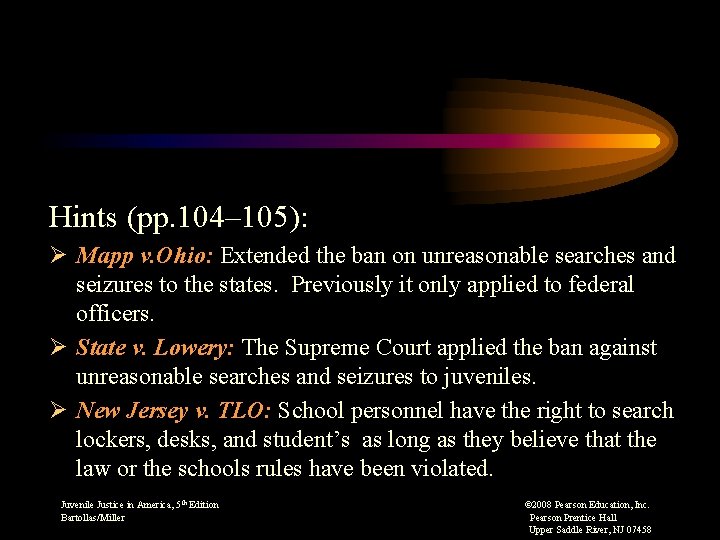
Hints (pp. 104– 105): Ø Mapp v. Ohio: Extended the ban on unreasonable searches and seizures to the states. Previously it only applied to federal officers. Ø State v. Lowery: The Supreme Court applied the ban against unreasonable searches and seizures to juveniles. Ø New Jersey v. TLO: School personnel have the right to search lockers, desks, and student’s as long as they believe that the law or the schools rules have been violated. Juvenile Justice in America, 5 th Edition Bartollas/Miller © 2008 Pearson Education, Inc. Pearson Prentice Hall Upper Saddle River, NJ 07458
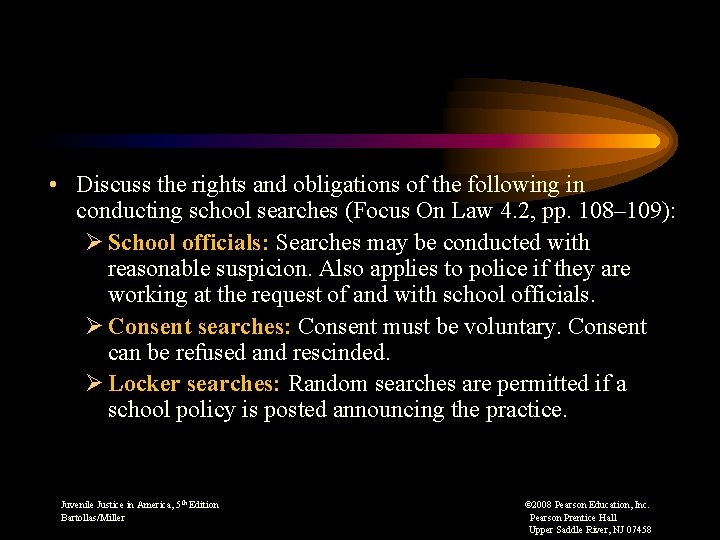
• Discuss the rights and obligations of the following in conducting school searches (Focus On Law 4. 2, pp. 108– 109): Ø School officials: Searches may be conducted with reasonable suspicion. Also applies to police if they are working at the request of and with school officials. Ø Consent searches: Consent must be voluntary. Consent can be refused and rescinded. Ø Locker searches: Random searches are permitted if a school policy is posted announcing the practice. Juvenile Justice in America, 5 th Edition Bartollas/Miller © 2008 Pearson Education, Inc. Pearson Prentice Hall Upper Saddle River, NJ 07458
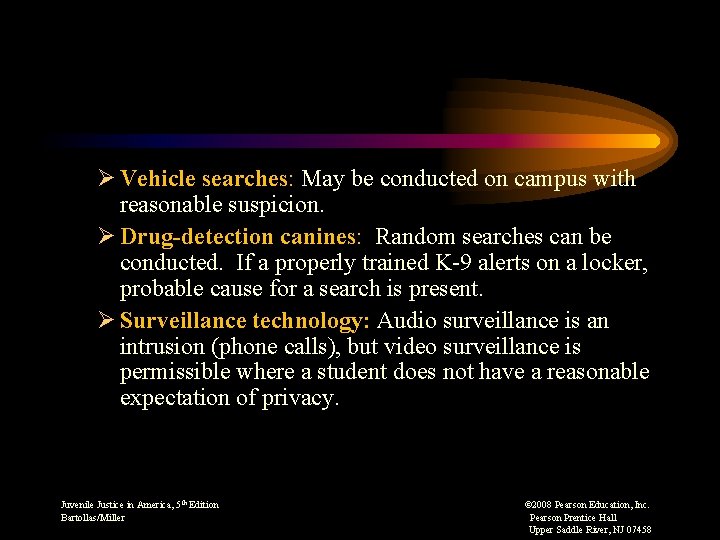
Ø Vehicle searches: May be conducted on campus with reasonable suspicion. Ø Drug-detection canines: Random searches can be conducted. If a properly trained K-9 alerts on a locker, probable cause for a search is present. Ø Surveillance technology: Audio surveillance is an intrusion (phone calls), but video surveillance is permissible where a student does not have a reasonable expectation of privacy. Juvenile Justice in America, 5 th Edition Bartollas/Miller © 2008 Pearson Education, Inc. Pearson Prentice Hall Upper Saddle River, NJ 07458
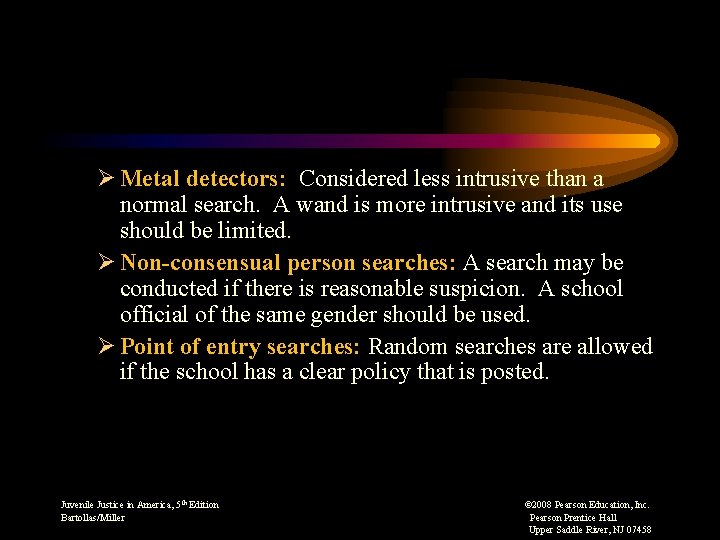
Ø Metal detectors: Considered less intrusive than a normal search. A wand is more intrusive and its use should be limited. Ø Non-consensual person searches: A search may be conducted if there is reasonable suspicion. A school official of the same gender should be used. Ø Point of entry searches: Random searches are allowed if the school has a clear policy that is posted. Juvenile Justice in America, 5 th Edition Bartollas/Miller © 2008 Pearson Education, Inc. Pearson Prentice Hall Upper Saddle River, NJ 07458
5. What does the Fourteenth Amendment to the U. S. Constitution state? Juvenile Justice in America, 5 th Edition Bartollas/Miller © 2008 Pearson Education, Inc. Pearson Prentice Hall Upper Saddle River, NJ 07458
• The Fourteenth Amendment states that standards of fairness and due process must be used in obtaining confessions. The totality of the circumstances in extracting confessions must also be taken into consideration in determining the appropriateness of a confession. Juvenile Justice in America, 5 th Edition Bartollas/Miller © 2008 Pearson Education, Inc. Pearson Prentice Hall Upper Saddle River, NJ 07458
• What are some major Fourteenth Amendment cases concerning interrogation and confessions? Discuss them. Juvenile Justice in America, 5 th Edition Bartollas/Miller © 2008 Pearson Education, Inc. Pearson Prentice Hall Upper Saddle River, NJ 07458
Hints (pp. 110– 111): Ø Brown v. Mississippi: Force may not be used to gain a confession. Ø Miranda v. Arizona: Supreme Court interpreted the right against self-incrimination and the right to an attorney. Juvenile Justice in America, 5 th Edition Bartollas/Miller © 2008 Pearson Education, Inc. Pearson Prentice Hall Upper Saddle River, NJ 07458
6. What is fingerprinting, and why is it controversial? Juvenile Justice in America, 5 th Edition Bartollas/Miller © 2008 Pearson Education, Inc. Pearson Prentice Hall Upper Saddle River, NJ 07458
Hints (p. 111): Ø Youth records: • The concern is that the records of arrested youth will not be destroyed one they no longer all under the juvenile court system. Juvenile Justice in America, 5 th Edition Bartollas/Miller © 2008 Pearson Education, Inc. Pearson Prentice Hall Upper Saddle River, NJ 07458
7. What is a lineup? Juvenile Justice in America, 5 th Edition Bartollas/Miller © 2008 Pearson Education, Inc. Pearson Prentice Hall Upper Saddle River, NJ 07458
• A lineup consists of the police placing a number of suspects in front of witnesses or victims who try to identify the person who committed the crime against them. Juvenile Justice in America, 5 th Edition Bartollas/Miller © 2008 Pearson Education, Inc. Pearson Prentice Hall Upper Saddle River, NJ 07458
• What are the rights of juveniles in lineups? Juvenile Justice in America, 5 th Edition Bartollas/Miller © 2008 Pearson Education, Inc. Pearson Prentice Hall Upper Saddle River, NJ 07458
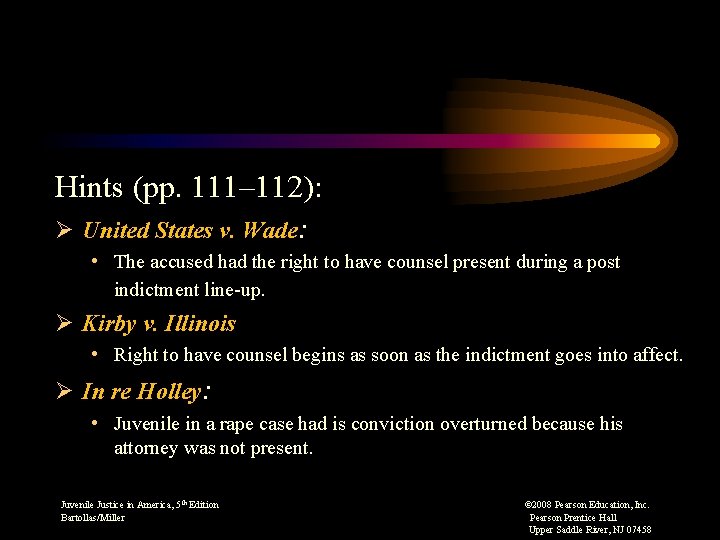
Hints (pp. 111– 112): Ø United States v. Wade: • The accused had the right to have counsel present during a post indictment line-up. Ø Kirby v. Illinois • Right to have counsel begins as soon as the indictment goes into affect. Ø In re Holley: • Juvenile in a rape case had is conviction overturned because his attorney was not present. Juvenile Justice in America, 5 th Edition Bartollas/Miller © 2008 Pearson Education, Inc. Pearson Prentice Hall Upper Saddle River, NJ 07458
8. How do different types of police departments handle the problems of juvenile crime? Juvenile Justice in America, 5 th Edition Bartollas/Miller © 2008 Pearson Education, Inc. Pearson Prentice Hall Upper Saddle River, NJ 07458
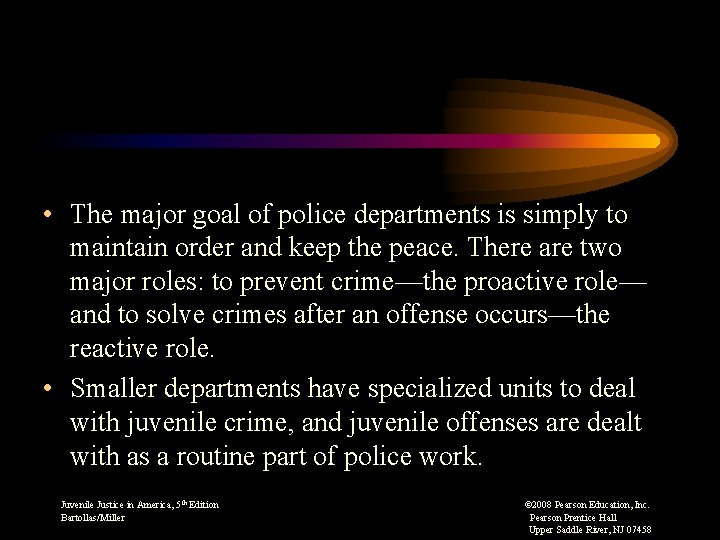
• The major goal of police departments is simply to maintain order and keep the peace. There are two major roles: to prevent crime––the proactive role–– and to solve crimes after an offense occurs––the reactive role. • Smaller departments have specialized units to deal with juvenile crime, and juvenile offenses are dealt with as a routine part of police work. Juvenile Justice in America, 5 th Edition Bartollas/Miller © 2008 Pearson Education, Inc. Pearson Prentice Hall Upper Saddle River, NJ 07458
9. What is a juvenile officer? Juvenile Justice in America, 5 th Edition Bartollas/Miller © 2008 Pearson Education, Inc. Pearson Prentice Hall Upper Saddle River, NJ 07458
• An individual officer that works solely with juvenile crime. Juvenile Justice in America, 5 th Edition Bartollas/Miller © 2008 Pearson Education, Inc. Pearson Prentice Hall Upper Saddle River, NJ 07458
10. What is a juvenile unit? Juvenile Justice in America, 5 th Edition Bartollas/Miller © 2008 Pearson Education, Inc. Pearson Prentice Hall Upper Saddle River, NJ 07458
• These units have the normal crime-fighting tasks of detecting, investigating, and prosecuting offenders for everything from bicycle thefts to serious felonies. Juvenile Justice in America, 5 th Edition Bartollas/Miller © 2008 Pearson Education, Inc. Pearson Prentice Hall Upper Saddle River, NJ 07458
11. What is a gang control unit? Juvenile Justice in America, 5 th Edition Bartollas/Miller © 2008 Pearson Education, Inc. Pearson Prentice Hall Upper Saddle River, NJ 07458
• It is a unit formed to deal with a specific gang problem and is not a permanent unit within the police force. Juvenile Justice in America, 5 th Edition Bartollas/Miller © 2008 Pearson Education, Inc. Pearson Prentice Hall Upper Saddle River, NJ 07458
12. What are the special challenges facing police in the community? Describe each. Juvenile Justice in America, 5 th Edition Bartollas/Miller © 2008 Pearson Education, Inc. Pearson Prentice Hall Upper Saddle River, NJ 07458
Ø Community Oriented Policing Ø Problem Oriented Police Ø Preventing drug use Ø Reducing gun use Ø Gang prevention and deactivation Juvenile Justice in America, 5 th Edition Bartollas/Miller © 2008 Pearson Education, Inc. Pearson Prentice Hall Upper Saddle River, NJ 07458
Hints (pp. 114– 117): Ø Community policing: • Philosophy that holds that police departments should develop partnerships with neighborhood residents, develop programs tailored for specific problems, and give rank-andfile officers more decision-making freedom with regard to how best to deal with particular problems. Juvenile Justice in America, 5 th Edition Bartollas/Miller © 2008 Pearson Education, Inc. Pearson Prentice Hall Upper Saddle River, NJ 07458
• Community Oriented Policing is useful in juvenile justice because: – It moves officers from the patrol cars into direct engagement with the community. – It frees officers from emergency response systems so they can be more proactive at preventing crime. – It makes police operations more visible and increases accountability. – It decentralizes operations. – It encourages the police to partner with the community. – It moves decision-making and discretion to the police officer on the street. Juvenile Justice in America, 5 th Edition Bartollas/Miller © 2008 Pearson Education, Inc. Pearson Prentice Hall Upper Saddle River, NJ 07458
Ø Problem-oriented policing: • Philosophy holds that instead of thinking in terms of global concepts such as “crime” and “disorder, ” the police should address particular problems and develop creative responses to each one. Juvenile Justice in America, 5 th Edition Bartollas/Miller © 2008 Pearson Education, Inc. Pearson Prentice Hall Upper Saddle River, NJ 07458
• What were some of the plans of action the police developed when initiating a problemoriented policing plan at Franklin Mall? (Focus on Practice 4. 3) Juvenile Justice in America, 5 th Edition Bartollas/Miller © 2008 Pearson Education, Inc. Pearson Prentice Hall Upper Saddle River, NJ 07458
Hints (pp. 117– 118): Ø Violent crimes as first priority Ø Decrease motor violations Ø Scheduled social activities for juveniles at the mall Ø Coordinating with the local school district Juvenile Justice in America, 5 th Edition Bartollas/Miller © 2008 Pearson Education, Inc. Pearson Prentice Hall Upper Saddle River, NJ 07458
• What does DARE stand for? Juvenile Justice in America, 5 th Edition Bartollas/Miller © 2008 Pearson Education, Inc. Pearson Prentice Hall Upper Saddle River, NJ 07458
• Drug Abuse Resistance Education Juvenile Justice in America, 5 th Edition Bartollas/Miller © 2008 Pearson Education, Inc. Pearson Prentice Hall Upper Saddle River, NJ 07458
Ø D. A. R. E. was created as a cooperative effort between the Los Angeles Police Department and the Los Angeles school district. The program placed uniformed officers in classrooms to teach formal curriculum to fifth and sixth graders. Ø Subsequent research found that the program was effective in increasing student knowledge about substance abuse, but that the programs short-term effecting on deterring drug use was limited. Juvenile Justice in America, 5 th Edition Bartollas/Miller © 2008 Pearson Education, Inc. Pearson Prentice Hall Upper Saddle River, NJ 07458