
Part II The Middle Ages and Renaissance Mc

- Slides: 35
Part II The Middle Ages and Renaissance Mc. Graw-Hill © 2006 The Mc. Graw-Hill Companies, Inc. All rights reserve
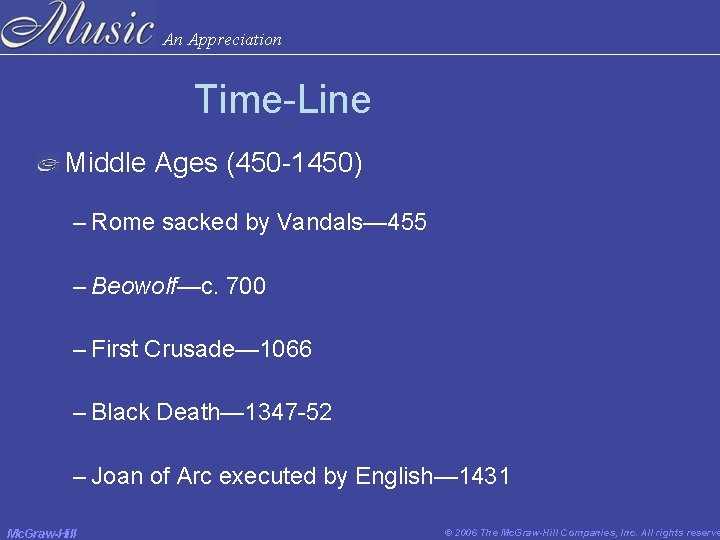
An Appreciation Time-Line Middle Ages (450 -1450) – Rome sacked by Vandals— 455 – Beowolf—c. 700 – First Crusade— 1066 – Black Death— 1347 -52 – Joan of Arc executed by English— 1431 Mc. Graw-Hill © 2006 The Mc. Graw-Hill Companies, Inc. All rights reserve
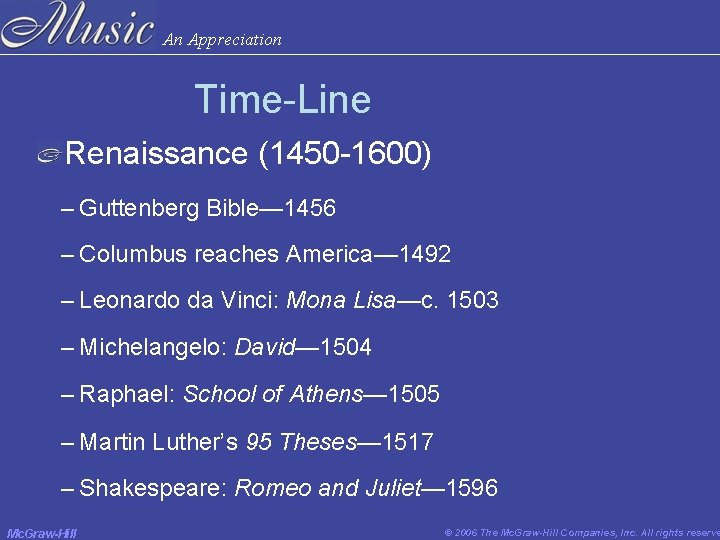
An Appreciation Time-Line Renaissance (1450 -1600) – Guttenberg Bible— 1456 – Columbus reaches America— 1492 – Leonardo da Vinci: Mona Lisa—c. 1503 – Michelangelo: David— 1504 – Raphael: School of Athens— 1505 – Martin Luther’s 95 Theses— 1517 – Shakespeare: Romeo and Juliet— 1596 Mc. Graw-Hill © 2006 The Mc. Graw-Hill Companies, Inc. All rights reserve
An Appreciation The Middle Ages Period of wars and mass migration Strong class distinctions – Nobility: castles, knights in armor, feasting – Peasantry: lived in huts, serfs—part of land – Clergy: ruled everyone, only monks literate Mc. Graw-Hill © 2006 The Mc. Graw-Hill Companies, Inc. All rights reserve
An Appreciation The Middle Ages Architecture – Early: Romanesque – Late: Gothic Visual Arts – Stressed iconic/symbolic, not realism Late Middle Ages saw technological progress Mc. Graw-Hill © 2006 The Mc. Graw-Hill Companies, Inc. All rights reserve
An Appreciation The Renaissance Rebirth of human learning and creativity Time of great explorers Humanism Fascination w/ ancient Greece & Rome Mc. Graw-Hill © 2006 The Mc. Graw-Hill Companies, Inc. All rights reserve
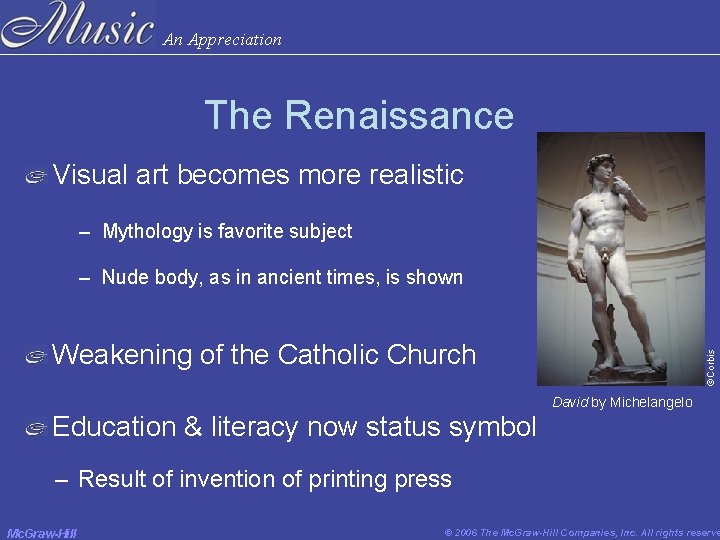
An Appreciation The Renaissance Visual art becomes more realistic – Mythology is favorite subject – Nude body, as in ancient times, is shown ©Corbis Weakening of the Catholic Church David by Michelangelo Education & literacy now status symbol – Result of invention of printing press Mc. Graw-Hill © 2006 The Mc. Graw-Hill Companies, Inc. All rights reserve
An Appreciation Chpt. 1: Music in the Middle Ages Church dominates musical activity – Most musicians were priests – Women did not sing in mixed church settings Music primarily vocal and sacred – Instruments not used in church Mc. Graw-Hill © 2006 The Mc. Graw-Hill Companies, Inc. All rights reserve
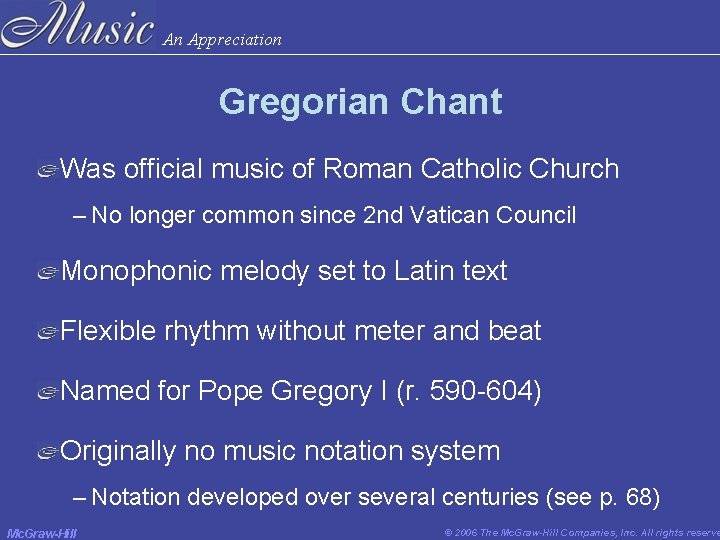
An Appreciation Gregorian Chant Was official music of Roman Catholic Church – No longer common since 2 nd Vatican Council Monophonic melody set to Latin text Flexible rhythm without meter and beat Named for Pope Gregory I (r. 590 -604) Originally no music notation system – Notation developed over several centuries (see p. 68) Mc. Graw-Hill © 2006 The Mc. Graw-Hill Companies, Inc. All rights reserve
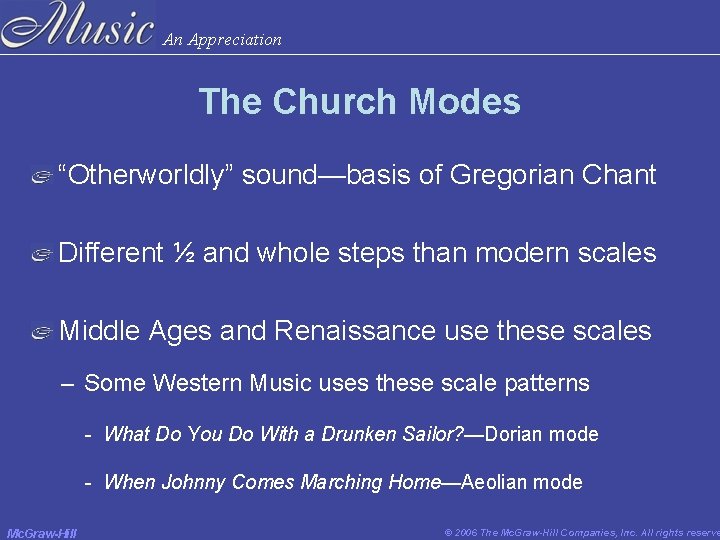
An Appreciation The Church Modes “Otherworldly” sound—basis of Gregorian Chant Different ½ and whole steps than modern scales Middle Ages and Renaissance use these scales – Some Western Music uses these scale patterns - What Do You Do With a Drunken Sailor? —Dorian mode - When Johnny Comes Marching Home—Aeolian mode Mc. Graw-Hill © 2006 The Mc. Graw-Hill Companies, Inc. All rights reserve
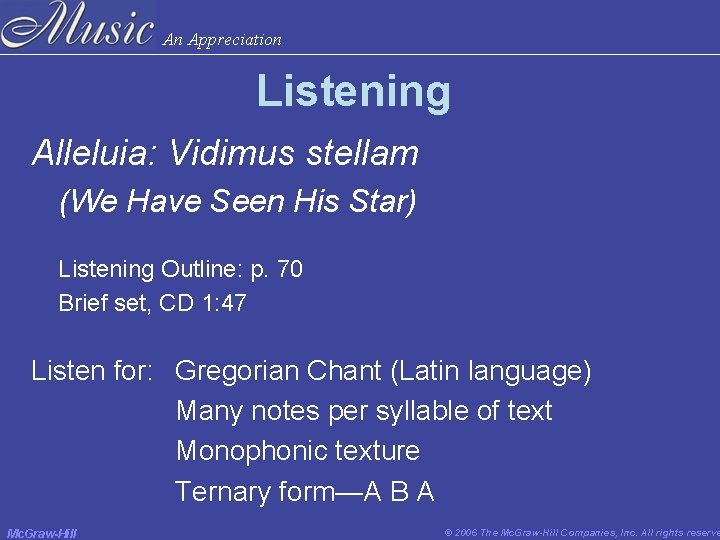
An Appreciation Listening Alleluia: Vidimus stellam (We Have Seen His Star) Listening Outline: p. 70 Brief set, CD 1: 47 Listen for: Gregorian Chant (Latin language) Many notes per syllable of text Monophonic texture Ternary form—A B A Mc. Graw-Hill © 2006 The Mc. Graw-Hill Companies, Inc. All rights reserve
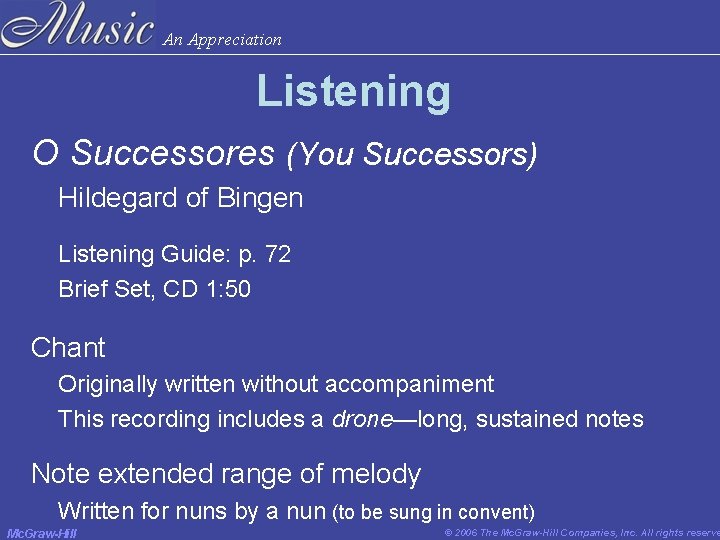
An Appreciation Listening O Successores (You Successors) Hildegard of Bingen Listening Guide: p. 72 Brief Set, CD 1: 50 Chant Originally written without accompaniment This recording includes a drone—long, sustained notes Note extended range of melody Written for nuns by a nun (to be sung in convent) Mc. Graw-Hill © 2006 The Mc. Graw-Hill Companies, Inc. All rights reserve
An Appreciation Secular Music in the Middle Ages Troubadours (southern France) and Trouveres (northern France) – Nobles wrote poems/songs for court use - Performed by jongleurs (minstrels) – Topics: courtly love, Crusades, dancing Mc. Graw-Hill © 2006 The Mc. Graw-Hill Companies, Inc. All rights reserve
An Appreciation Estampie Medieval (Middle Ages) dance music Triple meter with strong beat (for dancing) – Notated as chant: only a single melody line - Performers probably improvised accompaniment Listening example—Brief Set, CD 1: 51 – This performance played on period instruments - Melody played on rebec (bowed string instrument and pipe (tubular wind instrument) - Drone on psaltery (plucked or struck string instrument) Mc. Graw-Hill © 2006 The Mc. Graw-Hill Companies, Inc. All rights reserve
An Appreciation The Development of Polyphony: Organum Between 700 -900 a 2 nd line added to chant – Additional part initially improvised, not written – Paralleled chant line at a different pitch 900 -1200 added line grew more independent – Contrary motion, then later a separate melodic curve – c. 1100 note-against-note motion abandoned - 2 lines w/ individual rhythmic and melodic content - New part, in top voice, moved faster than the chant line Mc. Graw-Hill © 2006 The Mc. Graw-Hill Companies, Inc. All rights reserve
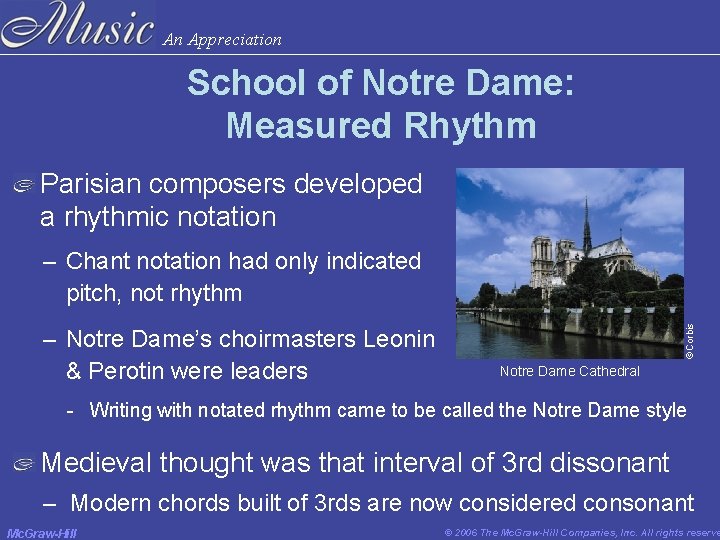
An Appreciation School of Notre Dame: Measured Rhythm Parisian composers developed a rhythmic notation – Notre Dame’s choirmasters Leonin & Perotin were leaders ©Corbis – Chant notation had only indicated pitch, not rhythm Notre Dame Cathedral - Writing with notated rhythm came to be called the Notre Dame style Medieval thought was that interval of 3 rd dissonant – Modern chords built of 3 rds are now considered consonant Mc. Graw-Hill © 2006 The Mc. Graw-Hill Companies, Inc. All rights reserve
An Appreciation 14 th Century Music: “New Art” In France Composers wrote music not based on chant – Borrowed secular melodies to put in sacred music New music notation system had developed – New system allowed for better rhythmic notation – Syncopation, now possible, became common The new type of music was called ars nova Mc. Graw-Hill © 2006 The Mc. Graw-Hill Companies, Inc. All rights reserve
An Appreciation Guillaume de Machaut Mid- to late-14 th Century composer (1300 -1377) – Also famous as a poet – Though a priest, spent most of life working at court Wrote both sacred and secular music Best known for his Notre Dame Mass Mc. Graw-Hill © 2006 The Mc. Graw-Hill Companies, Inc. All rights reserve
An Appreciation Listening Puis qu’en oubli sui de vous (Since I am forgotten by you; around 1363) by Guillaume de Machaut Vocal Music Guide: p. 78 Brief Set, CD 1: 52 Listen for: Mc. Graw-Hill Melancholy feel Rondeau form (8 lines, ab aa ab ab, ) Syncopation Interpretation (3 notated lines, 1 text) © 2006 The Mc. Graw-Hill Companies, Inc. All rights reserve
An Appreciation Listening Agnus Dei from Notre Dame Mass by Guillaume de Machaut Vocal Music Guide: p. 79 Brief Set, CD 1: 53 Performance Profile: Andrew Parrott-conductor Listen for conductor’s interpretation, use of solo voices, and attempt to create an historically accurate performance 14 th Century, part of mass ordinary Polyphonic— 4 voices (parts) Ternary form: A B A (form results from the text) Agnus Dei, qui tollis peccata mundi: miserere nobis Agnus Dei, qui tollis peccata mundi: dona nobis pacem Mc. Graw-Hill © 2006 The Mc. Graw-Hill Companies, Inc. All rights reserve
An Appreciation Chapter 2: Music in the Renaissance Church choirs grew in size (all male) Rise of the individual patron – Musical center shifted from Church to courts – Court composers wrote secular & sacred music – Women did not sing in mixed church settings Mc. Graw-Hill © 2006 The Mc. Graw-Hill Companies, Inc. All rights reserve
An Appreciation Musicians: higher status & pay than before – Composers became known for their work Many composers were Franco-Flemish – Worked throughout Europe, especially in Italy became music capital in 16 th Century – Other important centers: Germany, England & Spain Mc. Graw-Hill © 2006 The Mc. Graw-Hill Companies, Inc. All rights reserve
An Appreciation Characteristics of Renaissance Music Words and Music Vocal music more important than instrumental Word painting/text painting Mc. Graw-Hill © 2006 The Mc. Graw-Hill Companies, Inc. All rights reserve
An Appreciation Texture Polyphonic Primarily vocal-a cappella – Instruments, if present, doubled the vocal parts Rhythm and Melody Rhythm “flows” and overlaps – Composers less concerned with metrical accents Smooth, stepwise melodies predominate – Melodies overlap rhythmically between voices Mc. Graw-Hill © 2006 The Mc. Graw-Hill Companies, Inc. All rights reserve
An Appreciation Sacred Music in the Renaissance Two main forms: Motet – Short polyphonic choral work – Latin text usually overlaid with vernacular text – Often borrows lowest voice part from a chant Mass—the Catholic worship service – Long work that includes 5 main parts of service - Kyrie - Sanctus - Gloria - Agnus Dei - Credo Mc. Graw-Hill © 2006 The Mc. Graw-Hill Companies, Inc. All rights reserve
An Appreciation Josquin Desprez 1440 -1521 (contemporary of Columbus & da Vinci) Wrote both sacred and secular music – Worked with the Papal Choir in Rome – Worked for King Louis XII of France Leading composer of his time—famous while alive – His work influenced other composers – Was highly praised by Martin Luther Mc. Graw-Hill © 2006 The Mc. Graw-Hill Companies, Inc. All rights reserve
An Appreciation Listening Ave Maria…Virgo Serena Josquin Desprez Vocal Music Guide: p. 84 Brief Set, CD 1: 56 Listen for: Four voices Polyphonic imitation Overlapping voice parts Mc. Graw-Hill © 2006 The Mc. Graw-Hill Companies, Inc. All rights reserve
An Appreciation Palestrina Culmination of the Renaissance (1525 -1594) Worked primarily in Rome – Music director at St. Peter’s Mc. Graw-Hill © 2006 The Mc. Graw-Hill Companies, Inc. All rights reserve
An Appreciation Palestrina Worked during and after Council of Trent – Council of Trent (1545 -1563) addressed: - Abuses & malpractice within Church - Emerging Protestantism - Role of music in worship - Some advocated a return to monophonic music - Finally decided on non-theatrical worship music Wrote music meeting demands of Trent – His work became the model for mass composers Mc. Graw-Hill © 2006 The Mc. Graw-Hill Companies, Inc. All rights reserve
An Appreciation Listening Pope Marcellus Mass (1562 -63) Kyrie by Palestrina Vocal Music Guide: p. 87 Brief Set, CD 1: 59 Six voices Polyphonic imitation w/ overlapping voice parts Text: Kyrie eleison Christe eleison Kyrie eleison Mc. Graw-Hill © 2006 The Mc. Graw-Hill Companies, Inc. All rights reserve
An Appreciation Secular Music in the Renaissance Madrigal – Intended for amateur performers (after dinner music) – Extensive use of text painting – Printed in part-book or Printing opposing-sheet format Printing – Originated in Italy - English madrigal lighter & simpler Mc. Graw-Hill © 2006 The Mc. Graw-Hill Companies, Inc. All rights reserve
An Appreciation Listening As Vesta was Descending (1601) by Thomas Weelkes Vocal Music Guide: p. 89 Brief Set, CD 1: 62 Follow text (English) throughout song Note text painting: Pitches rise on “ascending” Pitches fall on “descending” “Running down” “Two by two, ” “three by three, ” “all alone” Mc. Graw-Hill © 2006 The Mc. Graw-Hill Companies, Inc. All rights reserve
An Appreciation Instrumental Music Still subordinate to vocal music – Increasingly, instruments accompanied voices – Sometimes played adapted vocal music alone Published music stated that various parts of the music could be sung or played Mc. Graw-Hill © 2006 The Mc. Graw-Hill Companies, Inc. All rights reserve
An Appreciation Purely instrumental music existed almost exclusively for dancing – Dancing became ever more popular during the Renaissance Distinction between loud outdoor instruments and softer indoor ones Composers did not specify instrumentation Mc. Graw-Hill © 2006 The Mc. Graw-Hill Companies, Inc. All rights reserve
An Appreciation Listening Passamezzo and Galliard by Pierre Francisque Caroubel From Terpsichore (1612) by Michael Praetorius Listening Guide: p. 91 Basic Set, CD 1: 81 Renaissance dance music Dances frequently played in pairs Passamezzo in duple meter (form: a a’ b b’ c c’) Galliard in triple meter (form: a a’ b b’ c c’ a’ b’ c’) Instrumentation not specified in written music Mc. Graw-Hill © 2006 The Mc. Graw-Hill Companies, Inc. All rights reserve